Quick answer
B2B marketing for manufacturers means making your plant known, credible and easy to verify with engineers, the procurement team and leadership. Unlike ordinary B2B, the buying cycle runs 6 to 18 months, the buying committee has 5 to 16 people, and technical trust decides everything. You need to build in-depth content, be present on LinkedIn and YouTube, and nurture leads through each stage.
Key takeaways
- The manufacturer buying cycle runs 6 to 18 months, with a buying committee of 5 to 16 people.
- 95% of the time, the winning supplier was already on the shortlist from day one.
- Engineers complete 62% of the buying process before contacting a salesperson.
- Technical content such as data sheets, test videos and case studies is the proof that builds trust.
- LinkedIn reaches the right job titles, YouTube proves capability through visuals.
Many factories lose orders before they even know those orders exist. By the time a procurement team sends an RFQ (request for quote), the shortlist of suppliers they seriously consider is usually already written. B2B marketing for manufacturers is not a game of chasing keywords or running ads for clicks. It is the work of getting your factory onto that shortlist before the buyer enters the market, by building technical credibility and a presence that engineers, procurement teams and leadership can verify.
What is B2B marketing for manufacturers?
B2B marketing for manufacturers is the discipline of generating qualified industrial buyers through brand, content and demand creation programs designed for the realities of industrial sales. Those realities include buying cycles of 6 to 18 months, a buying committee that Gartner measures at 5 to 16 people, requirements for technical credibility, and trust signals such as ISO certification, reference customers and factory tours.
This is very different from B2B marketing for SaaS software. The table below is an illustrative comparison based on the general characteristics of the two industries, not official statistics:
| Criterion | Industrial manufacturing | B2B SaaS |
|---|---|---|
| Sales cycle | 6 to 18 months | Usually shorter, depending on contract size |
| Buying committee size | 5 to 16 people | Usually fewer people, focused on operations and finance |
| Average contract value | Varies widely by industry and product | Varies widely by customer segment |
The goal of marketing for manufacturers is therefore not to “get more leads” in some vague sense. The goal is to get your company onto the buyer’s shortlist before they enter the market, and to create demand that your factory can actually meet. If you promise what the factory cannot deliver, you are digging your own grave.
Why does marketing for manufacturers need its own playbook?
Six structural realities make marketing for manufacturers impossible to copy from a standard B2B textbook: long sales cycles, multi-party buying committees, mandatory technical credibility, specific trust signals, geographic concentration, and the dominance of the pre-search phase. Ignore any one of these six and your marketing program will underperform no matter how good the tactics are.
Two shifts in buyer behavior make this playbook even more urgent. Industrial buyers increasingly prefer to research on their own before talking to a salesperson, and they use online tools to verify suppliers. Industrial buyers no longer wait for your sales team to call them to get information.
The most direct consequence shows up on the shortlist. According to the 6sense 2025 Buyer Experience report, 95% of the time the winning supplier was already on the buyer’s shortlist from day one. And according to the 2026 State of Marketing to Engineers research from TREW Marketing and GlobalSpec, engineers complete 62% of the buying process before contacting a salesperson. That means most of the race has already been run before you know you are in it.
Who takes part in the buying decision inside a factory?
An industrial order is not decided by one person. The buying committee has 5 to 16 people from up to four functions: engineering, procurement, finance and operations. Each group looks at the same supplier with a different question. Engineers ask about tolerances and specifications. Procurement asks about terms and delivery reliability. Finance asks about total cost of ownership. Operations asks about downtime and integration.
Each stage of the buying cycle has a lead stakeholder, and your content has to keep up with them:
- Early stage: design or process engineers lead. They need application notes, CAD files and specification comparison tables. Example: a design engineer at a medical device factory downloads your CAD file to check the fit with their drawings before recommending a supplier.
- Middle stage: operations and quality speak up. They need proof of reliability, certifications and real operating data. Example: an operations shift lead watches a stress test video on YouTube to confirm the component does not fail under real load conditions.
- Late stage: procurement and finance decide. They need total cost of ownership analysis and clear commercial terms. Example: a procurement director compares the 5-year total cost of ownership between you and two other suppliers before signing the contract.
The common mistake is to produce content only for the early stage, because that is when the buyer is “searching”. But if you have no proof of reliability for the middle stage, or no cost analysis for the late stage, you will be cut before you ever reach the negotiating table.
How do you get onto the shortlist before the RFQ appears?
Getting onto the shortlist is not luck. It is the result of three deliberate actions, repeated consistently before demand appears.
First, build a clear position. Decide what your company stands for in one sentence. Are you a high-precision component manufacturer for the medical device industry, or a high-volume, competitively priced contract shop for the automotive industry? That position forces you to accept trade-offs. You cannot be both the cheapest and the most precise. Pick one, and let all your content say it.
Second, stay memorable. Your lead today is not buying. But when the need appears in month 8 or month 14, who will they remember? The job of marketing is to keep the company in their minds throughout that long stretch, through useful content that shows up consistently, not through interruptive ads.
Third, provide verifiability. Engineers do not want to call to ask about specifications. They want to check for themselves. Put data sheets, CAD files, application notes and performance evidence on your website and channels, so buyers can verify your capabilities without talking to anyone. A component manufacturer posting real stress test videos on YouTube so engineers can watch them before getting in touch is a typical example. That video does not generate clicks right away, but it answers the question “can they actually do it?” before that question is ever asked out loud.
What technical content actually persuades engineers?
Engineers are not persuaded by generic marketing messages. They want technical depth, specifications and proof of performance. A post saying “we are proud of our quality” means nothing to an engineer comparing tolerances across three suppliers.
The content formats that work best for technical buyers include:
- Application notes: explain how your product solves a specific technical problem in a specific industry.
- CAD files: let design engineers drop your product into their drawings and check the fit right away.
- Specification comparison tables: set your product against the alternatives on each technical metric, honest about strengths and weaknesses.
- Process videos: show how the product is machined, tested or run under real conditions.
- Case studies: tell the story of a real customer with the problem, the solution and the measured results.
One simple rule that gets broken all the time: avoid stock photos. Post real photos of completed work, machines on the floor, or staff explaining the process. Industrial buyers spot stock photos instantly, and they cost you more credibility than having no photo at all.
How does The7 Digital see this problem?
We see many manufacturers struggle to choose between Broadcast and Browse content. The 7B X-ray by market helps score which gear is turning and which is stuck in each country. For a components manufacturer trying to enter the European market, if the Broadcast gear is not turning, the market does not know you exist, so Browse content like a specification comparison table will have no one searching for it. Conversely, if Browse is stuck because the website lacks technical documentation, LinkedIn ads may bring the right people in but you will not keep them. We use the 7B Model to set priorities, not to promise numbers. Clients check the figures in their own accounts and tools, and can pause or adjust at any time.
What role do LinkedIn and YouTube play for manufacturers?
LinkedIn is the platform most worth investing in for industrial B2B because it lets you target specific job titles such as mechanical engineers, procurement managers and plant operations directors. No other platform gives you this kind of precise access to the technical decision-makers inside a plant. When a chief engineer needs to find a components supplier, they check LinkedIn first to see whether the company is really active, whether it is credible, and whether it is doing the work it claims.
The most important rule on LinkedIn: post real work, not stock photos. A photo of actual completed work, machines on the factory floor, or an engineer explaining a process always beats a generic “we are excited to announce” post. Industrial buyers notice the difference immediately.
Posts from the personal accounts of engineers or shop floor supervisors sharing technical insight get more engagement and trust than posts from the company account. Buyers want to picture the real people behind the product, not an anonymous logo. So encourage your technical team to share their expertise on LinkedIn instead of relying only on the company page.
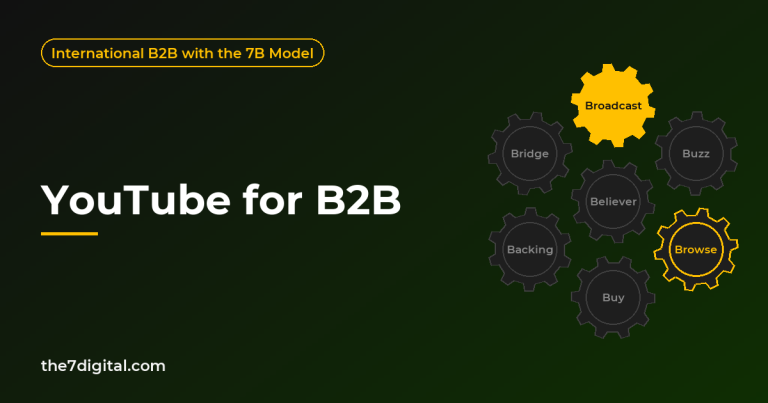
YouTube plays a different role: anything that is better shown than described in words. For manufacturers, that means product stress testing, installation guides, factory tours, or the machining process for a complex part. Search engines index video, and engineers respond strongly to real, practical video content.
A video of a product tested under real load is proof that technical buyers trust more than a spec sheet. A spec sheet saying a product withstands 10 tons is a claim. A video showing the product actually withstanding 10 tons without deforming is proof. For an engineer evaluating suppliers, that difference decides whether you make the shortlist.
How do you nurture leads through a 12-month buying cycle?
Industrial buying cycles run from 6 to 18 months, so your marketing plan has to be built by month and by quarter, not by week. A 90-day campaign cannot close an account that needs 18 months to evaluate. Instead, you need to build a path that keeps target accounts engaged with the right content at each stage of a slow evaluation.
That means consistent lead nurturing matters more than campaign bursts. A gap in the pipeline today shows up as a revenue gap in 12 to 18 months. So steady demand creation and account nurturing have to come before any single campaign push.
Build content around each stage of the buying journey:
- Awareness stage: the engineer does not yet know they have a problem to solve. Send educational content about industry trends, new standards, or ways to improve performance. For example: a chief engineer receives an article about new safety standards that apply to their line.
- Consideration stage: the engineer has defined the problem and is looking for solutions. Send application notes, specification comparison tables, test videos. For example: a production manager downloads a tolerance comparison table between two materials.
- Decision stage: the buying committee is comparing suppliers. Send case studies, certifications, customer references. For example: a procurement director receives ISO certification and a list of reference customers in the same industry.
Measurement has to change too. Instead of tracking instant conversions, measure your influence on the pipeline:
- Cost per qualified lead: a lead confirmed as a technical fit with budget, not just a document download.
- Revenue from marketing: revenue that can be traced back to specific marketing activities.
- Sales cycle speed: the time from when an account enters the pipeline to when the deal closes.
- Lead-to-customer conversion rate: what percentage of leads actually buy.
Common mistakes and how to avoid them
Mistake 1: Copying SaaS or B2C marketing straight into manufacturing. Buyer behavior, the mechanics of trust and the sales cycle in manufacturing are fundamentally different from software or consumer goods. An automated email campaign built for the short SaaS cycle will fail when applied to the 12-month cycle of industrial equipment. Redesign the entire journey around how industrial buyers actually behave.
Mistake 2: Pushing commercial messages too early. Before an engineer confirms that a product meets the technical tolerances, any message about price, promotions or “contact us now” gets filtered out. Marketing like that does not just underperform, it also damages credibility. Let technical content lead and commercial messages follow.
Mistake 3: Focusing only on lead generation and forgetting memory and verification. The supplier that wins the tender was usually already on the shortlist from the start, before the RFQ appeared. If you only run lead generation ads once demand has appeared, you are already too late. Invest in brand awareness and technical content before demand forms.
Mistake 4: Using stock photos and generic social media posts. Industrial buyers spot the difference between real photos and stock photos instantly, and it costs you more trust than having no photo at all. A post saying “we are proud of our quality” means nothing to an engineer comparing tolerances. Post real work, real people, real processes.
What does The7 Digital recommend for manufacturers?
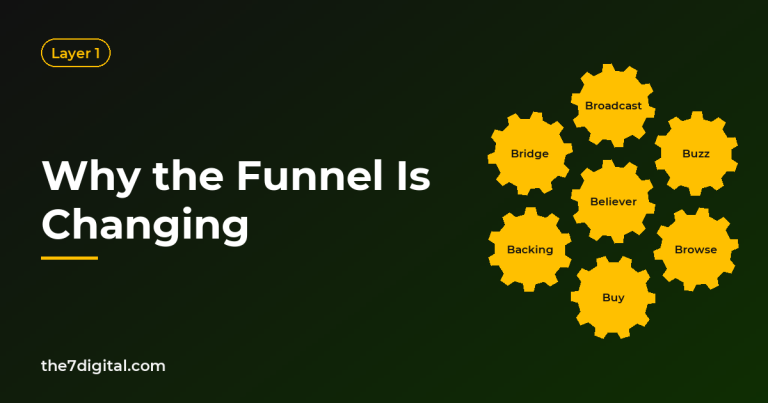
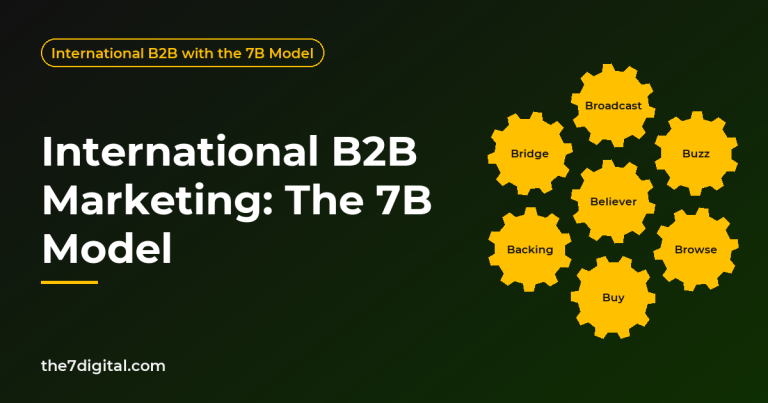
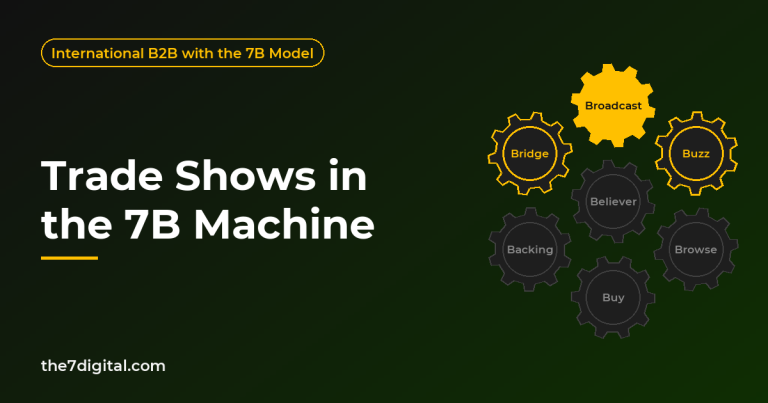
We look at B2B marketing for manufacturers through the 7B Model and its seven gears: Broadcast, Buzz, Browse, Buy, Believer, Backing, Bridge. For manufacturers, the first priority is Broadcast: seeding valuable presence into the market, clear enough, steady enough and sharp enough that the right people know you exist. Technical content on your website, LinkedIn and YouTube is the sustainable way for manufacturers to do Broadcast.
Browse is where emotion meets reason: buyers verify and compare you through six gateways, including search and AI answers on the results page, AI assistants, review platforms, LinkedIn, YouTube and podcasts, and communities and forums. Manufacturers need to be present at the gateways engineers and procurement teams use to evaluate, not just on their own website.
Before you run ads, we recommend diagnosing which gear is stuck with the 7B X-ray tool by market. This tool helps manufacturers choose between Broadcast content and Browse content for each market: if the market does not know you exist, prioritize Broadcast; if the market knows you but cannot verify you, prioritize Browse. If buyers do not know you exist, ads simply waste budget. When to use LinkedIn ads: when you already have technical content that goes deep enough and you want to put it in front of the right job titles at target accounts. When to use YouTube Ads: when the product needs to be proven in motion, such as testing, operation or a factory tour.
We do not promise specific numbers; clients check the figures in their own accounts. With a long buying cycle, measurement should focus on awareness and lead quality, not clicks.
Where to start this week?
Do not wait for the perfect strategy. Start with five small steps this week:
- Write one clear positioning sentence for your company. State who you serve and what sets you apart from competitors. If this sentence is vague, every marketing effort after it will be vague too.
- Pick one flagship product or service and create one in-depth technical document. An application note or a specification comparison table is enough to start.
- Publish that document on your website, then share it on LinkedIn from the personal accounts of your engineers or managers. Include real photos of the work, the machines or the process.
- Shoot a short video showing the product working in real conditions and post it on YouTube. No elaborate production needed; authenticity matters more than image quality.
- Set up a process for tracking leads. Record who downloaded the document, who watched the video, and schedule nurturing with content suited to each stage.
These five steps do not cost much, but they lay the foundation for all your B2B marketing later. What matters is starting and keeping it steady, because in manufacturing, trust is built over time, not through a single campaign.
Frequently asked questions
How is B2B marketing for manufacturers different from ordinary B2B?
The buying cycle is longer (6 to 18 months), the buying committee is larger (5 to 16 people), and the bar for technical credibility is higher. Trust is built through certifications, plant tours and technical documentation, not through logos or reviews the way it is with software.
Where should a manufacturer start with marketing?
Start by defining a clear position and creating in-depth technical content for one flagship product. Then distribute that content on your website, LinkedIn and YouTube to build presence and verifiability.
Does LinkedIn work for manufacturers?
Yes, LinkedIn is the most worthwhile platform for industrial B2B because it lets you target specific job titles. Posting real work and having technical staff share it builds more trust than posts from the company account.
Is YouTube necessary for manufacturer marketing?
YouTube is very useful for anything that shows better than it describes, such as stress testing, installation guides or plant tours. Real test videos are proof that engineers trust more than spec sheets.
How do you measure marketing performance for a manufacturer?
Measure by cost per qualified lead, revenue from marketing, sales cycle speed and conversion rate. Because the cycle is long, track influence on the pipeline rather than instant conversion metrics.
What is the biggest mistake in manufacturer marketing?
The biggest mistake is copying B2B SaaS or B2C tactics as they are, ignoring technical depth and the buying committee's evaluation process. That gets manufacturers cut from the shortlist before they have a chance to quote.