Summary: A B2B buying committee is the group of people who shape one company purchase: in Webster and Wind’s terms, users, influencers, buyers, deciders and gatekeepers. Nobody closes alone, and the real bottleneck is consensus, so your content has to serve every seat. In the 7B Model, the buying committee sits in the Buy gear.
Picture the trip. You fly into Ho Chi Minh City, the meeting with the general director runs long in the best possible way, and they walk you to the lift asking how soon you could start. You fly home with a forecast. Three weeks later the forecast has not moved. Nobody has said no. Your contact writes that the team is reviewing internally, that the chief accountant needs a few more numbers, that IT wants another look at the integration.
If that sounds familiar, you have plenty of company. Forrester’s State Of Business Buying 2024 report found that 86% of B2B purchases stall during the buying process (Forrester, 2024). Look at the scene again: nobody criticized the product, and nobody pushed back on the price. The deal did not die. It paused in rooms you were not invited into.
The problem is a word every sales team uses daily: close. It assumes one person, one moment and one nod. B2B does not work that way, and for a foreign supplier in Vietnam it works that way even less, because the table may include a plant manager in Binh Duong, a procurement lead in Hanoi and a regional director in Singapore. This article covers who sits at that table, why consensus is the real bottleneck and what content serves each seat without splitting your story.
Who actually sits at the table?
The classic answer dates from 1972. In Organizational Buying Behavior, Frederick Webster and Yoram Wind classified the buying roles inside an organization, the group academics call the buying center. The Open University (2020) summarizes the five roles in its introductory course. The user often starts a purchase by voicing a need. The influencer is a reference point for others, usually with specialist technical knowledge. The buyer is a purchaser by profession. The decider can say yes or no. The gatekeeper, such as a personal assistant, can make or break a supplier’s marketing.
The point most sales teams miss is that these are roles, not job titles. A plant director in Dong Nai can be both user and influencer. And some seats sit outside the customer’s company altogether. Forrester’s 2026 report counts 13 internal stakeholders and nine external influencers in a typical buying decision (Forrester, 2026). Those outsiders may be consultants, former colleagues, implementation partners or peers from an industry association, and their influence often travels through dark social: private messages, closed groups and forwarded emails that no dashboard records.
The book behind the 7B Model retells those roles in a marketer’s language as five people around the meeting table (Mô hình 7B cho B2B book, chapter 2): the internal champion, the signer, the influencer, the direct user and the person who can veto. Webster and Wind describe who does what; the five seats ask what each person needs from you to say yes, and who can stop the whole table.
Two seats the 1972 list does not name outright are the ones I see deciding the most deals. The champion carries your case into rooms you cannot enter; they do not sign, they persuade the signer. The veto holder rarely says yes, but one “not yet” can freeze everything: IT on security and integration, legal on terms, procurement on price and conditions. Not every champion can move a whole table, and champions, mobilizers, blockers and skeptics goes deeper into that difference.
Why does nobody close alone?
There is no standard committee size, and I would be wary of anyone who offers one. Forrester’s 2024 research found that, on average, 13 people within an organization are involved in the buying decision, and 89% of purchases involve two or more departments (Forrester, 2024). In Gartner’s 2025 survey of 632 B2B buyers, researcher Delainey Kirkwood describes buying groups ranging from five to 16 people across as many as four functions (Gartner, 2025). Read those figures as a shape, not a quota: cross-functional, inside and outside the company, with a different worry in every seat.
Why so many people? Because a B2B buyer is not only buying a product. They are buying the risk that comes with it. A new system can disrupt operations for a quarter. A long contract can lock a budget for years. And when the supplier is foreign, the table adds a question of its own: who picks up the phone, in Vietnamese, when something breaks? Barbara Winters, vice president and principal analyst at Forrester, puts it plainly: “B2B buyers are under immense pressure to justify investments and minimize risk.” A committee is how a company insures its own decision, and buyers value it: 94% of buyers with groups of six or more report clear benefits, including broader perspectives (Forrester, 2026).
Procurement is also arriving earlier than many suppliers expect. According to Forrester (2026), procurement professionals are decision-makers in 53% of business buying cycles and engage from the start of the process, looking beyond price to features and functions. If you still treat procurement as the last stop for haggling, you are arriving late to a meeting that started months ago.
So close is the wrong word. For the seller, the deal ends when the decider signs. For the buyer, the signature is the last step of a longer process: agreeing on the problem, the criteria and the acceptable risk, and only then on the supplier. You can win the signer’s heart and still lose the table. How a committee works through those repeating jobs is the subject of the B2B buying journey.
Is the bottleneck persuasion or consensus?
Gartner’s data answers bluntly. In its survey of 632 B2B buyers, run in August and September 2024, 74% of buyer teams showed unhealthy conflict during the decision process (Gartner, 2025). Gartner defines that as members with conflicting objectives, disagreement on the best course of action, or being overruled by external decision-makers. In the same survey, buying groups that reached consensus were 2.5 times more likely to report a high-quality deal.
Other research points the same way. Forrester (2024) found that 86% of B2B purchases stall and 81% of buyers are dissatisfied with the provider they chose. The Edelman and LinkedIn (2025) report Invisible Influence, based on a survey of 1,934 business executives, found that more than 40% of B2B deals stall because of internal misalignment within buying groups. The numbers differ because the questions differ, but the story is the same: deals stall when the people at the table cannot reach one conclusion.
Edelman and LinkedIn call part of that table hidden buyers: internal stakeholders who influence purchasing decisions but are often left out of sales and marketing strategies. They are not on your lead list and they do not fill in forms. Yet according to Edelman and LinkedIn (2025), 63% of hidden buyers spend more than an hour a week with thought leadership content, against 64% of target buyers. A content plan aimed only at the signer leaves most of the seats empty.
Here is the twist. The natural reflex is to personalize hard, one message per person. Gartner warns against exactly that. According to Gartner (2025), content focused on individual-level relevance can create conflict within the buying group, with a 59% negative impact on consensus, while tailoring for buying-group relevance improves consensus by 20%. Serving each role is still right. Splitting the story is not. Five seats need five doors, but all five doors must open into the same room: one shared definition of the problem, one promise and one core body of proof.
What does content for every seat look like?
Start from the question each seat brings into the meeting, not from your product. Here is a quick audit table built on the five seats (Mô hình 7B cho B2B book, chapter 9).
| Seat | The question they bring | Content that answers it |
|---|---|---|
| Champion | How do I explain this to my boss? | A forwardable one-page summary |
| Signer | Is it worth the risk? | One clear benefit figure, peer customers |
| Influencer | What does the market say? | Independent reviews, trade press |
| Direct user | Will this mean more work for me? | Demo videos, guides, a trial |
| Veto holder | Is it safe and compliant? | Security documents, model contracts |
Invest in the champion first, because they sell for you in rooms you cannot enter. They need things they can forward today: a one-page summary of the problem, the solution and the expected result; a benefit calculator filled with their own company’s numbers; a short success story from their industry. Do not gate those assets. Every form you make them fill in is a moment where your champion has to ask your permission to help you.
The signer will not read your long paper. Give them one benefit figure they can grasp in ten seconds and customers like them whose names they know. The influencer, especially the outsiders Forrester counts, trusts the market more than your brochure, so their content is mostly Backing: reviews, trade press and peers who speak for you. The direct user wants to see their working day after the change, through demos, honest comparisons, help guides and a trial. More than 60% of business buyers now use a trial, and 78% of buyers making purchases of $10 million or more trial first (Forrester, 2026).
The veto holder is the most dangerous seat to ignore until the last week. IT asks about security and integration, legal about terms and data, procurement about price, warranty and payment. And the veto is real: according to G2 (2026), nearly half of software buyers said their CFO vetoed an approved deal in the last year. Those questions will come. The only choice you have is whether they arrive when your answers are ready or in the week the contract seemed about to be signed.
Amazon Web Services: A separate door for the people who can say no
AWS Artifact is a clean example of serving the veto seat. Amazon Web Services describes it as a self-service portal with on-demand access to compliance reports from AWS and from independent software vendors. Customers can find auditor-issued reports, certifications, accreditations and other third-party attestations of AWS, and review, accept and manage their agreements with AWS.
The people who need those documents are not the signer and not the engineers who will use the service every day. They are security, compliance and legal: precisely the people who can say not yet. AWS does not make them wait for a sales call to request a report. It gives them their own door, open whenever they want. You do not need AWS’s scale to copy the idea. A clear security page, plain-language model contracts and a procurement FAQ on warranty and payment, published openly, are already a door.
Five seats, five kinds of content, one story. Write the core document first: one page that states the problem in words the whole table can agree with, plus the promise and three key proofs. Everything for each seat then points back to it. The chief accountant reads the cost chapter and the engineer reads the operations chapter, but both are reading the same book. If you run account-based marketing, this is where it earns its keep: each target account stops being a company name and becomes a table with named seats.
What happens when the committee spans more than one organization?
A buying committee does not always sit inside one company. In public tenders, the party that awards the contract, the party that operates the product and the party that carries the long-term risk can belong to different organizations.
BYD: Six buses and a fifteen-year promise
According to BYD Europe (2023), the company won its order through the first public electric bus tender in Europe, awarded by the government of Friesland Province in the Netherlands. The order covered six 12-metre electric buses and a 15-year maintenance contract for the public transport operator Arriva, and the buses went into service in Schiermonnikoog in 2013.
Read through Webster and Wind, that is a committee spread across at least two organizations. The province awarded the order through a public tender, with documents, criteria and accountability. Arriva ran the buses every day, which puts it in the user seat. The detail I find most telling is not the six buses but the fifteen-year maintenance contract. For the first public electric bus tender on the continent, it answers the question every veto holder carries into the room: who keeps this running for the next fifteen years?
Ten years on, BYD marked the anniversary with representatives of the Friesland government, and the six buses had covered 877,549 kilometres (BYD Europe, 2023). BYD’s article adds that Friesland and Arriva set a precedent that many other European countries followed. In September 2025, according to Bus & Coach Buyer (2025), BYD delivered its 5,000th electric bus for Europe to Umove, which will run it in Copenhagen.
I am not claiming that Friesland caused bus number 5,000. No source says so. The point is the shape of Buy: many people, many rounds, and a first signature that opens a decade of proof the next committee can check. The first committee is usually the hardest to win, because there is nobody to ask yet; every later one can ask who has used this, and for how long.
Where does the buying committee fit in the 7B Model?
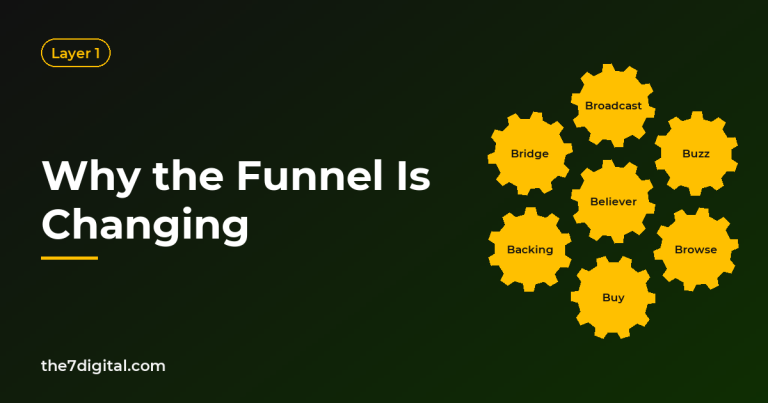
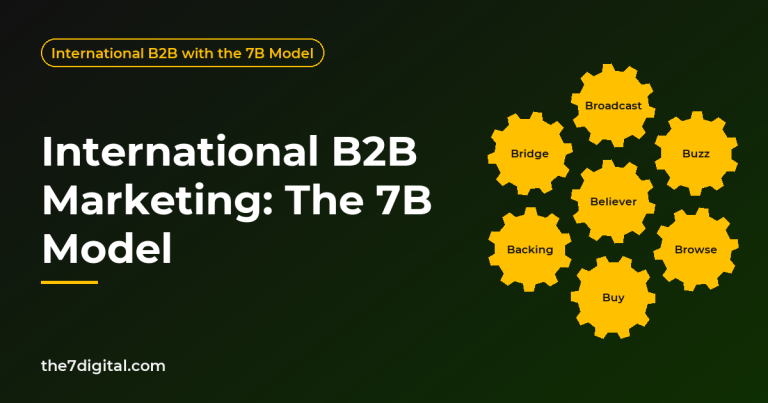
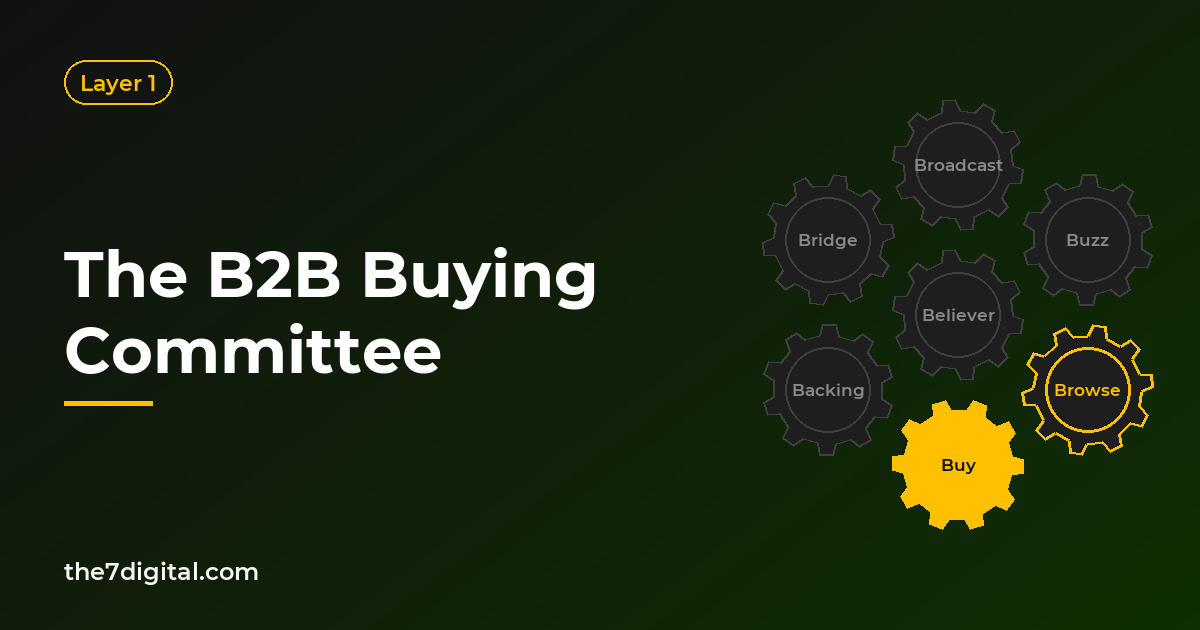
The buying committee is the heart of the Buy gear: A process of many people and many rounds; a door, not the final wall. Many people, because the table can have five to 16 seats (Gartner, 2025). Many rounds, because consensus never arrives in a single meeting. A door, because the committee that chooses you today is the first group to judge you tomorrow, and the source of proof for the next table.
The gear next to it here is Browse: Where emotion meets reason: buyers verify and compare you through six gateways. Those gateways are search engines and AI answer summaries, conversational AI, specialist review platforms, LinkedIn, YouTube and podcasts, and communities and forums (Mô hình 7B cho B2B book, chapter 8). Every seat verifies through a different one. The finance director asks an AI assistant about long-term cost, the engineer watches YouTube, the influencer checks review platforms. Being present at one gateway serves one seat.
In the three operating layers, Browse and Buy belong to demand capture. But a committee exposes something capture alone cannot fix: the seats are not ready at the same time. Your champion may have followed you for a year while the finance director hears your name for the first time (Mô hình 7B cho B2B book, chapter 2). That is why the two operating principles fit committees so tightly: customers can enter anywhere; one stuck gear slows the whole flywheel. Each seat enters from a different gear, and one unserved seat is enough to stall the deal.
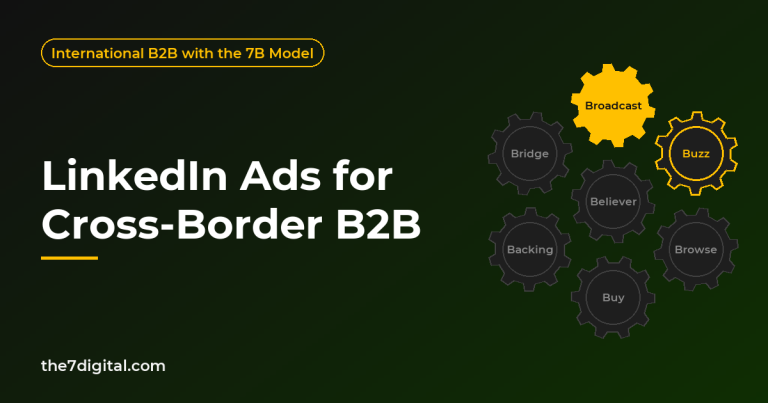
Seats that are not yet in the market have to be reached earlier, through Broadcast and Buzz, so that the first time they search for you there is already a memory to find. According to Bain & Company (2026), around 90% of buyers purchase from their Day 1 list, the vendors they have in mind when the process starts, and hidden buyers such as procurement, finance and IT hold half of the influence over that decision.
Across the three energy flows (paid, owned, earned-and-shared), Buy is owned-heavy, because sales needs a library of content you control to serve each role (Mô hình 7B cho B2B book, chapter 5). The influencer seat is fed mainly through the earned-and-shared flow, via Backing.
In the Layer 2 series I will introduce the 7B Buying Table Map, the tool that matches content to each member of the buying committee: first in the cross-cultural buying council, then in full in five buyers, five products. The 7B Model was developed by Nguyen Dinh Bao (Bao7) at The7 Digital and is set out in full in the book Mô hình 7B cho B2B (Stop Begging, Start 7B). If the model is new to you, start with the 7B Model.
Selling B2B into Vietnam and ASEAN
Start with who is buying. Foreign-invested firms generated 77.3% of Vietnam’s merchandise exports in 2025, while domestic firms accounted for 22.7%, according to the National Statistics Office of Vietnam (2026). If you sell into export manufacturing, many of the plants you call on are likely to be foreign-invested, and their committees may stretch well beyond Vietnam: a plant manager who runs the line, a regional procurement team that sets the rules, a headquarters that signs. Map those seats before you map your campaign.
Then look at language, seat by seat. In the EF English Proficiency Index 2025, Vietnam ranked 64th with a score of 500 (EF Education First, 2025). The same page breaks the score down by job function: Marketing 511, Sales 507, Purchasing & Procurement 495 and Technicians & Maintenance 467 (EF Education First, 2025). English materials can reach your champion and still slow down the procurement lead and the technicians who will judge the trial. Translate the veto and user materials first, because those are the seats where an English-only document most easily turns into a polite “not yet”.
ASEAN is not one table either. On the same index, Malaysia ranked 24th with a score of 581 and Thailand 116th with 402 (EF Education First, 2025). A single English deck labelled “ASEAN” lands very differently in Kuala Lumpur, Ho Chi Minh City and Bangkok, so localize by market and by seat, not by region.
Channels follow the same logic. LinkedIn had 10.0 million members in Vietnam in late 2025 and its ads reached 13.5% of the adult population, while Facebook had 79.0 million users, according to DataReportal (2025). LinkedIn is a strong way to reach the leadership seats, but a plan that only reaches people on LinkedIn may leave part of the table untouched.
Finally, respect the paperwork your veto seats already carry. In EuroCham’s Q3 2026 Business Confidence Index survey, administrative procedures and paperwork were the obstacle respondents cited most often, at 60% (EuroCham Vietnam, 2026). A bilingual model contract, a clear security and compliance pack and a procurement FAQ do not add to that pile. They take something off it, and that is a reason to say yes.
Conclusion: the signer only signs what the table already agreed
Go back to the trip at the start. The general director’s nod did not close the deal. It meant one seat was leaning your way. The other seats were still meeting and still asking questions you had not answered. In B2B the signer rarely decides alone. The signer stamps what the table has agreed.
So stop asking who the decision maker is. Ask how many seats this table has, what question each seat brings into the room and where each seat will look for answers while you are not there. Then build content so every seat has its own door and the whole table shares one story. Do that and you no longer have to close. You only have to help a group of people agree, and let the signature follow.
To see why committees are one reason the linear view of buyers is breaking down, read why the funnel is changing and four frameworks that replace the funnel. For how organizational buying differs from consumer buying in the first place, read how B2B marketing differs from B2C.
Frequently asked questions
Who sits on a B2B buying committee?
In the classification of Webster and Wind (1972), five roles: users, influencers, buyers, deciders and gatekeepers. They are roles, not job titles, and some seats sit outside the customer’s company.
How many people are on a B2B buying committee?
There is no standard number. Forrester (2024) found an average of 13 people within an organization involved in the buying decision, and Gartner (2025) describes buying groups of five to 16 people across up to four functions.
Why do B2B deals stall even after the signer agrees?
Because the signer rarely decides alone. Gartner (2025) found that 74% of B2B buyer teams show unhealthy conflict during the decision process, and Edelman and LinkedIn (2025) report that more than 40% of deals stall due to internal misalignment. One unanswered seat is enough to stop the whole table.
Should I create different content for each committee member?
Yes, but anchor it to one shared story. According to Gartner (2025), content focused on individual-level relevance can have a 59% negative impact on buying-group consensus, while buying-group relevance improves consensus by 20%. Give each seat its own door, and make every door lead to the same definition of the problem.
References
- The Open University (2020). Understanding your customers, section 3.4 Business decision makers (citing Webster and Wind, 1972, Organizational Buying Behavior). https://www.open.edu/openlearn/money-business/understanding-your-customers/content-section-3.4
- Forrester (2024). Forrester: To Master B2B Buying Mayhem, Providers Must Prioritize Buyers’ Needs (release on The State Of Business Buying, 2024). https://www.forrester.com/press-newsroom/forrester-the-state-of-business-buying-2024/
- Forrester (2026). Forrester’s 2026 Buyer Insights: GenAI Is Upending B2B Buying As Leaders Face Mounting Pressure To Justify Every Dollar Spent (release on The State Of Business Buying, 2026). https://www.forrester.com/press-newsroom/forrester-2026-the-state-of-business-buying/
- Gartner (2025). Gartner Sales Survey Finds 74% of B2B Buyer Teams Demonstrate “Unhealthy Conflict” During The Decision Process, as republished by IT-Online: B2B buyer teams demonstrate “unhealthy conflict”. https://it-online.co.za/?p=296904
- Edelman and LinkedIn (2025). Invisible Influence: Unlocking the Power of Hidden Buyers, as reported by Marketing-Interactive: Report: Over 40% of B2B deals stall due to hidden buyers. https://www.marketing-interactive.com/report-over-40-of-b2b-deals-stall-due-to-hidden-buyers
- BYD Europe (2023). BYD Celebrates Milestone eBus Anniversary in the Netherlands. https://bydeurope.com/article/455
- Bus & Coach Buyer (2025). 5,000th BYD electric bus in Europe. https://www.busandcoachbuyer.com/5000th-byd-electric-bus-in-europe/
- Amazon Web Services (n.d., accessed 7 November 2026). AWS Artifact: Security Compliance Management. https://aws.amazon.com/artifact/
- National Statistics Office of Vietnam (2026). Báo cáo tình hình kinh tế – xã hội quý IV và năm 2025 (Socio-economic situation report, Q4 and full year 2025). https://www.nso.gov.vn/du-lieu-va-so-lieu-thong-ke/2026/01/bao-cao-tinh-hinh-kinh-te-xa-hoi-quy-iv-va-nam-2025/
- EF Education First (2025). EF English Proficiency Index 2025: Vietnam. https://www.ef.com/wwen/epi/regions/asia/vietnam/
- EF Education First (2025). EF English Proficiency Index 2025: Malaysia. https://www.ef.com/wwen/epi/regions/asia/malaysia/
- EF Education First (2025). EF English Proficiency Index 2025: Thailand. https://www.ef.com/wwen/epi/regions/asia/thailand/
- DataReportal (2025). Digital 2026: Vietnam, by Simon Kemp. https://datareportal.com/reports/digital-2026-vietnam
- EuroCham Vietnam (2026). EuroCham Business Confidence Index Q3 2026: Translating Economic Gains Into Business Opportunities. https://eurochamvn.org/eurocham-business-confidence-index-q3-2026-translating-economic-gains-into-business-opportunities/
- G2 (2026). New G2 Research: AI Is Reshaping How B2B Software Deals Are Won and Lost. https://company.g2.com/news/buyer-behavior-2026
- Bain & Company (2026). Raising the Odds on a Deal: How Likelihood to Buy Rewires B2B Growth. https://www.bain.com/insights/raising-the-odds-on-a-deal-how-likelihood-to-buy-rewires-b2b-growth/