


S.A.V.E Marketing: An Upgrade to the 4P and 7P Models
The business world is in constant motion, shaped by proven methods and philosophies that define how companies around the globe operate effectively. One of the oldest foundations of business frameworks is the 4P Marketing Mix, which focuses on Product, Price, Promotion, and Place.
But the business landscape keeps changing, and new rules come with it. Consumer behavior is shifting in ways we have never seen before, the global economic environment plays an increasingly important role in business success, and new business models keep emerging, most notably the revolutionary S.A.V.E model. The core principles of the 4P model are gradually becoming outdated compared with today’s market realities.
This reality prompted Harvard Business Review to publish the article “The Four Ps of Marketing“, which aims to re-evaluate the structure of the traditional 4P model and reshape it into a more modern framework that businesses can apply in today’s context.
S.A.V.E: The New Marketing Mix Model
S.A.V.E stands for Solution, Access, Value, and Education. Unlike the traditional 4P model, S.A.V.E promotes a more holistic approach to business that fits the modern market. The S.A.V.E model lets businesses adapt better to consumer needs, carefully weigh the factors that define our times, and build on the principle of putting the customer at the center.
The S.A.V.E model makes it easier to turn consumers into loyal customers of your brand by delivering precisely targeted value and shareable content that matches customer behavior.
S.A.V.E marks a fundamental shift in how business is done today. It recognizes that consumers are better informed, less loyal to brands, and demand far more creative marketing solutions.
The S.A.V.E model achieves its goals by building high-value engagement and lasting relationships on social media platforms, through carefully crafted content, and through the way a business responds to consumer needs.
What’s more, S.A.V.E drops many aspects of the 4P model that no longer fit today’s market standards. With the rise of the internet and its impact on the global market, many strategies in the 4P model are simply no longer competitive enough in today’s business landscape.
Exploring the S.A.V.E Model: How Does It Affect the 4P Model?
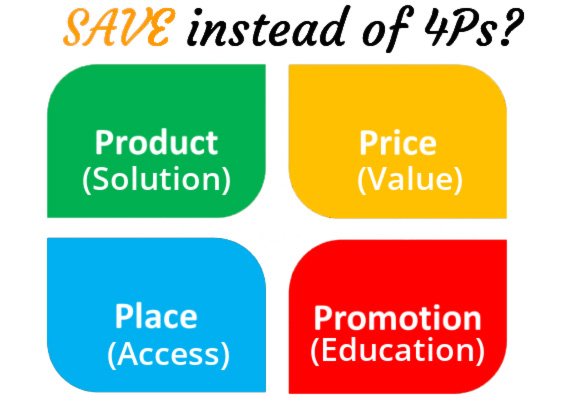
Each element of the S.A.V.E model offers a different approach from the way the 4P model is traditionally applied. By examining the structure of each S.A.V.E element and how it relates to the 4Ps, we can see how well this fundamental shift in business strategy fits today’s market realities.
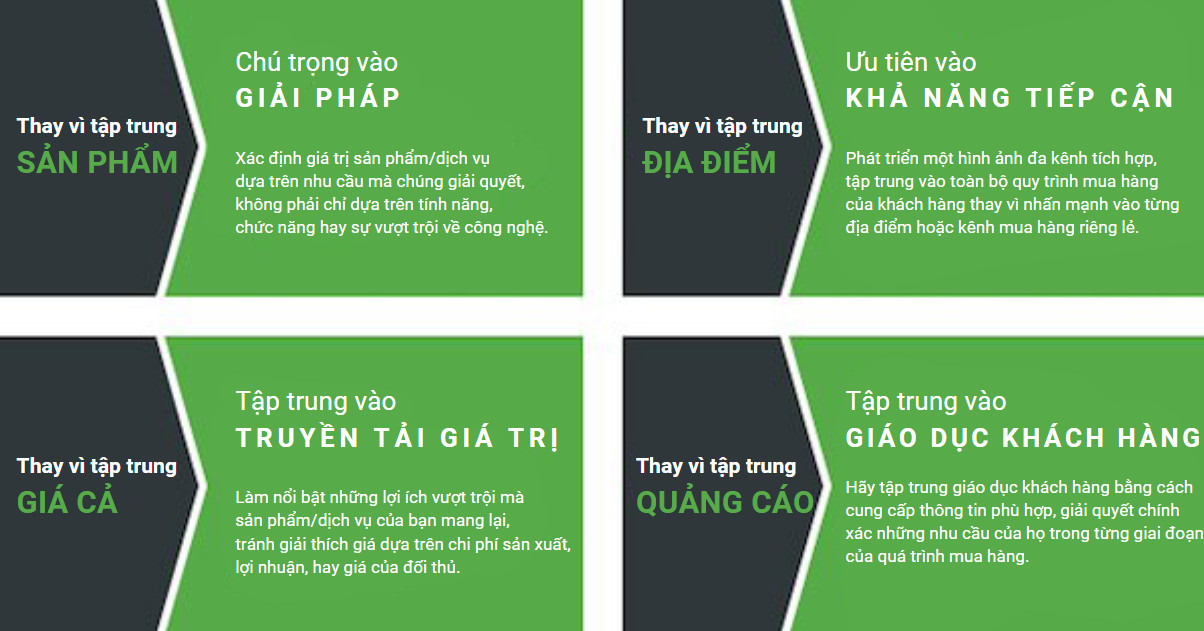
SOLUTION: Instead of Focusing Only on Product
A product-based business model was once the hallmark strength of the industrial era. If a business offered a durable, reliable product, success depended almost entirely on that product. Profit was tied closely to product quality, and focusing on making the best product was a perfectly reasonable strategy.
That is no longer true in the modern market. Today, consumers care more about whether a product or service solves the problem they face. That is why a solution-centered approach is far more effective at increasing business value than focusing on the product alone.
If a business fixates only on product features and quality, it is unwittingly focusing too much on its competitors and what they are offering.
SOLUTION in the S.A.V.E model is the opposite of the product-based approach, which creates distance between a business and its customers. Instead, a solution-based approach looks straight at the problems your target audience is facing, which pushes the business to find more creative solutions to those problems.
A great example of this is the launch of the iPod, a device that offered a compact, groundbreaking solution for enjoying music anytime, anywhere.
ACCESS: Instead of Focusing Only on Place
Before the internet became widespread and began affecting business so thoroughly, location was vital to a business. If you owned a shoe store in the middle of a busy shopping mall, you could reach and engage customers far more easily.
Today, that approach is not entirely wrong in certain cases. For most businesses, however, what matters more is how accessible their service is under the S.A.V.E model. Consumers care more about whether your product or service can be used anytime, anywhere, and on any device.
The more barriers you remove between you and your customers, the better your results will be. The success of businesses like Amazon and of social networks, which serve almost everyone in the world with nothing more than a web browser, is the clearest proof.
VALUE: Instead of Focusing Only on Price
In the past, the business model was fairly simple: offer the best product at the most reasonable price. This price-based approach was the formula that made companies successful in the industrial era.
Today’s consumers, however, are often skeptical of cheap products. Instead, they focus more on the perceived value a product delivers. This factor is even more important than price, and it shows the major role value plays in how consumers judge a brand.
The value-based pricing strategy of the S.A.V.E model works best when you have built a strong brand image, or when your product has standout features, or your service is unique in a way competitors in the market cannot match.
EDUCATION: Instead of Focusing Only on Promotion
Promotion was once a pillar of traditional advertising. Businesses spent money to appear in the media and, in turn, raise brand awareness.
Today, however, consumers can easily filter information amid a sea of advertising content. With the strong growth of on-demand media channels, building effective brand awareness through direct promotion has become much harder.
An educational approach delivers far better results instead. If you position your business as an expert, or even an industry leader, while providing valuable content that educates consumers, you will build a relationship based on trust and respect.
The goal of EDUCATION in the S.A.V.E model is to create high-quality, informative content that gives consumers real value and leads them to engage with your message of their own accord. This subtle shift toward building loyalty is the turning point: from “selling” to consumers to nurturing a sense of trust and attachment to the brand.
If you are looking for an effective way to optimize your business’s presence on social media platforms and build strong relationships with customers, The7’s marketing services are a trusted partner you can rely on. We offer the most modern strategies and tools to help your business achieve its goals.

Nguyễn Đình
Bảo




As CEO of The7, I am committed to sharing practical, useful knowledge with every reader. Every article on The7 is based on my 7 years of hands-on experience in marketing — Facebook advertising, LinkedIn advertising, Google advertising, and marketing strategy. I hope you take away plenty of insight from these posts and apply it successfully in practice.
Related Articles
Building a Full-Funnel Content Marketing Strategy on LinkedIn
Table of Contents Toggle Why Build Content Marketing for the Full Marketing Funnel? (Why Full-Funnel Content Marketing?)Creating Your Strategy (Creating Your Strategy)Implementing Your Content Strategy (Rolling out your content strategy)Summary...
Designing Creative Content for LinkedIn
Table of Contents Toggle Why Is Good Creative Content So Important? (Why is Good Creative Important?)Key Components of Creative Design (the core elements of creative design)Summary (summary) Why Is Good...
Building an Organic Business Presence on LinkedIn With a LinkedIn Page
Table of Contents Toggle Why Have a LinkedIn Page?Establishing Your LinkedIn PageKeeping Your LinkedIn Page ActiveThe Measure of SuccessSummary About LinkedIn Page (Summary) Why Have a LinkedIn Page? For a...
6 Best LinkedIn Marketing Strategies for B2B in 2026
Table of Contents Toggle LinkedIn 2026: Where B2B Decisions Get MadeStrategy #1 – Why Is LinkedIn the Best B2B Marketing Channel Today?1. Decision-makers are concentrated here2. Users are in work...

7 Social Media Trends for 2026: The Era of Real Value, Real Conversion, and Real People
Table of Contents Toggle Social media is entering the biggest restructuring of the decadeTrend 1: Why is buying directly in-app becoming the new standard for 2026? (On-Platform Conversion)What should businesses...
What Is TikTok Marketing? Effective TikTok Marketing Strategies
TikTok has been topping the global rankings of the most downloaded and most visited apps. That makes it a gold mine for marketers who love creativity. In this article, The7...