Quick answer
For B2B, the LinkedIn company page is no longer the main content distribution channel but a layer of trust verification. A credible page clearly states what you do and for whom, shows proof from real customers and team members, and is complete, up to date, and consistent with what buyers have already seen from individual leaders, sales, and marketing.
Key takeaways
- The LinkedIn company page is a trust verification layer, not the main reach engine, so it must be complete and specific rather than just posting regularly.
- B2B buyers have long journeys with multiple stakeholders; they use social and AI to check you out, so the page must be clear, easy to understand, and have social proof.
- Personal profiles of leaders and employees create reach; the company page confirms the brand, team, and next step.
- Credible content focuses on customers, case studies, and expert advice, not just product talk and awards.
- Page trust is measured by behavioral signals: page profile views, outreach reply rates, sales feedback, not just follower counts.
Many B2B companies still treat their LinkedIn company Page as a place to post daily content and chase reach. But real buyers use the Page differently: they open it after hearing your name somewhere, to check whether you are credible. A credible LinkedIn company page is not your main content channel. It is the validation layer that gives buyers the confidence to move forward.
Why the LinkedIn company Page matters to B2B buyers
A B2B purchase decision is rarely made by one person in a few days. Research from WARC in partnership with LinkedIn recorded an average buying cycle of 272 days involving 22 stakeholders. Throughout that period, buyers continuously look for information to reduce risk for the whole group’s decision.
Most of that research happens on social media before buyers ever meet the sales team. According to a LinkedIn report, B2B buyers spend about 67% of their research time on social platforms. In other words, before you get the chance to present your solution, they have already looked into your company across multiple touchpoints.
In this journey, the LinkedIn company Page acts as a trust verification layer. Buyers usually hear about you through content from executives, salespeople or a referral. When they click on the company logo, they want to see an overall picture that is serious and consistent with what they just heard.
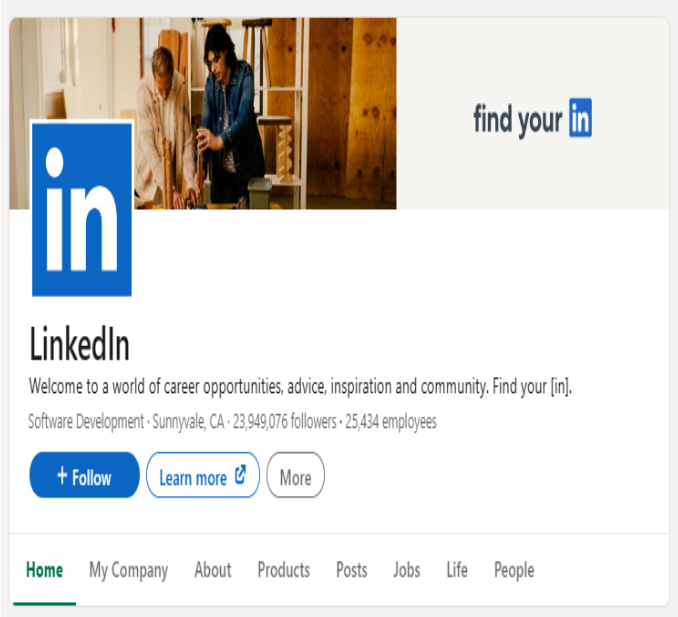
LinkedIn describes the company Page as a place that provides an organization-level summary and lets businesses post updates. That is exactly what buyers expect: a place to scrutinize the company before replying to an email or accepting a meeting. So treat the Page as the destination buyers go to when they want to check you out, not the only channel for pushing reach.
What makes a LinkedIn company Page credible in a buyer’s eyes?
Trust is the top priority for B2B marketers. LinkedIn reports that nearly 94% of B2B marketers say building trust is the most important factor for brand success. But trust does not appear on its own. It is built from specific signals that buyers see on the Page.
A credible Page quickly answers three questions: who you are, whose problem you solve, and how you do it. Avoid rambling company history or describing your internal structure. Buyers do not need to know how many departments you have. They need to know whether you understand their problem.
Research from WARC and LinkedIn points to three groups of signals that make B2B brands more likely to be chosen, summarized as the 3Rs: Recommendations, Relatability and Relationships. Applied to a LinkedIn Page, that means:
- Recommendations: include testimonials, reviews or stories from real customers.
- Relatability: describe customer situations that resemble the person viewing the Page, instead of just calling yourself a “market leader”.
- Relationships: show a spirit of long-term partnership, not just a one-time sale.
How complete the Page is also signals professionalism. PromiseClick notes that a LinkedIn Page with complete content can receive about 30% more views per week than a sparse one. When buyers see a neglected Page, they have a legitimate reason to doubt how serious you are.
Where the LinkedIn company Page sits in the 7B Model and the buyer journey
In The7 Digital’s 7B Model, LinkedIn as a whole is one of the six gateways of the Browse gear. This is where emotion meets reason: buyers verify and compare before moving into Buy. The LinkedIn company Page is not where initial demand is created. It is where buyers return to confirm what they have already heard.
The job of demand creation usually belongs to Broadcast and Buzz, and on LinkedIn these two gears run more powerfully through personal profiles. Profiles of executives, experts and the sales team seed valuable presence into the market. When they share perspectives and experience, the market answers back, mostly in private channels.
Data from Sprout Social shows that content from employees generates about 8 times more engagement than content from brand channels. So a buyer’s first touchpoint is usually a post or comment from an individual, not a post from the company Page.
For a founder-led B2B company, the founder’s personal profile creates reach, while the company Page confirms the business, the proof and the next step. When buyers receive a connection request or read an analysis from the founder, they often click on the company logo to check. That is when Browse happens on the Page.
On the Page, buyers look for alignment between what the individual says and what the company shows. If the founder talks about solutions for manufacturing plants, but the company Page only vaguely describes “digital services”, trust starts to crack. Conversely, if the Page accurately reflects the expertise, the target customers and the proof, buyers have another reason to keep going.
Which parts of your LinkedIn Page should you optimize so it looks professional and clear?
LinkedIn has observed that a well-optimized Page can receive around 5 times more profile visits and 3 times more follower growth than a poorly optimized Page. That does not mean you should chase follower counts. But it does show that buyers respond clearly to a Page that has been looked after.
Before thinking about daily content, complete three foundational parts: brand identity, the About section, and contact information with a clear call to action (CTA).
Brand identity
Your logo and banner are the first things buyers see. They need to be sharp, correctly sized, and clearly show your industry and the customer you serve. A blurry banner or an outdated logo makes a Page look abandoned, even if you post regularly.
Your tagline should be a short sentence that states which customer group you help and what problem you solve. You can add industry keywords to improve your chances of appearing when buyers search on LinkedIn. Avoid generic phrases like “leading solutions” or “trusted partner” without specific context.
The About section
The About section should be concise and written for the reader. Start with the customer’s problem, then explain how you help them solve it. Avoid only talking about your internal structure or a list of achievements that mean nothing to the buyer. Use specialist keywords naturally so buyers can find you more easily.
For example, instead of writing “We were founded in 2016 with a team of 20 people,” write “We help manufacturing companies reach B2B customers through LinkedIn ads and a content system that builds trust.” The second sentence tells buyers immediately whether they should stay on the Page.
Contact information and CTA
Your website, email, and phone number must be accurate. The CTA button on your Page should lead to a landing page that fits B2B buyers, not just a generic homepage. If you want buyers to book a consultation, make the button lead directly to your booking page. If you want them to download a specialist resource, link to that download page.
Every part of the Page serves one purpose: helping buyers confirm who you are, that you understand their problem, and that they can take the next step easily. When these three parts are complete, your LinkedIn Page starts doing its real job: turning curiosity into trust.
What content on a Page reassures buyers instead of just chasing views?
B2B buyers do not need another product advertising channel. They need proof that your promise has been verified by people like them. The LinkedIn Influence Report notes that marketers believe endorsements from customers and peers influence trust more than product features or price. This completely changes how you should choose content for your Page.
WARC and LinkedIn’s Buyability research calls these three groups of signals Recommendations, Relationships, and Relatability. On a LinkedIn Page, they appear in concrete forms: short case studies, customer quotes, logos of representative customers when permitted, and stories of using the product in a context similar to your target customer.
Make the customer the main character
TopRank Marketing suggests treating proof content as a place where the customer becomes the main character instead of just a stage for the brand. When writing about a project, start with the problem the customer faced, then describe how they used your solution and the result they achieved. Your product should only appear in the middle of the story, not at the center.
A post like this can be as short as: “A mechanical factory in Binh Duong took an average of 12 days to quote international customers. After using our quoting management system, the time dropped to 4 days and the close rate improved clearly.” A reader who runs another factory will see themselves in that story.
Combine specialist content with proof
Alongside proof content, your Page should share educational and thought-leadership content, drawn from your blog, webinars, or in-depth resources. The goal is for the Page to show specialist expertise consistent with what your individual team members are sharing. When a buyer reads an analysis from a founder and then visits the Page, they need to see the same perspective and the same depth of understanding, not a place that only posts announcements.
Avoid turning the Page into an internal bulletin board full of job openings and company milestones. Buyers prioritize information that helps them make decisions over internal imagery. That does not mean you should never post about your team, but content about people should tie to expertise: an engineer explaining how to handle a technical fault, a sales specialist sharing questions customers often ask.
How do you use leaders and employees to build trust for your LinkedIn Page?
A LinkedIn Page cannot build trust on its own without real people behind it. Sprout Social reports that around 68% of marketers say their company has an advocacy strategy, meaning a strategy for employees to share and talk about the company on social media. That figure shows this is no longer a luxury option but a common practice among serious marketing teams.
The same source points out there are more than 65 million decision-makers on LinkedIn, and content from employees often gets around 8 times more engagement than content from brand channels. More notably, individual voices are often trusted 3 times more than the CEO’s voice. This matches the view from Workshop Digital and PromiseClick that LinkedIn is an ecosystem that prioritizes people.
A coordination process between individuals and the Page
A sensible strategy is to optimize the Page first, then provide content, guidance, and a sharing calendar for employees so they can direct viewers to the Page when appropriate. Employees should not just mechanically click share on Page posts. They need to write a few lines of personal perspective before sharing, because that perspective is what creates the difference between a person and a broadcast channel.
PromiseClick suggests founders and leaders can be the main source of reach, while the Page shows the team, culture, product, and the next step for buyers to keep engaging. When an executive posts a market analysis, interested readers will find the Page on their own. At that point the Page must be ready to answer the question: “What does this company do, who has it helped, and should I trust it?”
Bring the Page into the sales process
You need to train sales and marketing teams to use the Page in outreach, meaning proactive customer contact activities. Include the Page link in InMail, email, and proposals as a credible reference point. When sales sends a connection request, they can say: “You can see more about how we have worked with similar factories on our company Page.” A sentence like that turns the Page from a display space into a sales tool.
How do you measure whether your LinkedIn Company Page is building trust?
Trust is hard to measure directly, but buyer behavior is measurable. WARC and LinkedIn report that around 94% of B2B buyers used LLMs, meaning large language models like ChatGPT or Gemini, in their buying journey in 2025. A LinkedIn Page is only one part of that journey, but it is the part you control best on LinkedIn.
Ghost’s LinkedIn data shows an optimized Page can generate twice as many leads from organic social as a Page that works like a static directory. Still, every business should benchmark against its own numbers instead of treating outside figures as targets. What matters is knowing you are improving against your own previous period, not against a generic standard.
Ignore vanity metrics
PromiseClick points out that organic reach for Pages has dropped sharply, down to roughly 1 to 2 percent of the newsfeed, an estimated decline of 60 to 66 percent since 2024. So impressions should not be your primary measure. A post seen by few people but the right people is still worth more than a post that spreads widely but never reaches anyone with decision authority.
More useful metrics are Page visits, click-through rate from the Page to your website, the number of demo requests or forms submitted after someone views the Page, and qualitative feedback from sales when prospects mention LinkedIn. If sales reports that more and more prospects say “I looked at your Page before agreeing to meet,” that is a signal trust is forming.
Use platform data and real-world data
You can use LinkedIn’s Page Analytics as your primary source to see whether the job functions, titles and companies of Page visitors match your target accounts. If the Page attracts lots of fresh graduates while you sell solutions to plant managers, the content is heading in the wrong direction. If most visitors are mid-level managers at manufacturing companies, you are close to the right people.
On a regular cadence, for example every quarter, ask a few new customers whether they checked your LinkedIn Company Page before booking a meeting. That is useful real-world data alongside platform metrics. Customer answers will tell you what role the Page plays in actual decisions, something no report can measure.
The7 Digital’s perspective and recommendations: where should B2B brands start?
In The7 Digital’s 7B Model, the LinkedIn Company Page is one of the key touchpoints of Browse, where the emotion created by Broadcast and Buzz gets verified by reason. Buyers have heard about you through a founder’s post or a mention in a private group; now they need a place to confirm you are real, capable and trusted by others. A LinkedIn Page does that better than a website because it sits right inside the environment buyers already use.
For B2B companies in Vietnam, we recommend prioritizing three things. First, sharpen the Page’s messaging so buyers know who you help and what problem you solve. Second, add minimum social proof: a few short case studies, customer quotes or logos of representative clients. Third, train your team to use the Page in customer outreach, from sales including the Page link in InMail to marketing driving traffic from personal content back to the Page.
If resources are limited, we suggest investing in personal content for one to three key faces to create Broadcast and Buzz, while optimizing the Page as the verification point, rather than posting heavily on the Page where nobody sees it. A founder who posts consistently plus a Page with complete information will produce far more impact than a Page that posts every day but has no real people amplifying it.
Looking across the full 7B, the LinkedIn Company Page also supports the other gears. The Page lays the groundwork for Backing when partners and customers reshare your content from an official source. The Page is also a Bridge when customers refer you to new people on LinkedIn, because the person being referred usually visits the Page before responding. A strong Page gives the referral more weight.
A LinkedIn Company Page is not the place to expect immediate deals. It is the place to reduce perceived risk in the buyer’s mind, especially for high-value contracts with multiple approvers and long cycles. That is why we always encourage businesses to review their own Page metrics and their actual customer journey, then adjust the Page’s role within the overall B2B marketing and sales strategy. If you are building a B2B marketing system for a manufacturing company, see the guide Marketing B2B cho doanh nghiệp sản xuất to understand where the LinkedIn Page fits in the bigger picture.
Frequently asked questions
Why does the LinkedIn company page get low reach but still matter for B2B?
Due to algorithm changes, many sources report declining organic reach for pages while reach from personal profiles has surged. Yet buyers still click the company logo to check who you are. The page thus becomes a trust verification layer, influencing whether they reply, book a meeting, or continue the conversation.
Does the LinkedIn company page need daily posts to look credible?
Not necessarily. For B2B, what matters more is that the page is complete, clear, and has content proving capability, not posting frequency. A consistent schedule, such as 1 to 2 valuable posts per week, is usually enough to keep the page looking alive and aligned with personal profile activity.
Which parts of the LinkedIn company page should I optimize first?
Prioritize three areas: the banner and tagline that clearly state who you help and with what problem, a concise but specific About section focused on the customer, and contact information with a CTA leading to a relevant landing page. Then move to proof content like case studies and customer stories, followed by a regular posting schedule.
What social proof should I put on the LinkedIn company page without sounding boastful?
Focus on customer stories rather than a list of awards. Use short quotes, result summaries, or logos of representative customers when permitted. The effective approach is to tell the customer's context, challenge, and outcome, with you appearing as a partner, not the hero.
Can the LinkedIn company page generate B2B leads directly or is it just for branding?
Platform data suggests an optimized page may correlate with higher organic leads, but the page's primary role is to clarify and reinforce trust. Leads typically come from sales team activity, ads, and personal content; the page helps those leads feel more confident about moving forward with you.
Should a small B2B business invest in the LinkedIn company page or focus entirely on personal profiles?
Even if you focus on personal profiles of founders and team members, you should still make a minimal investment so the page looks professional, complete, and credible. Buyers often check both. A sensible approach is to optimize the page well once, update it periodically, and focus new content more on personal profiles.