


What Is a Focus Group? How to Run One Quickly and Effectively

Focus Group is a term that is no stranger to the marketing industry. But if you’re just starting to explore the field, the concept may still feel unfamiliar. So what is a focus group and how do you run one effectively? This article answers your questions about focus groups and walks you through how to conduct one successfully.
What Is a Focus Group?
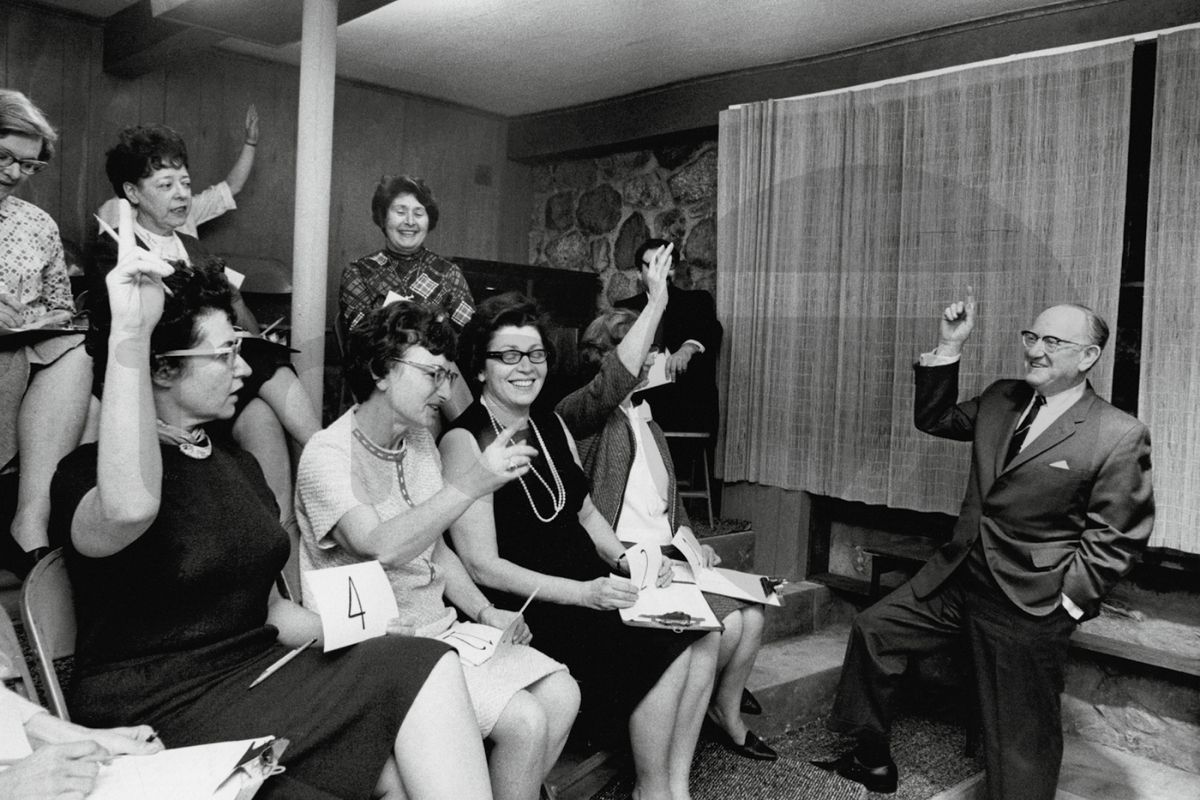
Focus Group is an important market research method introduced by psychologist and marketing expert Ernest Dichter in 1991. It uses small group discussions (usually 6-10 people) to explore and analyze potential customers’ views on a product or service.
A focus group has several defining characteristics:
- Qualitative research: A focus group gathers a wide range of opinions from consumers to better understand their behavior, attitudes and reactions to a specific topic.
- Group discussion: A moderator leads the discussion and keeps the environment open and free so participants share honest opinions.
- The important role of participants: Every participant contributes personal opinions and perspectives, which significantly shape the outcome of the focus group.
>>> You can learn more about The7’s online marketing consulting services
The Important Role of Focus Groups
Focus groups are widely used across many fields, especially marketing and market research, by consumer goods and service companies. Here are the benefits of a focus group:
- Real, objective data: Provides accurate information about customers’ experiences, attitudes, priorities and interactions with a product.
- Deep insights: Helps businesses better understand customers’ wants, expectations and feedback.
- Decision support: Contributes to evaluating a product’s potential, refining the product and shaping a suitable marketing strategy.
- Product optimization: Helps businesses adjust a product’s design before launch, increasing its chances of success in the market.
- Strategy development tool: Supplies data for building effective business strategies and social research.

Pros and Cons of the Focus Group Method
Pros
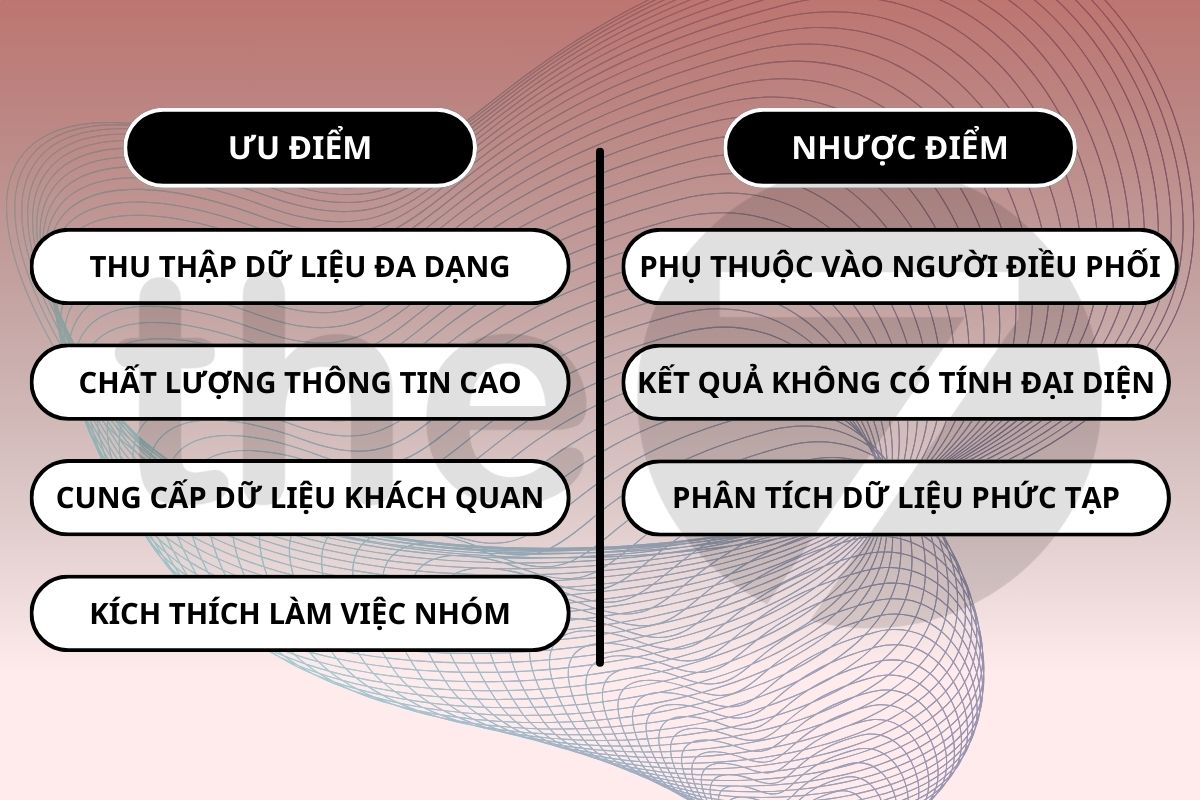
- This method helps collect diverse data objectively, improving the quality of the research information.
- A focus group gives an accurate, in-depth view of consumers’ opinions and attitudes, helping researchers understand the problems buyers are facing.
- It encourages effective teamwork, helping different members and departments in an organization connect and collaborate better.
The focus group interview method gives businesses information about customers and their experiences
Cons
- The quality and effectiveness of a focus group depend heavily on the moderator’s skills and experience. The moderator needs to encourage participation, keep everyone focused and manage the discussion effectively.
- Focus group results can’t be taken as representative of the entire market or target audience.
- Because it is qualitative research, analyzing focus group data can be complex and difficult, especially when opinions and discussions need to be turned into measurable data.
How to Run a Focus Group Effectively
Step 1: Prepare Your Information Before the Interview
Before conducting any focus group interview, get clear on the goal of the interview and the kind of information you want to collect.
Set criteria for choosing participants and screen them against those criteria. Based on that, you can decide how many discussion groups to run and how large each group should be.
Finally, set the time and place for the interview. Only then can the interview begin.

Step 2: Conduct the Focus Group Interview
Run the focus group interview using a set of prepared questions, led by experienced experts who understand the topic in depth. Make sure every participant is heard and no one is overlooked during the interview.
In Vietnam and other Eastern markets, interview groups usually have about 5-6 participants, smaller than the 8-10 common in the West. This reflects cultural differences, prioritizing comfort and the quality of interaction within the group.

Step 3: Collect the Results and Evaluate in Detail
Once the focus group interview is finished, all the data collected, including notes and video recordings, is carefully compiled and gathered. This information is then analyzed through a dedicated process to make sure the final results meet the goals set for the research.

What Does It Take to Run an Effective Focus Group?
To make your focus group sessions more effective, make sure the interview setting is friendly and comfortable so participants feel at ease and willing to share. That can include arranging an airy meeting room, offering light refreshments and making conversation easy. A comfortable space encourages people to open up and share their opinions freely, which leads to high-quality, reliable data.
Before the session, define clearly what information you want to collect. Prepare your questions and a skillful way to steer the discussion in advance, avoiding abrupt changes of topic and keeping the conversation on track.

Focus Group Questionnaire
How Do You Design a Focus Group Questionnaire?
Designing the questionnaire for a focus group plays an important role in improving the quality and effectiveness of the discussion. Well-designed questions draw participants in and make sure you gather complete information from them, which helps you achieve the goal of the focus group.
Number of questions
An ideal focus group interview should be limited to about 8 questions to stay focused and effective, though you can stretch to 10 or, if necessary, a maximum of 12 questions.
Question criteria
- Clear and simple: Phrase questions clearly and avoid vague or ambiguous wording to limit misunderstandings.
- Focused on one idea: Each question should focus on a single specific issue.
- Open-ended questions: Favor open-ended questions over closed ones to encourage in-depth discussion from participants.
- Non-threatening: Make sure questions don’t make participants uncomfortable or offend them.
Common types of questions
- Engagement Questions: Help everyone in the group get to know each other and feel comfortable with one another and with the discussion topic.
- Exploration Questions: Dig deeper into the issue, drawing out participants’ opinions, viewpoints and feelings. Limit closed questions in this section.
- Exit Questions: Wrap up and make sure all the necessary information has been discussed, checking whether any questions or details are missing or haven’t been covered.
A Concrete Example of a Focus Group Questionnaire
A laundry detergent company wants to run a survey to collect users’ opinions on its newly launched Detergent X. Here is a concrete example of a questionnaire for a business running a focus group interview about a laundry detergent product:
Engagement Questions
- Which laundry detergent do you usually use for your family?
- What made you choose that detergent?
- In your opinion, what matters most when choosing a laundry detergent?
- Are you satisfied with the detergent you currently use? Why or why not?
Exploration Questions
- Are you familiar with our Detergent X?
- If so, can you share your first impressions of this product?
- What advantages do you think Detergent X has compared with other products on the market?
- Have you tried Detergent X yet? If so, can you share how well you think it works?
- In your opinion, who is Detergent X best suited for?
- What improvements would you suggest to make Detergent X even better?
- What price do you think is reasonable for Detergent X?
- Would you be willing to recommend Detergent X to family and friends?
Exit Questions
- Overall, how would you rate Detergent X?
- Do you plan to use Detergent X in the future?
- Is there any other information about Detergent X that we haven’t covered and you’d like to share?
Through the detailed look at what a focus group is and the guidance on running one effectively in this article, The7 hopes readers have gained important knowledge and a well-rounded view of this research method. We hope this knowledge helps you successfully apply focus groups to your own research and project development.
>> You may also want to check out these articles:
Mystery Shopper: What Is It? Steps to Become a Mystery Shopper

Nguyễn Đình
Bảo




As CEO of The7, I am committed to sharing practical, useful knowledge with every reader. Every article on The7 is based on my 7 years of hands-on experience in marketing — Facebook advertising, LinkedIn advertising, Google advertising, and marketing strategy. I hope you take away plenty of insight from these posts and apply it successfully in practice.
Related Articles
Building a Full-Funnel Content Marketing Strategy on LinkedIn
Table of Contents Toggle Why Build Content Marketing for the Full Marketing Funnel? (Why Full-Funnel Content Marketing?)Creating Your Strategy (Creating Your Strategy)Implementing Your Content Strategy (Rolling out your content strategy)Summary...
Designing Creative Content for LinkedIn
Table of Contents Toggle Why Is Good Creative Content So Important? (Why is Good Creative Important?)Key Components of Creative Design (the core elements of creative design)Summary (summary) Why Is Good...
Building an Organic Business Presence on LinkedIn With a LinkedIn Page
Table of Contents Toggle Why Have a LinkedIn Page?Establishing Your LinkedIn PageKeeping Your LinkedIn Page ActiveThe Measure of SuccessSummary About LinkedIn Page (Summary) Why Have a LinkedIn Page? For a...
6 Best LinkedIn Marketing Strategies for B2B in 2026
Table of Contents Toggle LinkedIn 2026: Where B2B Decisions Get MadeStrategy #1 – Why Is LinkedIn the Best B2B Marketing Channel Today?1. Decision-makers are concentrated here2. Users are in work...

7 Social Media Trends for 2026: The Era of Real Value, Real Conversion, and Real People
Table of Contents Toggle Social media is entering the biggest restructuring of the decadeTrend 1: Why is buying directly in-app becoming the new standard for 2026? (On-Platform Conversion)What should businesses...

What Is TikTok Marketing? Effective TikTok Marketing Strategies
TikTok has been topping the global rankings of the most downloaded and most visited apps. That makes it a gold mine for marketers who love creativity. In this article, The7...