Quick answer
Professional services marketing is how you put your company's expertise and credibility in front of the market so that when B2B buyers have a problem to solve, they think of you first. The focus is on building trust, maintaining a consistent presence, and nurturing opportunities through a buying cycle that can last many months.
Key takeaways
- Professional services marketing differs from product marketing: buyers purchase trust in people and judgment, not features.
- The buying cycle often lasts many months, so you need an always-on program that prioritizes building demand and reputation over short-term lead hunting.
- Position a clear niche and the problem you solve exceptionally well, then prove it with in-depth content, case studies, and personal presence.
- Focus on a few strong channels such as your website, SEO, LinkedIn, events, email, and referral partners, using advertising as a supporting layer.
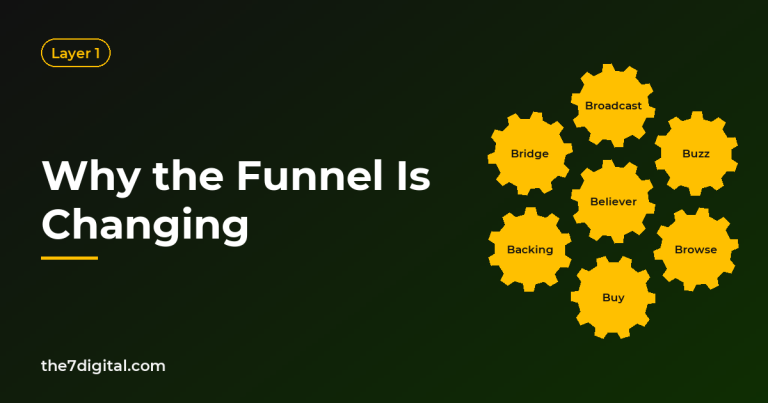
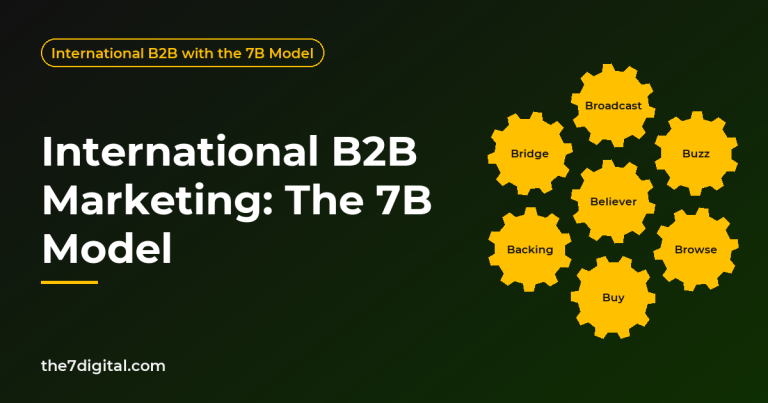
- The 7B Model helps put professional services marketing into motion: from Broadcast creating awareness to Believer and Bridge amplifying referrals.
Figures worth saving
379 days
Average B2B sales cycle length
Long buying cycles demand always-on marketing to nurture trust, not just short-term campaigns.
Dentsu, 2024 the7digital.com
80%
Deal win share of the vendor preferred before contact
Invest in brand building to be on the shortlist before contact, improving win rates.
6sense, 2025 the7digital.com
38%
Win rate improvement when problem misalignment is resolved
Use thought leadership to resolve disagreements on core problems, boosting win rates.
Emblaze, 2024 the7digital.com
Many professional services firms are genuinely excellent at what they do, yet the market never sees it. B2B buyers are not short of capable providers. What they lack is a clear reason to choose you over three other firms that look almost exactly like you. Marketing for professional services is not a matter of running ads to pull in leads quickly. It is about building positioning, trust and a consistent presence across a buying cycle that can stretch well beyond a year.
What is professional services marketing and how does it differ from B2B product marketing?
Professional services are fields such as law, management consulting, finance, accounting, engineering, architecture and marketing agencies. Firms in these industries do not sell a tangible product. They sell capability, judgment and the credibility of their people. A client cannot hold, trial or return a strategic consulting engagement.
The hardest part is that most professional services firms look identical in terms of what they do. One accounting firm prepares financial statements in much the same way as another, partly because industry regulations have already defined the process. When a client looks at three equally capable providers, they often see no difference large enough to pick one. This is the sea of sameness that many services firms are stuck in.
Marketing thinking for B2B products, especially SaaS, tends to revolve around volume, conversion funnels, the number of MQLs (marketing qualified leads, meaning leads qualified enough to hand to sales) and speed to close. That thinking assumes the buyer can try the product, compare features and decide within a few weeks. Professional services marketing works differently. The focus is on credibility, relationships and depth of expertise demonstrated through content, speaking and referrals.
When a law firm or consulting firm applies a SaaS style marketing model, the result is usually one of two things: the phone does not ring, or only off target leads call in. Mass email to purchased lists, generic white papers with no point of view, retargeting ads chasing buyers everywhere. These actions signal a sales machine rather than an expert, and they reduce credibility instead of building it.
The rest of this article focuses on B2B companies selling professional services in Vietnam: long buying cycles, multiple people involved in the decision, and trust as the factor that decides who makes the shortlist.
Why is professional services marketing hard, especially in B2B?
The first challenge is selling something intangible. The client is buying a promise of future results, but you cannot let them touch a consulting service before the contract is signed. On top of that, confidentiality clauses often prevent you from showing the details of past client work. You are good, but proving it in concrete terms is difficult.
The second challenge is timing. In the professional services market, according to The B2B Effectiveness Blueprint: Professional Services Edition by Considered Content, only about 5% of potential buyers are actively looking for a provider at any given moment. The other 95% have no immediate need, or have not yet recognized their problem. If marketing only chases short term campaigns, you will be absent exactly when that 5% starts searching.
According to Pedowitz Group, the professional services buying cycle typically lasts 6 to 18 months. During that time, buyers ask their networks, read what you have published, listen to podcasts and attend events where you speak. Also according to Pedowitz Group, the RFP call (request for proposal, a formal request for pricing) often comes about 12 months after they first become aware of your brand.
This trend is not limited to professional services. According to data from Dentsu, the average B2B sales cycle in 2024 was 379 days from initial research to signed contract, up 16% from 2021. That means the entire B2B market is slowing down and becoming more complex, not just professional services.
The most striking finding is that the shortlist forms very early. A 2025 study by 6sense of more than 4,000 buyers found that 94% of buying committees had already ranked their preferred providers before contacting anyone, and the preferred provider won 80% of deals. In other words, by the time sales gets the first call, the game is nearly over.
The implication for professional services marketing is clear. If you only run short term campaigns when budget allows, or passively wait for referrals from past clients, you will be absent exactly when buyers build their shortlist. Genuinely strong expertise cannot save a brand nobody sees.
How should you position and choose a niche for B2B professional services?
Niching down means that instead of saying we do everything, you choose one industry group, one type of problem or one specific situation where you solve it better than anyone else. The goal is not to shrink the market, but to become the obvious choice in the eyes of a specific group of buyers. When a CFO in manufacturing looks for a restructuring consultant, they should think of you first.
Niching is how you break out of the sea of sameness. In service industries that are standardized or tightly regulated, such as accounting or auditing, it is hard to differentiate on what you do. But you can differentiate on how you do it, on who you serve and on your distinct point of view about the client’s problem. An accounting firm that specializes in serving SaaS companies raising a series A round will have a very different story from a generalist accounting firm.
Two important pillars of positioning are a specific niche and customer centric branding. Customer centric branding does not describe your service. It speaks the language of the client’s problems and goals. Instead of we provide HR consulting services, say we help 500 employee factories reduce turnover in the first 6 months.
A simple way to put this into practice: pick 1 to 2 industries (for example manufacturing, SaaS, banking), pick 1 to 2 trigger situations (IPO, M&A, restructuring, market expansion), then rewrite your positioning statement using this structure: We help [client group] solve [problem] in the context of [situation]. This sentence must be specific enough that someone in that client group reads it and nods: that is exactly my problem.
Positioning also needs to connect with the B2B buying committee. In a professional services deal, there is rarely a single decision maker. The CFO cares about cost and risk, the CEO cares about business results, the head of operations cares about process, legal cares about compliance. Be explicit about how you help each of these roles. This makes marketing content easier to write, and gives sales ready made language for talking to each person in the buying committee.
How do you build trust with thought leadership and in-depth content?
Generic content erodes the credibility of a professional services firm. A “5 things to know about labor law” article makes you look like every other law firm. By contrast, a piece titled “Why the new e-invoicing decree changes how you manage tax risk in construction” shows you are a firm that truly understands the issue. Content with a specific point of view, tied to real situations, is what conveys real capability.
Instead of writing for everyone, write, speak, or present about a specific situation in your niche. Your point of view must be clear and defensible. You do not need to please everyone. You need the right target accounts to think: “This person understands my problem better than I do.”
Effective thought leadership formats include: bylined articles in industry publications, podcasts (as a guest or produced in-house), keynotes or panels at industry conferences, LinkedIn posts from individual experts’ personal accounts, and in-depth webinars. What they share is that they let readers see how you think, not just a list of services.
Content authority plays a decisive role. Long-form, in-depth content such as guides, case studies, webinars, and detailed blog posts demonstrates your reasoning ability and working method. As a result, customers shift their trust from “hearing someone recommend you” to “seeing your expertise for themselves.” This is a critical transition before sales enters the conversation.
A quality case study should include five elements: the client’s context, your approach, the timeline, measurable results, and the role each party played. A good case study transfers trust before the two sides ever meet. If you want to go deeper, see this article on how to write a B2B case study clients will actually approve.
A practical editorial process: each quarter, pick one strategic theme, meaning a major problem your target accounts are facing. From that theme, publish one long-form, in-depth article. Then repurpose it into 3 to 5 LinkedIn posts, one webinar, and one sales document. Keep the message consistent throughout. This approach means you do not have to come up with new ideas every week, while still maintaining a steady presence.
Thought leadership is not marketing’s job alone. The experts inside your company, from lawyers to lead engineers, need to take part in writing and speaking. Marketing plays the role of editor, theme owner, and distributor. When real human expertise is put in front of the market consistently, trust starts forming long before a prospect has a need.
Which channels should you prioritize in professional services marketing?
Do not spread budget and headcount too thin across too many channels. For professional services, the goal of a channel is not broad reach, but accumulating credibility and generating quality conversations. Pick a few channels you can do really well and maintain consistently, rather than showing up half-heartedly everywhere.
The core channel group usually worth prioritizing for B2B professional services firms includes website and SEO, LinkedIn, events and webinars, email nurturing, and referral partnerships. Paid advertising is an acceleration layer on top of these channels, not a replacement.
Website and SEO: where prospects research on their own
B2B buyers typically research on their own for a long time before reaching out. Your website must be optimized for experience: fast loading, clear structure, and content that answers the questions of someone actively looking for a solution. SEO helps you get found at the exact moment they are comparing options, not when they are casually scrolling social media.
SEO for professional services should focus on long-tail keywords that tie a service to a specific industry. For example, instead of trying to rank for “accounting services,” a firm might optimize for “forensic accounting for legal disputes.” Building topic clusters around one deep specialty helps search engines and readers see that you genuinely understand that field, rather than doing a little of everything.
LinkedIn: where experts speak up
LinkedIn is the ideal channel for individual leaders and experts to share insight, join industry discussions, and nurture relationships with each member of the buying committee. B2B buyers evaluate a company through specific people, and LinkedIn lets you show their judgment publicly.
Do not just post company announcements. Let your experts comment on a regulatory change, analyze a financial trend, or share lessons from a completed project. This kind of content keeps you showing up in the feeds of the right people for months, before they have an active need.
Events and webinars: combining online and offline
Attending industry events lets you meet prospects where they are already in a mindset for professional exchange. Hosting in-depth webinars lets you invite the right group of potential buyers into a structured conversation, without geographic limits. Both fit well with industries that need direct discussion, where one sharp audience question can open a consulting opportunity.
When hosting a webinar, pick a topic narrow enough to attract the right people, not a generic topic to pull in volume. A webinar on “how to handle tax risk in M&A transactions” will produce a far higher-quality conversation than “an overview of corporate tax.”
Email nurturing: staying in touch across a long cycle
With a long buying cycle and many parties involved, most people who discover you today are not ready to buy. An email newsletter segmented by industry or topic lets you keep delivering value without requiring them to come back to your website every week. A good newsletter does not sell; it shares observations, common client questions, and practical lessons.
Referral partnerships and paid advertising
Referral partnerships with complementary firms (for example, a law firm with a financial advisory firm, or a marketing agency with a technology implementation partner) help you reach prospects in situations where trust already exists. In return, you also need to be ready to refer back when appropriate, so the relationship stays sustainable in both directions.
Organic content builds the foundation, but advertising helps you stay visible to target accounts throughout a long cycle. LinkedIn ads let you target by job title, industry, and company size, while paid search helps you show up when prospects are actively looking for a solution. Think of advertising as an acceleration layer for content that has already proven its value, not a substitute for content.
How do you design a marketing journey for a long buying cycle?
As covered in the previous section, the buying cycle for professional services tends to be quite long. During that time, a lead may encounter you through a LinkedIn post, an industry event, a partner referral, a newsletter email, and your website before they ever send an inquiry. Your marketing journey has to be designed for that entire path, not for a single click.
Many B2B strategies fail at three points: they build awareness too late, they lose the buyer’s attention in the middle of the cycle, and they cannot measure impact when a deal closes long after the first touch. The way to avoid this is to deliberately map the journey to each stage of the buyer’s thinking.
The five stages of a professional services buyer
- Problem awareness: the buyer realizes they have a problem to solve, but is not yet sure what to do about it.
- Independent research and comparison: they explore solutions, read articles, and ask their network.
- Shortlisting providers: they build a shortlist of companies that seem like a fit.
- Deep evaluation and trial: they review case studies, meet experts, and may request a small pilot project.
- Decision and implementation: they choose a provider and start working together.
Assign content and channels to each stage
Each stage needs a different type of content. At the problem awareness stage, LinkedIn posts, podcasts, and industry PR help buyers recognize you as someone who understands their problem. At the independent research stage, in-depth guides, SEO content (search engine optimization so buyers can easily find you when they search), and webinars become important because buyers are actively looking for answers. At the deep evaluation stage, demo workshops, detailed case studies, and direct meetings with experts are what set you apart.
Do not try to use one type of content for the entire journey. A LinkedIn post cannot replace a detailed case study, and a webinar cannot replace a direct meeting with an expert. Build a sequence of content that connects from one stage to the next, with each piece answering a buyer’s question at the exact moment they need it.
Reach the entire buying committee
In B2B, the decision to buy professional services is rarely made by one person. There may be a CFO concerned about cost, a head of legal concerned about risk, and end users concerned about the day-to-day experience. If you only talk to one person, you are missing the people who can veto the decision.
Use account and job title targeting on LinkedIn, along with email segmented by role, to deliver the right message to the right person. A CFO needs to see content about cost control and risk forecasting, while a head of operations needs to see content about process and efficiency. Both need to feel that you understand their specific concerns.
Marketing and sales must speak the same language
A seamless experience between marketing and sales is a hard requirement. Marketing content should be reused by sales in calls, proposals, and follow-ups. If marketing promises a “strategic partner” but sales talks about a “budget service package,” the customer will feel misled. Build your sales materials from the marketing content you have already published, and let sales contribute to content topics based on the real questions they hear from buyers.
How do you measure marketing for professional services?
With a long buying cycle, if you only measure leads this month and revenue next month, you will almost always see “poor” results even when the program is on the right track. A client may read your article today, listen to a podcast next month, get referred by a partner the month after, and only send a consultation request much later. If you only look at lead forms within 30 days, all the earlier brand-building effort will look wasted.
Instead, layer your metrics across three levels:
- Awareness and reach: reach, branded search volume, content views. These metrics show whether the market knows you exist.
- Quality engagement: video watch time, substantive comments, email reply rates. These metrics show whether your content genuinely connects with what readers care about or just gets skimmed.
- Opportunities and pipeline: the number of deals touched by marketing, opportunity value, conversion rate from opportunity to proposal. These metrics show whether marketing is contributing to future revenue.
Measure pipeline influence instead of only direct leads
Some guides for long-cycle B2B suggest measuring marketing by pipeline influence, rather than only crediting leads directly to a campaign. That means you look at all the marketing touchpoints a deal went through before entering the CRM, not just the last touchpoint. This approach reflects the reality that clients rarely decide because of a single ad or a single article.
In practice, full measurement is hard. A client reads an article, listens to a podcast, gets referred by a friend over several months before entering the CRM, and many touchpoints are never recorded. So combine quantitative data with asking clients directly “how did you hear about us” on the first call. The answer often reveals channels that measurement tools cannot see. And always cross-check the numbers against real data in your own CRM and ad accounts before making decisions.
Split effort between lead generation, demand creation and brand
Research by Considered Content on professional services marketing suggests a reference split of effort between lead generation, demand creation and brand building as follows:
| Category | Suggested effort split |
|---|---|
| Lead generation (direct lead capture) | 10% |
| Demand generation (creating and nurturing demand) | 40% |
| Brand and reputation | 50% |
The table above is not a hard rule, but it gives you a reference point when planning: avoid pouring all resources into short-term lead hunting tactics while forgetting to invest in long-term reputation and demand.
Use a one to two page marketing plan
A concise marketing plan helps the team execute and stay aligned with goals. The plan should include: objectives, target audience, three main tactics, owners, timeline and KPIs. When everyone looks at the same single page, prioritization and adjustment become far clearer than with a 50-page document nobody rereads.
On a regular cadence, for example quarterly, review: which tactics generate quality conversations and the right deals, which tactics only create noise without going anywhere. Then adjust resource allocation, cut ineffective activities without hesitation and double down on the activities that are creating real opportunities.
Where do professional services firms usually get marketing wrong?
The biggest mistake is applying volume-chasing tactics from SaaS or consumer goods to professional services. Spamming cold lists, gated but generic content, retargeting that follows prospects everywhere makes clients perceive you as a pushy seller rather than a trusted expert. In an industry where purchase decisions are built on trust, these signals easily erode credibility.
Another common mistake is running quarterly “on-off” campaigns without always-on activity. Only a small share of leads are in market at any given moment; the rest need to be reached and nurtured early. If you only show up when a campaign is live, you are invisible to most of the market most of the time.
Spreading too thin across too many channels
Many firms try to be present on every platform for fear of missing opportunities. The result is an unclear message, diluted resources and no channel that truly performs. Choosing a few suitable channels and doing them really well is always better than being everywhere at average quality.
Content that only describes services
Content that only lists services and company profiles makes you look like every other “good enough” provider. Clients do not need to know what you offer; they need to know what you think about their problem and how you have helped others solve a similar one. Without examples, case studies and a specific point of view, your content gives clients no reason to choose you over a competitor.
Separating marketing from the experts
When experts do not appear, do not sign their names, do not speak, clients cannot see the person they are actually buying. In professional services, clients buy human judgment, not company process. If your experts are absent from all marketing content, you are hiding your most valuable asset.
Judging marketing only by 30-day lead forms
When you only look at lead forms filled in within 30 days, you unintentionally suffocate long-term reputation-building activities such as speaking at events, podcasts, PR and in-depth content. These activities rarely generate leads immediately, but they are the foundation for every quality lead in the future. If you cut them because you do not see short-term results, you are weakening the very source of your long-term opportunities.
What does The7 Digital recommend for B2B professional services marketing?
We are The7 Digital, a digital marketing agency in Ho Chi Minh City with a strong focus on B2B marketing and the 7B Model in our approach. For professional services, the 7B Model fits especially well because it emphasizes three layers: demand creation, amplification and demand capture, with trust as the thread connecting those layers, rather than forcing customers into a short-term sequence of actions.
For professional services firms in the early stage, we usually prioritize two gears: Broadcast and Browse. Broadcast is seeding valuable presence into the market: building content on LinkedIn, your website and SEO so the right people know you exist. Browse is where buyers verify and compare: when they research you, they need to find deep, consistent and sharp content that convinces them you truly understand their problem.
When the market starts responding, with people discussing and referring you, the Buzz and Backing gears come into play. Buzz is the market mentioning your name in private channels, mostly beyond the reach of measurement tools. Backing is customers, the ecosystem and AI speaking up on your behalf: content gets reshared, past clients appear in case studies, partners mention you in their networks.
Believer is the hinge point. The service experience must be good enough for customers to believe, because professional services marketing cannot keep polishing the image forever if execution is weak. If it is not solid yet, we would advise fixing the service offering and experience first before accelerating marketing. A disappointed client will tell their network, and every prior effort will erode.
Bridge appears when you have a base of customers who trust you. This is the time to build communities, referral programs and partner collaborations so customers bring in more customers. In industries that depend on networks, Bridge is often the gear that makes the flywheel amplify better, because it does not rely on ad budget but on the quality of relationships already built.
We do not promise specific numbers; every business needs to verify figures in its own accounts and tools. At The7 Digital, we always treat marketing as a long-term flywheel following the 7B Model, not a series of isolated campaigns. When each gear is designed correctly and runs smoothly, B2B companies have a better chance to build trust, create demand and capture opportunities more naturally, which suits the nature of professional services where trust matters more than clicks.
Conclusion
Marketing for professional services firms is not a race to generate leads quickly. It is a process of building trust, maintaining steady presence and nurturing opportunities across a long buying cycle. Start by choosing a few suitable channels, designing the journey around each stage of buyer thinking, measuring pipeline influence rather than only short-term lead forms, and avoiding common mistakes like spreading across too many channels, publishing generic content or separating experts from marketing.
The most important thing is patience. Reputation in professional services is built over years, not weeks. When you treat marketing as a long-term flywheel, every article, every speaking opportunity and every quality conversation is a brick in the foundation of trust. And that foundation is what brings customers to you when they truly need you.
Frequently asked questions
How does professional services marketing differ from product marketing?
With professional services, buyers cannot 'try' or touch the product; they buy judgment, process, and the credibility of people. The purchase decision is therefore more relationship- and reputation-driven, the cycle is longer, and any sign of an overly aggressive 'sales machine' erodes trust.
Should small professional services firms invest in branding?
Yes, but branding should start with individual leaders and experts: sharing knowledge, telling project stories, and showing up where your buyers are already paying attention. You don't need a big budget, just a clear message and consistent effort on a few truly relevant channels.
How long does it take to see results from professional services marketing?
The buying cycle can range from a few months to over a year, so you usually cannot expect to 'close deals' right after a few posts or a single campaign. You will see early signals in higher-quality conversations, more people knowing what you do, and gradually more well-matched opportunities entering the pipeline.
Should we run ads for B2B professional services?
Ads can help if you use them to maintain presence in front of target accounts and share valuable content, not just push lead forms. LinkedIn and paid search are suitable for appearing while buyers are researching, but content and personal presence remain the core of trust.
How can marketing and expert teams collaborate effectively?
Marketing should play the role of editor and amplifier, while experts provide ideas, examples, perspectives, and appear under their real names. A shared content calendar, a few idea-exchange sessions each month, and a process for turning raw content into articles, videos, and slides will help both sides work in sync.
With a limited budget, which channel should we start with for professional services?
Prioritize a clear website, a few in-depth content pieces on your buyers' core problems, and consistent presence on the personal LinkedIn profiles of your leaders. Once this foundation is in place and you start seeing positive signals, consider adding webinars, industry PR, or ads targeting specific accounts.