


What Is B2B Marketing? The 7B Model Explained
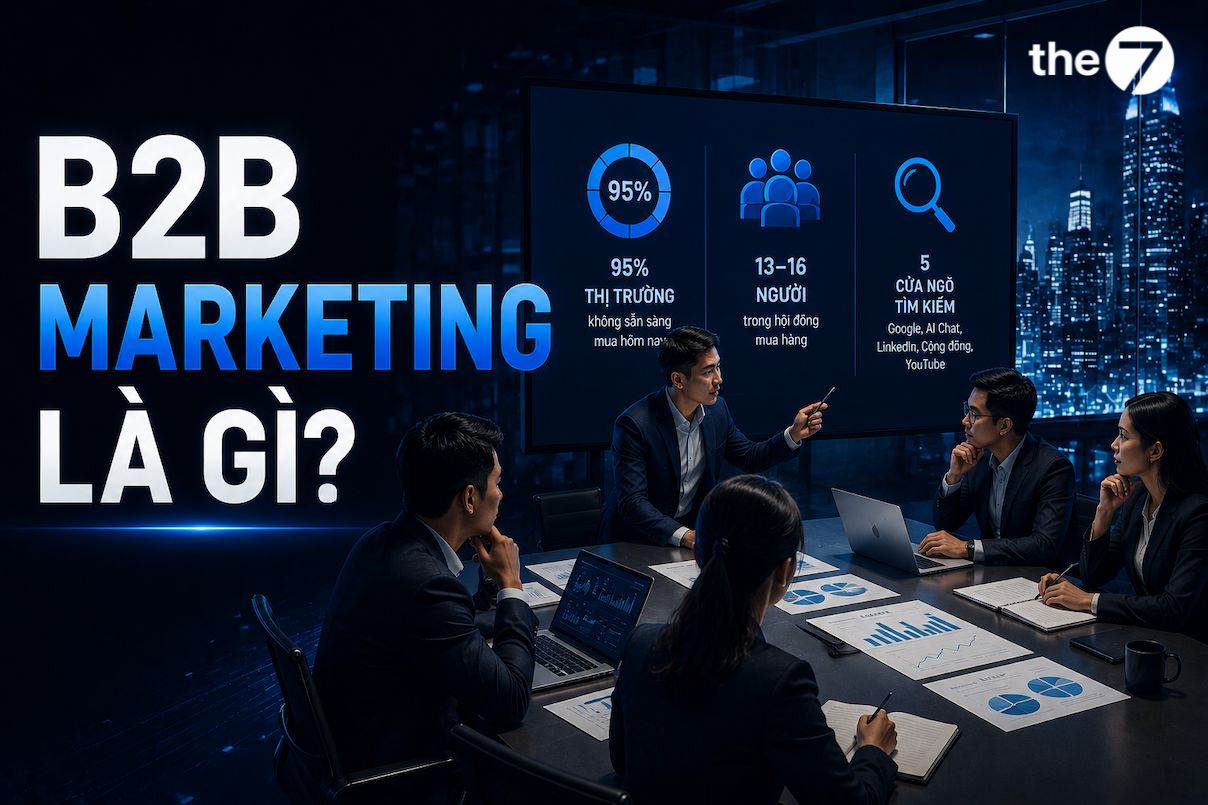
B2B marketing is the system of marketing activities aimed at businesses buying from other businesses. Unlike B2C, B2B marketing has to serve a buying committee of 13 to 16 people, accumulate mental availability with the 95% of the market that isn’t ready to buy, and show up across 5 search gateways, including AI chat. If you still define B2B marketing as “marketing for businesses,” this article is for you. And Sany Heavy Industry, from China, has proven the opposite over 35 years of building a global construction-equipment empire.
B2B marketing is not “marketing for businesses.” That definition is correct by the dictionary but useless in practice. If you see B2B marketing as B2C marketing with the audience swapped from consumers to companies, you will lose in today’s world. And Sany Heavy Industry, the Chinese construction-equipment giant, has spent 35 years showing the whole world that B2B marketing is truly a completely different game. They did not beat Caterpillar on cheap pricing. They won with a content machine, a relentless presence in the minds of contractors from Brazil to Indonesia, and a system in which every gear turns at the same time.
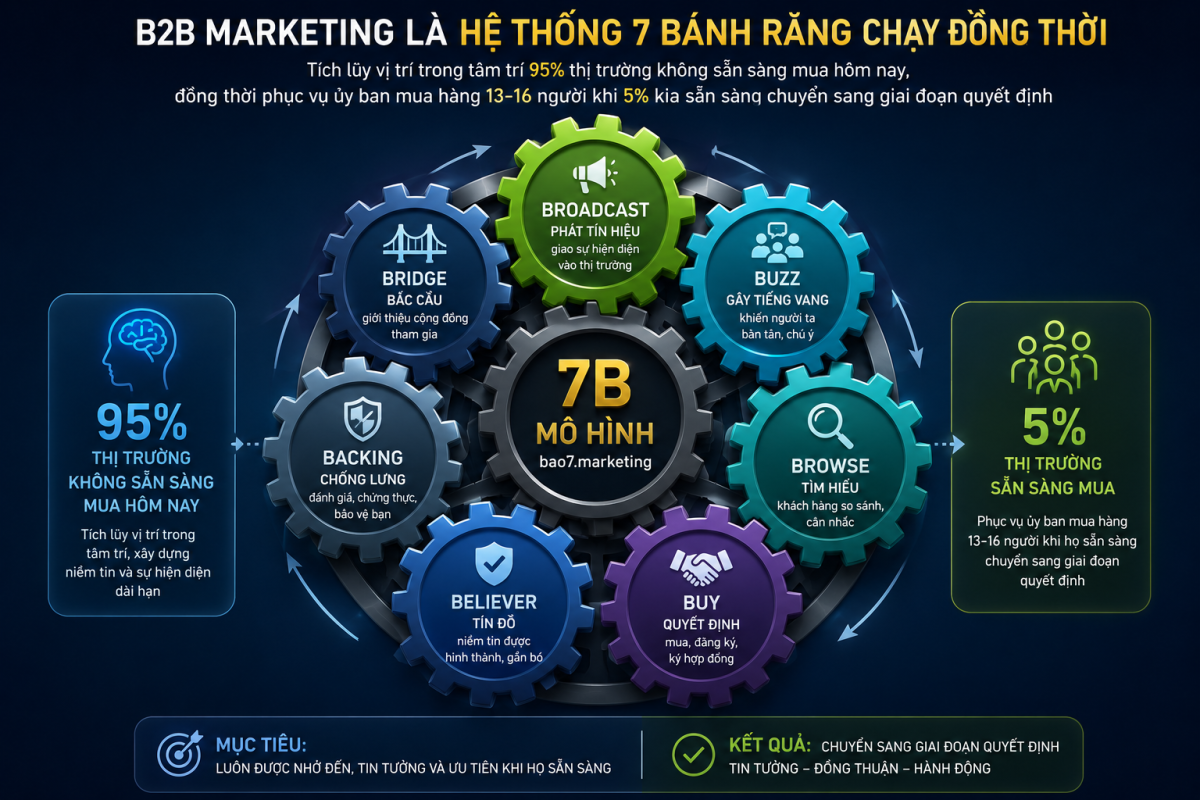
So what is B2B marketing? It is a system of 7 gears running simultaneously to accumulate mental availability with the 95% of the market not ready to buy today, while also serving a buying committee of 13 to 16 people when the 5% ready to buy move into the decision stage. Four elements of this definition are worth engraving in your mind. One, accumulation, not persuasion. Two, the 95% of the market, not the 5%. Three, a committee of 13 people, not a lone individual. Four, a parallel system, not the sequential funnel still shown on every dashboard since 2010.
In this article, you’ll see how B2B marketing evolved from the academic research of the 1970s, through HubSpot’s inbound craze, through the ABM movement, through the 95/5 shock from Ehrenberg-Bass, all the way to today’s AI era. You’ll see the four questions the old definition can’t answer. You’ll see how the 7B model actually operates. And most importantly, you’ll see how Sany Heavy Industry and Cainiao, two Chinese giants, applied these principles to compete head-on with century-old Western names.
How was the concept of B2B marketing born, and how has it evolved?
Many people assume B2B marketing is HubSpot’s offspring. The truth is it has roots going back more than half a century, in university lecture halls, before the internet even existed.
Academic roots: When a business was first seen as its own kind of buyer
In the 1960s and 1970s, Frederick Webster Jr. and Yoram Wind at Wharton School did something nobody had done before: they treated the organization as a distinct buying entity that couldn’t be forced into the mold of the individual consumer. A company is not a scaled-up human being. Its buying behavior is far more complex. Sales cycles stretch across months, even years. The decision doesn’t rest with one person but with a whole group of stakeholders with different concerns. Specifications run hundreds of pages. Procurement happens through RFPs and tenders. They captured all of these traits in the 1972 book Organizational Buying Behavior, giving birth to the concept of “industrial marketing.” It wasn’t until the 1990s that the term was renamed “B2B marketing” to also cover service industries like consulting, software, and finance.
The inbound craze and the MQL trap
In 2006, Brian Halligan and Dharmesh Shah founded HubSpot. Together with Marketo and Eloqua, they popularized a formula that felt almost magical: Content + SEO + Email + Marketing Automation. The entire B2B world fell in love with inbound marketing. From 2010 to 2015, MQL and SQL became the two most powerful letters in every CMO’s dictionary. The sales pipeline was reduced to a simple multiplication: MQLs times conversion rate times deal value. Neat. Easy to report. Easy to optimize. The only problem was that it didn’t reflect reality.
ABM: From hunting leads to hunting accounts
Roughly from 2014 to 2018, ITSMA pushed Account-Based Marketing onto the main stage. The logic was compelling: instead of nurturing 10,000 anonymous leads, focus on 100 to 500 target accounts with deep personalization. Platforms like 6sense, Demandbase, and Terminus sprang up like mushrooms. ABM was really a return to the spirit of original industrial marketing, but this time armed with technology.
The 95/5 shock: When the whole world realized it was shooting at the wrong target
In 2021, the Ehrenberg-Bass Institute and the LinkedIn B2B Institute published a finding that made the entire industry stop and reconsider: at any given moment, only 5% of the B2B market is actually ready to buy. The other 95% has no active need. They won’t buy for months, even years. Yet the entire B2B marketing machine before that, from inbound to ABM, was designed to optimize for that 5%. The 95% who are the future market was systematically ignored. The concept of “mental availability” from consumer marketing officially entered the B2B dictionary.
The AI chat era: When buyers stop typing into Google
ChatGPT launched in late 2022, followed by Claude and Perplexity. B2B buyers’ search behavior changed forever. Instead of typing a few keywords into Google and getting 10 blue links, they now ask complex questions in AI chat and receive synthesized answers drawn from multiple sources. GEO has become a required skill. And Gartner 2025 reports that 61% of B2B buyers don’t want to meet a sales rep. They want to research, evaluate, and decide for themselves.
These five eras did not erase one another. Each stage left a legacy: the industrial era gave us the concept of the buying committee, the inbound era gave us content and automation, ABM gave us account-level targeting, 95/5 gave us mental availability, and the AI era gave us new search behavior. The 7B model is how all of these legacies get integrated into one operating definition for the future.
Why has the old definition of B2B marketing expired?
Try holding a truckload of old definitions up against four questions. If a definition can’t answer them, it doesn’t deserve a place in your marketing plan.
The classic definition says: “Create demand.” Push content, run ads, build lead magnets to generate demand. Sounds great. But the harsh reality is you cannot create demand in someone who doesn’t need it yet. A CFO who rolled out an ERP system two years ago is not going to buy a new ERP this week, no matter how many ads you shove in front of them. They haven’t entered their buying cycle yet. Every effort to stuff CTAs, demo requests, and free trials in front of someone in a “not interested” state only creates annoyance and wastes money. The 2026 reality, based on Ehrenberg-Bass research, is that the job with the 95% is to accumulate mental availability. So that when their buying cycle finally starts, you’re the first name they think of. This is the difference between hunting and growing a forest. (See more on the 95/5 Rule.)
Are you selling to one person, or to 13 people?
The classic definition revolves around nurturing a lead. A lead is an individual. The common logic is to find an internal “champion” who will love your product and go persuade their colleagues. Sounds convenient. Until you learn that Forrester 2024 reports the average B2B buying committee has 13 people. Gartner 2025 puts the number between 5 and 16. And 86% of B2B deals stall at least once because some stakeholder wasn’t reached. You have a fantastic champion in the IT department. But the CFO doesn’t have enough data to calculate ROI. Legal never got an answer on data security. The COO doesn’t see an implementation roadmap. The deal dies. The 2026 reality: marketing has to serve all 13 people, not push one person to go persuade the other 12. (See more in Article 27 on the Buying Committee.)
Empower the buyer to self-serve, or keep trying to push them to sales?
The old definition places marketing in a support role to sales. Marketing generates MQLs, hands them to sales, sales calls, advises, and closes. The whole system is built around the “request a demo” moment. But Gartner 2025 reports that 61% of B2B buyers don’t want to meet a sales rep. They want to research, compare, and decide for themselves. Forrester 2024 shows that 75% of the buying journey is complete before a customer ever contacts a vendor for the first time. The real race happens in the dark, while the buyer is still hidden. If your information isn’t available for them to find and evaluate on their own, you’re not even on the shortlist. The 2026 reality: marketing has to provide enough digital resources for buyers to complete 80% of the journey on their own. Sales only steps in at the final stage, in an advisory role for complex questions. (See more in Article 33.)
How has AI chat changed the search game?
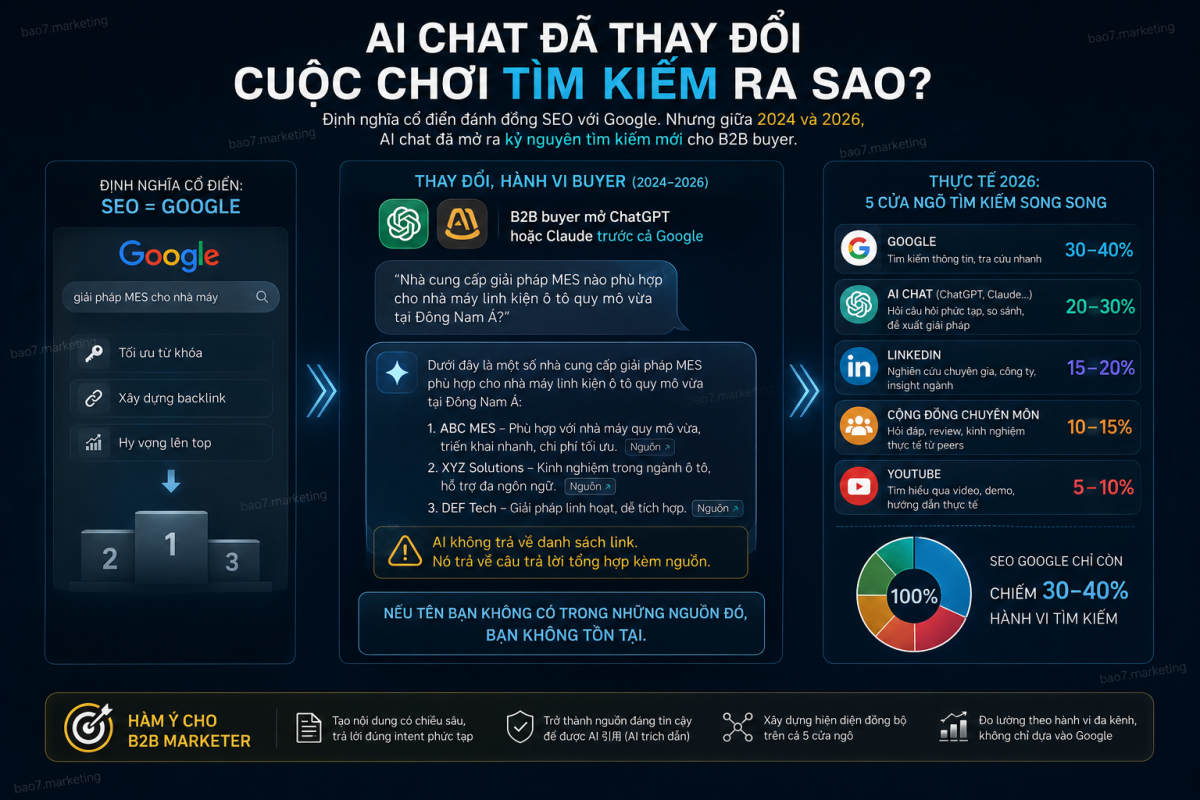
The classic definition equates SEO with Google. You optimize keywords, build backlinks, and hope to rank. But between 2024 and 2026, B2B buyers started opening ChatGPT or Claude before Google for complex queries. They ask long questions like “which MES solution providers fit a mid-size auto-parts factory in Southeast Asia.” AI doesn’t return a list of links. It returns a synthesized answer with sources. If your name isn’t among those sources, you don’t exist. The 2026 reality: there are 5 parallel search gateways, Google, AI chat, LinkedIn, professional communities, and YouTube. Google SEO now accounts for only 30 to 40% of behavior. (See more in Article 56.)
The 7B Model: A new definition for a new reality
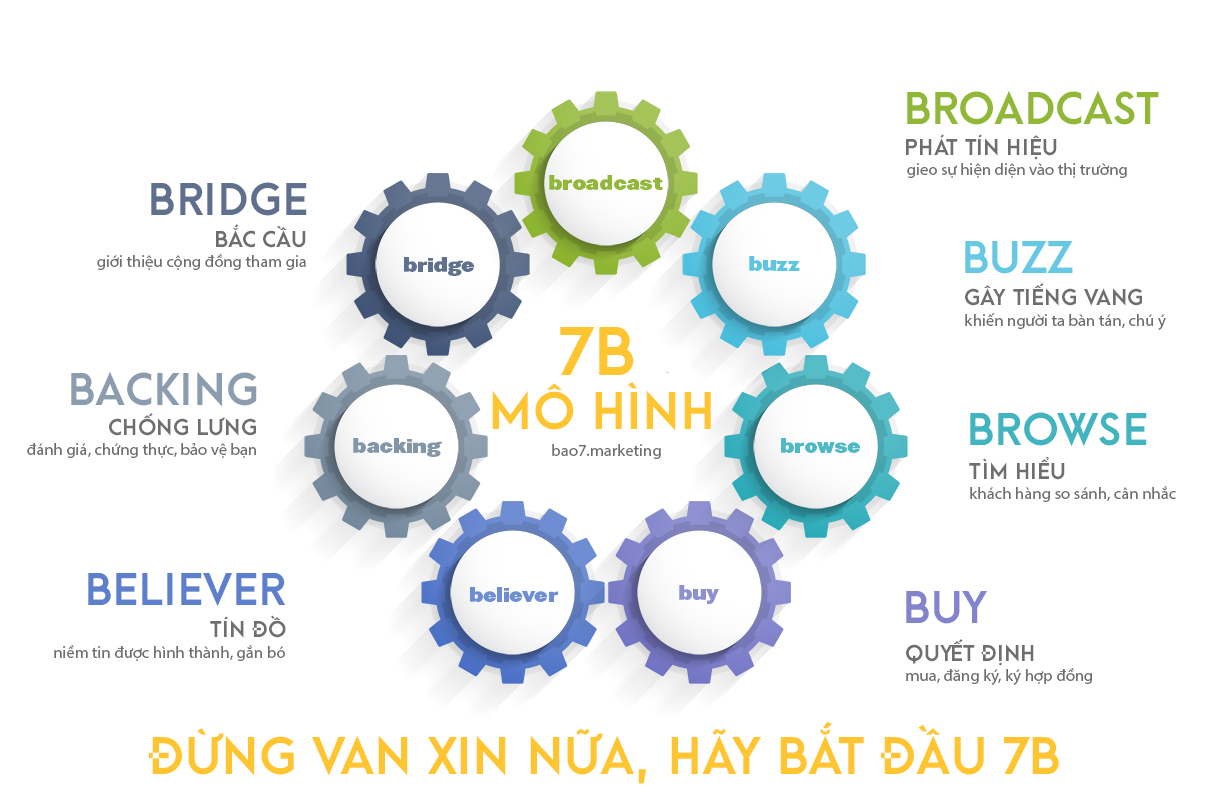
None of the four questions above have a good answer in the old definition. That’s why I built the 7B model. It’s a system of seven gears running in parallel. They don’t replace earlier concepts like the funnel or the flywheel. They reorganize them in a way that reflects the true reality of B2B buying today.
Broadcast is the first gear. This is the activity of signaling value into the market to build mental availability with the 95% who aren’t buying yet. The CEO writes on LinkedIn. The founder runs an industry podcast. The company publishes research. No CTA. No demand for a response. Just presence.
Buzz is the echo from third parties. Past customers speak well of you. Industry experts cite your research. Media covers you. You don’t control Buzz. But Buzz is ten times stronger than Broadcast, because people trust their peers more than they trust a vendor.
Browse is presence across the 5 search gateways of 2026. Not just Google SEO, but also being cited by AI chat, showing up on LinkedIn when people search, appearing in professional communities, and having video on YouTube.
Buy is serving the 13-person committee digitally. A distinct set of materials for each role: an ROI spreadsheet for the CFO, security documentation for the CISO, an integration guide for engineers, case studies for end users.
Believer is marketing that doesn’t stop when the customer signs the contract. Marketing runs throughout the customer lifecycle so the customer adopts the product more deeply, doesn’t churn, expands, and eventually becomes a believer, ready to refer new customers.
Backing is the fuel for the other six gears. Three layers of proof: from customers, from the market, and from the technical infrastructure that lets AI read and cite you.
Bridge is the gear that closes the loop. It turns current customers into a channel for creating new customers through referrals, co-marketing, and community network effects.
These seven gears run simultaneously, not sequentially. This is the core difference from the funnel model. There is no “top of funnel” or “bottom of funnel” in 7B. Every gear has to be turning at the moment a customer enters a buying situation, because a customer can enter at any point. They might meet you for the first time through a podcast, through a colleague’s referral, through an answer on ChatGPT, or through a case study on your website.
This is called Chaotic Logic Theory. Every gear matters simultaneously. Every interaction can be the deciding touchpoint. Marketing’s role isn’t to push someone from stage A to stage B, but to keep the entire system turning at a steady rhythm.
Compared with other models, 7B has some clear differences. HubSpot’s Inbound Marketing is sequential, “attract” then “convert,” “convert” then “close.” 7B is parallel. Inbound was designed for a single buyer’s journey. 7B is designed for a 13-person committee. ABM focuses on a curated list of accounts. 7B operates at both the whole-market level and the account level. ABM is really a tactic that lives inside 7B’s Buy gear. The Demand Generation and Demand Capture model splits into “creating demand” and “capturing demand.” 7B treats both as one continuous accumulating flow. HubSpot’s Flywheel has three stages. 7B has seven gears with clear functions. The Flywheel is missing Backing and Bridge at an operational level.
The 2026 definition of B2B marketing isn’t a different definition. It’s a more complete one, matched to four market realities that didn’t even exist five years ago.
Sany Heavy Industry: The challenger from China
Sany Heavy Industry was the world’s third-largest construction equipment manufacturer in 2024, behind only Caterpillar and Komatsu, with revenue over 100 billion yuan. 35 years ago, Sany was just a small machine shop in Hunan. They didn’t climb into the global top 3 with cheap pricing. They did it with a content-marketing machine, thought leadership, and a sophistication of global B2B presence that few people outside China are aware of. Most of the West defaults to assuming “Chinese companies win on price.” Sany is proof of the opposite. They invested in a marketing strategy just like Caterpillar’s, and in some markets, they’ve won.
In the early 2000s, Sany began exporting equipment outside China. Their problem was typical for any manufacturer from an emerging market: zero brand awareness in the Middle East, Africa, Southeast Asia, and Latin America. Buyers in these markets were already used to Caterpillar, Komatsu, John Deere. Sany was an unfamiliar name. And no procurement department wants to pick an unfamiliar supplier for equipment worth half a million to two million dollars, because the risk is simply too large.
How Sany applied 7B, even before the framework had a name, is a remarkable lesson. For Broadcast, they published Sany Heavy Industry News Magazine starting in 2003, sent free to more than 50,000 contractors and distributors worldwide. The content wasn’t a product brochure, it was thought leadership on the construction industry. Their CEO appeared regularly on industry television. Sany Talk Show, a self-produced program, aired on specialized channels. For Buzz, they partnered with Bauma, the largest construction-equipment trade fair in the world, held in Munich, starting in 2007. They sponsored and spoke there. They built a customer-reference program with more than 100 named contractors across more than 180 countries.
For Browse, they rolled out a multilingual website: English, Spanish, Portuguese, Arabic, Russian, French. They produced localized technical content for each region. Their YouTube channel is full of equipment demo videos and customer stories. For Buy, they built a digital resource kit for five roles in the buying committee: procurement gets price comparison sheets, engineers get detailed specifications, operators get training videos, finance gets leasing and installment options, the CEO gets an ROI spreadsheet. For Backing, they hold comprehensive ISO certification, a reference network of more than 30,000 deployed machines, and technical white papers from their R&D team. For Bridge, they built a network of more than 400 global distributors and co-marketing partnerships with local construction associations.
The result? Exports made up 30% of revenue in 2024, up from 5% in 2008. They rank in the top 3 by market share in Brazil, Indonesia, and Russia. Brand value reached $4 billion according to Brand Finance 2024. They compete directly with Caterpillar in many government tenders in developing markets.
The lesson from Sany is clear: B2B marketing in export manufacturing isn’t “lead conversion.” It’s the process of being found and trusted long before a first quote request ever appears. Sany invested more than 20 years in accumulating mental availability with global buyers. It’s one of the rare cases showing a company from an emerging market can beat long-established Western brands with content marketing, not with price.
Cainiao: The 11-year-old daring to challenge century-old giants
Cainiao is the logistics arm of Alibaba Group, founded in 2013. Unlike Maersk with its fleet of ships or DHL with its fleet of aircraft, Cainiao operates as a smart logistics network, coordinating more than 3,000 partner logistics companies globally instead of owning infrastructure. In 2024, Cainiao processed more than 5 billion cross-border packages, becoming the largest cross-border logistics network in the world. They compete with DHL, FedEx, UPS, and Maersk Cross-Border Logistics, brands all 50 to more than 100 years old. Cainiao is only 11. And here’s how they captured the mental availability of B2B exporters.
Cainiao publishes the Smart Logistics Outlook, a biennial report on cross-border e-commerce logistics. 80 to 120 pages, free, no gate. Distributed globally through the Alibaba ecosystem’s 4 million merchants. The content quality is analyst-grade, cited by McKinsey China, BCG, and World Bank logistics research.
They hold an annual Smart Logistics Conference in Hangzhou with more than 5,000 attendees from more than 80 countries. Cainiao’s CEO and Jack Ma (in the early years) delivered keynotes. Speakers from DHL, FedEx, and Maersk are invited to participate, raising the event’s credibility. They built Cainiao Academy, a free education platform for merchants on cross-border logistics, with more than 100 courses and 500,000 enrolled students. Their thought leadership even reaches into policy circles: partnerships with UNCTAD, and WTO trade-policy groups. Cainiao leadership sits on the advisory boards of several international trade organizations.
Why does it work? Every cross-border e-commerce merchant in China, Southeast Asia, and the Middle East knows Cainiao as the default choice when they need to export. When a merchant grows into an enterprise and starts evaluating B2B logistics solutions, Cainiao is already the first name in their mind.
This is Broadcast, Backing, and Bridge running simultaneously. Broadcast because they publish consistently, with no CTA. Backing because their reports are cited by analysts and policymakers. Bridge because the merchant academy turns users into advocates and a channel for acquiring new customers.
The lesson from Cainiao: the freight-logistics industry doesn’t win on “better service.” It wins by publishing research that becomes the reference material for the entire industry, and by building an ecosystem network that turns users into an acquisition channel. An 11-year-old logistics company from China can compete with brands 50 to 100 years old by building a content machine and a community network early on.
DHL: The Western benchmark for Broadcast and Backing
For a reference point, look at DHL. They compete globally with Maersk, Kuehne+Nagel, FedEx, UPS, and now Cainiao too. Logistics is a commodity industry. Pricing is comparable. Service is comparable. Hard to differentiate. Nearly every 3PL’s marketing looks alike: capability brochures, delivery case studies, customer testimonials. DHL chose a different path.
Starting in 2013, DHL launched the Logistics Trend Radar, a biennial report analyzing more than 30 trends affecting global supply chains. It was followed by Future of Work in Logistics, Sustainable Logistics, AI in Supply Chain. Each report is 50 to 100 pages, free to download, no gate, mostly not even requiring an email address. They don’t stuff their own services into these reports. They publish research the way a genuine think tank would. They also built the DHL Innovation Center in Cologne, Germany, a physical experience space where buyers directly encounter DHL’s vision, welcoming more than 30,000 visitors a year.
The result? Every supply-chain consultant at McKinsey, Bain, Gartner, and IDC reads DHL’s reports. Every VP of Logistics at a Fortune 500 company reads them. Every MBA student focused on supply chain reads them. When a large corporation issues an RFP for 3PL services, DHL is automatically on the shortlist of 3 to 5 vendors, no sales outreach needed.
This is Broadcast and Backing running simultaneously for over a decade. Broadcast because they publish consistently, with no CTA. Backing because their reports get cited in the press, in textbooks, in MBA case studies, creating a halo of authority no competitor can copy in the short term.
What’s interesting is that DHL and Cainiao apply the same principle, Broadcast and Backing, but execute it differently. DHL focuses on analyst-grade thought leadership in the West. Cainiao focuses on building an ecosystem network with merchants in China and ASEAN. Two approaches, two different market contexts, the same underlying principle. This is the core point: the principles of 7B are universal, but how you apply them depends on your context.
Where should you read next?
What B2B marketing is should now be clear. But the definition is only the first step. To actually run 7B, you need to understand each gear, understand the underlying principles, and know how to apply them to your own industry.
To understand the foundational principle that 95% of the market isn’t ready to buy today, read Article 20: What is the 95/5 Rule. To understand the 7B model in detail, gear by gear, read Article 25: What is the 7B Gear Model. To understand why the old funnel model is collapsing, read Article 23: What is the marketing funnel and why is it changing. To understand the 13-person buying committee and how to serve them, read Article 27: What is the B2B buying committee. To confront the reality that 61% of buyers don’t want to meet sales, read Article 33: Why 61% of B2B buyers don’t want to meet a sales rep.
In the upcoming articles in this foundational cluster, you’ll see exactly how each gear operates, and how to apply it across different industry contexts. You’ll see cases from Sany, XCMG, CATL, BYD, Huawei, and Cainiao on the Chinese side, and Caterpillar, John Deere, DHL, and Maersk on the Western side. To see 7B working across industries and geographies.
If you want to go deeper into running the 7B system, with 13 video modules, detailed case studies, and implementation tools for your own industry, check out the 7B Mastery course at bao7.marketing/khoa-hoc-7b. Or if you just want to follow new content, subscribe to the newsletter to get new articles every week.

Nguyễn Đình
Bảo




As CEO of The7, I am committed to sharing practical, useful knowledge with every reader. Every article on The7 is based on my 7 years of hands-on experience in marketing — Facebook advertising, LinkedIn advertising, Google advertising, and marketing strategy. I hope you take away plenty of insight from these posts and apply it successfully in practice.
Related Articles
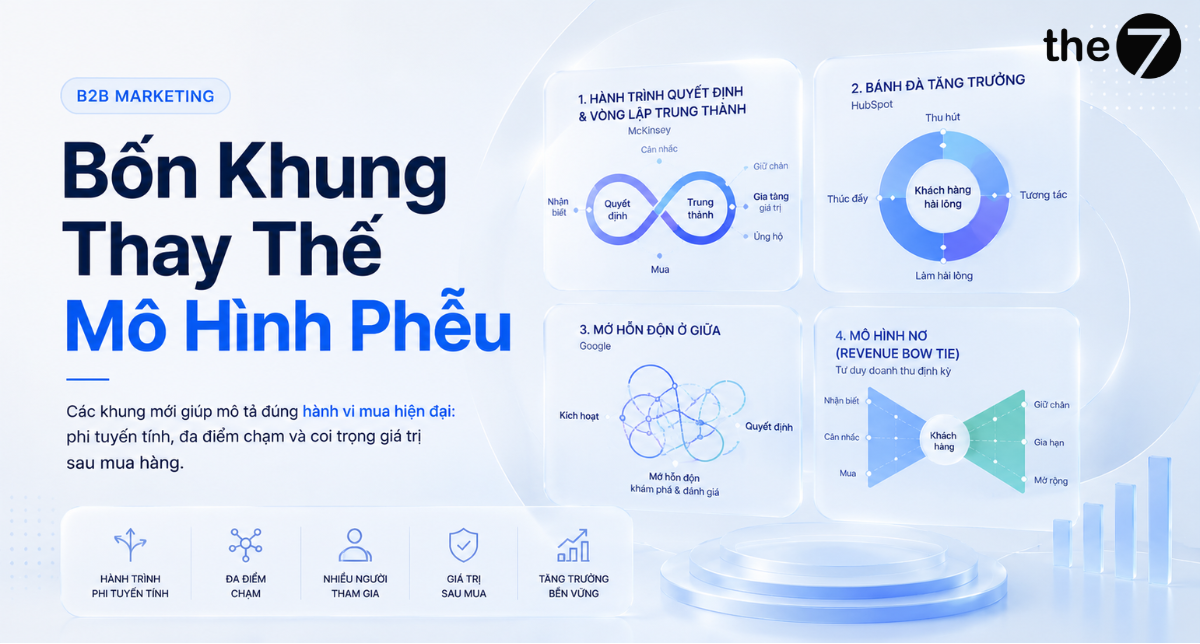
Four Frameworks That Replace the Funnel Model
Summary: As the funnel model increasingly fails to capture how modern buyers actually behave, a number of new frameworks have emerged to replace or repair it: McKinsey’s decision journey and...
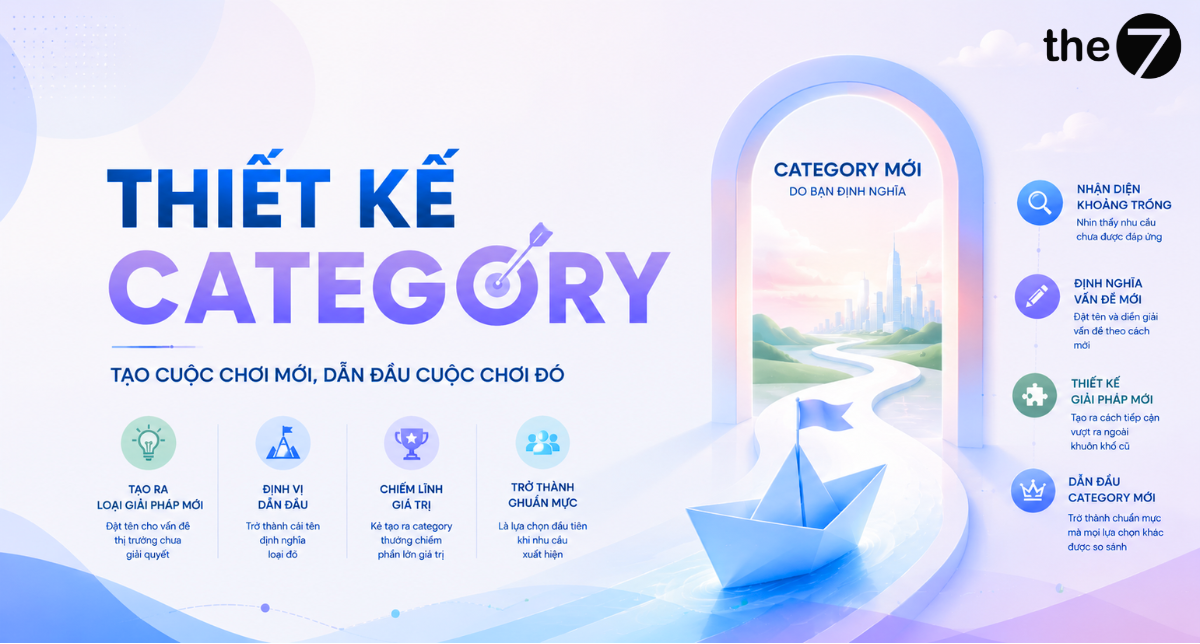
What Is Category Design?
Summary: Category design is the act of creating an entirely new type of solution in the market’s mind, instead of competing within an existing category, and then becoming the name...
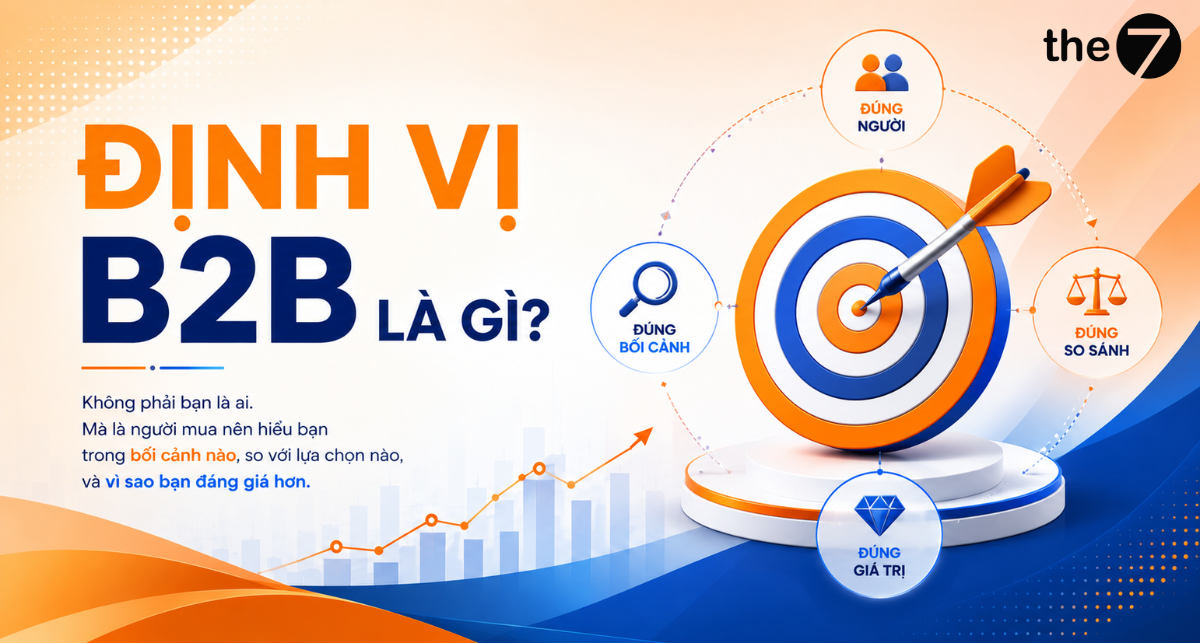
What Is B2B Positioning?
Summary: B2B positioning is the act of choosing the context you place your product into – the frame of reference that makes its value obvious to the buyer. Positioning isn’t...
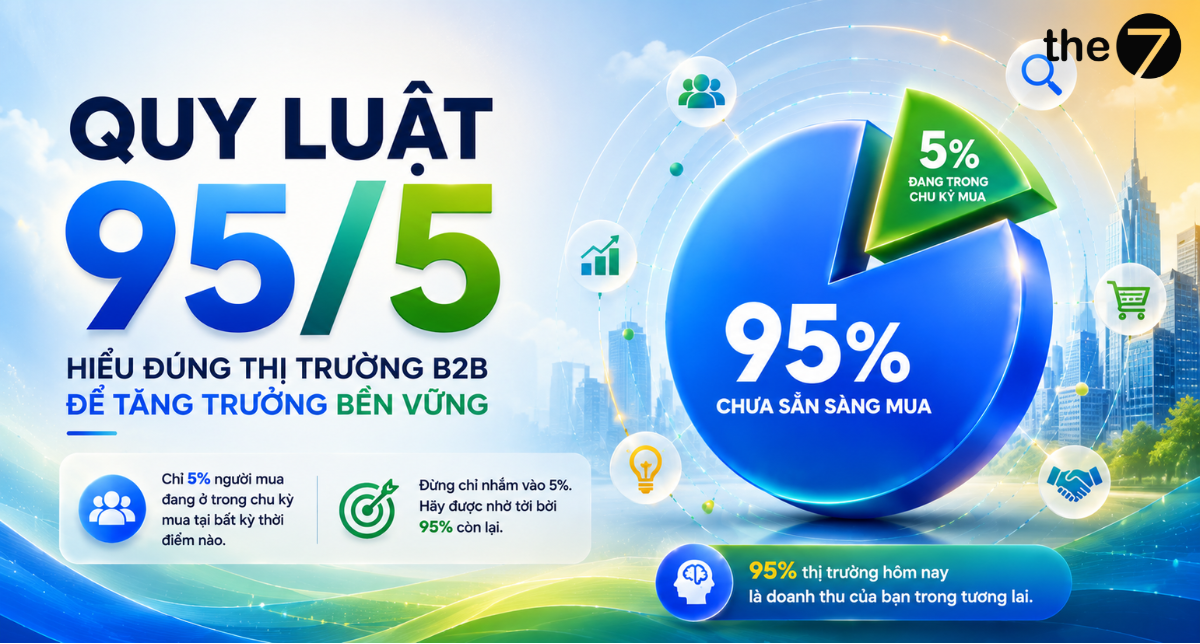
What Is the 95/5 Rule?
Summary: The 95/5 rule states that at any given moment, only about 5% of B2B buyers are actually in-market, actively in a buying cycle, while roughly 95% are not yet...
What Is Mental Availability in B2B?
Summary: Mental availability is how easily a brand comes to mind in a buying situation. It isn’t about having the sharpest argument, the slickest pitch, or the most convincing feature...
What Are B2B Events and Trade Shows?
Summary: B2B events and trade shows are in-person gatherings such as conferences, industry trade shows, workshops, and private meetings, where a business meets buyers, customers, partners, and the industry community...