


What Is the 95/5 Rule?

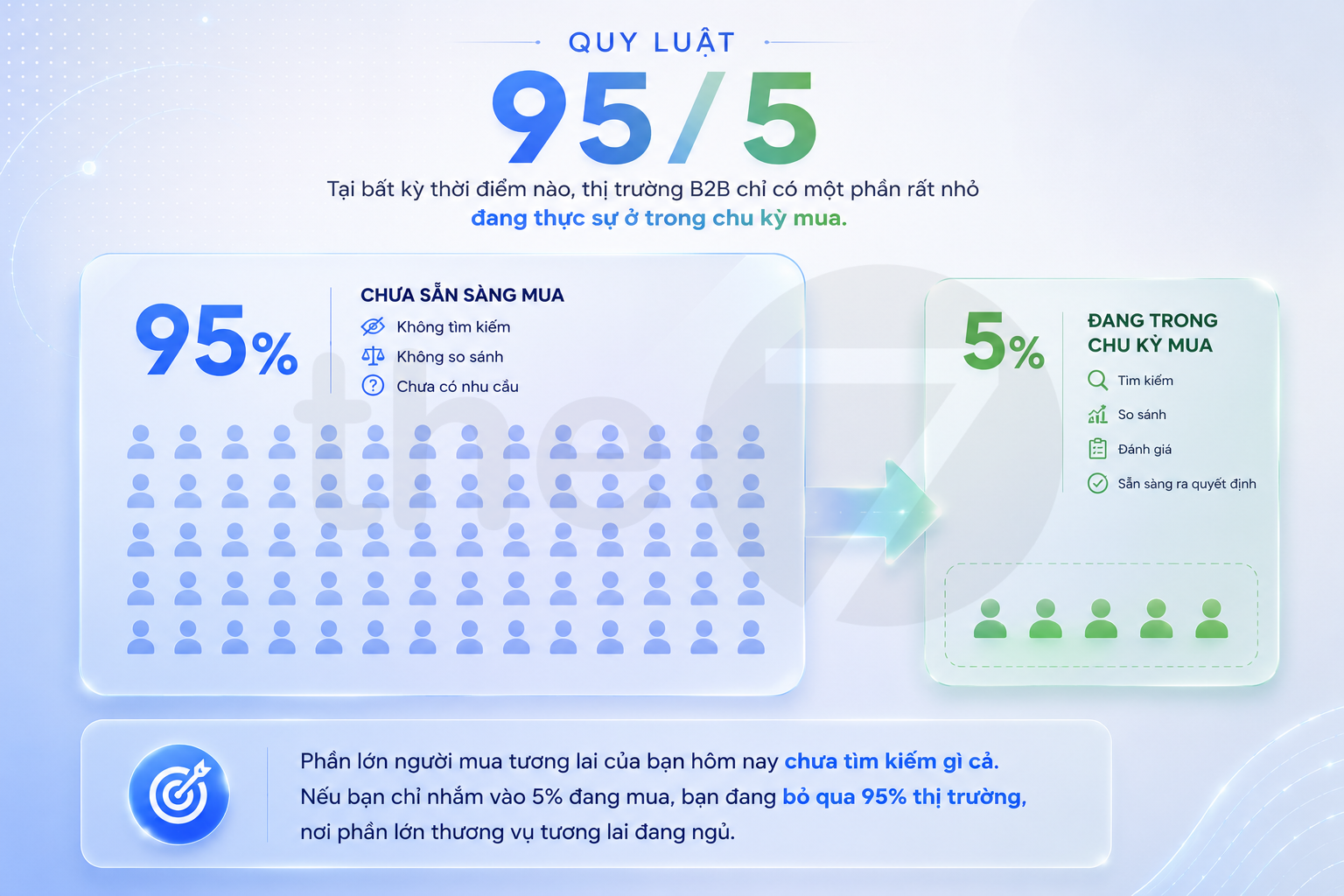
Summary: The 95/5 rule states that at any given moment, only about 5% of B2B buyers are actually in-market, actively in a buying cycle, while roughly 95% are not yet ready. The consequence is that most of your future buyers aren’t searching for anything today. If you only target the 5% who are buying now, you’re ignoring the 95% of the market where most future deals are still asleep. In the 7B model, the 95/5 rule isn’t a gear. It’s the reason the entire machine is designed to lean toward the six demand-creation gears, and it’s one of the clearest death certificates for the linear funnel.
I’ve referenced the 95/5 number in many articles, each time just touching on it before pointing back here. Now it’s time to explain it in full, because this is one of the most important rules shaping my entire way of thinking about B2B marketing. It isn’t an interesting number to quote in a presentation. It’s a fact about market structure. Once you truly understand it, almost every resource-allocation decision in B2B marketing changes.
Most B2B businesses behave as if their entire market is ready to buy. They design every marketing activity to target people who are searching, comparing, and preparing to decide. They optimize for immediate action. They measure effectiveness through forms, appointments, leads, quotes, demos, and other signals visible in the short term. But the implicit assumption behind this entire approach — that buyers are ready to buy — is wrong for most of the market at almost any given moment.
And this flawed underlying assumption is the root of a great deal of waste in B2B marketing. Businesses think they’re marketing to the market, but in reality they’re only squeezing into a very small slice of it: the group currently in a state of preparing to buy right now. They think they’re optimizing for growth, but in reality they’re optimizing for competing over the people who have already woken up, while most future buyers are still asleep.
This article exists to explain the 95/5 rule in full: what it actually says, why that number exists, and a deeper truth hidden underneath it. First, let’s start with the definition.
The 95/5 rule states that at any given moment, only about 5% of prospects in a B2B market are actually in a buying cycle — actively searching, comparing, evaluating, and likely to make a decision in the near future. The remaining 95% are not in a buying cycle at that moment. They may be a good-fit customer. They may have budget in the future. They may go on to buy in this category. But today, they don’t yet have a compelling enough reason to act.
This rule was popularized by the LinkedIn B2B Institute and the Ehrenberg-Bass Institute in 2021, tied to John Dawes’s analysis of purchase frequency in B2B markets. Since then, it has become one of the foundational principles of evidence-based marketing thinking. The core idea is simple: most buyers aren’t buying most of the time. But that very simplicity is what makes it easy to underrate. Everyone has heard of 95/5, but very few businesses actually reorganize their marketing around it.
Why 5%? The Math Behind the Buying Cycle
The 5% figure sounds arbitrary, but it isn’t a number invented for effect. It’s the logical consequence of something very concrete: the length of the B2B buying cycle.
In B2B, people don’t buy continuously. A company buys an enterprise software system and then uses it for years before considering a replacement. A factory buys heavy equipment and runs it for a decade. A business signs a contract with a service provider and keeps that contract across multiple cycles, as long as no problem is big enough to force a change. The gap between two purchases in the same category is typically long, measured in years rather than days or weeks.
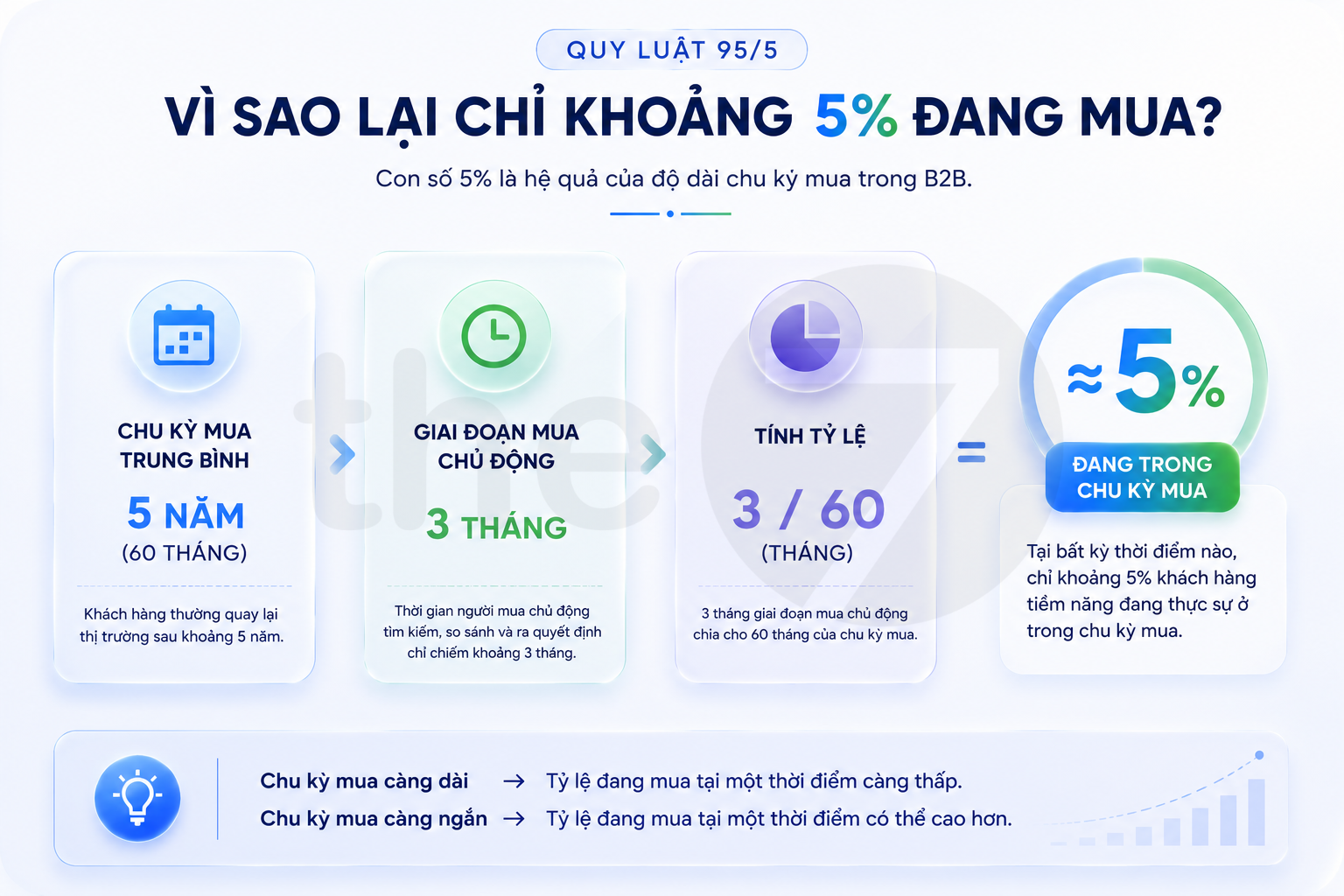
Take a simple example. Research from the LinkedIn B2B Institute and the Ehrenberg-Bass Institute puts the average buying cycle at 5 years — meaning a typical customer only re-enters the market roughly every 5 years — so in any given year, only about 20% of the market is likely to enter a buying cycle. But “within a year” is still a wide window. If the active buying phase only lasts about a quarter — roughly three months out of the full 5-year cycle — then at any specific point in time, the share of people genuinely in a buying cycle is only around 5%. Put more simply: 3 months divided by 60 months is 5%.
This is how the 5% figure should be understood. It isn’t magic. It’s the shadow cast by the length of the buying cycle. The longer the buying cycle, the smaller the share of people buying at any given moment. The shorter the cycle, the higher that share can be. So 95/5 shouldn’t be read as a fixed number for every industry, category, or market. It’s a directional rule, a way of viewing market structure. In many B2B industries, 5% is a reasonable estimate. But in some, the real number could be 3%, 8%, 10%, or even lower than 5%.
A category with a very long buying cycle, such as heavy industrial equipment, production lines, or plant infrastructure, may have a share of active buyers lower than 5%, because buyers only make decisions after many years or even a decade. A category with a shorter cycle, such as certain operational services, marketing tools, small software, or outsourced services that can turn over annually, may have a higher in-market share. The core point isn’t to argue whether the exact figure is 5% or 7%. The core point is that in nearly every B2B market, most buyers are not in a buying cycle at any given time.
You can estimate this ratio for your own category with a very simple formula: divide the length of the active buying phase by the average buying cycle. If customers typically switch suppliers every four years, and the active phase of searching, evaluating, and deciding lasts about three months, the in-market share at any moment is roughly 3 divided by 48, or just over 6%. If the buying cycle is eight years and the active phase is still about three months, that share drops to just over 3%. This isn’t an exact calculation, but it’s enough to pull businesses out of the illusion that “the whole market is ready to listen to sales.”
Once you understand that 95/5 comes from the length of the buying cycle, it stops being an abstract statistic and becomes a concrete truth about your market. Most of the people who will buy from you next year aren’t searching for anything today, because they’re still in the middle of their current solution’s cycle. Tomorrow’s buyers aren’t searching for anything today. And that’s the truth that shapes everything.
95/5 Is the Shadow of a Deeper Truth
The 95/5 rule is already powerful, but it’s still only the statistical surface of a deeper truth about B2B markets. And that deeper truth is the real foundation of how I built the 7B model.
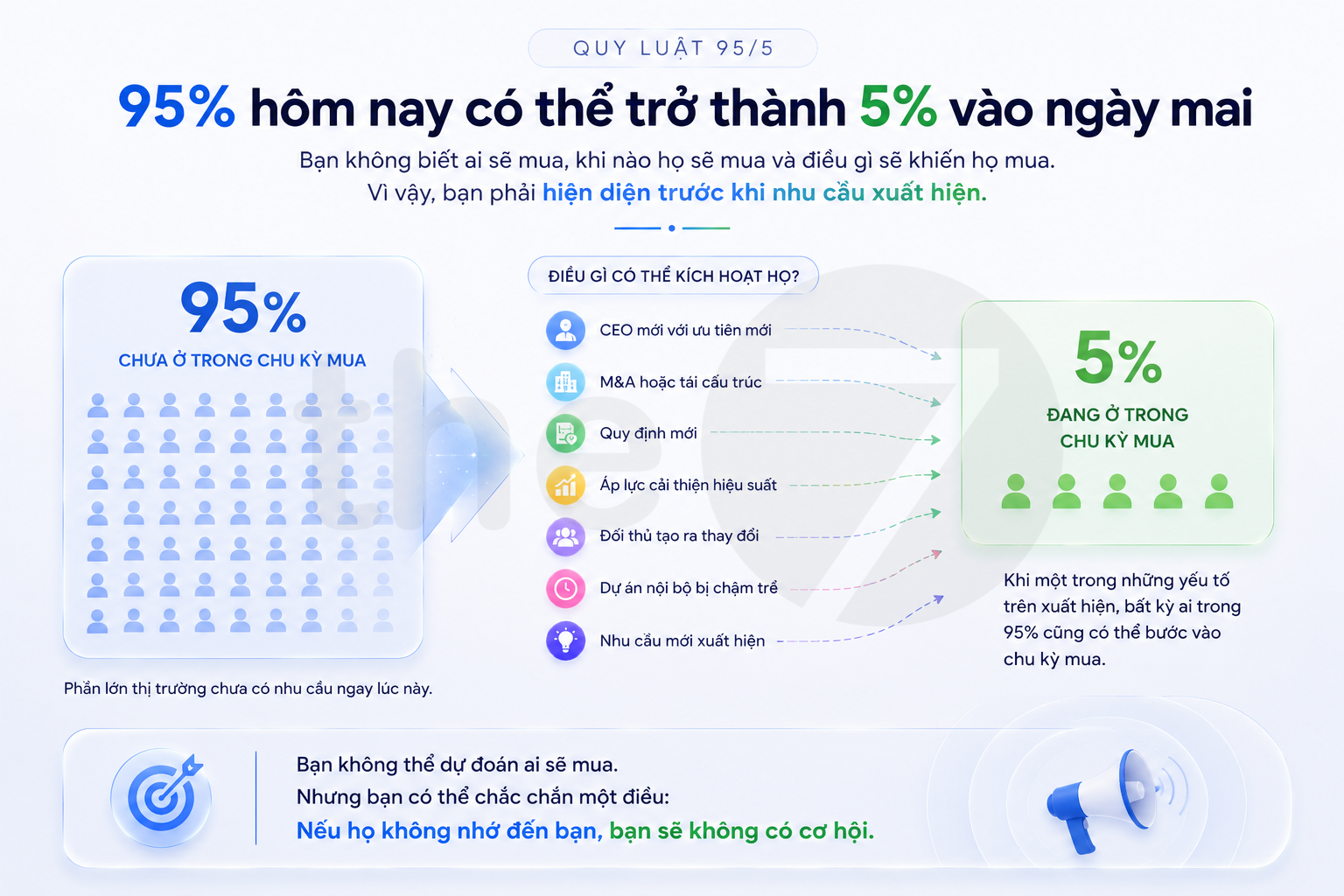
The 95/5 figure gives you a static snapshot: at any moment, about 5% are buying, about 95% aren’t. But it doesn’t tell you something far more important: you can’t know in advance who among that 95% will shift into the 5%, when, or what will trigger that shift. A company happy with its current supplier can suddenly enter a buying cycle because of a leadership change, an operational incident, a new regulatory requirement, an expansion opportunity, an M&A deal, a restructuring, board pressure, or simply because someone new has taken charge and wants to replace the old system.
No one, not even the company itself, can predict exactly when or why this shift will happen. Today they may have no need at all. Next month they could become a very hot lead. But the reason they heat up doesn’t live neatly in your dashboard. It lives in the real life of their business: in internal meetings, in friction between departments, in revenue pressure, in personnel changes, in system failures, in market opportunities, in things you simply cannot see.
I call this deeper truth Chaotic Logic. The B2B buying journey isn’t a straight line you can predict and follow. It’s a chaotic system in the strict sense of the word: sensitive to countless small factors, non-linear, and impossible to predict precisely at the level of any single individual. You can’t know which buyer will enter the market, when, or through what path, because that depends on far too many factors outside your observation and control. The 95/5 rule is the statistical shadow this chaos casts. Because you can’t predict individuals, what you see at the market level is only an aggregate ratio: a small share buying, a large share not yet buying.
And this is where the truth leads to a very powerful strategic conclusion. If you can’t predict who will buy and when, the sensible strategy isn’t to wait for them to raise their hand before showing up. The sensible strategy is to be present before they raise their hand. You can’t wait until someone enters the 5% and only then try to get remembered, because by that point they’ve already started thinking of the names already in their head. If you aren’t one of them, you’re entering the game too late.
You have to build presence and memory with the entire market, including the 95% who aren’t ready yet, so that when any of them unexpectedly shifts into the 5%, you’re already in their mind. This is exactly why mental availability matters so much. It’s how you prepare for an event you cannot predict. You don’t know which day a buyer will wake up. But you can prepare so that when they do, your name is one of the first that comes to mind.
This is also where the 95/5 rule becomes the funnel’s death certificate. The funnel assumes a journey that is predictable and can be followed in sequence: the buyer enters at the top, gets nurtured through each stage, and drops out the bottom as a customer. But if the buying journey is genuinely chaotic, if you don’t know who will enter the market or when, if most future buyers today aren’t even in any funnel at all, then the funnel misdescribes reality. There is no orderly flow from top to bottom. There is a vast market, mostly asleep, from which individuals and organizations unexpectedly wake up at unpredictable moments.
The 95/5 rule and Chaotic Logic together show why a machine of constant presence makes more sense than a sequential funnel. You don’t build marketing to push buyers down through stages. You build marketing so the market remembers you before the need appears, trusts you as the need grows, and chooses you when the need turns into action.
Why Chasing the 5% Is a Trap
Understanding 95/5 and the chaos beneath it leads to a practical warning: pouring most of your resources into the 5% who are currently buying is a trap, even though on the surface it looks perfectly reasonable.
It looks reasonable because that 5% is about to buy, so targeting them produces fast, measurable results. You run search ads against high-intent queries. You retarget people who’ve visited the pricing page. You target accounts showing research signals. You call people who just downloaded a document. Some convert, you see forms, appointments, pipeline, quotes. Everything looks clean, tidy, and easy to report on.
But the trap is that every one of your competitors is targeting that exact same 5%. The whole industry crowds into the same small pond. Everyone runs ads against the same purchase-intent keywords. Everyone retargets the same people who just visited the website. Everyone tries to catch intent signals from the same accounts. Everyone sends “book a demo,” “get a consultation,” “request a quote” messages to the people who are about to decide. The result is that the cost of winning a customer in that 5% keeps rising, because competition keeps intensifying in a very cramped space.
The more you depend on the 5%, the easier it is to fall into an expensive race. CPM rises. CPC rises. CPL rises. Sales costs rise. Win rates fall. Buyers are surrounded by too many nearly identical suppliers, saying nearly identical things, right at the moment they’re already overloaded with information. You work harder and harder to win an increasingly expensive slice of the pie.
Meanwhile, the remaining 95%, where few businesses have the patience to invest in building memory, is where most future deals are actually forming. Everyone in that 95% will eventually have a day when they enter a buying cycle. When that day comes, they won’t start with a blank slate in their head. They’ll think of the names already sitting in their memory. They’ll search for brands they’ve heard of before. They’ll ask colleagues about names that sound familiar. They’ll favor suppliers that feel lower-risk, not because they’ve read every brochure, but because those names have accumulated in their mind over time.
Businesses that have patiently stayed present with the 95% become the names that come to mind. Businesses that only chase the 5% are absent, because they never built memory with that buyer while the buyer wasn’t ready yet. When buyers enter the market, they don’t suddenly give every brand an equal, fair shot. They enter carrying memories, a sense of familiarity, pre-existing trust, referrals they’ve heard, content they’ve read, presence they’ve seen, and associations already built beforehand.
This is the core paradox of the 95/5 rule. The approach that delivers fast results — targeting the 5% — has a low ceiling and rising costs. The approach that delivers slow results — building memory with the 95% — is where real, sustainable growth actually comes from. A business fixated on harvesting only the 5% is like someone picking crops on a tiny plot the whole village is fighting over, while leaving a vast field fallow that they could have planted long ago.
This doesn’t mean ignoring the 5%. That group still needs to be harvested, and harvested well. You still need search ads, conversion pages, comparison content, case studies, a sales team, fast response processes, and mechanisms that make it easier for active buyers to reach a decision. But that doesn’t mean all of marketing should be pulled toward the 5%. The issue isn’t choosing 95 or 5. The issue is that most businesses behave as if only the 5 exists.
Resource allocation should mirror market structure. If most of the market isn’t ready, most resources should go toward building memory, trust, and presence with the not-yet-ready group. A smaller but sharper portion should go toward converting the currently-buying group. Put simply: sow more than you reap, because without sowing, there’s nothing to reap in the future.
Where Does the 95/5 Rule Fit in the 7B Model?
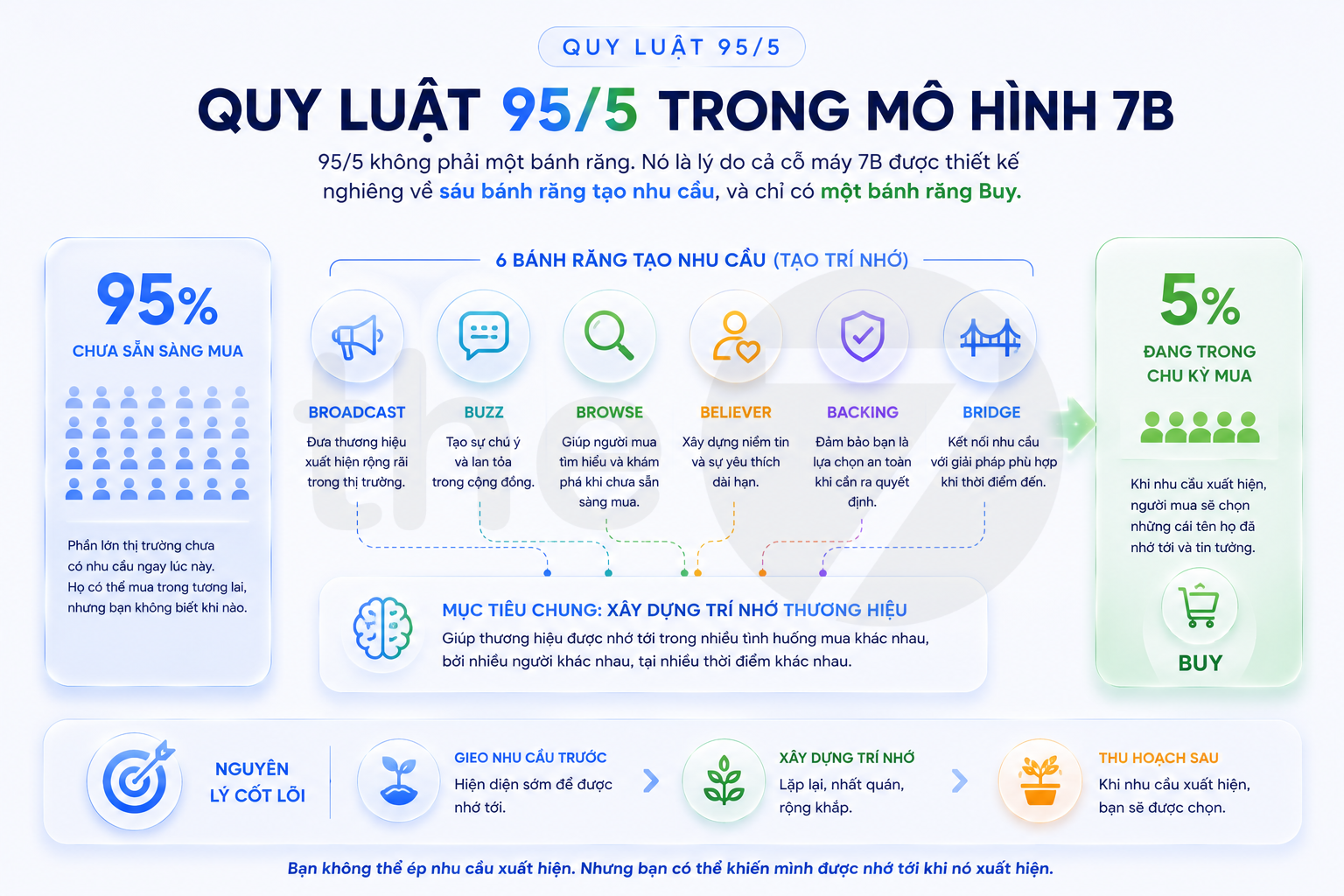
When you place the 95/5 rule inside the 7B model, it isn’t a gear. It’s the foundational reason behind the entire shape of the machine.
Look back at the structure of the 7B model. The six demand-creation gears — Broadcast, Buzz, Browse, Believer, Backing, Bridge — serve the work of building and nurturing demand with the entire market. One gear, Buy, serves the work of harvesting the group that’s ready. Why is the machine designed to lean so heavily toward the six demand-creation gears? The answer is precisely the 95/5 rule.
Because 95% of the market isn’t ready to buy at any given moment, most of marketing’s job can’t be to wait for them to raise their hand. Most of the job has to be building memory and presence with that 95%. That’s the work of the six demand-creation gears. Broadcast keeps the brand appearing regularly in front of the market. Buzz creates conversation and social signals. Browse gives buyers something to search, read, watch, and self-educate with as their curiosity begins. Believer turns customers and advocates into a force of trust. Backing creates proof, credibility, and endorsement. Bridge opens paths through partners, communities, ecosystems, and relationships a brand alone would struggle to reach.
Buy is still very important, but Buy is only one gear out of seven. It’s where demand is converted into action. It isn’t where all demand is created. If you make Buy carry the work of creating demand, building trust, nurturing memory, building credibility, generating word of mouth, and closing the deal all at once, you’re making one gear do the work of the entire machine. That’s why so many businesses find performance marketing feeling heavier, more expensive, and harder to scale every year.
The entire architecture of the 7B model is a direct answer to the 95/5 reality. If the market worked the other way around, if 95% of customers were always ready to buy, a harvest-leaning system would make sense. A funnel focused on conversion could be sufficient. But the market doesn’t work that way. Most of it is always not-yet-ready, and the moment it becomes ready is unpredictable. So the right machine has to be a system of constant presence, leaning toward sowing, ready for anyone who unexpectedly steps into the market.
This is the complete logical chain connecting three foundational concepts. The 95/5 rule explains why: because most of the market isn’t ready, and you can’t predict when it will be. Mental availability explains the goal: becoming the name remembered when they enter the market. The six demand-creation gears explain the how: the specific mechanisms for building that mental availability over time. The 95/5 rule is the bottom foundation stone, the reason the entire sowing part of the machine exists.
Three Examples Across Three Industry Types
Let’s look at a few examples across different industries, since each has a different buying-cycle length. That very difference helps make it clear: 95/5 isn’t a fixed number, but a way of viewing the rhythm of a market’s buying behavior.
In enterprise software, a major system is typically used for years before being replaced. CRM, ERP, HRM, operations management software, data systems, security platforms — all carry high switching costs. A company doesn’t replace a system just because it saw a good ad. It only enters a buying cycle when there’s a big enough reason: the old system can’t handle new scale, operating costs are too high, data is fragmented, there’s a security risk, leadership has changed, or a new digital transformation project has begun. So at any given moment, only a small share of prospects are genuinely buying. A smart company in this industry can’t just sit and wait for buyers to search for “best software.” It has to be present months or years in advance, so that when a business unexpectedly decides to replace its system, its name is already there in mind.
In heavy industrial equipment, the buying cycle is even longer. A production line, machinery, manufacturing equipment, industrial HVAC systems, plant solutions, or specialized equipment can be used for many years, even a decade. That means the out-of-market share is even larger. The share actively buying at any moment can be lower than 5%. In industries like this, building long-term memory with the community of engineers, plant owners, contractors, consultants, procurement staff, and leadership matters even more. If you only target people buying right now, you miss nearly the entire market nearly all of the time.
In professional services — strategy consulting, B2B marketing, law, finance, executive search, or transformation consulting — demand is often triggered by unexpected events. A company might not need a consultant for two years, then suddenly need one the moment revenue stalls, the market shifts, the old team no longer fits, a new investor comes in, or the CEO wants to restructure. This industry shows the chaotic nature of buying timing very clearly. No one can predict exactly when a company will need consulting. So a smart consulting firm doesn’t only hunt for people asking for quotes. It maintains steady presence across its entire target market, so that when the unexpected trigger event happens, it’s the name that comes to mind.
Three examples, three different cycle lengths, one principle: because most of the market isn’t ready and the moment of readiness is unpredictable, winning comes from constant presence with the entire market, not just from fighting over the small group currently buying.
Three Mistakes from Ignoring the 95/5 Rule
The first mistake is designing all of marketing as if everyone were ready to buy. This is the root mistake. When you assume the whole market is in a buying cycle, you pour everything into triggering immediate action: filling out forms, booking calls, requesting quotes, messaging, calling sales. You treat people who haven’t acted as “not interested,” when the truth is they may be a great fit who simply hasn’t reached their buying moment. The fix is to accept that most of the market isn’t ready at any given time, and to design marketing not only to harvest current demand but also to build memory for future demand.
The second mistake is pouring the budget into the 5% and then complaining that costs keep rising. Many businesses put most of their budget toward winning current buyers, then are surprised when cost per customer keeps climbing. They don’t realize every competitor is crowding into that same small pond. When the entire market optimizes for the same small group, that group becomes very expensive. The fix isn’t to shut down conversion activity, but to reduce dependence on it. You still need a strong Buy, but you can’t let Buy swallow the entire budget, attention, and strategic imagination of the company.
The third mistake is expecting instant results from building memory with the 95%. Since that group isn’t ready to buy, investing in them doesn’t produce the kind of results where you run a campaign today and get a deal next week. Many businesses lose patience, see no rise in the dashboard’s form count, and pull the whole budget back to the 5%. But the value of building memory with the 95% only shows up once they enter a buying cycle, which could be months or years later. The fix is to understand this as a long-term investment in mental availability, and to measure it with more appropriate signals: how well you’re remembered, how often you show up on consideration lists, branded search volume, the quality of direct traffic, the rate at which buyers proactively name you to sales, and how familiar the market is with the brand.
So How Should You Allocate Resources?
The answer isn’t to mechanically put 95% of the budget into brand and 5% into performance. The 95/5 rule isn’t a rigid budget formula. It’s a reminder that resource structure should mirror market structure. If most of the market isn’t ready, most of the effort can’t be devoted solely to short-term conversion.
In practice, a business needs two layers of activity running in parallel. The first layer is long-term demand creation: building mental availability, creating familiarity, building proof, building trust, expanding the reach of presence, making the market repeatedly encounter the brand in meaningful contexts. This layer serves the 95%. The second layer is converting current demand: helping active searchers understand easily, compare easily, trust easily, contact easily, and buy easily. This layer serves the 5%.
The problem for many businesses isn’t that they have Buy. The problem is that they only have Buy. They have search ads, landing pages, forms, sales scripts, a CRM, CPL reports, but not enough Broadcast, Buzz, Browse, Believer, Backing, and Bridge to create memory beforehand. When the market doesn’t know you, doesn’t trust you, has never heard of you, has never seen proof about you, Buy has to work overtime. It has to introduce, persuade, build trust, and close action all within a very short window. That’s why conversion costs rise while lead quality stays low.
A business that understands 95/5 won’t ask, “How do we get everyone to buy right now?” It will ask a better question: “How do we make sure that when the market enters a buying cycle, we’re already one of the names they remember?” That question pulls marketing out of the short-term trap. It forces the business to build memory assets, not just hunt for action signals. It forces the business to think in years, not just weeks. And it forces the business to see marketing as a demand-creation machine, not just a form-generating machine.
Conclusion: Tomorrow’s Buyers Aren’t Searching for Anything Today
Back to where I started. Most B2B businesses behave as if the entire market is ready to buy. But the 95/5 rule shows that assumption is wrong for most of the market at almost any given moment. Only about 5% are in a buying cycle, and that number is the logical consequence of the length of the B2B buying cycle.
But the 95/5 rule is only the surface. The deeper truth is that you can’t predict who will shift from the 95% to the 5%, when, or why, because the B2B buying journey is a chaotic system. And that very unpredictability leads to the core strategic conclusion: you have to be present with everyone, all the time, so that when anyone unexpectedly enters the market, you’re already in their mind.
Tomorrow’s buyers aren’t searching for anything today. They haven’t filled out a form. They haven’t clicked an ad. They haven’t asked for a quote. They haven’t talked to sales. But that doesn’t mean they don’t matter. On the contrary, they are your future market. If you only show up once they start searching, you’re already late. If you’ve built memory with them beforehand, you enter buying day with an advantage competitors can’t buy in the final few days.
In the 7B model, the 95/5 rule is the foundational reason behind the entire shape of the machine. It’s the bottom stone that justifies leaning toward the six demand-creation gears. It explains why Buy needs to exist but must not dominate the whole system. And it shows why the sequential funnel no longer accurately describes B2B reality.
Don’t pour all your energy into winning the 5% buying today. Build memory with the 95% who will buy tomorrow.
To understand the deeper truth about the unpredictability of the buying journey and the goal that building memory with the 95% is aimed at, read the article on mental availability. To understand why the funnel no longer describes reality accurately, read the article on why the funnel model is changing. And to understand how the entire seven-gear machine is designed around this rule, read the article on the 7B gear model.
Frequently Asked Questions
What is the 95/5 rule?
The 95/5 rule states that at any given moment, only about 5% of B2B buyers are in a buying cycle, while about 95% aren’t ready to buy. The main implication is that businesses shouldn’t market only to the group buying right now, but must build memory and presence with the group that will buy in the future.
Why is only about 5% of the market buying?
Because B2B buying cycles are typically long. Many businesses only replace suppliers, software, equipment, or services after several years. If the active buying phase only makes up a small portion of that entire cycle, then at any specific moment, the share of people genuinely buying will be very low.
Is the 95/5 ratio the same across every industry?
No. 95/5 is a directional rule, not a fixed number for every category. Industries with longer buying cycles may have an active-buyer share lower than 5%. Industries with shorter cycles may have a higher share. The important point is that in most B2B markets, most buyers aren’t ready at any given moment.
Why shouldn’t you only target the 5% who are buying?
Because that’s the smallest and most heavily contested group. If you only target the 5%, your business gets pulled into an expensive cost race with competitors. Sustainable growth comes from building memory with the 95% who aren’t buying yet, so that when they enter a buying cycle, your brand is already on their consideration list.

Nguyễn Đình
Bảo




As CEO of The7, I am committed to sharing practical, useful knowledge with every reader. Every article on The7 is based on my 7 years of hands-on experience in marketing — Facebook advertising, LinkedIn advertising, Google advertising, and marketing strategy. I hope you take away plenty of insight from these posts and apply it successfully in practice.
Related Articles
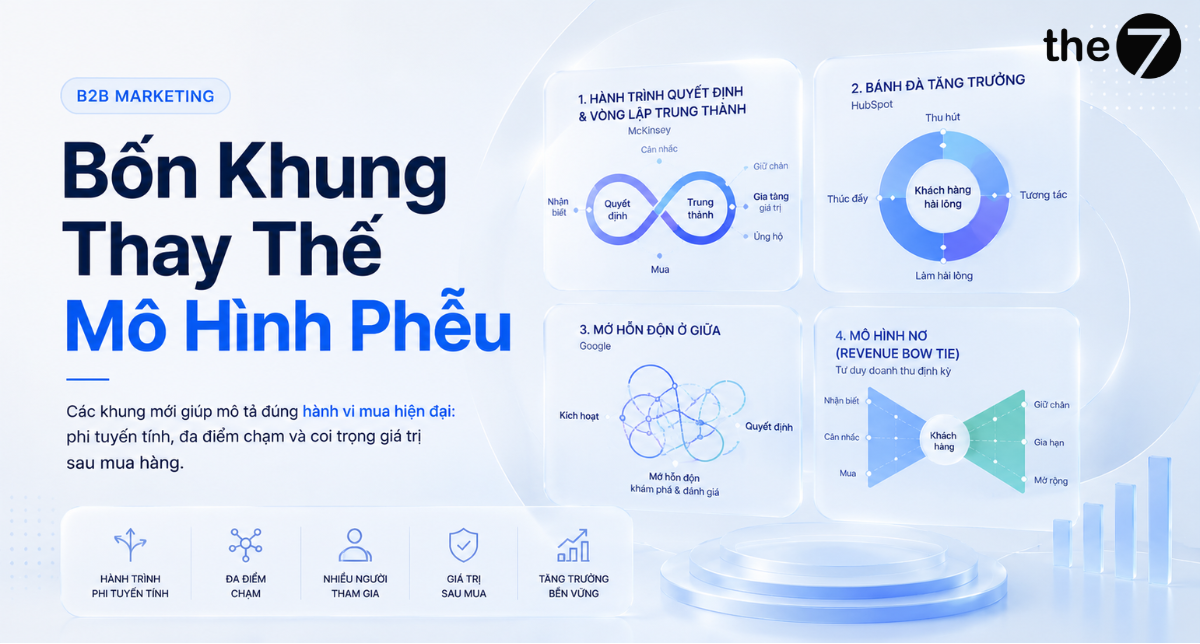
Four Frameworks That Replace the Funnel Model
Summary: As the funnel model increasingly fails to capture how modern buyers actually behave, a number of new frameworks have emerged to replace or repair it: McKinsey’s decision journey and...

What Is Category Design?
Summary: Category design is the act of creating an entirely new type of solution in the market’s mind, instead of competing within an existing category, and then becoming the name...
What Is B2B Positioning?
Summary: B2B positioning is the act of choosing the context you place your product into – the frame of reference that makes its value obvious to the buyer. Positioning isn’t...

What Is Mental Availability in B2B?
Summary: Mental availability is how easily a brand comes to mind in a buying situation. It isn’t about having the sharpest argument, the slickest pitch, or the most convincing feature...
What Are B2B Events and Trade Shows?
Summary: B2B events and trade shows are in-person gatherings such as conferences, industry trade shows, workshops, and private meetings, where a business meets buyers, customers, partners, and the industry community...
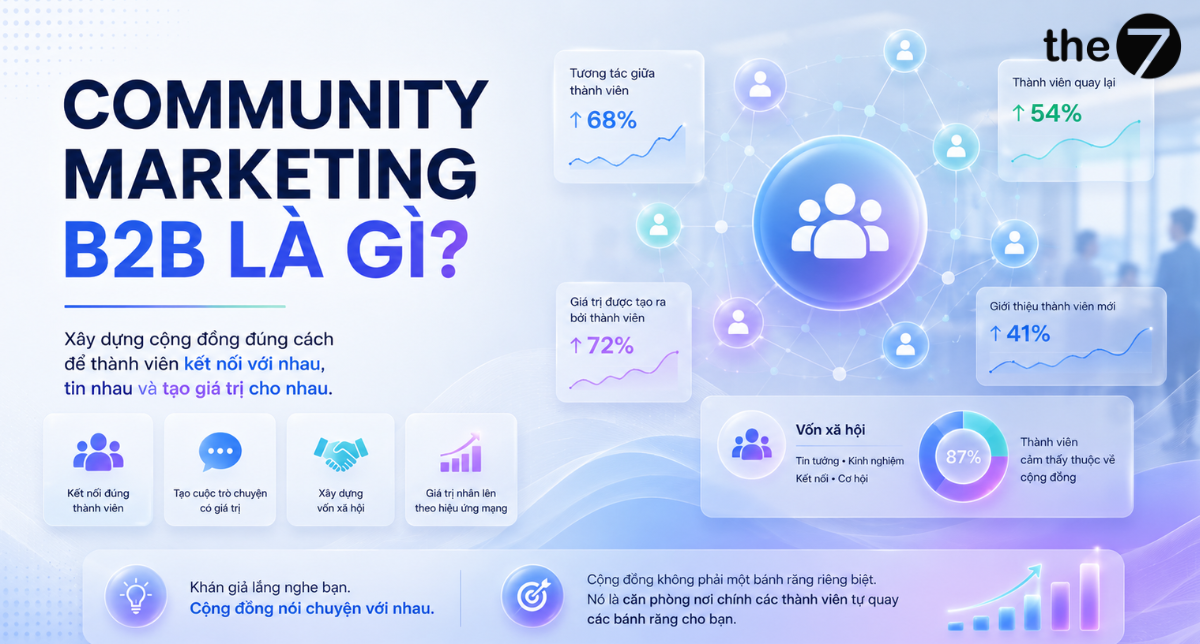
What Is B2B Community Marketing?
Summary: B2B community marketing is about building and nurturing a community where members connect with each other around a shared interest, not just with the brand. The core distinction comes...