


What Is Category Design?
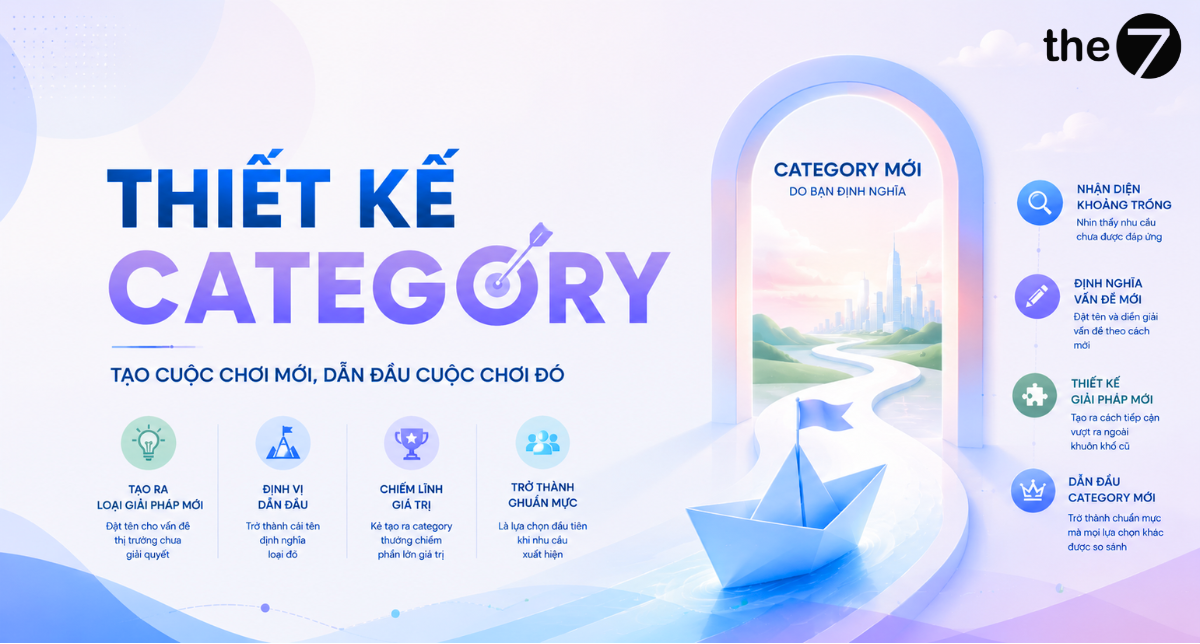
Summary: Category design is the act of creating an entirely new type of solution in the market’s mind, instead of competing within an existing category, and then becoming the name that defines that category. Don’t just try to win the old game — create a new one. The company that creates a category and leads it usually captures most of the value of the entire category, because it becomes the standard against which every other option is compared. In the 7B model, category design is the most ambitious move among the six demand-creation gears: instead of merely claiming a spot in the mind, they install an entirely new compartment in the market’s mind, with your name as its owner.
In the article on B2B positioning, I said positioning is choosing the context you place yourself in — choosing a frame of reference that makes your value obvious in the buyer’s eyes. But there is a move even more ambitious than choosing the right context among contexts that already exist. That move is creating an entirely new context, a new type of problem, a new type of solution, and getting the market to see you as the default name for that type. That is category design.
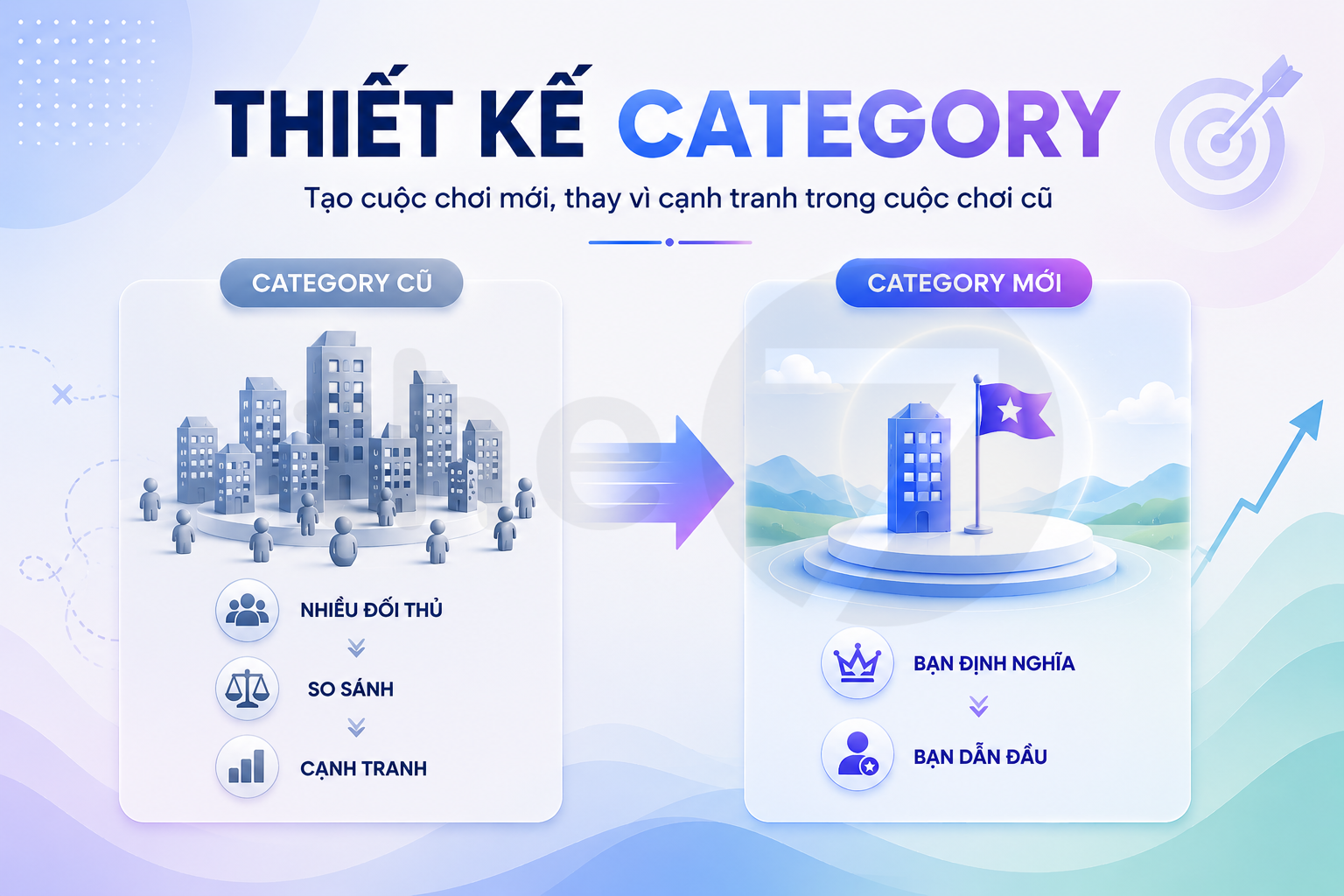
Most businesses accept the market as it is. They look at existing categories, choose one to compete in, and try to do better than their rivals on the same playing field. They try to have better features, better prices, better service, better case studies, sharper messaging. This approach isn’t wrong, and in many cases it’s the most practical one. But it has a very clear ceiling: you are playing a game whose rules someone else set. In an existing category, there is already a leader, already criteria for comparison, already a way buyers understand the problem, and you are just one more option trying to earn a spot.
Category design chooses a different path. Instead of trying to play the old game better, you create a new game where you set the rules. Instead of trying to convince the market you are better within an existing category, you show that the old category is no longer enough to solve a new problem. Then you name that problem, define a new type of solution, and place your business as the leader of that new category.
This article aims to clarify what category design really is, why the creator of a category usually wins big, how a category gets created in the market’s mind, and just as important, when to use this move and when not to. First, we need to start with the definition.
Category design is the act of creating and defining a new type of solution in the market’s mind, by naming a problem that existing categories don’t solve well, then positioning your business as the leader of that new category. Unlike positioning, which chooses a spot within an existing market, category design creates a new market, or at least a new way of classifying things in the buyer’s head. This concept was developed clearly in modern category-design thinking, especially through the book Play Bigger, and is closely related to the idea of creating new market space instead of competing in old space.
Why does the creator of a category usually win big?
To understand why category design is worth so much, you need to look at a very important rule about how value gets distributed in a market. In many categories, the reward is not shared evenly among all players. It tends to skew heavily toward the leading name, especially the name that defined how the market understood that category from the start.
In the book Play Bigger, published in 2016, authors Al Ramadan, Dave Peterson, Christopher Lochhead, and Kevin Maney analyzed how economic value is distributed across categories and made a notable observation: the leader of a category, or the “king of the category,” doesn’t just win by a slight margin over competitors. They typically capture most of the value of the entire category, while the rest is split among all the competitors behind them. This is not a small advantage in awareness or media coverage. It is a strategic advantage, where the one who defines the category becomes the center of the entire way the market thinks.
Why is the distribution so skewed? Because once a category is successfully defined, buyers start seeing that entire type of problem through the lens of whoever defined it. The name that created the category becomes the standard, the reference point, the first example the market thinks of when that type of problem comes up. When you are the one who defined the category, you are no longer just an ordinary option among many. You become the default choice, the name that comes to mind first when the need arises.
This creates a very hard advantage to break. Every competitor that comes after is forced to explain itself in relation to you. They may say they’re cheaper than you, faster than you, a better fit than you, more specialized than you, easier to use than you. But the mere fact that they have to compare themselves to you reinforces your central position in the market’s mind. Competitors think they’re attacking you, but in many cases, they’re unintentionally confirming that you are the standard of the category.
That is why category design is one of the most powerful strategic moves. In an existing category, you compete on criteria set by the old leader, usually from a chasing position. In a category you create, you set the criteria, you define the problem, you become the standard, and everyone else has to run within your frame of reference. The difference between these two positions is enormous. It explains why many of the biggest winners in business are not just companies that played better within an old category, but companies that created an entirely new category.
A complementary way of looking at this comes from thinking about market space. In 2005, W. Chan Kim and Renée Mauborgne introduced the famous concept of red oceans and blue oceans in the book Blue Ocean Strategy. A red ocean is a crowded market space, where many businesses compete on the same criteria, fighting over the same group of customers, eroding profit margins. A blue ocean is a new space, where competition hasn’t yet taken shape, the rules of the game haven’t been locked in, and whoever creates that space has the opportunity to capture a huge advantage.
Category design is, in essence, a way of creating a blue ocean in the market’s mind. You’re not just finding a small niche in an old market. You’re changing how the market classifies a problem, and in doing so, opening up new territory where you can become the leader.
Category design starts from a new problem, not a new name
The creator of a category can win very big. But the more important question is: how do you create a category? The answer doesn’t start with the product, and it doesn’t start with a catchy new name. It starts with a new problem.
This is where many businesses get category design wrong. They think creating a category means giving their product a new name. An old piece of software gets called by a new term. An old service gets repackaged under a new name. An ordinary practice gets dressed up as a new “category” to sound different. But putting a new name on an old thing doesn’t create a category. It only creates confusion.
Real category design starts with identifying a problem that existing categories don’t solve well. It could be a problem buyers already feel but don’t yet know how to name. It could also be a shift in technology, behavior, the market, the supply chain, data, regulation, or how operations are organized, that makes old solutions less relevant. When the world changes, old categories often keep the same old point of view. The gap between the new problem and the old category is exactly where a new category can be born.
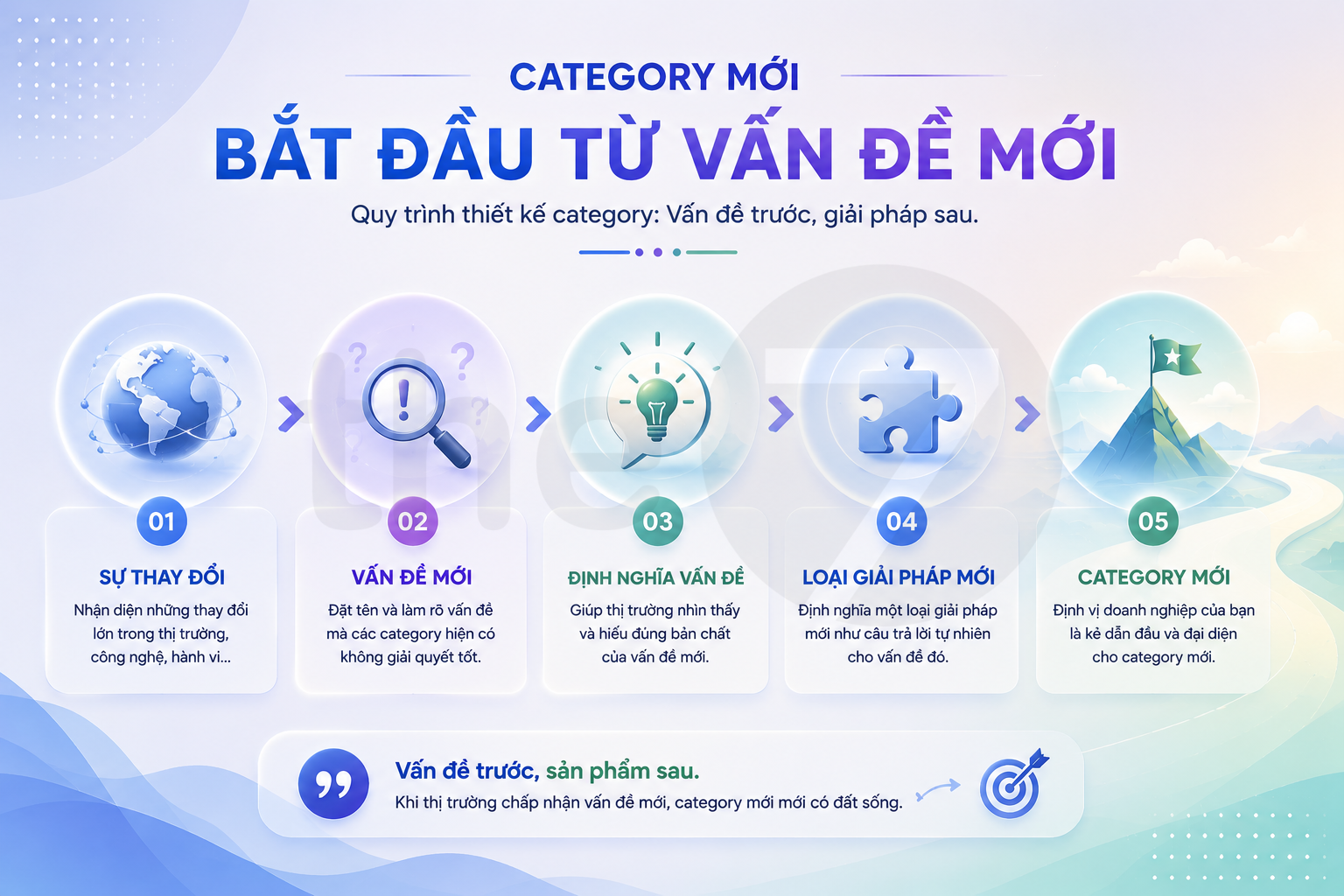
The category-design process usually follows a very clear order. First, you identify a major shift in the world, a shift that makes the old way of doing things no longer good enough. Next, you name and clarify that new problem, helping the market see something they previously only sensed vaguely. Then, you define a new type of solution as the natural answer to that problem. Finally, you position your business as the name that represents that new category, not by declaring it once, but by continuously leading how the market thinks about the problem.
The core lies in the order: problem first, product second. You don’t start with “we are a new category.” You start with “the world has changed, and the old problem is no longer the old problem.” You make buyers see that existing categories were designed for a context that is now outdated. Once the market accepts that there is a new problem requiring a new type of solution, you becoming the leader of that solution type finally has a foundation.
This is why category design is largely a battle to educate the market about a problem, not a battle to promote a product. The product still matters, but the product is not the starting point of the story. If the market doesn’t yet believe the new problem is real, they won’t need your new category. If they haven’t seen what the old category is missing, they won’t understand why they need a different type of solution. And if they haven’t shifted how they see the problem, every message about your product will get pulled back to the old criteria for comparison.
This is also why category design requires so much thought leadership. You have to continuously put out a new perspective on the market, a new understanding of the problem, a new language for buyers to name what they’re facing. You’re not just selling a product. You’re planting an idea. You’re not just saying “choose us.” You’re saying “look at this problem differently.” And once that perspective is widely accepted, the new category starts to take root.
When should you design a category, and when shouldn’t you?
Category design is a powerful move, but it isn’t the right choice for every business. This part is very important, because if you only look at success stories, it’s easy to think every business should create its own category. That isn’t true.
Category design is expensive and slow. It requires you to educate the entire market about a new problem, a new perspective, and a new type of solution. This work cannot be completed with a few articles, a few ad campaigns, or a nice name on a website. It takes time, consistency, budget, content, media, proof, community, a trained sales team, and the ability to endure years of planting ideas before the market truly accepts them.
Throughout that process, you are spending money to educate the market, but there is no guarantee the market will go the direction you want. Maybe the problem you see is real, but not big enough. Maybe the market agrees with your view, but isn’t ready to pay for it. Maybe the new category takes shape, but a better-resourced competitor jumps in and takes it over. Maybe you’re right too early, and being right too early in business can sometimes hurt just as much as being wrong.
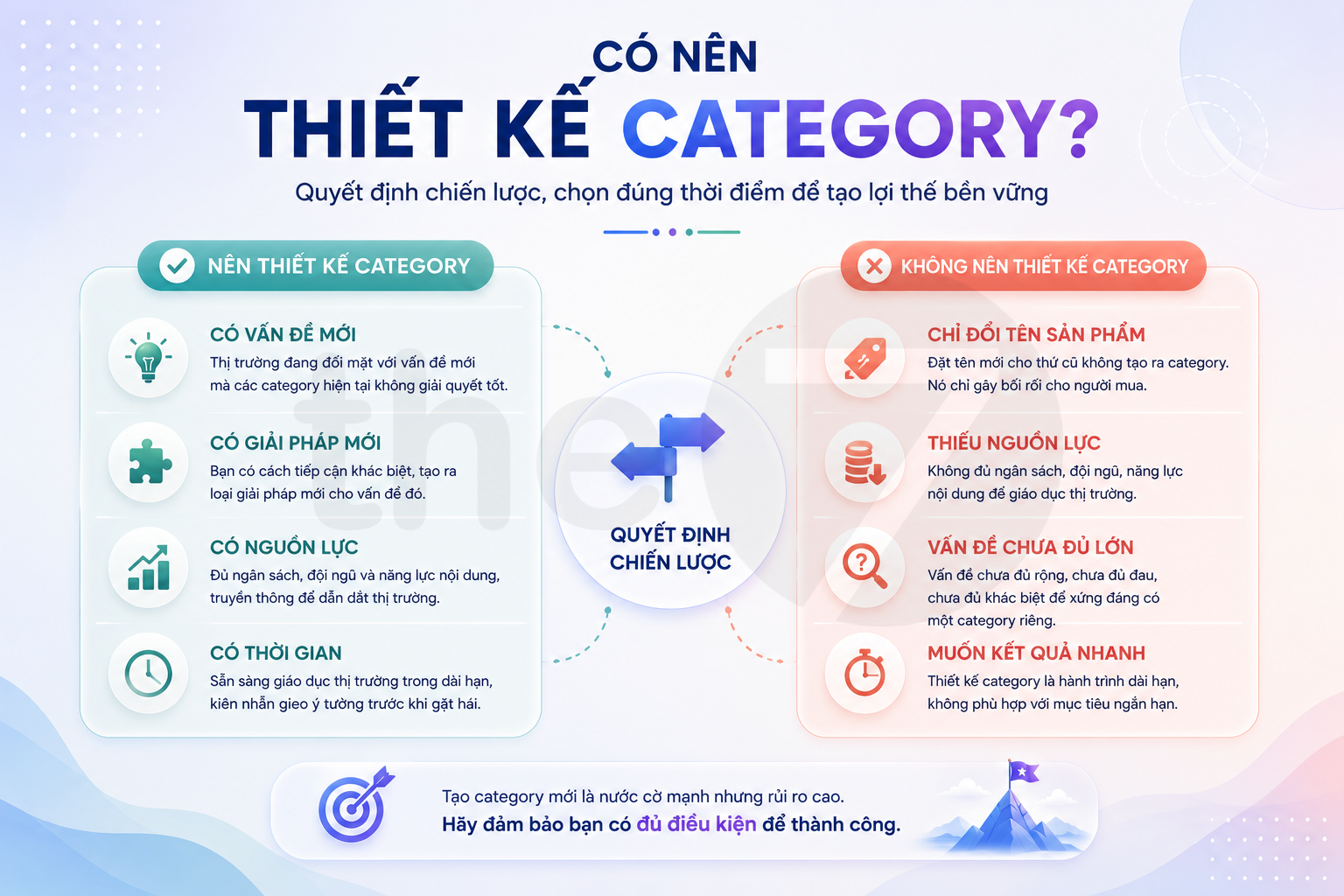
So category design only makes sense when certain conditions come together. The first condition is that you genuinely have something new, solving a real problem that old categories can’t handle. If your product or service is just a minor variation of something that already exists, trying to call it a new category won’t make the market believe you more. It will only make buyers spend more energy trying to figure out what you’re talking about.
The second condition is that you need enough resources and enough patience to pursue the market-education process. Category design is not a tactic for generating fast revenue. It is a long-term strategic investment. If a business is short on cash, short on distribution channels, short on content capability, short on a sales team that understands the story well enough, or short on the ability to sustain the message for years, trying to create a category can become a very heavy burden.
The third condition is that you need a well-founded belief that the problem you’ve identified is big enough to deserve a category. Not every problem is big enough. Some problems are only big enough to create a feature. Some problems are only big enough to create a niche. Some problems are only big enough to create a sharper positioning message. A new category is only worth pursuing when the problem is broad enough, painful enough, durable enough, and different enough from how the market currently classifies things.
When these conditions come together, category design can create a massive advantage. But when they don’t, trying to design a category is a costly mistake, even a form of strategic arrogance. If you don’t genuinely have anything new, putting a catchy category name on an ordinary product only confuses buyers. If you don’t have enough resources to educate the market, you may run out of money before the category has a chance to form. If the problem isn’t big enough, you may create a name that no one needs to remember.
For most businesses, in most cases, smart positioning within an existing category is the better choice. This is especially true for small and medium businesses, professional service firms, manufacturing companies, or companies selling an already-familiar solution that just needs to clarify why it’s a better fit for a specific group of customers. You don’t always need to create a new game. Often, the old game still has plenty of room to win, if you choose the right field, the right audience, the right message, and the right distribution.
This honesty matters a lot. Category design is often told as a glorious path, but it is a high-risk path. It’s meant for the right situation, not for every business that wants to sound different. Strategic wisdom isn’t just about knowing when to create a new game. It’s also about knowing when not to fool yourself into thinking you need to create a new game.
Where does category design sit in the 7B model?
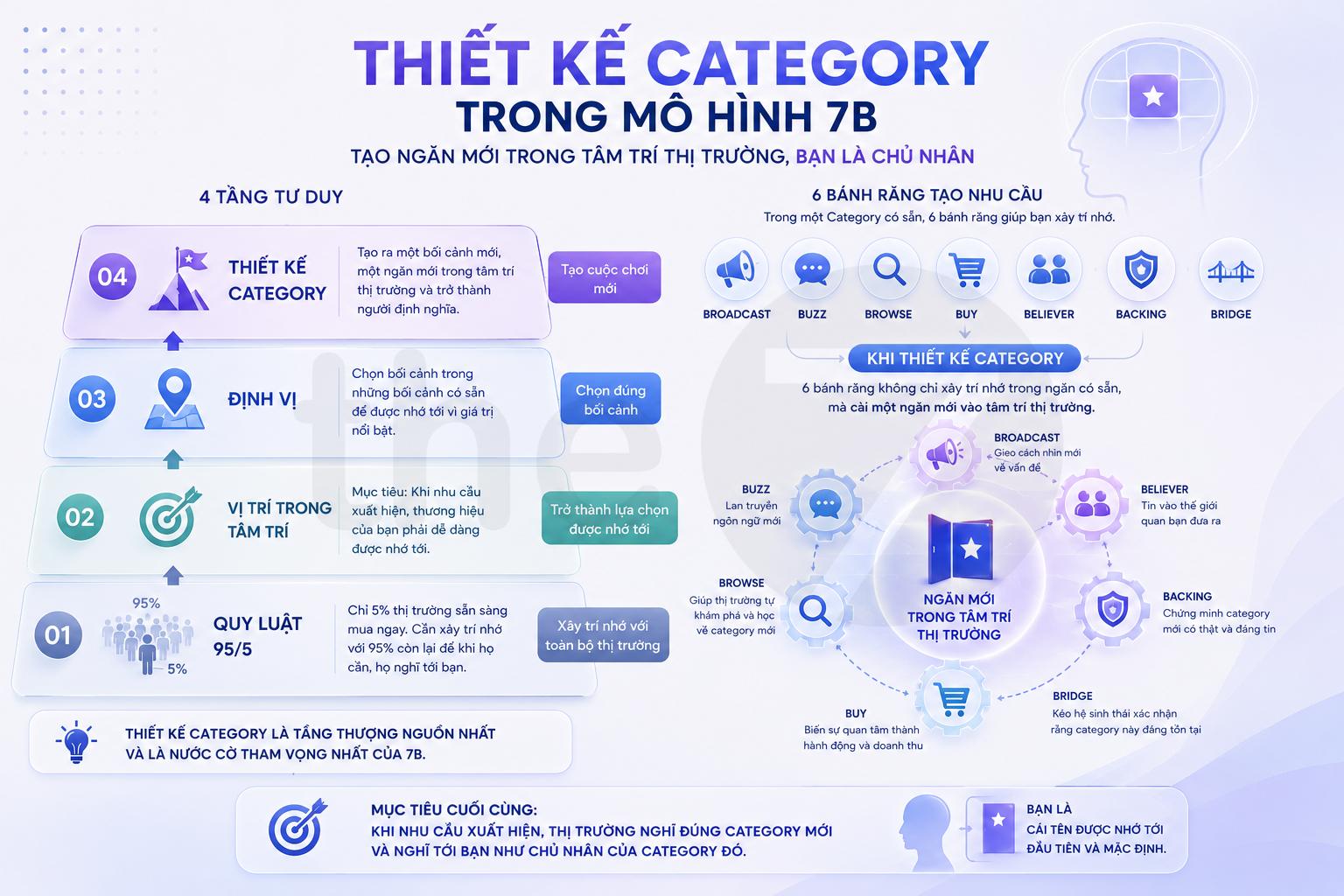
When placing category design within the 7B model, it’s important to understand that it is not a gear of its own. Nor is it on the same level as activities like Broadcast, Buzz, Browse, Buy, Believer, Backing, or Bridge. Category design sits further upstream. In fact, it sits even further upstream than positioning.
If positioning is choosing a context among existing contexts, category design is creating an entirely new context. If mental position is the goal of being remembered, positioning decides what you’re remembered for, while category design goes further: it creates a new compartment in the market’s mind so buyers can remember you as the owner of that compartment.
Think about this layer by layer. The 95/5 rule tells us why you need to build memory with the entire market, not just the group buying right now. Mental position is the goal of that memory-building: when demand arises, your brand needs to be easy to recall. Positioning decides what context you’re remembered in, compared to which alternatives, with which value standing out. Category design is the most ambitious layer: it doesn’t just choose a context to be remembered in, it creates a new context so the market remembers you as its definer.
This is why I consider category design the most ambitious move among the six demand-creation gears. In normal operation, these six gears help you build mental position within an existing category. Broadcast helps you put out perspective and content. Buzz helps your idea get talked about and spread. Browse helps buyers find you when they’re researching on their own. Believer turns customers, community, or followers into people who believe in your point of view. Backing creates proof and outside validation. Bridge opens paths through relationships, partners, community, and ecosystem. All of them together help your brand become familiar, trustworthy, and easy to remember.
But in category design, these six gears do something bigger. They don’t just build memory for the brand within an existing compartment. They install an entirely new compartment into the market’s mind. Broadcast doesn’t just talk about you, it plants a new perspective on the problem. Buzz doesn’t just create noise for the brand, it gets the market to start repeating the new language. Browse doesn’t just help buyers find you, it helps them educate themselves about the new category. Believer doesn’t just believe in the product, it believes in the worldview you’re putting forward. Backing doesn’t just prove you’re trustworthy, it proves the new category is real. Bridge doesn’t just expand relationships, it pulls other parties in the ecosystem into confirming that this category deserves to exist.
Do you see it now? Category design is not a communications campaign. It is an effort to restructure how the market thinks. It turns the six demand-creation gears into a machine for planting ideas at the category level. The goal isn’t just to get buyers to remember you when they think of an existing category. The goal is to get them to learn a new category, then attach that category to you.
This is where category design completes the picture of the foundational concept cluster. The 95/5 rule explains why you must sow before you reap. Mental position explains that the goal of sowing is to be remembered. Positioning explains what you want to be remembered for within an existing context. And category design is the most ambitious version: creating a new context to be remembered in as its owner.
A few examples to make it concrete
Look at an example in enterprise software. A company realizes that how businesses operate has changed, but existing software is still designed for an old model. Instead of saying it’s a better piece of software within the old category, the company shows that there’s a new problem the old category doesn’t solve. They name that problem, define a new type of solution, and over years of content, events, reports, case studies, community, and a sales team, they get the market to accept this as its own category. Once the category is accepted, they are the default name because they taught the market how to name it.
In professional services, a company can do something similar by showing that traditional consulting services are no longer enough to handle a new type of strategic problem. They don’t say they’re “a better consulting firm.” They say the problem has changed, the old approach is no longer sufficient, and the market needs a new type of service. If they do it well enough, long enough, and the problem is truly big enough, they can become the name attached to that new service category.
But it’s also worth looking at an opposite example. A small manufacturing business, selling a familiar type of component or equipment, usually should not try to create a new category if they don’t have breakthrough technology, don’t have the resources to educate the market, and don’t have a problem big enough to change how buyers classify things. For them, the right path may be sharp positioning within an existing category: serving a specific industry better, a specific standard, a specific type of customer, a specific level of reliability, or a specific buying situation better. That is not a less ambitious choice. It may be the wiser choice.
These three examples all point to one principle: category design creates a huge advantage in the right situation, but positioning within an existing category is the right choice for most businesses. Ambition doesn’t replace real conditions. A new category isn’t born just because a business wants to be different. It’s born when the market genuinely needs a new way of understanding.
Three mistakes in thinking about category design
The first mistake is putting a new name on something old and calling it a new category. This is the most common mistake. Many businesses think that just coming up with a new term, a new label, a phrase that sounds more strategic, is enough to create a category. But a category doesn’t start with a name. A category starts with a real problem. If the problem isn’t new, if the solution isn’t meaningfully different, if buyers have no reason to change how they classify things, then the new name is just a coat of paint. The fix is to go back to the foundational question: what new problem is emerging that existing categories don’t solve well?
The second mistake is trying to design a category without meeting the conditions for it. Because category-design stories are often very compelling, many businesses want to jump straight into this move even without a sufficiently new product, without sufficient resources, without the ability to lead thinking, and without proof the problem is big enough. The result is that they burn a lot of energy explaining a category the market doesn’t need. The fix is to honestly assess the conditions: are we truly creating a new way of solving something, does the market genuinely feel the pain, and do we have what it takes to educate the market for years?
The third mistake is focusing on the product instead of the problem. Even businesses that do have something new can easily fall into this trap. They want to talk about features, technology, models, platforms, processes, or what makes them different. But in category design, the thing that needs to be accepted by the market first is not the product, but the problem. If buyers don’t yet believe the new problem is real, they won’t need your new category. If they haven’t seen that the old way is no longer enough, they’ll pull you back into the old frame of reference to compare price, features, and familiarity. The fix is to focus effort on helping the market see, name, and feel the importance of the new problem.
Conclusion: don’t just win the old game, create a new one
Back to where I started. Most businesses accept the market as it is, choose an existing category, and try to play better than their competitors within it. They optimize messaging, optimize features, optimize sales channels, optimize price, optimize ads. All of that can be the right thing to do. But there is a more ambitious move: instead of just trying to win the old game, create a new game where you set the rules.
Category design is the act of creating a new type of solution in the market’s mind and becoming the name that defines that type. The creator of a category usually captures most of the category’s value, because they become the standard against which every other option is compared. But a new category isn’t born from a nice name. It’s born from a new problem that’s big enough, a new perspective that’s convincing enough, and a market-education process that’s long enough for that perspective to take root.
This is a powerful move, but also a high-risk one. It’s expensive, slow, and not for every business. If you don’t genuinely have anything new, don’t have enough resources, or the problem isn’t big enough yet, trying to design a category can waste your money, waste your time, and confuse buyers. For most businesses, smart positioning within an existing category is still the more practical choice. Don’t rush to dream of creating a new game when the old game still has room for you to win.
But if you genuinely have something new, if you see a problem the old category doesn’t solve, if you have enough resources and enough patience to educate the market, then category design can be the move that changes your entire position. In the 7B model, this is the biggest ambition of the six demand-creation gears: instead of just claiming a spot in an existing compartment of the mind, they install an entirely new compartment in the market’s mind, with your name as its owner.
To understand how to choose a context within an existing market, a more practical step for most businesses, read the article on B2B positioning. To understand why category design requires sustained thought leadership, read the article on thought leadership. To understand the goal category design is aiming for, read the article on mental position. And to understand the full seven-gear machine that category design mobilizes at its most ambitious level, read the article on the 7B gear model.
Frequently asked questions
What is category design?
Category design is the act of creating and defining a new type of solution in the market’s mind, instead of competing in an existing one. It starts with naming a new problem that current categories don’t solve well, then positioning your business as the name that represents that new category.
How is category design different from positioning?
Positioning is choosing an existing context so buyers understand who you should be compared to and why you’re worth choosing. Category design goes further: it creates a new context. If positioning is choosing the right compartment in the buyer’s mind, category design is creating a new compartment and putting your name in it.
Why does the creator of a category usually win big?
Because the creator of a category usually becomes its standard. Once the market accepts the new way of classifying things, the name that defined the category becomes the default choice, while later competitors must explain themselves in relation to the leader. That very comparison reinforces the leader’s central position.
When should you design a category?
You should only design a category when you genuinely have a new solution for a real problem that old categories don’t handle well, have enough resources to educate the market over a long period, and have grounds to believe the problem is big enough to deserve its own category.
When should you not design a category?
You should not design a category when your product is just a minor variation of something that already exists, when you don’t have enough resources to educate the market, or when the problem isn’t big enough yet. In those cases, sharp positioning within an existing category is usually the more practical and effective choice.

Nguyễn Đình
Bảo




As CEO of The7, I am committed to sharing practical, useful knowledge with every reader. Every article on The7 is based on my 7 years of hands-on experience in marketing — Facebook advertising, LinkedIn advertising, Google advertising, and marketing strategy. I hope you take away plenty of insight from these posts and apply it successfully in practice.
Related Articles
Four Frameworks That Replace the Funnel Model
Summary: As the funnel model increasingly fails to capture how modern buyers actually behave, a number of new frameworks have emerged to replace or repair it: McKinsey’s decision journey and...
What Is B2B Positioning?
Summary: B2B positioning is the act of choosing the context you place your product into – the frame of reference that makes its value obvious to the buyer. Positioning isn’t...

What Is the 95/5 Rule?
Summary: The 95/5 rule states that at any given moment, only about 5% of B2B buyers are actually in-market, actively in a buying cycle, while roughly 95% are not yet...
What Is Mental Availability in B2B?
Summary: Mental availability is how easily a brand comes to mind in a buying situation. It isn’t about having the sharpest argument, the slickest pitch, or the most convincing feature...
What Are B2B Events and Trade Shows?
Summary: B2B events and trade shows are in-person gatherings such as conferences, industry trade shows, workshops, and private meetings, where a business meets buyers, customers, partners, and the industry community...
What Is B2B Community Marketing?
Summary: B2B community marketing is about building and nurturing a community where members connect with each other around a shared interest, not just with the brand. The core distinction comes...