


Building a Full-Funnel Content Marketing Strategy on LinkedIn
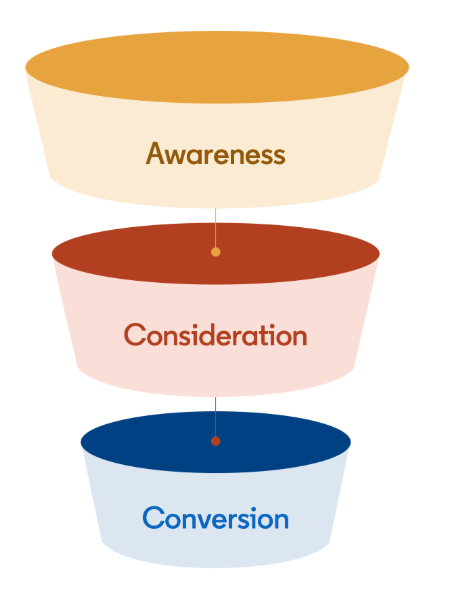
Why Build Content Marketing for the Full Marketing Funnel? (Why Full-Funnel Content Marketing?)
Why Do You Need a Full-Funnel Strategy? (Why does a business need a Full-Funnel strategy?)
Like many other activities, Marketing takes time to deliver results. Businesses need time to build trust and relationships with customers, while staying consistent and repeating their message to increase brand recognition and recall.
Today, customers no longer move along one fixed path through the marketing funnel — they can shift flexibly between stages. That’s why businesses need an always-on Full-Funnel strategy so they can reach customers at any stage of the buying journey.
Combining organic and paid activity on LinkedIn helps your brand message appear more often in front of the members of the Buying Committee, increasing your chances of converting them into customers.
The Marketing Funnel
To better understand a Full-Funnel strategy, let’s first look at the Marketing Funnel model, the target audience,
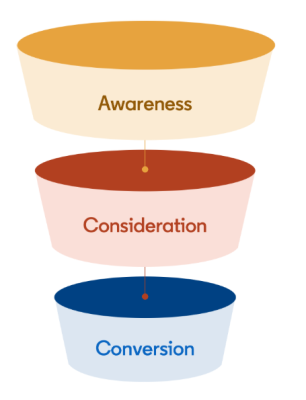
and the goals at each stage of the customer journey.
Awareness
Help the right audience learn about your business and your brand.
Consideration
Keep customers interested and nurture them so your brand stays on their shortlist when they have a need.
Conversion
Turn potential customers into actual customers, or attract the right candidates to join your business.
- As marketers, we tend to focus straight on the activities that drive conversion, since that’s the easiest result to measure. However, if you only focus on the Conversion stage, you can miss out on many important opportunities along the customer’s journey.
Every customer has a different buying journey, with their own pace and way of making decisions. Especially in a B2B environment, the purchase decision usually doesn’t come from a single individual but from a group of people (the Buying Committee). That’s why there’s no single strategy that fits every audience.
Businesses need to build content suited to each stage of the marketing funnel to maintain a continuous presence and reach customers at the right time, with the right message. In addition, Campaign Manager on LinkedIn will suggest ad formats suited to the objective of each campaign, helping you optimize the effectiveness of paid advertising.
Balancing Brand building and Demand generation throughout the customer journey will help businesses create a lasting impact while building stronger relationships with customers.
In the following sections of this course, you’ll be introduced to tips and best practices you can apply at each stage of the marketing funnel to boost effectiveness and optimize results for your business’s marketing activities.
Content through the Customer Journey (Content at each stage of the customer journey)
LinkedIn members engage with many different types of content, formats, and topics. They want to stay up to date on industry trends and news, learn best practices, and see how other businesses or experts approach the issues they care about. In other words, they’re willing to engage more deeply with content if it’s genuinely useful and relevant to their needs.
On average, a customer will encounter around 10 different pieces of content before making a conversion decision. That’s why businesses need to build a continuous Content Journey that combines multiple types of content suited to each audience segment and each stage of their career or buying journey.
On LinkedIn, this is your opportunity to maintain a continuous presence, deliver the right content at the right time, and gradually guide customers toward a final decision.
Creating Your Strategy (Creating Your Strategy)
Setting Up a Full-Funnel Strategy (Building a Full-Funnel strategy)
Not sure where to start? Let’s look at the foundational elements for building an effective Full-Funnel strategy.
Step 1. Align teams across the business
To successfully execute a LinkedIn strategy, departments such as Marketing, Talent, and Corporate Communications need to work closely together if they all use LinkedIn. Alignment across teams helps keep the brand voice consistent and keeps the editorial calendar synchronized.
Step 2. Clearly define your social media goals and mission
A clear goal acts as a compass, helping every team build content in the same direction with a consistent message.
Example: If a business wants to be known as a brand focused on sustainability, the Marketing team might build Thought Leadership content about reducing business carbon emissions, while the Talent team highlights remote-work policies. On the other hand, if Marketing talks about sustainability while the Talent team promotes benefits related to frequent business travel, the brand’s message becomes inconsistent and confusing to the audience.
Step 3. Analyze your followers
Take time to analyze the demographics of your LinkedIn Page followers. Understanding the similarities and differences between your Page followers and your website visitors will help you build content that better fits your potential customers. As a result, your content strategy will stay aligned with your marketing goals and deliver better results.
Step 4. Audit existing content
Review all the content your business currently owns to identify what already exists and what gaps need to be filled. From there, build a plan for producing new content to maintain an always-on communication strategy and meet customer needs at every stage of the buying journey.
Step 5. Set measurable goals
Set goals for both your organic and paid activity following the SMART principle:
- Specific
- Measurable
- Attainable
- Relevant
- Time-based
At the same time, identify the KPIs that match your campaign goals and track results regularly so you can evaluate, adjust, and optimize the effectiveness of your marketing activities.
Blending Organic and Paid through the Customer Journey (Combining Organic and Paid content across the customer journey)
As we’ve seen in the customer journey, LinkedIn users constantly move back and forth between organic and paid content. This shows that brands need to maintain a presence across every touchpoint to reach customers. When done well, users won’t be able to tell the difference between a brand’s organic and paid content.
Imagine your target customer is at work. While scrolling LinkedIn, they see a Single Image Ad sandwiched between a colleague’s poll and a post congratulating a friend on a new job. The ad catches their attention, but since they’re about to head into a meeting, they close the browser.
That evening, while scrolling LinkedIn on their phone, they come across a post with a similar topic and style, shared or commented on by a friend. This time they have more time, so they read the post and start engaging with the brand’s community.
Both organic and paid can help a business reach its marketing goals. But they’re more effective when combined into a single, mutually reinforcing strategy. When customers see a brand repeatedly across different touchpoints, they’ll remember it more easily and gradually come to see it as the right solution for their needs or problems.
The ultimate goal is to create and distribute compelling content suited to each stage of the customer’s journey, keeping them connected and moving them closer to a conversion decision.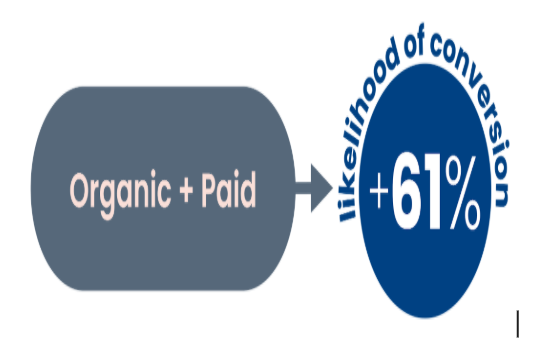
Did you know that LinkedIn Page followers who see both organic and paid content are 61% more likely to convert than those who only see paid ads?
Delivering a seamless, consistent experience between organic and paid content helps businesses achieve better marketing results.
Combining the two not only helps expand your reach but also lowers the cost per conversion. At the same time, businesses can build stronger brand recognition among followers and target customers.
Another benefit is that you can reuse the same content for both your organic and paid strategy. This saves time, optimizes resources, and improves efficiency in your day-to-day marketing operations.
A combined organic and paid strategy can reduce the cost per conversion by as much as 12%.
When organic and paid are aligned, businesses can reuse and optimize the same content source across both channels, saving time and resources. At the same time, running each format separately also helps expand reach and gather valuable data and insights through testing and performance measurement.
Organic Media
Organic media is the channel that lets businesses share content relevant to audiences who already know the brand. This can include product information, community activities, Executive Thought Leadership, or company updates.
Organic activity helps maintain brand awareness while nurturing relationships with existing and potential customers, gradually guiding them toward a conversion decision.
Paid Media
Paid media helps businesses reach new customer segments that organic content can struggle to reach. It’s also an effective tool for testing new content ideas, messages, and audiences.
Content that resonates with your current followers won’t necessarily resonate with new target customers, especially when a business wants to expand into other segments or shift its brand positioning.
In addition, paid media lets businesses reuse and amplify content that has already performed well organically, helping optimize content production resources and increase brand awareness.
Unlike organic, paid media also lets you target multiple audience segments precisely at the same time, such as current followers, potential customers, or Lookalike Audiences, boosting engagement and campaign effectiveness.
With the ability to serve many different marketing goals, paid media is a flexible tool. So before launching a campaign, businesses need to clearly define their goals and understand their current followers and target customer profile to build the right strategy.
Next, let’s look at two illustrative scenarios to understand how organic and paid work together in practice.
Brand A
Owns a fully built-out, professional LinkedIn Page with compelling organic content that offers plenty of useful information about the business, its products, leadership team, and company culture.
Brand B
Owns a bare-bones LinkedIn Page with incomplete company information, no brand visuals, and only a handful of posts.
Imagine you see a paid ad from each of these two brands and feel interested, so you decide to visit their LinkedIn Page to learn more. At this point, you’ll be looking for information that helps you trust the brand and confirms it’s the right business for you.
Ask yourself questions like:
- What information do you want to know about the brand?
- Which brand do you think would build trust and draw you in more easily?
This is a clear example of how organic content supports and amplifies the effectiveness of paid media. When organic and paid are connected within a single strategy, a business can build an always-on presence, build trust with customers, and improve the effectiveness of its overall marketing efforts.
Balancing Brand-building content with Demand-generation content
To increase conversions and optimize marketing effectiveness, businesses need to blend Brand-building and Demand-generation activities harmoniously across both organic and paid channels. What matters isn’t prioritizing one over the other, but creating balance between the two strategies.
Many businesses tend to focus straight on Demand campaigns because they deliver fast results and easily measurable KPIs. However, this approach mainly reaches customers who already have a need or are already ready to engage with the brand.
Brand Marketing, meanwhile, plays a complementary role by reaching audiences who aren’t ready to buy yet. By providing useful information and building trust over time, businesses can gradually create demand and increase the likelihood that customers choose the brand when a need arises in the future.
“Successful marketers use Content Marketing to create demand among new audiences who don’t yet know the brand, not just to capture demand that already exists.”
— Robert Rose, Chief Strategy Advisor, Content Marketing Institute.
When Brand content and Demand/Acquisition content are run together, conversion rates can be up to 6 times higher than focusing on just one type of content alone. Let’s look at how to build the right mix.
Combining Brand and Demand across Organic and Paid channels
When building a combined organic and paid strategy, many businesses assume that paid advertising should only serve Brand and Demand goals, while mid-funnel nurturing should be handled through organic content.
In reality, an effective strategy needs to combine organic and paid consistently across every stage of the marketing funnel. The two channels should support and complement each other to deliver a consistent customer experience, rather than operating separately.
There’s no one-size-fits-all formula for every business. How you combine Brand and Demand, as well as Organic and Paid, will depend on each business’s goals, marketing objectives, and characteristics.
Improving lead quality to grow your pipeline
Customer: Lacework
Lacework is a cloud security platform that uses data and machine learning to help businesses detect security vulnerabilities and misconfigurations in their cloud environments.
By moving from one-off campaigns to a Full-Funnel marketing strategy, Lacework nurtured leads throughout the journey from Awareness to Conversion, achieving 6 times the ROI.
Let’s look at another scenario:
Your business is invited to speak at an industry conference about your culture of innovation and how it helped create your company’s new product.
To make the most of this opportunity, the business can build a communications plan around the event, combining both organic and paid channels to boost brand awareness, attract potential customers, and sustain interest before, during, and after the conference.
In this scenario, when building the strategy, you carefully analyzed your LinkedIn Page followers to determine the right type of organic content. Since more than 60% of your followers are company employees, you chose to run celebratory, recognition-focused content to encourage them to engage. At the same time, this content also helps promote your company culture to potential candidates who follow the page.
Over time, Brand Awareness content will help attract more followers. As your follower count grows, so will the share of followers who aren’t employees. These could be target customers or people involved in the purchase decision.
As a result, organic content will play an increasingly important role in lead generation, helping the business reach, nurture, and build relationships with these valuable audiences more effectively.
There’s no single formula for combining organic and paid across the full marketing funnel. Both can support brand awareness and lead generation. So before building a strategy, businesses need to assess their goals, resources, and organizational characteristics to find the mix that fits them best.
Implementing Your Content Strategy (Rolling out your content strategy)
Repurpose Existing Content
In marketing, we always have to weigh resources: how long something takes, how much staff it needs, what it costs, and how many people it can reach. In reality, not every business has the time and resources to keep producing new content nonstop.
The good news is, with a bit of planning and creativity, you can make great use of the content you already have.
The “Big Rock” model: Constructing and deconstructing content
One effective way to deliver content across the whole marketing funnel is to apply the “Big Rock” model. This method involves two approaches: Construct and Deconstruct.
Construct (Building a large piece of content)
Construct is the process of pulling together many smaller pieces of content on the same topic to create a single, more in-depth and valuable piece — a “Big Rock.”
Example: A Product Marketer might compile the most popular how-to videos into a full course or in-depth guide, then offer it as gated content that requires users to sign up to download.
Deconstruct
Conversely, deconstruct means taking a Big Rock and breaking it into multiple formats to reuse across different channels. This approach maximizes the value of your content and saves significant production time.
Example: From a research report, you can extract data to create several different pieces of content, such as:
- An infographic for Single Image Ads
- A short video or animated video
- A blog post
- A podcast episode
This way, a single piece of source content can be turned into multiple versions suited to each channel and audience, while maintaining a consistent presence across your content marketing strategy.
As customers encounter these smaller pieces of content one after another, they gradually build trust and a connection with the brand. As a result, they’ll become more receptive to deeper, more in-depth content that might have felt too complex or not quite relevant to their needs before.
By that point, the potential customer is ready for the business to guide them to the next step in their journey, such as downloading a resource, registering for an event, requesting a consultation, or making a purchase decision.
If you need more resources for content production, you can partner with members of the LinkedIn Marketing Partners for Content & Creative network. They can help businesses build many types of content, including videos, blog posts, in-depth articles, and ad creative.
Remix Your Existing Content
Another way to make use of existing content is to tap into content already used on other channels, such as your blog, other social platforms, or high-performing organic posts.
Instead of creating something entirely new, you can adapt and reformat this content for LinkedIn to reach more people and improve communication effectiveness.
Research shows that B2B content creates a bigger impact when shared on LinkedIn alongside other social platforms.
Multi-channel content distribution not only expands your reach but also increases engagement, strengthens brand awareness, and boosts the effectiveness of your content marketing campaigns.
Reuse Your Organic Content by Boosting
Boosting is a feature that lets you quickly turn an organic post into a paid ad.
It’s a simple but effective way to reuse content that’s already performing well, helping you save time, keep campaigns always-on, and balance your organic and paid activity.
Always-On Marketing
LinkedIn users are working professionals who tend to use the platform regularly and engage proactively. As the line between work and personal life becomes increasingly flexible, decision-makers and Buying Committee members may search for information online at nearly any point during the week.
This means businesses need to maintain an Always-on marketing strategy — always present whenever customers need them. If your customers are online, your brand should be too, ready to reach and engage with them.
When customers typically search for information
- During the workday: About 70% of decision-makers search for information during working hours.
- Evenings: More than 70% continue researching and gathering information after work.
- Weekends: About 50% still spend time searching for information related to work or purchase decisions.
These numbers show that customers don’t just engage during business hours — they actively seek out information in the evenings and on weekends too. So instead of only running short-term campaigns, businesses should build an always-on content strategy to maintain a continuous presence and reach customers at every point in their journey.
Next, let’s look at how an Always-on marketing strategy is put into practice.
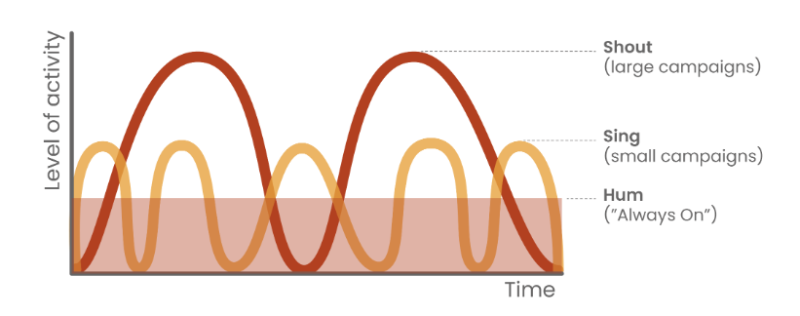
Hum (Presence-maintaining content)
“Hum” content is short, easily digestible, posted frequently, and doesn’t require much time or budget to produce. It’s conversational content that helps a brand stay continuously engaged with its community and top of mind with customers.
This type of content usually includes industry trend updates, expert perspectives (POV), news, and commentary on current events. Posting on your LinkedIn Page, commenting on followers’ posts, or engaging daily all help maintain your brand’s presence.
In Campaign Manager, “Hum” content is typically used for objectives like Brand Awareness or Website Visits.
Sing (Interest- and consideration-building content)
“Sing” content is designed to capture customer interest and show them that your business can help solve their problems or meet their needs. Compared to “Hum” content, this type requires more time and resources to produce. “Sing” content usually includes quarterly market summary reports, webinars, or in-depth resources that deliver value and build trust with customers.
In Campaign Manager, “Sing” content is typically used for objectives like Engagement or Lead Generation.
Content types suited to “Sing”
- Infographic
- Whitepaper
- Video
- Playbook
The goal of “Sing” is to nurture customer interest, help them understand your brand better, and gradually move them from Awareness to Consideration in the buying journey.
Shout (High-impact flagship content)
“Shout” content requires the highest investment — usually flagship content businesses run periodically or as part of major campaigns. This content carries deep value and helps establish a brand’s credibility, expertise, and standing in the industry.
“Shout” content usually includes annual research reports, trend reports, comprehensive guides, or large-scale events.
In Campaign Manager, “Shout” content is typically used for objectives like Lead Generation or Website Conversions.
Content types suited to “Shout”
- Annual/Quarterly Reports
- Trends/Research Papers
- Industry Insights
The goal of “Shout” is to create high-value content that attracts quality leads, reinforces brand positioning, and drives conversion actions at the final stage of the customer journey.
Combine organic and paid flexibly across all three content types — Hum, Sing, and Shout — to expand your reach while nurturing customers throughout their journey.
Each content type has its own role:
- Hum helps maintain a regular presence and build brand awareness.
- Sing builds interest, delivers value, and encourages customers to consider you.
- Shout delivers high-value, in-depth content to attract potential customers and drive conversion.
When run consistently across both organic and paid channels, these three content types form a cohesive content marketing strategy, helping brands reach the right audience, sustain engagement, and effectively guide customers from Awareness to Conversion.
Summary Strategy (Strategy summary)
Ready to take your LinkedIn marketing strategy to the next level? Let’s recap the key points from this lesson:
- Maintaining a Full-Funnel strategy in an Always-on model, combining organic and paid on LinkedIn, will help your business’s message appear more often in front of the members of the Buying Committee.
- Customers are always online, and each one has a different buying journey. That’s why your content needs to act like a “brand representative” and a “salesperson,” helping customers easily access information and make decisions without friction.
- Delivering the right content at each stage of the marketing funnel — from Awareness to Consideration to Conversion — helps businesses reach the right audience at the right time and drive business growth.
- Combining organic and paid content not only helps expand your customer base but also strengthens engagement with existing customers, while optimizing resources and improving marketing effectiveness.
- Make the most of your existing content by repurposing it, converting it into new formats, or adapting it for different channels, audiences, and objectives.

Nguyễn Đình
Bảo



As CEO of The7, I am committed to sharing practical, useful knowledge with every reader. Every article on The7 is based on my 7 years of hands-on experience in marketing — Facebook advertising, LinkedIn advertising, Google advertising, and marketing strategy. I hope you take away plenty of insight from these posts and apply it successfully in practice.
Related Articles
Designing Creative Content for LinkedIn
Table of Contents Toggle Why Is Good Creative Content So Important? (Why is Good Creative Important?)Key Components of Creative Design (the core elements of creative design)Summary (summary) Why Is Good...
Building an Organic Business Presence on LinkedIn With a LinkedIn Page
Table of Contents Toggle Why Have a LinkedIn Page?Establishing Your LinkedIn PageKeeping Your LinkedIn Page ActiveThe Measure of SuccessSummary About LinkedIn Page (Summary) Why Have a LinkedIn Page? For a...
6 Best LinkedIn Marketing Strategies for B2B in 2026
Table of Contents Toggle LinkedIn 2026: Where B2B Decisions Get MadeStrategy #1 – Why Is LinkedIn the Best B2B Marketing Channel Today?1. Decision-makers are concentrated here2. Users are in work...
26 Predictions for Social Media Marketing Trends in 2025
It’s that familiar time of year again, when experts and analysts start revealing their predictions for the social media marketing trends worth watching, along with the shifts that promise to...
LinkedIn Advertising Guide for Beginners
LinkedIn offers businesses a huge opportunity to reach potential customers, build their brand, and even find talent to grow with. In this article, let’s join The7 in exploring how to...

7+ Ways to Optimize Your LinkedIn Account to Boost Career Opportunities
LinkedIn is a great platform for connecting with recruiters and finding jobs. If you know how to optimize your LinkedIn account, it becomes much easier to present yourself and make...