


Breakthrough B2B Marketing Strategy: Flip Your Lead Funnel for Maximum Results
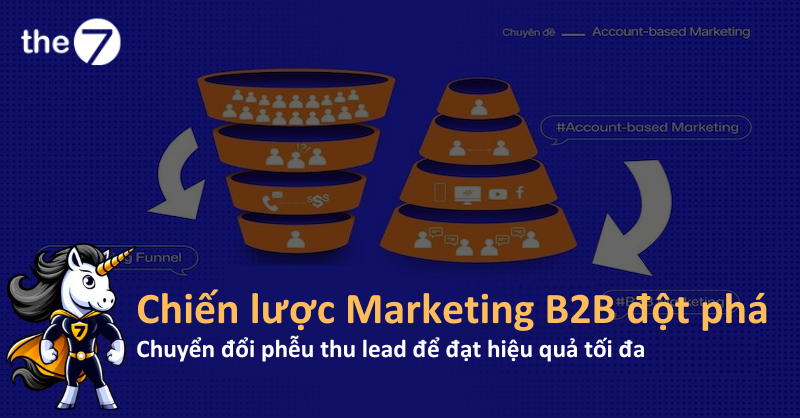
Don’t let your B2B campaigns get stuck with low conversion rates because of outdated models and the old-school reverse funnel. This article offers a fresh perspective on B2B Marketing: a creative Reverse Funnel model that will revolutionize how you reach and optimize customer conversions!
Don’t Let Your B2B Marketing Revolve Around Lead Volume
Before the reverse funnel model came along, the traditional marketing funnel served as the foundation of every marketing strategy, especially in B2B. The model is compared to a funnel: a business attracts a large pool of potential customers at the start, then screens and categorizes them to find the highest-quality leads.
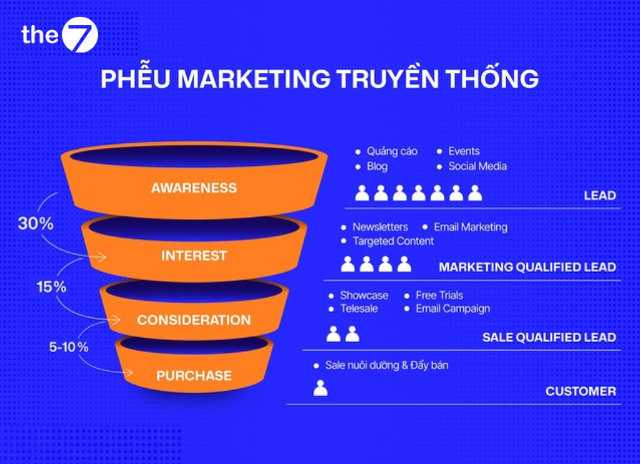
How the traditional marketing funnel works:
- Awareness: The business runs broad communication and marketing activities to collect a large number of potential customers (leads). Commonly used channels include advertising, SEO, content marketing, PR, and more.
- Interest: The collected list of leads is converted and screened to select Marketing Qualified Leads (MQLs) – potential customers who are interested in the product/service. The business provides more information and answers questions to nurture the relationship with MQLs.
- Consideration: The business keeps nurturing MQLs to turn them into Sales Qualified Leads (SQLs) – potential customers with a genuine need to buy. The business evaluates each SQL’s level of interest, ability to pay, and fit with the product/service.
- Purchase: SQLs are converted into official customers by signing a contract and making payment.
Advantages of the traditional marketing funnel:
- Easy to measure and track: Businesses can track the performance of each stage in the funnel to optimize their marketing strategy.
- Helps identify the potential customer audience: Categorizing leads by stage helps businesses better understand the needs and wants of their potential customers.
- Increases conversion rate: Nurturing leads effectively helps raise the rate at which leads convert into customers.
Limitations of the traditional marketing funnel:
- Expensive: Attracting and nurturing leads can cost a lot in marketing spend.
- Time-consuming: It takes time to move leads through each stage of the funnel.
- Inflexible: It is hard to adjust the marketing funnel quickly to keep up with market changes.
With advances in technology and changes in customer behavior, the traditional marketing funnel is gradually being replaced by newer marketing models such as the reverse funnel and the flywheel model.
Ms. Dương Nguyễn, a campaign manager at an advertising agency in Ho Chi Minh City, shared her company’s experience of using the traditional marketing funnel and a lead-based marketing strategy for many years.
Specifically, when rolling out advertising packages for education brands during enrollment season, with a goal of collecting 100 leads, Ms. Dương and her team launched a multi-channel campaign across social media, email marketing, Facebook Ads, and blog SEO. They focused on conversion-oriented content to boost click-through rates, such as giveaways of free, high-quality documents, reports, and Internet Listening, to attract leads.
Thanks to this campaign, the team quickly hit its KPI for lead volume and optimized the cost per lead. The leads collected were then passed to the telesales team for consultation and screening, sorted into Marketing Qualified Leads (MQLs) and Sales Qualified Leads (SQLs), and finally closed with a contract.
However, the share of customers who actually bought was very low, averaging only 3-5% and reaching 10% at best. Of all leads, only about 30% became MQLs and 10-15% became SQLs. More than 70% of leads were dropped right at the second step because they had no potential. As a result, the marketing cost for each closed contract was quite high.
With the traditional funnel model, many customers are screened out and eliminated in the earliest stages, leaving only a small number of Sales Qualified Leads (SQLs) that actually survive to the Purchase stage. This leads many businesses, including Ms. Dương’s, to assume that the more leads they collect at the start, the higher their chances of filtering out SQLs and closing contracts.
The traditional marketing funnel often pulls B2B businesses into chasing the largest possible number of leads. They invest heavily in performance marketing, run ads, optimize algorithms, and use compelling CTAs. These activities produce good-looking metrics, making businesses believe they have reached plenty of customers. In the sales department, however, reality looks very different.
Problem one: Although lead volume is high, the conversion rate is very low. Focusing on “quantity” makes businesses neglect the “quality” of their leads. A low conversion rate from ads forces businesses to keep collecting more leads to improve the conversion rate and grow revenue.
Problem two: The quality of customer care declines because the sales team has to manage too many leads and does not have enough time to tap the potential of the genuinely high-quality ones.
In the end, even though cost per lead (CPL) drops and the number of leads rises significantly, sales still don’t improve. According to a HubSpot report, 61% of marketers choose to send leads straight to the sales team, but only 27% of those are high-quality leads likely to convert. As a result, the conversion rate from lead volume in the traditional funnel model is very low, leading to major waste in the marketing efforts of B2B businesses.
Why the Traditional Marketing Funnel Is Becoming Outdated in B2B Marketing: 2 Key Reasons
Beyond the problem of lead quality, there are two other important reasons why the traditional marketing funnel is a poor fit for B2B marketing.
First, the traditional funnel was designed for B2C, not optimized for B2B
The traditional marketing funnel is built on a basic sales process in which a business approaches an individual customer. In B2C, the entire journey and purchase decision rest on the behavior and habits of one specific person, with clear buying stages and a fast cycle. This funnel is optimized for the B2C sales process.
In B2B marketing, by contrast, the journey and purchase decision involve multiple people with different levels of influence. If you rely on a single lead (one contact at a brand) and put it into the traditional funnel, it is easy to misjudge the opportunity and miss potential B2B customers.
Second, the traditional funnel imposes a fixed cycle on every customer
The traditional marketing funnel imposes a fixed behavioral cycle: Awareness – Interest – Consideration – Purchase. However, this cycle doesn’t always fit every customer, especially in B2B marketing, where each stage is shaped by many different individuals. Every customer has their own journey and needs, so applying a fixed cycle can reduce marketing effectiveness and cost you conversion opportunities.
A Breakthrough Shift: From the Traditional Funnel to an Account-Based Marketing Strategy
To solve this problem, marketing expert Seth Godin proposed a new model for B2B marketing back in 2006, called the “Reverse Funnel.” This model turns the traditional marketing funnel into an inverted cone process.
At the tip of the cone, the business starts with an initial contact (an individual’s contact information) and grows it into an account (a brand or company). The business then adds more contacts within that account and builds a marketing strategy for each contact.
The marketing strategy built on this reverse funnel model is called Account-Based Marketing (ABM) – a marketing strategy focused on each business customer. ABM has four stages:
- Identify: Identify the first contact.
- Expand: Expand the contacts within the account.
- Engage: Run personalized marketing to each contact.
- Advocate: Turn customers into advocates for your business.
With the reverse funnel model, businesses can create more effective marketing strategies that focus on quality and deep engagement with each business customer.
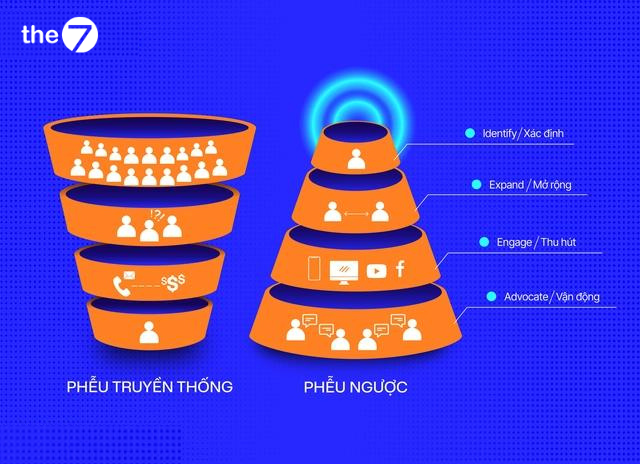
Instead of starting with many leads and gradually narrowing down to a few customers like the traditional funnel, the reverse funnel model lets you dig deeper and wider into the opportunities that come from one initial contact. That makes the reverse funnel a better fit for B2B marketing, where many people take part in the buying decision.
Ms. Uyên Đỗ, a Sales Manager at an agency in Ho Chi Minh City, shared that by applying the reverse funnel model, her company gained many new sales opportunities from a single customer. Ms. Uyên recalled how she approached Brand A in the banking and finance sector, starting with the first contact, the Director of Communications & External Relations, who needed brand communication. Her team then explored the Business Units (business divisions/subsidiaries) within Brand A to look for more opportunities to sell products and services.
This process led the team to a second contact: the brand’s Marketing department, which needed communication for its card products and app. Ms. Uyên connected with the head of that department and pitched products suited to their needs, while continuing to develop and offer products that fit the brand communication needs of the first contact.
“Since we adopted Account-Based Marketing (ABM) in 2023, our brand marketing and sales performance had grown by 30-40% by 2024. At first, my team and I tested ABM by digging deeper into existing customers. From there, we uncovered many more sales opportunities with new contacts and applied the approach across many brands,” Ms. Uyên said.
Conclusion
Reverse funnel thinking and Account-Based Marketing are no longer unfamiliar concepts. Still, many marketers remain bound to the basic lessons of the traditional marketing funnel and the habits built over hundreds of familiar lead-based marketing campaigns. Although these tools work, they aren’t optimized for the distinct nature of B2B marketing, which wastes marketing effort while sales stay flat.
That is why shifting to reverse funnel thinking and applying Account-Based Marketing to your B2B marketing campaigns is an inevitable trend for businesses. In the upcoming articles in our Account-Based Marketing series, we’ll explore how to carry out this strategy most effectively for B2B marketing. Stay tuned so you don’t miss any important insights!
>> See more: What Is a Target Customer? Target Customer Analysis Strategy for 2024
By Khánh Huyền
Source: Marketing AI

Nguyễn Đình
Bảo




As CEO of The7, I am committed to sharing practical, useful knowledge with every reader. Every article on The7 is based on my 7 years of hands-on experience in marketing — Facebook advertising, LinkedIn advertising, Google advertising, and marketing strategy. I hope you take away plenty of insight from these posts and apply it successfully in practice.
Related Articles
Building a Full-Funnel Content Marketing Strategy on LinkedIn
Table of Contents Toggle Why Build Content Marketing for the Full Marketing Funnel? (Why Full-Funnel Content Marketing?)Creating Your Strategy (Creating Your Strategy)Implementing Your Content Strategy (Rolling out your content strategy)Summary...
Designing Creative Content for LinkedIn
Table of Contents Toggle Why Is Good Creative Content So Important? (Why is Good Creative Important?)Key Components of Creative Design (the core elements of creative design)Summary (summary) Why Is Good...
Building an Organic Business Presence on LinkedIn With a LinkedIn Page
Table of Contents Toggle Why Have a LinkedIn Page?Establishing Your LinkedIn PageKeeping Your LinkedIn Page ActiveThe Measure of SuccessSummary About LinkedIn Page (Summary) Why Have a LinkedIn Page? For a...
6 Best LinkedIn Marketing Strategies for B2B in 2026
Table of Contents Toggle LinkedIn 2026: Where B2B Decisions Get MadeStrategy #1 – Why Is LinkedIn the Best B2B Marketing Channel Today?1. Decision-makers are concentrated here2. Users are in work...

7 Social Media Trends for 2026: The Era of Real Value, Real Conversion, and Real People
Table of Contents Toggle Social media is entering the biggest restructuring of the decadeTrend 1: Why is buying directly in-app becoming the new standard for 2026? (On-Platform Conversion)What should businesses...

What Is TikTok Marketing? Effective TikTok Marketing Strategies
TikTok has been topping the global rankings of the most downloaded and most visited apps. That makes it a gold mine for marketers who love creativity. In this article, The7...