


The Lever 7 Strategy: How to Increase Sales Effectively

We are living through what many describe as a “polycrisis,” a stretch of hard times marked by a pandemic, war, and a slowing economy. If you’re feeling worn out, try something different: start your own business, build something of your own, and pour the best years of your life into something called passion. Who knows, the universe might answer with a sweet gift.
According to statistics, as many as 80% of businesses fail within their first 2 years, and 96% will no longer exist within 10 years. And the remaining 4% are not all wild successes either. On the contrary, most businesses never reach a million dollars in sales. But you can absolutely get there! In the “Lever 7 Strategy” solution, I’ll share 7 stages that help you create potential, sales, and profit for any business in any market.
Who Is This Strategy For?
It is best suited to new marketing staff and startups, but probably not to established brands or individuals and organizations that don’t value “breakthrough-ism” and “think different.”
In the “Lever 7 Strategy,” You’ll Learn:
- How to identify your true believers and create the perfect approach to reach them.
- How to make an offer that potential customers can’t refuse.
- How to tap into new markets using the Honey Trap Technique.
- How to boost your brand through high-potential environments by understanding insight correctly.
About the Author Bảo Nguyễn
Bảo Nguyễn is a Vietnamese digital marketer. In 2016, at the age of 24, he founded the digital marketing company The7 out of a friend’s warehouse in Ho Chi Minh City. Today, the company employs more than 20 specialists and manages an annual budget of 40 billion VND.
No matter what field you work in, and no matter how great your product or service may be, the minute you decide to scale your business, you are no longer a doctor, a lawyer, or a designer. You become a marketer.
That means the fate of your business and your dream of becoming a millionaire don’t lie in creating the best product or service. They lie in finding the best way to market it to the right potential customers.
Stage 1: Understand and Find the True Believer
Revenue is the lifeblood of a business, just like you need to breathe oxygen every day. Without it, your business will die. That is why the first step in building a successful business is not building the perfect product, but understanding and identifying your dream buyer, whom we call the True Believer.
So how do you sell effectively? The answer is marketing. Most businesses are started by technical experts, yet every successful company is built by the hands of marketing experts. Expert business owners tend to talk dryly about the technical features of their product and how their company is better than the competition, but customers don’t care about that. Customers only care about the troubles and pains they are facing, not your product and not your service. Business owners who know marketing do this very well: they zero in on the customer’s problem and solve it to win the customer’s heart.
The Bigger Market Formula
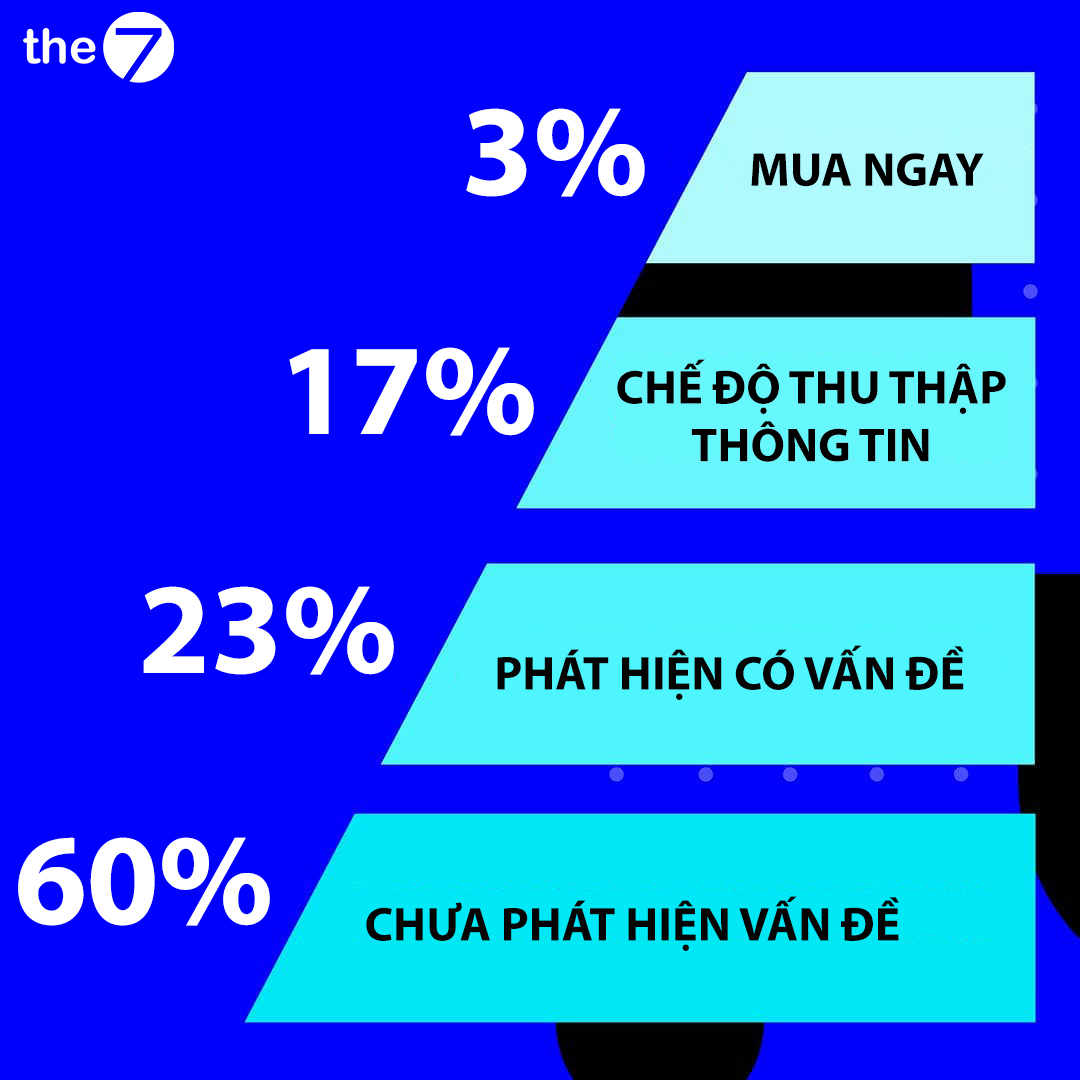
In every industry, you only need a small slice of the whole market that is actively looking to buy to achieve significant success. We’re talking about the 3% of customers at the top of the Bigger Market Formula who are customers like this:
– Customer: I’m thirsty.
– Business: I sell water.
Put the two together and you have an order. But the remaining 97% of customers are a place with very little competition, and it goes something like this:
– Customer: I’m thirsty. What should I drink?
– Business: You should drink lemonade, because it’s good for your health and rich in vitamin C.
That is one example of the 37% in the information-gathering step. And the remaining 60% of customers don’t even know there is a product or service that solves their thirst problem.
Why do most people focus on that 3% instead of the other 97% of the market? Because this group of customers is easier to sell to, so people concentrate on the 3%. If you want to scale, you have to understand and target the remaining 97% of customers. Keep in mind that more than 60% of them don’t even know they have a problem your product or service could solve!
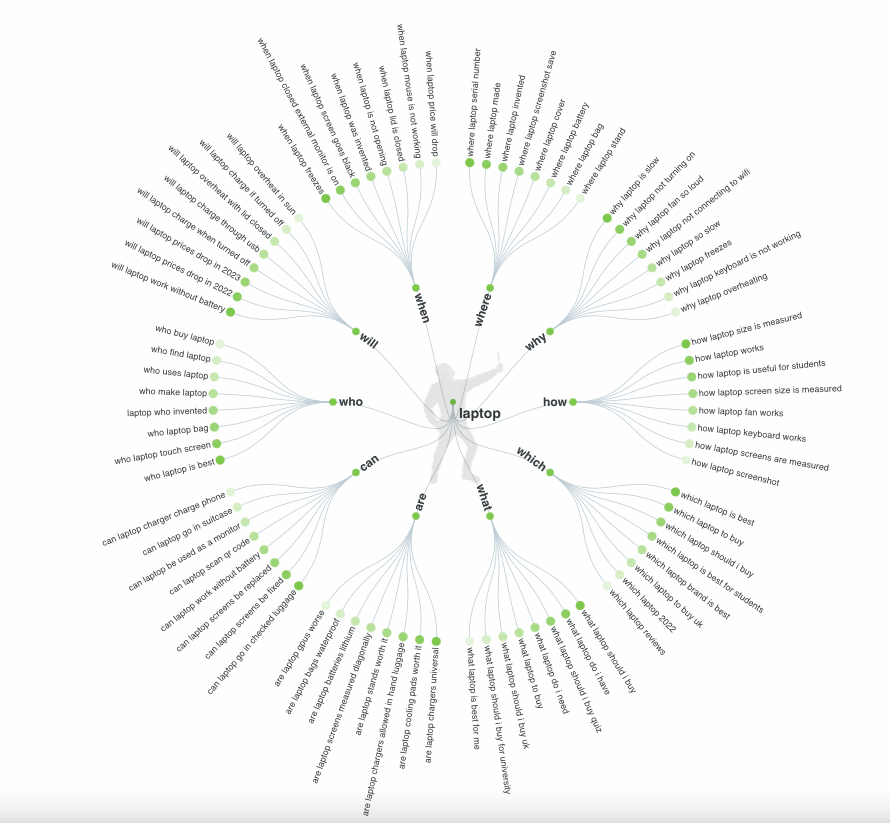
First and foremost, you have to create a profile of your potential customer, a True Believer. Here is an example of how to build a True Believer profile with answerthepublic.com, for a customer who wants to buy a laptop:
Stage 2: The Perfect Approach to the True Believer
In 1906, the Italian economist Vilfredo Pareto discovered that 80% of the wealth in Italy belonged to only about 20% of the population. Since then, the Pareto principle has been observed across many areas of life and work. In other words, just 20% of buyers bring in 80% of sales.
To create the perfect approach for your dream buyers, give away High-Value Content, or HVC for short. When creating an HVC, you must follow three simple rules:
- A compelling headline.
- Make sure every point touches your customer’s pain.
- Keep it simple and easy to understand.
The goal of an HVC is to wow people by delivering not just a product or service but an experience. Done right, an HVC will spark a conversation in their minds:
“If this is the free gift, imagine how amazing their product / service must be!!!”
Please note that when offering High-Value Content, promising alone is not enough. You need to plan how you will deliver on it!
Stage 3: Capture Customers and Business Opportunities
99% of businesses try to sell as fast as possible, so they approach their business opportunity like an army attacking a fortress surrounded by high, solid walls: a head-on assault. Instead, we should approach it the way a sophisticated young man romances a beautiful woman. You can’t propose when you’ve just met at a bar. First you have to dine together, talk, and get close, then wait for the right moment to pop the question.
For example, use a landing page to collect customer information. This is the simplest and most effective way to let potential customers know you have a solution to their problem and that they can check it out for themselves. Every lead-capture page needs all 5 of the following elements:
1. A compelling headline. It must be surprising, sensational, and easy to understand. Here is a simple formula you can apply right away: “[PROBLEM]? Get my [SOLUTION] and [RESULT]!”
2. A subheadline. This is where you restate what customers will get from you. Example: “A 25-page cookbook with 10 amazing recipes you can make in 15 minutes, PLUS gorgeous high-resolution photos.”
3. Curious bullet points, which are “teasing bits of information that make readers curious or hint at a surprise.” Here are three of the many formulas that consistently work well: “How to X without Y,” or “What you should never do if you want X.”
4. An attractive image. Be sure to include a visual representation of what your customers will receive in exchange for their email address, phone number. It could be a free report, an ebook, a tutorial video – really anything you like. As long as it’s free, of course.
5. An information form. Don’t ask potential customers for detailed personal information. Ask only for the few details you need to contact them, and your conversion rate will be high.
Stage 4: The Mafia Offer
If you want potential customers to buy something, you have to make them the “Godfather’s” offer, meaning an offer they can’t refuse. If your offer and guarantee don’t keep your customers up at night, it isn’t strong enough or attractive enough.
The response you’re looking for from your customers isn’t “Hmm, sounds good,” but “How can they offer me this?” or even “Who’s crazy enough to promise this much?”
The Mafia Offer includes 7 key components:
1. Proof. “A clear and credible explanation of why you are making such an amazing promise.” Tell customers why you are cheaper, faster, or better than everyone else.
2. Layered value. Set a credible regular price as the benchmark for your product or service. Then reveal an even more attractive discounted price. Finally, compare the discounted price to a daily or weekly figure to make it look even more ridiculous. You can even compare it to something trivial, for example: “For the price of one cup of coffee a day, you get X for life.”
3. Price quotes. Don’t offer just one price; offer at least three. New customers usually pick the middle one, and the 3% group always picks the most expensive one. By combining multiple offers, you are sure to increase your return on investment.
4. Flexible payment terms. If your goods are high-value, break the purchase into a payment plan of three or four installments.
5. Limited-time bonuses. This is a free gift customers receive along with the product or service they are buying. As you know, free gifts usually come with time pressure and take the form of, “But wait, there’s more: if you order right now, you’ll also get a huge bonus gift at the same price!”
6. A guarantee. Minimize risk by making a commitment. Make your guarantee as strong as possible. In short, a 1-year warranty is the most common, but you’re free to go further if you can.
7. Scarcity. The offer must be limited in time and quantity so customers know what they are losing if they don’t decide early. So put an expiration date on your coupon, add a countdown clock, and even “only … left at this price.” They always work, even when customers are skeptical of them.
Stage 5: Traffic
Once you’ve identified your dream buyer, created your HVC, prepared a lead-capture landing page, and presented the “Mafia Offer” on that page, it’s time to evaluate which digital marketing channels suit your business and, of course, to dig deeper into the art and science of creating ads worth clicking.
Assuming your goal is to scale your business, you have to build multiple traffic streams to keep potential customers coming in. In other words, optimizing your website so Google can read and understand it easily (search engine optimization, or SEO for short) is only the necessary starting point. Next, you should move on to Facebook, and then YouTube, TikTok, and Instagram.
Once customers have decided to visit your landing page, you must work to be truly engaging, attention-grabbing, and specific, and sometimes you even have to show off everything you have, applying the strategies mentioned above to the fullest. State the direct benefit and hint at your offer. Dig into the customer’s benefits: always give them something more powerful, smarter, and more attractive than your competitors offer. Finally, never underestimate the power of fear: ads that dispel fear are among the most effective, and they always have their reasons.
Stage 6: The Honey Trap
As we mentioned, only 3% of your potential customers are ready to buy right from the start, and 97% are not in “buy now” mode when they see your options and offers, either because they are unaware of the problem (60%) or because they are aware of it but aren’t ready to do anything until it has been researched (37%). The Honey Trap Technique is designed for them.
The Honey Trap Technique is essentially a series of two or three uniquely edited YouTube videos that give potential customers pure value. That means these videos aren’t meant to sell anything. Their only goal is to inform people about the problem your company’s product or service solves, without mentioning a sale. At the end of these videos, however, you must add a call to action along these lines: “If you like this content and want to commit to achieving result X, I have a truly great offer for you. Follow the link below to book an appointment with me.”
The Honey Trap is like guiding your potential customers down a metaphorical path to their desired end state. Along the way, you deliver plenty of value and all the goodwill that comes with it. Producing three videos may take you a lot of time, but it is well worth it. Done right, a video series like this can create very strong attraction among the 97%, drawing in eager, genuine buyers. In other words, you are taking on more risk than safety if you don’t create these videos.
Stage 7: Converting Sales
Sell like a doctor. This is the mantra of salespeople. Almost every business piles on heaps of features and service benefits when trying to sell, hoping something will strike a nerve and move potential customers to buy. But why do I stress selling like a doctor? A doctor is far more refined and starts like this: “Where does it hurt?” In medicine, “A prescription without a diagnosis is malpractice,” and the same goes for sales.
To convert potential customers into buyers, follow this simple 7-step process:
1. Start with the “Why” question. Dig deep. Use the Five Whys technique to get to the heart of the problem, where each of their answers forms the basis for the next question.
2. Discover the destination your customer wants with the “Where” question. Identifying the customer’s address is something you need to do, but we also need to find out “where” they want to be one year from today. If “why” holds a desire, then “where” reveals a destination. Both matter if you want to make a sale.
3. Acceptance. Get your potential customers to admit that everything they’ve tried to piece together so far to get where they want to go hasn’t worked, and that they need something new from someone new.
4. Deliver the promised value. This is the most important part of the sales pitch – it’s where you prove to potential customers that you can help them by actually helping them.
5. Earn commitment. After helping potential customers solve their problem – or giving them an outline of how you can help – it’s time to ask them the all-important question, “Would you like to hear more?”
6. Write the “Prescription.” If you get a “yes” to that last question, you can comfortably take a few minutes to give an overview of your product or service, tailored to the earlier “why” and “where.”
7. Close the deal. Based on the potential customer’s tone and engagement, by this point you should be able to tell whether they are “cold,” “warm,” or “hot” on your offer. Take their temperature one last time, then make your offer. Once you’ve stated it, don’t say another word until you get a “yes.”
Conclusion
Archimedes once said: ‘Give me a place to stand, and I will move the Earth.’ Indeed, if we truly understand our potential customers and their innermost thoughts (insight), we will have a solid fulcrum. Combined with a system of captivating messaging and professional marketing techniques, it creates an effective lever that lets a business use a small amount of resources to produce a huge result.

Nguyễn Đình
Bảo




As CEO of The7, I am committed to sharing practical, useful knowledge with every reader. Every article on The7 is based on my 7 years of hands-on experience in marketing — Facebook advertising, LinkedIn advertising, Google advertising, and marketing strategy. I hope you take away plenty of insight from these posts and apply it successfully in practice.
Related Articles
Building a Full-Funnel Content Marketing Strategy on LinkedIn
Table of Contents Toggle Why Build Content Marketing for the Full Marketing Funnel? (Why Full-Funnel Content Marketing?)Creating Your Strategy (Creating Your Strategy)Implementing Your Content Strategy (Rolling out your content strategy)Summary...
Designing Creative Content for LinkedIn
Table of Contents Toggle Why Is Good Creative Content So Important? (Why is Good Creative Important?)Key Components of Creative Design (the core elements of creative design)Summary (summary) Why Is Good...
Building an Organic Business Presence on LinkedIn With a LinkedIn Page
Table of Contents Toggle Why Have a LinkedIn Page?Establishing Your LinkedIn PageKeeping Your LinkedIn Page ActiveThe Measure of SuccessSummary About LinkedIn Page (Summary) Why Have a LinkedIn Page? For a...
6 Best LinkedIn Marketing Strategies for B2B in 2026
Table of Contents Toggle LinkedIn 2026: Where B2B Decisions Get MadeStrategy #1 – Why Is LinkedIn the Best B2B Marketing Channel Today?1. Decision-makers are concentrated here2. Users are in work...
7 Social Media Trends for 2026: The Era of Real Value, Real Conversion, and Real People
Table of Contents Toggle Social media is entering the biggest restructuring of the decadeTrend 1: Why is buying directly in-app becoming the new standard for 2026? (On-Platform Conversion)What should businesses...
What Is TikTok Marketing? Effective TikTok Marketing Strategies
TikTok has been topping the global rankings of the most downloaded and most visited apps. That makes it a gold mine for marketers who love creativity. In this article, The7...