Quick answer
A B2B ideal customer profile (ICP) is a description of the type of company that is the best fit for your product, has a high likelihood of buying, and will succeed with it long term. To build an ICP, analyze your current best customers, find common traits, write a set of criteria for who to target and who to exclude, then have marketing and sales use it together and update it regularly.
Key takeaways
- An ICP is a profile of an ideal company, while a buyer persona is a profile of the buyer inside that company.
- Start your ICP from your most successful current customers, not just internal assumptions.
- A good ICP includes positive criteria and a negative ICP for accounts to avoid.
- Marketing, sales, and product should share the ICP and adjust it based on real data.
- In the 7B Model, the ICP is the foundation for Broadcast, Buzz, and Browse in B2B marketing.
If you rely only on job titles or buyer personas, B2B teams can easily end up talking to the right person at the wrong company, and the deal never closes. That is why a business needs a clear B2B ideal customer profile (ICP) before investing in advertising or expanding the sales team.
What is a B2B Ideal Customer Profile (ICP) and why does it matter?
A B2B Ideal Customer Profile (ICP) describes the type of company most likely to buy, most likely to succeed with your product, and most likely to deliver long-term value to your business. An ICP works at the account level, not the individual level. It answers a single question: which companies should we be talking to in the first place?
A complete ICP typically combines three main groups of data. The first is firmographics: industry, headcount, and revenue range. The second is technographics: the technology stack and tools the company already uses. The third is behavioral signals: buying intent data and how they engage with your content. ZoomInfo describes these three data groups as the foundation for identifying which organizations will buy, succeed, and generate the highest lifetime value.
An ICP is not about picking a broad industry like “technology companies” or “manufacturers.” It is a set of criteria specific enough to filter the market before you build buyer personas or run ads. If the criteria stop at industry and size, marketing will generate leads that look alike, but sales cannot close them because the actual buying conditions at each company are too different.
The biggest benefit of an ICP is higher pipeline quality. When you know exactly which companies are worth pursuing, sales wastes less time on accounts you cannot win. The buying cycle tends to shorten because you only approach companies that already meet the conditions to buy. Win rates rise because effort goes to the right places. Marketing resources become more focused instead of being burned on campaigns that target too broadly.
An ICP also helps marketing and sales speak the same language about what a “good customer” looks like. When both teams look at the same set of criteria, they can agree more easily on account priorities, basic qualification standards, and how to assess lead quality, instead of each side interpreting things its own way.
In B2B, the buying cycle is often long and involves multiple people in the decision. An opportunity at the wrong company can consume months of pursuit and then fail at the final stage because the budget is not there or the problem is not urgent enough. That is why choosing the right type of company from the start matters far more than generating a high volume of leads.
What is the difference between an ICP, a buyer persona, and a total addressable market (TAM)?
These three concepts are often used interchangeably, but they answer three different questions. The total addressable market (TAM) is the entire set of companies that could theoretically buy your product. The ICP is the group of companies inside the TAM with the highest degree of fit, the companies you should actually pursue. A buyer persona is the individual profile of a decision-maker or influencer inside the companies that belong to your ICP.
Resources from ZoomInfo and CustomerVector both emphasize the same point: an ICP works at the account level, while a buyer persona works at the human level. The ICP tells you which companies to pursue. The persona tells you how to talk to each person inside that company. The two tools complement each other, but they cannot replace each other.
Many teams get confused because common buyer persona templates often include industry, size, and revenue in the description. CustomerVector points out that this is exactly what blurs the line between the two concepts. Firmographic fields like industry, size, and revenue belong to the ICP, not the persona. When teams stuff them into a persona, marketing thinks it has an ICP, but it really only has an individual profile attached to a few disconnected company details.
The consequences of building personas before an ICP are easy to spot. The pipeline swells but win rates stay low because sales is working opportunities that look similar on the surface but have very different chances of closing. Marketing generates leads with the “right title,” but sales does not want to call because the company behind the lead does not meet the conditions to buy. The buying cycle drags on unpredictably because sales has to filter accounts on the fly while pursuing them. CustomerVector describes these failure patterns as a typical sign of a sequencing problem, not a problem with the persona content itself.
That is why B2B companies should follow a clear order: define the ICP first, then build buyer personas for the right people at the right companies. Once you have an ICP, personas become sharper because you know the exact company context each person works in. Without an ICP, a persona is just a character sketch with no stage.
What data should you prepare before building a B2B ideal customer profile?
An ICP should not be written from internal assumptions. An ICP built from the opinions of a few people inside the company usually reflects what the team wants to sell, not what the market is actually paying for. Real customer data, especially from accounts that are happy and bring high value, is the only reliable raw material.
Cognism suggests a good starting point: the super users group. These are the customers who use your product best, stay loyal, refer new business and are easy to work with. They are living proof of which type of company truly fits you. Start your analysis with this group instead of looking at the entire customer list.
For quantitative data, pull it from your CRM and sales records. The fields to review include win rate by customer segment, average contract value, time from first contact to close, industry, headcount, revenue range and the technology they use. This data is usually available if the sales team logs it properly throughout the sales process.
For qualitative data, a practical approach is to interview 5 to 10 representative customers to go deeper. You can ask about the context before they bought, why they chose you over competitors, how they evaluate vendors and what could make them leave. Their answers reveal signals that never show up in the CRM, such as the internal pressure driving the purchase decision or the real criteria that earned their trust.
Marketing, sales and customer success should all take part in gathering data. Marketing sees content behavior and lead sources. Sales sees why an opportunity was won or lost. Customer success sees which customers stay with the product long term and which leave early. Each team holds only part of the picture. If only one team writes the ICP, the profile will be skewed toward that team’s perspective.
In the Vietnam market, data can be scattered and less complete than in markets with a mature B2B data ecosystem. But that does not mean you have to wait until you have “big data”. A few dozen good customers are enough to find common patterns in industry, size, buying situation and success conditions. Starting with small but real data is still better than waiting for a perfect dataset that never arrives.
How to build a B2B ideal customer profile (ICP) step by step
Building an ICP is not a meeting-room exercise where the team lists what it “wishes for.” It means looking back at your existing customer data, finding the group that delivers the best results, and describing that group in clear criteria. Here are six practical steps in order.
Step 1: Pick your “most successful” customers based on data
Start by filtering your current customer list against four criteria: contract value, renewal rate, account expansion, and how well they collaborate during implementation. A customer who pays a high fee but constantly complains and never renews should not sit in the “most successful” group. Cognism defines an ideal customer as a company that both benefits from your product and brings you value through revenue, referrals, or useful feedback. Pick 10 to 20 customers who meet most of these criteria as your analysis sample; this is a practical suggestion, not a fixed number.
Step 2: Group and compare by firmographics
Firmographics are the characteristics that describe a business at the company level. ZoomInfo and Stackmatix both use these basic firmographic fields: industry, headcount, revenue, geography, growth stage, and business model. Put each customer in your “most successful” group into a table (hypothetical example below), record their firmographic values, and look for common patterns.
| Customer | Industry | Headcount | Annual revenue | Geography | Engagement outcome |
|---|---|---|---|---|---|
| A | Manufacturing | 120 | USD 5 million | Ho Chi Minh City | Renewed for 3 years |
| B | Logistics | 80 | USD 5 million | Hanoi | Expanded service package |
| C | Manufacturing | 150 | USD 5 million | Binh Duong | Renewed for 2 years |
Looking at this hypothetical example, you can see manufacturing, a headcount of 80 to 150, and a repeating annual revenue level of USD 5 million. That is a signal to include in your ICP. If no clear pattern emerges, go back to Step 1 and check whether your “success” criteria are right.
Step 3: Add technographics and context
Technographics describe the technology your customers use. According to Stackmatix’s classification, you should record: which CRM they use, whether their infrastructure is cloud or on-premise, which tools they use that could integrate with your product, and which tools compete directly with you. ZoomInfo also treats technographics as a formal part of an ICP, alongside firmographics and behavioral signals.
For example, if you sell warehouse management software, an ideal customer might be a business using accounting software with an open API, running cloud infrastructure on AWS, and not yet using any specialized warehouse management software. If they are already using a direct competitor with 18 months left on the contract, switching costs will be high and your probability of winning is lower.
Step 4: Define pain points, outcomes, and behaviors
Stackmatix suggests recording four elements for each ICP: the operational or strategic problem you solve, the job-to-be-done (the work the customer needs to complete), the consequence if they do nothing, and the outcome metrics they want. For example: the customer needs to cut inventory reporting time from 3 days to 3 hours; if nothing changes, they keep missing order deadlines and losing customers; the metric they care about is on-time delivery rate.
Add the behavioral signals that both ZoomInfo and Stackmatix mention: the content they read, the events they attend, the communities they follow, and the review platforms they trust. These signals tell you where to show up when you run marketing, instead of only knowing who the customer is.
Step 5: Write a clear Positive ICP and Negative ICP
A Positive ICP is the list of characteristics you “should target.” A Negative ICP is the list of characteristics you “should not target.” Stackmatix emphasizes that the negative ICP prevents your pipeline from filling up with accounts that will never close, keeping the team focused on high-probability opportunities.
Common negative ICP examples: companies under 20 employees with no clear operational processes, newly founded businesses with no budget yet, or customers whose business model directly conflicts with the value you provide. Writing a clear negative ICP helps sales quickly reject opportunities that “look good on the surface” but have no conditions for success.
Step 6: Turn it into a usable document, not just a slide
An ICP only has value when the team uses it every day. A practical ICP document should have four parts:
- A short description of the ICP in 3 to 5 sentences, enough for a newcomer to understand in 2 minutes.
- A criteria table with three levels: “strong fit,” “moderate fit,” “not a fit.”
- A fictional company example representing the ICP, with a made-up name and specific context.
- Suggested questions for sales to qualify quickly on the first call.
An ICP must describe real people and real situations, not a “dream.” If most of your current customers do not match the ICP at all, revisit the ICP before changing your marketing strategy. You may be describing a market that has never bought from you, instead of the market that has already proven its value.
How do you apply a B2B ideal customer profile (ICP) to marketing, sales, and product?
An ICP is not a document to file away. It is the input filter for nearly every go-to-market decision. When the ICP is sharp, marketing, sales, and product all look in the same direction.
Use the ICP as the foundation for account-based marketing
In account-based marketing (ABM), you select a target account list in advance and then concentrate resources on it. Cognism treats the ICP as the foundation for building a high-quality account list for MDRs (marketing development representatives) and SDRs (sales development representatives). Without an ICP, an ABM list easily becomes a random collection of company names.
Use the ICP in advertising and audience targeting
Firmographic and technographic criteria in the ICP feed into targeting, but the execution differs by platform. On LinkedIn, you can limit by industry, company size, and job title. With Google and YouTube, you reach the ICP more indirectly through keywords, topics, customer lists, similar audiences, and in-market audiences.
The ICP helps you avoid targeting the right title at the wrong company, a problem both ZoomInfo and CustomerVector call out: a well-matched VP of Marketing is still a dead end if their company is too small to pay your fees or is locked into a contract with a competitor.
Connect to contact-level targeting
Once you have a list of accounts that fit the ICP, the next step is to find the right contacts inside those accounts. ContactLevel notes that uploading a raw contact list to an ad platform often matches only 20 to 40%, while using richer identity data can lift that to 70 to 99%. A sharp ICP helps you pick the right accounts before you invest further in enriching contact data. If the ICP is wrong, you are only enriching data for companies that will never buy.
Use the ICP in content and messaging
The ICP provides the foundation for writing content by industry, size, and tech stack. Buyer personas help you choose the right angle and language for each role on the buying committee. For example, with the same ICP of a manufacturing company of 100 to 200 employees, the message for a chief operating officer will differ from the message for a chief financial officer.
In the Vietnamese context, the ICP also needs to reflect who gives final sign-off: a family business owner, a board of directors, or a regional office or overseas parent company. This directly affects content, outreach channels, and expectations around deal cycle length.
The ICP sets the stage; the persona sets the lines.
Use the ICP in sales
The ICP becomes the criterion for qualifying and prioritizing opportunities. Sales stops wasting time on accounts that look good on the surface but lack the core conditions. ZoomInfo points out several disqualifying signals: the company has not yet reached the stage where it has a problem to solve, has no budget, or is locked into a long-term contract with a competitor. When the ICP is clear, sales can say no quickly and focus on real opportunities.
Use the ICP in product and services
The product team uses the ICP to prioritize features that serve the most valuable customer group, instead of trying to please every industry and every size. If your ICP is a manufacturing company of 50 to 200 employees, a feature built for a 5,000-employee enterprise should not sit at the top of the roadmap. Conversely, if your ICP is a large retail chain, optimizing for small independent stores is a waste.
CustomerVector stresses an important point: when the ICP comes first and is actually used, buyer personas, content, advertising, and sales activity all attach to the same stage. The result is a pipeline with more consistent quality, instead of running many disconnected activities while the win rate stays low.
How do you know the ICP is wrong, and how do you update it correctly?
A wrong ICP rarely shows up as “the ICP is wrong.” It shows up as operational symptoms that teams tend to blame on content, advertising, or sales. CustomerVector lists common symptom patterns: a full pipeline but a low win rate, marketing generating leads that sales never calls, long and unpredictable sales cycles, and messaging that works sometimes but not others. If you see at least two of these four symptoms, that is a practical signal to review the ICP before changing the ad creative.
Review the ICP with data
The simplest way to check is to compare results between two groups of accounts: those that closely match the current ICP and those that fall outside it. Look at the gap across three metrics: win rate, average contract value, and time to close. If the off-ICP group has a higher win rate or larger contract value, the current ICP is missing a valuable segment.
ICP review cadence
The ICP is a living document, but you should not change it every week. A practical suggestion is to review it every 6 to 12 months. Review sooner if one of three events occurs: you launch a new product, you enter a new industry, or the win rate drops even though execution quality has not changed. Small, data-backed changes are better than constantly wiping the slate clean and rewriting.
Test before officially changing the ICP
When you have a new hypothesis, do not immediately rewrite the entire ICP. Pick a few hypotheses, for example expanding the size range from 50 to 200 employees up to 30 to 300, or removing an industry with a low win rate altogether. You may consider testing on a small portion of the marketing budget and a specific sales group for about 4 to 8 weeks, then compare results against a control group. Only when the data supports the hypothesis should you update the official ICP.
A two-way feedback mechanism
Sales and customer success need a channel to report two special types of cases: accounts that go against the ICP but still win big, and accounts that fit the ICP but keep failing. The first type suggests the ICP is too narrow. The second type suggests an important criterion is missing from the ICP, such as readiness to change processes or support from the final decision-maker.
When you update the ICP, record the reason for the change and the data behind it. Six months later, you will need to know why the ICP once included an industry and then dropped it. A change history helps new team members understand the context and avoid repeating old decisions.
The7 Digital’s perspective: Where does the ICP sit in the 7B Model for B2B companies in Vietnam?
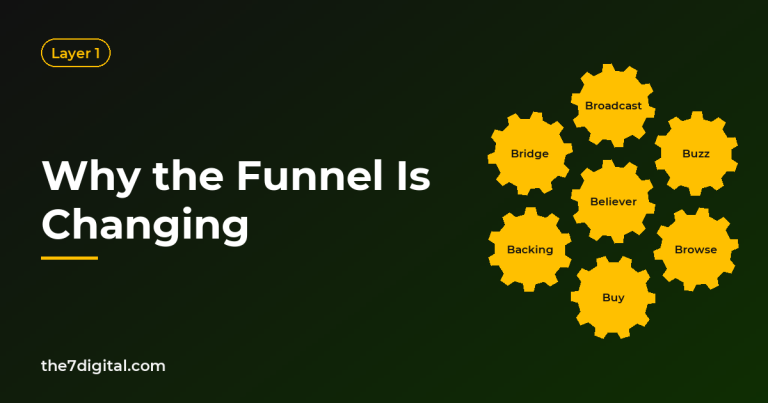
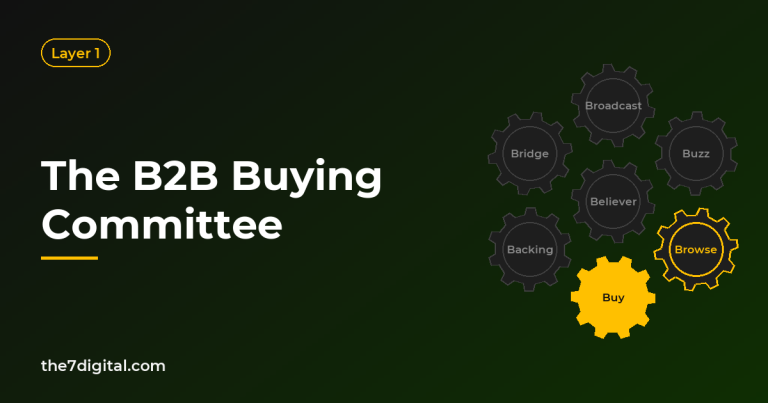
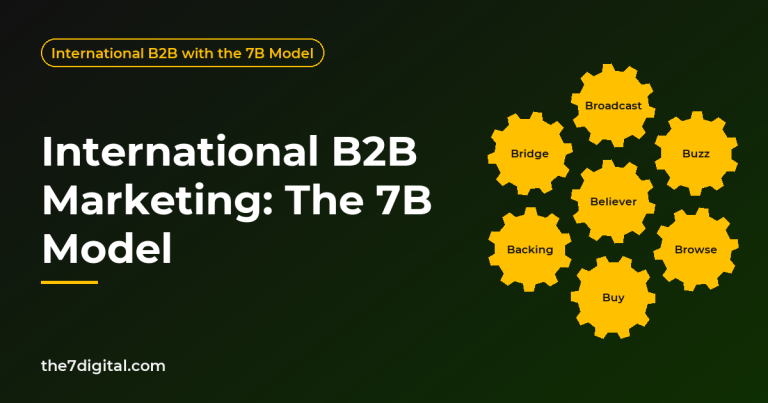
We use the 7B Model in our B2B marketing approach, with seven gears: Broadcast, Buzz, Browse, Buy, Believer, Backing, and Bridge. The ICP is not a separate gear; it is the foundation that keeps every gear turning in the right direction. In the demand creation layer, the ICP determines who you seed Broadcast signals to and which market will generate Buzz. If the ICP is wrong, you are seeding signals into a market with no real demand, and Buzz will struggle to form. In Browse, where buyers verify you through six gateways including search and AI answers on results pages, AI assistants, review platforms, LinkedIn, YouTube and podcasts, communities and forums, the ICP helps you choose the right gateways to show up in instead of spreading yourself thin everywhere.
For B2B companies in Vietnam, a common risk is a brand wanting to sell to every industry simply because the product “can be used” in that industry. The result is LinkedIn and YouTube ad budgets split into fragments, a blurry message, and no industry that actually remembers the brand. The ICP helps you pick the right sub-market to build a long-term presence in. If your team is still small, a practical suggestion is to accept an ICP narrow enough that you can run Broadcast clearly, consistently, and sharply for 6 to 12 months, then expand gradually once you have data and Believer customers.
There is one exception worth noting. If you are just entering the Vietnamese market and have very little data, do not tighten the ICP too much from the start. You may need 1 to 2 “looser” ICP rounds to learn from the market first, then narrow and refine it over time.
The minimum sequence we suggest for B2B companies using the 7B Model is:
- Lock in the first ICP version.
- Use the ICP to choose the main Broadcast channel, such as LinkedIn or YouTube.
- Build content and buyer personas aligned with the ICP.
- Observe feedback in Browse through search, communities, and LinkedIn to refine the ICP.
We do not promise a specific number, and we encourage clients to cross-check ICP data in their own CRM and ad accounts. When the gears in the 7B Model show the market responding differently from the initial assumption, the ICP needs to be adjusted, not the market forced to fit the old ICP.
The ICP is one of the starting points of the 7B flywheel. When the ICP is clear, Broadcast reaches the right people, Buzz has a chance to form in private channels, Browse gets real visitors, and Buy becomes a door instead of a wall. When the ICP is wrong, every effort downstream tends to amplify a misdirected signal. Taking time to build the ICP carefully before scaling ad spend helps you cut unnecessary trial and error, though no one can commit to an exact figure for that saving.
Frequently asked questions
How is a B2B ideal customer profile different from a buyer persona?
An ICP describes the type of company that is the best fit for you to serve, focusing on industry, size, revenue, business model, and context. A buyer persona describes the specific person inside that company, including job title, goals, pain points, and how they make decisions. Build the ICP first, then develop buyer personas.
What should a B2B ideal customer profile include?
A complete ICP typically includes: firmographics (industry, size, revenue, geography), technographics (technology and systems in use), business context and growth stage, the main problem you solve, the outcomes they want, behavioral signals that show they are in the market, and a negative ICP section to quickly exclude accounts you should not pursue.
Do small businesses need an ICP, or can they just sell to anyone who buys?
Even small businesses should have a simple ICP to avoid being pulled into projects beyond their capacity or with mismatched expectations. You can start with a few basic criteria like industry, size, and a few must-have conditions, then refine as you gain more customers and data.
How often should you update a B2B ideal customer profile?
A practical cadence is to review the ICP every 6 to 12 months, or when there are major changes like a new product launch, entering a new industry, or noticeable shifts in win rates and sales cycles. Each update should be based on CRM data, sales feedback, and customer input, not just gut feeling.
How can sales and marketing actually share one ICP in practice?
Turn the ICP into a working document, not just a slide. Agree on basic qualification criteria based on the ICP, integrate them into forms, lead scoring, and CRM reports, and hold regular sessions where marketing and sales review won and lost accounts against the ICP and adjust together.
Does an ICP help with more precise targeting in LinkedIn and YouTube ads?
An ICP gives you clear criteria on industry, size, function, and technology to set up LinkedIn audiences that closely match high-likelihood accounts. On YouTube, you can use the ICP to build account or contact lists to upload as audiences, then combine with keyword and content targeting to reach the right people in those companies.