


Applications of Generative AI in Marketing and Business
Generative AI is emerging as a key tool in business and marketing, especially in marketing automation. As business and marketing strategies keep changing, this technology is drawing more and more attention. In the first quarter of 2023, for example, investment in generative AI rose significantly, reaching a total of $11.2 billion, according to Pitchbook data.
This innovation is not just a passing trend. It is already changing every aspect of the marketing industry. Adopting Generative AI has helped marketers save a significant amount of time when creating content.
What Do We Know About Generative AI in Marketing and Business?
In business and marketing, adopting Generative AI has undoubtedly created a powerful, dynamic transformation. AI’s ability to rapidly analyze huge volumes of data, make accurate predictions, and automate tasks has changed how businesses interact with customers, improve their operations, and drive their growth.
The impact of Generative AI on marketing is like having a powerful tool at your disposal. It helps create personalized content, precisely tailor ad types and campaigns, and segment customers with great sophistication, all aimed at making marketing strategies more effective.
Generative AI is not limited to marketing. It also affects pricing strategies, improves the customer experience, and strengthens fraud detection in other areas of business. AI not only helps businesses stay competitive, but also puts them in a favorable position to seize opportunities and lead industry change by predicting and guiding trends.
As AI continues to develop, the partnership between this advanced technology and the fields of marketing and business will open up new, breakthrough opportunities and drive success.
In short: Generative AI is becoming an important tool for driving breakthrough improvements in business and marketing. That makes now the right time to explore the world of Generative AI and better understand its potential.
See more: https://the7digital.com/ai-marketing/8-loi-ich-cua-ai-24169/
Applying Generative AI to Customer Experience (CX)
“Generative AI is not only a powerful new technology, but also a means for AWS customers to achieve their business goals and develop new ones. It is not just about what the technology can do, but about how creatively businesses integrate it into the way they deliver value to customers, creating a competitive advantage. This is the view AWS takes on Generative AI.”
Mark Schwartz, Enterprise Strategist at Amazon Web Services.
Imagine a future in which interactions between customers and virtual assistants are finely tailored, and intelligent customer support centers can anticipate needs and deliver shopping experiences matched to each person’s preferences. This future is steadily becoming reality thanks to the power of Generative AI, backed by large models such as large language models (LLMs). In this transformation, Amazon Web Services (AWS) is leading the way.
In the new era of artificial intelligence (AI), businesses can take advantage of pre-trained models (also called foundation models, or FMs) that can generate human-like text and images. AWS is pioneering this field with Amazon Bedrock, opening the door for businesses in every industry to use Generative AI.
AWS offers a range of Generative AI tools, including conversational search, text summarization, and code generation, helping organizations work more effectively with their information sources. In addition, when a customer’s request can’t be resolved through traditional methods, AI spares agents from repeating the same answer and instead generates responses that are more helpful and more accurate.
Watch this video to learn more about Amazon’s Generative AI for customer experience:
AI in Video Creation: The DiepNep Case
DiepNep, a pioneering Canadian company, has set a new standard in AI-based video production. It developed DiepNep AI, a cloud platform that lets users create videos from text alone.
What sets DiepNep AI apart is its use of deep learning methods such as natural language processing (NLP), computer vision, and machine learning (ML). This combination produces videos that are not only realistic but also captivating and highly memorable.
DiepNep AI runs on a cloud model, so users anywhere in the world can access it easily with just an internet connection. This model fosters collaboration without geographic barriers among diverse teams, making it an ideal choice for video projects that require teamwork. Notably, this AI video creation tool has been used by many major companies such as Google, Coursera, IBM, Deloitte, Forbes, and more.
However, DiepNep’s video “This is not Morgan Freeman – A Deepfake Singularity,” in which the actor’s voice is simulated by AI, has raised questions about ethics, misinformation, copyright and legal issues, data privacy, and more.
Watch the video and decide for yourself how powerful AI video creation is:
Another organization using artificial intelligence to pioneer video courses at an unprecedented scale is Cyber Inc. Its AI algorithm thoroughly analyzes customer data, identifies the most requested topics, and then generates video scripts along with lesson blueprints. Thanks to this breakthrough technology, the company has built an impressive catalog of more than ten thousand video courses.
Gen AI for Image Creation: The DALL-E x Heinz Collaboration
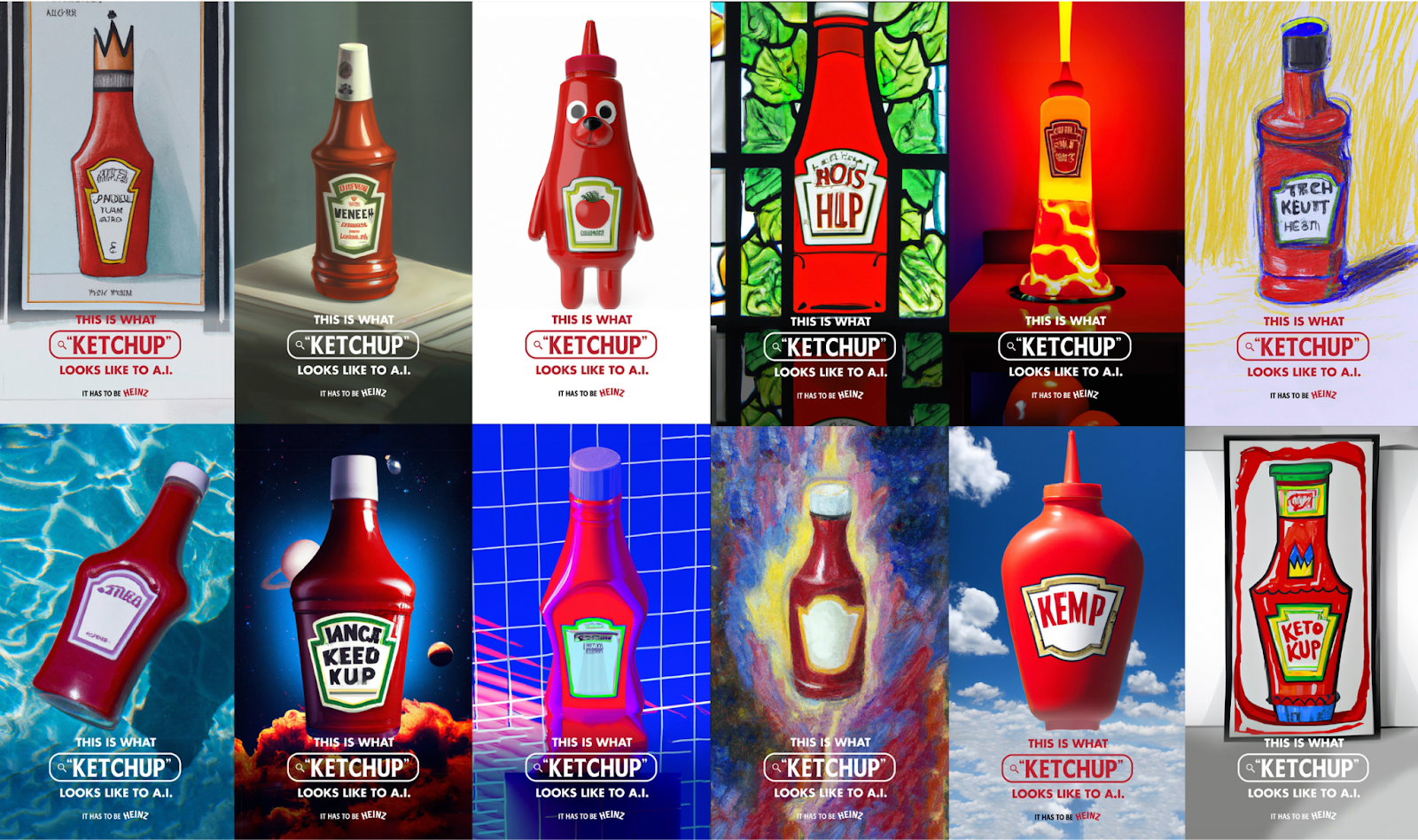
Remember the Heinz A.I. Ketchup x DALL-E 2 project, a major step forward in marketing thanks to significant advances in Gen AI image creation? Yes, that is the project in which Heinz set out to reveal how artificial intelligence understands the iconic Heinz ketchup bottle.
Using the DALL-E 2 image generator, the American food manufacturer began a creative exploration spanning many imaginative scenarios. From “ketchup scuba diving” to “ketchup in outer space,” the images produced by this AI are not only mesmerizing but also strikingly similar to the classic Heinz ketchup bottle.
“Using the new artificial intelligence programs that turn text into images on the internet, we wanted to find out what A.I. thinks “ketchup” looks like. And so, we used A.I. to create images of ketchup on Dall-E 2.
The Heinz A.I. Ketchup project has been recognized as strong proof of the interplay between human creativity and the capabilities of artificial intelligence, offering a new perspective on how brands can capture audience interest in marketing and business.
If you’re interested in the Heinz project, check out our blog. There, we take a deep dive into how companies in the Digital Marketing space have refreshed their marketing strategies. In Digital Marketing, adopting Generative AI is expanding the scope of creativity and planning, especially in advertising.
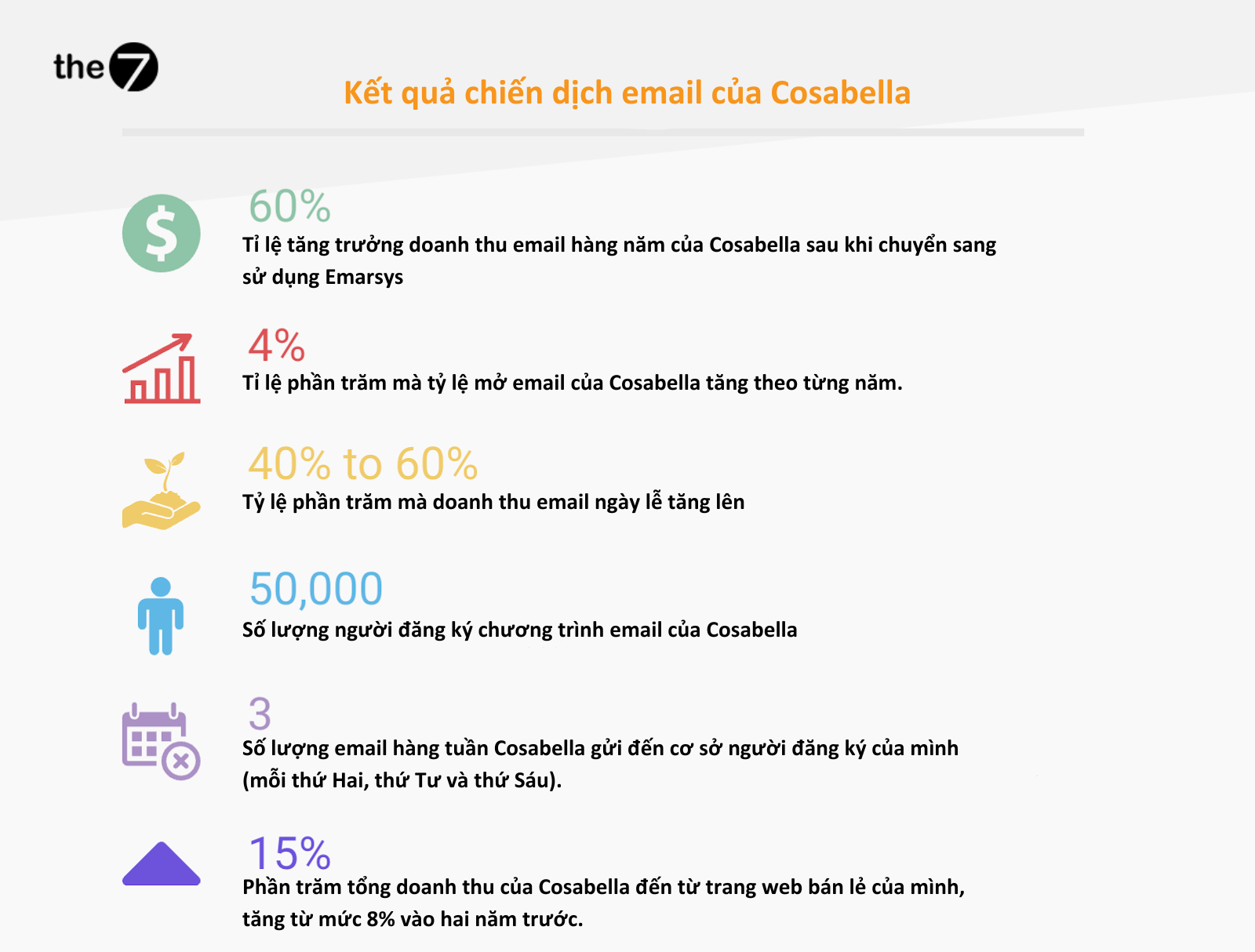
A prime example is Cosabella, a well-known lingerie brand that adopted Generative AI to create personalized ads, including both text and images. Cosabella developed an AI algorithm to analyze customer data and track social media trends, then used it to produce text and image ads tailored to each audience. The results of these AI-based ad campaigns were impressive, with a 20% increase in click-through rate and a 15% increase in conversion rate.
Cosabella’s success story with artificial intelligence (AI) demonstrates the powerful transformation Generative AI brings to Digital Marketing. Using Generative AI to personalize ads not only helps businesses deliver precise, engaging messages to their target audience, but also lets marketers optimize ads based on each customer’s individual characteristics. This includes analyzing purchase history, browsing behavior, and social media activity to create ads that match each person’s exact needs and preferences.
The marketing experience Facebook delivers is a prime example of Generative AI in Digital Marketing. Facebook uses this technology to personalize ads and the news feed for each user, increasing engagement and keeping users on its platform.
In short, in marketing, Generative AI can deliver personalized content and track performance, helping businesses build stronger connections with their target audience. This leads to growth in click-through rate and conversion rate. However, the ethical and transparent use of AI remains a key factor that deserves close attention.
Generative AI in Business Intelligence (BI): The Amazon QuickSight Case
When it comes to Business Intelligence, Amazon leads with its AI tool QuickSight!
Amazon QuickSight, a tool favored by leading businesses such as Netflix, Airbnb, GE Healthcare, and Amazon itself, is a powerful solution that helps marketers improve their efficiency and results. With a large customer base of more than 150,000 businesses, Amazon QuickSight can analyze customer data, identify trends, track marketing campaign performance, forecast customer behavior and needs, and help optimize pricing strategy.
Consider the case of Netflix: the streaming platform has adopted a generative AI tool to collect customer data, with the goal of generating relevant, personalized recommendations for each user.
Similarly, an e-commerce company that wants to boost its sales can segment customers into groups based on purchase history and known preferences. Using this information, the company can run effective email campaigns through Amazon QuickSight.
Swami Sivasubramanian, Vice President of Database, Analytics, and Machine Learning at Amazon Web Services (AWS), emphasized in a recent keynote that AWS’s services and capabilities will make Generative AI easier to use while extending access to this technology to all kinds of customers in every area of business, including engineering, marketing, customer service, finance, and sales.
Here is the full keynote:
Generative AI for Content Production: The Team Whistle and SmartAsset Cases
Team Whistle and SmartAsset are living proof of applying Generative AI to content production, and this approach has significantly improved the effectiveness of their marketing campaigns.
Team Whistle, an organization in the sports and entertainment industry, made a notable mark with one of its YouTube videos. It used Generative AI to create keywords, metadata, and hashtags, which tripled the views of that video. The result not only boosted the video’s popularity but also widened its audience reach. It is a smart strategy with an enormous payoff!
SmartAsset, a company in the financial technology sector, is also using Generative AI. It helps businesses reduce their electronic waste and digital footprint while making their advertising more creative. With Generative AI, SmartAsset adjusts ad content so it connects better with the target audience. This not only improves the effectiveness of marketing campaigns and the content production process, but also contributes to a more sustainable Digital Marketing ecosystem.
Generative AI is becoming an important part of the marketing industry, especially at companies that use AI in their marketing strategies. This technology helps professionals improve how they present products to people. Generative AI helps not only with professionally optimizing SEO strategy, but also with creating personalized content and extending reach to a global audience through multilingual campaigns. It is a powerful tool that is changing how marketing work gets done.
Many of the world’s biggest companies, including Amazon, Walmart, and Target, are using artificial intelligence (AI) to improve product descriptions. Specifically, Target, one of the largest retail chains in the US, has used AI to create product descriptions that are easy to understand and relevant to its customers.
Based on analysis of customer data, purchase history, online behavior, and interactions with marketing initiatives, Target creates a personalized shopping experience for each customer. This approach includes offering unique product recommendations, creating individual offers, and carefully organizing content, whether customers are browsing Target’s website or shopping in physical stores. In addition, Target applies AI to improve how it recommends products to customers.
Conclusion
Generative AI in marketing and business is opening up many growth opportunities. Although many people believe Generative AI could replace human roles, real-world applications from brands such as Amazon, Target, Heinz, and many other companies show that AI can improve marketing strategies, make operations more efficient, and enhance the customer experience (CX).
AI has proven to be an important tool in many areas, from personalizing products, descriptions, and recommendations to building pricing strategies and managing inventory. Examples of how businesses like Amazon, Target, and Heinz use AI are clear evidence, encouraging businesses to tap into the potential of Generative AI to improve their marketing strategies, build stronger relationships with customers, and succeed in the digital era.

Nguyễn Đình
Bảo




As CEO of The7, I am committed to sharing practical, useful knowledge with every reader. Every article on The7 is based on my 7 years of hands-on experience in marketing — Facebook advertising, LinkedIn advertising, Google advertising, and marketing strategy. I hope you take away plenty of insight from these posts and apply it successfully in practice.
Related Articles

7 Social Media Trends for 2026: The Era of Real Value, Real Conversion, and Real People
Table of Contents Toggle Social media is entering the biggest restructuring of the decadeTrend 1: Why is buying directly in-app becoming the new standard for 2026? (On-Platform Conversion)What should businesses...
Artificial Intelligence (AI) Helping Solve Environmental Problems: Potential and Challenges
Artificial intelligence (AI) is driving a powerful revolution, reshaping life across many fields. With the strength of breakthrough technologies, AI is expected to be a key to solving global environmental...
How Coca-Cola Cleverly Uses AI in Flavor Development and Media Strategy
When people think of Coca-Cola, they usually picture explosive ad campaigns and a vibrant brand image. Few realize, however, that this beverage “giant” is quietly driving a marketing revolution with...
GPT-4o Officially Launches: The New Multimodal Super AI
OpenAI’s ChatGPT has just taken a major leap forward with GPT-4o (also known as Omni), a new generation of multimodal super AI. Beyond understanding language, GPT-4o handles images, video and...
5 AI-Driven Content Trends Taking Off in 2024
In the ever-changing world of marketing, innovation is the key to success. Staying ahead of trends and understanding customer needs are essential for any business that wants to claim a...
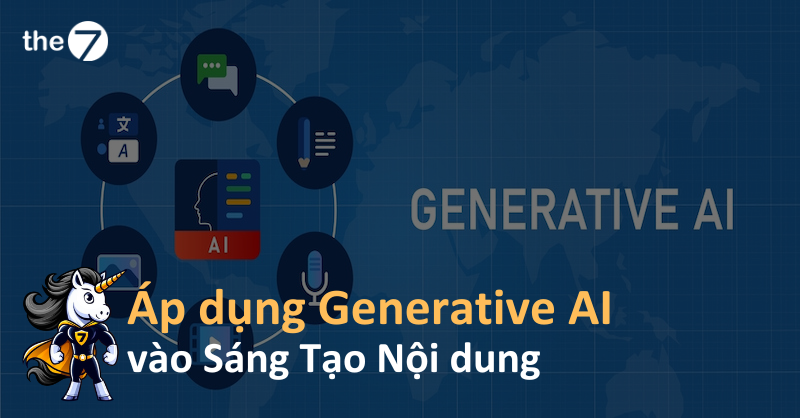
Applying Generative AI to Content Creation
Content creation has moved to center stage. Whether it’s a blog post, a marketing campaign, or a social media update, businesses and individuals are constantly competing to produce fresh content...