


What Is the 7B Marketing Model for B2B?
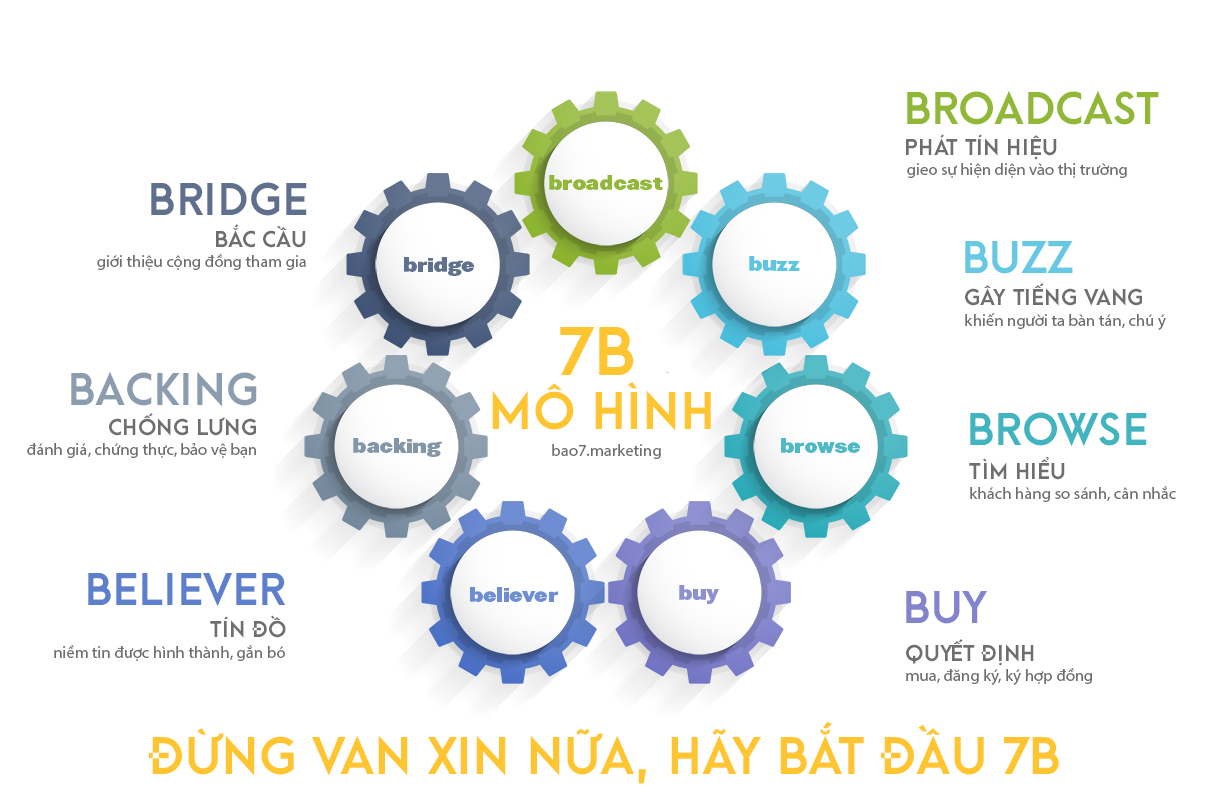
The 7B gear model is a B2B marketing framework developed by Bao7, made up of 7 gears running simultaneously: Broadcast (sending out value signals), Buzz (third-party echo), Browse (presence across 5 search gateways), Buy (serving the 13-person buying committee), Believer (marketing to existing customers), Backing (proof that fuels the whole system), and Bridge (turning customers into a channel that generates new customers). Unlike a sequential funnel, 7B operates in parallel — every gear matters at the same time. The framework is built on Chaotic Logic Theory — every interaction can be the decisive touchpoint, and marketing’s role is to keep the whole system turning at a steady rhythm.
In 2026, a B2B CMO stands in front of a dashboard with 47 metrics. This month there were 1,247 MQLs, a 3.2% conversion rate, and 38 SQLs. She doesn’t know what matters. She doesn’t know where to invest. The dashboard doesn’t tell her which gears of the system are turning freely, which ones are grinding, or what’s the root cause of the pipeline missing this quarter’s target. Every number is green, but the feeling in her gut isn’t. This is exactly the problem the 7B model solves. The model doesn’t replace the dashboard. It gives the dashboard meaning. It shows you which gears are actually generating movement, and which ones are just making the report look good.
The 7B gear model is a B2B marketing framework developed by Bao7, made up of 7 gears running simultaneously: Broadcast (sending out value signals), Buzz (third-party echo), Browse (presence across 5 search gateways), Buy (serving the 13-person buying committee), Believer (marketing to existing customers), Backing (proof that fuels the system), and Bridge (turning customers into a channel that generates new customers). Unlike the sequential funnel you still see on every dashboard since 2010, 7B operates in parallel. Every gear must be turning at the same time. No gear is an “early stage” or a “final stage.” No gear is allowed to sit idle. Because in a world where buyers can enter their journey at any point — from a podcast, a referral, a ChatGPT answer, or a case study on your website — you have no right to neglect any single touchpoint.
In this article, you’ll see how the 7B model emerged from four shocks that made every old framework obsolete. You’ll get a dissection of each of the seven gears — its own function, underlying principle, how to measure it, and the fatal mistakes I’ve seen repeated again and again at hundreds of companies. You’ll see how the seven gears interact with each other on the principle of
parallel operation and continuous feedback loops. You’ll understand why Chaotic Logic Theory is the underlying philosophy of this entire system. You’ll get a 12-month roadmap for implementation. And finally, you’ll see how Sany Heavy Industry, Salesforce, and Ant Group — three giants from three different industries, three different continents — operated in the true spirit of 7B long before this model had a name.
What context laid the foundation for 7B’s emergence?
7B wasn’t born in a laboratory. It was born from the harsh reality that things once taught as truths in B2B marketing collapsed one after another. Four conceptual turning points over the past 5 years have completely changed the ground under marketers’ feet.
Turning point one: The 95/5 rule. In 2021, the Ehrenberg-Bass Institute and the LinkedIn B2B Institute published a finding that made the entire industry sit up. At any given moment, only 5% of the B2B market is ready to buy. The remaining 95% has no need today. They won’t buy for months, even years. Yet the entire B2B marketing machine before that — from inbound to ABM — was designed to optimize for that 5%. An industry worth hundreds of billions of dollars was missing its target 95% of the time. The new model had to serve both, and in fact had to serve the 95% more.
Turning point two: The 13-person buying committee. Forrester 2024 reports the average B2B buying committee has 13 people, and 89% of purchase decisions require input from two or more departments. Gartner 2025 puts the number at 5 to 16 people. 86% of B2B deals stall at least once because a stakeholder wasn’t reached. The model of nurturing a single lead, finding one internal champion, and hoping that person convinces their colleagues is dead. The new model has to be multi-threaded outreach from the very start.
Turning point three: 61% self-service. Gartner 2025 surveyed 632 B2B buyers and found 61% prefer a buying experience with no sales rep involved. 73% actively avoid vendors that send irrelevant information. Marketing is no longer sales’s lead-gen sidekick. Marketing has to build the entire digital infrastructure so buyers can complete 80% of their journey on their own.
Turning point four: AI chat. ChatGPT launched in late 2022, with Claude and Perplexity following. B2B buyers’ search behavior has fragmented into 5 parallel gateways: Google, AI chat, LinkedIn, professional communities, and YouTube. Google SEO now accounts for only about 30 to 40% of behavior. A framework that only knows Google SEO is blind to the other four channels.
Where did the 7B model come from?
I run The7 Digital, an agency specializing in paid media and web for global B2B clients. After many projects with B2B companies spanning multiple industries, I realized something: American marketing frameworks like HubSpot inbound, the ABM playbook, or the demand generation funnel were written for the US SaaS market. They don’t directly apply to a Chinese construction equipment manufacturer trying to sell into Brazil. They don’t apply to an 11-year-old logistics company trying to compete with 100-year-old brands. They don’t apply to an Asian fintech trying to build global payment infrastructure.
7B took shape as a synthesis of practice, not something out of a research lab. Its intellectual sources come from many places: Ehrenberg-Bass with the concept of mental availability, the LinkedIn B2B Institute with the 95/5 rule, Christensen with Jobs-to-be-Done theory, together with a layer of Asian practice, where businesses have to sell globally from the position of a late entrant, without the advantage of a century-old brand.
Why gears, and not a funnel?
A funnel is a linear metaphor. People move from awareness down to consideration down to decision, in one direction. You pour customers into the mouth of the funnel, hoping a small percentage drop out the bottom. Funnel thinking leads to optimizing each segment in isolation, optimizing conversion rates between stages, and trying to push people through each rung.
B2B reality in 2026 doesn’t work that way. A buyer might start their journey with a LinkedIn post from your CEO, disappear for six months, then come back through a ChatGPT answer, then ask colleagues in a private group, then visit your website to look at a case study, and only then finally reach out. There’s no straight line. There’s no sequence.
Gears are a more accurate metaphor. Seven gears run in parallel. Each gear turns on its own, but simultaneously meshes with the others. One gear jams, and the whole system slows down. You can’t compensate for a broken gear by spinning another one faster. And most importantly: no gear is a “stage.” No gear comes before or after another.
Metaphors shape thinking. A funnel makes you think about pushing people through stages. Gears make you think about maintaining the health of the whole system. That’s the fundamental difference in how you run marketing.
How do the seven gears of 7B operate?
This is the most important part of the entire article. The seven gears are not seven stages. They are seven primitive marketing functions, each with its own job, its own underlying principle, its own way of being measured, and traps that I’ve seen again and again.
Broadcast: Why is continuously signaling value the foundation of everything?
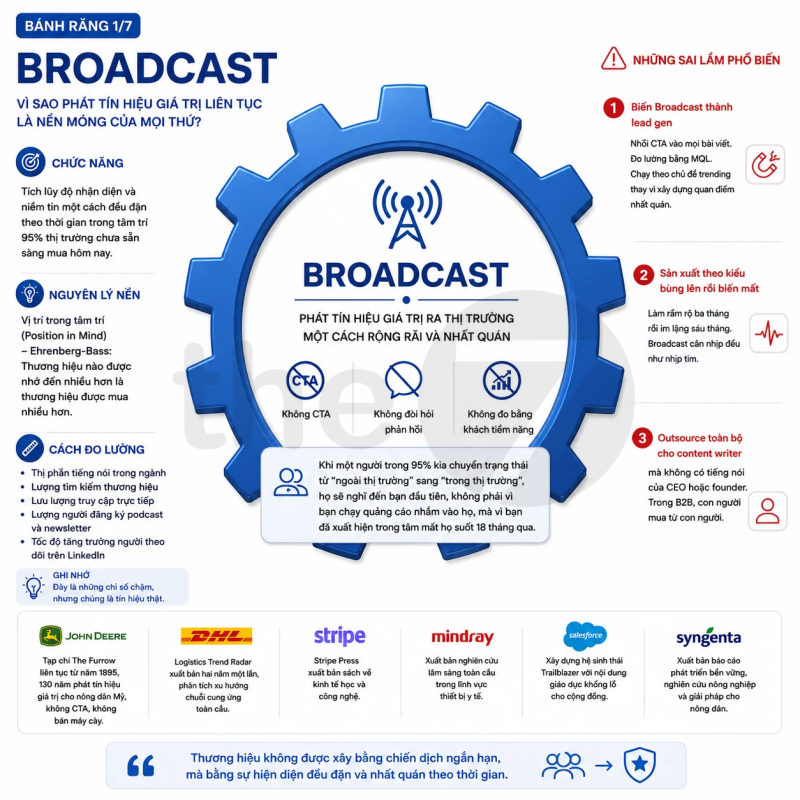
Broadcast is the activity of signaling value to the market broadly and consistently, with the single purpose of building mental availability among the 95% of the market not ready to buy today. No CTA. No call for a response. Not measured in leads.
Broadcast’s function in the system is to accumulate awareness and trust steadily over time. When someone in that 95% shifts from “out of market” to “in market,” they’ll think of you first — not because you ran ads targeting them, but because you’ve been in their line of sight for the past 18 months. The underlying principle is Ehrenberg-Bass’s mental availability: the brand that’s remembered more is the brand that’s bought more.
How you measure Broadcast isn’t MQLs. It’s share of voice in the industry, branded search volume, direct traffic, podcast and newsletter subscriber counts, and LinkedIn follower growth rate. These are slow metrics, but they’re real signals.
The most common mistake is turning Broadcast into lead gen. Stuffing a CTA into every post. Measuring it by MQLs. Chasing trending topics instead of building a consistent point of view. The second mistake is a boom-and-vanish production pattern: going hard for three months, then going silent for six. Broadcast needs a rhythm as steady as a heartbeat. The third mistake is outsourcing it entirely to content writers with no CEO or founder voice in it. In B2B, people buy from people.
In manufacturing, John Deere has published The Furrow magazine continuously since 1895 — 130 years of signaling value to American farmers, no CTA, no tractor sales pitch. In logistics, DHL’s Logistics Trend Radar is published every two years, analyzing global supply chain trends. In finance, Stripe Press publishes books on economics and technology. In healthcare, Mindray publishes global clinical research. In SaaS, Salesforce built the Trailblazer ecosystem with a massive library of educational content. In agriculture, Syngenta publishes sustainability reports. All of these are Broadcast.
Buzz: Why is third-party echo ten times more powerful than talking about yourself?
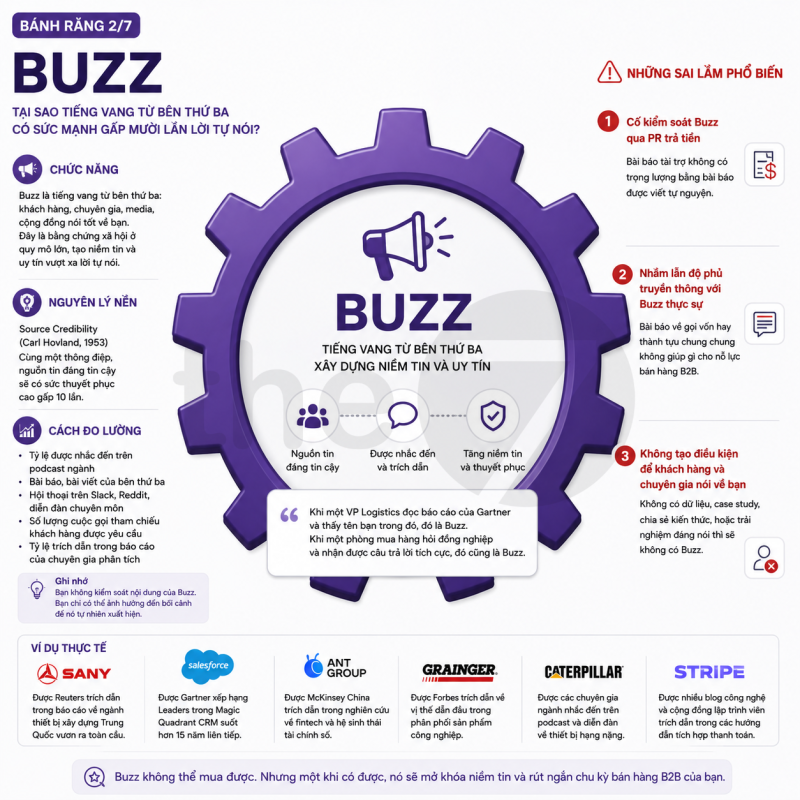
Buzz is third-party echo. Past customers speak well of you. Industry experts cite your research. Media covers your case study. You don’t control the content of Buzz. You can only influence the conditions that create it.
Buzz’s power lies in the source. The same message, coming from a trusted source, is 10 times more persuasive. This is psychologist Carl Hovland’s 1953 principle of source credibility. Buzz is social proof at scale. When a VP of Logistics reads a Gartner report and sees your name in it, that’s Buzz. When a procurement team asks colleagues in a Slack group and gets the answer “we use these guys, they’re good,” that’s Buzz.
You measure Buzz through mention rate on industry podcasts, third-party articles, conversations on Slack and Reddit, the number of customer reference calls requested, and citation rate in analyst reports.
A common mistake is trying to control Buzz through paid PR. A sponsored article doesn’t carry the same weight as one written voluntarily. The second mistake is confusing media coverage with real Buzz. An article about a funding round does nothing for your B2B sales effort. What you need is to be mentioned in a professional context.
In construction, Sany is cited by Reuters in reports on China’s construction equipment industry going global. In SaaS, Salesforce has been ranked a Leader in Gartner’s CRM Magic Quadrant for more than 15 consecutive years. In finance, Ant Group is cited in McKinsey China’s research on fintech. In wholesale, W.W. Grainger is cited by Forbes for its leading position in industrial distribution.
Browse: How do you show up across all five search gateways in 2026?
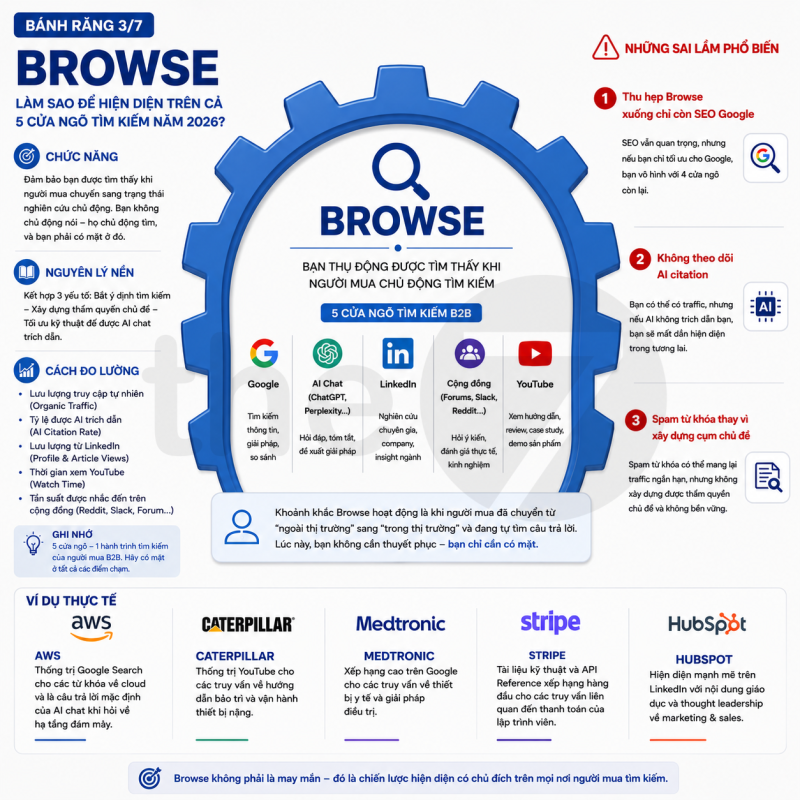
Browse is the activity of ensuring you’re present across every gateway B2B buyers use once they shift into active research mode: Google, AI chat, LinkedIn, professional communities, and YouTube.
Browse differs from Broadcast on one key point: Broadcast is you actively transmitting, while Browse is you passively being found. The moment Browse kicks in isn’t when you want to speak — it’s when the buyer wants to listen. They’ve shifted from “out of market” to “in market,” and they’re searching for answers on their own. At this point, you don’t need to persuade anymore. You just need to be there.
The underlying principle is a combination of capturing search intent, building topical authority, and the technical work needed to get cited by AI chat. You measure Browse through organic traffic, AI citation rate, LinkedIn page traffic, YouTube watch time, and frequency of mentions in communities.
The most common mistake is narrowing Browse down to just Google SEO. SEO still matters, but if you only optimize for Google, you’re invisible on the other four gateways. The second mistake is not tracking AI citations. The third mistake is keyword-stuffing instead of building topic clusters.
In cloud computing, AWS dominates Google Search for cloud-related keywords and is the default answer from AI chat when asked about cloud infrastructure. In manufacturing, Caterpillar dominates YouTube for heavy equipment maintenance queries. In healthcare, Medtronic ranks highly for medical device queries. In finance, Stripe’s developer documentation ranks at the top for developer payment queries.
Buy: How do you serve a 13-person buying committee with digital resources?
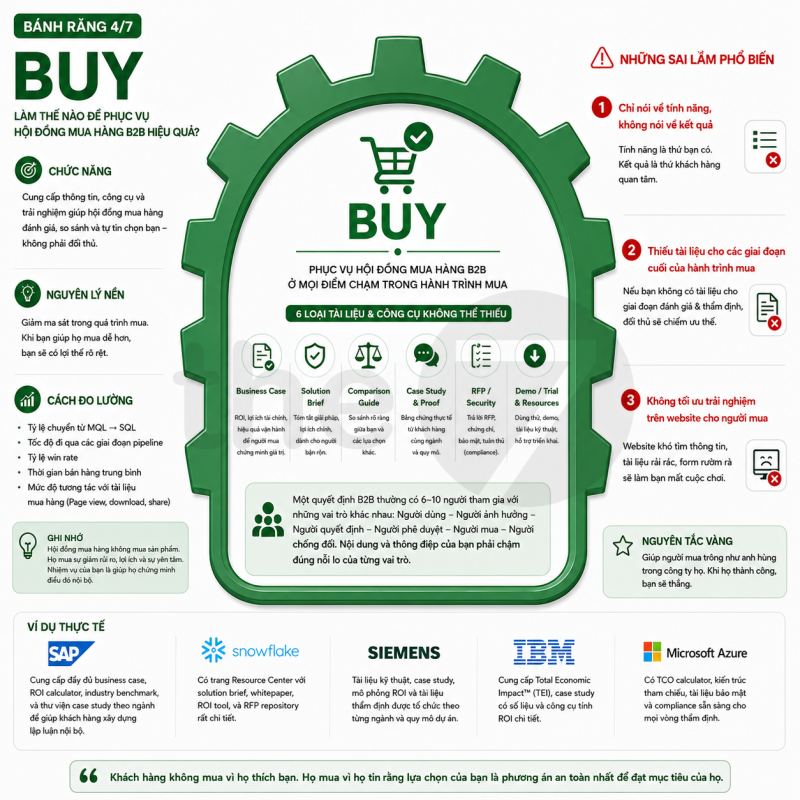
Buy is the gear that serves the 13-to-16-person buying committee through digital infrastructure. Not a single landing page with a demo form. Rather, a set of materials tailored to each individual on the buying committee, distributed through a multi-threaded campaign, so each person has the information and validation they need for their own particular concern.
Buy’s function in the system is to reduce the risk of deals stalling. As mentioned, 86% of B2B deals stall because a stakeholder wasn’t reached. Buy solves this by ensuring the CFO has an ROI spreadsheet, the lead engineer has technical specs, legal has in-depth compliance documentation, and the COO has an implementation roadmap. All of it available for self-service.
The underlying principle is the complexity of the buying center from Webster and Wind’s 1972 research, updated with new data from Forrester and Gartner, combined with role-based personalization. You measure Buy not by MQLs, but by the number of unique contacts engaged per account, role coverage per deal, time from first touch to close, deal velocity, and account engagement score.
Common mistakes include: using a single message for “the decision-maker,” not tracking other contacts within the same account, and treating marketing as lead generation only, rather than deal acceleration.
In manufacturing, XCMG built 5 landing pages for 5 different roles on government contractors’ buying committees. In cloud computing, AWS’s Enterprise Solutions Architect program serves technical decision-makers with personalized engagement. In healthcare, Medtronic’s clinical specialist team serves physicians, procurement, and hospital administrators separately. In professional services, McKinsey’s CRM tracks multi-stakeholder engagement within each client account.
Believer: Why does marketing to existing customers matter as much as finding new ones?
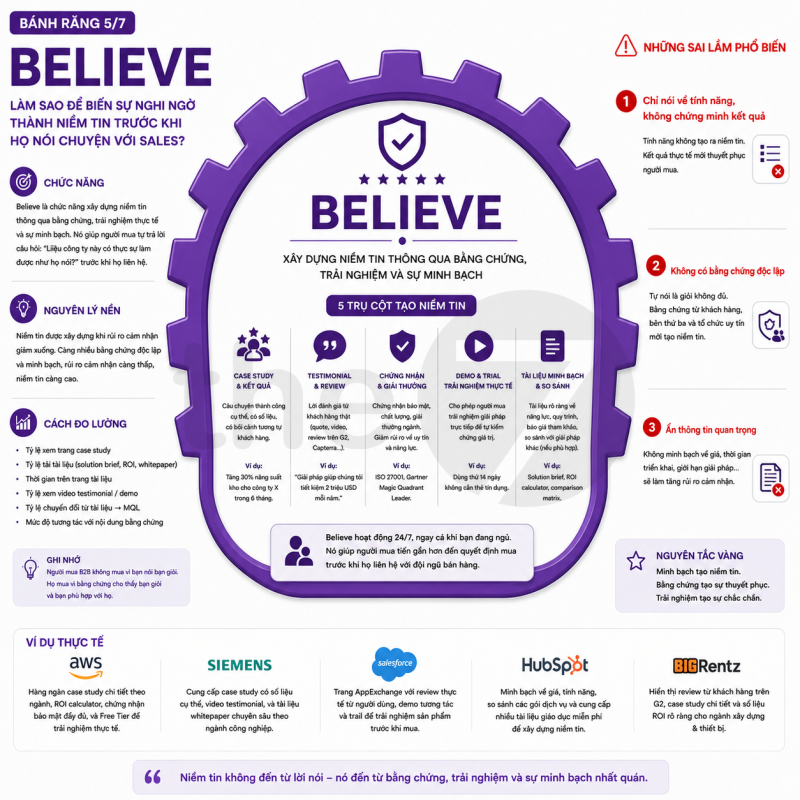
Believer is marketing directed at existing customers to activate, retain, expand, and turn them into believers who are willing to refer new customers. This is the most neglected gear in B2B.
Believer’s function is to generate compounding revenue through net revenue retention (NRR). A company with 130% NRR can double its revenue in three years from existing customers alone. Believer is also the raw material for Buzz, since happy customers create echo, and for Bridge, since happy customers refer new customers.
The underlying principle is “land and expand”: treating the first deal as a springboard, not a destination. You measure Believer through NRR, expansion revenue per account, advocacy score, volume of customer-generated content, and referral rate.
The most common mistake is defining marketing as new-customer acquisition only. Once a deal is signed, the customer gets handed off to customer success, and marketing disappears. This is the biggest waste in B2B.
In SaaS, HubSpot Academy is the classic Believer machine: educating existing customers, deepening product usage, and driving expansion revenue. In cloud computing, AWS’s annual re:Invent conference drives major expansion from existing customers. In education, Coursera for Business expands seat licenses through its customer success program. In finance, Stripe Connect documentation is dedicated specifically to customers running marketplaces.
Backing: What proof fuels the entire system?
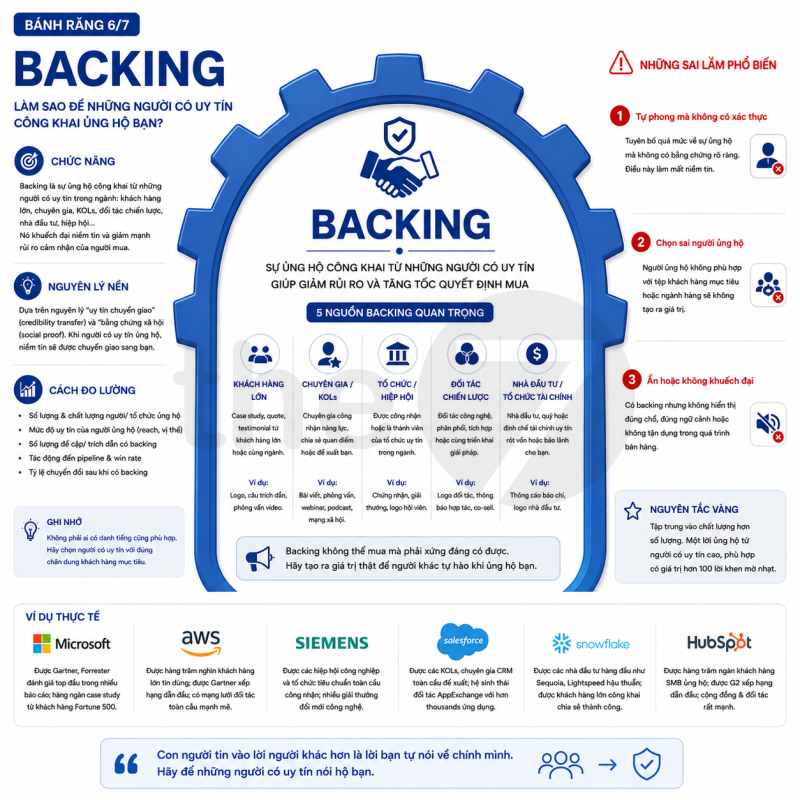
Backing is the layer of proof that fuels the other six gears. It has three tiers: the customer tier with case studies, testimonials, and reviews; the market tier with analyst reports, media mentions, and industry awards; and the technical tier with schema markup and structured data so AI can read and cite it.
Backing’s function is reducing perceived risk. In a B2B deal worth $10,000 to $1 million, where a buyer’s career can take a hit if they choose wrong, third-party proof is often the final deciding factor. Backing answers the unspoken question: “If I get this wrong, how do I justify it to my boss?”
The underlying principle is the default risk-averse state of B2B buyers, as Daniel Kahneman showed in Prospect Theory, plus social proof at scale. You measure Backing through the number of named case studies, presence in analyst reports, media mention count, review platform ratings, and schema data implementation rate.
A common mistake is under-investing in case study production. Many B2B companies have 50 happy customers but only 2 case studies. The second mistake is having no analyst relations strategy. The third mistake is ignoring schema markup.
In manufacturing, Caterpillar has 100 years of accumulated Backing, with case studies from the 1920s still citable today. In professional services, McKinsey Quarterly has been published for 60 years, serving as dual-purpose Backing infrastructure. In cloud computing, AWS has more than 1,000 publicly published named customer case studies. In finance, Ant Group publicly discloses transaction volume and market share data, creating undeniable credibility.
Bridge: How do you turn existing customers into a sustainable channel for new customers?
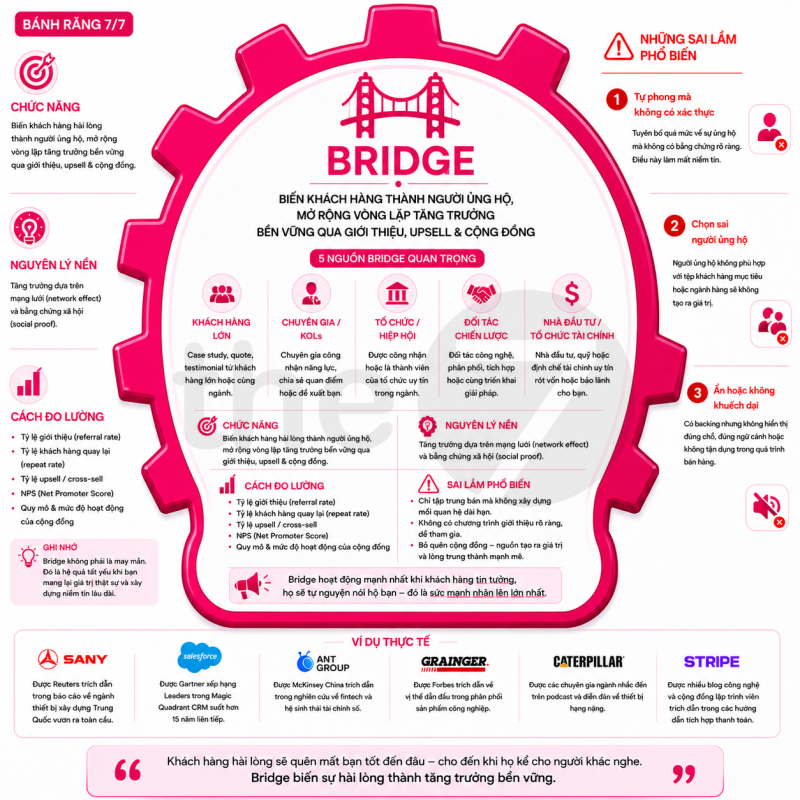
Bridge is the gear that closes the loop on the entire 7B system. It turns existing customers into a channel bringing in new customers, through systematic referrals, co-marketing, network effects from community, and partner ecosystems.
Bridge’s function is lowering customer acquisition cost through compounding network effects. A happy B2B customer has an acquisition value equivalent to 3 to 5 inbound leads, because a referral from a peer converts at a far higher rate.
The underlying principle is network effects and customer advocacy. You measure Bridge through the percentage of revenue coming from referrals, the number of active co-marketing partnerships, community member growth rate, and the percentage of pipeline coming from partners.
The most common mistake is having no formal referral program. Most B2B companies get referrals randomly, with no mechanism to encourage or scale them. The second mistake is ignoring co-marketing opportunities. The third mistake is not building a community.
In finance, Stripe built a partner ecosystem of more than 10,000 developers and agencies, contributing over 30% of opportunities and becoming one of its largest customer-acquisition sources. In SaaS, the HubSpot Partner Program has more than 6,000 agency partners globally. In cloud computing, the AWS Partner Network has more than 100,000 partners worldwide. In manufacturing, Caterpillar’s global network of 165 dealers amplifies Bridge in each local market.
How do the seven gears interact with each other?
The seven gears don’t stand alone. They form a complex, two-way interacting network, which is why the 7B system runs on a fundamentally different philosophy about the nature of the B2B buying journey.
Feedback loops between the seven gears
Each gear both draws energy from the other gears and feeds energy to them. Broadcast produces content indexed by Google and AI chat, directly feeding Browse. A thought-leadership post on LinkedIn today becomes a search result for a buyer’s question next month. Buzz generates third-party mentions, and those mentions become proof used in Backing. Browse channels researchers into Buy. Buy leads to Believer. Believer generates Buzz. Backing supplies proof to every other gear. Bridge feeds back into Buy with higher-quality leads and faster deal velocity.
This isn’t a straight line. It’s a network. In a system like this, you can’t optimize one gear in isolation. If you pour your entire budget into Browse while Backing is weak, customers will arrive but won’t convert. If Broadcast is strong but Browse is absent, people know about you but can’t find you when they need you.
Chaotic Logic Theory: Why must every gear turn at the same time?
Chaotic Logic Theory is the acknowledgment that in B2B in 2026, there’s no linear journey. A buyer can enter your system at any point, move through it out of order, and make a decision at a touchpoint you couldn’t have predicted.
This doesn’t mean buyers are irrational. It means the behavior of a 13-person committee — each with their own schedule, their own information sources, their own concerns — is a complex system where the final outcome doesn’t come from a single individual, but from the continuous collision of many signals and many people (emergent behavior). One committee member reads your Broadcast post today. Another watches a Browse video on YouTube next week. A third gets a Bridge referral next month. Nobody knows exactly who will influence whom, or which moment will be the decisive one.
The operational consequences come in three parts. One, every gear must be running at all times. You can’t pause Broadcast to focus on Buy this quarter, because you don’t know who needs Broadcast right now. Two, every interaction can be the decisive one. There’s no “low-priority touchpoint.” Three, marketing’s role isn’t optimizing conversion rates between stages — it’s maintaining the health of the whole system. Attribution can’t be first-touch or last-touch. It has to be multi-touch combined with self-reported data, because 70 to 80% of buyer interactions are anonymous and can’t be tracked through a form fill.
The underlying philosophy of Chaotic Logic is influenced by Lorenz’s chaos theory, where a small change in initial conditions can lead to large differences in outcome; by complex-systems science, with its emergent behavior in multi-agent systems; and by Asian pragmatism: working with reality as it is, not as textbooks describe it. (See also Article 26 on Chaotic Logic Theory.)
How do you check the health of the 7B system?
A healthy 7B system shows the following signs. First, the six gears — Broadcast, Buzz, Browse, Believer, Backing, and Bridge — account for about 95% of total marketing effort. The Buy gear accounts for only 5%. This ratio reflects the 95/5 rule: most of the effort goes toward building mental availability and long-term infrastructure. Second, no gear sits at 0%. One broken gear jams the whole system. Third, the feedback loops between gears are active. Fourth, your KPI dashboard tracks each gear separately, rather than lumping everything into a single funnel report.
Conversely, an unhealthy system shows clear symptoms. Buy takes up more than 60% of effort — a classic sign of “performance marketing first” thinking. One or two gears sit at 0%, usually Believer and Bridge. There’s no mechanism to track feedback loops. The dashboard only measures MQLs and SQLs, not the health of each individual gear.
A 12-month roadmap for implementing 7B
Implementing 7B isn’t an overnight overhaul. It’s a 12-month roadmap, split into four quarters, each with a clear objective.
Quarter 1 — Foundation. Start with a 12-question diagnostic to identify which gear is weakest in your organization. Don’t guess. Use data. In parallel, set up measurement infrastructure for all seven gears. Audit all existing content and classify it by gear. You’ll be surprised how much of your content falls into just one or two gears. Based on the diagnostic results, pick one or two priority gears. For industrial companies, Broadcast and Backing are typically the two weakest gears and need to be built first.
Quarter 2 — Build. Build the content engine for Broadcast. The CEO starts writing on LinkedIn. The company runs a regular podcast or newsletter. Don’t try to do everything. Pick one channel and run it consistently. Build Backing infrastructure: a systematic case-study production process, start reaching out to analysts, roll out schema markup on the website. Lay the groundwork for Browse: build SEO topic clusters, optimize for GEO to get cited by AI.
Quarter 3 — Activate. Put Buy into operation with role-specific materials and multi-threaded campaigns. Activate Believer with content dedicated to existing customers and lifecycle email. Connect the feedback loops between the gears.
Quarter 4 — Compound. Activate Buzz through collaboration with industry experts and a customer reference program. Activate Bridge with a formal referral program and partner channel. Run a full system health check and adjust the weighting between gears. Plan for year two with compounding effects already in motion.
How is the 7B model different from other popular frameworks?
Versus HubSpot Inbound. HubSpot’s Inbound Marketing is a linear four-stage model: attract, convert, close, delight. People move from being drawn in by content, to becoming a lead, to being closed by sales, to becoming a customer. 7B is parallel, with seven gears running simultaneously. Inbound is designed for a single buyer’s journey. 7B is designed for a 13-person committee. Inbound focuses on nurturing leads. 7B focuses on system health.
Versus ABM. ABM focuses on a curated list of accounts with deep personalization. In essence, ABM is an excellent tactic that sits within 7B’s Buy gear. But ABM doesn’t solve the problem of how those accounts got to know you before you targeted them. 7B operates simultaneously at the whole-market level, through Broadcast, Buzz, and Browse, and at the account level, through Buy, Believer, and Bridge.
Versus Demand Creation/Capture. Refine Labs’ binary model splits into “demand creation” and “demand capture.” 7B treats both as one continuous, cumulative flow, not a binary. Demand creation maps roughly onto Broadcast, Buzz, and Browse in 7B. Demand capture maps onto Buy. 7B adds Believer, Backing, and Bridge.
Versus HubSpot’s Flywheel. The Flywheel has three stages: attract, engage, delight, with the idea that happy customers come back and bring in more new customers. The Flywheel is better than a funnel because it acknowledges the loop. But its three stages are too broad — there’s no distinction between Broadcast and Browse, or between Buzz and Backing. The Flywheel lacks Backing and Bridge at an operational level.
Three case studies: Sany, Salesforce, and Ant Group
Case 1 — Manufacturing: Sany Heavy Industry
Sany Heavy Industry is the most compelling proof that 7B works in practice — long before this model had a name. From a small machine shop in Hunan in 1989, Sany rose to become the world’s third-largest construction equipment manufacturer.
Sany runs all seven gears with discipline. Broadcast: Sany Heavy Industry News magazine, published since 2003, sent free to more than 50,000 contractors and distributors worldwide. The CEO appears regularly on industry television. Buzz: Partnership with Bauma, the largest trade show in the global construction equipment industry. In 2025, Sany unveiled 35 products at Bauma, attracting more than 200 prospects on the first day, with expected orders of nearly 3 billion yuan. Browse: A multilingual website in English, Spanish, Arabic, Russian, and Portuguese. Buy: Landing pages for each role on the buying committee. Believer: A reference network with more than 30,000 machines already deployed. Backing: A comprehensive ISO certification system. Bridge: A network of more than 400 distributors globally, with 150 dealers in Europe alone.
Result: Exports account for 30% of revenue, with a top-3 market share in Brazil, Indonesia, and Russia. In 2025, Sany became the first construction equipment company to make GYBrand’s “World’s Top 500 Brands” ranking.
Case 2 — SaaS: Salesforce
Salesforce runs 7B at the highest level of maturity in B2B SaaS. Broadcast: The Trailblazer ecosystem with a massive library of educational content, plus the annual Dreamforce conference, the world’s largest B2B event. Buzz: Ranked a Leader in Gartner’s CRM Magic Quadrant for more than 15 consecutive years. Browse: Dominates SEO and AI chat citations for CRM-related queries. Buy: An ABM platform serving multi-stakeholder buying committees. Believer: Trailhead Academy, with more than 5 million certifications issued. Backing: More than 1,000 named customer case studies. Bridge: The Partner Program, with more than 6,000 agency partners worldwide.
Result: More than $35 billion in revenue, the world’s number-one CRM.
Case 3 — Finance: Ant Group
Ant Group grew from Alipay (2004) into global B2B fintech infrastructure. Broadcast: Launched a fintech podcast in 2024 and publishes thought leadership regularly. Buzz: Cited in McKinsey China’s fintech research. A strategic partnership with DBS was signed at the Singapore Fintech Festival 2025, integrating Alipay+ into DBS’s banking ecosystem. Browse: Multilingual technical documentation. Buy: A dedicated enterprise accounts team. Believer: Alipay Business expansion for existing customers. Backing: Public disclosure of transaction volume and market share data. Bridge: The Alibaba partner ecosystem, with Alipay+ serving more than 150 million merchants across more than 100 markets.
Result: Serves 1.3 billion users, with B2B operations expanding globally through the partner network.
Where should you go from here?
The 7B gear model is a synthesis of four conceptual turning points: the 95/5 rule, the 13-person buying committee, 61% self-service, and AI chat. It replaces the linear funnel metaphor with the parallel gear metaphor, and runs on the foundation of Chaotic Logic Theory.
To dig deeper into each piece of this picture, you can start with the foundational pillars. To understand the most important principle behind how weight is allocated in 7B, read “What Is the 95/5 Rule?” To dig deeper into the non-linear operating philosophy, read “What Is Chaotic Logic Theory in B2B Marketing?” To understand the actual buying unit the Buy gear is designed to serve, read “What Is the B2B Buying Committee?” To understand why the traditional funnel model no longer fits, read “What Is the Marketing Funnel, and Why Is It Changing?” And for a bird’s-eye view of the frameworks competing to replace the funnel, read “Four Models Competing to Replace the Funnel in B2B 2026.”
If you want to dig deep into the entire 7B operating system with 13 video modules, a diagnostic tool, a resource library, and detailed case studies from 12 industries, check out the 7B course at bao7.marketing/khoa-hoc-7b. This is where I break down the whole model with concrete implementation tools for each gear and each industry. And if you just want to follow new content, subscribe to the newsletter to get a new pillar piece every week.

Nguyễn Đình
Bảo




As CEO of The7, I am committed to sharing practical, useful knowledge with every reader. Every article on The7 is based on my 7 years of hands-on experience in marketing — Facebook advertising, LinkedIn advertising, Google advertising, and marketing strategy. I hope you take away plenty of insight from these posts and apply it successfully in practice.
Related Articles
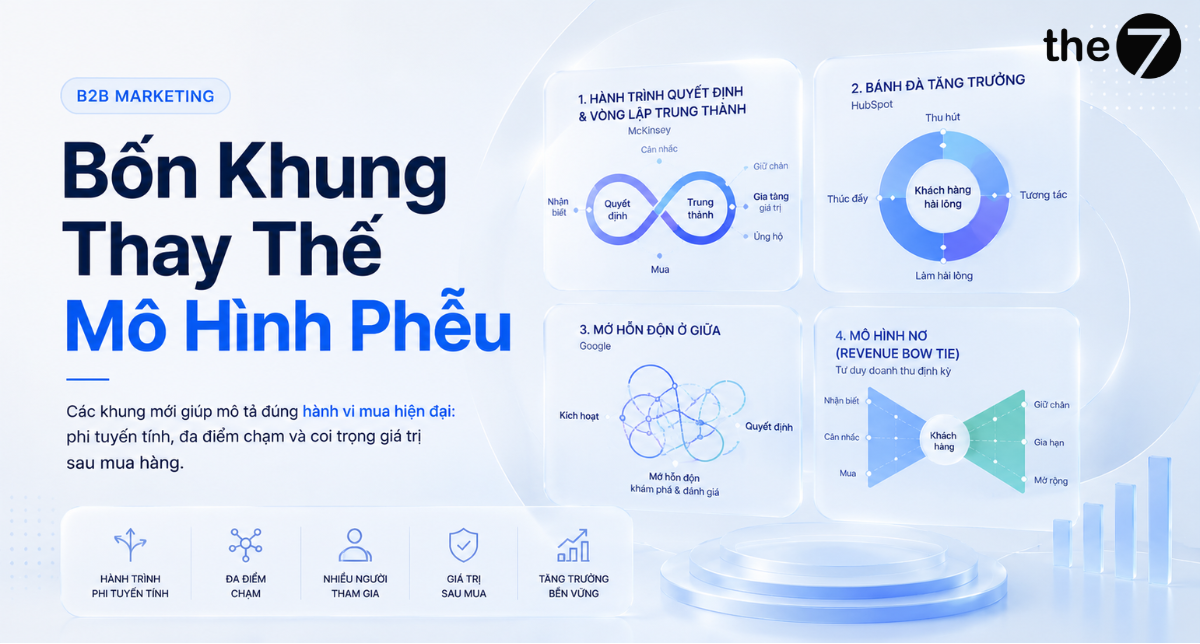
Four Frameworks That Replace the Funnel Model
Summary: As the funnel model increasingly fails to capture how modern buyers actually behave, a number of new frameworks have emerged to replace or repair it: McKinsey’s decision journey and...
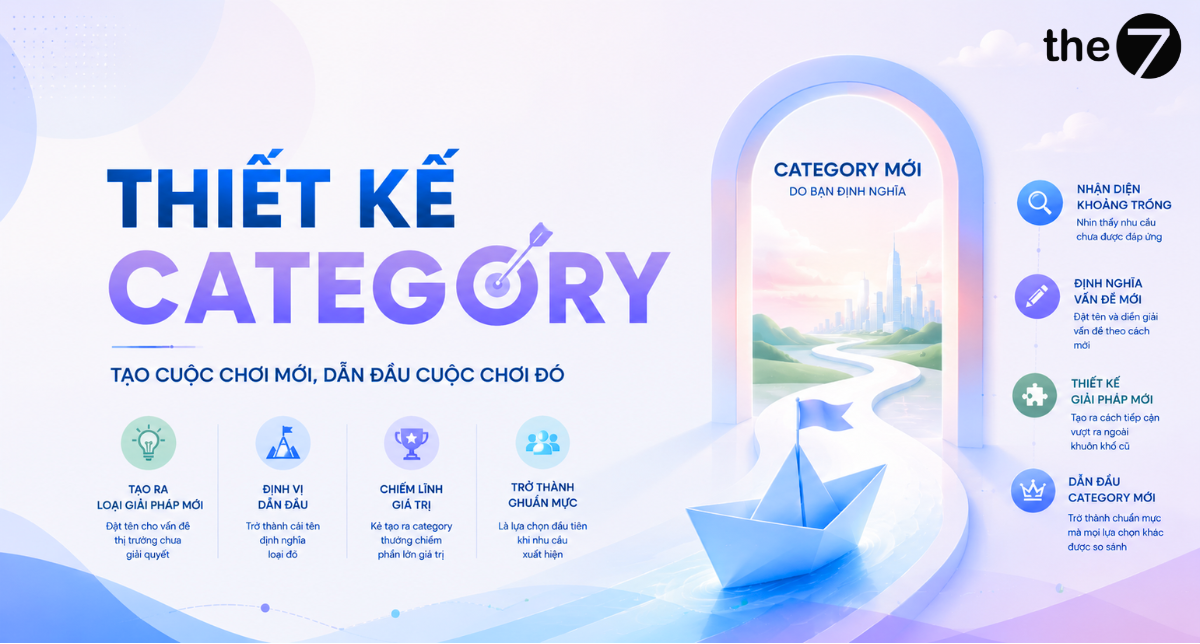
What Is Category Design?
Summary: Category design is the act of creating an entirely new type of solution in the market’s mind, instead of competing within an existing category, and then becoming the name...
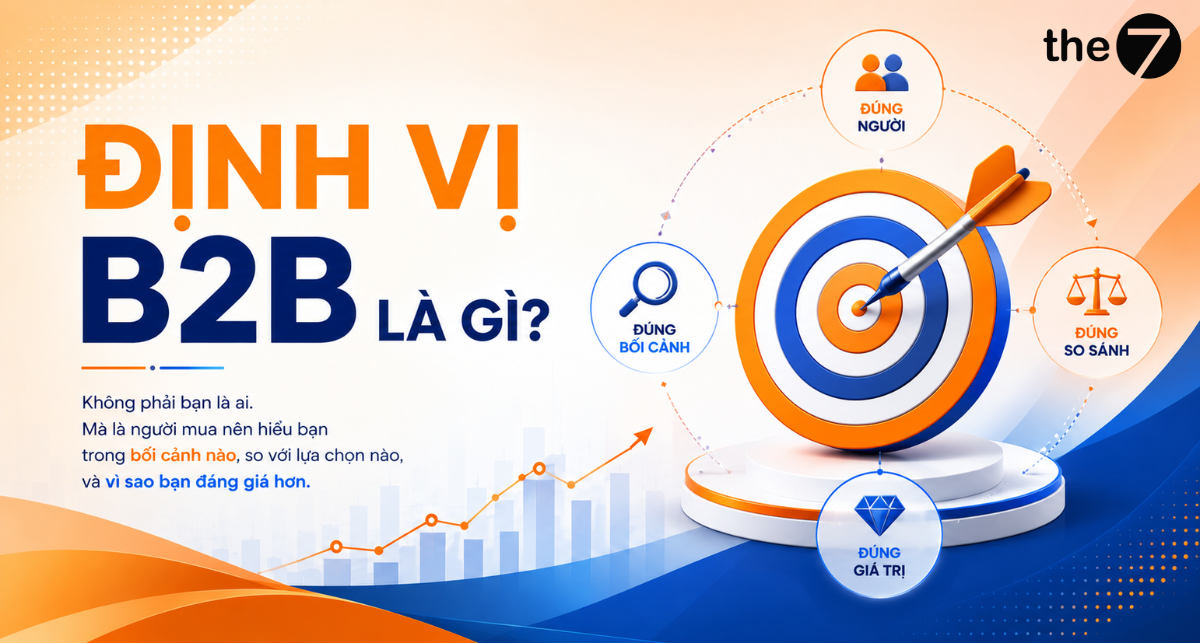
What Is B2B Positioning?
Summary: B2B positioning is the act of choosing the context you place your product into – the frame of reference that makes its value obvious to the buyer. Positioning isn’t...
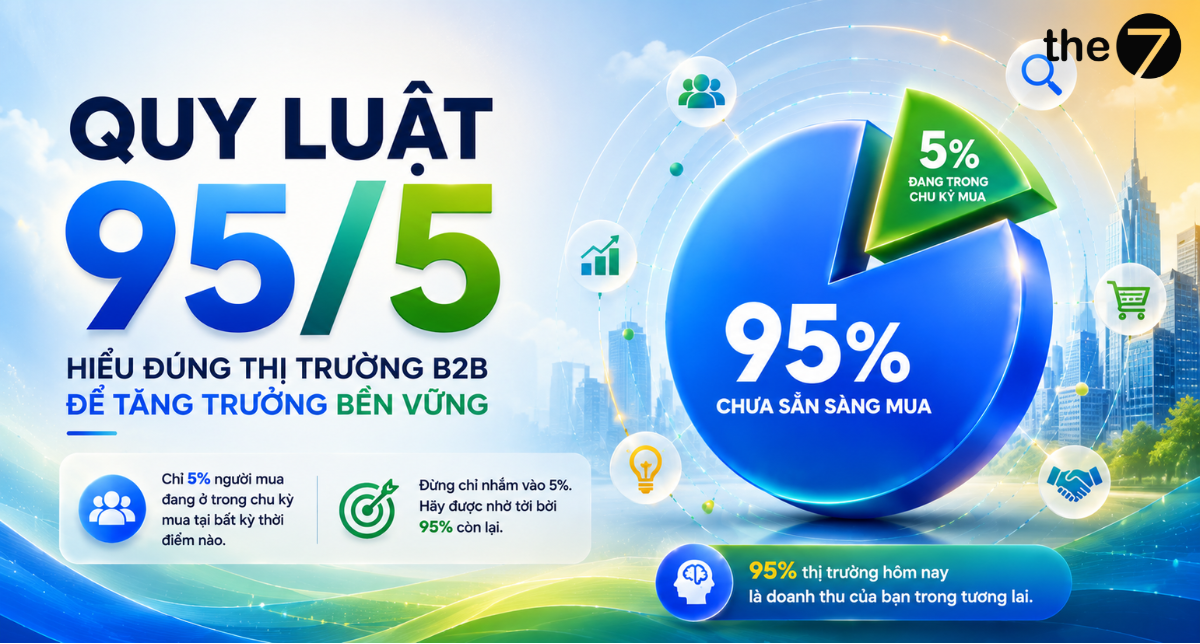
What Is the 95/5 Rule?
Summary: The 95/5 rule states that at any given moment, only about 5% of B2B buyers are actually in-market, actively in a buying cycle, while roughly 95% are not yet...
What Is Mental Availability in B2B?
Summary: Mental availability is how easily a brand comes to mind in a buying situation. It isn’t about having the sharpest argument, the slickest pitch, or the most convincing feature...
What Are B2B Events and Trade Shows?
Summary: B2B events and trade shows are in-person gatherings such as conferences, industry trade shows, workshops, and private meetings, where a business meets buyers, customers, partners, and the industry community...