


What Is Inbound Marketing?
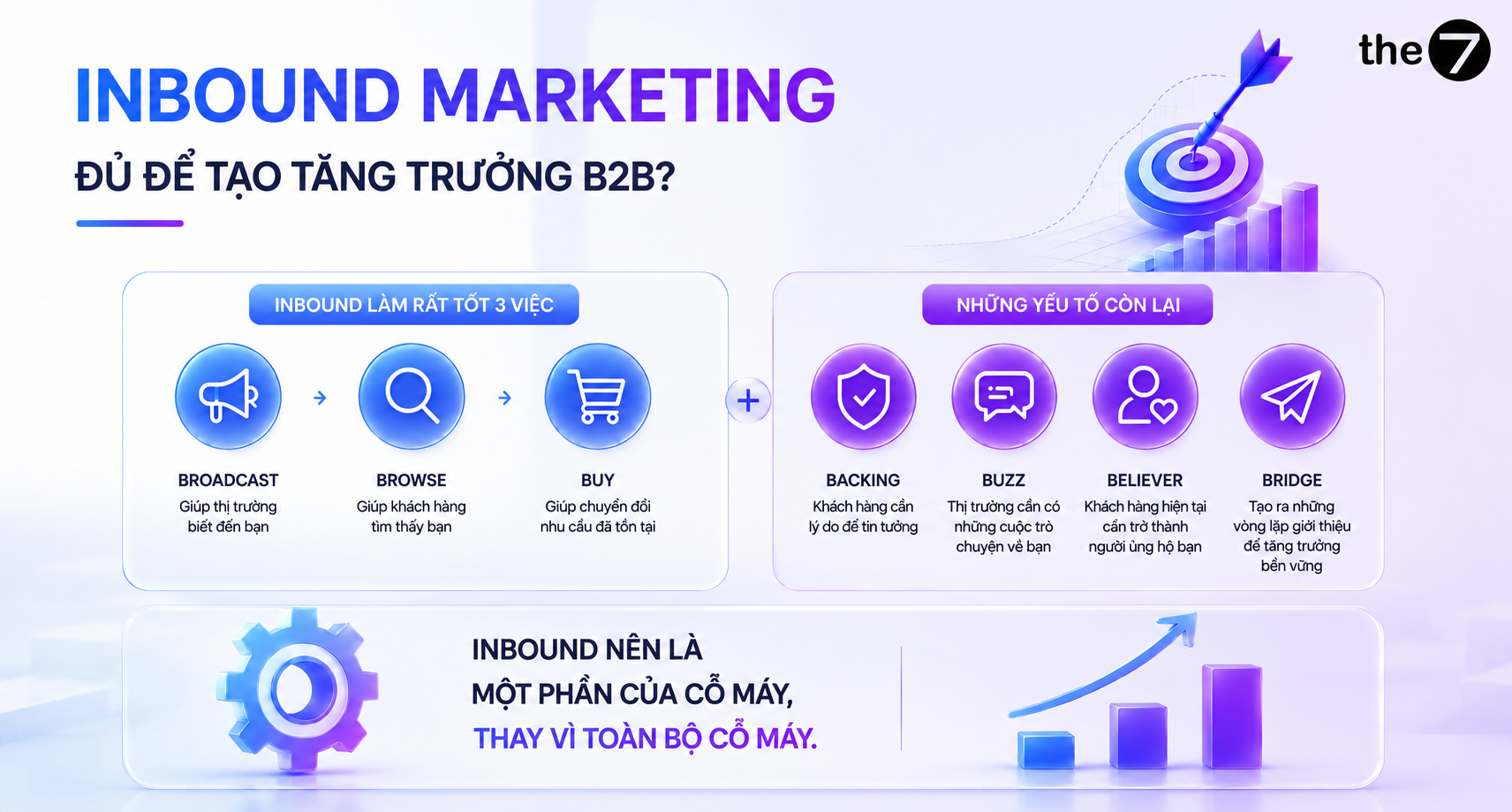
Inbound marketing is an approach that attracts buyers to come to you through useful content, instead of interrupting them with ads. It was popularized by HubSpot starting in 2006 and dominated B2B marketing thinking for a decade. Inbound isn’t wrong. But it only touches three of the seven gears in the 7B model, and it was designed for a buying world that no longer exists: one buyer, one straight-line journey, one funnel.
I have a fairly special relationship with inbound marketing. On one hand, I’m grateful for it. Inbound is one of the most important ideas ever to appear in B2B marketing. It helped an entire generation of marketers, myself included in my early years, escape the mindset of only buying ads and chasing customers. It popularized a very powerful principle: if you keep creating value for the market, customers will tend to come to you when they need to buy.
But on the other hand, I’ve also seen many businesses turn inbound into their entire marketing strategy. They build a blog. They create ebooks. They put download forms on their resources. They run nurture email sequences. Everything follows the textbook. And yet growth still stalls.
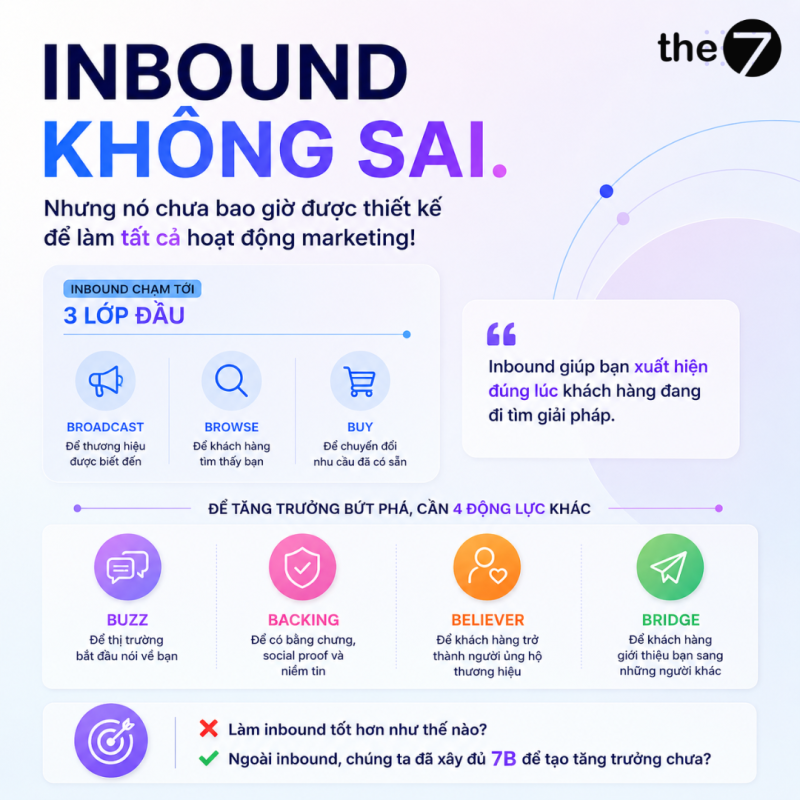
The problem isn’t that inbound is wrong. The problem is that many people mistook one part of the picture for the whole picture. This article isn’t meant to dismiss inbound marketing. On the contrary, I still believe inbound is a valuable idea. The goal of this article is to put inbound in its proper place: an important component, but only one component, of a much larger system.
First, let’s agree on a definition. Inbound marketing is a method of attracting customers with useful content and experiences, so they proactively come to the business instead of being interrupted by ads or outbound sales activity. The concept was popularized starting in 2006 by Brian Halligan and Dharmesh Shah, HubSpot’s two founders. The core idea is simple: if you help the market before you sell to the market, the market will remember you when a need arises.
How did inbound change B2B marketing?
For years, B2B marketing relied mainly on interrupting other people’s attention. Businesses bought email lists and blasted them. Sales called people who had never heard of the brand. Ads appeared in the middle of content people actually wanted to watch.
In 2006, Brian Halligan and Dharmesh Shah, HubSpot’s two founders, proposed a different idea. Instead of interrupting the buyer, help them. Instead of fighting for attention, become the thing they actively search for. From there, inbound marketing was born.
The formula is simple. Create content that answers the questions buyers are asking. Optimize it so they can find it on Google. Capture contact information when they want to dig deeper. Then nurture them with email until they’re ready to talk to sales.
This model worked extremely well for a decade. It was cheaper than interruptive advertising. It created a content asset that accumulated value over time. It helped businesses attract people actively searching for a solution instead of bothering people who weren’t interested yet.
HubSpot is the clearest proof. They built a massive content library, trained the market for free, and became the default answer to millions of marketing questions. People learned inbound from HubSpot, then bought HubSpot software to implement inbound.
That’s an excellent strategy. The problem is that many businesses saw inbound’s success and assumed inbound was the whole of marketing. In reality, it’s only one part of a much larger system.
So if inbound is that good, where’s the problem?
Inbound is right about its core principle: be helpful before you sell. That part still holds true today and will probably remain true for years to come. The problem isn’t the philosophy. The problem lies in the assumptions inbound was built on.
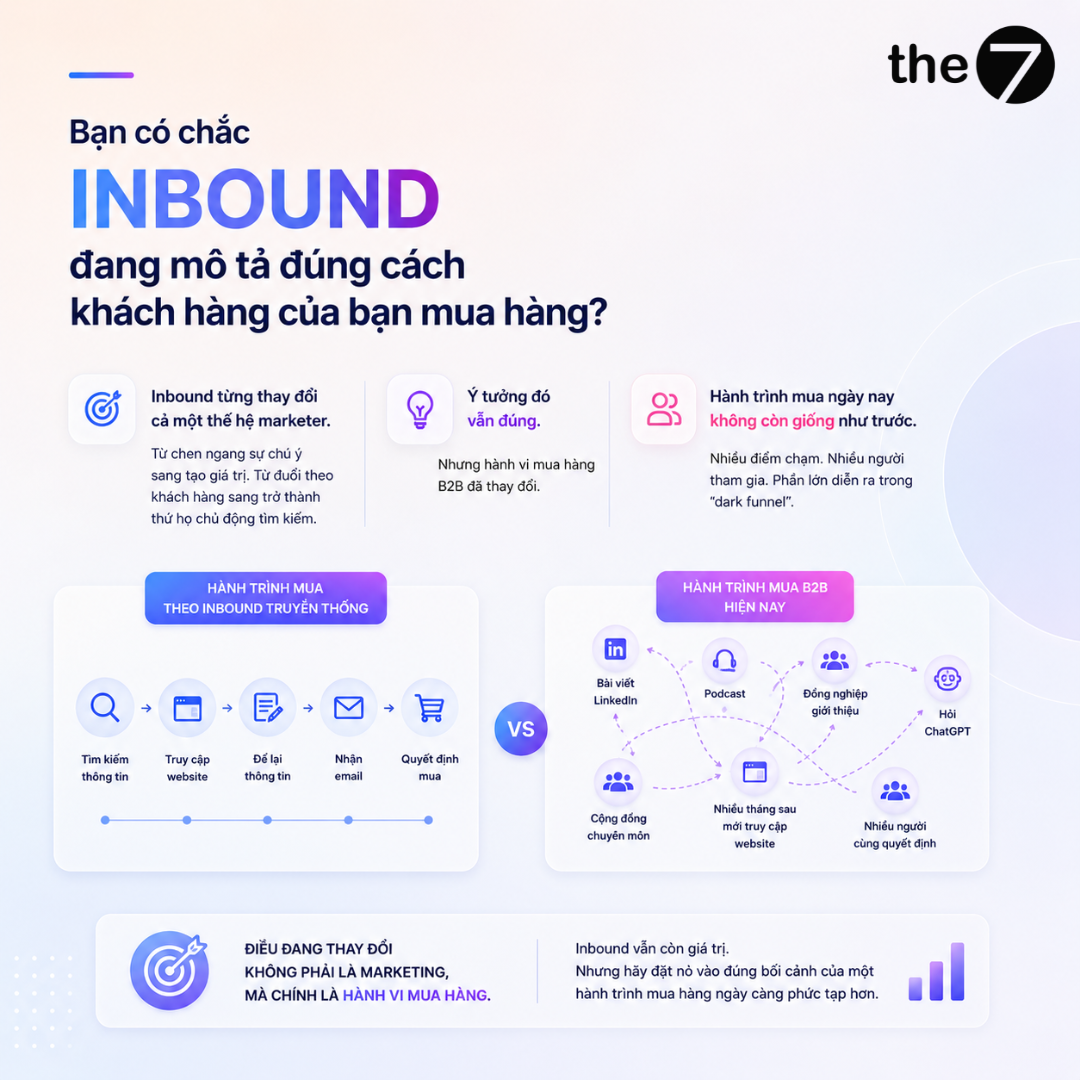
The first assumption is that the buying journey happens in a straight line. The buyer finds content, leaves their contact information, receives emails, and gradually moves toward a decision. But the real B2B buying journey rarely works that way. Someone might hear about you through a podcast, read a LinkedIn post months later, see your name come up in an internal conversation, ask ChatGPT, and only then visit your website. Touchpoints don’t line up into a straight path. They form a network.
The second assumption is that you’re selling to one person. Most of the inbound system is designed to nurture a single lead until they’re ready to talk to sales. But most B2B buying decisions aren’t made by one individual. They’re made by an entire group of people with different priorities, concerns, and levels of influence. Convincing one person doesn’t mean convincing the whole organization.
The third assumption is that everything important leaves a trace. The buyer reads an article, fills out a form, receives an email, and the business tracks that whole journey. But today, most research activity happens in places businesses can’t see. Buyers ask colleagues. Consult professional communities. Read content without leaving any information. Ask ChatGPT. Watch videos. Listen to podcasts. They form opinions long before filling out any form at all.
These three assumptions don’t make inbound a wrong idea. They just make inbound an incomplete one. Inbound is an important part of modern marketing. But it isn’t the whole of marketing. It describes a part of the buying journey, not the entire buying journey.
Where does inbound sit in the 7B model?
Here’s how I see inbound today: “Inbound isn’t a complete marketing system, it’s part of a larger system.” When you map inbound onto the 7B model, you’ll see most of its activity concentrated in three gears: Broadcast, Browse, and Buy.
Broadcast is publishing content so the market gets to know you. Browse is making that content surface when buyers actively search. Buy is converting people who’ve shown interest into sales opportunities and customers. That’s exactly what inbound does very well.
The problem is 7B doesn’t have three gears. It has seven. Inbound has almost no clear approach for Buzz, where others talk about you instead of you talking about yourself. It doesn’t treat Believer, meaning existing customers, as an independent marketing function. It doesn’t treat Backing as a proof system that needs to be built and run on its own. And it barely touches Bridge, the gear that turns existing customers into a source of new customers.
This isn’t a weakness of inbound. It’s simply inbound’s scope. But when a business uses inbound as its entire marketing strategy, it’s unknowingly leaving nearly half the machine idle.
This is why so many companies with a great blog, great SEO, and great email still see growth stall. They’ve optimized three gears to their limit, while the other four barely run at all. Inbound isn’t wrong — it’s just not the whole picture.
Let’s look at a few examples to see inbound’s limits clearly.
Amazon Web Services is probably one of the strongest inbound machines in the world. They own a massive library of technical documentation and show up in nearly every query an engineer might search. That’s Broadcast and Browse running almost perfectly. But AWS didn’t become a hundred-billion-dollar business on documentation alone. They also have a huge customer community, a global partner ecosystem, and events like re:Invent where customers learn more, use more, and refer more people. That’s Believer and Bridge.
In healthcare, Medtronic also produces a lot of content. But no hospital spends millions of dollars just because it read a blog post. Purchasing decisions are driven by clinical research, expert recommendations, and real-world evidence from organizations that have already implemented the solution. That’s Backing and Buzz — things that fall outside inbound’s scope.
Stripe is a similar example. Excellent technical documentation helped them become known. But what helped Stripe spread globally was thousands of partners, developers, and technology companies continuously recommending Stripe to others. That’s Bridge.
Three businesses. Three different industries. But the same pattern. Inbound helped them get found. The remaining gears helped them get chosen, trusted, and spread. That’s why no large business wins on inbound alone. They win because they run more gears than the three inbound touches.
How is inbound different from outbound and demand generation?
There are three concepts that often get conflated, and I want to separate them clearly.
Inbound and outbound are two opposite directions of the same question: who goes looking for whom. Inbound is the buyer finding you through content. Outbound is you proactively reaching the buyer through email, calls, or messages. Inbound pulls, outbound pushes. Both have their place. Outbound suits situations where you’re targeting a specific list of accounts and can’t afford to wait for them to come to you. Inbound suits situations where you want to build a cumulative content asset and let the market come to you. (See more on outbound marketing.)
Inbound and demand generation differ at the conceptual level. Inbound is a tactic, a way of attracting. Demand generation is a goal, an outcome. You can use inbound to help create demand, but inbound isn’t the whole of demand generation, because demand generation also needs Buzz, Believer, Backing, and Bridge — things inbound doesn’t touch. In other words, inbound is one of many paths, while demand generation is the entire forest. (See more on demand generation.)
Understanding these three concepts as distinct helps you escape the trap of thinking that doing inbound means you’ve done enough marketing. Inbound is only one part.
Three mistakes when implementing inbound
The first mistake is turning inbound into your entire marketing strategy.
Many businesses build a blog, do SEO, run email marketing, and then believe they have a complete growth machine. In reality, they’re only running part of the machine. Inbound is very strong at helping a business get found and considered. But it doesn’t create buzz in the market on its own, doesn’t turn customers into advocates on its own, and doesn’t create referral loops on its own. The issue isn’t doing inbound better. The issue is not stopping at inbound.
The second mistake is locking everything valuable behind a form.
Many businesses treat every piece of content as a good to be traded for contact information. They gate reports, gate research, gate in-depth content, and require readers to fill out a form before they can access it. The result is that most of the market never sees the best things they’ve created. Content whose job is to build presence should be spread as widely as possible. Only resources that genuinely serve the evaluation or purchase stage need a gate.
The third mistake is measuring success by lead volume.
Inbound leaves many businesses obsessed with how many forms get filled out each month. But leads aren’t revenue. And someone filling out a form doesn’t automatically mean they’ll buy. Meanwhile, a lot of real customers never fill out any form before reaching out. When you optimize for lead volume, it’s very easy to optimize for the wrong goal. What matters isn’t how many people filled out a form, but how many real sales opportunities were actually created.
Conclusion: inbound is part of the machine, not the whole machine
Inbound helped an entire generation of marketers escape the interruptive-advertising mindset. It taught us an important lesson: if you keep creating value for the market, the market will tend to come to you when a need arises. That part still holds true.
But today’s B2B buying world no longer operates the way inbound was originally designed for. Buyers don’t move in a straight line. Decisions aren’t made by one individual. And most of the research journey happens in places businesses can’t directly observe. That’s why inbound isn’t wrong. It’s just not enough.
In the 7B model, inbound runs three gears very well: Broadcast, Browse, and Buy. But sustainable growth doesn’t come from three gears. It comes from all seven gears turning together.
A business relying on inbound alone can still grow. But at some point, it will hit a ceiling. Not because inbound stops working, but because the remaining gears were never activated. Inbound is an important part of the machine. But it isn’t the whole machine.

Nguyễn Đình
Bảo




As CEO of The7, I am committed to sharing practical, useful knowledge with every reader. Every article on The7 is based on my 7 years of hands-on experience in marketing — Facebook advertising, LinkedIn advertising, Google advertising, and marketing strategy. I hope you take away plenty of insight from these posts and apply it successfully in practice.
Related Articles
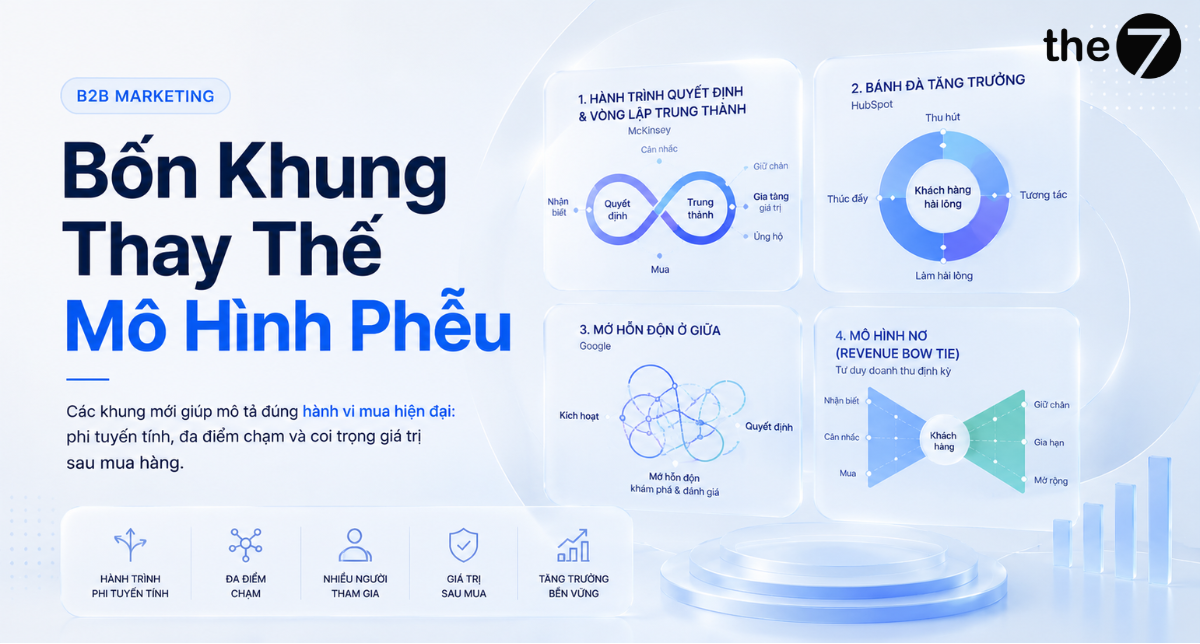
Four Frameworks That Replace the Funnel Model
Summary: As the funnel model increasingly fails to capture how modern buyers actually behave, a number of new frameworks have emerged to replace or repair it: McKinsey’s decision journey and...
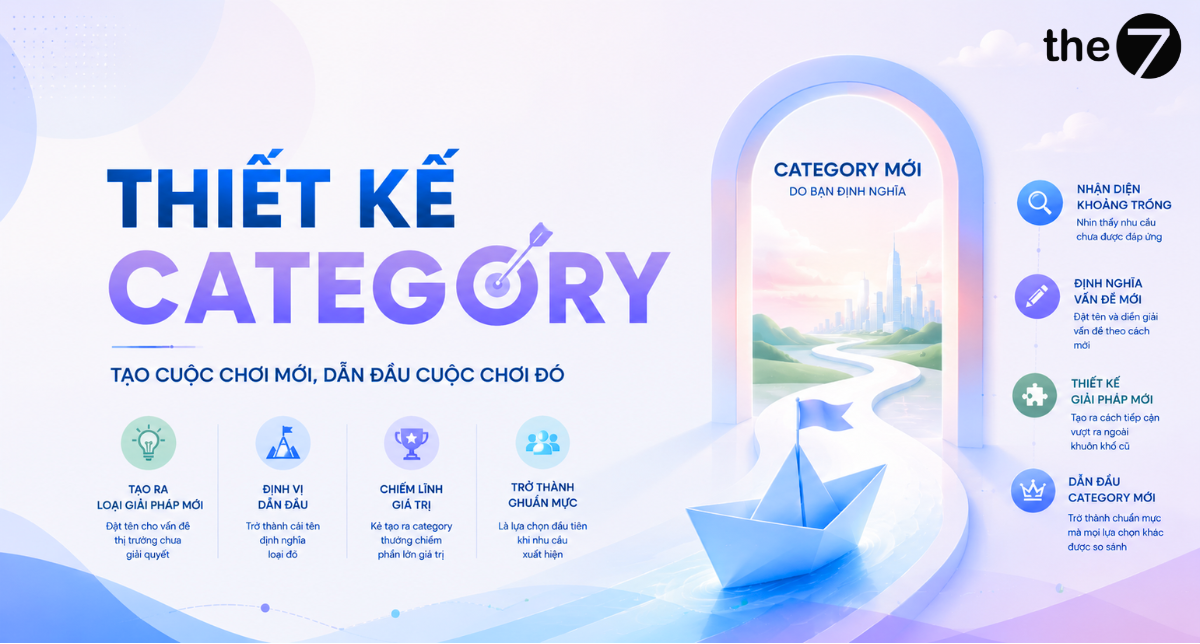
What Is Category Design?
Summary: Category design is the act of creating an entirely new type of solution in the market’s mind, instead of competing within an existing category, and then becoming the name...
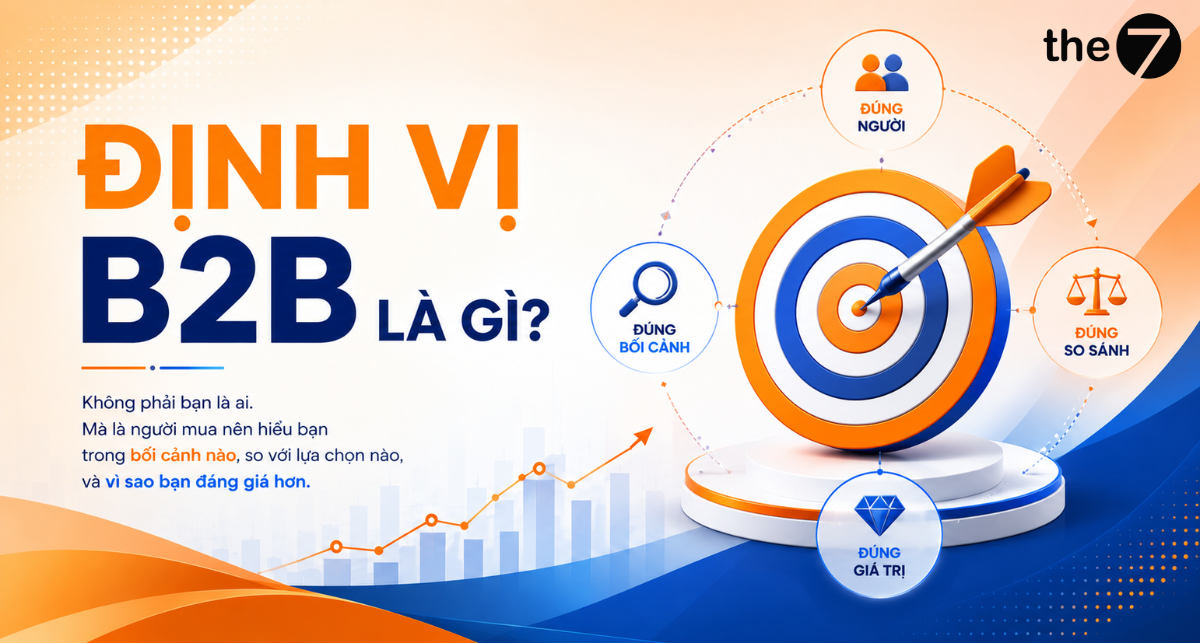
What Is B2B Positioning?
Summary: B2B positioning is the act of choosing the context you place your product into – the frame of reference that makes its value obvious to the buyer. Positioning isn’t...
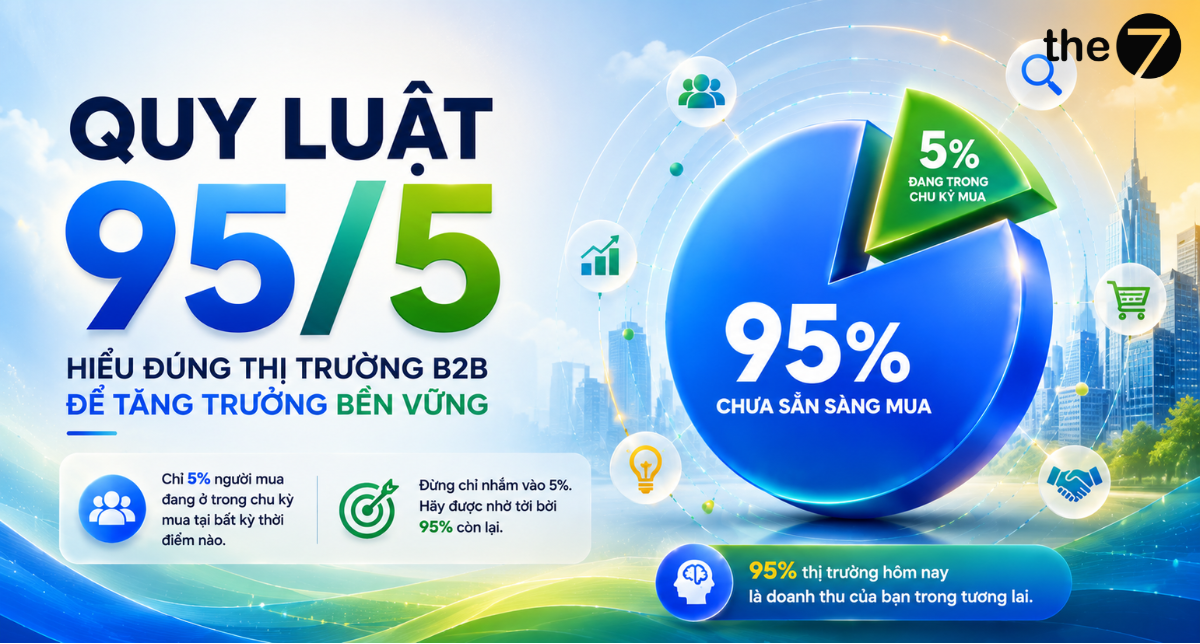
What Is the 95/5 Rule?
Summary: The 95/5 rule states that at any given moment, only about 5% of B2B buyers are actually in-market, actively in a buying cycle, while roughly 95% are not yet...
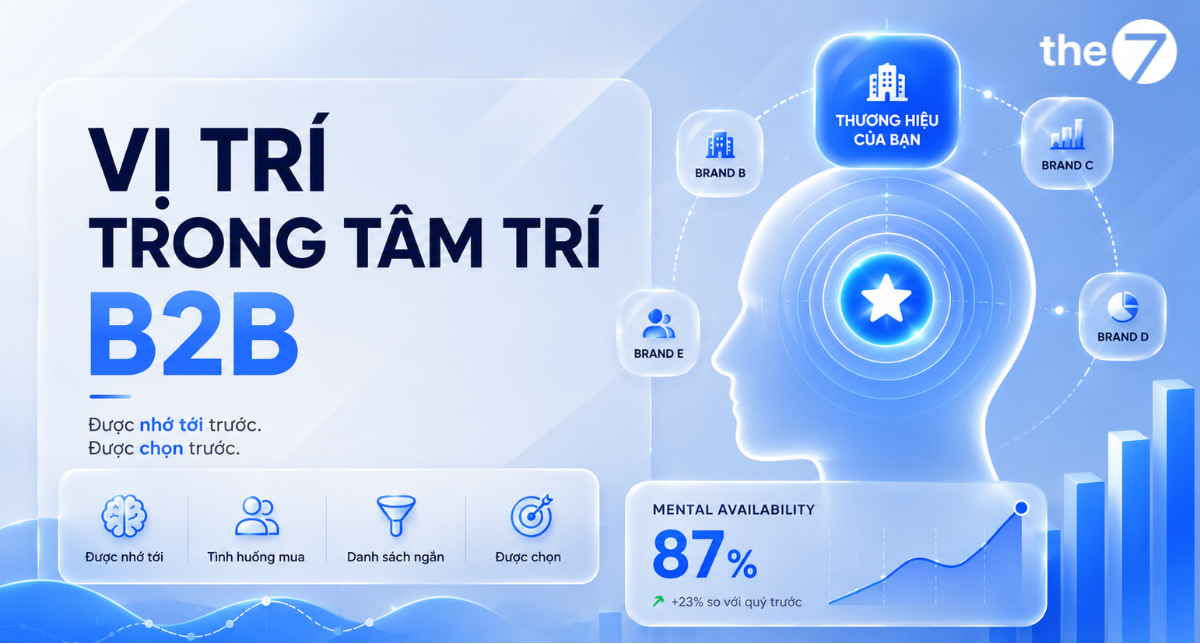
What Is Mental Availability in B2B?
Summary: Mental availability is how easily a brand comes to mind in a buying situation. It isn’t about having the sharpest argument, the slickest pitch, or the most convincing feature...
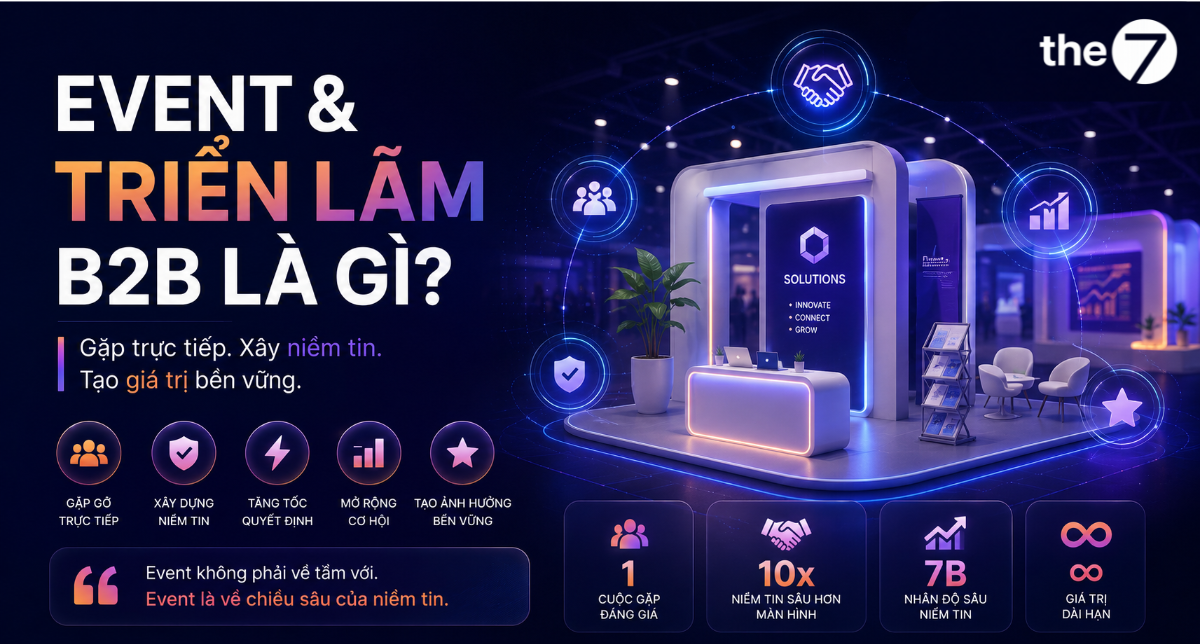
What Are B2B Events and Trade Shows?
Summary: B2B events and trade shows are in-person gatherings such as conferences, industry trade shows, workshops, and private meetings, where a business meets buyers, customers, partners, and the industry community...