


What Is B2B PR?
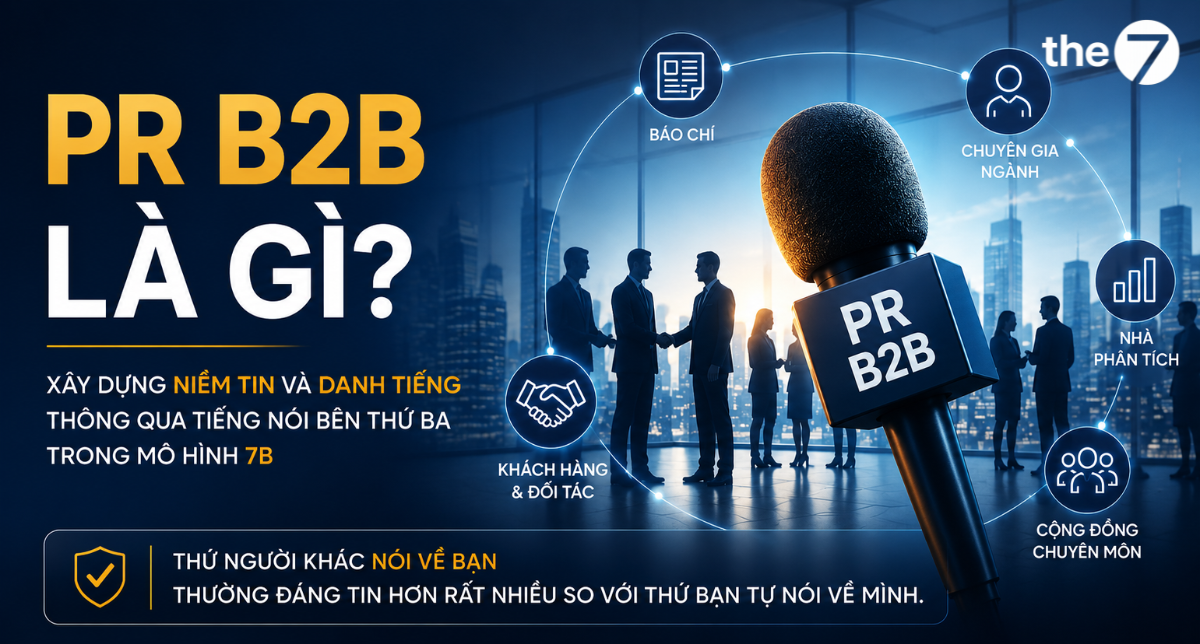
Summary: B2B PR is about building reputation and trust for a business through third-party voices — journalists, industry experts, analysts, customers, professional communities, and other independent sources — instead of relying only on the business talking about itself. The real power of PR doesn’t lie in how many times you appear in the press. It lies in a very simple truth: what other people say about you is almost always more credible than what you say about yourself. In the 7B model, PR is one of the main engines behind the Buzz gear, where the noise about you comes not from advertising or your own published content, but from sources buyers trust more than they trust you.
Most B2B businesses still understand PR in a fairly narrow, old-fashioned sense: write a press release, send it to the media, try to get covered, then count how many articles mentioned the company name at the end of the month. To them, PR feels like a secondary activity, usually ranked behind advertising, sales, events, or direct lead-generation work. If there’s budget, they do it; if not, they skip it. And when they measure it, they measure it with very surface-level metrics: how many posts, how many appearances, how many outlets mentioned the brand.
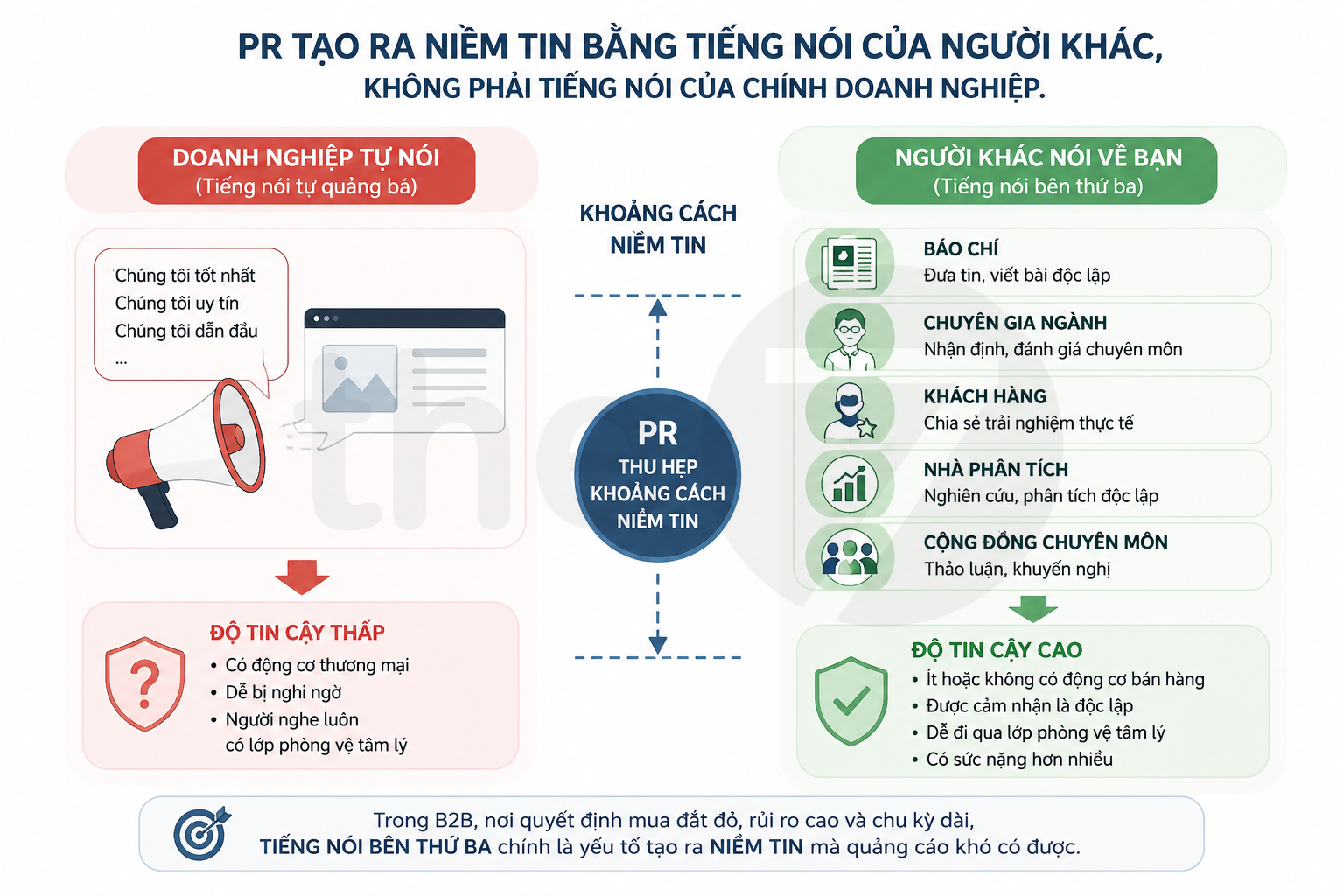
That view isn’t entirely wrong, but it’s far too shallow. It sees PR’s shell but misses the core that actually makes PR valuable. PR doesn’t exist just to get a business “in the news.” It exists because of a deeper principle of human trust: we tend to believe what others say about a party more than what that party says about itself. When a business says it’s good, credible, or a leader, listeners automatically discount it, because they know the business has a commercial motive. But when a journalist, an industry expert, a real customer, or an independent analyst says the same thing, it carries more weight, because it doesn’t come directly from the seller.
The entire value of PR lies in that trust gap. On one side is self-promotional speech, which always gets discounted because listeners know you’re trying to sell something. On the other side is independent speech, or at least speech perceived as independent, which can more easily get past a buyer’s psychological defenses. In B2B, where purchase decisions are often expensive, high-risk, multi-stakeholder, and slow, this trust gap matters even more. Buyers don’t just ask “what does this business say about itself” — they also ask “what does everyone else say about this business.”
This article is here to clarify what B2B PR really is, why it matters more than its old-fashioned appearance suggests, why PR becomes even more important in an era of declining trust, and where PR sits within the 7B model. First, we need to start with the definition.
B2B PR, short for public relations in a business environment, is the activity of building, maintaining, and managing a business’s reputation through third-party channels and voices — journalists, industry experts, analysts, independent organizations, customers, partners, professional communities, and industry influencers. Unlike advertising, where a business pays to talk about itself however it wants, PR seeks to have other sources talk about the business in a more credible way. It’s precisely that third-party element that creates the kind of trust advertising struggles to earn.
Why has trust left the institutions?
To understand B2B PR today, you can’t just look at the press or media releases. You have to look at a much bigger shift: how human trust has changed over the past two decades. Today’s buyers no longer default to trusting official institutions the way they once did. They’re more skeptical of mass media, more skeptical of government, more skeptical of corporate messaging, and especially skeptical of anything that smells too much like advertising. This isn’t just a feeling. It’s been measured for years.
Since 2000, Edelman has run an annual global survey called the Edelman Trust Barometer, measuring public trust in institutions such as government, media, business, and NGOs. Across more than two decades of data, a clear trend emerges: trust in traditional authority sources has declined, while trust has tended to shift toward sources seen as closer, more specific, and less propagandistic — technical experts, peers, professional communities, and independent voices.
This matters especially in B2B. In a B2B environment, buyers usually aren’t just buying a product. They’re buying a decision that can affect their work, their budget, their operating systems, and their own personal standing inside the organization. So they’re highly sensitive to risk. They don’t want to hear only from the seller. They want to know what people who understand the industry are saying, what other customers are saying, what experts are saying, what analysts are saying, what the community is saying. In other words, they seek outside validation before they’re willing to trust a business’s promises.
One finding that repeats year after year in the Edelman Trust Barometer is worth noting: people tend to trust technical experts or people like themselves more than they trust business leaders or a company’s official messaging. This is a very significant signal for B2B marketing. It shows that the closer a voice is to real expertise, real experience, and the buyer’s real interests, the more credible it becomes. Conversely, the more official, the more polished, and the more obviously commercially motivated a voice is, the easier it is to doubt.
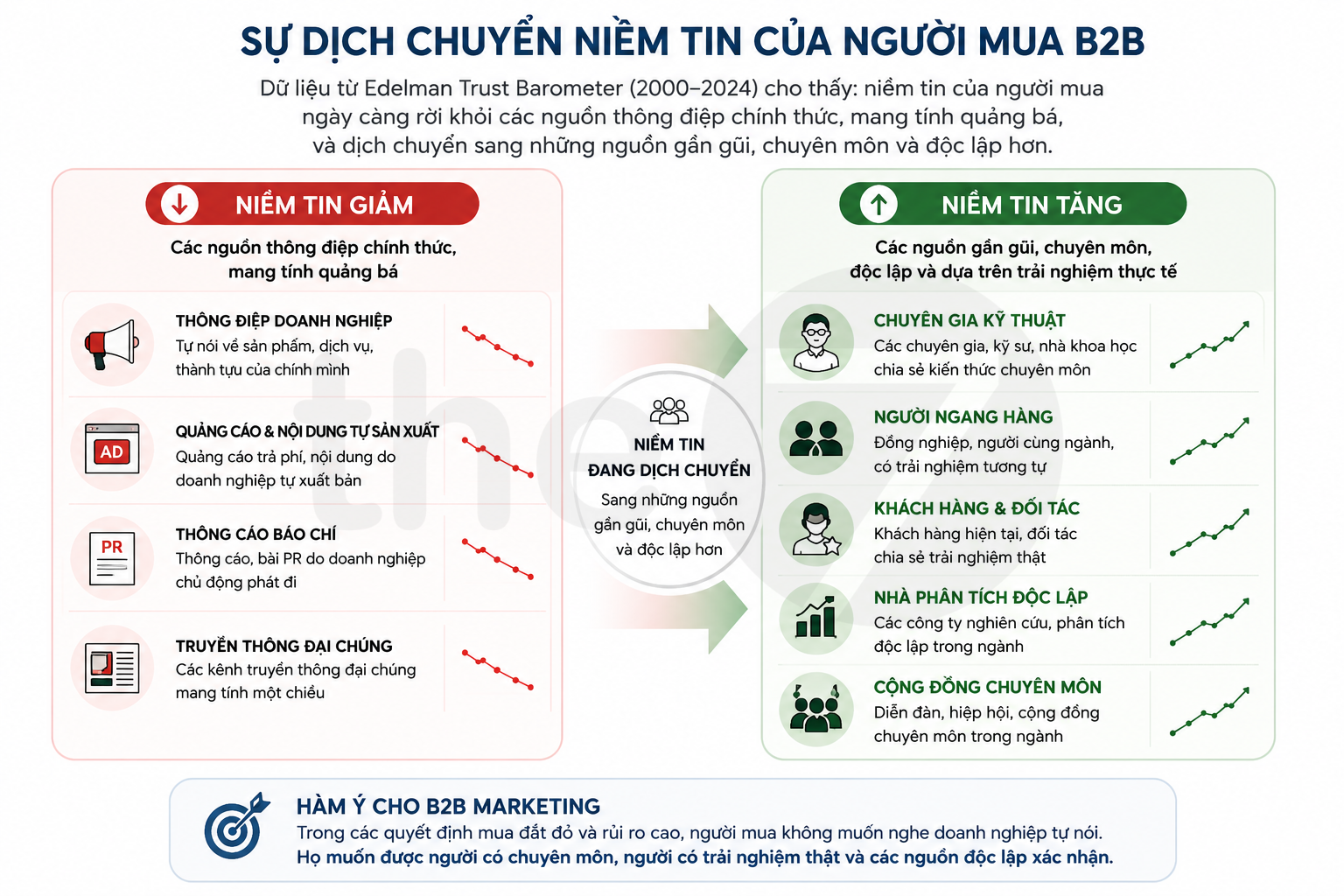
This shift completely reshapes the role of PR. If buyers are increasingly skeptical of a business’s own messaging, then the value of having a credible third party speak well of you only grows. This is a paradox many businesses haven’t noticed. They think PR has become obsolete because traditional media no longer holds the absolute power it once did. But in fact, precisely because trust in official messaging has declined, the demand for independent voices has grown even larger. PR hasn’t weakened. PR has simply changed shape.
In the past, PR was understood almost synonymously with media relations. Businesses tried to get journalists to write about them, to get covered, to appear in respected sections. That still has value, but modern PR is much broader. A credible third-party voice today isn’t only a journalist. It could be a well-regarded industry expert on LinkedIn, an analyst that buying committees consult, a real customer sharing their experience, a professional community discussing a vendor, an industry podcast buyers listen to regularly, or an independent report the industry trusts.
In other words, modern PR is the art of getting voices more credible than yourself to say good things about you. Not every such voice needs to appear in a major outlet. Not every such voice needs to generate massive views. What matters more is that it carries weight with the specific group of buyers you need to influence. A small analysis piece read by the right buying committee can be worth more than a mass-audience article with hundreds of thousands of views that no one in your target market cares about.
This is why B2B PR shouldn’t be seen as a surface-level communications activity. It’s part of a trust-building strategy. When buyers don’t trust your ads, they might still trust an independent analysis. When they don’t trust your sales pitch, they might still trust what another customer says. When they don’t trust your self-published blog post, they might still trust an industry expert talking about you who doesn’t look like they’re selling anything for you. PR is how a business enters those zones of trust.
Why is third-party speech more credible than self-promotion?
The trust shift explains the context of modern PR. But there’s a deeper principle explaining why third-party speech always carries more weight than self-promotion, regardless of era: people always evaluate speech based on the speaker’s motive.
When you say good things about yourself, listeners almost automatically discount it. Not because they hate you. Not because they assume you’re definitely lying. But because they understand you have a motive. A business saying “our product is the best, our service is the most professional, our solution is the most effective” is exactly what anyone would expect a business to say. That statement doesn’t create much new information, because it’s too convenient for the speaker’s own interest. The buyer thinks: of course you’d say that, you’re trying to sell something.
This is the fundamental problem with every self-promotional message. It might be true, but because the speaker benefits from saying it, the listener still doubts it. A company can genuinely be good. A solution can genuinely be strong. A team can genuinely be professional. But when the company itself says so, the message loses value. Listeners don’t just process the content of a statement — they also process the source of that statement. And when the source has an obvious commercial motive, credibility drops.
When an independent third party says good things about you, the psychological math reverses. A journalist writes about your business as a noteworthy example in the industry. A technical expert praises your solution. A customer describes how your product solved a real problem for them. An analyst places you among the vendors worth considering. Those voices don’t come directly from your marketing department, so listeners perceive them as more credible. They think: this person has no obvious reason to praise you, so maybe it’s true.
This is why a single line in an independent analysis piece can sometimes be worth more than an entire ad campaign. Advertising can build reach, build awareness, keep the market reminded, and it still plays a very important role. But advertising always carries the mark of self-interested motive. Third-party voices, if genuinely independent, carry something advertising can never create on its own: the credibility of a source that isn’t directly selling.
PR is how a business earns that kind of voice. And the word “earns” matters a great deal here. If a third-party voice is seen as paid, staged, or over-controlled, it immediately loses most of its value. When buyers realize an article is just a disguised ad, a compliment is just sponsored content, a review is just a pre-written script, they push it back into the same bucket as advertising. At that point, the third-party voice is no longer really third party. It’s just the business’s own voice wearing someone else’s mouth.
So the most important boundary of genuine PR is independence. PR isn’t buying a voice. PR isn’t forcing someone to say exactly the words you want. PR isn’t turning a journalist, expert, or customer into a mouthpiece for the brand. Real PR is creating something credible enough, notable enough, and valuable enough that independent voices have a genuine reason to talk about you.
This also explains why PR is harder than advertising. With advertising, you can buy space, buy impressions, buy clicks, buy reach. With PR, you can’t buy credibility that directly. You can hire a PR team, build relationships, prepare a narrative, provide data, and make it easier for journalists and experts to access information. But ultimately, if what you’re offering isn’t worth talking about, the echo will be very weak. PR can’t save a business that has nothing worth other people mentioning.
Real PR is earned, not bought
Precisely because PR’s power lies in independent voices, the core trait that separates PR from advertising is this: PR must be earned, not bought.
Advertising is space you buy. You pay to appear in front of a specific group of people. You control the message. You control the imagery. You control the timing. You control the call to action. In return, viewers know it’s an ad, so they receive it with a certain level of guard. High control comes paired with lower credibility.
PR runs in the opposite direction. You can’t fully control what a journalist will write, how an expert will comment, how a customer will tell their story, or which direction a community discussion will take. You can prepare, guide, provide information, and build relationships, but you don’t fully own that voice. In exchange for losing control, you gain credibility. Precisely because listeners feel you don’t fully control the message, they trust it more.
This trade-off between control and credibility sits at the center of PR. Businesses that want PR but still want the same control as advertising usually end up ruining PR. They want the journalist to write exactly the lines in their press release. They want the expert to say exactly the brand’s talking points. They want the customer to tell the story to a perfect script. But the tighter the control, the less natural the voice becomes. The more it resembles advertising, the more PR loses its value. A compliment that feels natural, independent, and unscripted carries far more weight than a polished paragraph of praise that reads like it was written by the marketing department.
Because PR has to be earned, the real work of PR isn’t writing a generic press release and blasting it to media outlets. That’s a very small, and usually the least important, part of the job. The real work of PR is creating something worth noticing: a story that’s genuinely worth telling, data that genuinely has news value, a perspective that’s genuinely sharp, an achievement that’s genuinely worth recognizing, a debate genuinely worth joining, or an industry shift significant enough that other people want to talk about it.
A B2B business can’t just say “we have a good solution.” That line is too ordinary. But if the business has proprietary data on a major shift in market buying behavior, that can be a story. If the business has a contrarian but well-grounded view on how the industry is getting something wrong, that can be a story. If the business helped a major customer solve a very difficult operational problem, and the customer is willing to tell that story in their own words, that can be a story. If the business creates a new standard, a new metric, an original piece of research, or a new way of categorizing the industry, that can be a story too.
In other words, PR doesn’t start with the question “how do we get in the news.” PR starts with the question “what do we have that’s worth other people wanting to talk about.” If the answer is nothing, then every PR activity that follows will be weak. You might squeeze out a few placements, buy a few spots, generate a little noise, but it’s hard to create real trust. But if the business has something genuinely worth saying, PR becomes a very powerful amplifier. It helps real value get seen through voices more credible than the business itself.
This is also why PR can’t be an activity bolted on at the very end, after everything else is finished. Many businesses build the product, build the sales motion, run the ads, and only then call in PR to “push some coverage.” But if the business hasn’t created a story, hasn’t got data, hasn’t got a point of view, hasn’t got evidence, hasn’t got a customer willing to speak up from the start, PR has almost no raw material to work with. Good PR isn’t just a communications technique. Good PR needs to be tied to strategy, product, customer experience, market research, and the business’s real capabilities.
PR amplifies what deserves to be amplified. It doesn’t create value out of thin air. It can’t turn a forgettable business into a trusted brand with just a few articles. It also can’t turn an empty story into a real echo. PR only shows its power when there’s something solid underneath it: real capability, real results, real data, a real point of view, real customers, and a real reason for the market to care.
Where does PR fit in the 7B model?
When you place PR within the 7B model, its position becomes very clear. PR is one of the main engines behind the Buzz gear.
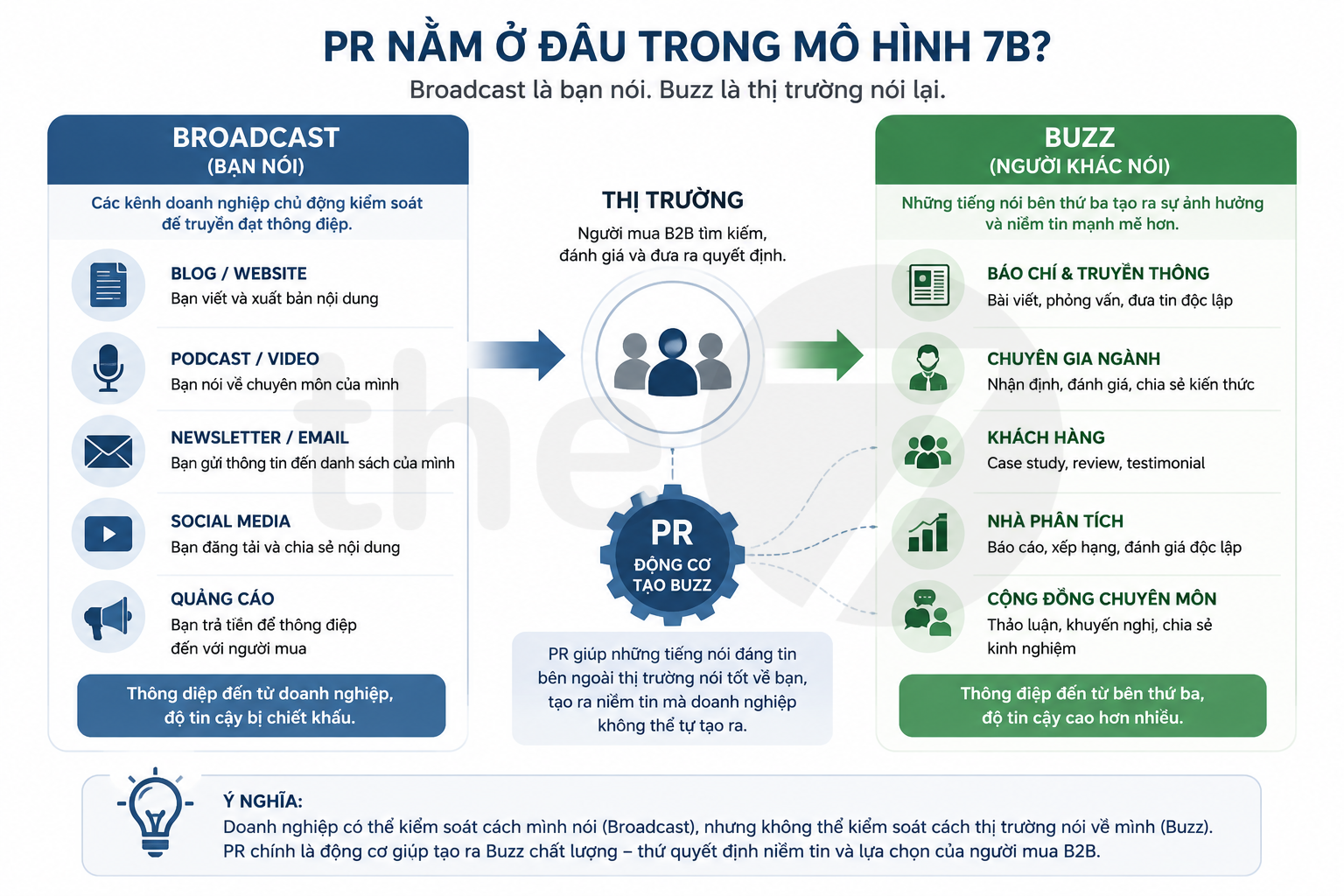
Buzz is the gear of third-party echo. It’s everything other people say about you, instead of what you say about yourself. When a journalist writes about you, that’s Buzz. When an industry expert mentions you in an analysis piece, that’s Buzz. When an analyst puts you on a list of noteworthy vendors, that’s Buzz. When a customer describes their real experience with your product, that’s Buzz. When an industry community discusses your point of view, your data, or your methodology, that’s Buzz too.
PR is the systematic engine for generating that kind of echo, instead of leaving it to chance. If Buzz is what the market says about you, PR is how you give the market a better reason to say it. Not by forcing them to repeat your slogans, but by giving them a story, data, evidence, and a perspective valuable enough that they want to talk about it.
It’s important to clearly separate Buzz from Broadcast, because these two gears are easy to confuse. Broadcast is your own voice. It’s the article you publish yourself, the video you shoot yourself, the podcast you produce yourself, the newsletter you send yourself, the report you release yourself, the ad you run yourself. Broadcast gives you a high degree of control. What you say, when you say it, who you say it to, in what tone — you decide. But because it’s your own voice, listeners will discount part of it.
Buzz is the opposite. Buzz is other people’s voice about you. You don’t fully control it, but that’s exactly why it’s more credible. A customer telling their own story carries different weight than you writing a self-congratulatory post. An independent expert analyzing why your approach is noteworthy carries different weight than you calling yourself a leader. An objective news article mentioning you in an industry context carries different weight than an ad displaying the same message.
A strong 7B engine needs both Broadcast and Buzz. Broadcast helps you build the core narrative, repeat your point of view, educate the market, and keep the initiative in your own messaging. Buzz helps that narrative get validated by sources more credible than you. Broadcast is you speaking. Buzz is the market speaking back. Broadcast plants the idea. Buzz makes that idea look more real in the buyer’s eyes, because they’re not just hearing it from you — they’re hearing it from many different sources.
This is where PR connects directly to real buying behavior in B2B. Most of the influence that matters most to a buyer doesn’t come from a single ad or a single self-published article. It comes from the sum of many signals: what colleagues say, what experts say, what the press says, what other customers say, what analysts say, what the community says. Buyers might not explicitly say they were influenced by PR, but they’re often making decisions inside an information environment that PR has already shaped.
Much of this echo also happens in places the business never sees. An article might get shared in a private chat group. An analyst report might get passed around internally among buying committee members. An expert’s praise might get mentioned in a meeting. A customer story might be used as evidence to ease a CFO’s, CTO’s, or CEO’s concerns. Businesses can’t always trace these touchpoints, but that doesn’t make them less important. In fact, many of the strongest influences in B2B happen in places that can’t be clearly measured.
Let’s look at a few examples across different industries to see how PR generates Buzz.
In enterprise technology, a company might invest in relationships with industry analysts. These are voices that many enterprise buyers trust when evaluating vendors. When a reputable analyst places the company among the noteworthy names, or ranks it highly in an industry report, that validation carries enormous weight. It’s nothing like an ad saying “we’re a good choice.” It’s more like outside evidence that this company genuinely deserves consideration. This is PR generating Buzz through analyst voices.
In financial services, a company might build relationships with reputable financial media by providing them data, analysis, and perspectives that genuinely have news value. When a trusted financial outlet quotes the company’s view as an expert source, the company borrows part of that outlet’s credibility. Readers don’t just see the company’s name. They see the company appearing in the role of a knowledgeable source. This is PR earning a voice through real value, not buying a placement for the sake of appearing somewhere.
In manufacturing, an equipment supplier might let its customer tell the real story of how the equipment helped solve a difficult operational problem. That story is far more credible than the supplier saying its equipment is effective. Because the customer is the one who used it, took on the risk, and experienced the results, their account carries different weight. This is PR generating Buzz through customer voices, one of the strongest forms of voice in B2B.
In professional services, a consulting firm might build PR through sharp market perspectives, original research reports, or opinions capable of shaping how the industry views a particular issue. If the perspective is fresh and sound enough, the press, experts, and the community will repeat it. At that point, the firm isn’t known only as a service provider — it becomes known as a source of thought. This is PR connecting very closely with thought leadership, because the echo doesn’t come from bragging about capability, but from the market recognizing a valuable way of seeing things.
Four examples, four contexts, but the same principle: PR creates value by getting voices more credible than yourself to say good things about you, or at least to validate that you’re worth paying attention to.
Types of third-party voices in B2B PR
To do B2B PR well, businesses need to understand that not all third-party voices are the same. Each type of voice plays a different role in buyer trust, and each requires a different approach.
The press is the most familiar type of voice. Its value lies in the ability to place a business within a broader context — industry trends, market shifts, growth stories, new data, social issues, or technology shifts. But the press shouldn’t be used as a place to post self-congratulatory releases. Journalists need stories that have value for their readers. So to get good press coverage, businesses have to learn to think like a newsroom: what’s new, what’s unusual, what’s important, what affects the market, what has evidence, what’s worth a reader’s time.
Industry analysts are a very important type of voice in many B2B sectors, especially technology, software, infrastructure, complex manufacturing, and enterprise solutions. They might not generate mass reach, but they have deep influence over buying committees. An analyst doesn’t just build awareness. They can influence the shortlist of vendors considered, the evaluation criteria, and the buyer’s perceived risk. Doing PR with this group demands a higher level of rigor: clear product data, provable capabilities, real reference customers, a credible roadmap, and the ability to answer deep technical questions.
Industry experts and thought leaders play an increasingly large role, especially in markets where buyers often learn through LinkedIn, podcasts, newsletters, conferences, professional communities, or private groups. They aren’t necessarily journalists, nor are they necessarily formal analysts, but they hold credibility with a specific audience. When they mention your business as a noteworthy example, the impact can be very strong, because their audience often already trusts them. However, this group is very sensitive to inauthenticity. If the approach feels too transactional, too bought, or too much like advertising, the voice loses its natural feel.
Customers are one of the strongest sources of PR, but also one of the most commonly misused. Many businesses turn customer stories into overly polished case studies full of generic praise and short on real detail. A good customer story doesn’t need to be perfect. It needs to be real. It needs context before adopting the solution, a specific problem, the implementation process, the difficulties, the results, and the reason the customer believes the solution was worth it. It’s precisely the less-than-perfectly-smooth details that sometimes make a story more credible, because they show this isn’t a pre-written advertising script.
Professional communities are the hardest type of voice to control, but they can be very powerful. In many B2B industries, buyers ask each other in private groups, industry forums, professional communities, closed circles, or personal networks. A business can almost never control these conversations, but it can influence them indirectly by creating a good experience, holding a clear point of view, providing useful resources, building loyal customers, and maintaining a consistent reputation. This is where PR overlaps with dark social, where the real echo happens outside the visibility of any dashboard.
Understanding these types of voices, a business stops asking the generic question “how do we do PR.” The better question is: which voice carries the most weight with our buyers, and have we created enough reason for that voice to mention us. For an enterprise technology company, analysts may matter enormously. For a consulting firm, industry experts and business media may matter more. For a B2B manufacturer, existing customers and industry partners may be the strongest PR source. There’s no single formula for every business, but the principle never changes: go to where the trust already lives.
Three mistakes in B2B PR
The first mistake is measuring PR by the number of media mentions. Many businesses still think PR success means having as many articles as possible mentioning their name. But the number of mentions doesn’t reflect what PR is really supposed to create: trust. One mention from a very credible source can be worth more than twenty mentions on channels nobody in the target market trusts. One article read by the right buying committee can matter more than ten posts that only create noise on the outside. The right approach isn’t just counting volume — it’s evaluating the quality of the voice: is the source credible, is it relevant to the buyer, does it place the business in a positive context, does it create evidence, does it help reduce perceived risk.
The second mistake is trying to control something that shouldn’t be fully controlled. Some businesses want PR but want it to run like advertising. They want to control exactly what the journalist writes, what the expert says, what the customer shares. But it’s precisely that lack of full control that creates credibility. The moment a voice looks scripted, bought, or overly steered, listeners will notice and dock trust for it. The right approach is to focus on creating something worth talking about, providing clear information, preparing good evidence, building genuine relationships, and then letting independent voices speak in their own natural way.
The third mistake is doing PR when there’s nothing worth saying. This is the most common mistake and also the hardest to fix. Many businesses want press coverage, want experts to mention them, want customers to tell stories, but don’t have unique data, a sharp point of view, strong enough results, real customer stories, or any notable contribution to the industry. In that case, PR becomes nothing more than a technique for pushing information around. And bland information, no matter how hard you push it, rarely becomes a real echo. The right approach is to invest first in PR’s raw material: original research, real achievements, real customers, real points of view, real evidence, and real stories.
There’s a fourth mistake worth mentioning too: separating PR from business strategy. PR shouldn’t be an activity that only makes the brand look pretty. In B2B, PR has to serve the market’s trust, support strategic positioning, reduce perceived risk in the buyer’s eyes, and help the other gears turn better. Good PR makes Broadcast more credible, because your message gets validated from outside. Good PR makes Browse stronger, because when buyers research you, they find independent sources talking about you. Good PR supports Buy, because the sales team has more outside evidence to use during the sales process. Good PR feeds Believer, because customers and the community have one more reason to feel proud of being associated with you.
What should you measure B2B PR by?
If you shouldn’t measure PR just by the number of mentions, then what should you measure it by? The answer isn’t to stop measuring. The answer is to measure the right layer of value that PR actually creates.
The first layer is source quality. An article on a source the market trusts has different value than a post on a less relevant channel. In B2B, relevance usually matters more than size. A small source that’s followed by the right buyers, the right experts, and the right buying committees can be worth more than a large but mass-market source. So when measuring PR, ask: who does this source influence, who reads it, who trusts it, and does it sit inside the buyer’s information ecosystem.
The second layer is context quality. Just getting mentioned isn’t automatically good. What context you’re mentioned in is what matters. Are you mentioned as an ordinary vendor, or as a leading example? Are you mentioned in a positive story about innovation, capability, growth, research, expertise — or do you just appear as a passing name? A deep analysis piece that places you in a credible position is worth far more than a shallow name-drop.
The third layer is reusability across the buying journey. A good PR result doesn’t just live once, at the moment it’s published. It can be reused in sales materials, on the website, in presentations, in nurture emails, in capability documents, in LinkedIn content, or in conversations with prospects. If an article, a review, a report, or a customer story helps the sales team answer the question “why should I trust you,” it carries value that goes far beyond its initial view count.
The fourth layer is impact on trust and positioning. This layer is harder to measure, but it’s the most important. After a period of PR activity, does the market see the business differently? Do buyers find it easier to trust? Do experts start mentioning the business more? Do prospects come into meetings with a higher level of familiarity? Does the sales team hear “I’ve seen you somewhere before” more often? These signals aren’t always as tidy as CPM or CPC, but they reflect the true nature of PR far better.
Measuring PR properly means shifting from the question “how many times did we appear” to the question “what are credible voices saying about us, to whom, in what context, and does it make buyers trust us more.” This way of measuring fits B2B better, because B2B doesn’t sell on attention alone. B2B sells on trust.
Conclusion: what others say about you is more credible than what you say about yourself
Back to where I started. Businesses that treat PR as writing press releases and counting media mentions are missing exactly what makes PR valuable. PR isn’t about appearing in the media for its own sake. PR is about earning voices more credible than yourself to say good things about you, or to validate that you’re worth paying attention to, in an era when buyers are increasingly skeptical of a business’s own official messaging.
The power of PR lies in the trust gap between what you say about yourself and what others say about you. When you praise yourself, listeners automatically discount it because they know you have a motive. When an independent third party says good things about you, that statement carries more weight because it doesn’t come directly from the seller. This is why PR must be earned rather than bought. It’s also why a single line in an independent analysis, a validation from an expert, a real story from a customer, or a remark from a reputable journalist can be worth far more than an entire ad campaign made up of nothing but self-praise.
In the 7B model, PR is one of the main engines behind the Buzz gear. It helps the echo about you come from sources buyers trust more than they trust you. Broadcast helps you tell your own story. Buzz gets that story validated by the market. A business with only Broadcast has to keep talking about itself forever. A business that adds Buzz starts getting other people to speak for it. And in B2B, where the risk of buying is high, the sales cycle is long, and trust is the hardest asset to earn, having others speak for you is usually far more powerful than talking about yourself forever.
Don’t ask how many times PR got you into the news. Ask what credible voices in your industry are saying about you. Ask whether buyers hear about you from any source other than yourself. Ask whether, when a buying committee looks for evidence, they find enough independent validation to reduce their perceived risk. And most importantly, ask whether your business already has something genuinely worth other people wanting to talk about.

Nguyễn Đình
Bảo




As CEO of The7, I am committed to sharing practical, useful knowledge with every reader. Every article on The7 is based on my 7 years of hands-on experience in marketing — Facebook advertising, LinkedIn advertising, Google advertising, and marketing strategy. I hope you take away plenty of insight from these posts and apply it successfully in practice.
Related Articles
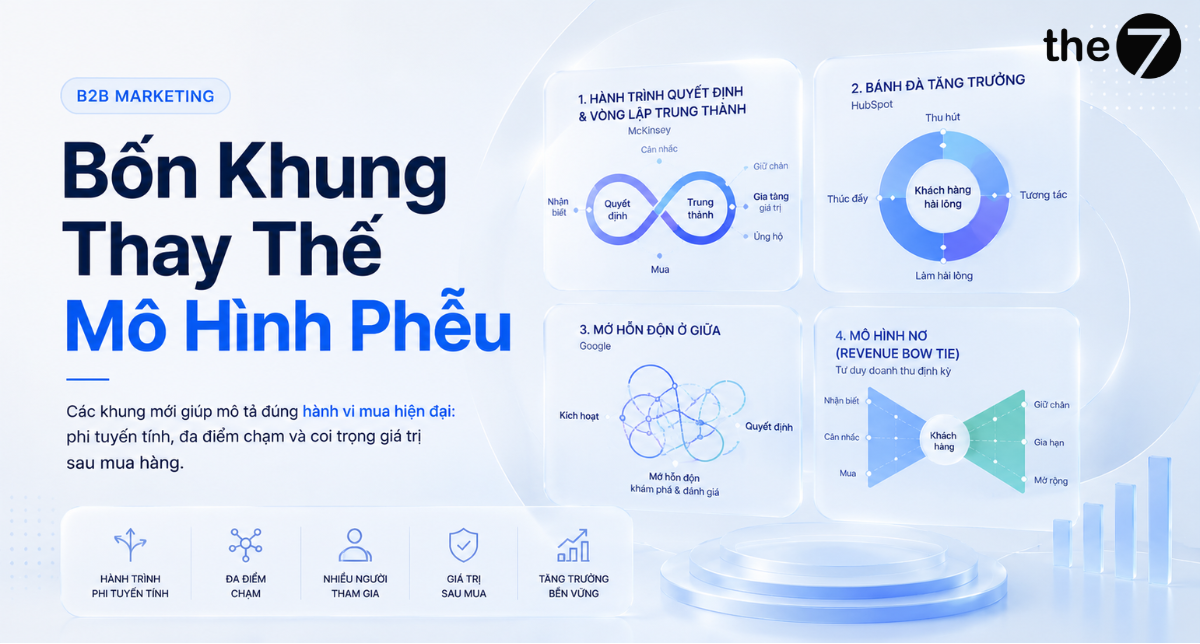
Four Frameworks That Replace the Funnel Model
Summary: As the funnel model increasingly fails to capture how modern buyers actually behave, a number of new frameworks have emerged to replace or repair it: McKinsey’s decision journey and...
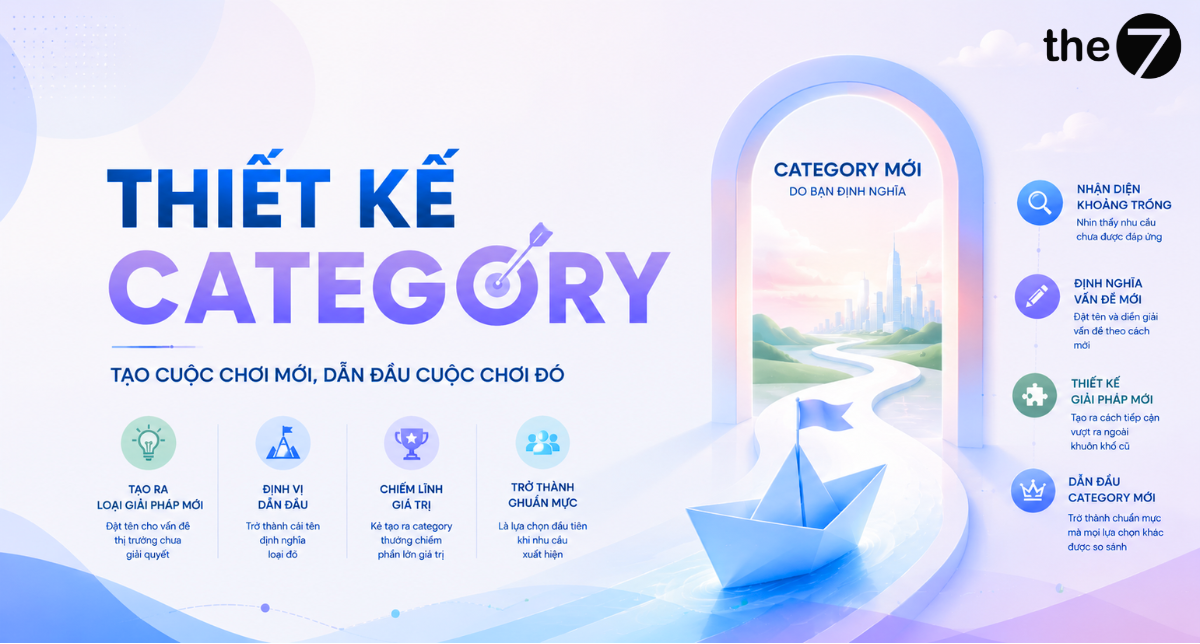
What Is Category Design?
Summary: Category design is the act of creating an entirely new type of solution in the market’s mind, instead of competing within an existing category, and then becoming the name...
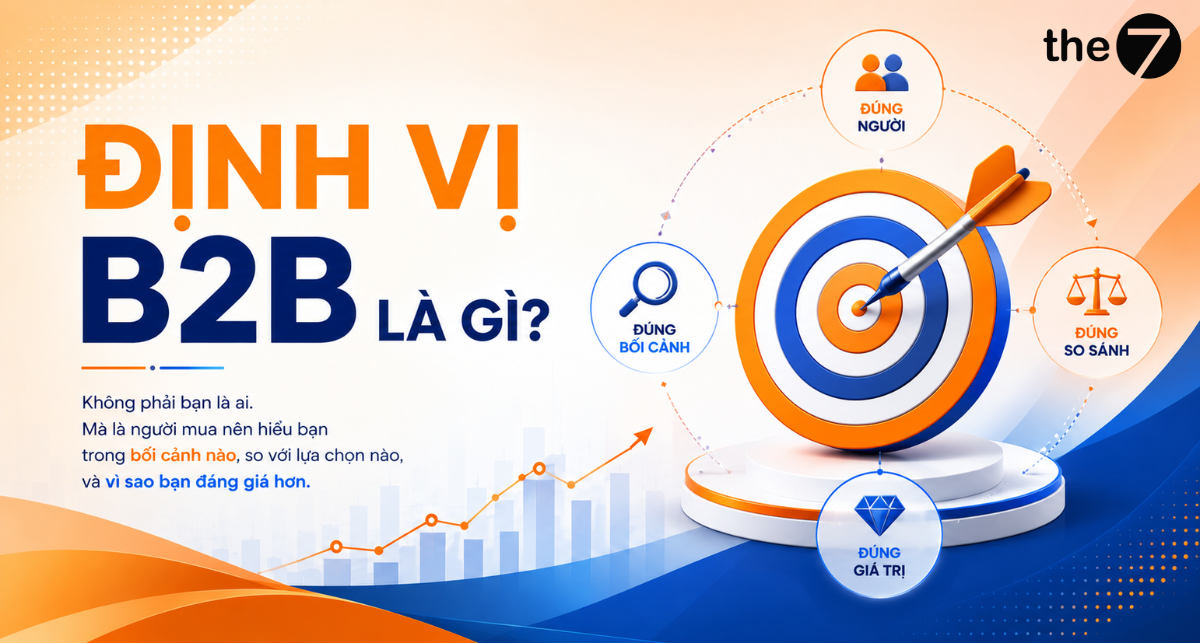
What Is B2B Positioning?
Summary: B2B positioning is the act of choosing the context you place your product into – the frame of reference that makes its value obvious to the buyer. Positioning isn’t...
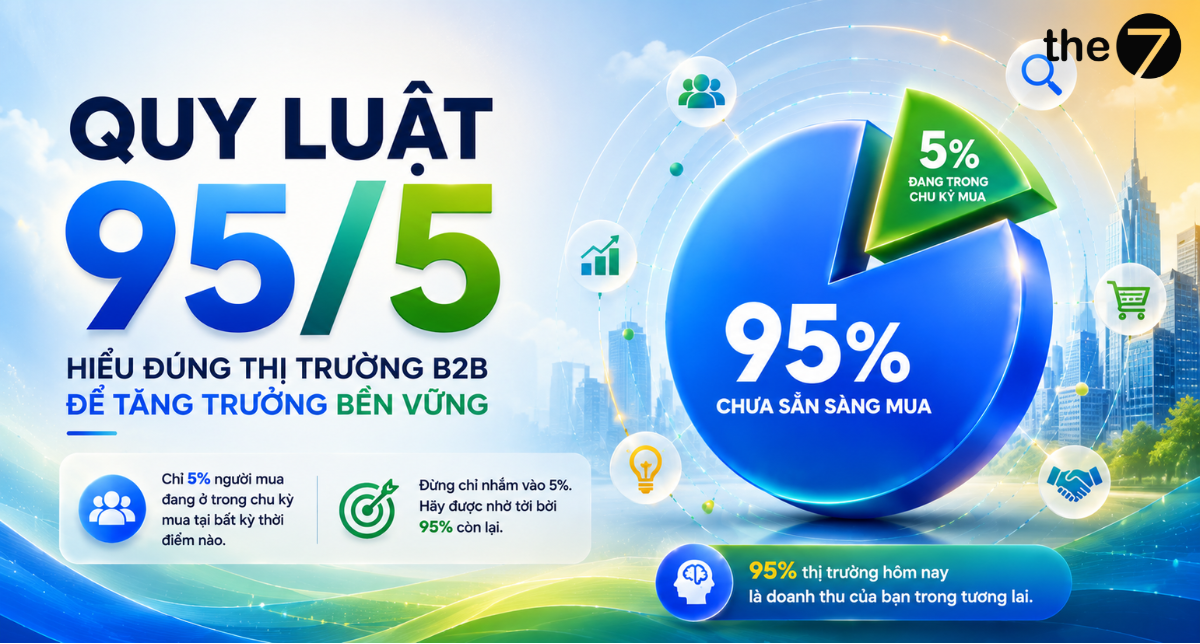
What Is the 95/5 Rule?
Summary: The 95/5 rule states that at any given moment, only about 5% of B2B buyers are actually in-market, actively in a buying cycle, while roughly 95% are not yet...
What Is Mental Availability in B2B?
Summary: Mental availability is how easily a brand comes to mind in a buying situation. It isn’t about having the sharpest argument, the slickest pitch, or the most convincing feature...
What Are B2B Events and Trade Shows?
Summary: B2B events and trade shows are in-person gatherings such as conferences, industry trade shows, workshops, and private meetings, where a business meets buyers, customers, partners, and the industry community...