


What Is B2B Community Marketing?
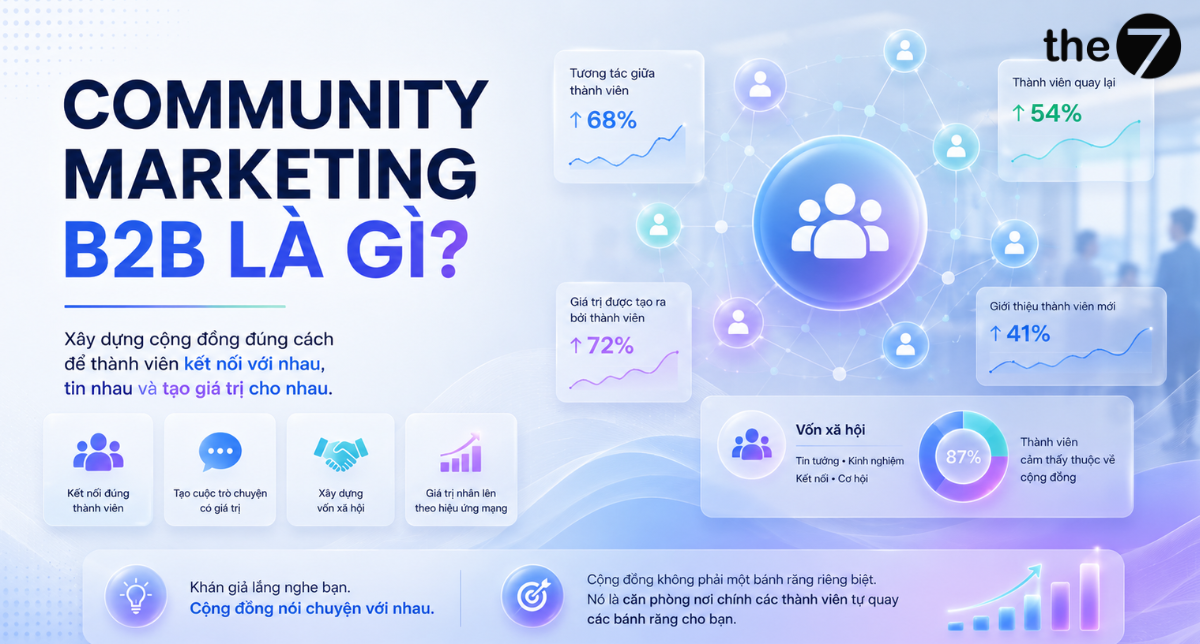
Summary: B2B community marketing is about building and nurturing a community where members connect with each other around a shared interest, not just with the brand. The core distinction comes down to one line: an audience listens to you, a community talks to itself. The power of a community comes from the social capital it creates, from humans’ deep need to belong, and from the network effect that multiplies value with every member. In the 7B model, community isn’t a separate gear. It’s the room where the members themselves turn the gears for you.
Most B2B businesses say they want to build a community, but what they actually build is just an audience tucked inside a small group. They set up a Facebook group, a LinkedIn group, a community on Slack, Discord, Zalo, or a dedicated platform. Then they invite people to join, post content, share announcements, run a few livestreams, and wait for engagement. From the outside, it looks like a community. There are members, posts, comments, a place for people to gather. But look closely at how value actually flows inside, and you’ll find most of these groups still operate like a one-way broadcast channel.
The brand talks, members listen. The brand posts, members watch. The brand asks, members offer a token reply. All the energy still flows outward from the brand, and participants remain just as passive as on any other channel. That’s not a community. That’s an audience sitting in a room labeled “community.”
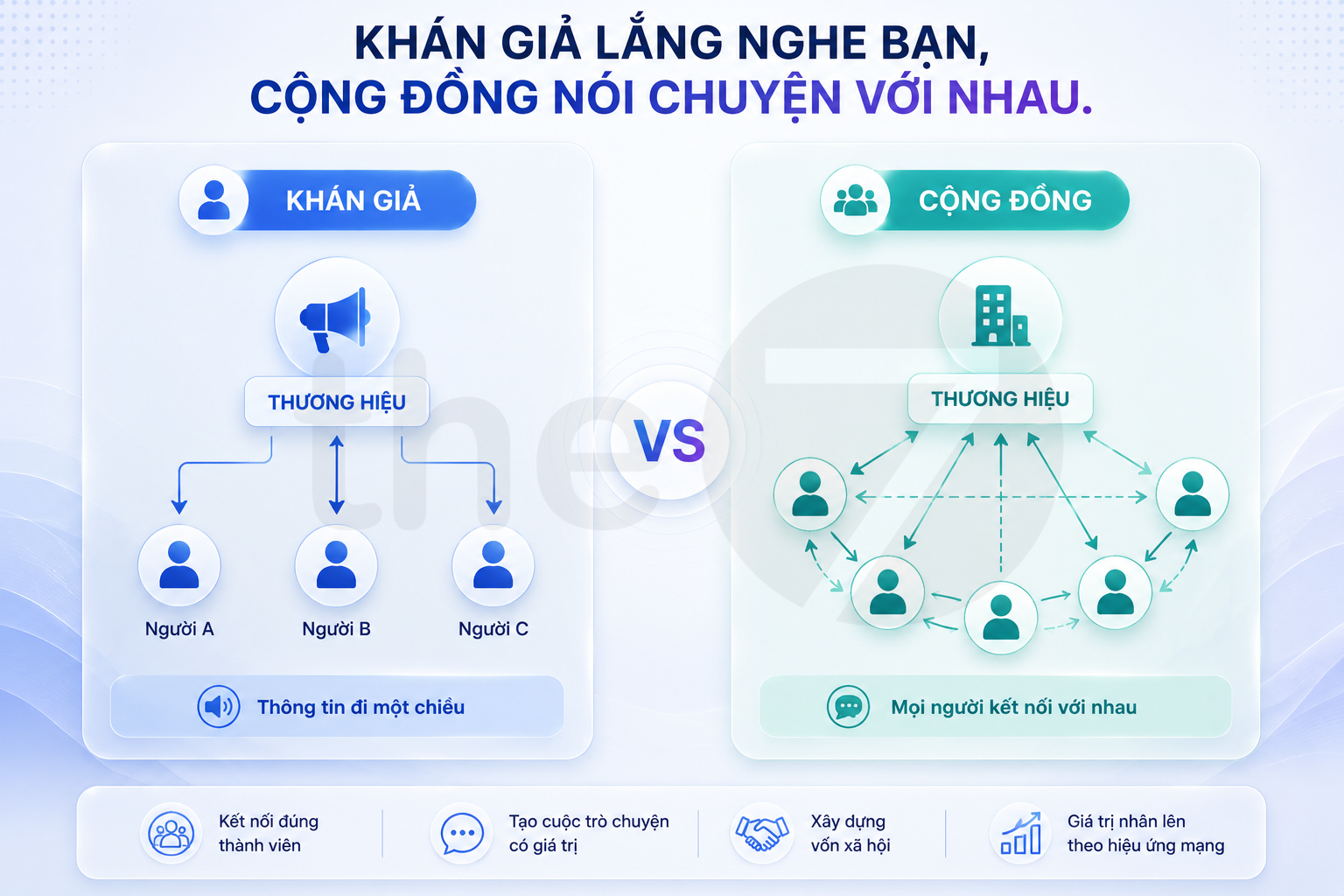
The difference between an audience and a community isn’t a minor matter of labeling. It’s a difference in nature, and it determines everything downstream: how you build it, how you measure it, how you nurture it, how you monetize it, and even how it creates competitive advantage. In an audience, value flows one way: from the brand to the follower. You speak, they listen. You publish, they consume. You occupy the center, and followers stand around that center. In a real community, value flows in many directions. Members talk to each other, help each other, learn from each other, refer each other, vouch for each other, and sometimes create value for one another that the brand never directly touches. At that point, the brand is no longer the only speaker in the room. The brand becomes the one who creates and maintains the room so those connections can happen.
Here’s the shortest way to put the distinction: an audience listens to you, a community talks to itself.
What is B2B community marketing?
B2B community marketing is the strategy of building and nurturing a community of people connected around a shared interest, profession, role, problem, or goal, where value doesn’t just flow from the brand to members, but also comes from interaction among the members themselves. Unlike building an audience, which is mainly a one-way relationship between brand and follower, a community creates a multi-directional network of relationships. In that network, every new member isn’t just someone receiving information — they can also become a source of experience, a relationship, a referrer, a validator, or a link that makes the community more valuable.
This is what sets a community apart from ordinary media channels. A good article can build trust. A good newsletter can hold attention. A strong LinkedIn presence can build familiarity. But a community creates something deeper: an environment where members are exposed not just to the brand, but to each other. A community only truly forms once members start to feel they’re getting value from other people in it, not just from the people running it.
In other words, a community doesn’t begin when you create a group. It begins when members have a reason to come back for each other.
A group can have ten thousand members and still not be a community if everyone is only there to view the admin’s posts. Conversely, a group with just a few hundred people can be a very strong community if members know each other, trust each other, ask each other questions, help each other, share real problems, and create valuable conversations without the brand having to drag every exchange along. Scale matters, but scale isn’t the only proof. The real proof is whether value flows between members.
In B2B, this matters even more because purchase decisions are rarely based on information alone. Buyers need reliability, validation, advice from peers in the same role, experience from people who’ve already implemented the solution, and the feeling that their choice isn’t made in isolation. A community creates the context for all of that to happen far more naturally than advertising or one-way content ever could.
Why does community create social capital?
To understand what value a community creates, we need to start with an important concept: social capital.
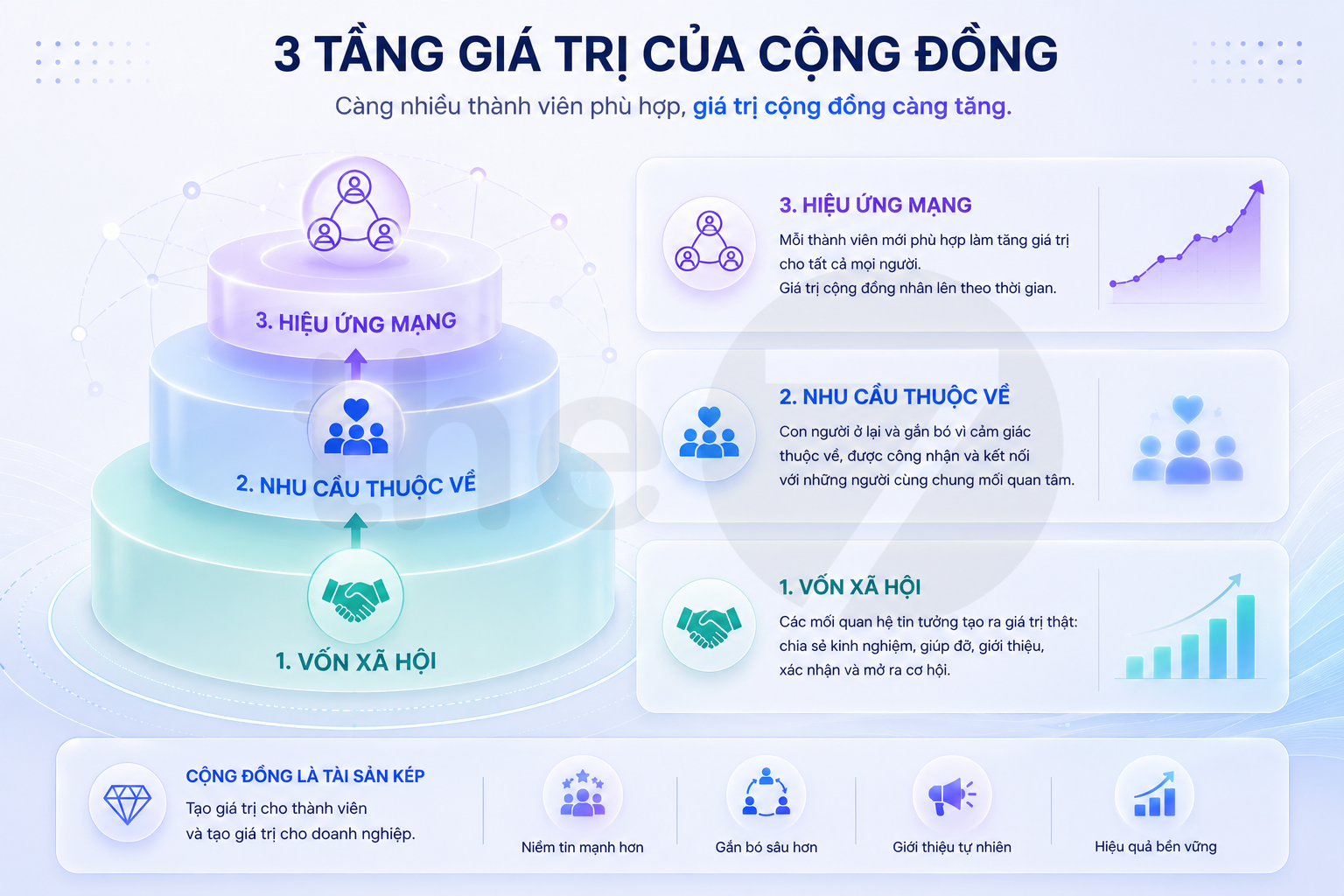
In 2000, political scientist Robert Putnam published his landmark work Bowling Alone, in which he wrote extensively about the decline of community life in America and the role of social capital. The core idea is clear: networks of relationships between people have real value. They aren’t intangible in the sense of being meaningless. They’re a form of capital, just like financial capital or physical capital, because they help people coordinate, trust each other, share information, and support one another more effectively.
When people connect within a network built on trust and reciprocity, that network creates value. People help each other faster. People refer each other more readily. People trust a piece of advice more because it comes from a peer, not from someone trying to sell them something. People share experiences they wouldn’t want to post publicly. The group as a whole becomes stronger than the sum of its disconnected individuals. That’s social capital, and it’s exactly what a community creates that an audience never can.
Putnam distinguishes between two types of social capital, and both matter a great deal in B2B. The first is bonding capital — the tight relationships within a group of people who share a strong common trait: the same profession, the same role, the same problem, the same circumstances, the same kind of work pressure. The second is bridging capital — relationships that connect different groups, giving people access to new information, opportunities, and perspectives. A strong B2B community typically creates both. It bonds people in the same role together while also bridging them to people, ideas, vendors, partners, and opportunities they’d struggle to reach on their own.
This is where the value of community goes far beyond the value of content or an audience. An article gives you information. An audience gives you attention. But a community gives you social capital — a network of trusted relationships with a shared history of interaction and the capacity to generate value repeatedly over time. From that network can flow all kinds of things: referrals, mutual validation, implementation experience, partnership opportunities, reputation protection, and a level of loyalty far deeper than simply following a brand.
For a business, this social capital can translate into very concrete outcomes. In a community with high social capital, members tend to refer others into the community, indirectly referring them to the business as well. They validate the business’s value through real stories rather than advertising claims. They help newcomers understand the product, the industry, the problem, and sometimes even take work off the sales or customer support team’s plate. More importantly, they stay longer, because what keeps them isn’t just the product — it’s the network of relationships built around that product, profession, or shared identity.
This is why a real community is a dual asset. It creates value for members and value for the business at the same time. And the longer it accumulates, the harder that value becomes to buy with money in the short term.
Why do people need to belong, not just to be informed?
Social capital explains what asset a community creates. But to understand why people join a community and stay in it, we need to look at a deeper psychological principle: the need to belong.
In 2000, Edward Deci and Richard Ryan published a classic review of self-determination theory, in which they identified three basic human psychological needs: autonomy, competence, and relatedness. Relatedness, or the sense of belonging, is the need to feel connected to others, to be recognized within a group, and to have meaningful relationships. This isn’t a peripheral desire. It’s a foundational psychological need, far stronger and more durable than the need to receive a few more scattered bits of information.
Applied to community, this principle explains something important: people don’t join a community just to get information. If information were all they needed, they could search Google, ask ChatGPT, read industry reports, watch webinars, listen to podcasts, or follow a few experts on LinkedIn. Information keeps getting cheaper, more abundant, and easier to find. But the feeling of belonging to a group of people like you, who understand your problems and speak your professional language, can’t be replaced by an article or a report.
Someone responsible for a narrow function inside a business can be professionally isolated. They have a title, responsibilities, KPIs, and pressure, but within their own organization there often aren’t many people who truly understand the problems they’re facing. A B2B CMO at an engineering company, a plant director, a head of procurement, a digital transformation lead, an engineer specializing in a very narrow field — all of them can find themselves in this position. They need information, but they also need a place where, when they voice a problem, others understand immediately without needing it explained from scratch.
Community fills that gap. It gives people a place to see that they aren’t alone. It creates the feeling that other people are facing the same problems, have also gotten things wrong, tried things, paid the price, and found a better way. The psychological value of this sense of belonging is far greater than any how-to guide. Content can capture people’s attention. Community makes them want to come back.
This leads to a very important implication for B2B businesses: the strongest communities are usually built not around a product, but around members’ shared identity or profession. People don’t yearn to belong to a narrow group of “users of Software X.” They yearn to belong to a group of “people doing this role better,” “people solving this kind of problem,” “people raising the bar in this industry,” or “people who share the same career ambitions.” The product can appear within the community, but it shouldn’t be the community’s sole reason for existing.
A community centered on the product tends to be useful only when members have a product problem. They come in to ask how to use something, fix a bug, find documentation, then leave. That kind of community still has value, especially in software or technology, but it usually stays at the support layer. A community centered on professional identity has deeper vitality. It makes members feel the community relates to who they are professionally, not just to the tool they happen to use. When a community touches identity, it creates far stronger loyalty.
This is why many good B2B communities don’t sell directly inside the community. They don’t turn every conversation into a demo opportunity. They don’t force the product into every topic. They understand that commercial value will follow later, if the community genuinely becomes a place where members trust, learn, and belong. Selling too early is the fastest way to break the sense of community, because that’s when members realize this room wasn’t built for them — it was built to funnel them into a sales pipeline.
Why does community value multiply with every member?
Social capital explains what asset a community creates. The need to belong explains why people stay. But there’s one more principle that explains why a community can become an ever-stronger, ever-harder-to-copy asset: the network effect.
The network effect is the phenomenon where something becomes more valuable to each user as more new users join. The very first telephone in the world was nearly useless because there was no one to call. The more people who had phones, the more valuable each phone became. A social network with few people isn’t very appealing, but once enough people who matter to you are there, you have a reason to keep coming back. A marketplace with many buyers attracts sellers, and many sellers in turn attract buyers. The value doesn’t sit in any single user — it sits in the network between them.
Community operates by a similar mechanism. A community of ten members can feel warm, but its connective value is limited. A community of a thousand members in the right profession starts to gain depth. A community of ten thousand quality members in a narrow industry can become that industry’s social infrastructure. Every new member, if they’re a good fit, doesn’t just add to the headcount. They bring in experience, questions, relationships, stories, resources, advice, and fresh perspective. They make the community more valuable to everyone already in it.
This creates two major consequences. First, community growth becomes self-reinforcing. The more good-fit members it has, the more valuable the community becomes. The more valuable it becomes, the easier it is to attract more good-fit members. Once it crosses a certain threshold, the community starts growing on its own, not only through the brand’s efforts but through the value it has already accumulated. Members refer newcomers. Newcomers see genuine activity. Genuine activity creates more value. Value pulls in more newcomers.
Second, community becomes an extremely hard asset to copy. A competitor can copy your product, copy your content, copy your website design, copy your ad messaging, even copy your channel strategy. But they can’t copy a network of trust that has formed over time among hundreds or thousands of people. They can create a new group, but they can’t replicate the history of interaction, the shared stories, the relationships already formed, the people with credibility inside the community, and the sense of belonging members have built with each other.
Combined, social capital and the network effect create a very particular moat. It isn’t a technology moat. It isn’t a budget moat. It isn’t a copyright moat. It’s a relationship moat. And this kind of moat is very hard to buy with money, because it requires time, trust, consistency, and the discipline to keep the community from being reduced to just another sales channel.
This is why community, though slow and hard to build, is one of the most durable marketing assets there is. In its early stage, it can look small, slow, and inefficient. But if built correctly, it can reach a point where the marginal cost of creating more value keeps falling while the network’s total value keeps rising. An audience can be poached by a competitor with better content or a bigger budget. A real community, with its social capital, its need for belonging, and its network effect, is far harder to take away.
Where does community fit in the 7B model?
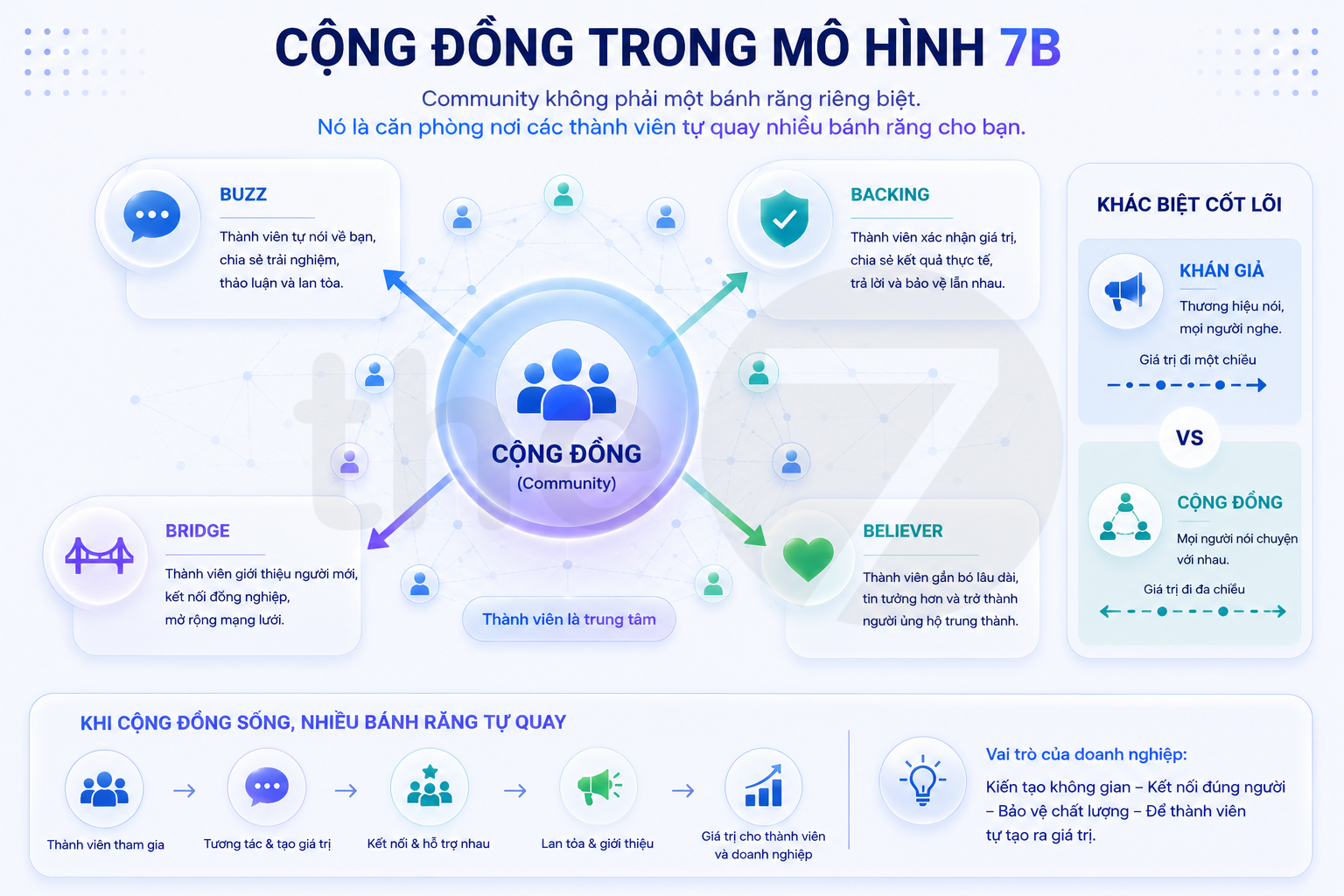
When you place community within the 7B model, the mistake is treating it as a separate gear. Community isn’t Broadcast, isn’t Buzz, isn’t Browse, isn’t Buy, isn’t Believer, isn’t Backing, and isn’t Bridge either. It’s a special room where members themselves turn several gears for you. See the article on the 7B gear model to understand how the seven gears work together.
Look at what happens inside a living community. Members talk about you to each other, share their experience using your solution, and pass along what they’ve learned from you or from one another. That’s Buzz — but Buzz that members generate themselves, not Buzz you’re trying to push out. Members validate your value to each other, tell real stories about the results they’ve achieved, and answer newcomers’ questions with real experience. That’s Backing — evidence coming from a peer, usually far more credible than a brand talking about itself.
Members refer the community to colleagues, invite peers to join, and pull more good-fit people into the network. That’s Bridge — but the bridge isn’t built only by the marketing or sales team. It’s built by members themselves because they think the community is worth sharing. Existing customers within the community also tend to grow more attached, because they don’t just use the product or know the brand — they have relationships, an identity, and habits within the community. That’s Believer, nurtured by the entire network, not just by your customer-care campaigns.
See what’s happening here? In a real community, many gears turn, but the ones turning them are mostly the members, not you. This is the fundamental difference between community and almost every other marketing channel. On other channels, you’re the one turning the gears. You put out Broadcast. You create content. You run ads. You do PR. You optimize conversion pages. You produce case studies. But in a community, your role changes. You’re no longer the one who has to turn everything yourself. You build the room, keep it orderly, bring in the right people, set good enough topics, protect the quality of interaction, and then let members turn Buzz, Backing, Bridge, and Believer for each other and for you.
This is a major mental shift. Businesses used to controlling their own messaging often find it hard to accept. They want everything to run through them. They want to be the best responder, the most frequent poster, the most visible presence, the one steering every conversation. But the more a community depends on the brand, the less it resembles a community. If members only react when the brand posts, the community isn’t alive yet. If the brand goes quiet for a week and everything goes quiet with it, the community isn’t alive yet. A real community is one where members have a reason to interact even when the brand isn’t dragging every exchange along.
The biggest mistake in building a community is trying to make the brand the center of every activity. Businesses do this because they assume a heavy presence proves the community is strong. But the truth is usually the opposite. A community where the brand talks the most may really just be an audience in disguise. The strength of a community lies in members speaking, asking, answering, referring, validating, and generating energy on their own. For that to happen, the brand has to be confident enough to step back. Not disappear, but shift from being the sole performer to being the one who builds the space.
B2B community examples across industries
In software, a company might build a community for power users of its product. There, members trade tips, help each other troubleshoot, share configurations, offer sample workflows, and describe creative uses the company itself may never have thought of. If the company answers every question, the community easily turns into a support desk. But if experienced members start answering each other, the community creates much stronger value. It helps newcomers learn faster, gives veterans more standing, builds Believer as users grow more attached, and builds Bridge as members invite colleagues to join.
In professional services, a firm might build a community for people in a specific leadership role — heads of growth, operations, HR, finance, legal, technology, or marketing at a certain type of business. These are often roles that are professionally isolated within their own organizations. The community gives them a place to meet peers from other companies, where they can speak more honestly about challenges, pressure, and hard decisions. The firm doesn’t need to sell its services every day inside the community. If the community genuinely generates social capital, the firm gradually becomes the first name members think of when they need a relevant partner.
In manufacturing, a supplier might build a community for engineers in a narrow technical field. This is a group that generic content rarely serves deeply enough. They don’t need general articles. They need detailed exchanges about standards, materials, operational failures, equipment choices, implementation experience, lessons from real projects, and problems only people in the trade would understand. As the community gains more skilled engineers, its value rises noticeably. Over time, if the community becomes the default gathering place for that niche, the business behind it owns an asset that competitors can barely replicate with a few ad campaigns.
These three examples come from three different industries, but they follow the same principle: community creates value when members connect and turn the gears themselves, not when the brand tries to be the center. The more valuable interaction happens between members, the stronger the community. The more value has to pass through the brand, the more it starts to resemble an ordinary content channel.
How do you start building a B2B community?
One reason community is hard to build is that the early stage is usually very slow. Without many members yet, the network effect doesn’t clearly show up. Without many conversations yet, newcomers walk into an empty room and have no reason to return. Without core members yet, everything depends too heavily on the organizing team. So the mistake many businesses make is opening the community too broadly too soon, inviting as many people as possible, and hoping numbers will turn into vitality on their own. But a community doesn’t grow just because it has a lot of people. It grows because enough of the right people interact with each other around a strong enough reason.
The early stage of a B2B community should start narrow — narrow in audience, narrow in problem, narrow in reason to join. Instead of building “a community for B2B businesses,” build “a community for B2B marketing directors in industrial companies trying to generate demand in international markets.” Instead of “a community for HR people,” build “a community for HR leaders at companies with 500 to 2,000 employees dealing with mid-level manager retention.” The narrower the community is early on, the more easily members recognize each other, the more easily they see shared problems, and the more easily they have conversations with real depth.
Once you have a clear audience, the next important step is finding core members. These don’t have to be the most famous people, but people with credibility, real experience, a willingness to share, and the ability to pull others into conversation. A small community of ten quality core members can be stronger than a large community of a thousand silent people. These core members are the ones who carry the community through its early stage, when the network effect isn’t yet strong enough to run on its own.
Next, a business needs to design community rituals, not just post content. A ritual could be a fixed monthly discussion, a private Q&A session, a thread for sharing lessons from failure, a new-member introduction board, a role-based meetup, or a format where members are invited to break down a real problem. Rituals matter because they create habit. A community doesn’t survive on a handful of spontaneous posts. It survives on recurring rhythms of interaction that let members know when to come back and what to come back for.
Finally, businesses need to remember that the early stage shouldn’t be measured by direct revenue. If you measure a young community by immediate orders or leads, you’ll kill it before it has a chance to grow. The early stage should be measured by signs of life: are members talking to each other, are people coming back, are people bringing in newcomers, are there real questions, are there answers coming from members, are any relationships forming. These signals are smaller than revenue, but they’re the evidence that social capital is starting to accumulate.
How do you measure community health?
Because a community isn’t an advertising channel, how you measure it shouldn’t look like advertising either. If you only measure member count, views, or likes, it’s easy to believe you have a community when really you just have a list of passive participants. Member count can be a scale metric, but it’s not a health metric. A large but silent community isn’t stronger than a small one with real interaction.
The first important metric is the rate of member-to-member interaction. If most comments are just reactions to the brand’s posts, the community is still dependent on you. But if members start asking each other questions, answering each other, tagging each other, sharing resources with each other, debating with each other, and continuing conversations without the brand stepping in at every turn, that’s a sign the community is alive. In short, measure what percentage of value is created by members, not by the brand.
The second metric is member return rate. Someone joining the group once doesn’t say much. Someone who returns weekly, joins discussions, reads content, answers others, or refers newcomers is a much deeper signal. A strong community doesn’t just attract new people — it gives existing people reasons to return. Return visits are proof the community is satisfying some need, whether that’s information, relationships, status, belonging, or career opportunity.
The third metric is the number of valuable connections created. In B2B, not all interactions are equal. A fun comment can be good for the atmosphere, but an introduction between two members, a meeting that follows a discussion, a collaborative project, advice that helps someone avoid a mistake, or a real implementation story that gets shared — these represent a deeper kind of value. If the community is creating connections like these, it’s accumulating social capital.
The fourth metric is the volume of value members create on their own. Do members proactively share resources? Do they write posts inside the community? Do they step up to run discussion sessions? Do they answer newcomers? Do they contribute real cases? Once members start contributing without needing constant prompting, the community has moved to a different level. It’s no longer a place where the brand feeds everyone. It becomes a place where many people feed the community together.
Finally, businesses can still measure commercial impact, but with an appropriate lag. A community can affect awareness, trust, referrals, retention, account expansion, and the speed of deal decisions. But these effects usually don’t show up as instantly as an ad click. If you force the community to prove ROI on a short-term basis, you’ll tend to turn it into a sales channel — and in doing so, it loses the very thing that made it valuable.
Three mistakes in B2B community marketing
The first mistake is building an audience and calling it a community. Many businesses set up a group and just post one-way content, turning it into just another Broadcast channel. Participants stay passive, and the brand stays the only source. This approach may add one more content distribution point, but it doesn’t create social capital. The fix is to design for members talking to each other, not just listening to you. Ask open-ended questions, connect members with similar problems, create formats for members to share experience, and — most importantly — step back enough for conversations among members to become the center of gravity.
The second mistake is building a community around the product instead of around identity. A product-centered community is usually only appealing when people are using the product or having a problem with it. It has value, but that value tends to be narrow. A community built around a shared profession, role, goal, or identity is far better able to satisfy the deeper need to belong. The fix is to put members at the center of the question: who do they want to become, what problems are they facing, what group do they want to be recognized in, and what kind of people do they want to connect with. Once you can answer those questions, the community will have a foundation deeper than the product.
The third mistake is expecting fast results and giving up too soon. Community grows by the network effect, which means the early stage is usually slow, low in value, hard to see results from, and easy to doubt. But this is also the stage where social capital begins accumulating. Many businesses give up right before the community reaches its critical threshold, because they’re measuring it against overly short-term metrics. The fix is to understand community as a long-term investment in a compounding asset. You need patience through the early stage, focusing on core members, interaction quality, and the rate of members talking to each other, before expecting the community to run itself at scale.
There’s a fourth mistake worth mentioning too: over-control. Businesses fear members saying the wrong thing, asking hard questions, comparing them to competitors, complaining, or offering a perspective that isn’t entirely flattering to the brand. Out of that fear, they over-moderate, over-direct, and sanitize every conversation into something harmless. But a harmless community is usually also a worthless one. Of course a community needs rules, norms, and moderation. But if everything is scrubbed as clean as a sales brochure, members will stop feeling it’s a place where they can be honest. And without honesty, there’s no social capital.
Conclusion: an audience listens to you, a community talks to itself
Back to where I started. Most businesses say they want to build a community, but what they’re actually building is an audience in the shape of a group. They still want to be the center, still want to broadcast messages, still want to control the conversation, still want to turn every interaction into a sales opportunity. But community doesn’t work that way. The difference between an audience and a community is a difference in nature. An audience listens to you. A community talks to itself. And it’s that talking-to-itself that creates all the value an audience never can.
The power of community comes from three layers of value. The first is social capital — a network of trusted relationships from which referrals, validation, experience, opportunity, and loyalty all flow. The second is the need to belong, a psychological drive deeper than the need for information, which keeps people coming back because they feel part of a meaningful group. The third is the network effect, which multiplies value with every good-fit member and turns the community into a relationship moat that competitors find very hard to copy.
In the 7B model, community isn’t a separate gear. It’s the room where members themselves turn Buzz, Backing, Bridge, and Believer for you, if you’re wise enough not to try to be the loudest voice in the room. Your role isn’t to occupy the center — it’s to build the space: bringing in the right people, giving them reasons to connect, protecting the quality of conversation, safeguarding trust, and letting members create value for each other.
Don’t build a group just to have one more place to post. Don’t call a passive audience a community. And don’t ruin a community by turning it into a sales channel in disguise. If you want community to become a real asset, remember this line: an audience listens to you, a community talks to itself. Your job isn’t to talk more. Your job is to make the right people want to talk to each other more.
To understand why members’ voices are more credible than the brand’s own voice, read the article on B2B PR. To understand how to turn members and customers into advocates, read the article on customer advocacy. To understand why most of a community’s value happens in exchanges you never see, read the article on dark social. And to understand the full seven-gear engine that community members can turn on their own, read the article on the 7B gear model.
FAQ
What is B2B community marketing?
B2B community marketing is the practice of building and nurturing a community of people connected around a shared interest, profession, role, or goal. The key point is that value doesn’t just flow from the brand to members — it also flows between members themselves.
How is a community different from an audience?
An audience is a one-way relationship: the brand speaks, followers listen. A community is a multi-directional relationship: members talk to each other, help each other, learn from each other, and create value for one another. An audience listens to you; a community talks to itself.
Why build a community around identity instead of the product?
A product-centered community is usually only appealing when people are using the product or need support. A community centered on professional identity, role, or a shared goal satisfies the need to belong at a deeper level, so it’s better able to create durable loyalty and long-term value.
Why is a B2B community hard to copy?
A community is hard to copy because its value lies in the social capital, history of interaction, trust, relationships, and network effect among members. A competitor can copy content or a product, but it’s very hard to copy a network of relationships that has been accumulated over time.

Nguyễn Đình
Bảo




As CEO of The7, I am committed to sharing practical, useful knowledge with every reader. Every article on The7 is based on my 7 years of hands-on experience in marketing — Facebook advertising, LinkedIn advertising, Google advertising, and marketing strategy. I hope you take away plenty of insight from these posts and apply it successfully in practice.
Related Articles
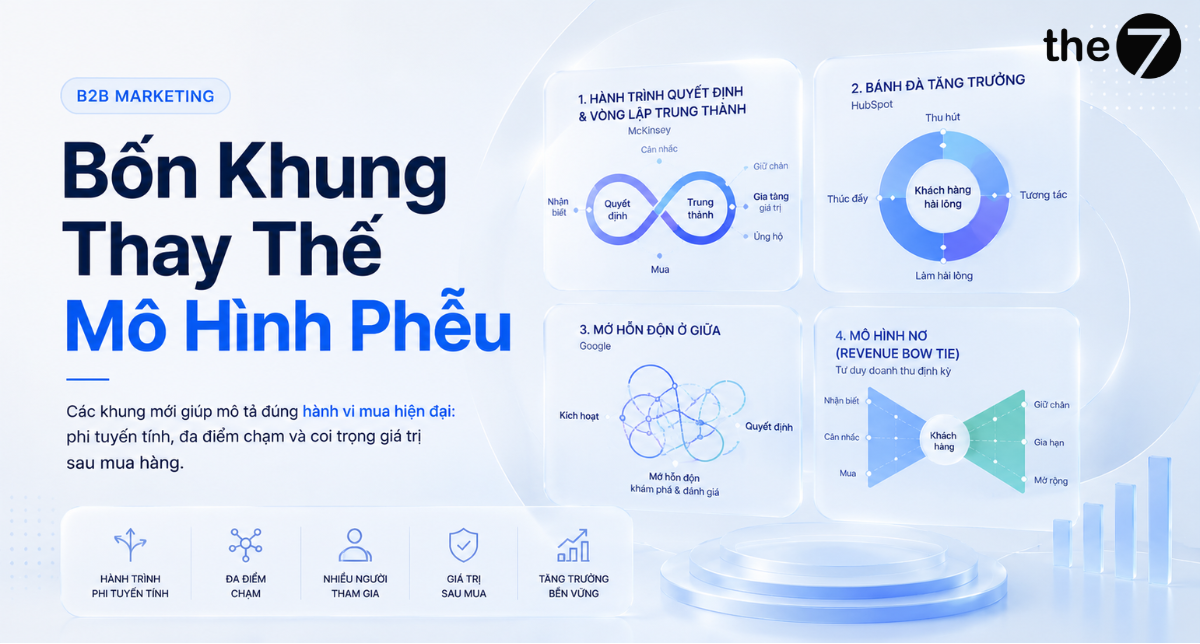
Four Frameworks That Replace the Funnel Model
Summary: As the funnel model increasingly fails to capture how modern buyers actually behave, a number of new frameworks have emerged to replace or repair it: McKinsey’s decision journey and...
What Is Category Design?
Summary: Category design is the act of creating an entirely new type of solution in the market’s mind, instead of competing within an existing category, and then becoming the name...
What Is B2B Positioning?
Summary: B2B positioning is the act of choosing the context you place your product into – the frame of reference that makes its value obvious to the buyer. Positioning isn’t...

What Is the 95/5 Rule?
Summary: The 95/5 rule states that at any given moment, only about 5% of B2B buyers are actually in-market, actively in a buying cycle, while roughly 95% are not yet...
What Is Mental Availability in B2B?
Summary: Mental availability is how easily a brand comes to mind in a buying situation. It isn’t about having the sharpest argument, the slickest pitch, or the most convincing feature...
What Are B2B Events and Trade Shows?
Summary: B2B events and trade shows are in-person gatherings such as conferences, industry trade shows, workshops, and private meetings, where a business meets buyers, customers, partners, and the industry community...