


Marketing Psychology in Practice: 40 Real-World Examples
In the age of Digital Marketing, we have grown very familiar with principles like “the customer is king” and with studying “customer behavior.” Yet at the end of the day, the real issue is that we need to understand the psychology of marketing (also known as Marketing Psychology).
Understanding Marketing Psychology is the foundation of success for any company or marketing project. Every organization and Marketing department should have someone who studies Marketing Psychology. This research helps pinpoint your competitive advantage in the market. It also gives your business a more complete picture of its customers.
Explore the services of The7:
What Is Marketing Psychology?
Put simply, Marketing Psychology is the practice of predicting buyer behavior based on how marketers perceive it. Put yourself in the shoes of a consumer. We have to research and work out what motivates customers to seek out a product.
Understanding Marketing Psychology helps us optimize our advertising strategy, drive purchase behavior, extend marketing content across multiple relevant channels, and tap into customers’ needs more easily.
How Important Are Customer Behavior and Marketing Psychology?
In the digital age, studying customer behavior and psychology is the key to improving the customer experience and to building a friendlier approach for potential customers. That is also the core purpose of mastering Marketing Psychology
In this article, let’s see how Marketing experts have made this topic concrete. The following examples are the key for businesses that want to optimize the customer experience in the age of Digital Marketing.
Take a look, and work through the 40 examples of customer behavior below step by step to bring real results to your business.
40 Examples of Marketing Psychology
1. Authority
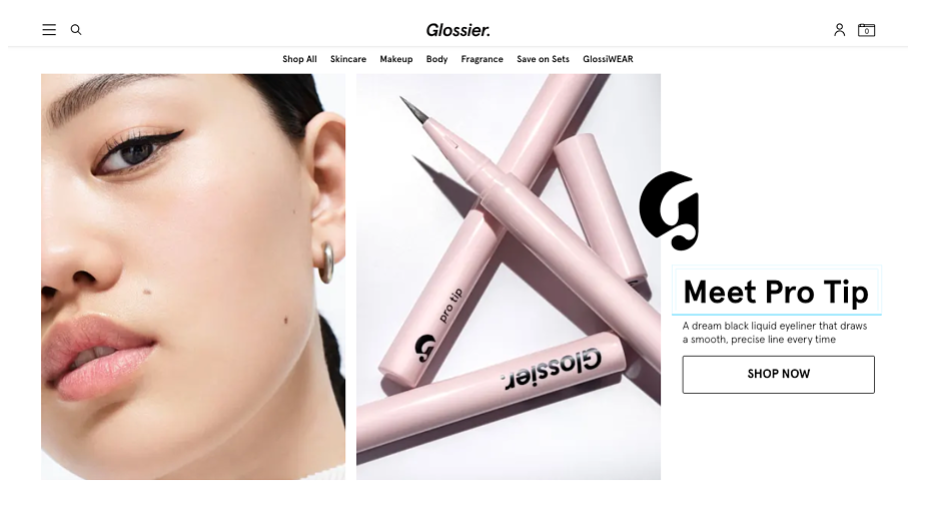
In the ad above, Glossier uses authority to boost trust in its product. The “Pro Tip” tells customers that this is the eyeliner professionals use.
Authority here shows up when consumers trust an organization, or the reputation a product’s brand carries.
Building authority depends on your company’s size, its brand ambassadors, or other channels that help your business become a trustworthy provider.
2. Liking

Overall, Lazada’s ad motivates customers because it is easy to understand. It also features a familiar face, the actor Trấn Thành, which builds trust and affection with customers.
Just like our reaction to Authority in section 1, it is perfectly natural for customers to love products that are easy to like.
Creating liking in an ad comes down to:
- Visual appeal
- Shared needs
- Reputable organizations
However, in the ad above, the discount (“Sale sập sàn,” a rock-bottom sale) is also part of the appeal. But that is another example altogether: price sensitivity.
3. Price Sensitivity

CGV’s discount program above targets students. Here, the company identified a specific audience and expanded its reach to them with an attractive discount.
Understanding how consumers react to the prices of products and services helps a business optimize its operations to fit consumer needs.
The lesson here: you should track your product prices and analyze which users are the right fit before launching a discount program. Contrary to common belief, discounting does not always drive purchase behavior.
4. Scarcity
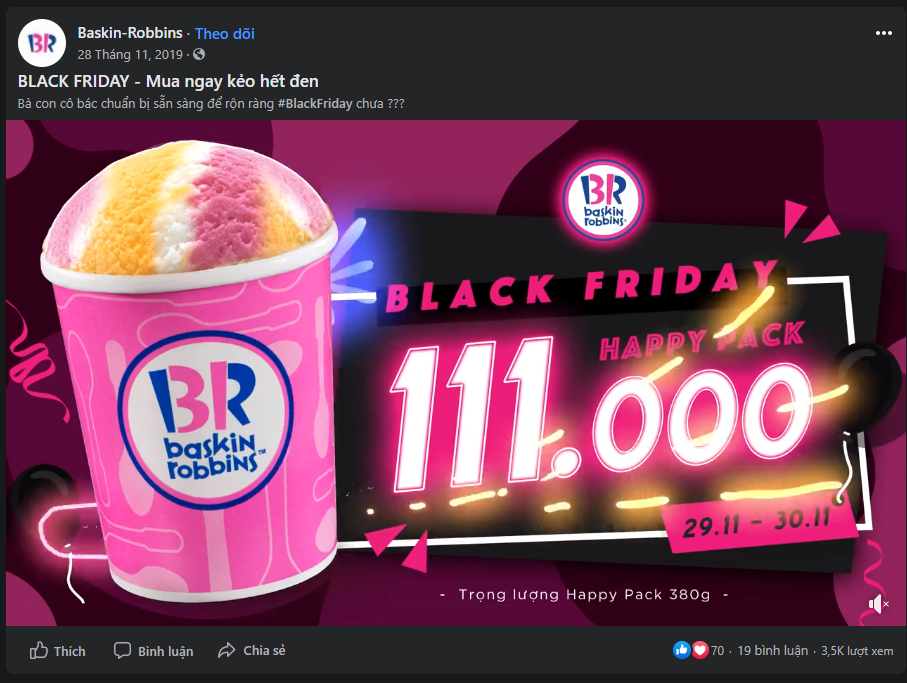
In this Baskin Robbins Facebook ad, the product’s scarcity comes from the limited promotion window (only 2 days). This gives interested customers a sense of urgency.
Psychologically, limited access fuels customers’ desire to buy. They will react as fast as they can to get the product or service they want.
Marketing campaigns can use scarcity of quantity or time to stimulate customer demand.
5. Uniqueness
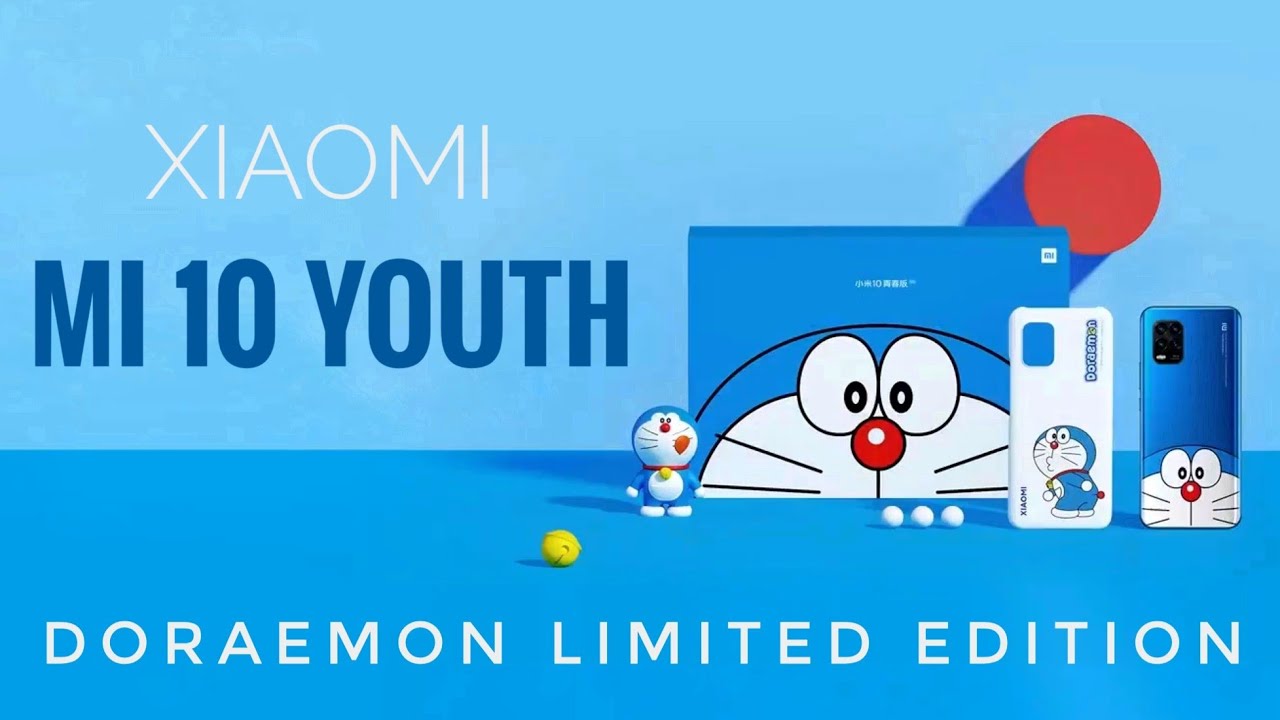
Similar to scarcity, the Xiaomi ad above highlights the uniqueness of the product. Limited-edition products always carry a higher value because they are only on sale for a short time. In this case, uniqueness adds value to the product.
To show the uniqueness of a product, a business can:
- Launch limited-edition products
- Share exclusive product information on media channels
- Emphasize the “scarcity” and “exclusivity” of the product
6. The Bandwagon Effect
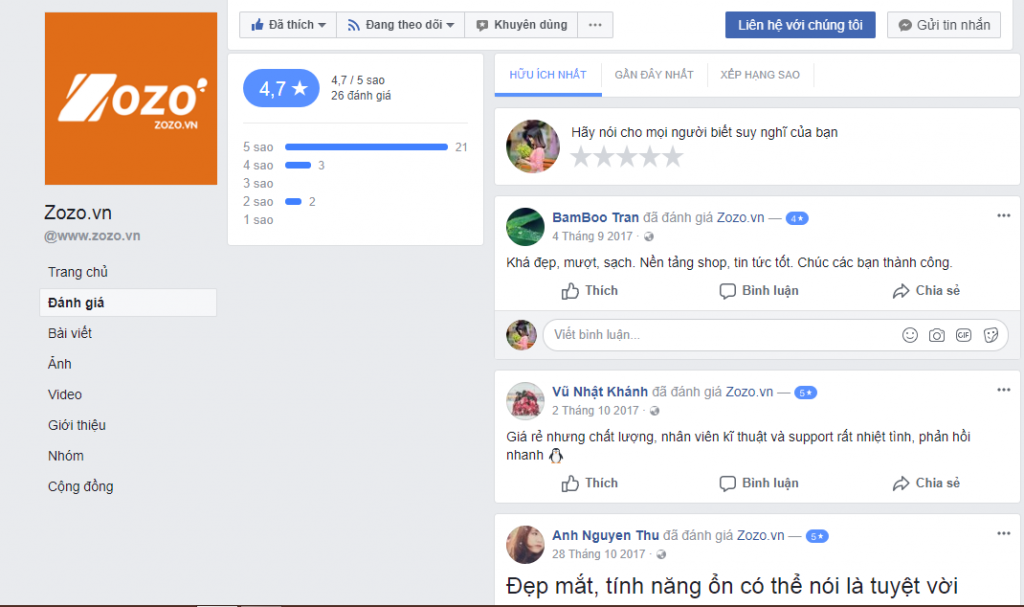
You will often follow the trends that people before you have judged to be good. This phenomenon is called the “bandwagon effect.” In other words, it is simply herd mentality.
In Marketing, the bandwagon effect can show up in many forms, such as:
- Fans
- Reviews
- Follower counts
- Best-selling products (Best Sellers), and so on
7. Community
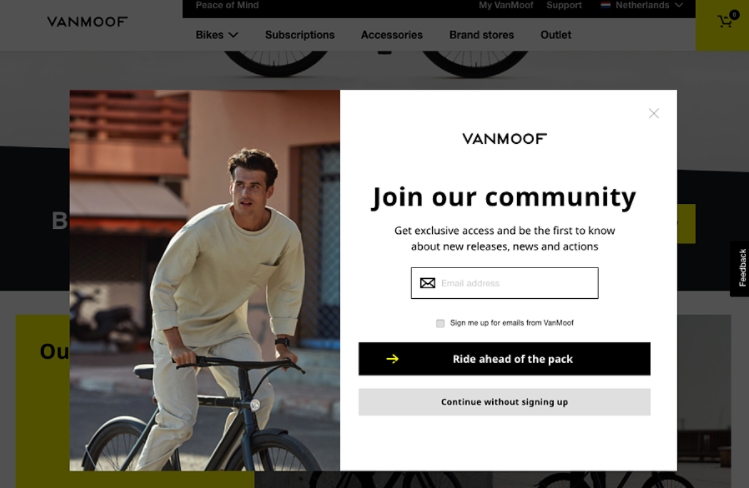
VanMoof encourages its customers to join its community. That is also a form of the bandwagon effect, inviting customers to become part of the organization.
Using community in Marketing nurtures the feeling of being “one of the few,” which makes customers feel better cared for when they own the product.
8. Commitment and Consistency
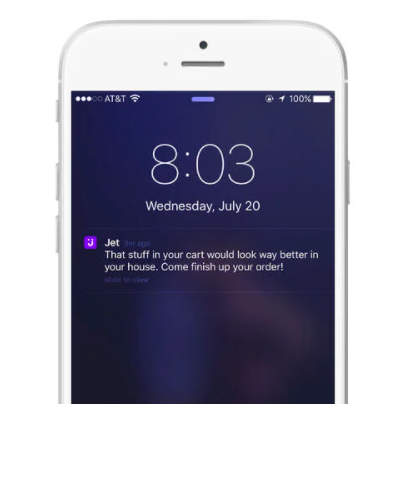
As we can see above, Jet’s notification reminds customers to complete their purchase.
Here, commitment and consistency are on full display. It shows that people usually feel compelled to follow through on the commitments they have made (in this case, adding a product to the cart).
The lesson here is that you can drive customers’ buying behavior by reminding them what is left in their cart, encouraging them to opt in to notifications about sale seasons or special offers.
9. Why Buy

In the ad above, Yamaha highlights the “fuel-saving” feature of its product.
“To buy or not to buy?” Every customer will always weigh the reasons to buy a product. This is especially true for expensive products (motorbikes, cars), where highlighting a feature shows how your product is different.
10. Loss Aversion

Matbao’s ad shows that missing the year-end sale would be a real shame. The dislike of being short-changed or losing something always pushes us to act. Customers will do whatever it takes to avoid missing out on a promotional campaign.
Keep this behavior in mind and build it into your specific advertising campaigns. It will help you earn more profit from your customers.
11. Focus on Product Features
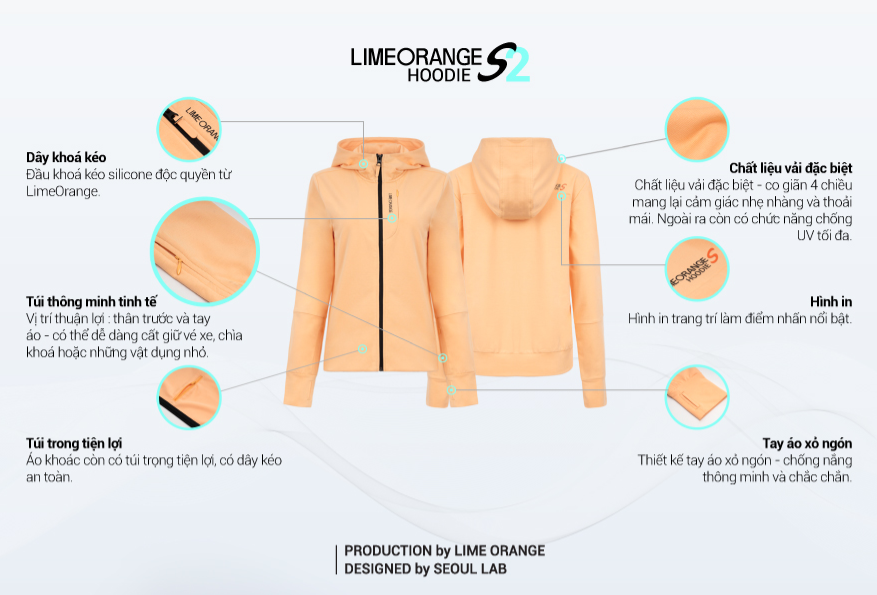
LimeOrange used images and callouts to show off its product features, focusing buyers’ attention on what LimeOrange products can do.
Generally, every customer browsing a product has little time to look it over. That means you should make product features as clear as possible.
Use visual tools such as product badges, animated images, and bold colors to capture customers’ attention.
12. Imagination
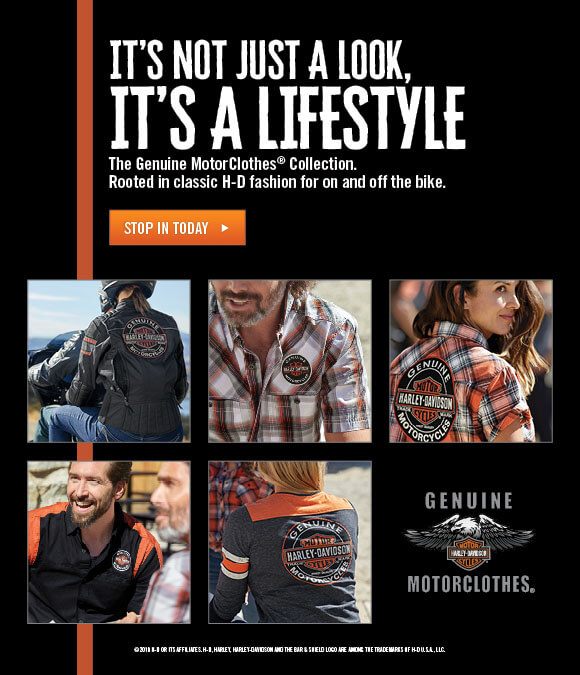
Inference, or imagination, always matters in Marketing. Harley Davidson shows us the story behind its product. It helps you easily picture the lifestyle the product brings (a sense of classic style).
To put imagination to work in Marketing:
- Show the product in use
- Use tactile imagery in product descriptions, meaning imagery that the sense of touch can pick up on.
13. The Weather Effect

Caluci’s ad suggests a product that suits the weather: “cold weather.”
The ad above uses the weather effect. It stimulates users’ desire to buy in line with the current weather. According to research, on bad-weather days (cold or rainy), consumers are more likely to search for products that suit the weather than on sunny days.
The takeaway: adjust your products by season and pay attention to the weather effect. Keep an eye on the weather so you can deliver relevant, well-matched advertising campaigns.
14. Rhyme
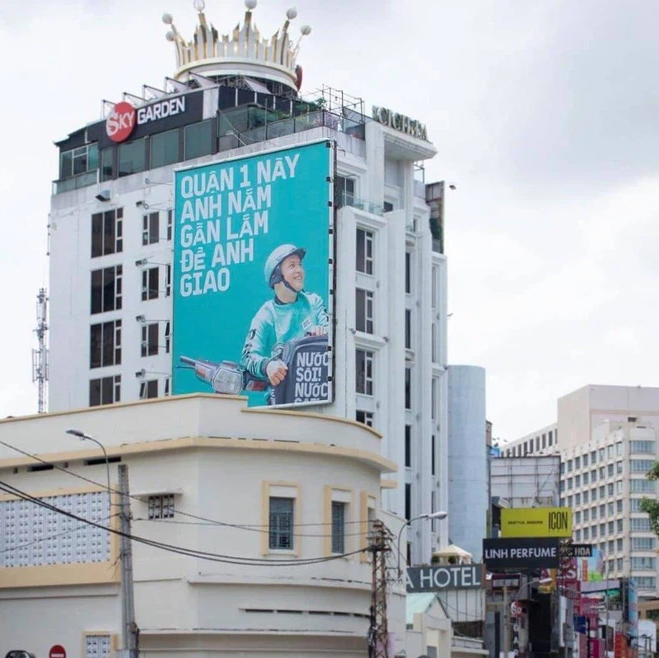
Short “verses” that carry a clear message. Baemin’s billboards have been spreading rapidly across online communities and earned praise from the Marketing world.
Using rhyming sayings makes your ads far more memorable.
15. The Fresh Start Effect

The fresh start effect is the general name for tapping into customers’ “new place, new things” mindset. These ads work best when they run at the start of a week, a new year, or a new season.
You can even use this effect around birthdays and the new year. It fuels customers’ desire to own something new at the start of a new phase (back to school, a new year, a new week).
16. Using Inspiring Words
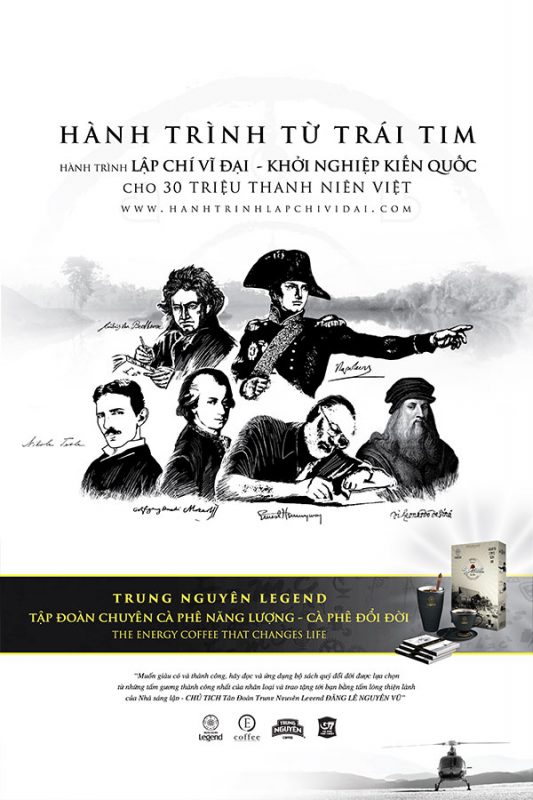
We often feel comfortable with what is “new,” so why is that?
Words like “Freedom,” “Fun,” “Love,” “Great,” “Wonderful,” “Power,” “Energy,” and “Professional” all give readers and listeners a surge of inspiration.
These words are collectively known as “God-Terms,” a concept introduced by Kenneth Burke. They inspire a positive sense of value in each person. Using them within rhetorical sentence structures can raise a product’s value as well as the Marketing effectiveness of an ad.
17. Novelty
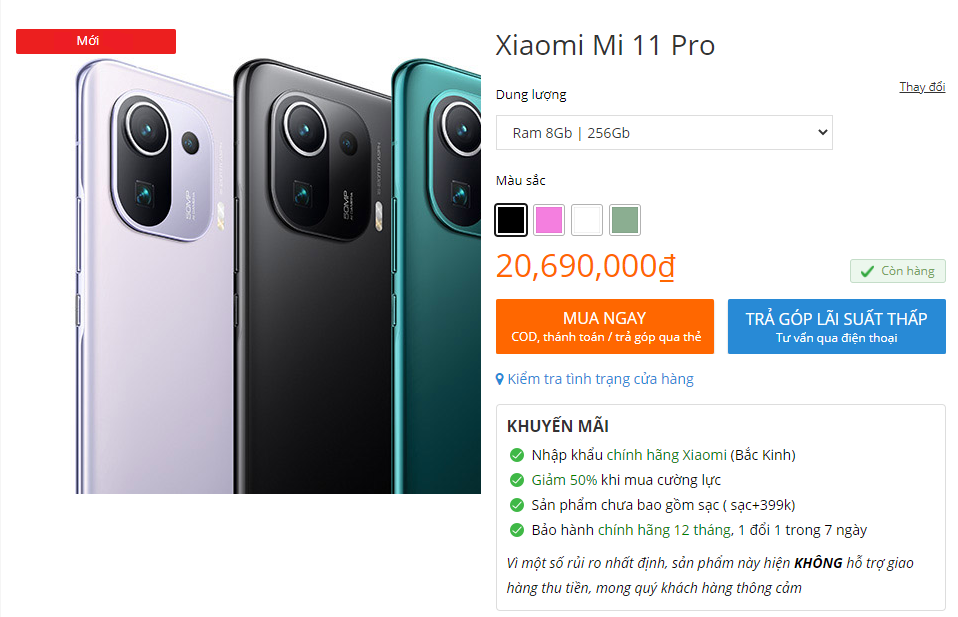
Overall, Xiaomi puts a “New” badge on its Mi 11 Pro. This taps into the novelty principle of marketing psychology. Highlighting a “new” product drives purchase behavior among people who love fresh, novel products.
For Marketing, building an advertising campaign around “newness” also helps drive business more effectively.
18. Cognitive Dissonance

Many Marketing campaigns use information as the centerpiece to “reassure” users when they decide to buy. In the ad above, we all know that drinking soda is bad for our health. Yet Pepsi launched a product guaranteed to be low in calories. That lets users talk themselves into it: “Pepsi is low-calorie, so a little won’t hurt.”
“Cognitive dissonance” is another marketing psychology principle applied in Marketing. Brands constantly try to roll out ads backed by endorsements from people who came before. Or they invest money in scientific reports that favor their products.
For marketers, your job is to put forward the idea that the product is right for the customer, or to hint at how the product’s features will fit their needs.
19. The Anchoring Effect

Which is the smarter investment: using a condom or having a child? The ad above sets up a comparison and uses the anchoring effect in a strikingly realistic way to drive users’ demand for condoms.
This marketing psychology principle is commonly used in discount programs (crossing out the old price and showing the new one) so customers can compare and weigh their options.
It also shows that the benefits your product delivers far exceed those of competing products.
20. The Decoy Effect
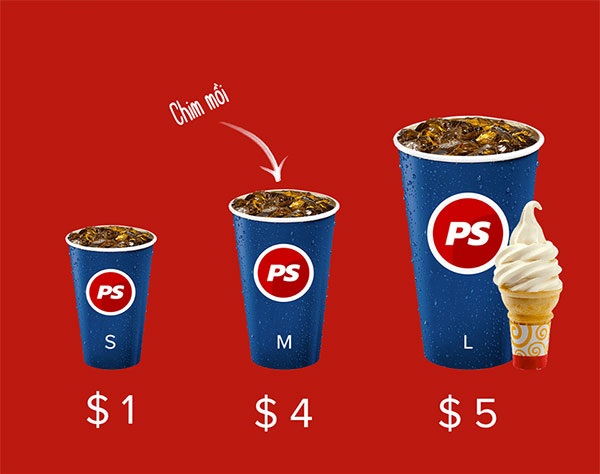
When buying a drink in this ad, the large size makes customers feel more drawn to it.
It differs slightly from the anchoring effect above. The decoy effect persuades users to buy higher-value products at a price that seems reasonable.
The decoy effect also eases customers’ worries about buying a higher-value package. It helps them believe their decision is the right one and that they are getting more benefits than the other options offer.
21. Autonomy
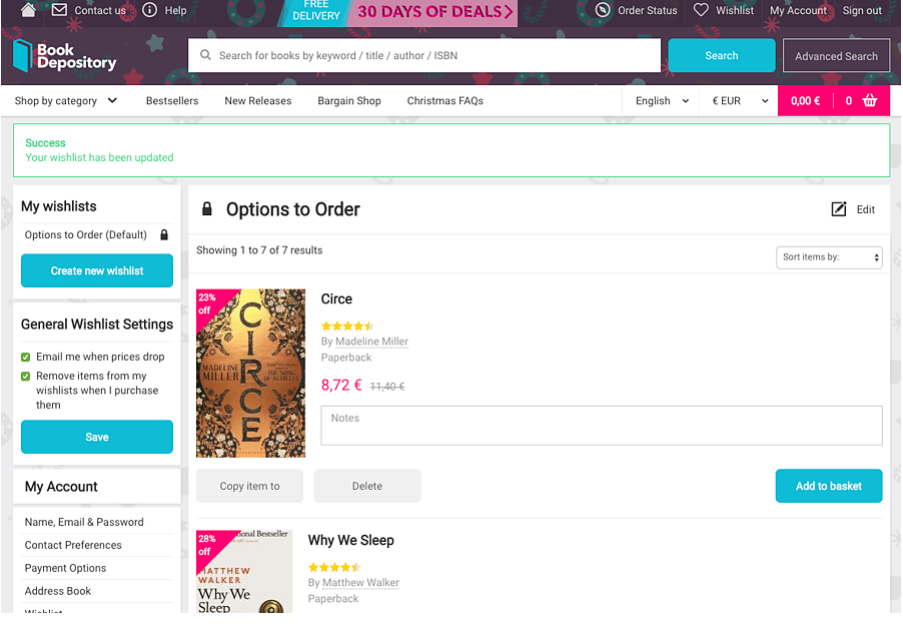
Book Depository offers a “Wish List” feature that gives customers different options when shopping. This creates a sense of autonomy.
You can offer customers options such as:
- Choosing the product style
- Choosing the product color
- Checkout options (gift wrapping at checkout, a choice of payment methods, and so on)
- Using the Cart and Wish List features
Autonomy gives customers a sense of control when they buy, and lets them choose products to their own taste.
22. Country of Origin

Vinamilk emphasizes the “from Japan” trait of its product, turning that trait into a benefit the product delivers.
Psychologically, this approach is highly effective, because every country is associated with a capacity for making certain products (the Swiss make good watches, Japan is a country with advanced knowledge, and so on).
These stereotypes can be a positive angle to use in Marketing, showing that a product comes from a country associated with quality.
23. The Noble Edge Effect

Around 2012, the Cruelty Free animal rights movement in cosmetics grew rapidly. The movement called for an end to testing cosmetics on animals. As a result, brands that committed to the movement were embraced far more by consumers.
The Noble Edge effect boosts your reputation and brand value and makes people remember you when:
- The brand takes a stand on cultural, political, environmental, or socioeconomic issues
- It commits to donating a share of product profits
- It supports community projects
- It has corporate responsibility policies
However, when applying the Noble Edge effect, you must be authentic and transparent in choosing which movement to link with your product.
24. The Pratfall Effect
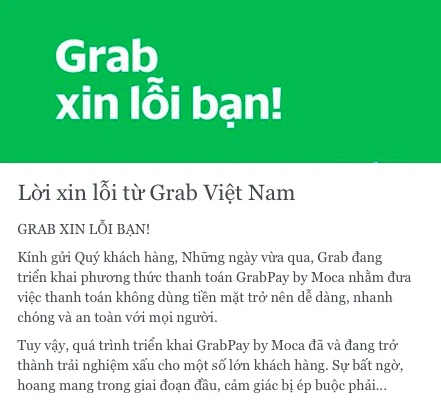
However, if your brand makes a mistake that reflects badly on it, you can apologize.
When influential brands make small mistakes, they can use them to create a bigger buzz. This is called the Pratfall effect.
Use your media channels to admit to customers where your brand falls short, especially when your service platform goes down or when a product is out of stock.
25. The Goal Gradient Effect

The Goal Gradient effect gives customers a clear visual of how much is left before they reach a goal.
Businesses can boost conversion rates by showing progress bars on the checkout page or, for loyalty programs, by giving customers clear progress toward some of their services.
26. Selective Perception
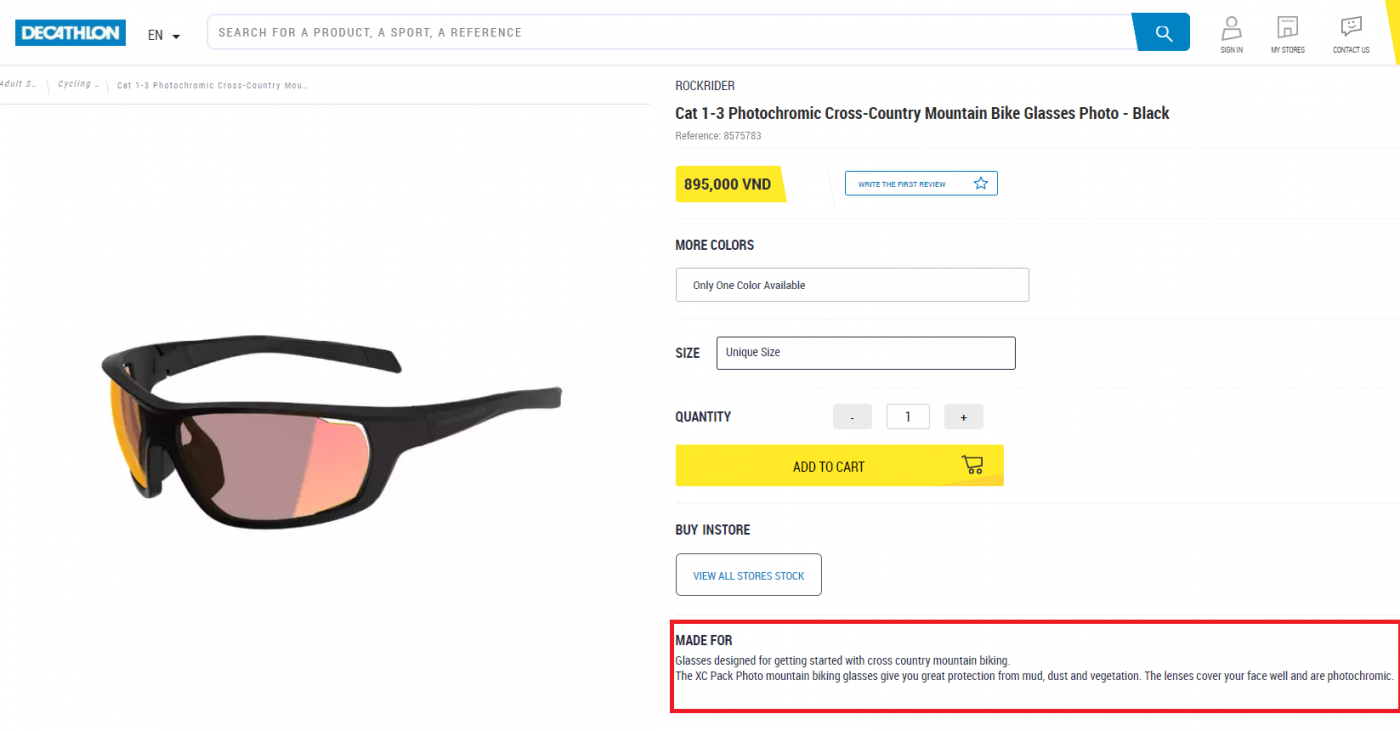
Decathlon guides customers on how to use its product: “the product is a pair of cycling glasses that block mud, dust, and fine particles. The lenses fully protect your face, and more.” That helps customers recognize whether the product is right for them.
When customers process the information that “best fits their needs,” that is called selective perception.
But to use this approach, you need to do market research first. It helps you understand your target audience better: how they use your product and which information will drive conversion rates up.
27. The Humor Effect

In recent years, we have all become very familiar with our Thai neighbors’ “saltier than seawater” ad. It is a perfect example of humor in Marketing.
Parody, satire, and poking fun at social issues are all tricks for winning people over in Marketing.
28. The IKEA Effect
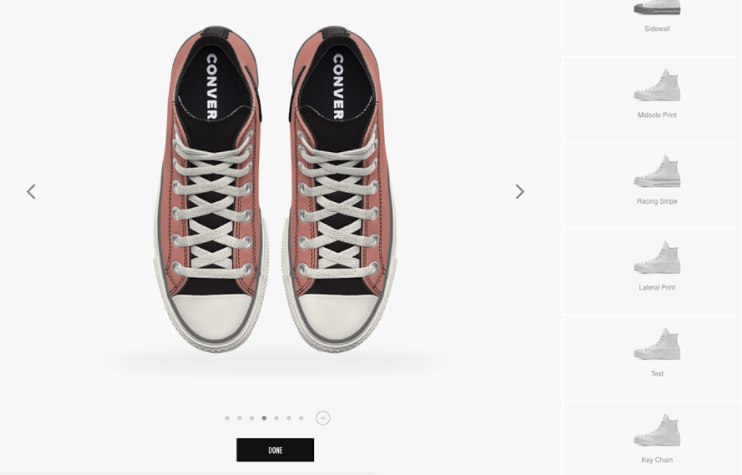
More than a furniture company, IKEA is also the name of an effect in marketing psychology. The name comes from an IKEA campaign that let customers take part in shaping the product they wanted.
The IKEA effect holds that users value a product they make themselves more than ordinary, ready-made products.
You can leverage the IKEA effect by creating an experience for customers during the product creation process, letting them build, design, zoom in and out, or change the colors of the product you offer.
29. The Readability Effect
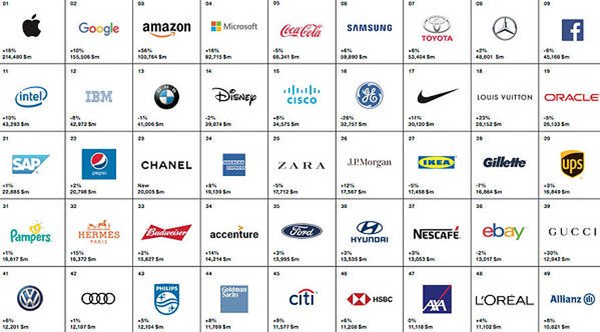
If you read the names of the world’s top brands, you will notice a trend: no brand name runs longer than three syllables, and they are usually very familiar words.
Basically, the easier content is to read, the lower the risk and the more it resonates with customers.
30. Minimalism
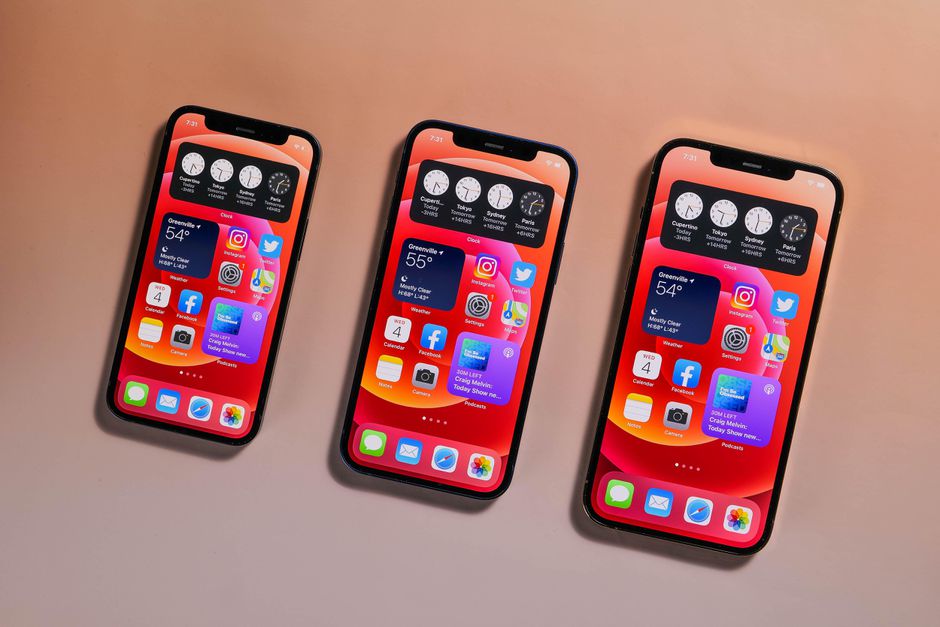
Similar to readability, minimalism is also part of Marketing psychology.
Just as easy-to-read things have a longer-lasting impact, things designed to be “simple” appeal more strongly to the senses.
Today’s market offers too many choices, so we want products and content that are simpler and more concise.
Simplify everything in Marketing, from layout and content to web design.
31. Awareness of the Customer Experience

Lazada once acknowledged the frustrations caused by its sale campaigns, and promised to return the following year.
This worked because Lazada was aware of the customer experience. Today, understanding the customer experience matters more and more.
So if you are aware of the customer experience, you will:
- Build your credibility
- Remove customers’ hesitation about your service
- Increase conversion
- Make your campaigns easier to understand
- Give your brand voice more credibility
32. The Mere Exposure Effect
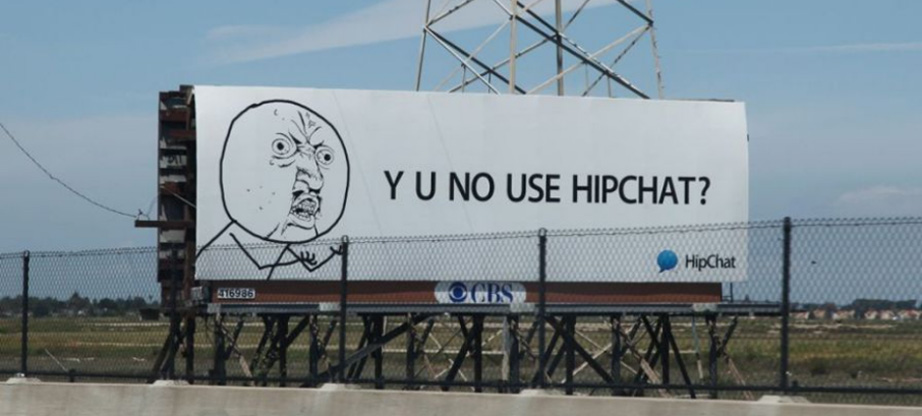
Although HipChat no longer exists, its billboard still impresses us because it gives us a feeling of familiarity with today’s social media meme culture.
The mere exposure effect is based on the idea that the more familiar customers are with your brand, the more likely they are to choose you. So appearing often in the media and interacting with customers is not a bad idea either.
33. Product Bundles
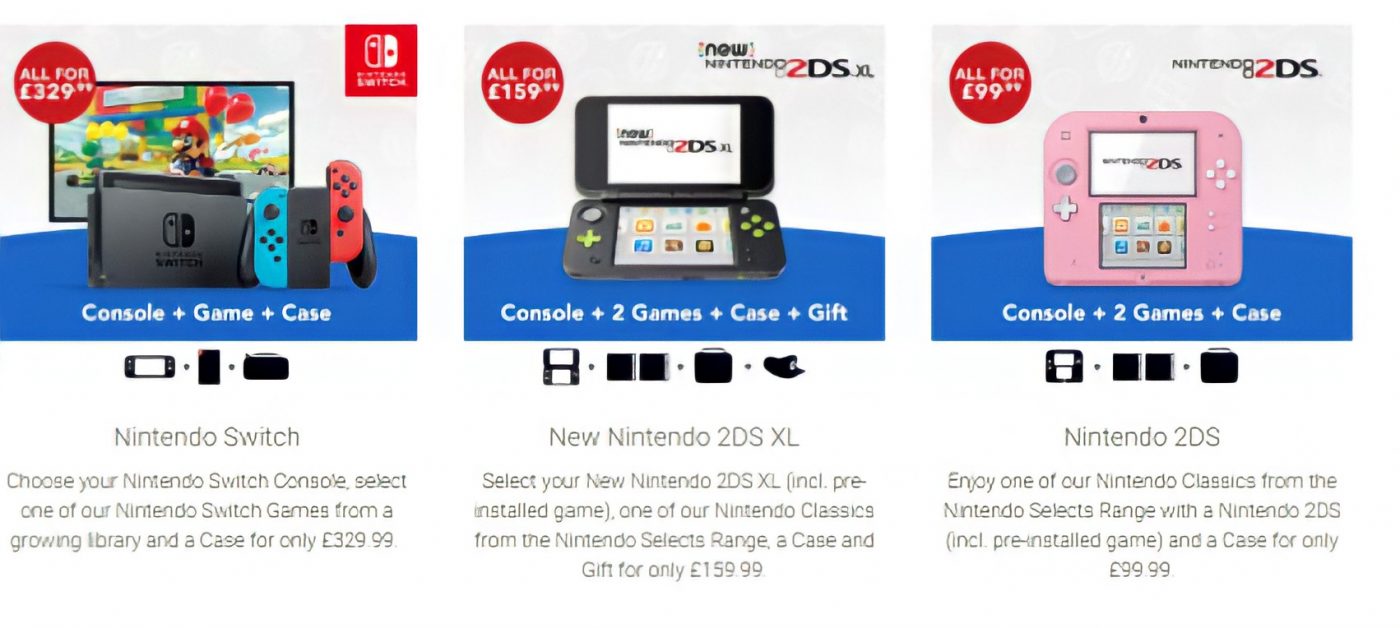
Nintendo suggests a complete set of its products. Everyone likes to pick a complete set, right?
With a “play it safe, buy it durable” mindset, customers also want a complete set when they buy. So messages like “Buy product X to complete your set!” tap into customers’ psychological tendencies.
34. The Blemishing Effect
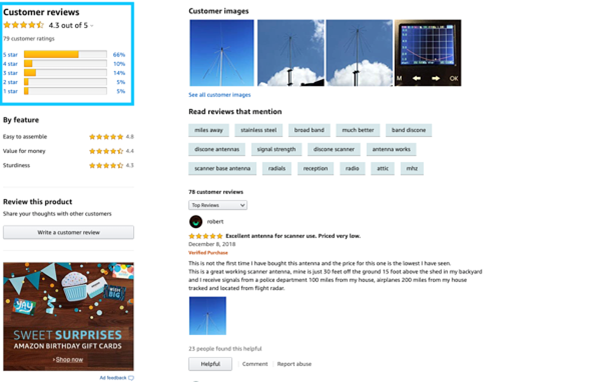
Amazon is well known for its honest product reviews. In this example, though, 5% of the reviews are 1-star.
Although bad feedback may seem negative, 5% is a small flaw compared with 66% 5-star feedback.
This is called the blemishing effect, and it can make a product or brand look more appealing by displaying objective information.
35. The Endowment Effect

Kangaroo lets customers try its products for 30 days before paying. The endowment effect means a product’s perceived value goes up once it belongs to someone. So after a trial, customers are less likely to refuse to buy.
This tendency shows that consumers place more weight on the things they own.
You can take advantage of the endowment effect by:
- Offering free trials and samples
- Creating interactive experiences with your product
- Letting customers experience the product as if it already belongs to them
36. Minimizing Choices
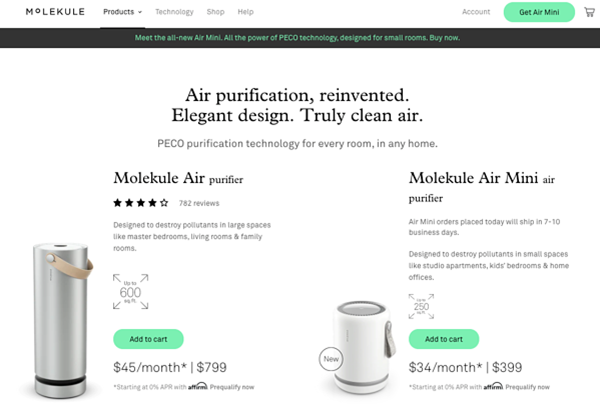
Can you believe the Molekule website has only 2 options when you buy?
Still, that is not necessarily a bad thing. Together with its minimalist design, Molekule significantly reduces shopping stress. It also upgrades other features that help people recognize its brand better.
Too many options make consumers anxious and can create friction between the business and its customers. Don’t overload your website with too many options, from the product listing page to the checkout interface.
37. Assurance

Emphasizing your after-sales policies is also a behavior within Marketing psychology. Every customer wants support when something goes wrong with a product.
For expensive products, assurance is essential to earning customers’ trust. You can build an advertising campaign around “money-back” guarantees for dissatisfied customers, or include warranty terms with attractive perks.
38. The Halo Spillover Effect
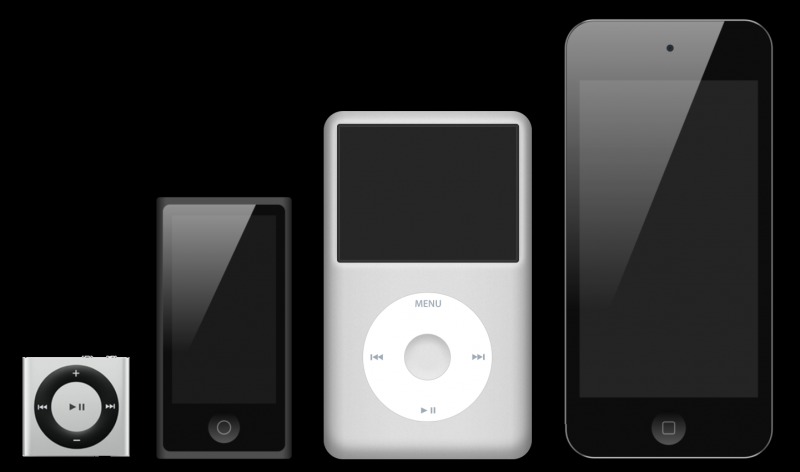
It is no exaggeration to say that Apple’s Marketing team keeps surprising the whole world.
The public’s first impression of Apple was the iPod music player. In the early days, Apple invested continuously in TV, newspaper, and billboard advertising for the iPod. The results were remarkable. Apple captured 73.9% of the music player market at the time. The iPod brand was so strong that almost no one knew what the second-ranked brand after the iPod was. So what marketing supported Apple’s phone line? The answer: no one cared. That is the crux of it. Apple poured its entire marketing budget into the iPod, creating a halo effect that spilled over into every other area of its business.
39. Social Movements

The environmental protection movement is booming and is one of today’s Marketing trends. Consumers want to do their part to protect the environment. By understanding marketing psychology, businesses can adapt their products to fit as well as possible.
Try to emphasize to your target customers which campaign your product is part of. That brings out your brand awareness.
40. Detailed Product Information

Providing plenty of information about a product or service increases the credibility of that product in customers’ eyes. So you should make this information easier for customers to access. Use different types of information, such as customer reviews, images, or matching products.
Conclusion on Marketing Psychology
In short, mastering marketing psychology will give you a competitive advantage in today’s Digital Marketing landscape.
What’s more, understanding and predicting customer behavior lets you get closer to your customers and serve them better.
However, the examples above are only the tip of the iceberg. Success in Marketing depends on whether you find the right balance among all of these items. That helps you maintain a solid brand image while creating products and advertising campaigns that people embrace.
>>> You can also read more articles from The7:
- Marketing Concepts Explained: The 13 Most Popular Types of Marketing in 2023
- Integrated Marketing: Its Role and How to Plan It in 2023
- 5 Basic Emotional Elements in Marketing
- Customer Profile: What It Is and 5 Ways to Create One
- Growth Hacking and Growth Marketing
- Word of Mouth Marketing: What It Is and the Benefits of WOM
-
What Is an Insight? How to Identify Customer Insights Effectively

Nguyễn Đình
Bảo




As CEO of The7, I am committed to sharing practical, useful knowledge with every reader. Every article on The7 is based on my 7 years of hands-on experience in marketing — Facebook advertising, LinkedIn advertising, Google advertising, and marketing strategy. I hope you take away plenty of insight from these posts and apply it successfully in practice.
Related Articles
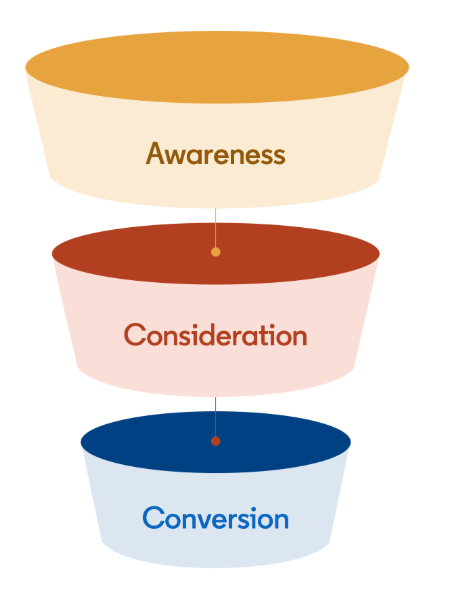
Building a Full-Funnel Content Marketing Strategy on LinkedIn
Table of Contents Toggle Why Build Content Marketing for the Full Marketing Funnel? (Why Full-Funnel Content Marketing?)Creating Your Strategy (Creating Your Strategy)Implementing Your Content Strategy (Rolling out your content strategy)Summary...
Designing Creative Content for LinkedIn
Table of Contents Toggle Why Is Good Creative Content So Important? (Why is Good Creative Important?)Key Components of Creative Design (the core elements of creative design)Summary (summary) Why Is Good...
Building an Organic Business Presence on LinkedIn With a LinkedIn Page
Table of Contents Toggle Why Have a LinkedIn Page?Establishing Your LinkedIn PageKeeping Your LinkedIn Page ActiveThe Measure of SuccessSummary About LinkedIn Page (Summary) Why Have a LinkedIn Page? For a...
6 Best LinkedIn Marketing Strategies for B2B in 2026
Table of Contents Toggle LinkedIn 2026: Where B2B Decisions Get MadeStrategy #1 – Why Is LinkedIn the Best B2B Marketing Channel Today?1. Decision-makers are concentrated here2. Users are in work...

7 Social Media Trends for 2026: The Era of Real Value, Real Conversion, and Real People
Table of Contents Toggle Social media is entering the biggest restructuring of the decadeTrend 1: Why is buying directly in-app becoming the new standard for 2026? (On-Platform Conversion)What should businesses...
What Is TikTok Marketing? Effective TikTok Marketing Strategies
TikTok has been topping the global rankings of the most downloaded and most visited apps. That makes it a gold mine for marketers who love creativity. In this article, The7...