


What Is AIDA? How to Apply AIDA in Marketing to Boost Conversions

In marketing, businesses apply the AIDA model to a huge range of content, from website and landing page copy to many other forms of advertising, because it is built on how customers actually behave when they decide to buy. So what is AIDA and what is the AIDA principle in marketing? Let The7 walk you through it below!
Marketing knowledge:
- What Is Marketing? The 13 Most Popular Types of Marketing in 2022
- What Is Integrated Marketing? Its Role and How to Plan It in 2022
- What Is Online Marketing? How to Advertise Online Effectively
- What Is Digital Marketing? 10 Popular Types of Advertising in 2022
1. What Is AIDA? The Elements of AIDA Marketing
For a long time, the AIDA model has been built on customer behavior and used as a tool for creating effective marketing strategies. Let’s look at what AIDA means in marketing:
1.1 What Does AIDA Stand For?
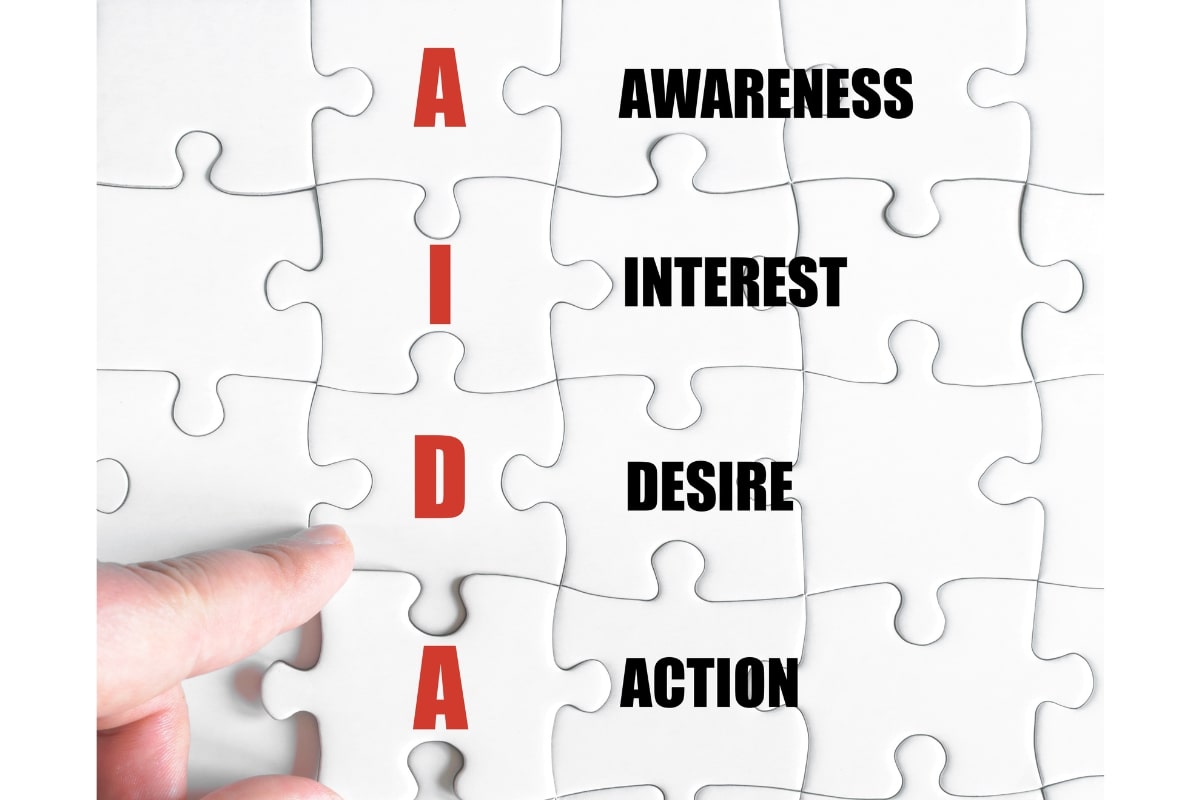
AIDA is an acronym for four words: Attention, Interest, Desire, Action. It is a model designed to direct an audience’s attention toward a particular topic.
The model was created by mapping behavior at each stage of the journey of buying a product or service. It corresponds to the four stages involved in persuading someone about a topic they have never encountered before.
In content marketing, mastering this model and combining it with a powerful message influences customer psychology and makes it easier to convince people to buy. That is also why AIDA is considered the highest rung on the ladder to a successful business strategy.
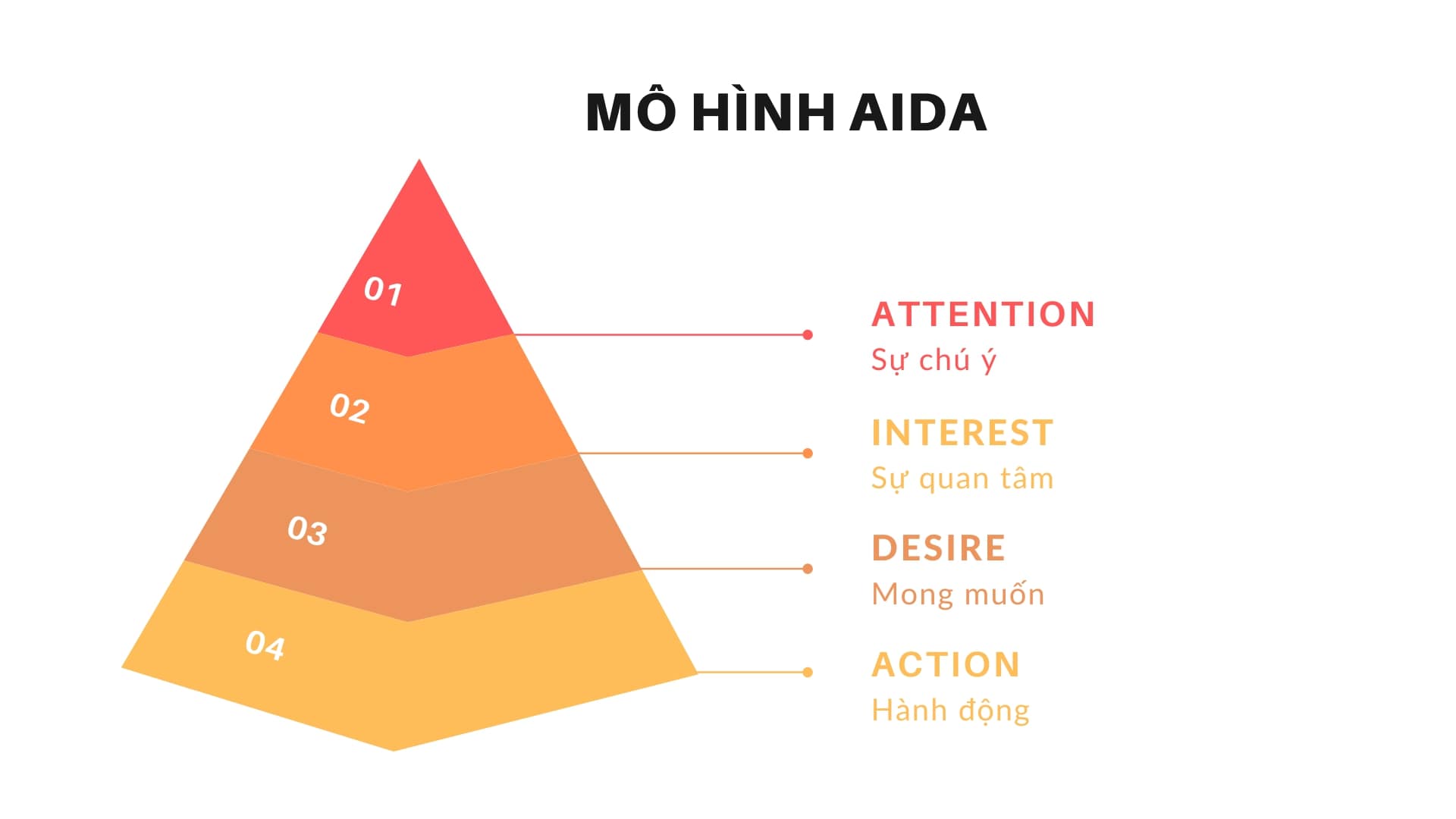
1.2 What Are the Elements of the AIDA Model?
Four factors make up the process that shifts a customer’s mindset. Understanding them makes it easy to apply the AIDA formula to your marketing activities and business strategy so you earn maximum profit at minimum cost.
1.2.1 Attention
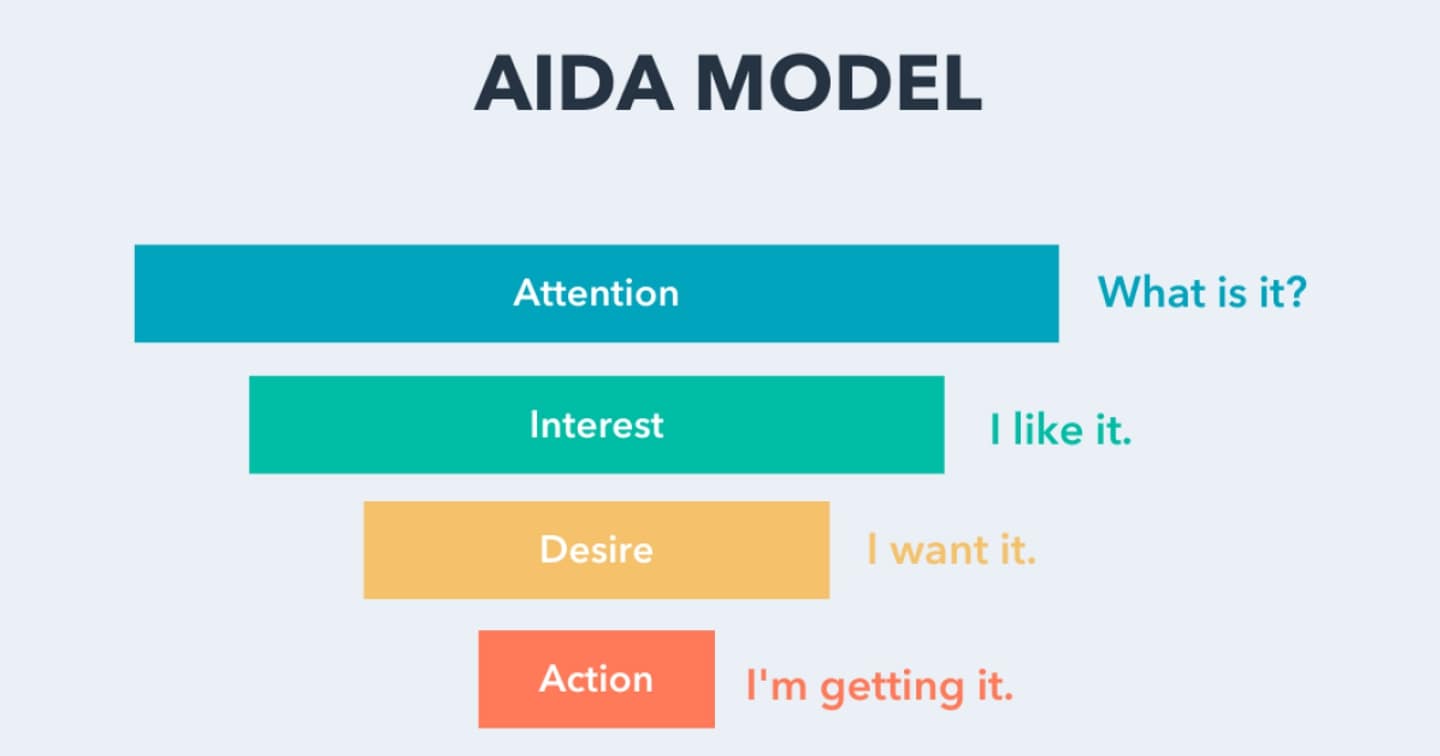
First, you have to capture the customer’s attention. This is the starting point that lets customers know what product or service you are selling. To do that, you need truly striking content that makes them stop and explore.
So how do you get customers to stop and look at your product among countless options? Use tools that lift your website toward the top of Google, and use sensational headlines, shocking wording, and ads with unusual content and fresh visuals that spark customers’ curiosity.
A first impression is always deep and hard to forget, so leave users with carefully crafted messages that build trust with customers from the very beginning.

1.2.2 Interest
Next, if your message hits the right need, solves a problem your customers are facing, or satisfies their interests, it is easy to win the interest of your target audience.
Only after they are interested will they be motivated to research the product you offer. To keep them moving from attention to interest, make sure your message is fresh and compelling, highlights standout features, and delivers practical benefits to users.
This is the moment to introduce your product, but stay close to what customers want, so that the product can meet their needs or solve the difficulties they are dealing with.
Use short, direct wording and real figures as proof, and select valuable information so customers think “I like this product,” which keeps them engaged for as long as possible.

1.2.3 Desire
Once customers are interested in your service or brand, keep pushing hard until they feel “I want this product.”
To achieve this, you need even more compelling content that offers real value to customers and points out what is unique to your product alone. You can also build an emotional connection so they feel close to the product. When you find the match between customers’ needs and the value your product brings, they will feel driven to want and own what you offer.

1.2.4 Action
Everything above means nothing if customers don’t go on to take action. So at this stage, steer users toward quick, decisive steps that close the sale, such as signing a contract, registering, buying, or paying.
Customers who reach this step are usually interested, genuinely like the product, and trust the brand. So guiding them to act needs to be fast and decisive. Prevent them from changing their minds by adding attractive offers, phone contact, and special policies that persuade and urge them to try the product quickly.

2. Why AIDA Matters in Marketing
To understand the importance of the AIDA model, you only need to look at the long-established international brands that use it, such as Apple, Nike, and Coca-Cola. The AIDA formula has a big influence on business strategy and brings important benefits such as:
- Market expansion and stronger brand awareness: More users will get to know your brand and the products you offer.
- Customers tend to search for and research products related to your brand for reference.
- It inspires customers, keeping them thinking about and longing for products from your business.
The AIDA formula has helped many big brands quickly capture a large share of the market and has become one of the most successfully applied models in advertising. It is also proof of the real-world performance you can get from applying this model.
3. How to Use the AIDA Model in Marketing Activities
Many marketers have realized that AIDA is not only a customer’s awareness journey but also carries great significance for marketing strategy. That is why the AIDA model is widely applied across marketing activities, including planning and content development.
3.1 Using AIDA in Marketing Planning
People use different platforms at different times and need information from different sources, so the AIDA model also defines how to execute at each stage.
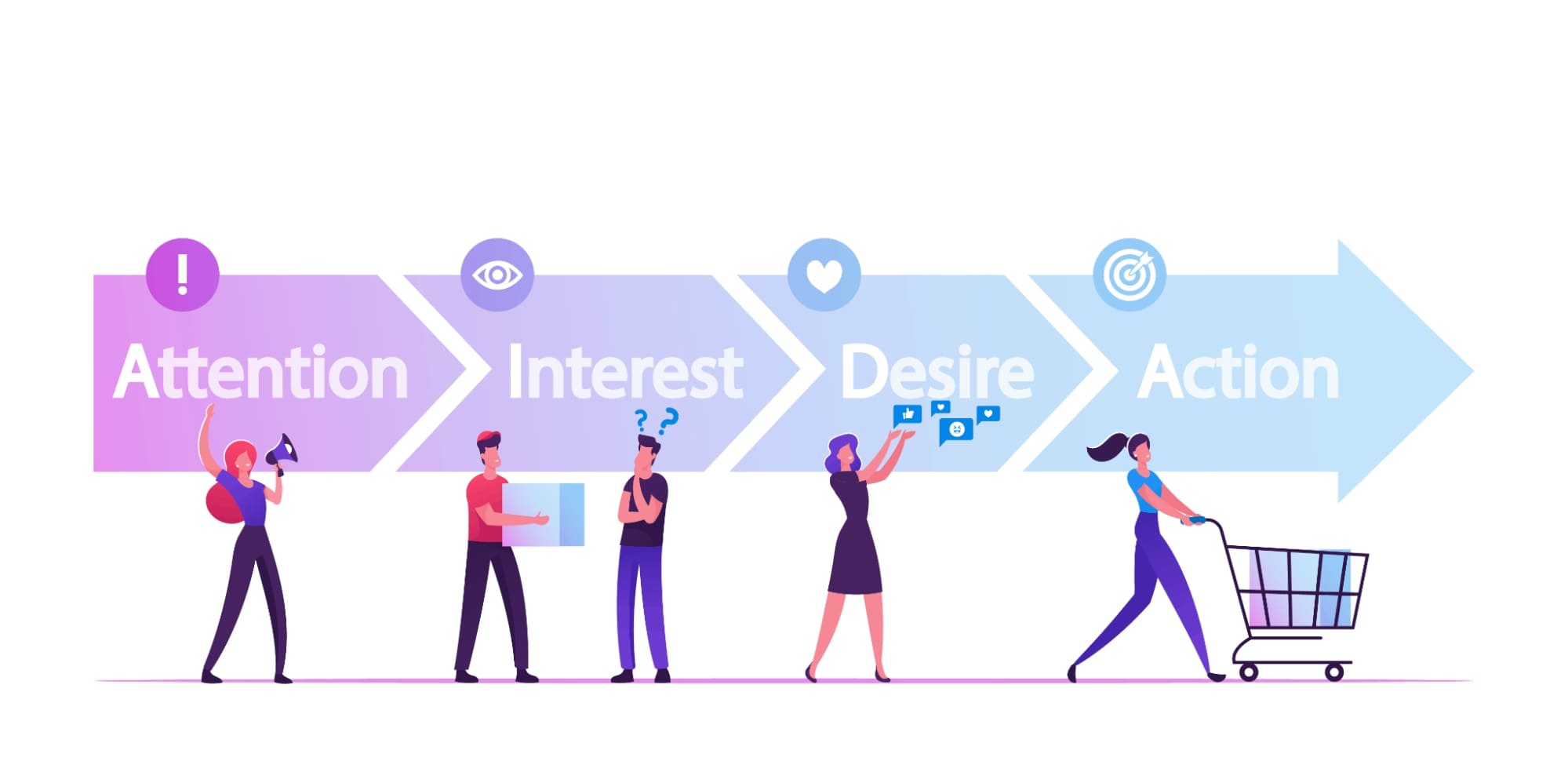
To build a marketing plan that goes in the right direction at every step, you need to answer the following questions:
- Building attention and awareness: How can people get to know my product? Which media channels will help users find out about us? What message do we need to increase brand awareness? Which tools or platforms should we use to reach customers?
- Generating interest: What topics is the target audience interested in? How can we earn their interest? What is the core content of the campaign for winning that interest? How should we build the company’s or business’s brand to get results? Where do we get this information?
- Creating desire: What bridge connects my product with customers and makes them want it? How should we engage with customers? Through live conversation or online chat?
- Calling for action: Where should the call to action be placed? Should we use a hotline number, or engage through the website or social networks such as Facebook or Zalo? Which channel will make it most effective and easiest for users to get in touch with us?
Beyond those questions, after-sales care is another way to score points with users. It makes customers more likely to become loyal, devoted fans of the brand who buy regularly and even tell friends about your products and services.
3.2 Using the AIDA Model in Content Writing
The AIDA model is widely used in content marketing writing. Applied correctly, it is a top-tier writing formula that builds trust in customers’ minds, positions your brand, and draws your target audience in to buy.

3.2.1 Tips for Applying the AIDA Model to Content Marketing
You can apply the AIDA model to build high-quality content as follows:
Grab the reader’s attention: Create a headline that is striking, compelling, and curiosity-provoking, one that taps into customers’ psychology and “pain points.” The headline message should be short, powerful, and shocking, and it should contain an important keyword related to the product or service you want to sell. Strategies you can apply to headlines include: emphasizing urgency with phrases like “can’t miss”; citing specific, tangible numbers; making the headline as detailed as possible; defining who your target audience is; asking questions to connect with readers’ mindset; using eye-catching images or video; and making shocking, bold claims or huge offers.

Build content that interests the reader: To create interest, content needs to be fresh, meet customers’ needs, and solve the “pain points” they are facing. That keeps readers on the page longer and exploring more content. To hold their attention, the content should deliver strong messages about features that match your customer insight. You can also add statistics and real customer numbers as proof, or use storytelling to win customers’ empathy.
Create the desire to own the product: Next, help customers see why they need this product. Your content should focus on the standout points, benefits, and distinctive features the product offers. Attractive promotions, awards won, expert opinions, partnerships with many partners, and so on are also ways to prove credibility, which strengthens customers’ desire to have the product.
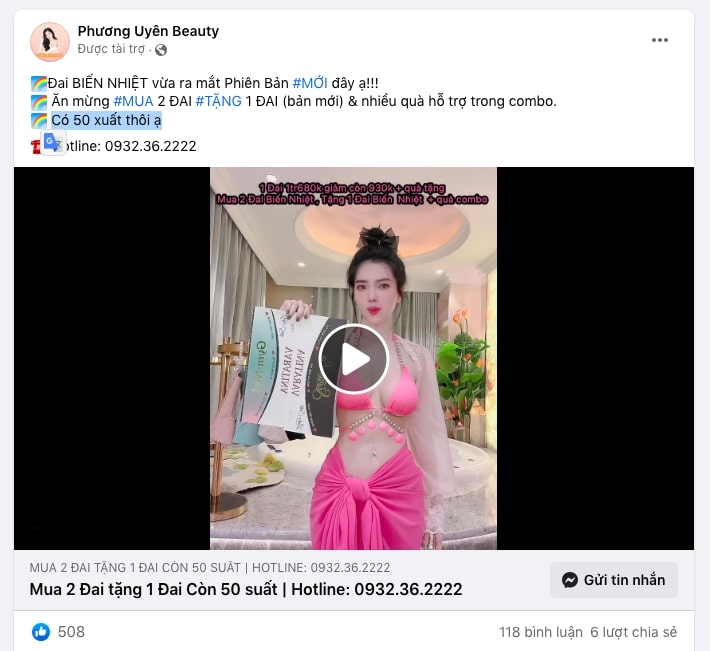
Call for action: Use strong, urgent wording so customers quickly take the action of buying, signing up, or filling in their information. Some ways to get users to act include: using a prominent CTA button with a short, concise call to action; leveraging scarcity to trigger fear of missing out; and offering “limited” deals or “only 1 hour left” to create time pressure that makes customers act fast.
A successful model for building a successful marketing strategy has to rest on a thorough analysis of customer behavior and psychology.
3.2.2 Examples of AIDA in Content Marketing
Here are a few examples of applying AIDA effectively in content marketing:
Example of a high-heel shoe ad:
=> Create attention:
THE PEAK OF FASHION: PREMIUM LEATHER WOMEN’S SHOES FROM ONLY 99,000 VND, NOT TO BE MISSED THIS TET!
Ultra-chic, turns every head, and always the center of every party.
Trusted by many supermodels and famous singers.
Made from premium leather imported from Portugal.
=> Create interest:
Free shipping on every order.
Elegant styling that never goes out of fashion.
Sizes 34-40
Heels of 5cm, 7cm, 9cm, 11cm
=> Create desire:
Only 99 pairs – just 3 days, February 10-13
=> Call for action:
Inbox us or call the brand’s free hotline now, and more.
Applying the AIDA model in marketing skillfully will generate business performance, help grow the brand, and leave a good impression in customers’ minds.
4. What Mistakes to Avoid When Using the AIDA Model
To avoid risks when following the AIDA formula, keep the following in mind:
Mistake 1: Focusing on Only One Stage
The AIDA model in marketing has four stages, and all four matter to the final result. If you focus on only one of them, your resources will be unevenly distributed, your content will lose cohesion and the power to persuade customers, and ultimately the overall performance of the marketing campaign will suffer.
Mistake 2: Not Getting the Most Out of Each Component of the Model
Even when you spread resources evenly across the four stages, none of them may reach its maximum effectiveness. To fix this, pay attention to and change even the smallest things in your plan, update your content and visuals, and use supporting tools to get the best results.
5. Brands That Have Successfully Applied the AIDA Model
Thanks to the benefits the AIDA model delivers, many brands have grown successfully by applying it. Examples include:
5.1 Netflix’s AIDA Model
Netflix is known as one of the strongest paid-TV brands in the world. Yet it also struggled when entering the Indian market, where people were used to free television content. Here is how Netflix attracted Indian viewers to its service:
Stage 1 – Building Awareness
To introduce its product to users, Netflix advertised on YouTube and Google AdWords. It announced and promoted itself repeatedly across video ads so that users kept seeing Netflix appear.
Stage 2 – Building Interest
After learning about Netflix, users visited Netflix landing pages, where they could try a free one-month trial with all the available features and programs.

Stage 3 – Creating Desire
After a month of using the service, users had grown used to the benefits and wanted to experience more. At this point Netflix rolled out upgraded subscription plans with bigger benefits to stimulate customers’ desire to own them, such as:
– Resolution upgraded to HD.
– Support for more users on the same account.
– Access to Netflix’s exclusive programs.
– Downloading and offline viewing.
– The option to turn off ads.
– Additional films from many other studios.
– Support for every device wherever you go, and more.
Stage 4 – Call for action
After this series of attractive benefits, users were won over and quickly signed up for Netflix’s different plans, then went on to make payment.
5.2 Apple’s AIDA Model
It was used when Steve Jobs introduced and launched the new iPhone:

Stage 1 – Building Awareness
Steve Jobs used a strategy of sparking curiosity and attention by announcing that he would launch a product line no one had ever seen. It was a smart move, since Apple and Steve Jobs were already quite famous.
Stage 2 – Building Interest
To keep the excitement going, Steve Jobs went on to discuss his analysis of smartphones in the new era.
Stage 3 – Creating Desire
He then laid out the problems phone makers were facing, and at the same time presented the solutions his new product could deliver.
Stage 4 – Call for Action
Finally, to spur purchases, Steve Jobs showed customers with their own eyes how he used the new iPhone and the unique strengths of the product.
Every business, large or small, will run into difficulties and challenges when it doesn’t know how to implement the AIDA model. So, to optimize results and costs, invest seriously in content and marketing skills. If you don’t have an in-house marketing team, use the professional team at The7 to develop an effective marketing strategy at an optimal cost.
Don’t hesitate to contact us when you need marketing services:

Nguyễn Đình
Bảo




As CEO of The7, I am committed to sharing practical, useful knowledge with every reader. Every article on The7 is based on my 7 years of hands-on experience in marketing — Facebook advertising, LinkedIn advertising, Google advertising, and marketing strategy. I hope you take away plenty of insight from these posts and apply it successfully in practice.
Related Articles
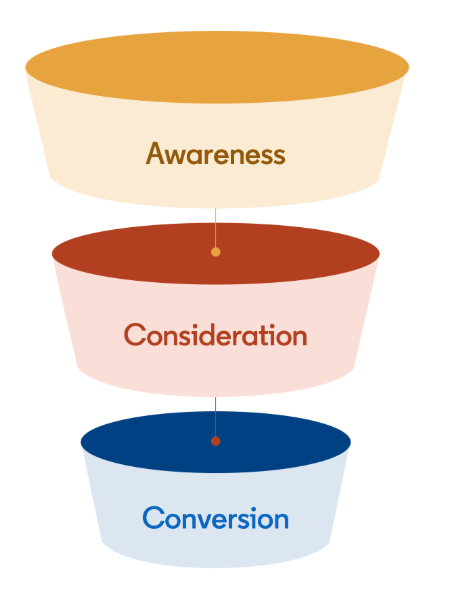
Building a Full-Funnel Content Marketing Strategy on LinkedIn
Table of Contents Toggle Why Build Content Marketing for the Full Marketing Funnel? (Why Full-Funnel Content Marketing?)Creating Your Strategy (Creating Your Strategy)Implementing Your Content Strategy (Rolling out your content strategy)Summary...
Designing Creative Content for LinkedIn
Table of Contents Toggle Why Is Good Creative Content So Important? (Why is Good Creative Important?)Key Components of Creative Design (the core elements of creative design)Summary (summary) Why Is Good...

Building an Organic Business Presence on LinkedIn With a LinkedIn Page
Table of Contents Toggle Why Have a LinkedIn Page?Establishing Your LinkedIn PageKeeping Your LinkedIn Page ActiveThe Measure of SuccessSummary About LinkedIn Page (Summary) Why Have a LinkedIn Page? For a...

6 Best LinkedIn Marketing Strategies for B2B in 2026
Table of Contents Toggle LinkedIn 2026: Where B2B Decisions Get MadeStrategy #1 – Why Is LinkedIn the Best B2B Marketing Channel Today?1. Decision-makers are concentrated here2. Users are in work...

7 Social Media Trends for 2026: The Era of Real Value, Real Conversion, and Real People
Table of Contents Toggle Social media is entering the biggest restructuring of the decadeTrend 1: Why is buying directly in-app becoming the new standard for 2026? (On-Platform Conversion)What should businesses...

What Is TikTok Marketing? Effective TikTok Marketing Strategies
TikTok has been topping the global rankings of the most downloaded and most visited apps. That makes it a gold mine for marketers who love creativity. In this article, The7...