


Four Frameworks That Replace the Funnel Model
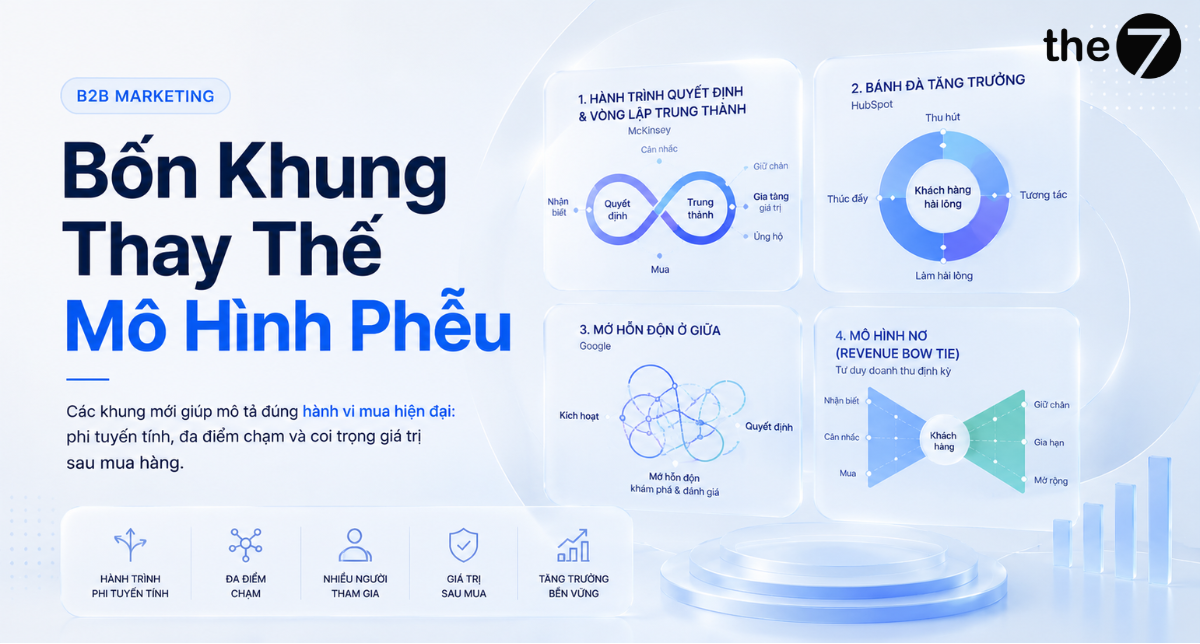
Summary: As the funnel model increasingly fails to capture how modern buyers actually behave, a number of new frameworks have emerged to replace or repair it: McKinsey’s decision journey and loyalty loop, HubSpot’s flywheel, Google’s messy middle, and the bow-tie model from recurring-revenue thinking. Each framework points to a real flaw in the funnel and fixes it in a way worth learning from. McKinsey fixes the linear assumption and puts the post-purchase phase at the center. HubSpot turns satisfied customers into a growth engine. Google shows that buyers don’t move in a straight line, but get caught in a loop of exploration and evaluation. The bow-tie model extends the journey into retention, renewal, and post-purchase growth. But what all four frameworks have in common is that they’re still trying to redraw the shape of the buying journey. In the 7B model, the difference is that 7B doesn’t try to answer the question “what shape is the journey?” It abandons that question altogether, because the real journey is too chaotic to have a stable shape. Instead, 7B asks a different question: which seller-side functions need to be running at all times to serve buyers, no matter what shape their path takes?
In the piece on why the funnel model is changing, I argued that the funnel no longer accurately describes how modern buyers make decisions. It’s still useful as a simple image for explaining the idea that “many people know about you, few buy,” but it’s no longer precise enough to serve as an operating map for marketing, especially in B2B. Buyers don’t fall neatly from one tier down to the next. They move forward, step back, compare, forget, come back, ask other people, read more, drop off, and then unexpectedly show up at a point your measurement system never predicted.
But recognizing that the funnel is broken is only the first step. The harder question is: if the funnel is no longer accurate, what replaces it? Over the past two decades, consultants, technology companies, behavioral researchers, and growth practitioners have proposed new frameworks to describe the buying journey. Some became very well known, some turned into everyday language in modern marketing, some dug deep into buyer behavior, and some reflect a shift in business models, especially subscription and recurring-revenue businesses.
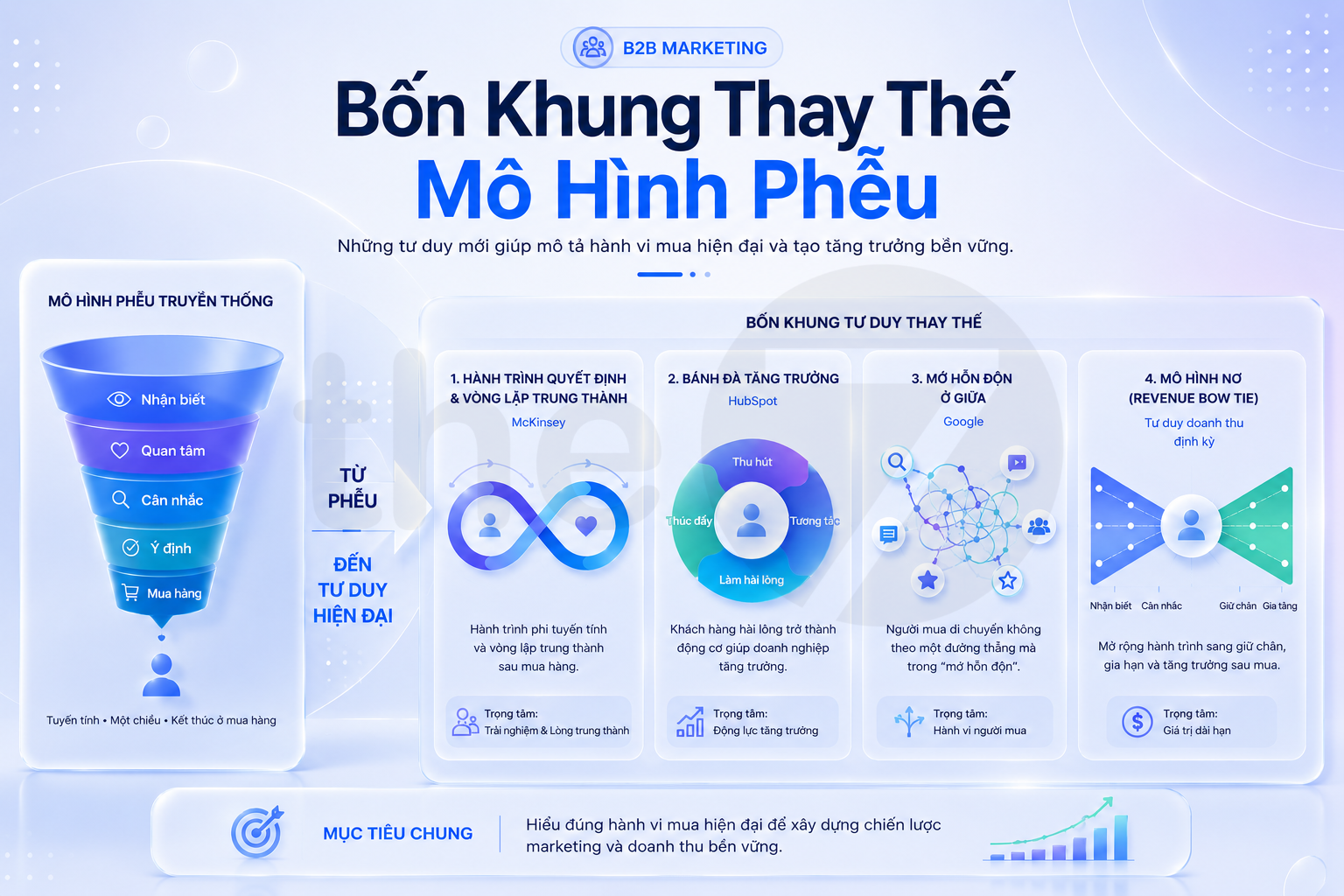
This piece isn’t meant to dismiss those frameworks. Quite the opposite: I think that to understand why the 7B model needs to exist, you first have to give the frameworks that came before it a fair hearing. Every framework that replaced the funnel is worth studying, because each one spotted a real flaw in the funnel. McKinsey saw that the journey isn’t linear and that post-purchase decisions matter more than the old funnel assumed. HubSpot saw that customers aren’t an output, but a source of momentum. Google saw that the middle of the journey isn’t tidy at all, but a chaotic loop between exploration and evaluation. The bow-tie model saw that, in recurring-revenue businesses, most of the real value sits after the purchase.
So the right way to read this piece isn’t “which framework is right, which is wrong.” The right way to read it is: what flaw in the funnel does each framework fix, what does each still miss, and why isn’t 7B just another shape in the same game of drawing the journey? 7B is a fundamentally different way of thinking. It doesn’t try to redraw the path buyers take. It builds a functional machine that keeps running, so that whatever path a buyer follows, the business shows up the right way.
Why the Funnel Needs Replacing, Not Just Patching
Before getting into the four replacement frameworks, it’s worth briefly recapping exactly where the funnel breaks down. Without understanding where it breaks, it’s easy to see the replacement frameworks as just different illustrations of the same thing. But in reality, each new framework arose as a response to a specific flaw in the funnel model.
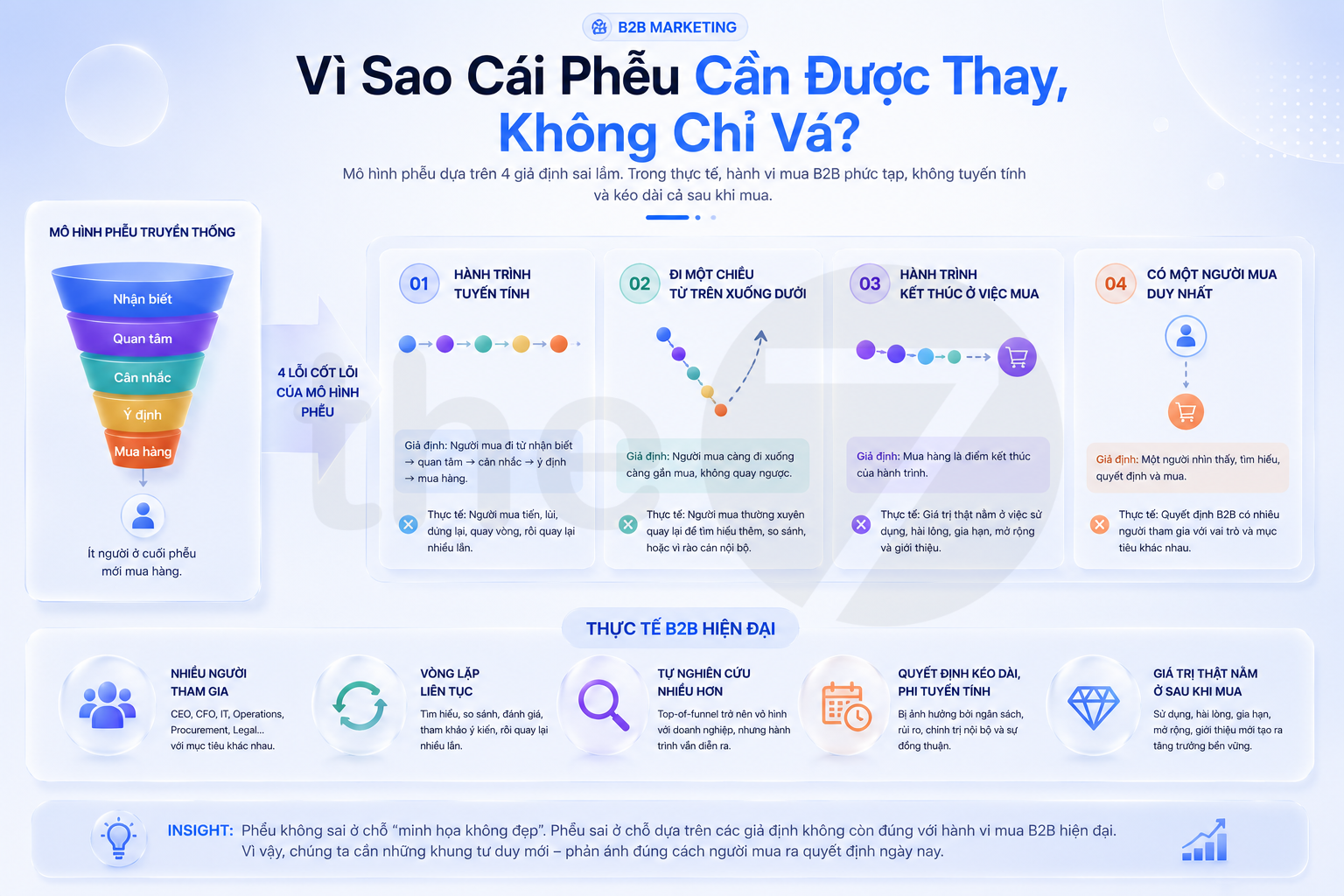
The funnel rests on four big assumptions. The first is that the buying journey is linear. Buyers start at awareness, move down to interest, consideration, intent, and finally purchase. On paper, it’s all very clean. But in reality, buyers don’t move that way. They might know you for a long time before they ever have a need. They might be considering you, then stop because their budget got cut. They might come back six months later because someone on the buying committee just changed jobs. They might listen to your podcast, see a LinkedIn post, ask a friend in the industry, and quietly add you to their shortlist without ever passing through a single “stage” in your CRM.
The second assumption is that the journey flows one-way, from top to bottom. In the funnel, the further down a buyer moves, the closer they are to purchase, and ideally they never move back up. But B2B reality doesn’t work that way. A software buying group might shortlist three vendors, then expand the list back out to seven names after an internal meeting. A CEO might already like a solution, but the CFO asks for a cost review, sending the whole group back into evaluation. A CMO might have filled out a form, but the ops team then discovers a CRM integration problem, pulling the deal back into research. The B2B buying journey usually isn’t a straight line down; it’s a series of loops pulled around by budget, risk, internal politics, and how much consensus exists on the buying committee.
The third assumption is that the journey ends at purchase. This is a major flaw of the funnel in today’s world. In many industries, especially software, professional services, industrial equipment, and long-term B2B solutions, signing the contract isn’t the finish line, it’s just the starting point. Whether the customer actually uses the product, whether they’re satisfied, whether they renew, whether they expand the contract, whether they refer others, whether they become social proof for you, all of that is what really determines the deal’s true value. If you only look as far as the purchase, you’ll optimize for winning new customers while neglecting how to turn that customer into a long-term growth asset.
The fourth assumption is that a single buyer moves through the funnel. In B2B, this is almost pure fiction. It’s rare for one lone person to see an ad, read some content, meet with sales, and decide to buy on their own. Most B2B deals involve multiple people: users, influencers, budget holders, technical approvers, legal, the people who’ll operate the thing after purchase, and sometimes a quiet objector with the power to slow everything down. Every person on the buying committee has their own journey, their own fears, their own criteria, and their own level of exposure to the brand. So saying “the buyer is at this stage of the funnel” is an oversimplification.
These four assumptions may have been useful in an era with fewer media channels, less data, a more observable buying journey, and business models that typically ended at the first transaction. But in modern B2B, those four assumptions are no longer enough. That’s why the funnel doesn’t just need “patching” by adding a few steps, renaming a few stages, or bolting on a post-purchase section. It needs replacing with a deeper way of thinking. The four frameworks below are four significant attempts to do exactly that.
Framework One: McKinsey’s Decision Journey and Loyalty Loop
One of the earliest influential replacement frameworks came from McKinsey in 2009, when they proposed replacing the traditional funnel with what they called the customer decision journey. This was a significant turning point, because McKinsey didn’t just add a few stages to the old funnel; they changed how we understand the nature of the purchase decision itself. Instead of viewing the buyer as someone being pushed gradually down through tiers, McKinsey saw them as someone continually weighing options, evaluating, experiencing, and returning to buy again within a loop.
McKinsey’s core argument is that the buying journey isn’t a funnel that narrows step by step. Buyers don’t start with countless options and whittle them down one by one until only a single choice remains at the bottom. Reality is more complicated. They typically start with an initial consideration set, the brands or vendors already sitting in memory. Then, as they move into evaluation, they might add new options to the list, drop some old ones, read reviews, ask people they know, compare information, and adjust their initial impressions. Eventually they buy, but the journey doesn’t stop there. After the purchase, their experience using the product directly shapes their next decision.
The most distinctive part of McKinsey’s framework is the loyalty loop. If the post-purchase experience is good enough, a buyer can enter a state of loyalty, where they don’t need to go back through the entire consideration process from scratch. They no longer need to widen their options much, don’t need to re-compare every vendor, and don’t need to walk through every evaluation step the way they did the first time. They buy again because they already trust you, already know you, are already satisfied, or because switching costs are too high. In other words, the post-purchase experience becomes the force that shapes the next buying decision.
This is a major fix to the funnel. The old funnel treated the purchase as the end point. McKinsey says no, the purchase is just one point in a larger decision loop. What happens after the purchase loops back and affects what happens before the next one. If the customer is satisfied, the business doesn’t have to start from zero every time. If the customer is disappointed, all the marketing spend that came before can be undone by what happens afterward. This view means marketing can no longer just be about attracting and persuading new people; it has to be tied to the product, the service, customer care, and the overall experience.
McKinsey fixes at least two major flaws in the funnel. First, they fix the linear assumption by showing that the journey is looped. Buyers don’t just move downward; they can go back, widen, narrow, re-evaluate, and continue. Second, they fix the assumption that the journey ends at purchase. In McKinsey’s framework, the post-purchase phase isn’t an afterthought, it’s what generates loyalty and shapes future growth. This is especially important in B2B, where a good customer doesn’t just generate one initial contract, but can generate years of renewals, expansions, referrals, and social proof.
But despite being a major advance, McKinsey’s framework still holds onto an underlying assumption: that the buying journey has a relatively defined shape, it’s just no longer a funnel but a loop. It redraws the journey from a straight line into a circle, but it’s still answering the same type of question: what does the buying journey look like? In other words, McKinsey improves the map, but still believes there’s a map stable enough to draw. For simpler markets, this approach is very useful. But in modern B2B, where many buyers are involved at once, many influence channels operate in the dark, and decisions get dragged through rounds of internal politics, a circular shape can still be too tidy compared to reality.
What McKinsey gives us is an important truth: the post-purchase experience feeds the next purchase decision. But it doesn’t fully resolve the operational question: if the journey isn’t just one loop but many overlapping loops among the multiple people on a single buying committee, how should a seller organize its marketing and revenue system? This is where the frameworks that follow keep fixing other parts of the funnel.
Framework Two: HubSpot’s Flywheel
The next influential replacement framework is the flywheel, heavily popularized by HubSpot around 2018. The flywheel idea isn’t entirely new. It draws on a famous image from Jim Collins’s Good to Great: a very heavy wheel that’s hard to push at first, but once it’s been turning long enough, it builds up momentum and becomes progressively easier to turn. HubSpot brought this image into marketing and growth, then used it to contrast with the traditional funnel.
In the funnel, customers move from top to bottom and fall out at the base. From that view, the customer is the final output of the marketing and sales process. You pour people into the top of the funnel, filter them down through tiers, and eventually a small number become customers. Then the system needs to keep pouring new people into the top to keep generating growth. This mindset makes businesses obsess over constantly “feeding the top,” meaning more traffic, more leads, more forms, more campaigns, more budget. It treats growth as a process of continuous consumption.
The flywheel changes that picture. In the flywheel model, customers don’t fall out of the system. They sit inside the system and can make the system spin faster. If a customer is happy, they refer you to others, leave positive reviews, talk about you in their community, buy again, or become proof that helps future buyers trust you faster. A good customer isn’t just booked revenue, it’s a new push for the entire growth machine. The more satisfied customers you have, the more momentum the flywheel builds. The more momentum, the lower the cost of convincing new people, because the market now has more proof, more referrals, more accumulated trust.
The flywheel’s strength is that it brings the concept of momentum into marketing. The funnel makes businesses think in terms of discrete campaigns: how many leads did this campaign generate, how many SQLs this month, how many deals this quarter. The flywheel makes businesses think longer-term: does what we do today add turning force to tomorrow’s system? Does content accumulate into an asset? Do customers become advocates? Does the product create an experience good enough to reduce friction? Is the customer care team helping the flywheel spin faster or slowing it down? This is a major shift in thinking.
The flywheel fixes an important flaw in the funnel: the funnel treats customers as the final output, while the flywheel treats customers as part of the growth engine. This is especially true in B2B, where a referral from an existing customer can be worth more than hundreds of ad clicks. A CIO trusts another CIO more than they trust a landing page. A steel-industry CEO hearing another steel-industry CEO talk about a vendor will pay far more attention than seeing a cold ad. A major customer agreeing to be a case study can become a driving force behind many later deals. The flywheel sees this far more clearly than the funnel does.
But the flywheel has its limits too. It’s a very powerful metaphor for momentum, but it’s still a metaphor about shape. It replaces the funnel with a spinning wheel, but still focuses on describing the entire system through a single image. It’s right that satisfied customers create growth, but it doesn’t always spell out which specific functions need to run to generate that momentum. What do you need to do to get known in the market? What creates buzz? What lets buyers do their own research? What converts existing demand? What turns customers into believers? What earns third-party recognition? What gets customers and partners to bring in new business? The flywheel says the system needs to spin, but it doesn’t always separate out the functional gears inside that system.
In other words, the flywheel is very good at fixing the mindset that “the customer is the end point.” It helps a business understand that satisfied customers are a growth resource. But to turn that mindset into concrete operations, a business still needs a clearer functional breakdown. Without one, the flywheel easily becomes just a pretty slide: customer at the center, a few “Attract, Engage, Delight” arcs drawn around it, and in the end marketing still measures forms, sales still pushes deals, and customer care is still treated as a post-sale cost. When that happens, the shape has changed but the operating model hasn’t.
Framework Three: Google’s Messy Middle
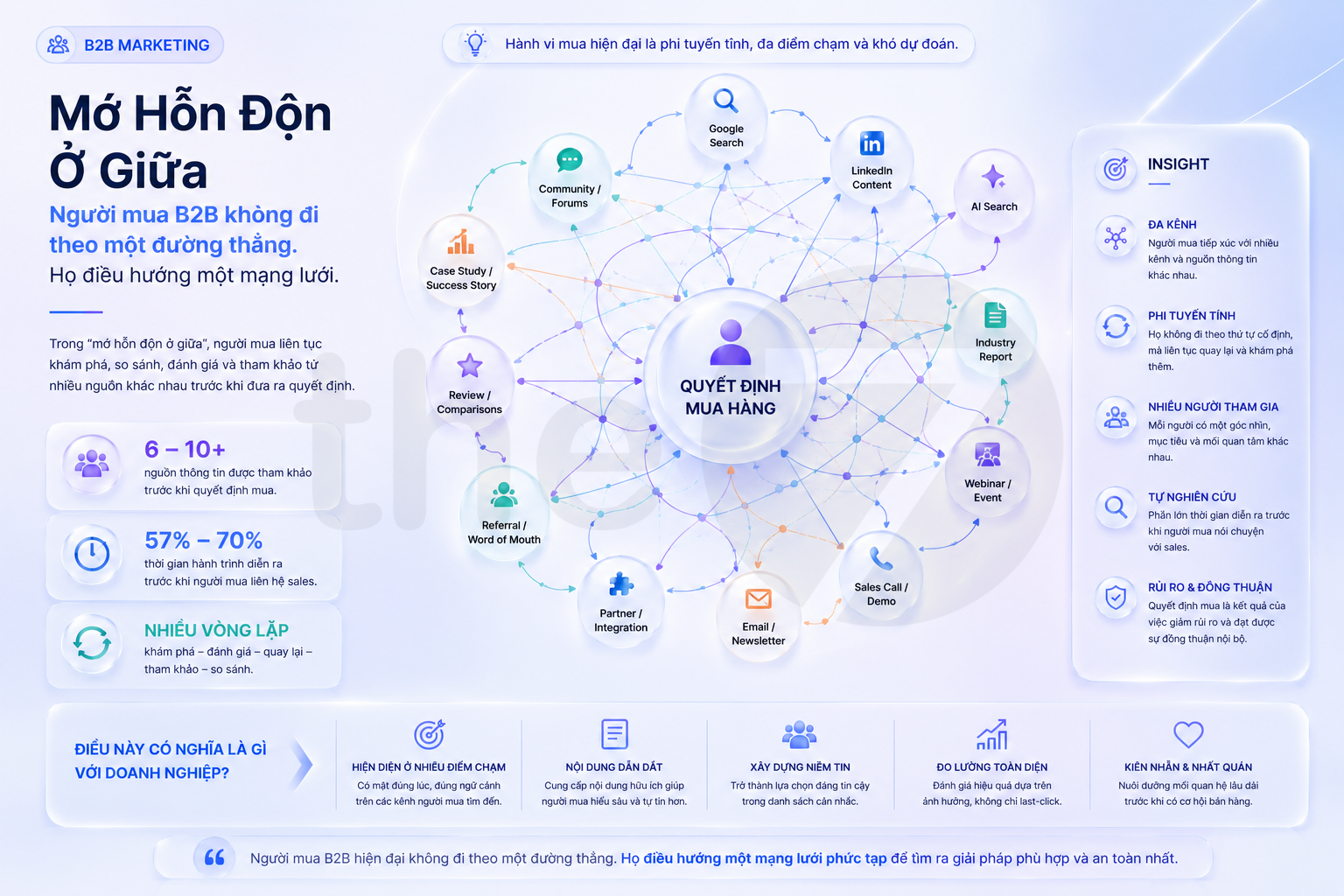
If McKinsey and HubSpot offer powerful strategic metaphors, Google provides one of the frameworks closest to actual behavior: the Messy Middle. In 2020, Google’s behavioral science team published research called Decoding Decisions, in which they tried to understand what happens between the moment someone develops a need and the moment they make a purchase decision. Their answer looked very different from the tidy funnel. There’s no straight line in the middle. In the middle is a mess.
The core idea of the messy middle is that buyers continuously cycle between two mental states: exploration and evaluation. While exploring, they widen their options. They look for more information, read more articles, check out more vendors, ask more contacts, open more tabs, save more videos, and take in more opinions. While evaluating, they narrow their options. They compare, eliminate, weigh risk, revisit budget, and consider who’s more trustworthy, more suitable, or less risky. The crucial point is that these two states don’t happen once in a fixed order. A buyer can explore, evaluate, then explore again, then evaluate again. They can loop around multiple times, triggered by a new piece of information, new advice, a new internal meeting, or a new fear.
This is where Google hits the funnel hardest. The funnel assumes buyers pass through relatively stable stages. The messy middle says no, the middle is a psychological and behavioral loop, where buyers are simultaneously widening and narrowing, curious and skeptical, searching for more and eliminating options. A buyer doesn’t necessarily move “further down” toward purchase after every interaction. An article might build more trust, but it might also reveal five other options they hadn’t considered. A demo might get them more excited, but it might also make them realize an implementation risk. A referral might get you onto the shortlist, but one bad review can knock you off it within minutes.
In B2B, this messiness is even more complex because it doesn’t happen inside just one person’s head. It happens inside many heads at once. The end user might be in exploration mode while the CFO is evaluating cost. The CTO might be looking at integration risk while the CEO only cares about strategic advantage. Marketing may have already won over the champion but never reached the person with veto power. So what’s called the “account journey” is really many overlapping messy middles, not a single path.
Google’s framework’s strength is that it’s grounded in observed behavior, not just a nice metaphor. It helps marketers understand why forcing buyers into funnel tiers is often wrong. When you think a buyer is in “consideration,” they might have just looped back into more exploration. When you think they’re “ready to buy,” a new stakeholder might have just pulled them back into risk evaluation. When you think they “have no need,” they may have already heard your name repeatedly in private conversations you can’t measure. The messy middle makes us more humble about buyers’ real behavior.
But this framework has its own limits too. It’s an excellent description of the problem, but not yet a complete blueprint for action. It tells you that buyers loop between exploration and evaluation, but it doesn’t automatically answer the full question: how should a seller organize its marketing machine to always be present in those loops? What content, what channels, what proof, what community, what advertising, what relationships, what existing customers, and what conversion system do you need to serve buyers inside that messy middle? Google shows you the maze, but it doesn’t build the whole machine you need to survive inside it.
In addition, the messy middle focuses heavily on the phase between need and decision. It’s very strong at explaining how buyers process choice, but it doesn’t fully cover the broader questions of B2B growth: how do you get remembered before a need even appears, how do you build long-term trust, how do you nurture customers after purchase, how do you turn customers into a channel that brings in new business, how do you earn third-party recognition. So the messy middle is a very important piece of the truth, but it’s still just a piece. It shows us where the funnel is wrong in the middle, but it doesn’t replace the seller’s entire operating system.
Framework Four: The Bow-Tie Model of Recurring-Revenue Thinking
The fourth replacement framework comes from a major shift in business models: the rise of recurring revenue, especially in subscription software and long-term service models. When a business earns money not just from the first transaction but from customers staying, renewing, expanding, and continuing to use the product for years, the old funnel becomes seriously inadequate. It stops right at the point where the real value story begins.
The bow-tie model starts from a very simple but crucial observation: in recurring-revenue businesses, the point of purchase isn’t the bottom of the funnel, it’s the pinch point in the middle. Before purchase, a business still needs to attract, educate, nurture, persuade, and convert new customers. But after purchase, the journey doesn’t stop. It extends into onboarding, usage, realizing value, retention, renewal, upsell, cross-sell, account expansion, and finally turning customers into advocates. So the bow-tie model draws two triangles meeting at the point of purchase: the left half looks like the old funnel, and the right half widens back out after the customer has bought.
The bow-tie model’s strength is that it forces a business to view the post-purchase phase as part of growth, not as back-office overhead. In many B2B businesses, especially SaaS, the first contract is only a small fraction of a customer’s total lifetime value. A customer who signs a small first-year deal but uses the product well, expands into multiple departments, and renews for years can be worth far more than a big contract that churns after year one. Using only the funnel, a business easily ends up optimizing for closing new contracts while neglecting whether the customer actually realizes real value. The bow-tie model fixes that by putting retention and expansion on the same growth map.
In B2B, this is especially important because purchasing doesn’t equal success. A company might sign a software contract but the team never uses it. A factory might buy a solution but roll it out slowly. A conglomerate might pilot a service in one department but never expand it to other units. If the post-purchase phase isn’t designed well, a business doesn’t just lose the chance for more revenue, it also creates silent customers who don’t refer anyone, don’t advocate, don’t do case studies, and sometimes become a drag on future deals. The bow-tie model helps us see that marketing and growth don’t end at the signature on the contract.
The bow-tie model fixes the funnel’s most serious flaw in recurring-revenue businesses: ignoring what happens after purchase. It states very clearly that customer value doesn’t live entirely in the first purchase. Real value lies in whether the customer stays, uses the product more deeply, buys more, refers others, and becomes living proof for the market. For businesses with subscription models, recurring services, maintenance contracts, long-term consulting, technology solutions, or long product life cycles, this is an extremely important fix.
But the bow-tie model still has one major limitation: it’s still a model about the shape of the journey. It replaces the funnel with a bow tie, widening out the post-purchase phase, but its front half typically still keeps the old funnel’s linear logic. Buyers are still drawn as moving from awareness, interest, consideration, purchase, and only then does the map widen into post-purchase. In other words, the bow-tie model fixes the post-purchase phase very well, but it doesn’t fully resolve the chaos of the pre-purchase phase. It extends the map, but doesn’t necessarily change the map’s fundamental nature.
Another limitation is that the bow-tie model was born out of a recurring-revenue context, so it’s very strong for SaaS and subscription services, but it doesn’t always apply smoothly to every B2B industry. In industrial manufacturing, capital equipment, infrastructure, strategic consulting, healthcare, construction, or project-based deals, the post-purchase phase still matters a great deal, but the “bow tie” shape may not be enough to describe the relationship loops, the influencers, the repeat purchases, the follow-on projects, and the layers of market recognition. The bow-tie model is right that post-purchase matters. But it still doesn’t fully answer the question: what full system of functions has to run continuously to generate demand, convert demand, sustain trust, create proof, and expand growth?
What These Four Frameworks Share, and What They Miss
Now let’s step back and look at all four frameworks at once. McKinsey says the journey is a decision loop, and the post-purchase experience creates a loyalty loop. HubSpot says growth is like a flywheel, where satisfied customers generate momentum for the system. Google says the middle of the journey is a mess, where buyers cycle repeatedly between exploration and evaluation. The bow-tie model says purchase isn’t the end, but the pinch point between a front half that attracts customers and a back half that retains, renews, and expands them.
Each framework is right about the part it sees. McKinsey is right that the journey doesn’t end at purchase. HubSpot is right that satisfied customers are a growth engine. Google is right that buying behavior isn’t linear but chaotic. The bow-tie model is right that the post-purchase phase holds most of the value in recurring-revenue models. These aren’t wrong ideas. On the contrary, they’re real advances over the old funnel. If a business only knows the funnel, learning any one of these four frameworks will help it stop oversimplifying the market.
But there’s one very important thing they all share: all four frameworks are still trying to answer the question of what shape the buying journey has. The funnel says the journey is a narrowing triangle. McKinsey says the journey is a circle. HubSpot says the growth system is a spinning wheel. Google says the middle is a chaotic loop between exploration and evaluation. The bow-tie model says the journey is bow-tie-shaped, pinching at the point of purchase and widening afterward. All of them are trying to replace an old shape with a more sensible new one.
The problem lies in that very question. If the buying journey truly has a stable shape, then searching for the right shape makes sense. If buyers really do follow a predictable pattern, we just need to find that pattern, draw it, and optimize around it. But if the buying journey is a chaotic system, where every buyer takes a different path, every buying committee has a different structure, and every deal is shaped by different forces, then “what shape is the journey” stops being a useful question. It’s like trying to draw the fixed shape of smoke. You can capture one moment and see some shape, but a moment later the shape has already changed.
This is even clearer in B2B. One buyer might know you through Broadcast for months without acting. Another might hear your name through Buzz in a private group. Another might enter Browse to research on their own without leaving a trace. Another might only show up once a need has reached Buy. An existing customer might become a Believer, then use Bridge to bring in a new account. An article, an award, an industry report, or a reputable partner can create Backing for you before sales even knows that account exists. These forces don’t line up along a straight line, a circle, or a bow tie. They happen in parallel, overlapping, breaking off and reappearing.
This is what the funnel-replacement frameworks tend to miss. They fix the shape, but still center the buyer’s journey as something that can be drawn. They ask: how does the buyer move? That question is still useful at the descriptive level, but it’s not enough to build an operating system. Because if every buyer moves differently, if every buying committee is its own system, if a lot of influence happens in dark, unmeasurable territory, then a seller can’t rely on just one journey map. A seller needs a machine that’s always running, with functions broad enough to serve many journey shapes at once.
In other words, the frameworks that replace the funnel fix specific flaws in it, but they haven’t fully escaped the “draw the journey” mindset. They give us better, deeper, more realistic shapes. But if the root problem is that the journey has no fixed shape, then a better shape still isn’t the final answer. This is where the 7B model steps into a different kind of question altogether.
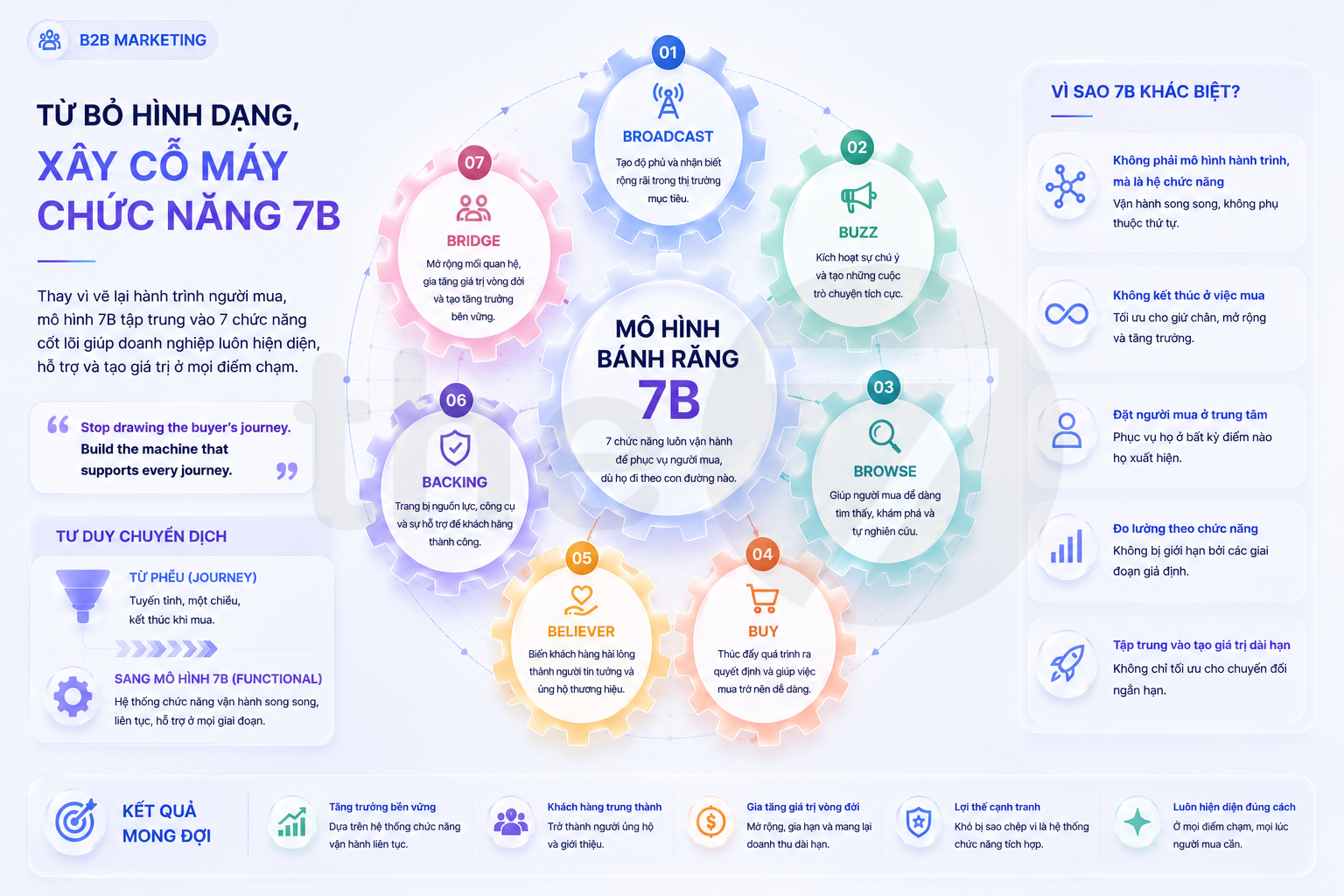
The 7B Model: Abandoning Shape to Build a Functional Machine
The 7B model isn’t a fifth entry in the list of “shapes that replace the funnel.” If you place it alongside the funnel, the circle, the flywheel, the messy middle, and the bow tie as just another shape, you’ll misunderstand its nature. 7B wasn’t created to say what shape the buying journey has. It was created from the opposite conclusion: the buying journey has no fixed shape stable enough to rely on. So instead of trying to draw a new shape, 7B abandons the shape-drawing game altogether.
7B’s question isn’t: what stages does the buyer pass through? 7B’s question is: if buyers can follow any shape at all, what functions does the seller need running at all times to still be present, still build trust, still be remembered, still be found, still convert existing demand, still nurture current customers, still earn recognition, and still turn relationships into new growth?
This is the core shift. The other four frameworks are primarily models of the buyer’s journey shape. 7B is a model of the seller’s functions. It doesn’t try to draw the path buyers take, because that path is chaotic, individual, and often invisible. Instead it defines seven gears, seven functions a business must run continuously: Broadcast to stay visible in the market, Buzz to generate discussion and spread, Browse to let buyers do their own research, Buy to convert existing demand, Believer to nurture customers and turn them into believers, Backing to earn third-party recognition, and Bridge to turn relationships into a channel that brings in new business.
When these seven gears turn together, a business doesn’t need to precisely guess which “stage” each buyer is at. A buyer who’s just discovering you can still encounter Broadcast. A buyer hearing the market talk about you can encounter Buzz. A buyer researching on their own can encounter Browse. A buyer with a clear need can move into Buy. Existing customers are nurtured through Believer. When the market needs proof, there’s Backing. People who already trust you, customers, partners, experts, community, can become a Bridge bringing new people into the system. These gears don’t line up in sequence. They spin in parallel.
This is why 7B fits modern B2B better. Within a single buying committee, each person may touch a different gear. The CEO might know you through Broadcast. The CMO might trust you thanks to an in-depth analysis piece in Browse. The CFO might need Backing to see you as credible. The champion might become a Believer before the company even buys. A former customer might create a Bridge by referring you to a new account. These interactions don’t happen in linear order, but they all belong to the same functional machine.
And this is where 7B doesn’t dismiss the other frameworks, it synthesizes what’s true in each of them. McKinsey says the post-purchase experience feeds the next decision. 7B has Believer to nurture existing customers and turn the post-purchase experience into a trust asset. HubSpot says satisfied customers generate growth momentum. 7B has Bridge to turn customers, partners, community, and advocates into a channel that brings in new business. Google says buyers loop between exploration and evaluation inside a messy middle. 7B has Broadcast, Buzz, Browse, Backing, and Buy all spinning together, so buyers can encounter the right support whether they’re widening or narrowing their options. The bow-tie model says the post-purchase phase matters. 7B has Believer and Bridge to make the post-purchase phase not just care, but a growth engine.
The difference is that 7B doesn’t draw those truths into a shape. It turns them into functions. That’s a huge difference. A shape helps us describe. A function helps us operate. A shape says “the journey might look like this.” A function says “no matter what the journey looks like, this still has to run.” In a chaotic market, a business can’t just need a pretty map. A business needs a durable machine.
Let’s look at this across a few industries. In enterprise software, a buying committee might loop back and forth between exploration and evaluation many times, and no one on the sales team sees every single interaction. Using only the funnel, a business would try to guess which stage the account is at. Using 7B, the business instead focuses on making sure the gears keep turning: content for self-research, proof to reduce risk, advertising to sustain recall, existing customers acting as believers, a conversion channel ready when the need appears. In professional services, much of the value lies in relationships and reputation, so Believer, Backing, and Bridge can matter just as much as Buy. In industrial manufacturing, buyers usually decide slowly, with many participants, heavy technical information, and significant implementation risk, so a continuously running functional machine fits better than trying to draw which funnel tier they’re sitting in.
So the 7B model isn’t saying McKinsey is wrong, HubSpot is wrong, Google is wrong, or the bow-tie model is wrong. It’s saying all of them are right about the part they see, but instead of picking one shape to replace the old one, we should take those true insights and build them into an operating system. If the journey is chaotic, don’t try to hold it still long enough to draw it. Build gears strong enough to serve it while it keeps moving.
Three Mistakes in How We Think About Funnel-Replacement Frameworks
The first mistake is changing the shape while keeping the same mindset. This is the most common mistake. Many businesses pull the funnel off their slides, replace it with a circle, a wheel, a bow tie, or some more elaborate diagram, and think they’ve modernized their marketing. But if underneath the new shape the team is still operating on the old logic, still forcing buyers through discrete stages, still treating forms as the center of the universe, still treating purchase as the end, still only measuring what shows up in the CRM, nothing has actually changed. The shape is new, but the operating system is still old. The fix isn’t finding a prettier shape; it’s re-examining the underlying assumption: do we still believe the journey has a fixed shape to manage? If we do, we’re still playing the funnel’s game.
The second mistake is treating a descriptive framework as an action framework. The messy middle is a clear example. It describes buyer behavior very well, but an accurate description doesn’t automatically translate into correct operations. Knowing that buyers loop between exploration and evaluation is necessary, but a business still has to answer the follow-up questions: what content helps them explore, what proof helps them evaluate, what channel keeps them remembering you, who helps them trust you, what experience keeps them around, and what relationships bring in new people? A descriptive framework helps us understand the world. An action framework helps us organize the work. A business needs both, but shouldn’t mistake one for the other.
The third mistake is thinking you have to pick a single framework. This too is a holdover from funnel thinking: the belief that there must be one truest map, one standard shape, one final diagram. But in reality, each of the four frameworks above captures one piece of the truth. There’s no need to choose McKinsey over HubSpot, or Google over the bow-tie model, as if they were mutually exclusive. McKinsey helps us see the role of the post-purchase experience. HubSpot helps us see the momentum of satisfied customers. Google helps us see the chaos between exploration and evaluation. The bow-tie model helps us see the retention and expansion that follow purchase. The question isn’t which framework wins, but how to bring those true insights into one unified operating system.
The fourth mistake, and the deeper one, is forgetting that the seller doesn’t control the buyer’s journey. A seller can influence, support, clarify, reduce risk, build trust, provide proof, and pave the way to conversion. But a seller can’t command a buyer to move from step one to step two to step three. In B2B, the journey is shaped by budget, timing, internal politics, strategic priorities, personnel changes, the level of consensus on the buying committee, and countless conversations that can never be measured. So instead of trying to “manage the journey,” a business should build a system strong enough to always be present at the moments that matter, even when it has no way of knowing in advance where those moments will come from.
Conclusion: Don’t Draw a Prettier Shape, Build a Machine That Never Stops Running
Let’s return to where I started. As the funnel grew outdated, many new frameworks emerged to replace it, and each deserves respect for fixing a real flaw. McKinsey’s decision journey fixes linearity and adds a post-purchase loyalty loop. HubSpot’s flywheel turns satisfied customers into a growth engine, instead of treating them as output falling out the bottom of a funnel. Google’s messy middle captures the truth that buyers don’t move in a straight line, but loop continuously between exploration and evaluation. The bow-tie model of recurring-revenue thinking extends the journey into retention, renewal, expansion, and advocacy after purchase. Each framework fixes an important piece.
But each replacement framework fixes one flaw in the funnel, none fixes all of them. More importantly, all four still play the same game: drawing a better shape for the buying journey. If the buying journey has a stable shape, that game makes sense. But if the buying journey is truly a chaotic system, unpredictable at the individual level, varying by person, by buying committee, by moment, and by context, then drawing a prettier shape still doesn’t escape the root problem. The shape might be right in some cases, but it isn’t enough to serve as the foundation for the entire operation.
The 7B model takes a fundamentally different approach. It doesn’t try to answer the question “what shape does the buying journey have?” It abandons that question. Instead, 7B asks: in a world where the buying journey has no fixed shape, what functions does the seller need running at all times? The answer is seven gears: Broadcast, Buzz, Browse, Buy, Believer, Backing, and Bridge. These seven gears aren’t seven stages for the buyer to pass through; they’re seven functions the seller must maintain to serve buyers in every state, at every moment, in every shape the journey takes.
That’s why 7B doesn’t dismiss McKinsey, HubSpot, Google, or the bow-tie model. It absorbs what’s true in each of them, but shifts them from shape to function. McKinsey’s post-purchase experience becomes Believer. HubSpot’s customer momentum becomes Bridge. Google’s loop between exploration and evaluation is served by continuously spinning gears like Broadcast, Buzz, Browse, Backing, and Buy. The bow-tie model’s post-purchase phase is nurtured by Believer and expanded by Bridge. What the other frameworks draw as shape, 7B turns into a machine.
Don’t try to draw a prettier shape for a journey that has no shape. Don’t just replace the funnel with a circle, a wheel, a loop, or a bow tie and think the problem is solved. A shape helps us understand part of reality, but only a machine lets us operate within that reality. In modern B2B, buyers will keep looping around, moving sideways, doubling back, disappearing, returning, asking other people, researching on their own, comparing options in the dark, and making decisions in ways your system can never fully see. Your job isn’t to force them onto a path you’ve drawn. Your job is to build a functional machine that never stops running, so that no matter what shape their path takes, they can still find you, understand you, trust you, choose you, stay with you, and bring others to you.
To understand why the buying journey has no fixed shape, read the piece on Chaos Logic Theory. To understand why the funnel breaks down at its very root, read the piece on why the funnel model is changing. To understand the seven-gear machine that synthesizes everything the other frameworks got right, read the piece on the 7B gear model. And to understand the gear that nurtures customers after purchase, which McKinsey and the bow-tie model both emphasize, read the piece on customer marketing.

Nguyễn Đình
Bảo




As CEO of The7, I am committed to sharing practical, useful knowledge with every reader. Every article on The7 is based on my 7 years of hands-on experience in marketing — Facebook advertising, LinkedIn advertising, Google advertising, and marketing strategy. I hope you take away plenty of insight from these posts and apply it successfully in practice.
Related Articles
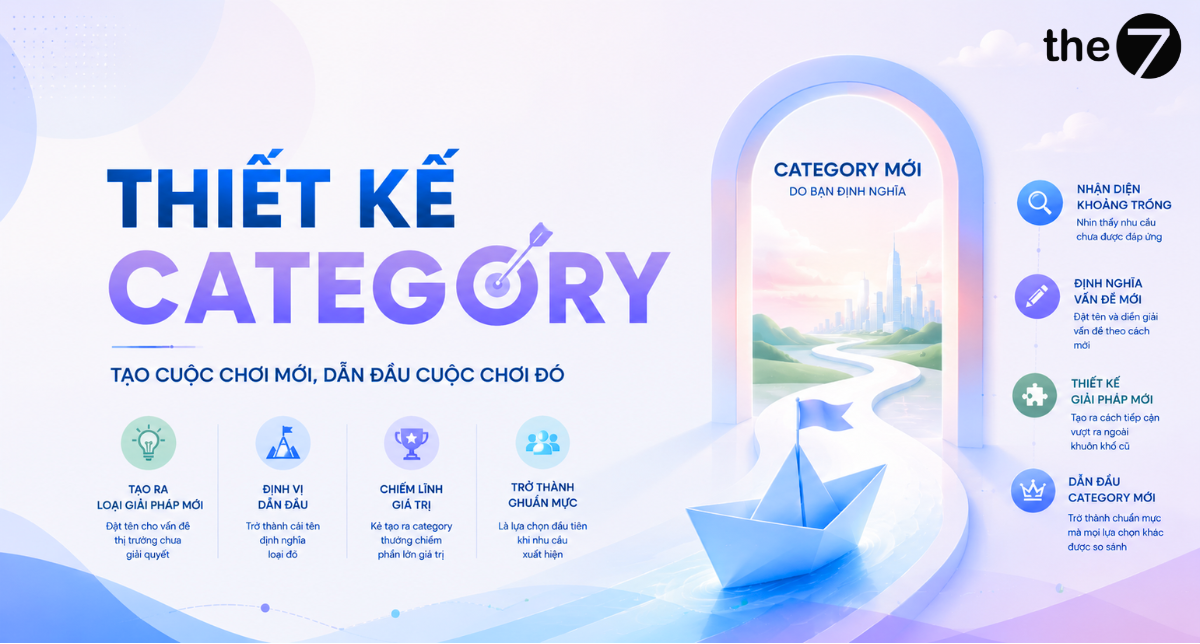
What Is Category Design?
Summary: Category design is the act of creating an entirely new type of solution in the market’s mind, instead of competing within an existing category, and then becoming the name...
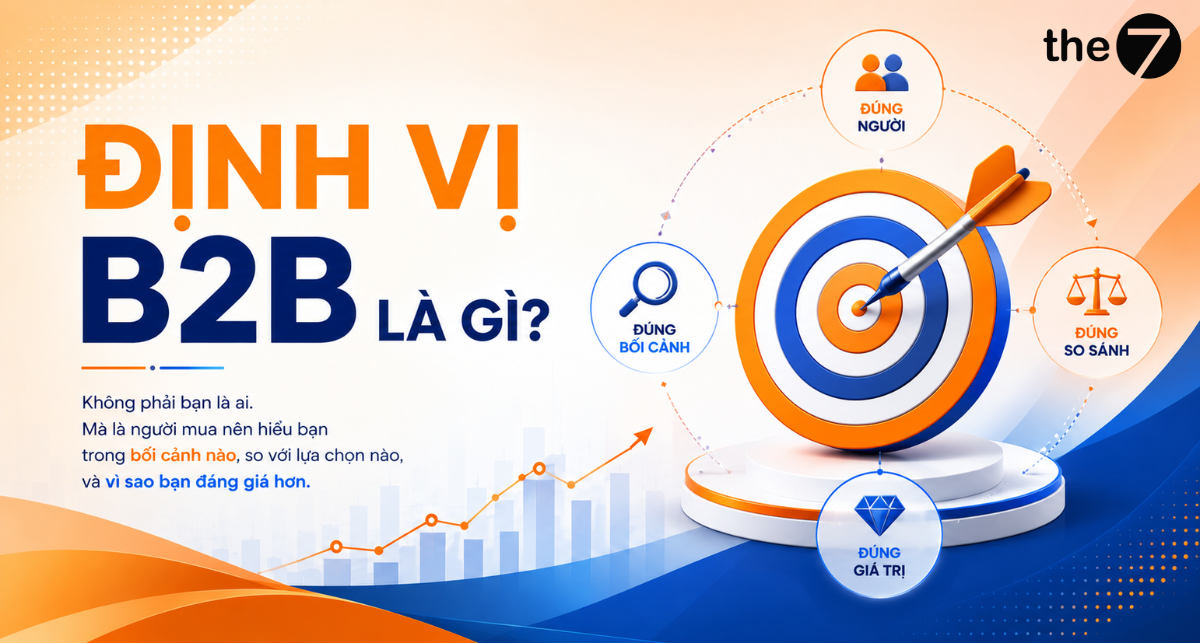
What Is B2B Positioning?
Summary: B2B positioning is the act of choosing the context you place your product into – the frame of reference that makes its value obvious to the buyer. Positioning isn’t...
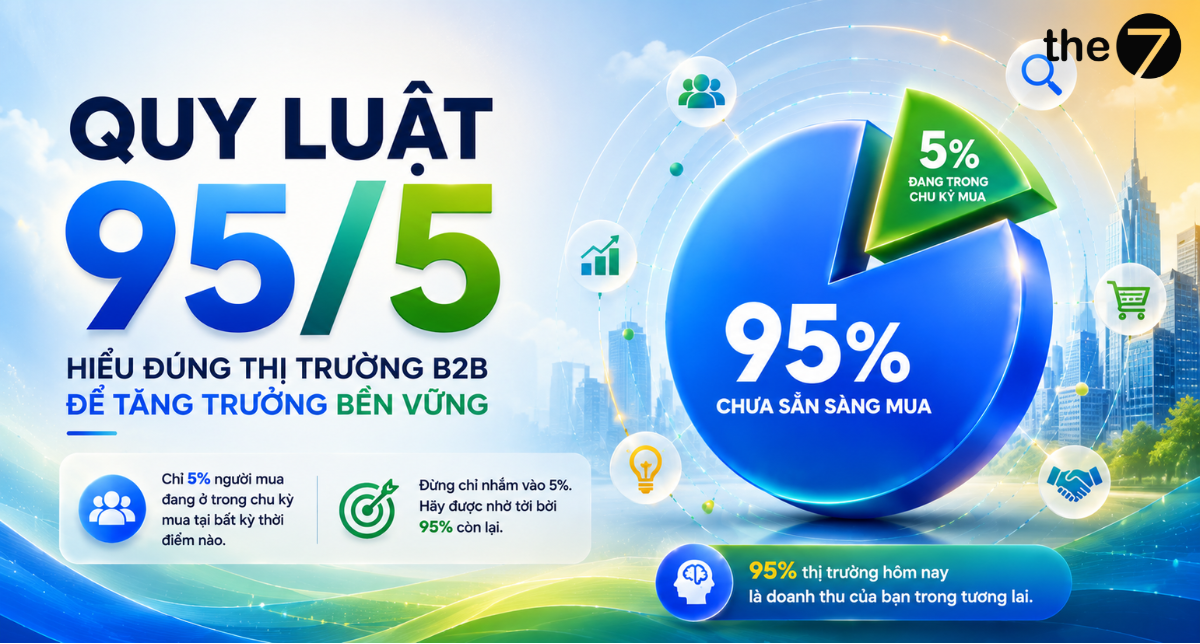
What Is the 95/5 Rule?
Summary: The 95/5 rule states that at any given moment, only about 5% of B2B buyers are actually in-market, actively in a buying cycle, while roughly 95% are not yet...
What Is Mental Availability in B2B?
Summary: Mental availability is how easily a brand comes to mind in a buying situation. It isn’t about having the sharpest argument, the slickest pitch, or the most convincing feature...
What Are B2B Events and Trade Shows?
Summary: B2B events and trade shows are in-person gatherings such as conferences, industry trade shows, workshops, and private meetings, where a business meets buyers, customers, partners, and the industry community...
What Is B2B Community Marketing?
Summary: B2B community marketing is about building and nurturing a community where members connect with each other around a shared interest, not just with the brand. The core distinction comes...