


What Is the SWOT Model? How to Build an Effective SWOT Analysis
The SWOT model, also known as the SWOT matrix, is a useful tool that helps businesses analyze their situation and make decisions about their business strategy. So why do you need to run a SWOT analysis, and how can you use this tool as effectively as possible? Let The7 walk you through it.
A Quick Overview of the SWOT Model
Over the past two years, we have watched many businesses undergo a remarkable “transformation,” while quite a few others were hit hard by the pandemic. What the businesses that rose to the occasion had in common was that they played to their strengths in time and fixed their weaknesses quickly.
This is also one of the core ideas behind SWOT analysis. Let’s take a closer look at what the SWOT model is and why it can help a business recover and accelerate growth.
1.1 What Is SWOT?
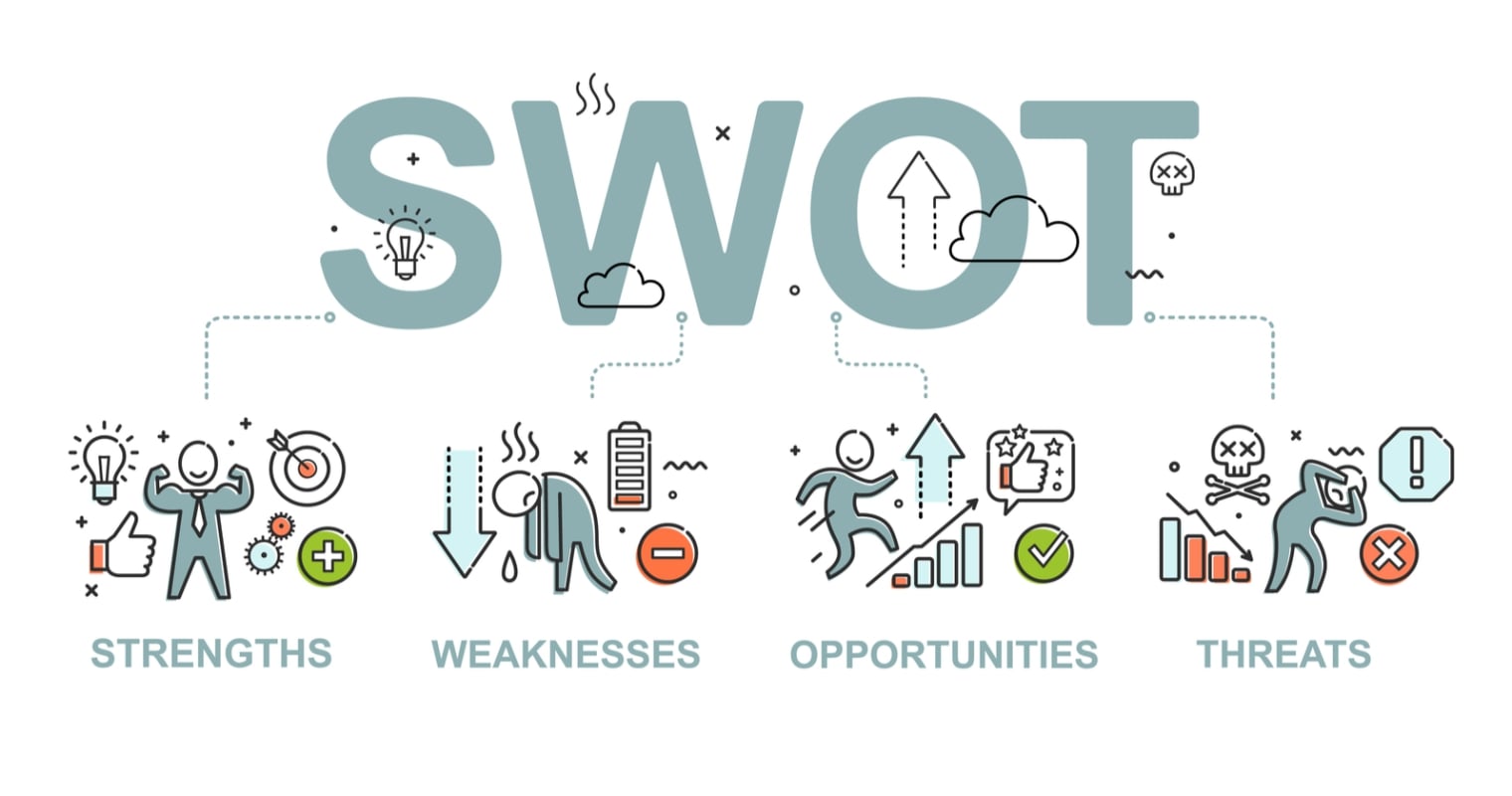
SWOT is an acronym for four terms: Strengths, Weaknesses, Opportunities and Threats. It is a business analysis model that many large companies use to improve their situation, based on an analysis of the internal and external factors that affect a business’s operations and long-term sustainability.
Strengths and Weaknesses are internal factors, meaning things inside the company that it can control and change, such as capital, people, location and size. Opportunities and Threats are external factors. They can affect the business but are hard to control at will, such as market trends, competitors and supply sources.

1.2 The Origins of the SWOT Model
The earliest predecessor of this model emerged in the 1960s and 1970s, thanks to the researchers Marion Dosher, Dr. Otis Benepe, Albert Humphrey, Robert Stewart and Birger Lie. They compiled a list and surveyed more than 500 companies to analyze why companies failed when carrying out their business plans. From that work they arrived at a model called SOFT, which stands for:
- Satisfactory What is good in the present.
- Opportunity What is good in the future.
- Fault What is bad in the present.
- Threat What is bad in the future.
In 1964, the SOFT model was changed by replacing Fault (F) with Weakness (W), and SWOT was born.
However, it was not until 1966 that the SWOT model was introduced to the public, through research by the Erie Technological corporation.
Historically, the model reached its peak in 1973, when it was put to use at J W French Ltd.
After 2004, the SWOT model was more or less complete and was adopted by many businesses, delivering optimal results while cutting down on other wasteful spending.
1.3 When to Use the SWOT Model
Businesses can use SWOT analysis in the following situations:
- When you need to make an important decision.
- When you are drawing up an overall strategic plan for the whole company, as well as smaller plans for individual departments.
- When you are brainstorming ideas for your business and marketing activities.
- When you need to identify weaknesses so you can fix them.
- When you want to build on the strengths you already have.
- When you need to deal with internal issues such as organizational structure, staffing and internal finances.

1.4 Pros and Cons of the SWOT Model
Pros:
- Free of charge: SWOT analysis is carried out by the company’s own people. This approach gives you a clear understanding of how the business is running and also saves on analysis costs.
- Influences decisions: Thanks to the specific analysis across four dimensions, a business can make important decisions that have a major impact on a project’s final outcome.
- Comprehensive: Through this analysis, a business can gather new ideas for its operations. Beyond helping you leverage your advantages, SWOT can also anticipate disadvantages and lay out plans to deal with future risks, helping you avoid problems before they arise.
Cons:
- Subjective analysis: Because the information comes from people inside the company, SWOT analysis is usually quite subjective, simple and shallow, and does not accurately reflect reality across all four dimensions. Since the information is subjective and has low reliability, SWOT alone is not enough to support any decision or conclusion for the business.
- Shallow analysis: SWOT only scratches the surface. It looks at the big picture rather than digging into the details of an issue. As a result, it is not convincing enough when applied to a highly complex problem.
- Lack of preparation: The analysis involves no critical challenge and is incomplete in many respects. The data collected only reflects personal bias, offers no basis for comparison, and contains little real-world information about external factors. Most of it is guesswork and is highly likely to be wrong.

1.5 Why the SWOT Model Matters for Businesses
Using the SWOT model (Strengths, Weaknesses, Opportunities, Threats) plays an important role in business management and planning. It helps you seize opportunities, deal with risks and make the most of your company’s strengths, and it brings many benefits for improving strategic decisions and managing the organization.
- Big-picture assessment: SWOT gives you an overview of your situation, taking into account both the internal factors (strengths and weaknesses) and the external factors (opportunities and threats) that are having an impact.
- Identifying strengths and weaknesses: SWOT clearly pinpoints your internal strengths and weaknesses, helping the organization see where it stands today, seize opportunities and fix its shortcomings.
- Seizing opportunities: By assessing opportunities, SWOT helps you find new directions and ways to grow.
- Dealing with threats: SWOT helps you identify and confront threats, so the organization can prepare response plans and minimize negative impact.
- Strategic planning: It provides a foundation for developing strategy, helping you determine how to leverage strengths and opportunities while addressing weaknesses and threats.
- Decision support: SWOT supplies useful information so you can make well-founded choices based on accurate data.
- Monitoring and evaluation: SWOT is useful not only for planning. It also helps you track and evaluate performance, measure progress and adjust your strategy when needed.

1.6 Principles to Follow in a SWOT Analysis
SWOT principles are a set of basic rules to follow when carrying out a SWOT analysis, making sure the results provide useful information to support decisions and strategy development.
The key principles for carrying out a SWOT analysis:
- Focus on the goal: Clearly define the specific goal or problem you want to analyze, so you stay focused on the most important aspect.
- Integrate data: Use relevant information and data from a variety of sources to identify strengths, weaknesses, opportunities and threats.
- Be objective: Assess things objectively, avoiding bias and judgments based on gut feeling.
- Categorize clearly: Clearly separate and analyze strengths, weaknesses, opportunities and threats so you understand each aspect better.
- Interaction: Look at how the elements of the SWOT interact, so you can define strategies that combine strengths with opportunities and handle weaknesses and threats.
- Flexibility: SWOT is a dynamic tool that can be adjusted over time as circumstances change, which calls for flexibility in adapting your strategy.
- Action planning: Based on the results of the SWOT analysis, draw up a specific action plan to leverage strengths, fix weaknesses, develop opportunities and deal with threats.

1.7 What Is SWOT Analysis?
SWOT analysis means examining the internal factors within a business as well as the external factors that affect it, in order to create a sound business strategy for the present and anticipate strategies for the near future.
SWOT analysis can be used for anything from small individual projects to an entire company, both now and in the period ahead. Typically, you analyze the four factors mentioned above:
- Strengths: Identify the standout features and internal advantages you have over competitors in your industry.
- Weaknesses: Internal characteristics that are still weak, have not been fixed, and put you at a disadvantage against competitors.
- Opportunities: Analyze the factors in the external social environment that could give the business additional advantages.
- Threats: Anticipate the negative factors that could harm business operations in the near term.

1.8 The Structure of the SWOT Matrix
The SWOT matrix has a structure of 2 rows and 2 columns, divided into 4 squares, one for each aspect: Strengths, Weaknesses, Opportunities and Threats.
This structure makes it easy to compare opposing factors, find root causes and immediately see the answer to the problem. You could say it is a very rigorous, systematic structure that is easy to apply.
To get objective and comprehensive results, a SWOT analysis should be carried out by a group of people who bring a range of perspectives.
The people who should take part in this analysis are senior managers, the head of the company and its employees, and customers can join in as well. Every opinion shared helps to build a marketing strategy that is that much stronger.
Businesses can use SWOT to evaluate their production and business operations on a quarterly or yearly basis. Running a SWOT analysis proactively helps a business keep up with its situation in a timely way and plan its activities appropriately, delivering the best possible results.

2. How to Build an Effective SWOT Model
Start by drawing a matrix of 4 squares representing the 4 main dimensions, arranged in order of priority from top to bottom. Then bring everything together by discussing and agreeing on the results to produce a complete SWOT.
For each dimension, focus on answering the following questions:
2.1 Strengths
This is the first factor listed, and it is an internal factor that you can control and change. The strengths you identify for your business will relate to questions such as:
– What does your business do well, and where does it stand out from competitors in the same industry?
– What qualities and distinctive traits make your brand more attractive and help it stand out from other brands?
– Which of your products do customers support and love the most?
– What about your internal workforce, leadership team and the expertise of your team members?
– What unique, fresh business or production ideas does your company plan to pursue?
– Which tangible and intangible assets and capital are resources that only your business has and no one else does?
The answers in this section will help you assess the core strengths that are unique to your business, and from there decide which advantages are worth investing in more heavily.

2.2 Weaknesses
No one is without weaknesses. Having the courage to acknowledge your shortcomings and pinpoint them so you can fix them in time is what keeps a business running effectively.
You can find your weaknesses by asking the following questions:
– What problems, aspects or complaints is your business facing or handling poorly, leaving customers dissatisfied?
– What do customers dislike about your products or services, or about your business?
– Why do customers leave bad reviews, cancel orders or stop buying?
– What are the weak points in your team, such as expertise, resources and work attitude, and what do competitors handle better than you?
– Are there problems with brand awareness, and is your brand less recognized than your competitors’?
– What resources do your competitors have that your business does not?
– Are there any obstacles in your sales channels?
Sometimes you can’t see your own weaknesses. To keep the results objective, ask for input from many other people and face the findings honestly.

2.3 Opportunities
Opportunities are the potential a business should make full use of to increase revenue and grow its operations. Opportunities can come from the market, from society or from organizations, such as:
– Current market trends and customer trends.
– Political changes that affect business operations.
– Advantages from new government regulations.
– A sharp rise in demand for a product or service because of a particular event.
– Changes in society, demographics and lifestyle, or a market with few competitors.
– Backing from media outlets or local authorities that the business has not yet fully tapped.
– Resources that the business has not yet fully used?
This factor covers everything you can do to boost sales and improve your business operations.

2.4 Threats
Threats, or risks, are the dangers that can affect production and business operations, slow growth, or even leave a company unable to recover. Specific examples include natural disasters, diplomatic instability and pandemics like the one we just went through.
Risks can come from competitors, society and the market. Because these are external factors, they are very hard to pin down and impossible to foresee. These hidden threats can get in the way of your company’s growth.
To anticipate potential threats, answer the following questions:
– Have new competitors appeared? Have your competitors changed in ways that put your business at a disadvantage?
– Could sudden changes in the legal and political system hurt your business operations?
– Which sales opportunities have you missed, and which technologies are becoming obsolete?
– Is there negative coverage on media channels?
– Are resources running out, or are employees unhappy?
– Is sales growth slower than the average of previous months?
– Are customers turning away, and are they leaving bad reviews about your brand and products?
These factors can bring down an entire business if you don’t know how to face and handle them skillfully.

3. How to Set Up a SWOT Matrix for Your Business in Detail
Now that you know the characteristics of each dimension of the SWOT model, The7 will show you how to set up a SWOT matrix in as much detail as possible:
3.1 Setting Up the SWOT Matrix for Your Business
A SWOT analysis on its own can still assess a company’s capabilities, but it is not enough to produce a specific business strategy. To choose the right strategy, you need to combine SWOT analysis with the TOWS strategy, pairing opportunities and threats as well as strengths and weaknesses, to arrive at an accurate strategy.

This is the ideal model for turning weaknesses into strengths and strengths into even bigger strengths, so you can find the right direction.
3.2 Maximize Strengths, Maximize Opportunities (SO)
The SO strategy builds your strengths up as far as they can go, maximizing both your advantages and your opportunities. By putting your resources to work while the market is creating room to expand, a business can come up with many ways to increase revenue from the strengths it already has.
3.3 Maximize Strengths, Improve Weaknesses (ST)
This is how you raise your strengths on the basis of the resources you already have. At the same time, you fix the weaknesses that remain, cutting them back as much as possible.
3.4 Improve Weaknesses, Maximize Opportunities (WO)
The WO strategy has more gaps to deal with. However, there are plenty of opportunities that become powerful weapons once you seize them. While you improve your weaknesses, taking advantage of the right moment is also a sensible option.
3.5 Minimize Weaknesses, Eliminate Threats (WT)
The WT strategy combines weaknesses and threats, so there is very little room for growth. Its goal is simply to reduce weaknesses to a minimum and push down as far as possible the threats that could affect the business.
>>> You can also read these related articles:
- The Marketing Mix Strategy
- Concentrated Marketing
- Building a Marketing Strategy for a Single Product
- What Are Marketing Goals?
4. An Example of SWOT Matrix Analysis
Vinamilk is currently Vietnam’s leading dairy processor and supplier, holding more than half of the domestic milk market and exporting abroad as well. Founded in 1967, Vinamilk has overcome many difficult and demanding challenges over the years. Its team knows how to use the SWOT model together with other tools to analyze and evaluate the situation, and so make the right decisions to get through those challenges.
4.1 Strengths
- The Vinamilk brand:
This is Vinamilk’s biggest strength, as consumers have trusted it for the past 55 years. Everyone in Vietnam, from the elderly to young children, knows the Vinamilk brand and its familiar products such as Ông Thọ condensed milk, Dielac milk, Vinamilk yogurt and Ngôi Sao.
Vinamilk was voted by consumers into the Top 10 High-Quality Vietnamese Goods from 1995 to 2009, and was named among the 100 Strongest Brands announced by the Ministry of Industry and Trade in 2006.
- The largest market share:
The giant Vinamilk holds as much as 50% of the domestic milk market. In market share it has no rival, with more than 80% of condensed milk and yogurt products, 45% of fresh milk and 16% of powdered milk in the domestic market alone.
Not only that, Vinamilk also exports to the US, Canada, Germany, the UK and more, and its products are now available in 31 countries and territories.
- A diverse, affordable product range:
Vinamilk has a diverse portfolio of dairy products that meets the needs of every audience and age group, from newborns to the elderly.
Its prices in particular have always been stable and affordable, within the budget of nearly every household.
- A nationwide distribution network:
Thanks to a retail channel system that spans all 64 provinces and cities, with more than 250 distributors and 135,000 direct points of sale, Vinamilk products are easy to distribute. This is also the key to Vinamilk’s success in winning a large share of its target customers. In addition, having so many points of sale makes it easy for Vinamilk to market new products when it launches them.

Vinamilk is also expanding into selling through online media channels to grow revenue and give customers a better experience.
- Control over supply for self-sufficiency
Vinamilk decided long ago that it could not depend forever on outside suppliers of raw materials, and chose to invest in dairy farms to secure its own inputs. This keeps the business running without interruption when supply runs short, and it also limits the risks of being unable to control the quality of inputs.
4.2 Weaknesses
Alongside the many strengths above, Vinamilk still has some weaknesses that need to be addressed soon to improve performance.
- First: Still dependent on imported raw materials
Vinamilk still imports 60% of its raw materials, which is a weakness that leaves it dependent. If world milk prices rise, input costs rise too, which has a considerable impact on the business.
- Second: A small share of the powdered milk market
Vinamilk’s powdered milk accounts for only 16% of the market, while most families choose imported powdered milk, which makes up 65%, followed by Dutch Lady’s powdered milk products at 20%. This shows that Vinamilk does not yet have enough resources to compete with imported products in the powdered milk market.
4.3 Opportunities
- A large pool of potential customers with strong demand for products and services
Even during the pandemic, growth rates for Vinamilk in particular and the dairy industry in general kept climbing. With the average Vietnamese person consuming 14 liters of milk a year, it’s safe to say the customer base will only grow, not shrink, barring any major upheaval.
- Vietnamese consumers’ awareness of “Vietnamese people use Vietnamese goods”
This slogan has been enthusiastically embraced by consumers, and Vinamilk’s products have become very familiar. In addition, imported products that fail to meet quality standards are an opportunity for Vinamilk to push them out and affirm the quality and credibility of a leading brand.
4.4 Threats
- Raw material supply that is not very stable
The milk from Vinamilk’s own farms can currently meet only about 25% of the volume it sells, and the rest of its raw milk is imported. Besides lacking control over supply, the dairy farming operations are also gradually revealing difficulties and challenges for Vinamilk as it looks for a stable source of raw materials.
- More competitors entering the market
Large international companies have begun to enter the market, making the dairy sector more and more fiercely competitive. Major groups such as Nestle, Abbott, Dutchlady, Anlene and Enfa are rolling out new strategies to win over potential customers. This is also a major threat for Vinamilk.
The above is an example of the basic information in a SWOT analysis of Vinamilk. As you can see, despite its many powerful advantages, Vinamilk still faces difficulties and challenges it must confront. Every business runs into this. What matters is to stay calm, analyze these aspects, and find the best solutions for your own company.
5. Applying the SWOT Model to Business Operations
5.1 The SWOT Model in Business
SWOT analysis in business plays an important role in assessing the full picture of a company’s situation by identifying the factors that influence it from both inside and outside the business.
- Strengths:
Strong brand: The business owns a strong brand, which adds value and builds customer trust.
Quality products and services: The company’s products and services are high quality and meet market needs and expectations.
Talented team: A skilled and dedicated team contributes to the company’s success.
Effective management: An effective management system optimizes internal processes and boosts productivity.
Stable finances: The company has stable finances, which keeps its business operations steady.
Good infrastructure: Infrastructure that fully meets the company’s needs keeps production and distribution running smoothly.
- Weaknesses:
Products that don’t meet market needs: The current product line does not fully meet customers’ needs and wants, which hurts business performance.
High production costs: Production and shipping costs are high compared with competitors, which weakens the company’s competitiveness.
Poor management skills: A lack of management skills is a limitation that can affect project management and team interaction.
Ineffective financial management: A rigid financial management system leaves little ability to control financial resources.
Inflexible distribution system: A distribution system that isn’t flexible enough makes it hard to respond to the market over time.
- Opportunities:
Market expansion: The chance to expand into new markets with growing demand, opening up more room for growth.
Changing consumer trends: The market is shifting toward new trends, opening the door to developing new products and services that fit current needs.
New technology development: The chance to apply new technology to improve product quality and optimize production processes.
International markets: Expanding export markets to take advantage of opportunities abroad, especially in fast-growing regions.
Partnerships with strategic partners: Identifying and developing strategic partnerships with partners that can deliver added benefits.
- Threats:
High competition: Pressure from intense competition can affect profits and market share.
Regulatory changes: Changes in laws and regulations can create compliance challenges and legal costs.
Market volatility: A volatile market demands flexibility to adapt to unpredictable changes.
Loss of talented employees: Heavy competition can lead to the loss of highly skilled employees.
Dependence on a single supplier: Relying on a single supplier can be a risk if there are disruptions or fluctuations in supply.
Once you have identified the factors in each part of the SWOT, you can use this information to develop your business strategy. For example, use your strengths to pursue opportunities and improve your weaknesses to deal with threats. SWOT helps you focus on the most important aspects of your business plan and shape a suitable strategy to grow the company.

5.2 The SWOT Model in Marketing
SWOT analysis in marketing plays an important role in assessing the business environment and helping you define an effective marketing strategy.
- Strengths:
Strong Brand: A strong brand builds trust and adds value for both the product and the company.
Quality Products and Services: High-quality products and services fully meet market needs.
Customer Focus: A customer-focused strategy boosts engagement and responds flexibly to customer needs.
Stable Finances: Maintaining a stable financial position supports your marketing strategies.
Advanced Technology: Using advanced technology to improve marketing processes and customer engagement.
Talented Team: A skilled and dedicated team makes your products stand out in the market.
- Weaknesses:
Products That Don’t Meet Market Needs: The risk that products do not fully meet market needs and wants.
High Production Costs: High production and shipping costs create competitive pressure.
Ineffective Advertising: An advertising strategy that does not deliver the desired performance.
Ineffective Distribution System: A distribution system that isn’t flexible enough reduces your ability to respond quickly to the market.
Weak Management: A lack of management skills can affect marketing strategy and team interaction.
- Opportunities:
Market Expansion: The chance to expand into new markets to increase sales.
Changing Consumer Trends: Creating new products to meet new market trends.
Export Opportunities: Exploiting export opportunities to scale the business.
E-commerce Growth: Taking advantage of the e-commerce trend to strengthen your sales process.
Favorable Tax Changes: Capturing the benefits of changes in tax regulations.
- Threats:
High Competition: Pressure from intense competition can affect market share and profits.
Market Volatility: Unpredictable market fluctuations can change customer demand.
Political Changes: Shifts in the political environment can affect marketing strategy.
Dependence on a Single Supplier: Relying on a single supplier can create a major risk during a supply crisis.
Strict Regulations: Changes in rules and policies can create new challenges for your marketing strategy.
Once you have identified the factors in each part of the SWOT, you can use this information to build your marketing strategy. For example, you can use your strengths to pursue opportunities and improve your weaknesses to reduce risks.

5.3 The SWOT Model in Human Resources Management
SWOT analysis in human resources management plays an important role in getting an overall assessment and defining the strategy for managing and developing people within the company.
- Strengths:
Diverse Team: A diversity of skills and experience creates a strong foundation for growth.
Effective Management System: The organization and performance of the management system contribute to the success of your people.
Professional HR Policies and Processes: Professional HR policies help ensure strong and fair people management.
Positive Corporate Culture: A positive work environment supports creativity and personal development.
- Weaknesses:
Low Job Performance: Performance issues need to be addressed to optimize productivity.
Lack of Diversity in the Team: Diversity needs to be strengthened to fully reflect the diversity of the community.
Unclear Performance Evaluation System: A lack of clarity in the performance evaluation process can affect people management.
- Opportunities:
Developing Training Programs and Soft Skills: Developing training programs to improve employees’ skills and capabilities.
Promoting Flexible Work Locations: Taking advantage of the flexible work trend to attract and retain talent.
Workforce Diversification Policies: Strengthening diversification policies to create an authentic and positive work environment.
Leveraging Technology for HR Management: Using technology to improve people management processes and team interaction.
- Threats:
Difficulty Recruiting and Retaining Employees: Intense competition can make it hard to recruit and retain talented people.
Changes in Labor Law: Changes in labor regulations can affect your HR management strategy.
Competition in Recruiting and Retaining Employees: Businesses compete to attract and keep highly skilled employees.
Dependence on a Single Supplier: Relying on a single supplier can create risks in staffing supply.
Challenges From Labor Market Volatility: Fluctuations in the labor market can create challenges for HR management.
After the SWOT analysis, an organization can use this information to develop an HR strategy, seize opportunities and resolve issues to deal with threats in a challenging people-management environment.

6. SWOT vs. BCG Comparison
Here is a table comparing and distinguishing the SWOT and BCG (Boston Consulting Group) matrices:
| Criteria | SWOT Matrix | BCG Matrix |
| Purpose | Assess internal and external conditions | Rank the position of a brand’s products and services |
| Analysis | Internal and external environment, strengths, weaknesses | Market growth rate, market share |
| Scope | Company, organization, project | Product, product line, business unit |
| Structure | 4 cells (2 rows, 2 columns): Strengths, Weaknesses, Opportunities, Threats |
4 cells: Star, Question Mark, Cash Cow, Dog |
| Goal | Optimize fit with the environment | Achieve the best profit |
| Evaluation parameters | Importance, ability to handle | Growth rate, market share |
| Measurability | Qualitative | Quantitative |
| Range of change | Changes depending on the environment | Changes depending on the market |
7. Frequently Asked Questions About SWOT
7.1 What Fields Is SWOT Applied To?
The SWOT model is a very popular strategic analysis tool in business, helping companies assess their competitive position in the market. What’s special is that it is not limited to business. Individuals can also use it for self-assessment and personal planning.
By analyzing Strengths, Weaknesses, Opportunities and Threats, the SWOT model gives you an overview of the internal and external factors that affect your goals and strategy. In business, it helps a company seize opportunities and deal with risks, while for individuals it can be a useful tool for assessing their skills and personal goals and building a career development plan.
7.2 Who Should Do a SWOT?
A SWOT analysis should be carried out by a group of people with diverse viewpoints and perspectives to ensure the greatest possible objectivity.
Input from people in different roles, such as management, sales, customer service and even customers themselves, is important for a comprehensive view during the SWOT process. The model not only builds connections among departments and teams in an organization but also encourages active participation in planning and business strategy development.
Continually analyzing your strategy and building a new SWOT matrix is very important for businesses, especially startups. SWOT not only helps systematize your strategy but also contributes to planning and shaping your future direction. Updating your SWOT regularly, about every 6 to 12 months, helps a business stay flexible and adapt to changes in the business environment.
7.3 When Should You Analyze a SWOT Matrix?
SWOT analysis is especially useful in the following situations:
- Before making any major change to your strategic plan: SWOT helps a business assess the internal and external factors that influence strategic decisions. This helps you identify the strengths to leverage, the weaknesses to fix, the opportunities to take advantage of and the risks to face.
- When your business comes up with a new idea or initiative: SWOT helps you assess the feasibility of the new idea and determine how it can work in the context of your organization. This helps you shape a specific implementation plan and get the most value from the idea.
- When your business wants to identify opportunities to develop and improve products and services: SWOT is an important tool for assessing the market, identifying customer needs and finding opportunities to improve and develop your products or services.
- SWOT analysis gives you a big-picture view and can be flexibly applied to almost any plan or project in a business, helping you define strategy and face challenges in an organized way.
Applying SWOT model analysis to evaluate your business operations is a way for business owners to objectively identify the weaknesses they need to fix and build up their strengths. An appropriate marketing strategy requires careful SWOT research from experienced experts. If your business does not have a marketing team yet, The7 is a top choice for full-service marketing, helping you build an effective and sustainable business strategy.
Don’t hesitate to contact us when you need marketing services:

Nguyễn Đình
Bảo




As CEO of The7, I am committed to sharing practical, useful knowledge with every reader. Every article on The7 is based on my 7 years of hands-on experience in marketing — Facebook advertising, LinkedIn advertising, Google advertising, and marketing strategy. I hope you take away plenty of insight from these posts and apply it successfully in practice.
Related Articles
Building a Full-Funnel Content Marketing Strategy on LinkedIn
Table of Contents Toggle Why Build Content Marketing for the Full Marketing Funnel? (Why Full-Funnel Content Marketing?)Creating Your Strategy (Creating Your Strategy)Implementing Your Content Strategy (Rolling out your content strategy)Summary...
Designing Creative Content for LinkedIn
Table of Contents Toggle Why Is Good Creative Content So Important? (Why is Good Creative Important?)Key Components of Creative Design (the core elements of creative design)Summary (summary) Why Is Good...
Building an Organic Business Presence on LinkedIn With a LinkedIn Page
Table of Contents Toggle Why Have a LinkedIn Page?Establishing Your LinkedIn PageKeeping Your LinkedIn Page ActiveThe Measure of SuccessSummary About LinkedIn Page (Summary) Why Have a LinkedIn Page? For a...
6 Best LinkedIn Marketing Strategies for B2B in 2026
Table of Contents Toggle LinkedIn 2026: Where B2B Decisions Get MadeStrategy #1 – Why Is LinkedIn the Best B2B Marketing Channel Today?1. Decision-makers are concentrated here2. Users are in work...

7 Social Media Trends for 2026: The Era of Real Value, Real Conversion, and Real People
Table of Contents Toggle Social media is entering the biggest restructuring of the decadeTrend 1: Why is buying directly in-app becoming the new standard for 2026? (On-Platform Conversion)What should businesses...

What Is TikTok Marketing? Effective TikTok Marketing Strategies
TikTok has been topping the global rankings of the most downloaded and most visited apps. That makes it a gold mine for marketers who love creativity. In this article, The7...