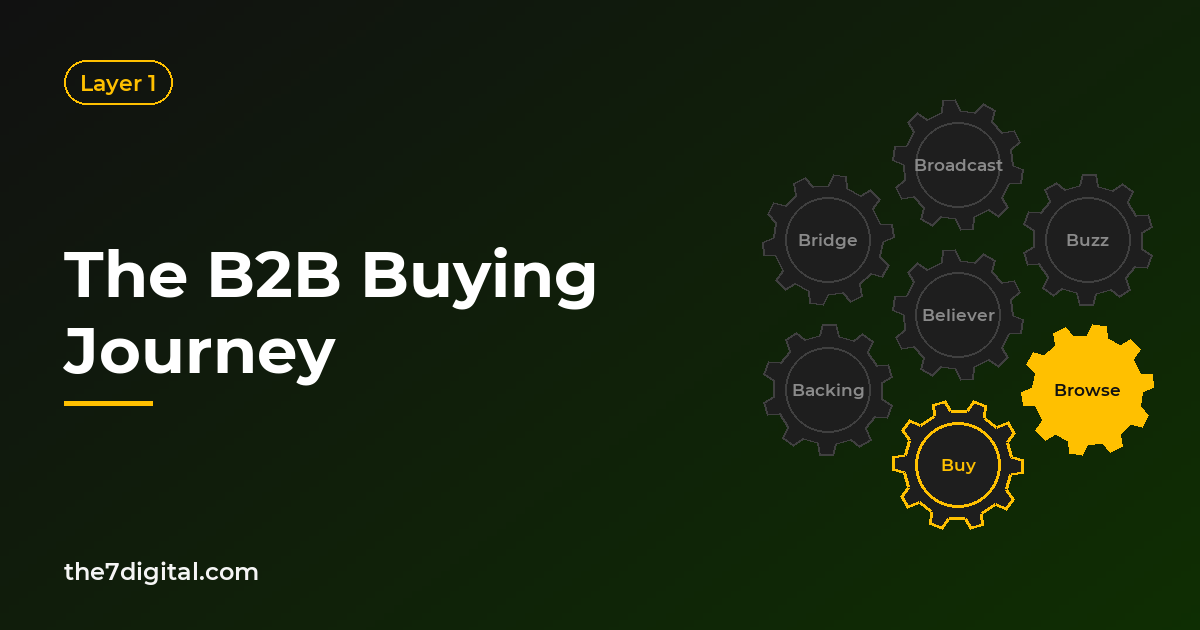
Summary: The B2B buying journey is six jobs buyers must get done: problem identification, solution exploration, requirements building, supplier selection, validation and consensus creation. The jobs run in parallel and loop back, so marketing has to show up for all six at once. In the 7B Model, the topic sits in the Browse and Buy gears.
Two quotes sit side by side on the 2026 PV Module Reliability Scorecard from Kiwa PVEL, an independent solar test lab. Frédéric Artigou, a PV technology senior expert at Engie, says the lab’s data helps his company “reduce risk and streamline our technical qualification of PV modules.” Xu Qiao, CEO of DMEGC, says being a multi-year Top Performer “has helped elevate our visibility with customers around the world.” One voice comes from a company that has to qualify modules for its projects, the other from a maker that wants to be qualified. Both are talking about the same job: validation.
That is the B2B buying journey in miniature: not stages that buyers pass through one after another, but jobs a buying group has to get done, usually at the same time and usually more than once. Gartner counted six of them in 2018, and your marketing cannot wait for the buyer to reach the right stage, because the buyer is already working on several jobs at once.
This article covers the six jobs, what pulls buyers back, what each job needs from marketing, two companies that show up for several jobs at once, an exercise for finding your own gaps, and how it plays out in Vietnam and ASEAN. For the philosophy behind it, read Chaos Logic Theory; this is the practical sequel.
What are the six jobs in a B2B buying journey?
On October 9, 2018, at its Sales & Marketing Conference in Las Vegas, Gartner (2018) described B2B buying as six “buying jobs.” Here they are, each with the question the buyer is trying to answer. The questions are my wording.
- Problem identification: Is this problem real, and worth solving now?
- Solution exploration: What are the ways to solve it?
- Requirements building: What must a solution do, and to what level?
- Supplier selection: Who can do it, and who makes the shortlist?
- Validation: Is what they tell us true?
- Consensus creation: Does the whole table reach the same conclusion?
The six are not equal. According to Gartner (2018), nearly every successful B2B purchase moves through the first four jobs, while validation and consensus creation run alongside them the whole way. I think of it as two speeds: four jobs move, two never switch off. So your assets for validation and consensus have to exist from the buyer’s first touch, not from the moment you send a quote.
Buyers also circle back. Most revisit nearly every job at least once before they buy, and Gartner titled its picture of that journey “A Long, Hard Slog” (Gartner, 2018). Why nobody can draw that path in advance is the subject of Chaos Logic Theory. What matters here is the consequence: you cannot schedule content by stage when the buyer does not move by stage.
Two more details from Gartner (2018) belong on your wall. Buyers use sales reps and supplier websites about equally for discovery and validation, so sales and marketing must deliver the same consistent information on every channel: your website and your rep are two doors to the same job. And the best suppliers act as a “buying Sherpa,” simplifying the purchase for the customer. A guide does not drag you up the mountain faster. A guide makes the route less confusing.
Try one thing today: rename the columns of your content calendar from stage names to the six questions above, then see which cells are empty.
Why do buyers keep going back to earlier jobs?
A loop is not a malfunction. It is how a buying group controls risk: each new piece of information can reopen a job that looked finished. These are the triggers I see most often.
An unanswered question. In its survey of more than 4,000 buyers, 6sense (2025) found that 89% of purchases included AI features and 58% of buyers engaged sellers earlier to clarify missing AI details. Most vendor websites, the report says, fail to explain those features clearly. My reading: an open question pulls the buyer back into solution exploration, and into your sales call earlier than they wanted.
Pressure from outside. Also in 6sense (2025), 49% of buyers said financial pressure shortened their buying cycles, 62% engaged sellers earlier as a result, and 70% said economic anxiety directly influenced vendor choice, often favoring incumbents. Kerry Cunningham of 6sense summed it up: buyers are “moving faster but not taking more risks.” Pressure pulls the risk conversation forward, and incumbents benefit.
A failed test. In Kiwa PVEL’s 2026 Scorecard, 87% of manufacturers had at least one failure in the lab’s product qualification program, and 45% had at least one delamination failure (Kiwa PVEL, 2026). One failed test sends a buyer back to supplier selection, and sometimes back to rewriting requirements.
An AI answer that cannot be trusted. According to Forrester (2026), genAI search is the starting point for B2B buyers, but the tools often deliver incomplete or unreliable information, which creates mistrust, and buyers compensate by seeking validation from trusted sources. Validation switches on at job two.
A new person at the table. In my experience, a new executive or department reopens problem identification from the start. Who sits at that table is the subject of the B2B buying committee.
The signature is not the end. Kiwa advises buyers to run batch testing and ongoing reliability monitoring on modules from the production line, then check the results against the earlier qualification, because discrepancies may point to problems on the line or with components (Kiwa, accessed 2026). Validation does not stop at the contract.
You cannot schedule a loop. You can stock the answer it will look for. This week, check each trigger above against your website: is the answer there, or must the buyer call your rep?
What does each job need from marketing?
This table is how I audit content by job. It is my own synthesis, not source data.
| Job | What the buyer is asking | Asset to have ready | Where buyers look | Warning sign |
|---|---|---|---|---|
| Problem identification | Is it real, and worth solving now? | Data-backed analysis, self-diagnosis tool | Search, AI chat, LinkedIn | Buyers appear only with a written quote request |
| Solution exploration | What are the ways to solve it? | Comparison of approaches, even rivals’ | AI chat, YouTube, search | First meetings full of basic questions |
| Requirements building | Which criteria must it meet? | Criteria list, spec sheet | Your website, technical documents | Quote requests copy a rival’s specs |
| Supplier selection | Who makes the shortlist? | Price range, delivery time, honest comparison | Brand-name search, review platforms | Dropped without knowing why |
| Validation | Is what they say true? | Independent test results, references, reviews | Review platforms, YouTube, LinkedIn | Deals stall on “let us look into it” |
| Consensus creation | Does the table agree? | Forwardable one-pager, benefits calculator | Email, internal chat groups | Champion keeps asking for more material |
The first two jobs. Google’s 2020 research on the “messy middle” was done on consumer goods, not B2B, so I borrow only its first recommendation: ensure brand presence while customers explore (Google (2020)). Content for these jobs talks about the problem, not yet your product, and whoever writes the earliest good answer tends to be remembered when the first job starts, because it already holds some mental availability.
Requirements and selection. Kiwa advises solar buyers to specify BOMs (bills of materials) instead of generic module models (Kiwa, accessed 2026), so answer at BOM level before you are asked. TrustRadius (2026) surveyed 1,862 technology buyers and found that 83% shortlist three products or fewer, and that transparent pricing has topped their wish list for four years running. My B2B reading: one headline spec line, a price range, a stated delivery time.
Validation. Forrester’s Barbara Winters advises vendors to make sure their claims can be validated through trusted external voices (Forrester, 2026). In Google’s simulation of 310,000 purchase scenarios, a fictional cereal brand supercharged with five-star reviews and 20% extra free still won 28% of shopper preference from the established favorite (Google, 2020). That is consumer goods, and the free offer does not travel to B2B. What does: independent test results, references and a profile on your industry’s review platform.
Consensus creation. This job runs the whole way (Gartner, 2018), and who does it is the subject of the B2B buying committee. At the asset level, give every validation asset a forwardable version: one page, sourced, with a named speaker. The buyer’s internal debate happens where you are not, in dark social.
A job without an asset is a place where the buyer has to look for themselves. And where they look may not be your page.
What does showing up for several jobs at once look like?
Two companies, two industries, two ways of showing up. One lets others verify it. The other moved the buying door next to where customers choose.
DMEGC Solar: Proof that someone else signs
Kiwa PVEL has run its Product Qualification Program since 2010. The 2026 Scorecard is the 12th edition: 43 manufacturers are named Top Performers, but across the 246 module types carrying that name, only 5 earned Top Performer status in every reliability test. For the first time the Scorecard will come out twice a year (Kiwa PVEL, 2026).
DMEGC Solar is the solar division of Hengdian Group DMEGC Magnetics. DMEGC was founded in 1980, listed on the Shenzhen Stock Exchange in 2006 and, by its own account, has annual module capacity of 21 GW (DMEGC Solar, accessed 2026). It is in the group of manufacturers that earned Top Performer in five tests, which Kiwa PVEL awards test by test, not as one overall ranking (Kiwa PVEL, 2026). Its home page stacks the proof right in the introduction: Kiwa PVEL Top Performer since 2021, BloombergNEF Tier 1 since 2019 (DMEGC Solar, accessed 2026).
On October 16, 2026, DMEGC announced that it had again been rated A, the safest group, in the Bankability Pyramid of the PV ModuleTech Bankability Ratings for Q3 2026, from PV-Tech Research and Informa Markets. The rating measures the likelihood that a manufacturer will keep operating and honoring its warranties (DMEGC Solar, 2026). Engie’s expert spoke about reducing risk. This is the other half: who will still be there to honor the warranty?
My reading: validation here has become a product. It runs before the shortlist (the ranking), in the contract (a named BOM), in production (monitoring) and after delivery (batch tests). The Top Performer list is a ready-made shortlist, and the A rating answers a finance seat’s question. That makes this a Browse story, because a specialist review platform is one of the six gateways (Mô hình 7B cho B2B book, chapter 8), and a Buy story, because technical qualification takes many people and many rounds.
The strongest proof for validation is usually issued by someone else, which is Backing. DMEGC does not praise its own panels. It lets a lab do the talking, then puts the lab’s title in the first thing visitors read.
Texas Instruments: Moving the store to the design desk
Texas Instruments (TI), the U.S. chip maker, said in its 10-K for 2019 that about 65% of its sales were fulfilled through distributors, who maintain inventory of TI products (Texas Instruments, 2020). It was investing in new capabilities and changing its distribution network, including website upgrades and e-commerce, to get closer to customers: as direct relationships expand, less business would flow through distribution and TI would need fewer distributors.
In its 10-K for 2025, TI reported that more than 80% of revenue was direct, which includes TI.com (Texas Instruments, 2026). The two figures measure different things, sales fulfilled through distributors in 2019 and direct revenue in 2025, so I do not subtract one from the other, and the filing does not credit the channel shift for revenue growth. TI’s stated reasons: access to more customers and more of their design projects, which means chances to sell more of its products into each design, plus better insight into customer needs.
My reading: TI measures opportunity design by design. The sale is decided while an engineer is still choosing parts, in requirements building and supplier selection, so TI moved the buying door next to that desk, on channels it owns. A buying door is also a listening door: better insight into customer needs flows back into content for solution exploration and requirements. And TI is not dogmatic about it. Customers can still use a single worldwide distributor and a few region-specific ones for order fulfillment, so which door a partner holds is a deliberate choice.
TI did not wait for buyers to find the store. It moved the store next to the design desk. One company lets others vouch for it, the other moves its store, and neither asks which stage the buyer is in.
How do you find the empty jobs in your own machine?
6sense (2025) found that buyers still average 16 interactions per person with the winning vendor, unchanged from the year before. Cunningham put the stakes this way: “Vendors that can’t provide clear answers upfront aren’t even making the shortlist.” The winner is met many times, across many jobs, not once at the “end.” Here is the afternoon exercise I use to find where you are missing.
- Pull your last ten deals, five won and five lost or stalled. Ask sales which questions buyers asked two or more times. Every repeated question is a job without an asset.
- Sort your assets into the six rows of the table above, then add two columns: where each asset lives (website, YouTube, LinkedIn, review platforms, sales decks) and who owns it.
- Find the blanks. In my experience they cluster in the two always-on jobs, validation and consensus creation.
- Take the gates off validation assets and turn each one into a door to the next job: the spec sheet leads to test results, test results to references, references to a price range.
- Measure by traces, not clicks. For every closed deal, record which content the buyer touched before signing (Mô hình 7B cho B2B book, chapter 14), and ask “How did you hear about us?” with no answers pre-filled. The method is in self-reported attribution.
Do not make more content. Fill the blank.
Where does the B2B buying journey fit in the 7B Model?
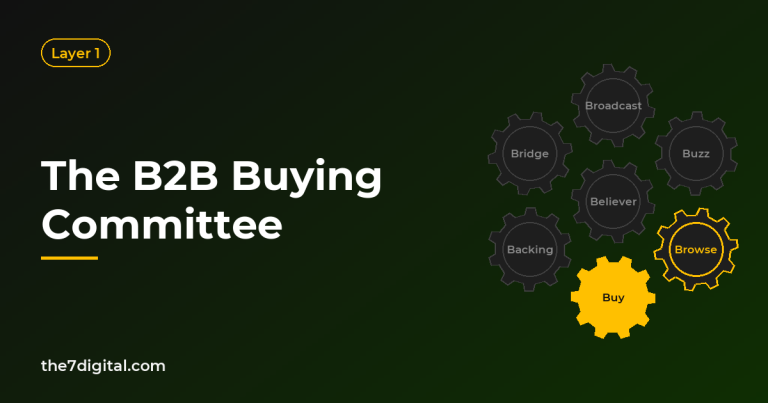
The buying journey is where the two demand-capture gears do their work. The main gear here is the Browse gear: Where emotion meets reason: buyers verify and compare you through six gateways. Four of the six jobs, from solution exploration to validation, happen mostly through those gateways: search engines and AI answer summaries, conversational AI, specialist review platforms, LinkedIn, YouTube and podcasts, and communities and forums (Mô hình 7B cho B2B book, chapter 8). The Kiwa PVEL Scorecard is the solar industry’s specialist review platform. The emotion is in the biases Google names, the reason is in specs and test results.
The companion is the Buy gear: A process of many people and many rounds; a door, not the final wall. Consensus creation is the many people, the loops are the many rounds, and batch testing after the contract, like the next design project from a TI customer, is the door.
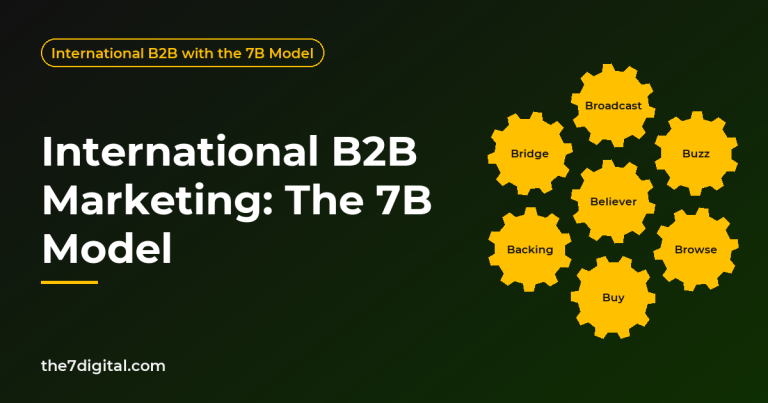
The three operating layers read: Demand creation (Broadcast, Buzz), amplification (Backing, Bridge), demand capture (Browse, Buy); Believer is the connecting loop. The six jobs do not fit inside the last layer alone. Problem identification is often seeded earlier by Broadcast and Buzz, validation feeds on the proof Backing provides, and after the signature Believer keeps later validations coming out well. For the whole machine, start with the 7B Model.
The three energy flows are: Paid, owned, earned-and-shared. Owned assets such as your website and a buying door like TI.com carry most of the six jobs, while earned-and-shared proof carries validation. The two operating principles say: Customers can enter anywhere; one stuck gear slows the whole flywheel. A job with no asset is a stuck gear.
The 7B Model was developed by Nguyen Dinh Bao (Bao7) at The7 Digital and is set out in full in the book Mô hình 7B cho B2B (Stop Begging, Start 7B).
Selling B2B into Vietnam and ASEAN
Start with where the first two jobs begin. The e-Conomy SEA 2026 report on Vietnam from Google, Temasek and Bain & Company (2026) says 44% of consumer journeys in Vietnam begin with AI, the highest in the region, and that Vietnamese is the default language of AI use, at 80% of conversations, the highest local-language share among the six markets surveyed. These are consumer and general AI-user figures, not B2B figures, but they point one way: if your content for problem identification and solution exploration exists only in English, the first answer a Vietnamese buyer reads may not come from you.
Next, look at where validation and consensus travel. DataReportal (2025) reported in Digital 2026: Vietnam that Zalo had 78.3 million monthly active users and that 91.4% of Vietnam’s internet users were also on Zalo. Again, general user figures, not B2B ones. But I would expect the champion who forwards your one-page summary to the executive team to do it in a chat group, in Vietnamese. Build assets that survive being forwarded: one page, named sources, numbers that still make sense out of context. That is dark social at work.
Third, your factory customers may sit inside someone else’s validation chain. Of the 43 manufacturers Kiwa PVEL named 2026 Top Performers, 8 listed at least one factory in Vietnam, Indonesia or Thailand for the module designs that earned the title, including JA Solar’s site in Bac Ninh Province (Kiwa PVEL, 2026). If you sell materials or equipment to plants like these, your documents become part of what their customers verify, so prepare BOM-level answers before you are asked.
Finally, decide which jobs you do yourself and which you leave to partners. Even TI, with more than 80% of its 2025 revenue direct, still offers a single worldwide distributor and a few region-specific ones for order fulfillment (Texas Instruments, 2026). In Vietnam many foreign suppliers will need a local partner for delivery, invoicing and service. But the answers to the early jobs, what the problem is, how to solve it, which criteria matter and what proves it, have to be yours, in Vietnamese, where buyers look first.
Conclusion: Stop asking which stage the buyer is in
Go back to the two quotes on Kiwa’s page. A company that qualifies modules and a company that wants to be qualified are talking about the same job, and neither asks which stage the other is in. The supplier that shows up for the most jobs is met the most times and, in my experience, is usually the one still standing on the shortlist. So stop asking which stage the buyer is in. Ask which job they are doing, and whether that job can find you.
To go further, read Chaos Logic Theory for why nobody can predict the path, the B2B buying committee for who does the consensus work, and why the funnel is changing for why thinking in stages is being replaced.
Frequently asked questions
What are the stages of the B2B buying journey?
Gartner describes jobs rather than stages: problem identification, solution exploration, requirements building, supplier selection, validation and consensus creation. Nearly every successful purchase goes through the first four, while validation and consensus run alongside them the whole time, and most buyers revisit nearly every job at least once (Gartner, 2018).
How long does a B2B buying journey take?
6sense’s 2025 survey of more than 4,000 buyers found that average buying cycles shortened from about 11 months in 2024 to 10 months in 2025 (6sense, 2025). What matters more than length is how often buyers loop back, and whether each loop finds an answer from you.
Which content matters most in the B2B buying journey?
Content for the two jobs that never switch off: validation and consensus creation. In my experience, independent test results, references, reviews and a summary a champion can forward do more to keep a deal moving than another awareness campaign, and none of them belongs behind a form.
How does the B2B buying journey work in Vietnam?
The same six jobs, but more of them start in AI and run in Vietnamese. In Vietnam, 44% of consumer journeys begin with AI and 80% of AI conversations happen in Vietnamese, according to Google, Temasek and Bain & Company (2026); these are general consumer figures, not B2B ones. Validation and consensus may well travel through chat apps such as Zalo, so Vietnamese, forwardable assets matter.
References
- Gartner (2018). Gartner Says the Marketing-to-Sales Handoff Should No Longer Exist. https://www.gartner.com/en/newsroom/press-releases/2018-10-09-gartner-says-the-marketing-to-sales-handoff-should-no-longer-exist
- Google (2020). How people decide what to buy lies in the ‘messy middle’ of the purchase journey. https://business.google.com/en-all/think/consumer-insights/navigating-purchase-behavior-and-decision-making/
- 6sense (2025). The Timeline for Influencing B2B Buyers Is Shrinking: Insights From 6sense’s 2025 Buyer Experience Report. https://6sense.com/newsroom/the-timeline-for-influencing-b2b-buyers-is-shrinking-insights-from-6senses-2025-buyer-experience-report/
- TrustRadius, HG Insights (2026). TrustRadius 2026 B2B Buying Disconnect Report Reveals AI Has Changed How Buyers Research, But Not What They Trust. https://hginsights.com/news/trustradius-2026-b2b-buying-disconnect-report-reveals-ai-has-changed-how-buyers-research-but-not-what-they-trust/
- Forrester (2026). Forrester’s 2026 Buyer Insights: GenAI Is Upending B2B Buying As Leaders Face Mounting Pressure To Justify Every Dollar Spent. https://www.forrester.com/press-newsroom/forrester-2026-the-state-of-business-buying/
- Kiwa PVEL (2026). PV Module Reliability Scorecard 2026. https://scorecard.pvel.com/
- Kiwa PVEL (2026). 2026 Top Performers by manufacturer. https://scorecard.pvel.com/manufacturers
- Kiwa (n.d., accessed 9 November 2026). Kiwa’s PV Module Procurement Best Practices. https://www.kiwa.com/modulebestpractices
- DMEGC Solar (n.d., accessed 9 November 2026). Solar Panel Supplier & Manufacturer. https://www.dmegcsolar.com/
- DMEGC Solar (n.d., accessed 9 November 2026). About us. https://www.dmegcsolar.com/about/index.html
- DMEGC Solar (2026). DMEGC Solar Rated A Again in PV Tech Research Bankability Pyramid. https://www.dmegcsolar.com/news/detail-dmegc-solar-rated-a-again-in-pv-tech-research.html
- Texas Instruments (2026). Form 10-K for the fiscal year ended December 31, 2025. https://www.sec.gov/Archives/edgar/data/97476/000009747626000059/txn-20251231.htm
- Texas Instruments (2020). Form 10-K for the fiscal year ended December 31, 2019. https://www.sec.gov/Archives/edgar/data/97476/000009747620000009/txn-20191231.htm
- Google, Temasek and Bain & Company (2026). e-Conomy SEA 2026: Vietnam. https://services.google.com/fh/files/misc/vietnam_e_conomy_sea_2026_report.pdf
- DataReportal (2025). Digital 2026: Vietnam. https://datareportal.com/reports/digital-2026-vietnam