


What Is Dark Social in B2B?
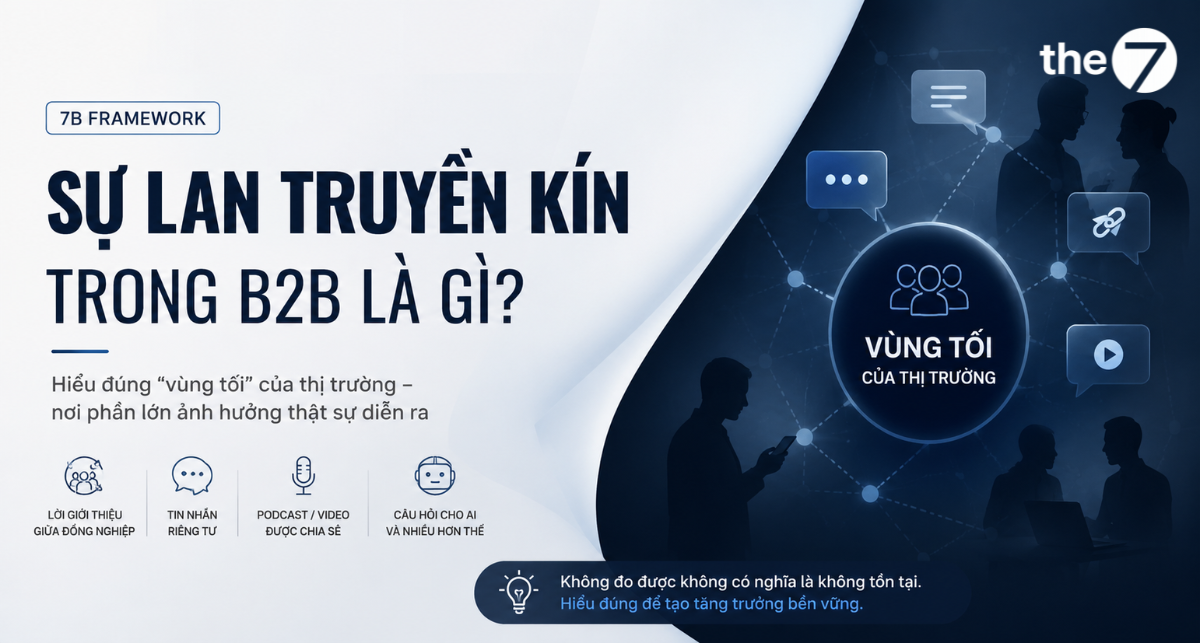
Summary: Dark social encompasses all the interactions that influence buying decisions but are nearly impossible to trace: private messages, conversations in closed groups, referrals between colleagues, a podcast heard on the commute, a video forwarded in chat, a question typed into an AI, and conversations you will never see. Most of the real influence in B2B happens here, in the market’s dark zone, where measurement tools cannot reach. The problem is not that marketing lacks data. The problem is that marketing tends to measure where there is light, not where there is truth. In the 7B model, dark social is not a separate gear. It is the dark room where many gears actually turn.
There is a very common illusion in B2B marketing: businesses think they know why a deal happened. They look at a dashboard and see a click from Google Ads, a form filled out, a retargeting campaign that converted, an email opened right before a sales meeting. Then they conclude the deal came from the last channel they can see. It sounds reasonable, because everything has a number, a source, a timestamp, a report. But that reasonableness is often just the reasonableness of a measurement system that is too narrow.
The deal you think you won through Google Ads may well have been decided long before, in a private message you will never read. Someone on the buying committee messages a colleague: this vendor works, I have used them. Just one line, sent in an internal chat app, can carry more weight than your entire ad campaign combined. It has no beautiful design, no call-to-action button, no landing page, no pixel, no UTM code, no report. But it has something more important than all of that: trust.
In B2B, trust usually beats everything. Buyers do not just need to know you exist, they need to feel that choosing you is safe. They need proof that someone else already tried it, already trusted it, already took responsibility, and was not blamed for choosing you. A private confirmation from someone credible can sometimes carry more weight than ten polished case studies, precisely because it does not come from a brand trying to sell. It comes from someone who appears to have no motive to oversell.
The problem is that line never shows up on any dashboard. Google Analytics does not see it, the CRM does not see it, the ad platform does not see it, the attribution report does not see it. To your measurement system, it does not exist. But in the buyer’s mind, it may be the deciding moment. This is one of the most uncomfortable truths in B2B marketing: most of what actually influences a buying decision happens where you cannot see it.
Because it is invisible, businesses tend to ignore it. Not because they are foolish, but because humans have a strong bias: we believe what we can measure. Whatever turns into a number seems more real. Whatever can be put into a report seems more important. Whatever can go into a KPI seems more worth managing. By contrast, private conversations, quiet referrals, a podcast heard while driving, an article forwarded in a closed group, a name mentioned casually between colleagues, all of it is too blurry. It does not sit cleanly in a table, there is no attractive number to present in a meeting.
So businesses focus on what is measurable, then gradually convince themselves that what is measurable is the whole story. This is not a small reporting error, it is a fundamental misunderstanding of the market. When you mistake the visible part for the entire reality, you will misallocate budget, misjudge channels, reward the wrong behaviors, cut the wrong activities, and end up building a marketing machine that is excellent at generating numbers but weak at generating trust.
What Is Dark Social?
Dark social refers to interactions that influence buying behavior but leave no clear trace in tracking systems. The term originates from journalist Alexis Madrigal, who coined “dark social” in 2012 to describe a large share of web traffic with no identifiable source, for example when someone copies an article link and sends it to another person via email, private message, or a chat app. The recipient clicks the link, and analytics tools might just record it as direct traffic, without knowing it actually came from a private share.
Originally, dark social was a story about traffic. But in B2B, it is much bigger than traffic. It is not just about where website visitors come from, it is the entire scope of influence happening outside marketing’s field of view: a referral in a chat group, a call between two people in the industry, an analysis forwarded on Slack, a podcast heard on the commute, a video shared internally, a past customer speaking well of you, an expert warning someone away from your competitor, a member of a buying committee asking an AI about your company, a CEO hearing your name enough times to quietly remember it.
No one fills out a form at that moment. No one leaves a clear trace for your system. No one tells the ad platform it happened. But influence is still created, trust still accumulates, familiarity still forms, and the shortlist inside the buyer’s head quietly shifts. That is the key point: not measurable does not mean not real. It just means your measurement system is not capable of seeing it.
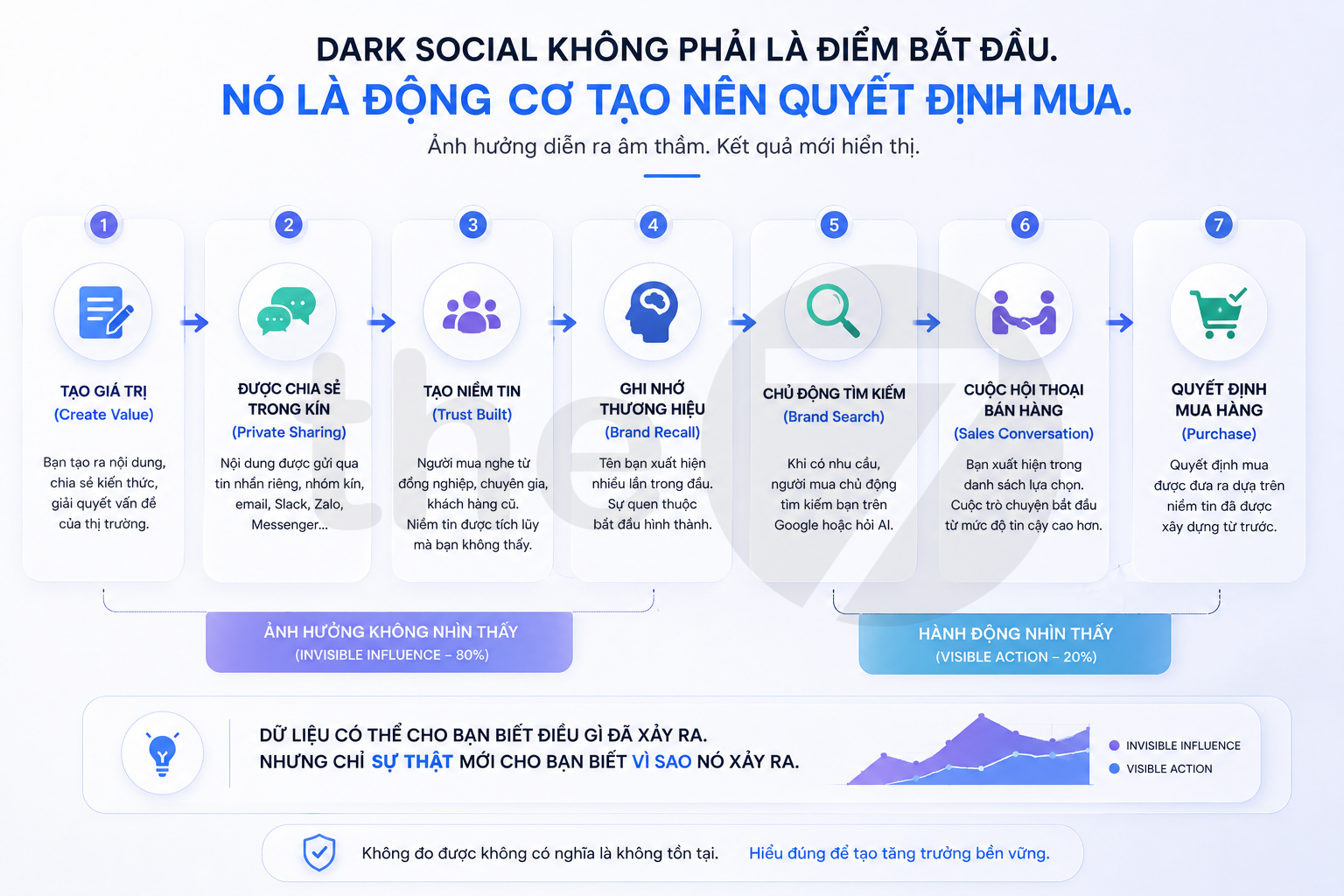
A B2B business might assume a buyer first learned about them from clicking a search ad. In reality, the buyer may have heard their name six months earlier in a private conversation, read an article of theirs without engaging, heard a podcast that mentioned them, seen a colleague share their material in an internal group, and only then, once the company had a need, typed their name into Google. The measurement tool only sees the final action, but that final action did not create the trust on its own, it is simply the point where trust that had accumulated long enough finally surfaces.
This is why dark social is dangerous for any overconfident attribution model. It reminds us that marketing does not only happen on channels the brand controls. Marketing also happens in the market’s memory, in customers’ words, in colleagues’ confirmations, in closed groups where the brand is not even present. If you only measure the places where you have placed a pixel, you will miss most of the places where the market actually makes its decisions.
The Problem Is Not a Lack of Data, It Is Mistaking Data for Truth
Modern marketing likes to pride itself on being data-driven. That is partly true, and that very truth is what makes it dangerous. Data helps us guess less, helps us see how the market reacts, helps us know which campaigns are generating signal, which messages get a response, which channels drive action. Without data, marketing easily slides into guesswork, becoming a game of personal taste and arguments with no anchor.
But there is a crucial boundary: data is not reality. Data is only the portion of reality your system happens to measure. A dashboard is not the market, it is just a record of the behaviors your tools are capable of observing. When a business forgets this, data stops helping it understand the market. Data starts replacing the market in its mind.
This is where many B2B businesses get stuck. They do not just use data to understand the buying journey, they use data as if it were the entire buying journey. They look at the last touch and think it is the cause. They look at a filled-out form and think it is the demand. They look at a click and think it is trust. They look at the channel with the final conversion and think that channel created the whole deal.
But B2B buyers do not operate inside your dashboard. They operate in a much messier world. They ask colleagues, listen to people in the industry, read content without engaging, save an idea and forget the source, hear your name several times before ever searching for it, discuss things in private groups, get influenced by people who never show up in your CRM. They can add you to, or remove you from, their shortlist before sales even knows they exist.
By the time they click that search ad, the form is just the final visible layer. But your system credits that visible layer, because it is the one standing in the light. Meanwhile, eighteen months earlier, the buyer had heard your name on a podcast, read your article, seen a colleague share your content in a closed group, heard another customer speak well of you, and quietly added you to their shortlist. None of that gets credited, not because it does not matter, but because it is not lit up.
This is why B2B marketing often rewards the wrong things. Channels at the end of the buying journey look the most effective, because they sit closest to the purchase action. Search ads, retargeting, sales emails, pricing pages, demo forms, all of them get credited easily because they are near the conversion point. But being near the conversion point does not mean you created the whole conversion. The harvester cannot take all the credit if no one planted the seed, watered it, and gave it the conditions to grow.
The problem is not that businesses need to abandon measurement. Measurement is still needed, very much so. The problem is businesses need to know where measurement is blind. A mature measurement system is not one that pretends to see everything, it is one that knows clearly what it can see, what it cannot, and what can only be inferred through indirect signals.
The Streetlight Effect: We Search Where It Is Easy, Not Where the Truth Is
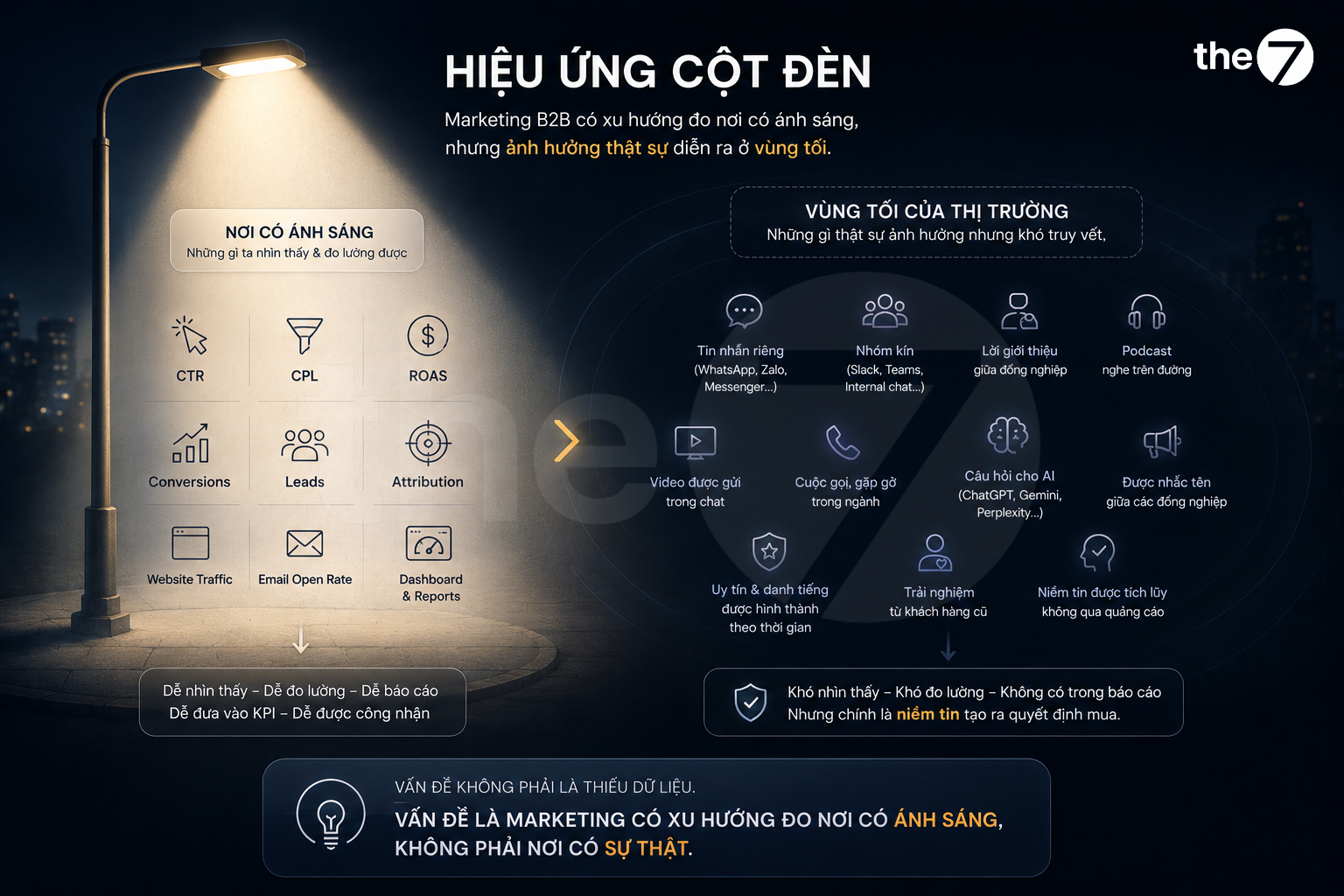
There is an old story behavioral scientists love to tell. A drunk man is bent over searching for his keys under a streetlamp. A passerby asks if he dropped them there. The man replies, no, I dropped them over there, in the dark. The passerby asks why he is searching here, then. The man answers: because this is where the light is.
This is called the streetlight effect. It describes a very human bias: we tend to search where it is easy to search, not where the thing we need actually is. Not because we do not understand the keys might be in the dark, but because searching in the dark is uncomfortable. It is vague, out of control, with no clear sense of progress. Searching under the streetlight is easier, we can see the ground, we can bend down, we can look like we are searching methodically.
B2B marketing does exactly this. The light is everything measurable: clicks, page views, form fills, conversion rates, cost per lead, the last touch before purchase. The dark is everything hard to measure: referrals, private conversations, podcasts, closed groups, internal messages, familiarity accumulated over years, the feeling of “I have heard this company’s name a lot.” The truth about why a deal got decided usually sits in the dark, but because the dark is hard to measure, businesses pour all their attention into the lit area.
They optimize that area, report on that area, reward and punish based on that area, then eventually come to believe that area is the whole reality. This is how an industry can go wrong while still feeling very professional. Everything has numbers, tables, charts, weekly reports, monthly reports, real-time dashboards. But a beautiful chart does not guarantee you are measuring the right thing. A clear report does not guarantee you understand the buying journey correctly. A sophisticated attribution model does not guarantee it is touching the real influence.
The result is that businesses start allocating resources based on the lit zone. They see search ads converting, so they increase the search budget. They see retargeting has a low cost per lead, so they pour money into retargeting. They see long-form content does not generate forms right away, so they cut content. They see a podcast cannot prove direct revenue, so they drop the podcast. They see community is hard to measure, so they do not invest in community. Each individual decision looks reasonable according to the data, but collectively it weakens the machine, because the business is cutting the very things that build trust before that trust ever surfaces as a conversion.
The first step out of the streetlight effect is not trying to light up the entire dark zone. You cannot read customers’ private messages, cannot listen to every conversation in a closed group, cannot attach a pixel to a buyer’s memory. The first step is admitting the dark zone exists, and that it is far bigger than the lit zone. Just admitting that already changes how you read the numbers. You become less naive about last-touch attribution, less obsessed with surface metrics, and you understand that some activities do not produce a signal right away but create the conditions for a later signal to appear.
So the question should not be which channel created this deal, because that question usually forces a messy reality into a falsely simple answer. The better question is: which system of influence made this deal possible? Asking it that way, you start seeing B2B marketing as a machine with many gears, some turning in the light and some turning in the dark. If you only look at the lit part, you will think the machine is simpler than it really is, and that is when you start making bad decisions.
Goodhart’s Law: When the Measure Becomes the Target
The streetlight effect explains why we look in the wrong place. But there is another problem that is even more dangerous: once we are looking in the wrong place, we optimize it so hard we break it. Economist Charles Goodhart made a famous observation: when a measure becomes a target, it ceases to be a good measure. Put simply, the moment you turn a number into a goal you must hit, people will find ways to hit that number. And once people optimize that number hard enough, the number starts losing its original meaning.
In B2B marketing, this happens every day. Take lead count as an example. At first, it seems like a reasonable measure. If marketing generates more leads, sales opportunities might get stronger. If more people fill out forms, maybe the market is more interested. At a moderate level, this number is useful, because it lets a business see part of the flow of demand.
But the moment lead count becomes the ultimate target, it starts to break. The marketing team gets told to generate 1,000 leads a month, and they will find a way to hit that number. They make forms easier to fill out, offer easier-to-download resources, run broader ads, use more appealing but less relevant messaging. They pull in students, curious onlookers, people with no buying authority, people in the wrong industry, people with no budget. The number goes up, the report looks better, but real quality goes down.
Sales gets handed a pile of junk leads. Conversion rates drop, trust between sales and marketing sours, real opportunities get buried in noise. The whole organization thinks it is growing, but it is really just pumping more junk into the system. The measure has become the target, and it has stopped being a good measure. It no longer reflects the health of the market, it reflects the marketing team’s ability to produce enough things that can be called leads.
The same thing happens with traffic. At first, traffic might reflect real market interest. But if traffic becomes the ultimate target, the content team will write topics that are easy to pull traffic for, even if they are irrelevant to real buyers. They write broader, shallower, more trend-chasing pieces with clickbait headlines. Traffic goes up, but trust does not. More people read, but fewer of the right people buy. The number goes up while the value goes down.
The same thing happens with engagement. If engagement becomes the ultimate target, content gets pulled toward whatever provokes a reaction. The brand says more controversial things, oversimplifies more, writes to get likes instead of writing to build trust. The result is a brand that looks louder, but not necessarily more credible. A post with high engagement that does not make buyers trust you any more is just noise with pretty numbers.
This is the double trap of dark social. Because the real influence is not measurable, businesses cling to surface metrics. And because surface metrics are easy to put into a KPI, they become the target. And once they become the target, Goodhart’s Law starts breaking them. In the end, businesses are both measuring the wrong place and ruining the very place they are measuring. They are steering the marketing machine with a dashboard that is missing needles and also bent out of shape.
The way out is not finding a more perfect measure. Any measure, once turned into an absolute target, can be gamed. The way out is putting the measure back in its proper place. A measure is a signal, not the truth. A measure is one piece of data, not the whole reality. A measure helps you think better, but it should not replace thinking.
In B2B, the things that matter most, such as trust, familiarity, credibility, referrals, and the buyer’s sense of safety, are very hard to reduce to a single number. Trying to force them into one number does not help you understand them better, it usually just breaks them faster. A mature organization is not one that abandons metrics, it is one that knows when metrics are pointing the way and when metrics are lying to it.
Most Word of Mouth Does Not Happen in Public
A common counterargument is that dark social sounds plausible, but it is probably just a small slice. Businesses might think these private conversations are just a layer of noise around the main system, while the important part still sits in public channels that can be measured, optimized, and managed. But research on word of mouth says the opposite: the public part we can see is often just the tip of the iceberg, while the private part is bigger and runs deeper.
Jonah Berger, a professor at Wharton, spent years researching why people talk about some things more than others. One of his most counterintuitive findings: most people assume word of mouth happens on social media, where it is public, visible, and countable in shares, likes, and comments. But in reality, most word of mouth happens offline or in private settings: face-to-face conversation, phone calls, texts, emails, closed groups, interactions that never surface on the public face of the internet.
Applied to B2B, this matters enormously. B2B is not an individual’s impulse purchase. It is typically a high-risk decision, involving a large budget, many stakeholders, a long consideration cycle, and internal political pressure. Buyers do not just ask whether the product is good. They ask whether choosing this vendor is safe, what their colleagues think, whether people in the industry have used it, whether anyone they trust can vouch for it, and whether they will be blamed if something goes wrong.
In that context, word of mouth carries tremendous weight. A referral from a trusted person can cut months off a period of doubt. A private warning can kill a deal before sales even knows it existed. A line like “that vendor gets it done” in a closed group of operations directors can be worth more than ten polished case studies. A line like “don’t go with them, their support is terrible” can undo every advertising effort you have made.
If most word of mouth happens privately, then most of the influence deciding your deal is also happening somewhere you cannot see. Not a small fraction, not an interesting margin of error, not a side story. In many B2B industries, this can be the core of trust itself. Buyers do not want to be the first to make a mistake. They look for safety signals from other people, and the strongest safety signals usually do not live in your advertising, they live in the words of people they trust.
This flips an underlying assumption of over-measurement-dependent marketing on its head. That assumption says: if I cannot measure it, it does not matter. In B2B, the opposite is often truer: the very things you cannot measure are often the things that matter most. Private word of mouth is persuasive precisely because it feels genuine, undirected, and does not come from a brand talking itself up. But that is exactly why it is the most invisible thing to your measurement system.
This is why many B2B brands get “bought” before they are ever contacted. Buyers have heard their name repeatedly, seen them appear in credible contexts, heard colleagues mention them, read an analysis, seen another customer comment positively, heard the founder on a podcast, seen content shared in an internal group. By the time they fill out a form, that action is just the final visible surface of a process that had been quietly unfolding all along.
Marketing likes to credit the last touchpoint, but the buyer’s mind does not work that way. They do not decide because of one click. They decide because a layer of trust has accumulated across many touchpoints, many confirmations, many hearings, many conversations, most of which cannot be traced. So B2B marketing’s real job is not just generating as many measurable interactions as possible. Its real job is creating something worth people talking about when you are not in the room.
A product worth recommending, content worth forwarding privately to a colleague, a perspective sharp enough that a listener retells it in a meeting, an experience good enough that a past customer is willing to speak well of you, a reputation clear enough that when someone asks “who should we go with,” your name has a chance to come up. You cannot control dark social, but you can influence it. The lever is giving the market something worth passing along.
Where Does Dark Social Sit in the 7B Model?
This is what sets dark social apart from many other marketing concepts. It is not a gear in the 7B model. It is the dark room where many gears actually turn. If you see 7B as a machine that creates and converts demand, dark social is the invisible environment in which Buzz, Bridge, and part of Broadcast’s real impact keep operating after the initial activity has already launched into the market.
Buzz is third-party echo. But real echo in B2B rarely lives only in press, social media, or public posts. It lives in private conversations. An expert tells a colleague you are worth checking out. A past customer tells an acquaintance your team gets things done. Someone in the industry hears your name repeatedly from different sources and starts defaulting to you as a trustworthy name. The public part of Buzz can be measured, but its heaviest part often happens in the dark.
Bridge is the bridges of referral. But a referral rarely starts with a website form. It starts with a private message: I know someone who could help you with this. Or a call: let me introduce you to this person. Or a forwarded email: you two should talk. In many large deals, Bridge is quiet, not public, with no visible campaign. It opens doors silently, shortens doubt, and gets you into the right room.
Broadcast is broadcasting to the market. This looks like the most public gear, since it includes everything a brand actively puts out: articles, videos, podcasts, opinions, research, reports, LinkedIn content, website content. But Broadcast’s real impact often plays out privately. You post something, likes are modest, comments are modest, on the surface it looks unremarkable. But someone copies the link and sends it to a colleague, a CEO saves it to read later, a department head brings the idea into a meeting, someone who never engages publicly remembers you six months later when a need arises.
That article never went viral in the newsfeed, but it moved. It moved through email, through chat, through meetings, through memory, through borrowed phrases you will never hear repeated. This is something many B2B businesses get wrong about content. They judge content by public likes, while the real value of a deep article might lie in it being sent privately to exactly the three right people on a buying committee.
This is why the 7B model does not believe in a linear funnel, and does not believe in last-touch attribution either. The funnel assumes a buyer follows a straight path: awareness, consideration, conversion, purchase. Last-touch attribution assumes the final touchpoint before purchase deserves most of the credit. Both rest on the same underlying assumption: that what matters in the buying journey can be seen, ordered, and measured back.
Dark social breaks that assumption. The real buying journey is not a single, well-lit line. It is a chaotic network of touchpoints, public and private, active and passive, measurable and unmeasurable, intentional and accidental. Someone reads your article today, hears your name on a podcast three months later, gets mentioned by a colleague in a closed group six months later, sees your search ad nine months later when the company finally has budget. The attribution system might only see that final click, but that click did not create the trust on its own, it just harvested trust that had already accumulated.
This is why I call the real B2B buying journey Chaotic Logic Theory. Not because it is illogical, but because it does not follow the straight line older marketing models like to draw. It is a system of many touchpoints, many influencers, many conversations, many overlapping effects, where most of the decisive moments happen outside your field of view. Dark social is one of the clearest pieces of evidence for that.
Once you accept that many gears turn in the dark, two things change. First, you stop demanding that every marketing activity prove its value with a straight line to revenue, because you understand that straight line is mostly imaginary. A deep analysis piece might not generate a lead today, but it could get sent into an internal group and become the reason you are on the shortlist six months later. A podcast might not generate a form fill, but it can build familiarity in the mind of someone influential on a buying committee.
Second, you shift from trying to trace every single touchpoint to trying to understand the whole system of influence. You ask buyers directly, track indirect signals, watch branded search rise, listen to what sales hears customers already knew before the call. You accept that technical data only gives you part of the picture, and the rest has to be inferred through context, interviews, and experience. This is not abandoning measurement. This is maturing in how you measure.
Three Examples of How the Dark Room Operates
In the software industry, a company might look at its dashboard and conclude customers come from branded search. The data shows many people typing the company name directly or clicking a search ad before booking a demo. Looking only at that, the marketing team would conclude branded search and bottom-funnel ads are the main source of customers. But when they ask more deeply, they might discover many of their best customers had already heard about the company in closed professional communities beforehand.
CTOs, tech leads, or operations specialists often ask each other in Slack, Discord, WhatsApp, or other private groups: has anyone used this tool, which vendor’s implementation went smoothly, which tool integrates easily, which support team responds fast. Someone answers: we use them, they are solid. That answer might be the reason the company made the shortlist. No analytics tool sees that line, but it may be worth more than the entire campaign. The company cannot measure all those conversations, but it can influence them by building a good enough product, clear enough documentation, fast enough support, and a reputation credible enough that when the conversation happens, what gets said is positive.
In professional services, a consulting firm might think its website and ads generate new clients. Reports show clients arriving via the website, reading a services page, booking a consultation, then signing a contract. But when you ask clients why they reached out, the answer is rarely as simple as the report suggests. They might say someone I trust referred me, I heard the other CEO say you do good work, or I had heard your name a few times through my network.
That entire chain of influence happens in the dark, over a meal, a call, a text, a forwarded email, conversations between people of similar standing. The dashboard sees none of it, but that is where the trust was built. In professional services, especially consulting, strategy, legal, financial, marketing, or technology work, buyers are not just buying capability. They are buying safety. And that safety usually comes from a private confirmation from someone they trust, not from a well-optimized landing page.
In manufacturing, an equipment supplier might think ads and trade shows are its main demand source. But in reality, engineers, plant managers, and procurement teams often discuss suppliers in technical forums, professional groups, or internal chat groups. They ask each other whether the equipment is durable, whether the documentation is easy to use, whether warranty service is fast, whether parts are readily available, whether the technical team actually provides support. These questions carry huge influence because they touch the buyer’s real risk.
These discussions shape a supplier’s reputation far more powerfully than advertising, yet they are almost invisible to the marketing team. A supplier cannot insert itself into every closed group to control the narrative. But it can make the product better, the documentation clearer, the support process faster, the case studies more genuine, so that whatever gets passed along in the dark is more likely to be positive. In manufacturing, a beautiful catalog might get you noticed, but a confirmation that the equipment has run reliably for three years without breaking down is what actually makes a buyer less afraid.
Three different industries, one shared principle: the thing that matters most is usually invisible, and marketing’s job is to influence it even when it cannot be measured perfectly. Businesses do not need to fantasize about seeing everything. But they need to be clear-eyed enough not to deny the things they cannot see.
How Do You Work With What Cannot Be Measured?
If dark social is invisible, does that mean businesses are helpless? No. The issue is not that you cannot do anything, it is that you have to give up the illusion of absolute control. You need to shift from a mindset of tracing every touchpoint to a mindset of influencing the whole system. Instead of asking how to measure every conversation, ask how to make sure that when those conversations happen, your brand is likely to come up in a positive light.
The first approach is to ask buyers directly. This is the simplest, most powerful, and most overlooked tool. When someone books a demo, fills out a form, responds to sales, or signs a contract, ask them how they first heard about you and what actually influenced their decision. But do not just ask a thin question like “which channel did you find us through.” That question usually produces a thin answer, because it forces a complex journey into a single simple channel label.
Ask more deeply: when was the first time you heard about us, what had you seen or heard about us before reaching out, did anyone refer us to you, what made you decide to put us on your shortlist, was there any content, podcast, video, article, conversation, or referral that influenced your decision. These questions are not perfect, buyers may misremember, forget some touchpoints, or only mention the most memorable one. But it is still far more accurate than blindly trusting the last touch.
Someone might click a search ad right before booking. But when you ask more, you learn they had heard your name from a partner six months earlier, read three of your articles, watched one of your videos, then got confirmation from a colleague before reaching out. The report says Google Ads, but reality is a whole system of influence. This is the foundation of self-reported attribution. For many B2B businesses, self-reported attribution is more trustworthy than technical attribution models, not because buyers remember perfectly, but because it reaches parts that technical tools simply cannot see.
Do not treat self-reported data as absolute truth. Treat it as a window, a small window, but one looking into the right room. When you collect enough self-reported answers consistently, you will start to see recurring patterns: who customers tend to mention, which content gets remembered, which channels build familiarity, which groups referrals come from, when a brand first entered someone’s shortlist. Those patterns are worth far more than an attribution report that looks precise but really only sees the ending.
The second approach is to read the shadow dark social casts. You cannot measure dark social directly, but you can measure the shadow it throws off. When many people talk about you in the dark, several signals tend to surface in the light. Rising branded search volume is one important signal. People do not naturally search for your name unless they have heard it somewhere. If branded search is climbing, the market may be talking about you more, even if you cannot see all those conversations.
Rising direct traffic is another signal. When users type your domain directly, open it from a bookmark, or land on your site with no clearly trackable source, they may have been influenced elsewhere: a private message, a chat group, a podcast, content forwarded by email, a referral. Sales is also an extremely important source of signal. If more and more prospects enter calls saying “I have been following you for a while,” “I already read that piece,” “someone mentioned you to me,” “I have been seeing your company a lot in the industry,” that is not a small thing. It is evidence that familiarity was built before sales ever showed up.
A rising referral rate is another shadow. If past customers, partners, or acquaintances are referring you more often, it means Bridge is turning. And most of Bridge’s movement rarely shows up on a dashboard. These signals do not give you absolute certainty, but B2B marketing does not need absolute certainty. It needs to read the direction the market is moving. If branded search is up, direct traffic is up, self-reported answers are more positive, prospects enter calls with a higher degree of familiarity, and referral rates are rising, dark social is very likely generating momentum.
The third approach is to create something worth passing along. This is the most important approach, because you cannot control dark social. Your real leverage lies in the quality of what people can pass along: a product worth recommending, an experience worth retelling, an analysis worth forwarding privately, a perspective distinctive enough to be remembered, a case study real enough for a buyer to forward to a colleague, an opinion sharp enough that someone repeats it in a meeting and says this vendor gets our problem.
You cannot script the private conversation between two colleagues. But you can create conditions for that conversation to happen, and more importantly, you can influence whether it says something good or something bad. If the product is bad, dark social still happens, it just kills you. If sales overpromises, dark social still happens, people just warn each other to stay away. If content is shallow, sounds like every competitor’s, and has no distinct point of view, dark social has almost no reason to appear.
Nobody forwards a colleague an article anyone could have written. Nobody retells a point of view with nothing memorable in it. Nobody refers an ordinary experience. Conversely, if you have something genuinely worth saying, dark social can become your strongest driving force. A deep article might get forwarded by a department head to their whole team. A podcast might make a CEO remember you. An industry report might make it into a strategy meeting. A good support experience might make a past customer refer you to someone they know.
This is why B2B content marketing cannot just be about publishing on a regular schedule. It has to create assets with the power to travel in the dark. The question is not how many likes this post got, but whether it is worth someone forwarding privately to a colleague. The question is not whether this video went viral, but whether it makes a buyer remember you in an internal discussion. The question is not whether this case study looks nice, but whether it is strong enough to help someone on a buying committee persuade the rest.
When you think this way, the quality of your marketing changes. You stop producing content just to fill a posting calendar. You start creating material for conversations you will never be part of. And that is marketing’s real role in a world where most influence happens in the dark.
Three Mistakes When Facing Dark Social
The first mistake is ignoring it because it cannot be measured. This is the most common mistake, and it is the streetlight effect in its purest form. Because dark social is hard to measure, businesses act as if it does not exist. They pour budget into whatever is visible, trust only what is on a dashboard, force every activity to prove a straight line to revenue, then cut the long-term trust-building activities because they do not show results fast enough.
On the surface, this looks like discipline. In reality, it can be blindness dressed up as data. The fix is not trying to measure every inch of the dark, because that is not realistic. The fix is admitting the dark exists, admitting it is large, and allocating resources proportionately to the gears turning within it, like Buzz, Bridge, and Broadcast’s long-term impact. You do not need to see every conversation to know they matter, the same way you do not need to see every root to know a tree lives off its root system.
The second mistake is turning surface metrics into the ultimate goal. This is the direct path to Goodhart’s Law. When lead count becomes the ultimate goal, lead quality gets sacrificed. When engagement becomes the ultimate goal, content gets pulled toward provoking reactions instead of delivering strategic value. When traffic becomes the ultimate goal, businesses write for curious crowds instead of real buyers. When cost per lead becomes the ultimate goal, the marketing team hunts for cheap attention, even when that attention has no value.
The fix is using surface metrics as reference indicators, not absolute destinations. Numbers are still necessary, but they need context. A campaign with fewer leads that sparks the right conversation with the right accounts can be worth more than one that generates thousands of junk forms. An article with fewer views but shared with exactly the right group of leaders can matter more than a viral piece that reaches the wrong audience. A podcast with fewer listeners but real buyers among them can create more influence than a short video with many views but no purchasing authority among them. Do not abandon measurement, but do not worship it either. A metric is a tool for thinking, not a substitute for thinking.
The third mistake is believing you can control the narrative. Some businesses know word of mouth matters, so they try to control it. They want to control the message in every conversation, write overly rigid scripts, force customers to speak in brand language, try to turn every referral into a clean process with tracking, forms, and referral codes. They want the dark to behave like a media channel that can be bought, measured, and optimized.
But dark social, by definition, sits outside your control. You cannot write the words for a private conversation between two colleagues, cannot moderate what customers say in a closed group, cannot force someone in the industry to refer you if they do not genuinely believe in you, cannot use forced messaging to substitute for real experience. Trying to control what cannot be controlled usually just wastes effort. Worse, it makes the brand feel fake.
What you can do is not control the narrative. What you can do is influence it through real quality: a better product, better service, sharper content, clearer opinions, faster support, a kinder post-sale experience, more genuine case studies, more modest promises that are actually kept. Dark social does not require you to be present in every conversation. It requires you to deserve being spoken well of when you are not in the room.
Conclusion: We Measure Where There Is Light, Not Where There Is Truth
Back to where I started. The deal you think you won through advertising may have actually been decided in a private message you will never see. Someone on the buying committee tells someone else this vendor is fine, I know them. A past customer refers you on a call. One of your analysis pieces gets forwarded into an internal group. A podcast makes a buyer remember you. A private conversation gets you onto the shortlist.
That is not the exception. That is how most B2B decisions actually form: in the dark, through private conversations, referrals, casual mentions, touchpoints nobody records. The biggest mistake is not failing to measure the dark, because most of it genuinely cannot be measured perfectly. The biggest mistake is acting as if only the lit zone is real.
We search for keys under the streetlight because that is where the light is, even though the keys fell in the dark. B2B marketing does exactly this when it pours all its attention into the measurable last touch, then ignores the entire invisible path that led the buyer there. That final click is not the moment trust was born. It is usually just the moment trust that had already accumulated long enough turned into action.
In the 7B model, dark social is not a separate gear. It is the dark room where many gears turn. Buzz turns there. Bridge turns there. And part of Broadcast’s real impact turns there too. What you create in the lit zone can go on living in the dark, forwarded, retold, reinterpreted, used as evidence in conversations you will never attend.
Accepting that dark room exists is the precondition for no longer measuring the wrong place. You cannot light up all of it, but you can influence it: by creating things worth passing along, by building a product and experience good enough to be referred, by making content sharp enough that people want to forward it privately to a colleague, by asking buyers directly what actually influenced them, and by reading the shadows dark social casts, such as branded search, direct traffic, self-reported answers, referral rates, and how familiar customers already are before they ever talk to sales.
B2B marketing does not fail from a lack of data. It fails when it mistakes visible data for the whole truth. A mature business is not one that throws away its dashboard, it is one that knows the dashboard is not the whole market. It knows some things are measurable and worth optimizing, some things are unmeasurable and worth nurturing, and some things can only be understood by actually listening to real buyers.

Nguyễn Đình
Bảo




As CEO of The7, I am committed to sharing practical, useful knowledge with every reader. Every article on The7 is based on my 7 years of hands-on experience in marketing — Facebook advertising, LinkedIn advertising, Google advertising, and marketing strategy. I hope you take away plenty of insight from these posts and apply it successfully in practice.
Related Articles
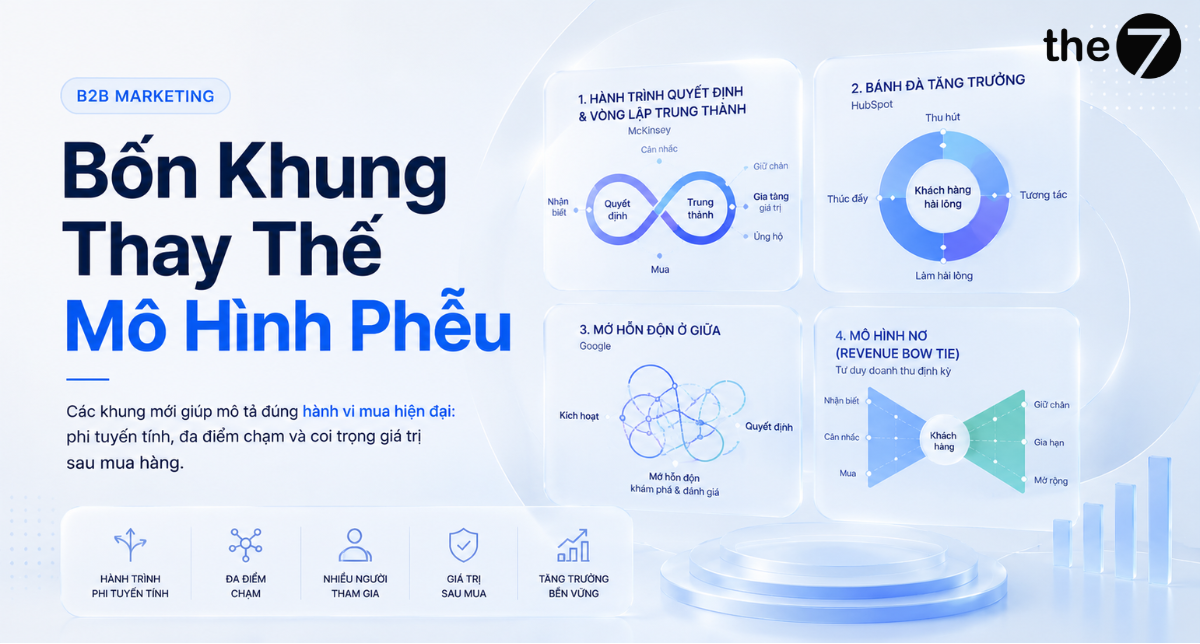
Four Frameworks That Replace the Funnel Model
Summary: As the funnel model increasingly fails to capture how modern buyers actually behave, a number of new frameworks have emerged to replace or repair it: McKinsey’s decision journey and...
What Is Category Design?
Summary: Category design is the act of creating an entirely new type of solution in the market’s mind, instead of competing within an existing category, and then becoming the name...
What Is B2B Positioning?
Summary: B2B positioning is the act of choosing the context you place your product into – the frame of reference that makes its value obvious to the buyer. Positioning isn’t...
What Is the 95/5 Rule?
Summary: The 95/5 rule states that at any given moment, only about 5% of B2B buyers are actually in-market, actively in a buying cycle, while roughly 95% are not yet...
What Is Mental Availability in B2B?
Summary: Mental availability is how easily a brand comes to mind in a buying situation. It isn’t about having the sharpest argument, the slickest pitch, or the most convincing feature...
What Are B2B Events and Trade Shows?
Summary: B2B events and trade shows are in-person gatherings such as conferences, industry trade shows, workshops, and private meetings, where a business meets buyers, customers, partners, and the industry community...