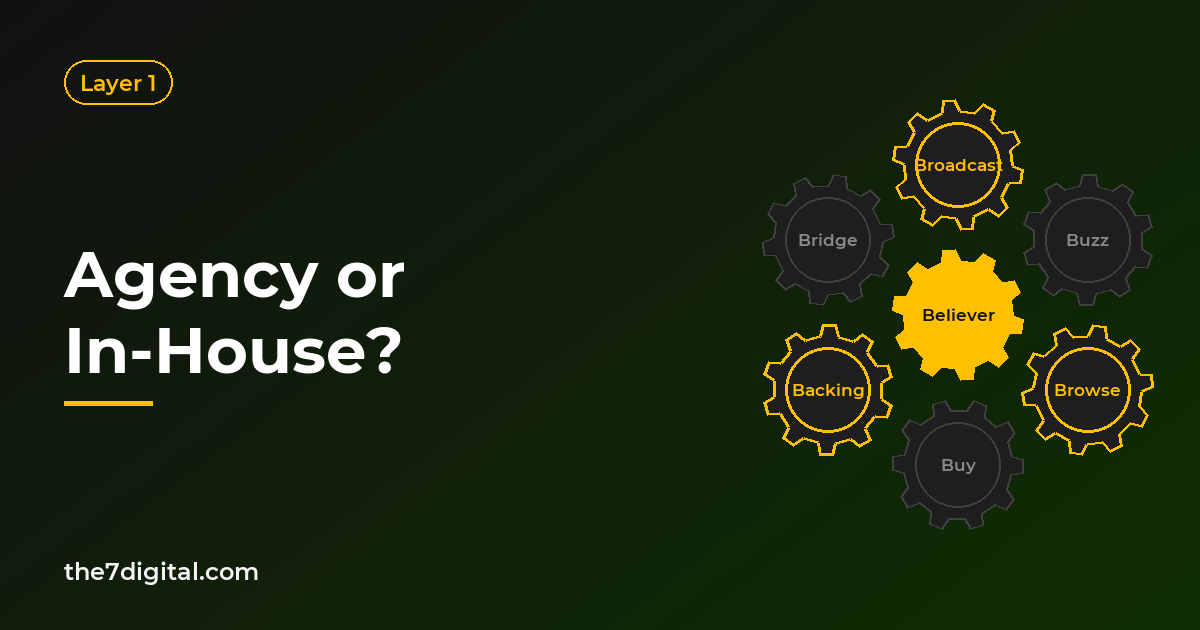
Summary: Agency or in-house is the wrong either-or for B2B marketing. Keep the gears that run on product knowledge and relationships, Believer and Backing, inside the company, and outsource the work that needs scale and tools, the paid side of Broadcast and Browse. In the 7B Model, this is an operating question: who captains each gear.
Picture a regional marketing director in Singapore with Vietnam on her plate for next year. Three proposals sit on her desk. A Ho Chi Minh City agency offers local media buying and Vietnamese content. HR has costed two in-country hires. The regional agency that runs Singapore and Malaysia offers to add Vietnam to its retainer. Each option has a sponsor in the room, and each sponsor is half right.
They are half right because they describe different jobs. The local agency sells reach and production. The in-country hires are about relationships: the plant manager who wants a call in Vietnamese, the distributor who expects a familiar face before the next order. The regional retainer sells consistency. Lump them into one word, marketing, and every answer fails somewhere.
Below you will find a test that replaces the either-or, two global B2B brands that drew the line, six questions for choosing an agency, and what changes in Vietnam and ASEAN.
Why is “agency or in-house” the wrong question?
Start with the companies that went furthest in-house. In an early 2023 survey of its members, with 162 respondents, the US Association of National Advertisers (ANA, 2023) found that 82% have an in-house agency, up from 78% in 2018. Yet 92% of the same respondents still work with external agencies, and on average only 61% of the work is done in-house (ANA, 2023). Even the most committed in-housers never picked a side. They drew a line.
The survey hints at where the line falls. Work goes outside mainly for capacity, or for capabilities the company does not have. Respondents who had considered bringing media in-house but had not done so said media is “too complex,” even though 54% of in-house agencies already handle some media planning or buying (ANA, 2023). Pulling the other way is data: the wish to own, control and protect first-party data drives work back inside.
The line is moving, too. In Gartner’s 2025 CMO Spend Survey, 22% of CMOs said generative AI had let them rely less on external agencies for creativity and strategy building (Gartner, 2025). New tools bring some rented work home. They do not answer the underlying question: which work should stay because it is your core competence?
That question is older than the web. In 1994, James Brian Quinn and Frederick Hilmer argued in MIT Sloan Management Review that firms should concentrate their own resources on a small set of core competencies and strategically outsource activities for which they have neither a critical strategic need nor special capabilities (Quinn and Hilmer, 1994). Applied to B2B marketing, the question stops being who should do marketing. It becomes which of the seven gears is core to you.
My test has two halves. Does this job depend on product knowledge and relationships, or on scale and tools? Knowledge work must come from people who live with the product. Relationship work must sit with people your customers will still see in three years. Scale work belongs where tools and specialists are paid for by many clients.
Which gears should stay in-house?
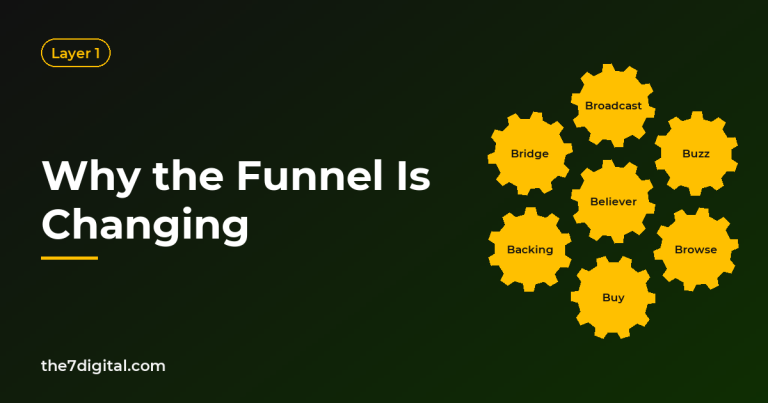
The first group is Believer and Backing. In the 7B Model, the Believer gear means: Customers who do not just buy but believe, through real experience after the deal. The Backing gear means: Customers, the ecosystem and AI speak up on your behalf. Both rest on something you cannot buy, a relationship tested over time. An agency can draft your customer interview guide. It cannot be the person the customer trusts.
Believer’s signals live in service, implementation and account management, not in marketing, and buyers weigh exactly those signals. In TrustRadius’s 2026 report, B2B technology buyers ranked product demos, free trials, prior experience and user reviews among the most influential resources (HG Insights, 2026). Three of the four come from real experience with your product and your people. No agency can manufacture experience.
Backing is harder still to rent, because B2B buyers check you through other people’s words. The same TrustRadius (2026) report found that 74% of buyers use reviews to inform purchase decisions. You can hire someone to nudge customers for reviews. Good reviews still come only when customers have something good to say, and your product and people create that.
Here is the paradox. The job B2B firms outsource most is the one that needs product knowledge most. In 2019 research by the Content Marketing Institute, half of North American B2B content marketers outsourced some content marketing, and content creation topped the outsourced list at 84% (Content Marketing Institute, 2019). Hiring writers is fine. Outsourcing the thinking is not. A technical article buyers trust has to start in an engineer’s head; the outside writer should be the hands that turn it into text and video.
Buyers notice when the thinking is outsourced. Gartner (2025) found that 69% of B2B buyers report inconsistencies between what a supplier’s website says and what its sellers tell them (Gartner, 2025). The figure does not say who causes the gap. It says content and selling are made in two places that do not talk, and the buyer pays for the mismatch.
Two more things should stay home: positioning and the expert voice. B2B positioning is a choice about what to give up, and only the people accountable for revenue can make it. The expert voice belongs to your engineers and founders. A good agency amplifies it; a weak one replaces it, and soon every supplier in your category sounds the same.
Which gears should you outsource?
The second group is the paid side of Broadcast and Browse. The Broadcast gear means: Seeding valuable presence into the market, clear, steady and sharp enough that the right people know you exist. The Browse gear means: Where emotion meets reason: buyers verify and compare you through six gateways. “Steady” and “six gateways” are where agencies hold a real edge, and the edge comes from scale, not genius.
Steady means paid amplification runs every month, across platforms, with dozens of variants tuned weekly. An agency running many accounts spots a platform change in the first week; a generalist on your team relearns it between two sales meetings. My piece on paid advertising in B2B covers what ad money should do; the question here is who spends it.
The six gateways of Browse are search engines and AI-generated answers, conversational AI, specialist review platforms, LinkedIn, YouTube and podcasts, and communities and forums (Mô hình 7B cho B2B book, chapter 8). Each has its own rules, and the rules keep moving. In 2023 alone, Google says it ran more than 700,000 experiments that led to over 4,000 improvements to Search (Google). No three-person team keeps pace with that across six gateways.
Tools are the second reason. Gartner (2023) found that organizations used just 33% of their martech stack’s capability on average in 2023, the second straight annual decline, from 58% in 2020 and 42% in 2022 (Gartner, 2023). At an agency, tool costs are shared across clients and the people using them use them daily. In-house, the same tools often get opened when the monthly report is due.
Production rhythm is the third. In the Content Marketing Institute’s 2024 survey, only 35% of B2B marketers said they have a scalable content creation model (Content Marketing Institute, 2024). Ideas are rarely the bottleneck. Hands are: the capacity to turn one pillar piece into seven or more outputs every week (Mô hình 7B cho B2B book, chapter 6).
In practice, these are the jobs I usually recommend outsourcing:
- Media buying and campaign operations on LinkedIn, YouTube, Google Search and retargeting.
- High-volume variant production: design, short video editing, translation.
- Technical SEO and monitoring of the Browse gateways.
- Measurement setup: tagging, data connections, dashboards.
- Peaks: trade show season, product launches, a new market.
Outsourcing the paid side is not outsourcing Broadcast and Browse. The message, the target account list, the definition of the right buyer and the measures of success stay yours. So do owned assets such as expert articles and engineering videos, even when an agency builds them. Let the agency drive. The car, the map and the registration should carry your name.
What do Intel and Cisco teach about hybrid models?
These stories run in opposite directions, yet draw the same line.
Intel: The in-house studio that shrank when strategy changed
Teresa Herd, who led Intel’s in-house agency, Agency Inside, told Digiday (2019) that when she arrived, 95% of the work was done outside, and that Intel had at one point used 1,500 agencies worldwide, 250 of them in the U.S. By the time Agency Inside was cut back, 70% of the work was internal (Digiday, 2019).
Her case for the model is worth remembering. Cost comes first, she said, but access to the business is invaluable: her team was “in the cafeteria, in meetings,” in places outside agencies never reach (Digiday, 2019). That is what I call company memory. It sits in no brief, because most of it has never been written down.
Then strategy changed. In December 2018, four years after setting up Agency Inside, Intel scaled it down, saying it was recalibrating its marketing strategy to be “more B2B and ecosystem-focused” (Media Marketing, 2018). Only about a third of the 90 staff were to be retained, and the report noted speculation that external agencies such as TBWA, which handled B2B, would benefit. The lesson is not that in-house failed. An in-house production shop is a fixed cost tied to one strategy; when the strategy moved, the muscle went back to agencies. I read the third who stayed as the memory Intel chose to keep.
Cisco: From 400 agencies to 40, with an in-house core
Cisco went the other way and still kept agencies. According to an ANA (2021) interview, since its 2016 launch Cisco’s in-house agency, The Hatch, has tightened its roster from roughly 400 agencies globally to about 40. The interview with Patti Cocciolo, then senior director of global brand marketing, describes the in-house team as bringing institutional knowledge, while relations with outside agencies became closer and more productive.
The order matters. Cisco did not bring work home to fire agencies. It built a team that understood the business well enough to write clear briefs, then kept the few agencies that delivered against them, with a relationship that has the feel of a unified team (ANA, 2021). Four hundred agencies means four hundred readings of the brand. Forty agencies plus a team that holds the memory is a machine.
At both companies, understanding of the business stayed in-house: the product, the people, the direction of strategy. Production and amplification moved in and out.
How do you choose a B2B agency?
Once you know what to outsource, the question is who. I use six questions. Strong agencies like being asked; weak ones dodge.
| Question | A credible answer | A warning sign |
|---|---|---|
| What do you report? | Gear-level signals: branded search volume, what customers write when asked how they heard about you, engagement quality, content buyers touched before closed deals | Clicks, cost per lead and form fills only |
| Whose name are the accounts and data in? | Yours; the agency gets access | The agency owns the ad accounts or stalls on customer IDs |
| Who actually works on my account? | You meet the weekly operator in the first meeting | The pitch team and the delivery team are different people |
| How will you learn my product? | Engineer interviews, sales call reviews, customer conversations | A request for product documents and nothing more |
| Will you say no? | Pushes back on gated content and click-based targets | Agrees to everything |
| What happens when we part ways? | Full handover of accounts, data and source files, in the contract | Data held hostage, transfer fees |
The second question sounds like admin, but it matters most. Google requires third parties that manage ads to give customers their Google Ads customer IDs on request and, when sharing cost data, to report the exact amount Google charged, excluding their own fees (Google Ads). An agency that hesitates over what the platform already requires will hesitate more when things go wrong.
The first question tells you whether an agency fits B2B. The four signals in the table are the new measures the 7B Model proposes in place of clicks (Mô hình 7B cho B2B book, chapter 14). They take time, because the machine has its own rhythm: three months of seeding, six months to see sprouts, twelve months for clear fruit (Mô hình 7B cho B2B book, chapter 5). An agency promising leads in month one of a demand creation program is promising the wrong thing. My article on mental availability explains why early signals are the ones to watch.
The fifth question tells you whether the agency works for you or for its own report. Gating every document behind a form is the fastest route to a pretty report. The 7B Model’s principle is the opposite: give away the thinking and put no barriers in front of content (Mô hình 7B cho B2B book, chapter 6). An agency that says “do not gate this” is protecting your machine at the cost of its own first month. Re-ask all six questions every six months, of the agency and of your own team.
The line also moves with scale. The Mô hình 7B cho B2B book gives the founder or expert only three to five hours a week, on content and relationships, against 15 to 20 for whoever runs repurposing, design, scheduling, ads and Browse checks (Mô hình 7B cho B2B book, chapter 13). The founder’s hours cannot be rented; most of the rest can. As the team grows, give each gear a captain with the 7B Gear Captain Matrix from building a B2B marketing team.
Where does agency or in-house fit in the 7B Model?
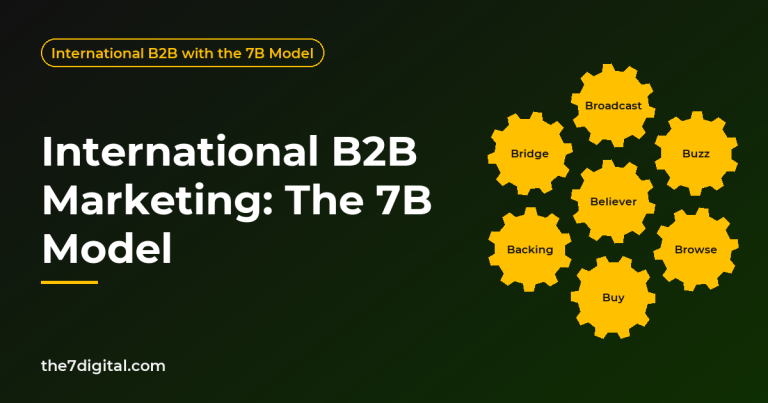
Agency or in-house is not a gear. It is an operating question that lives in the joints between gears, where the 7B Model’s two operating principles apply: Customers can enter anywhere; one stuck gear slows the whole flywheel.
The first principle means your Browse ads and your product pages must tell the same story, because a buyer can arrive through an ad today and a referral tomorrow. The second reminds you that jams happen at handoffs: an ad promises something sales has never heard of, or a customer case sits on the agency’s drive.
The model’s three energy flows are: Paid, owned, earned-and-shared. The line in this article tracks them. Paid is where agencies are strongest. Owned assets can be built by agencies but must be registered to you. Earned-and-shared cannot be bought, because it comes from relationships and real experience. That is why Believer and Backing stay home, and why the dark social they generate is the most valuable part of the machine, even though no agency dashboard captures it.
Across the three operating layers, outsourced work sits mostly on the paid side of demand creation (Broadcast, Buzz) and demand capture (Browse, Buy). Amplification (Backing, Bridge) and the Believer loop stay in-house. If an agency appears in the captain column of the 7B Gear Captain Matrix, someone inside still owns the outcome of that gear.
The 7B Model was developed by Nguyen Dinh Bao (Bao7) at The7 Digital and is set out in full in the book Mô hình 7B cho B2B (Stop Begging, Start 7B). If you are new to the gears, start with the 7B Model.
Selling B2B into Vietnam and ASEAN
Vietnam rewards a hybrid setup. In EuroCham’s Q3 2026 business confidence survey, human capital was the most cited advantage of doing business in Vietnam at 52%, yet 49% named talent shortages as an obstacle (EuroCham Vietnam, 2026). Good people exist, and you will compete hard for them. A full in-country department before revenue is slow and costly. Hire one owner first and rent the muscle around them.
Keep the memory close to the customer. The Culture Factor scores Vietnam 30 on individualism, which places it among collectivistic societies: loyalty to the in-group is close and long-term, and work relationships are seen in family-like terms (The Culture Factor). Vietnam ranked 64th in the EF English Proficiency Index 2025, with a score of 500 (EF Education First, 2025). English will carry part of your buying committee, not all of it.
So Believer and Backing in Vietnam need people who speak Vietnamese and will still be around next year: your own staff, or a distributor you trust. Where a distributor holds the relationship, treat it as a captain of Believer, as I describe in building a B2B marketing team, but keep the customer records in your name.
Be careful with a regional agency that plans Vietnam from Singapore. In late 2025, LinkedIn’s ads reached 101.3% of Singapore’s population aged 18 and above, a figure above 100% because LinkedIn counts registered members (DataReportal, 2025). In Vietnam the same ads reached 13.5% of adults, while Facebook’s ad reach was equivalent to 77.6% of the total population (DataReportal, 2025). A playbook tuned for Singapore risks overspending on LinkedIn in Vietnam and missing many owners, engineers and plant managers on the committee. Plan Vietnam from Vietnamese data, in Vietnamese.
Treat customer data as part of the memory. Vietnam’s Law on Personal Data Protection took effect on January 1, 2026, giving data subjects rights that include giving, withholding and withdrawing consent, and the ability to lodge complaints and seek compensation (Viet Nam News, 2026). If an agency uploads your customer lists for retargeting, the relationship and the risk are still yours. Keep the CRM and consent records in-house, give agencies access rather than ownership, and repeat the pattern market by market across ASEAN instead of stretching one retainer over the region.
Conclusion: Rent the muscle, keep the memory
Back to the director in Singapore. Her three proposals price two different capabilities. One is muscle: scale, tools, production rhythm and platform specialists. The other is memory: knowing the product, knowing the customer and holding relationships across years and staff changes.
Muscle can be rented, and should be when renting is cheaper. Memory cannot. A company that outsources its memory gets a machine that runs smoothly for a year and goes hollow after the first agency switch. A company that insists on owning all the muscle ends up with its best people adjusting bids at midnight instead of sitting with customers. The real question was never agency or in-house. It is which gears need memory and which need muscle.
So who runs the machine? Usually both, with the line drawn on paper and one person inside who keeps the drawing. The part The7 runs for clients sits on the muscle side: LinkedIn, YouTube, Google Search and retargeting, operated as one machine. On the memory side, we help build the habits and hand them back. The7’s comprehensive digital marketing services page shows that split in practice.
To assign a captain to every gear, read building a B2B marketing team. To fund the split before you staff it, B2B marketing budgets is the next step. And before you hire an agency for paid media, revisit paid advertising in B2B to know what to demand from that layer.
Frequently asked questions
Should a small B2B company hire an agency or do marketing in-house?
Usually both. A team of one or two should keep the expert voice, customer relationships and ownership of accounts and data in-house, and outsource variant production and ad operations, which depend on scale and tools rather than product knowledge.
Which parts of B2B marketing should not be outsourced?
Believer and Backing: the post-sale experience, relationships with champions, and cases and reviews from real customers, plus positioning, messaging and the expert voice. Agencies can help produce, but customer lists, relationships and the choice of stories should stay inside.
How do I choose a B2B marketing agency?
Ask what they report, whose name the accounts and data are in, who runs your account, how they will learn your product, whether they push back on bad requests, and what happens at handover. A B2B-ready agency reports signals such as branded search volume, not just clicks.
Should a foreign company use a local agency in Vietnam or run Vietnam from a regional hub?
Use both, for different jobs. A local agency or specialist should run paid Broadcast and Browse in Vietnamese, from Vietnamese channel data, while the regional team sets the message and measures. Keep one in-house owner for the market and keep customer data under your control.
References
- ANA (2023). In-House Agencies No Longer A Trend: They’re Here To Stay (ANA Report). https://ana.net/content/show/id/79185
- Gartner (2025). Gartner 2025 CMO Spend Survey Reveals Marketing Budgets Have Flatlined at 7.7% of Overall Company Revenue (Gartner content server copy). https://gcom.pdo.aws.gartner.com/en/newsroom/press-releases/2025-05-12-gartner-2025-cmo-spend-survey-reveals-marketing-budgets-have-flatlined-at-seven-percent-of-overall-company-revenue
- Quinn, J. B. and Hilmer, F. G. (1994). Strategic Outsourcing. MIT Sloan Management Review. https://sloanreview.mit.edu/article/strategic-outsourcing/
- TrustRadius, HG Insights (2026). TrustRadius 2026 B2B Buying Disconnect Report Reveals AI Has Changed How Buyers Research, But Not What They Trust. https://hginsights.com/news/trustradius-2026-b2b-buying-disconnect-report-reveals-ai-has-changed-how-buyers-research-but-not-what-they-trust/
- Content Marketing Institute (2019). 2020 B2B Content Marketing: What the Successful Do (New Research). https://contentmarketinginstitute.com/b2b-research/2020-b2b-content-marketing-what-the-successful-do-new-research
- Gartner (2025). Gartner Sales Survey Finds 61% of B2B Buyers Prefer a Rep-Free Buying Experience (Gartner content server copy). https://gcom.pdo.aws.gartner.com/en/newsroom/press-releases/2025-06-25-gartner-sales-survey-finds-61-percent-of-b2b-buyers-prefer-a-rep-free-buying-experience
- Google (n.d.). Search Engine Testing & Evaluation (How Search Works). https://www.google.com/search/howsearchworks/how-search-works/rigorous-testing/
- Gartner (2023). Gartner Survey Finds 63% of Marketing Leaders Plan to Invest in Generative AI in the Next 24 Months (Gartner content server copy). https://gcom.pdo.aws.gartner.com/en/newsroom/press-releases/2023-08-23-gartner-survey-finds-63-percent-of-marketing-leaders-plan-to-invest-in-generative-ai-in-the-next-24-months
- Content Marketing Institute (2024). B2B Content Marketing Benchmarks, Budgets, and Trends: Outlook for 2025. https://contentmarketinginstitute.com/b2b-research/b2b-content-marketing-trends-research-2025
- Media Marketing (2018). Intel dials down their in-house agency. https://www.media-marketing.com/en/news/intel-dials-down-their-in-house-agency/
- Digiday (2019). Intel’s Teresa Herd: In-house agencies have ‘invaluable’ access to the business. https://digiday.com/marketing/intel-teresa-herd-in-house-agency/
- Hosford, C., ANA (2021). Cisco’s In-House Agency Complements Agency Partnerships. https://ana.net/magazines/show/id/67539
- Google (n.d.). Transparency requirements (Google Ads policies). https://support.google.com/adspolicy/answer/16489093?hl=en
- EuroCham Vietnam (2026). EuroCham Business Confidence Index Q3 2026: Translating Economic Gains Into Business Opportunities. https://eurochamvn.org/eurocham-business-confidence-index-q3-2026-translating-economic-gains-into-business-opportunities/
- The Culture Factor (n.d.). Country Comparison Tool: Vietnam. https://www.theculturefactor.com/country-comparison-tool?countries=vietnam
- EF Education First (2025). EF English Proficiency Index 2025: Vietnam. https://www.ef.com/wwen/epi/regions/asia/vietnam/
- DataReportal (2025). Digital 2026: Singapore. https://datareportal.com/reports/digital-2026-singapore
- DataReportal (2025). Digital 2026: Vietnam, by Simon Kemp. https://datareportal.com/reports/digital-2026-vietnam
- Viet Nam News (2026). Several major laws to take effect from January 1, 2026. https://vietnamnews.vn/politics-laws/1733035/several-major-laws-to-take-effect-from-january-1-2026.html