


How Are Brand Marketing and Performance Marketing Different?
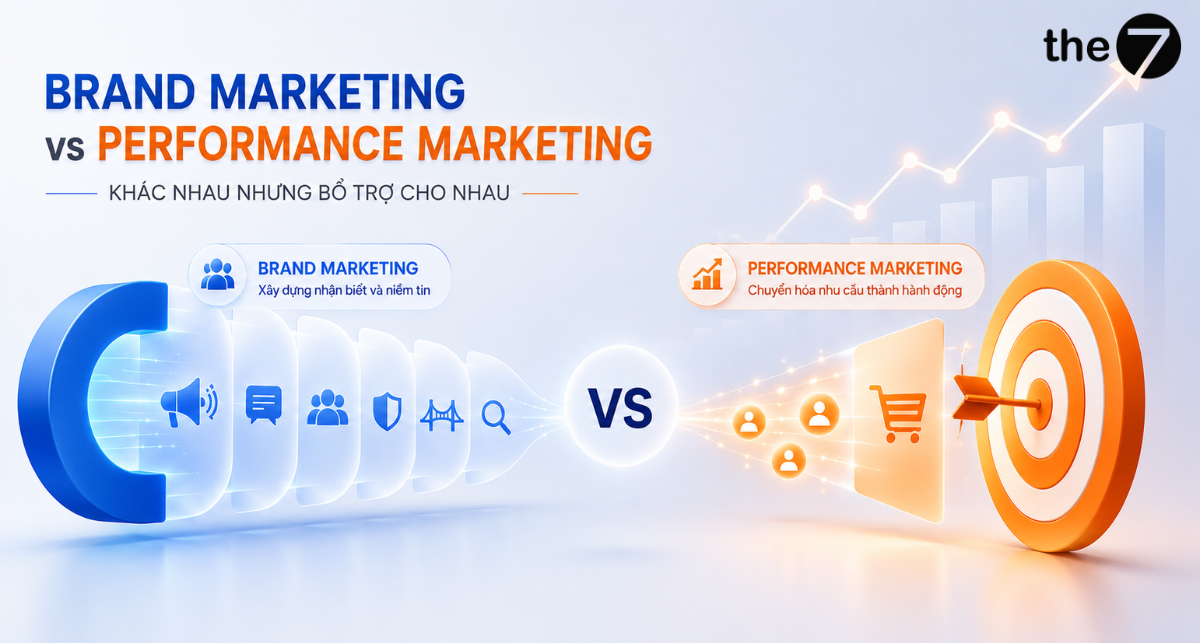
Summary: Brand marketing builds memory, familiarity, and trust with the market over the long term, without requiring an immediate response from customers. Performance marketing triggers an immediate, measurable action, such as a click, a form fill, a consultation request, or a purchase. These two types of marketing operate on two different psychological mechanisms and serve two different moments in the buyer’s mind. So they are not two opposing camps forcing businesses to pick one. In the 7B model, brand is the six demand-creating gears, while performance is the Buy gear, where demand is converted into action. The real issue isn’t choosing between brand and performance — it’s that most businesses let what’s easy to measure crowd out what actually matters.
There’s a debate that repeats in nearly every B2B marketing room: should you pour money into brand or into performance?
One side argues that brand is a luxury — vague, hard to measure, reserved for large corporations with deep pockets. In their view, small and mid-sized businesses don’t have time to “build a brand,” don’t have money to wait, and can’t pay employees with things like awareness, familiarity, or trust. For this camp, marketing has to generate leads, has to produce form numbers, has to produce appointments, has to produce visible revenue.
The other side argues that performance is short-sighted, only interested in short-term harvesting. They claim that the more a business chases immediate metrics like CPC, CPL, forms, or orders, the more it loses its ability to build a long-term position in the market’s mind. For this camp, performance is like constantly picking fruit without ever planting a tree. It can produce a beautiful report for a few months, but it gradually drains the source of future growth.
Both sides argue as if a business is forced to choose one and abandon the other. Either do brand, or do performance. Either invest long-term, or generate short-term results. Either build the brand, or generate leads.
I think this whole debate is asking the wrong question. And it’s wrong because both sides are misreading the true nature of these two things.
Brand and performance aren’t two competing strategies. They are two ways of acting on two different mechanisms in the buyer’s mind. One builds memory. The other triggers action. One makes the market know you, remember you, grow familiar with you, and trust you before the need even appears. The other helps someone who already has a need take one concrete next step: clicking an ad, filling out a form, requesting a quote, booking a demo, or making a purchase.
You don’t choose between memory and action, because action rarely happens if memory was never built. A person can’t prioritize you if they don’t remember you. They can’t trust you if you’re a complete stranger. They also can’t easily choose you in a high-risk decision if your name has never appeared in their head before.
So the real question isn’t whether to choose brand or performance. The real question is why most businesses let what’s easy to measure crowd out what actually matters.
This article will clarify both concepts through the lens of buyer psychology, and point out the trap that so many businesses fall into when they become overly dependent on performance. First, let’s start with the definitions.
Brand marketing is the set of activities that build awareness, familiarity, and trust with the market over the long term, without requiring an immediate response action. It doesn’t have to be an expensive TVC, an outdoor billboard, or a flashy visual campaign. In B2B, brand can be a series of in-depth analysis articles, an industry podcast, an original research report, an event the market remembers, a CEO who regularly appears with clear points of view, or your brand being consistently mentioned in the right industry conversations.
Performance marketing is the set of activities that drive a specific, immediately measurable action, such as a click, a form fill, a document download, a consultation sign-up, a demo request, or a purchase. It’s typically tied to search ads, conversion ads, landing pages, forms, CTAs, remarketing, sales emails, or activities that optimize the conversion path.
The core difference between brand and performance doesn’t lie in the channel or the budget. The same channel can be used for both brand and performance. LinkedIn can be used to build long-term authority, but it can also be used to pull in forms. Google can be used to capture existing demand, but it can also be used to build presence through content. Video can be brand, but it can also be performance if the primary goal is to trigger immediate action.
The real difference lies in the psychological mechanism each type of marketing acts on. Brand shapes what the buyer thinks, remembers, and feels about you before they have a need. Performance harvests action from those who are already ready.
Two psychological mechanisms: memory and action
To understand why brand and performance can’t replace each other, you have to understand that they hit two different parts of the decision-making process.
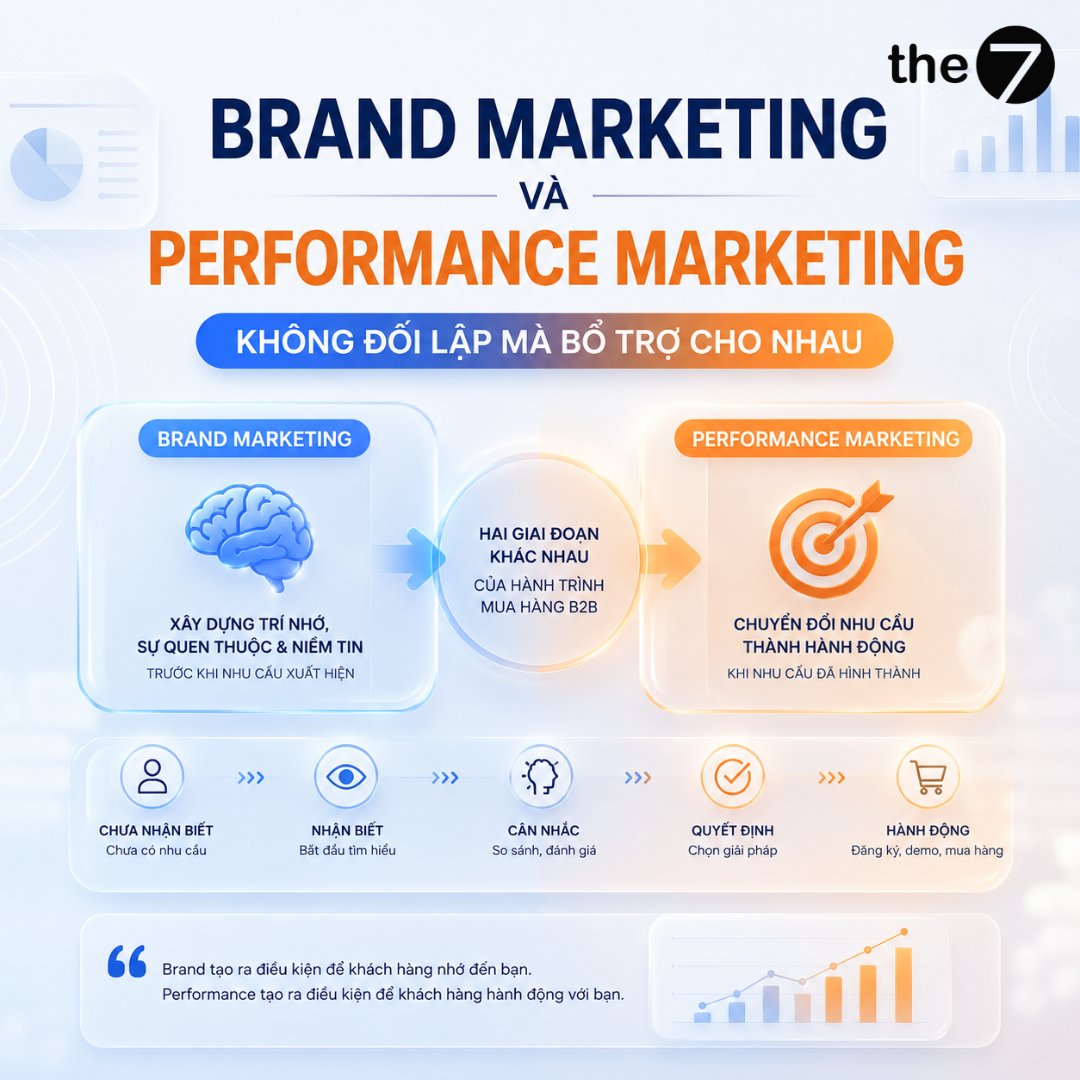
Performance hits the moment of action.
When a person already has a need, already knows what they need, and is in a ready-to-buy state, performance is the final push that gets them across the line. It could be a search ad that appears right when they type “CRM software for a B2B company.” It could be a clear pricing page, a shorter form, a lower-friction demo invitation, a well-timed reminder email, or a remarketing ad that brings them back after they’ve viewed a service page.
In that moment, performance is very powerful. It helps convert an existing intent into a concrete action. It reduces friction. It makes the next step clearer, faster, and easier to take.
But it needs to be said clearly: performance doesn’t create desire from zero. It doesn’t generate a deep need inside the buyer on its own. It mainly captures, amplifies, and converts a desire that has already formed. That’s why performance is immediately measurable — it acts on people who are already very close to the decision point. That person already has a need, has already started searching, has already compared, has already considered, or is at least interested enough to act.
Brand hits something that happens much earlier and much deeper: memory.
Long before a person has a need, brand plants an impression in their head. A name. A sense of familiarity. An early, vague belief that this business seems to understand the industry, seems trustworthy, seems deeply capable, seems to regularly show up in the right contexts.
At that point, the buyer hasn’t filled out a form. Hasn’t requested a quote. Hasn’t messaged sales. They may not even know that in a few months, or a year, they’ll need a solution like yours. But in their head, a memory structure has already begun to form. They’ve seen you. They’ve heard your name. They’ve read one of your viewpoints. They’ve seen others mention you. They haven’t bought yet, but you’ve already started occupying a small place in their mind.
When the need finally appears, maybe months or years later, what was planted earlier will determine whether you’re among the first names that come to mind. And in B2B, the list that pops into the buyer’s head is often far more important than the list marketers think they’re competing in. You might have a great product. You might have a great sales team. You might have a beautiful landing page. But if the buyer doesn’t remember you when the need appears, you don’t even enter the game.
Brand doesn’t create immediate action. It shapes the frame within which future action will take place.
This is the crucial point the brand-versus-performance debate usually misses: these two things don’t compete, because they act on two different moments and two different psychological states.
Performance is useless if memory hasn’t been built, because there isn’t enough desire to convert into action. You can have a beautiful form, a great landing page, a very clear CTA, but if the market doesn’t know you, doesn’t trust you, has no reason to prioritize you, your conversion rate will stay low and your cost will stay high.
Brand is also wasted without a harvesting mechanism, because the desire it plants will ripen and fall for someone else to pick. A person who already trusts you, remembers you, and is interested in your point of view, but who can’t find a clear path to contact you, no solution page, no pricing, no appropriate CTA when they’re ready to buy, may see that need drift to a competitor with a better Buy system.
One prepares the soil. One harvests the crop. Asking which one to choose is as meaningless as asking a farmer whether to sow or to reap. Without sowing, there’s nothing to reap. Without reaping, the work of sowing never turns into revenue.
Why is performance more appealing but more misleading?
Performance has an almost irresistible appeal, and that appeal comes from a single thing: it’s immediately measurable.
You launch a campaign in the morning. By the afternoon, you’ve already seen the number of clicks, landing page views, form fills, cost per lead, conversion rate, budget spent. You know exactly how much money you spent and how many actions you got back. You can build a clean spreadsheet with a cost column and a results column, present it to your boss, and everyone nods.
Performance gives a sense of control. It turns marketing into an equation that appears to have a solution. Want more leads? Increase the budget. High CPL? Optimize the ads. Low form fills? Fix the landing page. Poor conversion rate? Change the messaging. Everything looks logical, linear, and controllable.
Brand is the complete opposite. You publish content for six months. You build a steady presence. You have your CEO show up with clear viewpoints. You produce an industry report. You run a small event. You post analyses that people in the industry save, share, and mention in private groups. But you don’t know exactly which article led to which deal. You can’t build a clean spreadsheet with an arrow running straight from cost to revenue. When your boss asks “how much money did brand generate this quarter,” you don’t have a tidy answer the way performance does.
Brand feels vague. Not because it has no impact, but because its impact happens in memory, in perception, in familiarity, in conversations that carry no tracking code, and in moments when a buyer quietly changes how they see you.
Between something that feels controllable and something that feels vague, people choose the one that feels controllable. That’s instinct. And it’s also the biggest trap in B2B marketing.
Because there’s an uncomfortable truth hiding beneath this: what’s measurable isn’t always what’s important. It’s just what’s easiest to measure.
Think about this. The easiest thing to measure in marketing is usually the last click, because it happens right before the transaction and leaves a clear trace. Someone types your name into Google, clicks the ad, fills out the form, and the system records that Google Ads generated a lead. Looking at the numbers, everything is very clean. Cost here. Result there. Attribution says this campaign worked.
But the last click is rarely what actually created the decision. A person signing a contract today may have first heard your name at a conference eighteen months ago. Six months ago, they read one of your analyses and saw that you nailed a problem they were facing. Three months ago, a colleague mentioned you in a private conversation. A month ago, they saw your CEO share a sharp opinion on LinkedIn. Last week, they browsed your website but didn’t leave any information. Today, once the need became clear enough, they finally typed your name into Google and clicked the result.
Performance takes credit for the final click. But what actually built the decision was everything that happened before, everything brand did that can’t be neatly measured in a single spreadsheet row.
When you let what’s measurable dominate, you gradually funnel all resources into the final click and starve everything that created that click. You optimize what’s visible, and shrink what’s invisible but more important. This is how a business can have beautiful numbers every month while still stagnating year after year. They’re measuring what’s easy to measure and mistaking it for the whole reality.
They see forms coming from ads, so they conclude that ads created the demand. They see people searching for the brand name, so they think search is the winning channel. They see sales closing people who were already in the pipeline, so they think everything starts with the pipeline. But in reality, most of the decision was prepared long before, in places that don’t show up clearly in a report: memory, trust, familiarity, referrals, content that was read, conversations that were overheard, and the feeling of safety that comes from choosing a name you already know.
That’s why performance is both more appealing and more dangerous. It isn’t wrong. But if you let it dominate your entire way of thinking about marketing, it will make you confuse what’s easy to measure with what actually creates growth.
B2B buyers fear risk, and that’s where brand wins
There’s a truth about B2B buyers that shapes how brand works entirely: most B2B purchase decisions are driven by fear of risk, not by excitement.
When an individual buys something for themselves, they bear their own risk. They can buy on impulse. They can try a new product, an unfamiliar brand, a new app, a new restaurant. If it turns out wrong, the consequences are usually small. They lose a little money, lose an evening, or feel annoyed for a few days. The risk is mostly personal.
But when someone buys on behalf of an organization, everything changes. They’re not just buying a product. They’re making a decision that can affect budget, process, teams, personal credibility, and business outcomes. A wrong choice can get them questioned in a meeting, cost them their boss’s trust, cost them a bonus, delay progress, damage the company, and even threaten their own position.
So B2B buyers don’t just optimize for the best choice on paper. They optimize for the safest choice. They pick the option that, even if it goes wrong, they can still justify to their superiors and colleagues. They want a choice that looks reasonable, has evidence, is trusted by others, has a reputation, and carries risk-reducing signals.
There’s an old saying in the tech industry that sums this up: nobody ever got fired for choosing the biggest vendor in the market. It sounds like a compliment to the market leader, but it actually says more about buyer psychology. Buyers are always looking to reduce their own risk. When the stakes are high, they don’t want to be the one testing an unfamiliar name. They want to stand behind a choice they can defend.
This is where brand does something performance can never do.
Brand reduces perceived risk. When a name is already familiar, has appeared many times, has been mentioned by others, has credible content, has been seen in the right contexts, and appears to be a choice many people in the industry already know, choosing it feels safer. Familiarity itself is a risk-reducing signal.
A buyer facing two vendors of roughly equal capability, one whose name they’ve heard many times and one that’s completely unfamiliar, will almost always lean toward the familiar one. Not because the familiar one is necessarily better, but because it’s safer to present, safer to propose, and safer to defend if questioned.
Performance cannot create this sense of safety. A well-timed conversion ad can catch someone already ready to act, but it can’t make an unfamiliar name trustworthy in a few seconds. A beautiful landing page can reduce friction, but it can’t replace years of consistent presence. A short form can raise submission rates, but it can’t erase the sense of risk a buyer feels when they’ve never heard of you before.
Trust cannot be bought with a single click. It’s built over time, through repetition, through accumulated evidence, through consistently showing up in the right contexts, until familiarity turns into trust. That’s brand’s job. And it’s a long-term job with no shortcut.
The result is that the larger the deal, the higher the risk, and the more people involved in the decision, the more important brand becomes relative to performance. Because when risk is high, buyers rely even more on familiarity and trust to protect themselves. A single ad click can’t reassure a buying committee afraid of choosing wrong. A name already familiar to the whole committee can.
This is also why many B2B businesses misjudge brand’s role. They look at the performance report and see a form coming from an ad, so they think the ad created the customer. But they miss something more important: why did that person dare to fill out your form instead of someone else’s? Why did they trust you enough to listen to a consultation? Why did they put you on their shortlist? Why did they defend you in an internal meeting? Those questions can’t be answered by performance alone. They belong to brand.
Where do brand and performance sit in the 7B model?
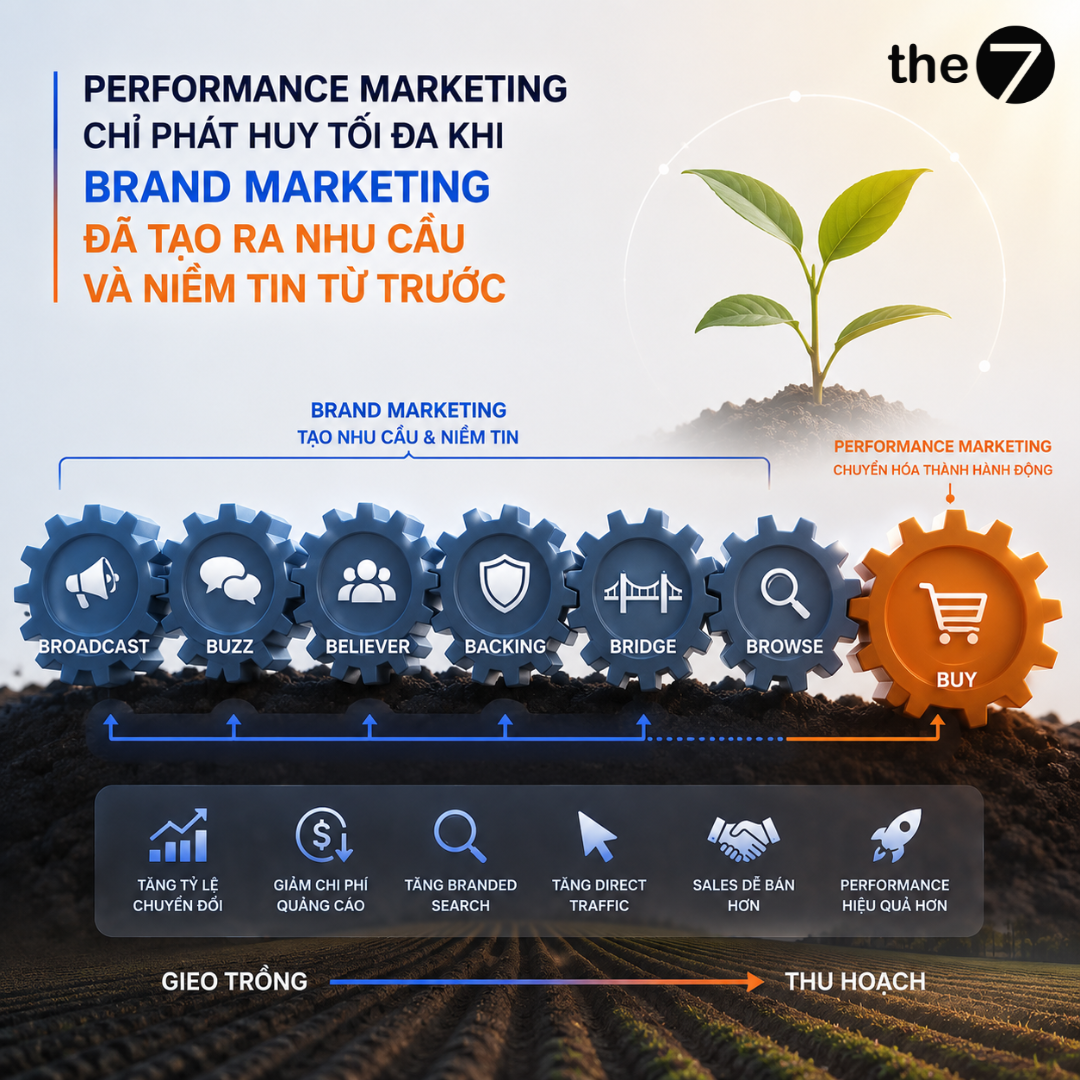
When you place this pair of concepts on the 7B model, the boundary between them becomes much clearer.
Brand, viewed through the seven gears, is exactly the six demand-creating gears.
Broadcast sends signals out to the market, helping the business appear consistently, build familiarity, and create memory. That’s brand.
Buzz gets other people talking about you, mentioning you, sharing you, referring you, or creating third-party trust signals. That’s also brand.
Believer builds a community of people who believe in your point of view, follow you, echo your ideas, and give the brand a genuine group of advocates. That’s brand.
Backing creates evidence, validation, research, case studies, data, experts, partners, or signals that help the market see you’re not just talking about yourself. That’s brand.
Bridge extends trust through relationships, partnerships, ecosystems, communities, and connections that place you within contexts that already carry built-in trust. That’s brand.
Browse, in the part where it builds authority and helps buyers research on their own, is also brand. Because when someone isn’t ready to buy yet but is exploring a problem, your content can become the thing that shapes how they understand that problem, how they name it, and how they remember you as a trustworthy option.
These six gears act on memory, familiarity, and trust. They don’t necessarily require immediate action. Their job is to plant demand, nurture demand, shape perception, and place the brand in the market’s mind before the buying moment arrives.
Performance, viewed through the seven gears, is exactly the Buy gear.
Buy includes everything that triggers action from people who are already ready: search ads for high-intent queries, landing pages, forms, pricing, CTAs, remarketing, conversion-path optimization, demo invitations, sales materials, fast-response processes, and every touchpoint that turns existing demand into a sales opportunity or revenue.
One gear. It harvests.
The beauty of this framing is that it turns a philosophical debate into a concrete allocation problem. You no longer ask, “should I believe in brand or believe in performance?” You ask whether your six demand-creating gears are running, and whether the Buy gear is harvesting effectively.
When a business pours nearly all its resources into Buy and starves the other six gears, that’s the concrete manifestation of letting performance crowd out brand. And the problem isn’t that performance is bad. The problem is that one gear can’t do the job of the other six.
Buy can help you harvest better, but it can’t produce the whole crop on its own. It can’t build memory by itself. It can’t create market trust by itself. It can’t make buyers feel safe choosing you by itself. It can’t place you on the list of remembered names before the need appears, by itself.
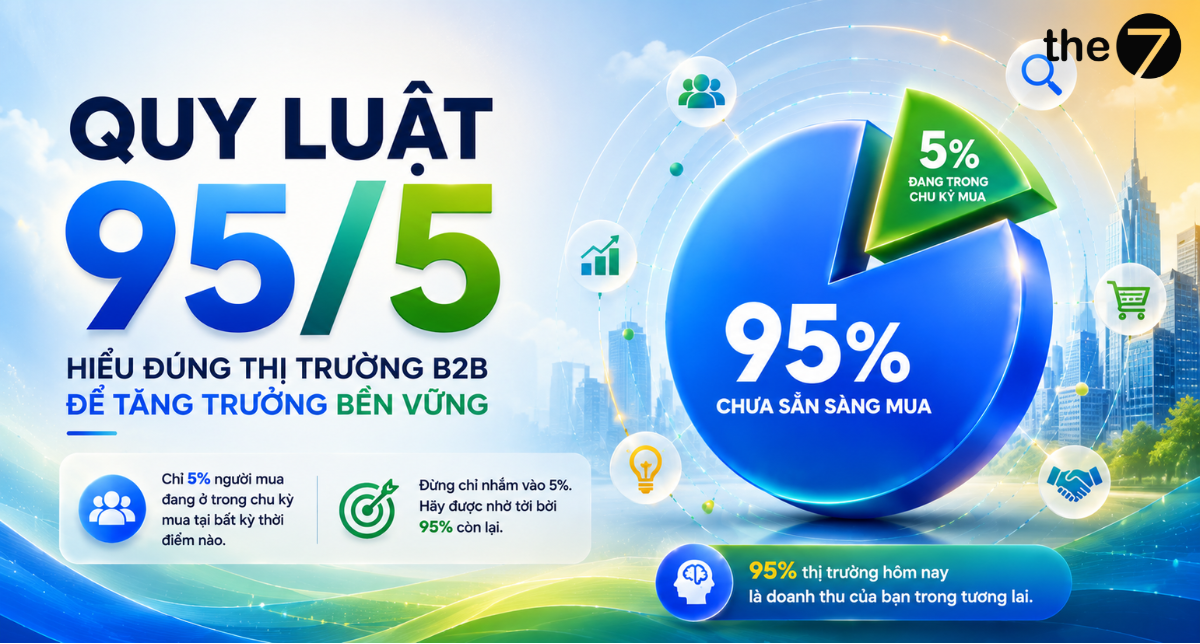
Part of the reason lies in the fact that most of the market isn’t ready to buy at any given moment, something I go into in more depth in the article on the 95/5 rule. If most of the market isn’t ready to buy, pouring nearly all your budget into the Buy gear means you’re only talking to a very small group already close to the decision point, while neglecting most of the rest of the market.
Let’s look at a few examples across different industries to see how the balance between brand and performance shifts.
In corporate finance, a bank serving large enterprises lives almost entirely on brand. Nobody borrows a hundred million dollars because of an ad. No CFO chooses a bank for a major deal just because of a beautiful landing page. What decides it is decades of reputation, presence at financial forums, relationships at the leadership level, deals already closed, and trust accumulated in the market. The stakes are so high that buyers only dare choose a name they trust absolutely. Here, performance in the conventional conversion-ad sense barely exists, because the dominant psychological mechanism is risk reduction, and only brand can deliver that at sufficient depth.
In medical devices, a supplier selling to hospitals faces an extremely risk-averse buying committee. A wrong decision doesn’t just affect the budget — it can affect patient lives, a doctor’s professional reputation, hospital leadership’s liability, and the safety of the entire operating system. What convinces them isn’t a well-timed conversion ad. What convinces them is clinical evidence, endorsement from leading experts, accumulated reputation, credible case studies, and the feeling that this choice is safe enough to defend to many stakeholders. It’s all brand, operating through the risk-reduction mechanism.
In software for small businesses, the balance can tilt more toward performance. Each decision carries lower risk. Contract values are smaller. Buyers tend to decide on their own, faster. If it goes wrong, they can cancel the subscription, switch software, or try another vendor without major consequences. A small business trying a monthly-paid software tool doesn’t carry the heavy professional risk that a corporation signing a multi-year ERP implementation contract does. So performance has more room to play. A well-targeted ad, a free trial, a clear landing page, a well-timed offer can drive conversion.
But even here, brand doesn’t disappear. As the software market gets more crowded and every product looks similar, the familiar name still beats the unfamiliar one. Buyers might act faster, but they still need a minimum level of trust. If two pieces of software have comparable features, comparable pricing, comparable interfaces, the more familiar brand has the edge. Brand is still what decides the winner when everything else is equal.
Three industries, three different tilts, but the same underlying principle: the higher the risk of the decision, the more the balance tilts toward brand, because the higher the risk, the more buyers rely on trust to protect themselves.
So how should you allocate between brand and performance?
There’s no single right number for every business, but there’s a guiding principle: allocation should follow the level of risk and complexity of the buying decision in your industry.
The bigger the deal, the larger the buying committee, the longer the sales cycle, and the heavier the consequences of a wrong choice, the more resources should go toward brand. Because in those situations, the decision isn’t mainly driven by the final push. It’s driven by accumulated trust, by a feeling of safety, by risk-reducing signals, and by your name already being present in the buyer’s mind beforehand.
Conversely, the smaller the deal, the more reversible the decision, the faster buyers decide on their own, and the lighter the consequences of a wrong choice, the more heavily performance deserves investment. Because in those situations, buyers can act fast, try fast, and fix mistakes fast. A well-timed push can close the action without years of memory-building beforehand.
But no matter which way your industry leans, there’s a mistake more dangerous than any allocation calculation, and I see it repeat every time the economy gets tough: cutting brand first.
When budgets tighten, performance looks safer because it’s measurable. The boss wants to see numbers. The CEO wants to see pipeline. The CFO wants to know how many leads each dollar brings back. So the business keeps performance and cuts brand. They stop content. Stop events. Stop research. Stop community building. Stop long-term presence activities. They keep whatever can generate a form right now, because that’s easier to defend in the budget meeting.
This is one of the worst decisions a business can make, because it eats into the foundation of trust that every future deal depends on.
You might be fine for the first few quarters. Performance can still harvest from what brand planted earlier. The market still remembers you. Buyers are still familiar with you. The pipeline still carries some accumulated demand from the past. But then familiarity starts to fade. New names begin taking your place in the market’s mind. New buyers no longer know you as well as before. Industry conversations mention you less. And as brand weakens, you have to spend more and more on performance to compensate for an increasingly faded brand.
That’s a very dangerous spiral. Weak brand makes performance more expensive. More expensive performance makes the business panic even more and cut brand further to fund performance. The more brand gets cut, the less the market remembers you. The less you’re remembered, the higher the cost to trigger action. Eventually, the business ends up buying every single lead at an ever-rising price, while losing the ability to generate organic demand from the market.
Smart businesses protect brand even in hard times, especially in hard times. Because hard times are when many competitors retreat, reduce their presence, cut content, stop events, and go quiet in the market. When they pull back, a gap opens up in customers’ minds. Whichever business dares to stay, keep showing up, keep building trust, keep sending signals, gets a chance to capture more mindshare at a relatively lower cost.
Brand isn’t a luxury you only do when you have spare cash. In B2B, brand is an asset that reduces risk, lowers long-term sales costs, and makes performance work more effectively. Performance isn’t the opposite of brand. Performance thrives when brand is strong.
Conclusion: what’s measurable isn’t necessarily what matters most
Back to the original debate. The brand camp and the performance camp argue as if a business must choose one. By now you can see why that question is flawed from the start.
Brand and performance don’t compete, because they act on two different psychological mechanisms at two different moments. Brand builds memory, familiarity, and trust for the future. Performance triggers action from those who are already ready today. One prepares the soil. One harvests the crop. One makes you remembered and trusted. One turns that memory and trust into a concrete action.
The trap isn’t choosing the wrong side. The trap is letting what’s measurable crowd out what matters. Performance is easy to measure, so it’s easy to favor. It has numbers right away. A report right away. Forms right away. A cost-per-lead figure right away. But the most measurable thing, the last click, is rarely what actually created the decision. What creates the decision is usually everything brand planted beforehand: a well-timed appearance, an analysis that changed how the buyer thought, a colleague’s referral, familiarity accumulated over months, a sense of safety in choosing a name already known.
Those things don’t show up neatly in a spreadsheet. But they decide whether you get remembered. They decide whether you get trusted. They decide whether you make the shortlist. And in B2B, the game is very often already decided long before the customer fills out a form.
A business that invests only in the final measurable thing will get very good at harvesting an increasingly barren field, because it never sowed anything. It can optimize the landing page, the form, the ads, the CTA, but if the market doesn’t remember, doesn’t trust, doesn’t feel safe, all that optimization is just squeezing extra results out of an increasingly dry source of demand.
Strong businesses don’t choose between brand and performance. Strong businesses understand each part’s role. They use brand to build memory and trust across the 95% of the market not yet ready to buy. They use performance to harvest efficiently from the group already ready to act. They don’t let one Buy gear carry the workload of the six demand-creating gears. And they don’t treat brand as pretty decoration with no path to revenue.

Nguyễn Đình
Bảo




As CEO of The7, I am committed to sharing practical, useful knowledge with every reader. Every article on The7 is based on my 7 years of hands-on experience in marketing — Facebook advertising, LinkedIn advertising, Google advertising, and marketing strategy. I hope you take away plenty of insight from these posts and apply it successfully in practice.
Related Articles
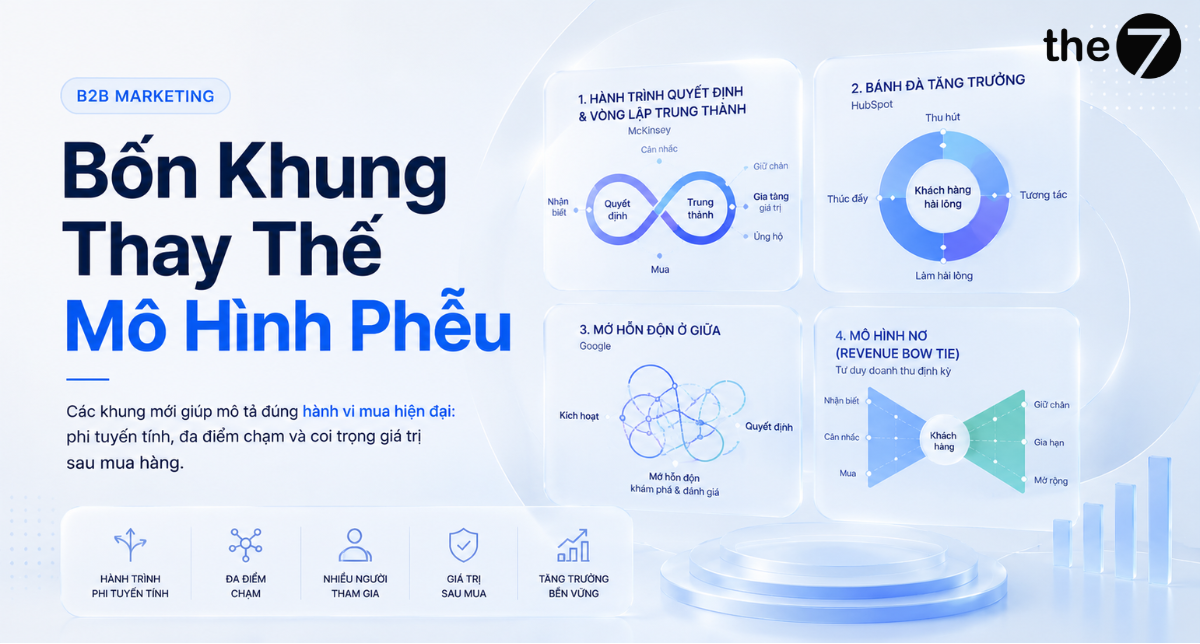
Four Frameworks That Replace the Funnel Model
Summary: As the funnel model increasingly fails to capture how modern buyers actually behave, a number of new frameworks have emerged to replace or repair it: McKinsey’s decision journey and...
What Is Category Design?
Summary: Category design is the act of creating an entirely new type of solution in the market’s mind, instead of competing within an existing category, and then becoming the name...
What Is B2B Positioning?
Summary: B2B positioning is the act of choosing the context you place your product into – the frame of reference that makes its value obvious to the buyer. Positioning isn’t...
What Is the 95/5 Rule?
Summary: The 95/5 rule states that at any given moment, only about 5% of B2B buyers are actually in-market, actively in a buying cycle, while roughly 95% are not yet...
What Is Mental Availability in B2B?
Summary: Mental availability is how easily a brand comes to mind in a buying situation. It isn’t about having the sharpest argument, the slickest pitch, or the most convincing feature...
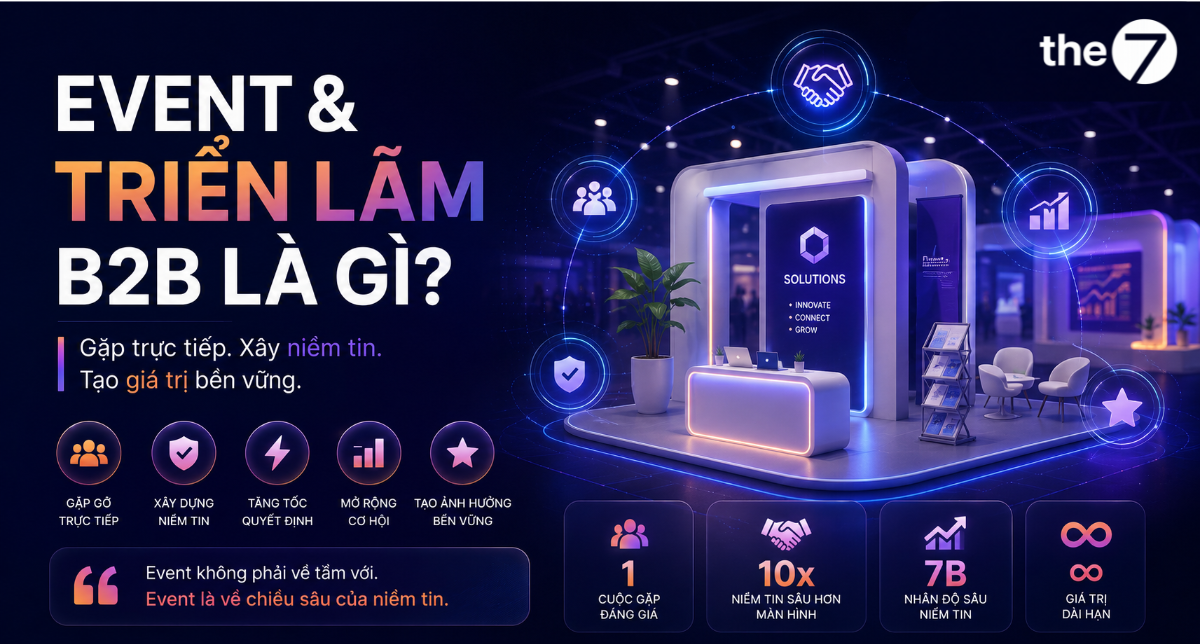
What Are B2B Events and Trade Shows?
Summary: B2B events and trade shows are in-person gatherings such as conferences, industry trade shows, workshops, and private meetings, where a business meets buyers, customers, partners, and the industry community...