


How to Convert Demand Into Orders in B2B Marketing
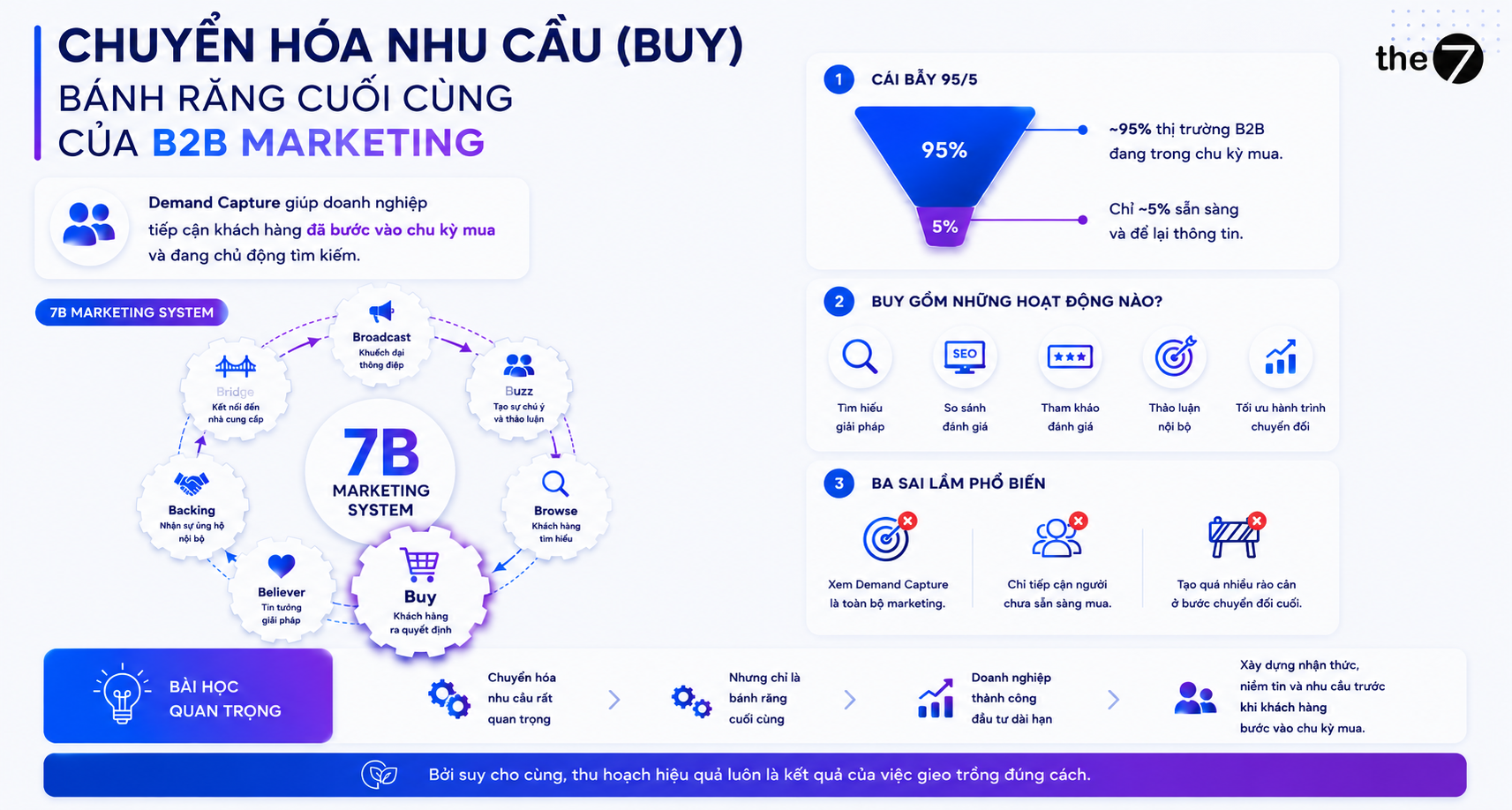
Demand Capture is the sum of marketing activities focused on customers who have already entered the buying cycle and are actively searching, comparing, or evaluating solutions, through channels such as search, comparison, and quote requests. It does not create new demand. It only harvests what has already been sown. In the 7B model, Demand Capture is the Buy gear, the last and smallest gear, accounting for only about 5% of the effort. Most businesses do the opposite: they pour 80% of their resources into this and wonder why the business never grows.
I wrote a post about How to Create Demand in B2B Marketing, and I closed it with one line: you cannot harvest by selling if you never planted a single seed in the customer’s mind beforehand. This article is about the other half of the story. About converting demand into revenue. And I need to say one thing plainly from the start, because it is the root of nearly every mistake I see in B2B marketing in Vietnam: most businesses think Demand Capture is the entirety of marketing. They pour money into Google Ads, optimize landing pages, run email marketing, and call that “doing marketing.” Then they’re surprised when they turn off the ads and everything grinds to a halt.
Demand Capture is necessary. But it is the easiest, smallest, and most misunderstood part of the whole system. To understand why, let’s start with the definition.
Demand Capture is the sum of marketing activities aimed at people who are already in the buying cycle, actively searching for and comparing solutions, to move them toward a decision. It includes search advertising, SEO for high purchase-intent queries, comparison pages, pricing pages, and demo-request paths. It differs from Demand Creation in that Demand Creation builds a position in the mind of the entire market, while Demand Capture only harvests the portion of the market that is already ready. One side plants. One side picks.
Why is Demand Capture the easiest part, yet the most overused?
Demand Capture is appealing because it delivers fast, immediately measurable results. You turn on Google Ads this morning, and by the afternoon someone has filled out a form. You watch the numbers move on your dashboard. You can calculate the cost per lead. Everything is neat, instant, and easy to report to your boss.
Demand Creation is the opposite. You publish content for six months without seeing a single deal you can attribute to it. You don’t know whether last week’s LinkedIn post led to next quarter’s contract. It is slow, murky, and hard to report.
Between something that pays off immediately and something you have to wait three years for, people choose the immediate payoff. That’s instinct. And it’s also the trap. Because the thing that pays off immediately also has a very low ceiling.
This is where I need you to stop and look at a number. According to research by Ehrenberg-Bass and the LinkedIn B2B Institute in 2021, at any given time only about 5% of the B2B market is actually in the buying cycle. The remaining 95% is not ready. Demand Capture, by definition, only reaches that 5%. That means when you pour 80% of your budget into Demand Capture, you’re throwing 80% of your resources into a pond containing 5% of the market, alongside every competitor also fighting over that same pond. Cost per click rises. Cost per lead rises. Margins get thinner. You work harder and harder for an ever-shrinking slice of the pie. Meanwhile, the 95% of the market, the truly large pond, gets nothing planted in it at all.
I call this the harvesting trap. A business caught in this trap still looks busy, still has nice numbers every month, still has leads coming in. But it isn’t growing. Because it’s only ever picking, never planting. And one day, when the 5% pond runs dry, or a competitor outbids you on every click, there’s nothing left to pick.
How is Demand Capture different from Demand Creation?
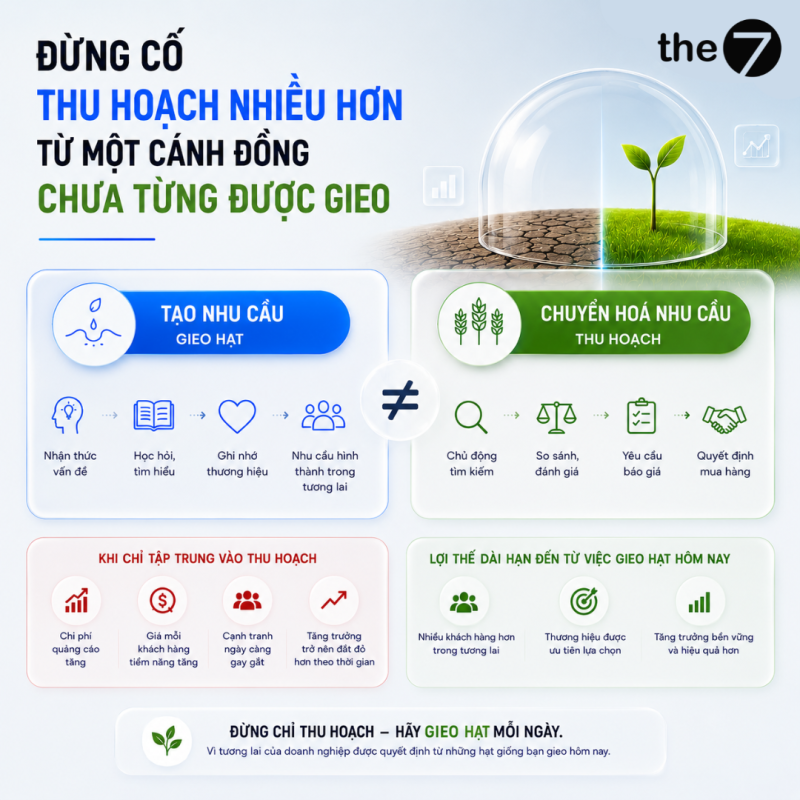
Let’s return to the farmer image. Demand Creation is farming: choosing seed, plowing soil, sowing, watering, waiting. Demand Capture is harvesting: going out to the field, picking the ripe fruit, bringing it home.
The core difference lies in the state of the buyer at the moment you reach them. When you run Demand Creation activities, the buyer has no need yet. They aren’t searching for anything. Your job is to appear in their field of view, build familiarity, so that when the need arises, your name is already in their head. You’re talking to the 95%.
When you do Demand Capture, the buyer already has a need. They’re typing into Google. They’re asking ChatGPT to compare vendors. They’re reading your pricing page. Your job isn’t to convince them they need a solution. They already know that. Your job is to make sure you’re there, and that you’re the easiest choice for them to step toward. You’re talking to the 5%.
This is why the two require completely different skills. Demand Creation needs storytellers, patience, and a tolerance for murky measurement. Demand Capture needs optimizers, precision, and fast reflexes to every signal. A marketing team that’s great at Demand Capture isn’t necessarily great at Demand Creation, and vice versa.
But the most important thing is the order. Demand Capture cannot come first. It doesn’t create demand, it only harvests what has already been sown. A buyer types a solution to their problem into Google because they had already recognized the problem existed. Someone asks ChatGPT to compare five vendors because they were already in the buying cycle. Demand Capture is the fight to win people who already want to buy. The problem is that desire was always created earlier. Sometimes by you. Sometimes by a competitor. If you weren’t the one who planted the seed, there’s a good chance you’re now paying to compete for ripe fruit in someone else’s garden.
Five ways to capture demand, and where they sit in the 7B model
Demand Capture consists of five main activities. I’ll walk through each one, and you’ll see that all of them fit neatly inside a single gear of the 7B model.
The first is search advertising. When a buyer is already in the buying cycle and types a high-intent query into Google, such as the name of the solution they’re looking for, or a competitor’s name plus a word like “alternative,” that’s the golden moment to show up. They’re raising their hand. They’re telling you they want to buy. Search ads for these queries are usually expensive, but conversion rates are high, because you don’t have to convince anyone they have a problem to solve. Important note: don’t pour ad spend into queries like “what is a CRM?”, “what is ERP?”, or “what is a CDP?”. These people are still researching the market, not ready to buy, and should be reached with free content instead of paid ads.
The second is showing up in search when the buyer is actively looking for answers. This is the unpaid version of search advertising. Instead of buying your position, you build content that precisely answers the questions buyers in the cycle are asking. They want to know the cost. They want to know how long implementation takes. They want to know how your solution differs from competitors. They want to know whether it integrates with their existing systems. Every such question is a door leading to a deal. When a buyer goes looking for answers, you need to be the first one there. Not with generic market-education articles, but with content that moves them closer to a purchase decision.
The third is being present where buyers do their comparing. Not every buying journey starts on Google. In many industries, buyers go to review platforms, vendor directories, or specialized sourcing marketplaces to build a shortlist of potential options. At this stage, the question is no longer “which solution fits?” but “which vendor should I choose?”. If your name isn’t on that list, you’ve essentially been eliminated before the first conversation even happens. And if you’re on the list but lack reviews, proof, or credible social proof, you’ll struggle to be taken seriously. Once a buyer enters the comparison stage, presence matters just as much as product quality.
The fourth is purchase-intent data. Every deal leaves a trail before it ever appears in the CRM. A company starts reading about a new topic. Multiple people within the same organization begin researching the same category of solution. Searches and vendor-evaluation activity suddenly spike. These are signals that a need is forming inside a business. High-level Demand Capture isn’t about sitting and waiting for buyers to raise their hand. It’s the ability to spot these signals before your competitors do, and show up exactly when the search for a solution has just begun.
The fifth is optimizing the conversion path. Once a buyer has actively come looking for you, the battle is half won already. The biggest mistake at this point is making them do more work. Filling in one more field. Reading one more overview page. Waiting for one more reply email. Every extra step is a chance for them to change their mind or turn to a competitor. Your job is to make buying easier than leaving. The demo page must be lean. The form must be short. People who want to self-serve need enough information to decide on their own. People who want to talk to sales need to find sales immediately. This is not the place to show off creativity. This is the place to remove friction.
Now look back at these five approaches. Search advertising. SEO for high-intent queries. Comparison platforms. Purchase-intent data. Conversion-path optimization. All five share one thing in common: they only work once the buyer already has a need. All five serve a single purpose, moving people who are already ready toward a decision. In the 7B model, all five fit inside exactly one gear. It’s Buy.
Why is Buy only one-seventh of the system?
This is the one point I want you to remember above everything else in this article. Demand Capture, which most businesses believe is the entirety of marketing, is actually just one of the seven gears in the 7B model. The other six gears, Broadcast, Buzz, Browse, Believer, Backing, Bridge, all serve the work of creating and nurturing demand. Only Buy is harvesting. (See also the article on the 7B gear model.)
And how much effort should Buy take up. About 5%. This number isn’t something I made up. It mirrors the 95/5 rule itself. If only 5% of the market is ready to buy at any given moment, the gear dedicated to harvesting that 5% has no reason to consume more than 5% of your resources. The rest must go to sowing, because sowing is what determines whether you’ll have anything left to harvest three years from now.
Most businesses reverse this ratio. They put 60, 70, even 80% of their effort into Buy. That’s a classic sign of short-term performance thinking. The dashboard is always flashing numbers. Every day brings new leads. There’s always something to report in the weekly meeting. But behind those numbers, a problem is quietly growing. The cost of acquiring a customer keeps rising. Competition keeps intensifying. And new sales opportunities never really stay abundant, because the business is fixated on harvesting without investing enough in sowing.
A healthy 7B machine spends most of its energy on the six demand-creating gears and only a small share on Buy. A sick machine does the opposite. It tries to solve every problem by harvesting more, while the field behind it grows more depleted by the day.
There’s an interesting paradox here. When the other six gears run well enough, the Buy gear almost turns itself.
Buyers come to you because they’ve already heard of you. They’ve read your content. They’ve seen others mention you. They accumulated trust long before entering the buying cycle. By the time the need arises, they don’t start by searching a long list of vendors. They start by searching for you.
They visit your pricing page not because your ads chased them across the internet. They visit because they actively typed your company’s name into Google or ChatGPT. When that happens, conversion becomes far easier. Lower cost. Higher conversion rate. Shorter sales cycle.
And that’s exactly the paradox: the businesses best at harvesting usually don’t spend most of their resources on harvesting. They spend most of their resources on sowing. It’s the investments in Demand Creation made months, even years earlier, that make today’s Buy gear turn so effortlessly.
Three ways to view Demand Capture through the 7B lens
I’ll take three businesses from three industries to show how Demand Capture operates when it’s placed correctly, as the seventh gear rather than the whole machine.
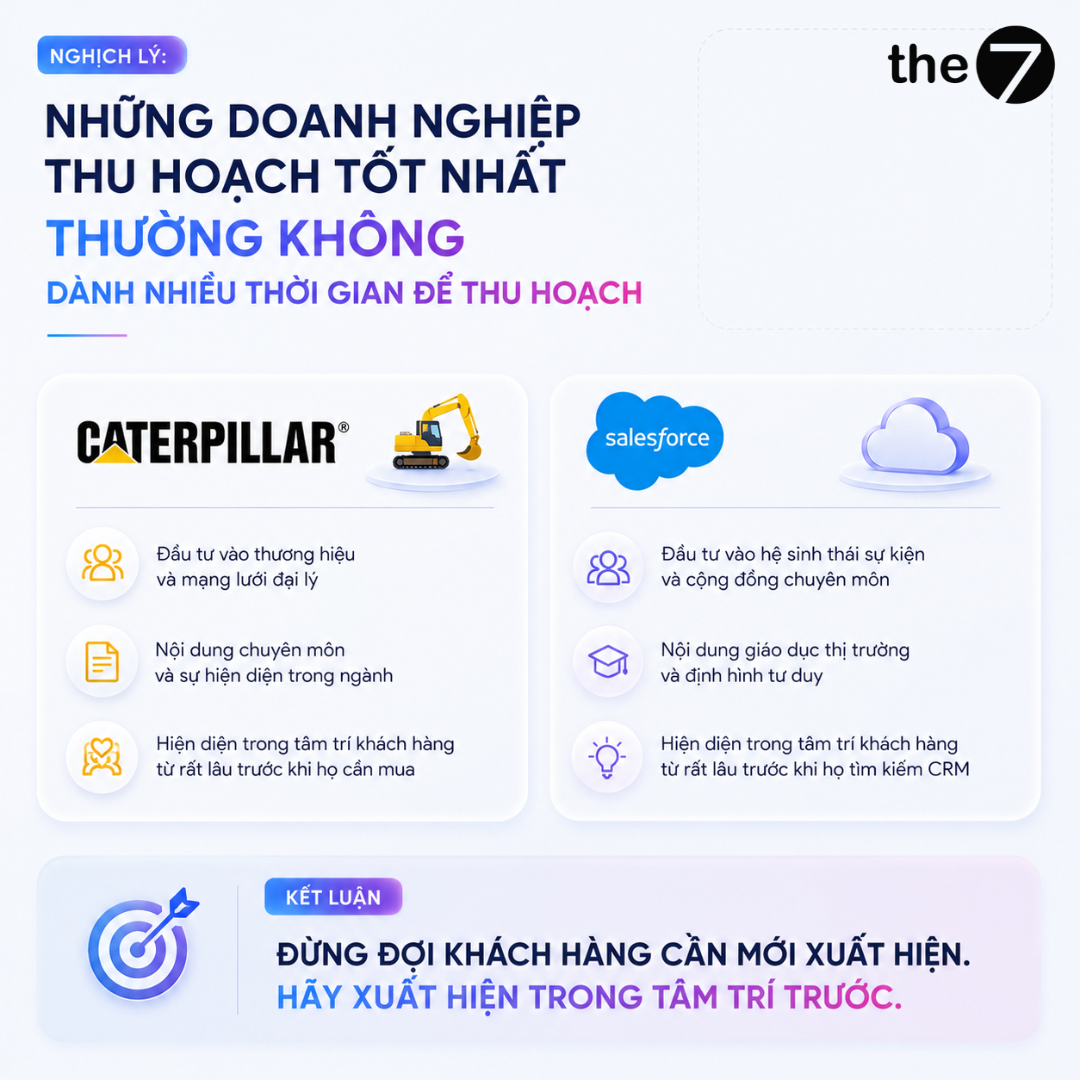
Caterpillar captures demand almost without needing search ads. When a construction company anywhere in the world enters the buying cycle for heavy machinery, they don’t Google “best excavator” and click the first ad. They already know Caterpillar, through hundreds of maintenance videos on YouTube, through a local dealer network, through decades of presence in the industry. Caterpillar’s Demand Capture work is mainly about making sure the dealer network can quote quickly and that the path from interest to contract has no friction. They don’t have to pay a premium for every click, because demand was already created by the other six gears. Their Buy is cheap because the rest of the machine already did the work.
Salesforce captures demand on a platform where they’re both the seller and the one who defines the rules of the game. When a company looks for CRM software and goes to review sites to compare, Salesforce is already there with thousands of genuine reviews. When that company’s employees already hold a Salesforce certification from the free learning platform, choosing Salesforce almost stops being a Demand Capture decision at all. It becomes the default choice. Salesforce’s Buy gear works well because the Believer and Backing gears already made them the safe choice long before the comparison even began.
Consider LinkedIn: a B2B marketing director decides to find a channel for generating enterprise leads. They don’t start with “what is advertising”. They search “LinkedIn Ads vs Google Ads”, “LinkedIn Ads cost”, “LinkedIn Ads agency in Vietnam”, or ask ChatGPT which channel fits their business. That’s when the Demand Capture battle begins. The buyer already has a need. They’re just looking for the right person or platform to solve it.
Three businesses, three different approaches to Demand Capture. But the same rule. None of them succeeded by pouring all their money into converting buyers. They convert effectively because they invested in creating demand beforehand.
Three mistakes that make Demand Capture expensive and useless
The first mistake is treating Demand Capture as the entirety of marketing. This is the root mistake, and I’ve said it throughout this article. When you let Buy consume most of your resources, you’re fighting over the 5% pond at ever-rising cost, while leaving the 95% pond empty. You’re busy but you don’t grow. The fix isn’t getting better at Demand Capture. The fix is shifting resources to the other six gears.
The second mistake is spending ad money on people who aren’t ready to buy. Plenty of businesses run search ads for queries like “what is a CRM?”, “what is ERP?”, or “how to manage customers effectively”. The problem is that people searching these phrases are usually still learning and exploring, not close to a purchase decision. You’re paying for every click from people who might be months, even years, away from buying.
Search advertising should focus on queries that show clear purchase intent, such as comparing vendors, researching cost, implementing a solution, or looking for a competitor alternative. That’s when the buyer has actively raised their hand. People who are just starting to explore should be reached with free content instead. That’s the job of Browse: helping readers learn, discover, and come back when they truly need to buy, instead of forcing the business to pay for every click from the very start.
The third mistake is tripping up the buyer right before the finish line. You did everything right. The other six gears brought the buyer to the point of decision. They want to see pricing. They want to request a demo. They want to talk to sales. But then they hit a form that’s far too long. A pricing page locked behind a signup wall. A website with no clear contact information. Or a complicated process that forces them through unnecessary steps. Every such barrier is a chance for the deal to vanish. When a buyer is ready to move forward, your job isn’t to make them do more work. Your job is to help them move forward as easily as possible. Effective Demand Capture isn’t about adding more touchpoints. It’s about removing whatever is standing in the way of the purchase decision.
Conclusion: Demand Capture is the last gear, not the first
Most B2B businesses treat Demand Capture as all of marketing. But in reality, it’s only the final gear in the 7B system. Demand Capture doesn’t create demand. It only helps people who are already ready to buy move to a decision faster and more easily. So Buy’s effectiveness always depends on everything that happened before it.
A business that focuses only on Buy is like a farmer who only thinks about harvesting and forgets to sow. Harvesting matters enormously, but it can’t happen if nothing was planted beforehand. That’s why Buy is only one gear in 7B, not the whole machine.
If you want to understand how to create demand before converting it, read How to Create Demand in B2B Marketing. If you want to understand why only about 5% of the market is ready to buy at any given time, read the article on the 95/5 rule. And if you want to understand how the seven gears work together, read the article on the 7B model.

Nguyễn Đình
Bảo




As CEO of The7, I am committed to sharing practical, useful knowledge with every reader. Every article on The7 is based on my 7 years of hands-on experience in marketing — Facebook advertising, LinkedIn advertising, Google advertising, and marketing strategy. I hope you take away plenty of insight from these posts and apply it successfully in practice.
Related Articles
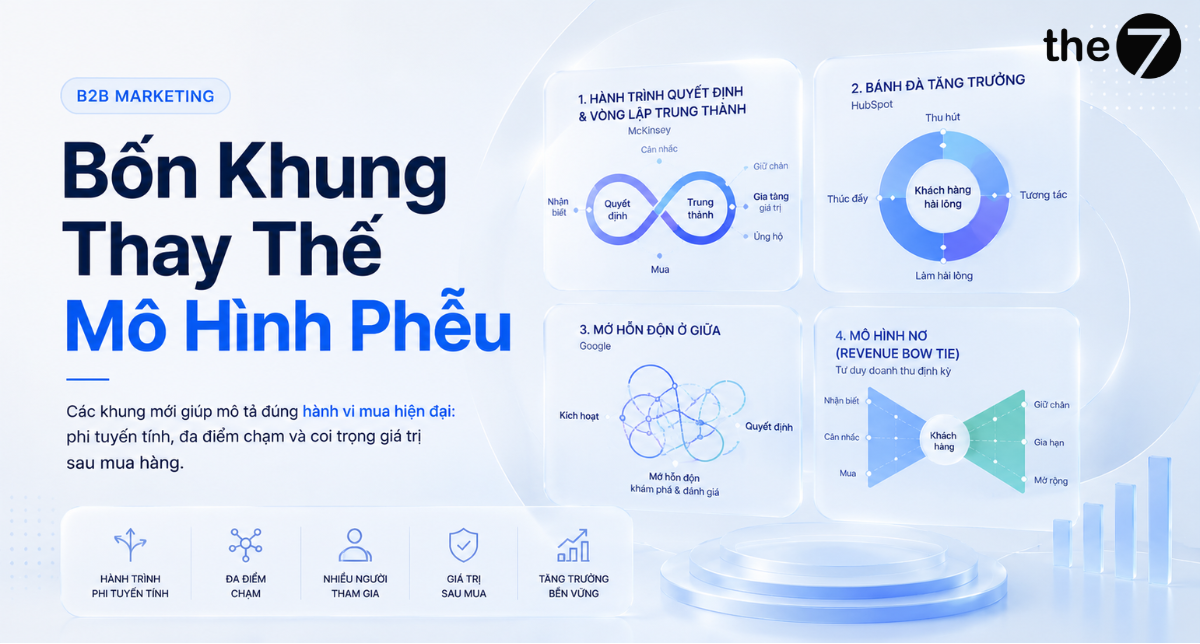
Four Frameworks That Replace the Funnel Model
Summary: As the funnel model increasingly fails to capture how modern buyers actually behave, a number of new frameworks have emerged to replace or repair it: McKinsey’s decision journey and...
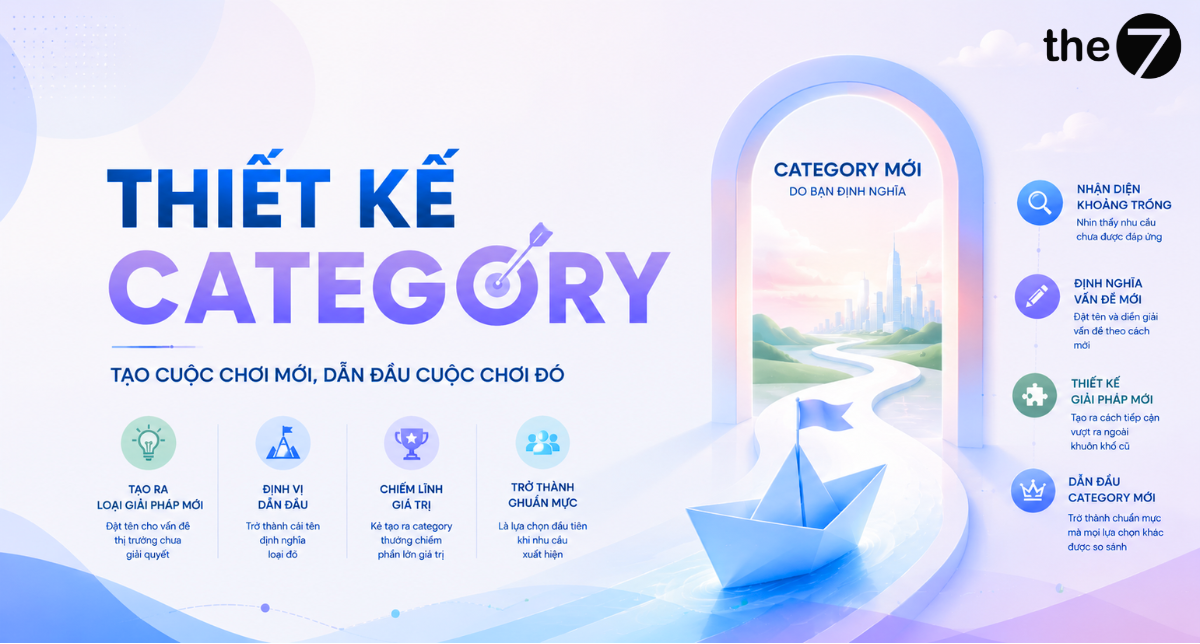
What Is Category Design?
Summary: Category design is the act of creating an entirely new type of solution in the market’s mind, instead of competing within an existing category, and then becoming the name...
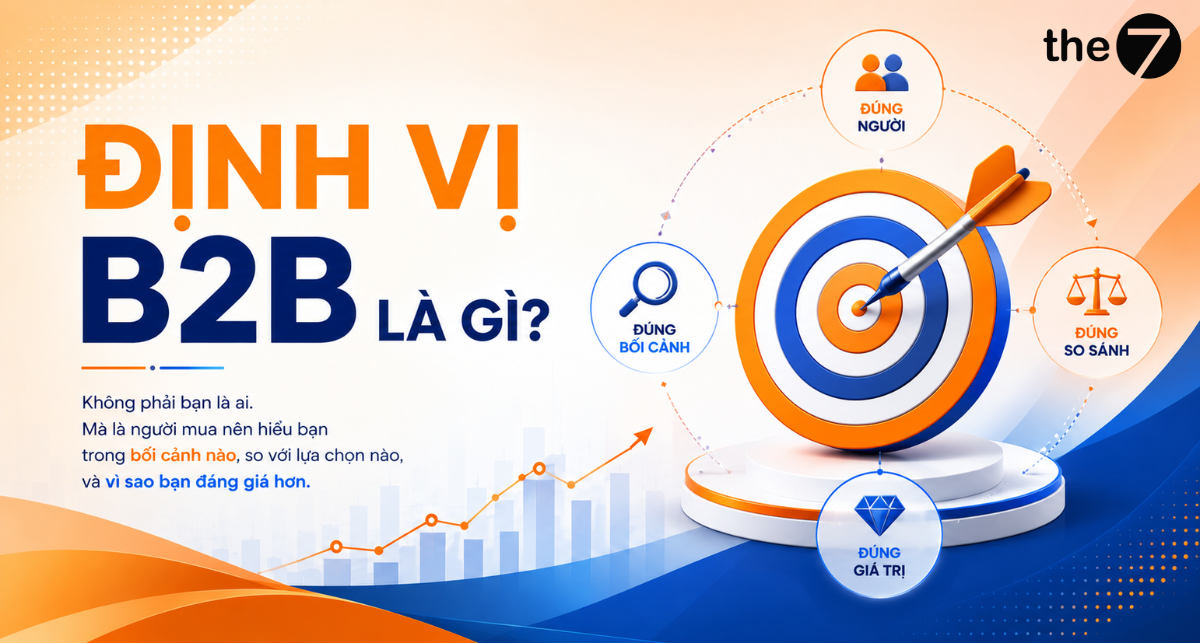
What Is B2B Positioning?
Summary: B2B positioning is the act of choosing the context you place your product into – the frame of reference that makes its value obvious to the buyer. Positioning isn’t...
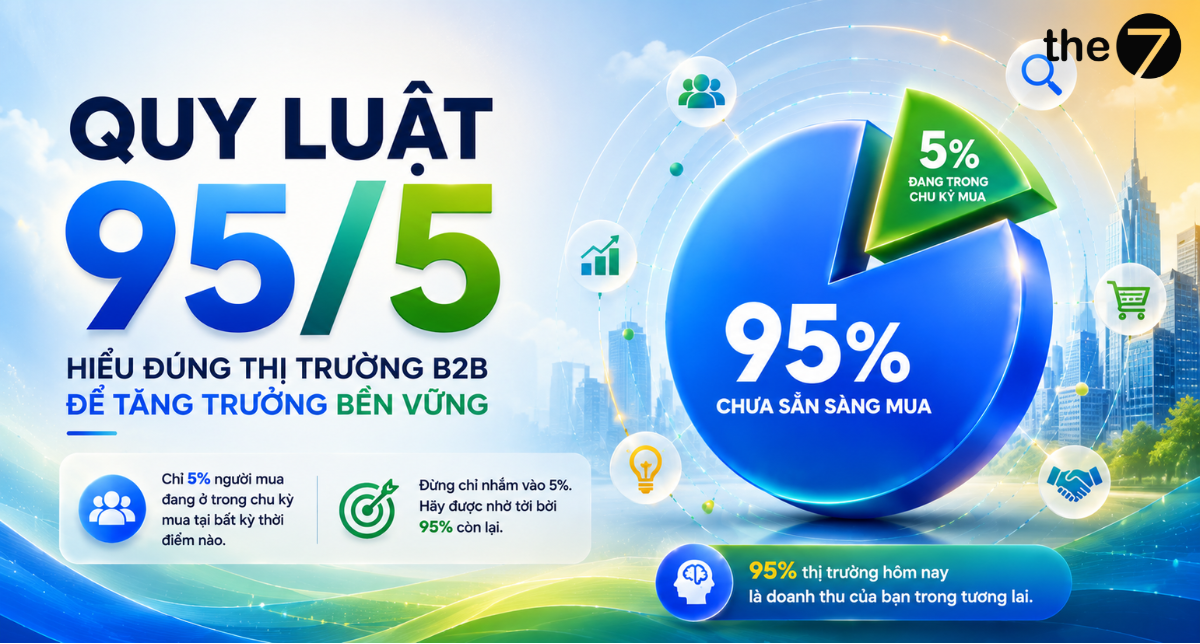
What Is the 95/5 Rule?
Summary: The 95/5 rule states that at any given moment, only about 5% of B2B buyers are actually in-market, actively in a buying cycle, while roughly 95% are not yet...
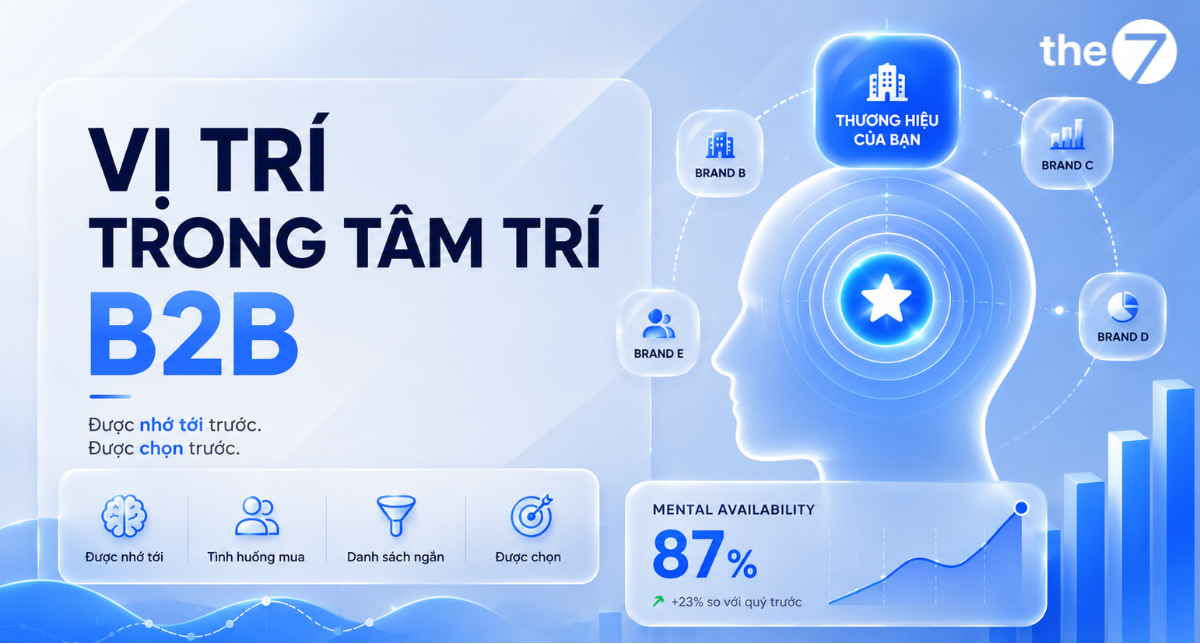
What Is Mental Availability in B2B?
Summary: Mental availability is how easily a brand comes to mind in a buying situation. It isn’t about having the sharpest argument, the slickest pitch, or the most convincing feature...
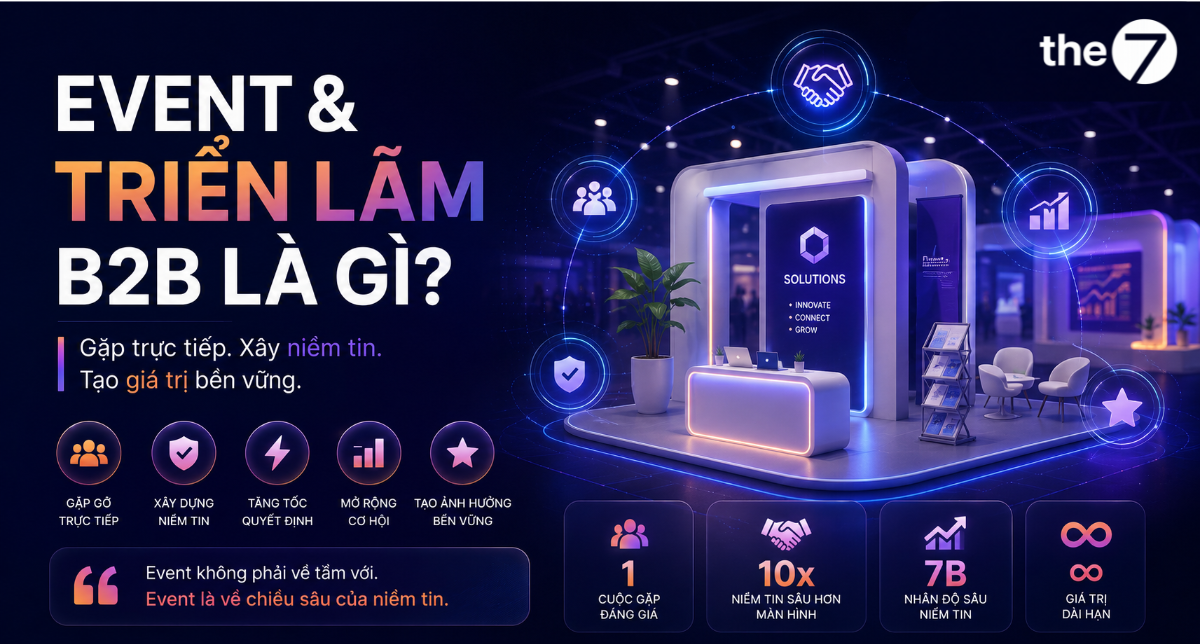
What Are B2B Events and Trade Shows?
Summary: B2B events and trade shows are in-person gatherings such as conferences, industry trade shows, workshops, and private meetings, where a business meets buyers, customers, partners, and the industry community...