


What Is B2B Content Marketing?
What Is B2B Content Marketing?
Summary: B2B content marketing is the practice of creating and distributing valuable content to attract, build trust with, nurture, and retain a clearly defined target market. But most B2B content today is close to worthless, for a deep reason: something anyone can do proves nothing. Content only carries real weight when it’s costly to produce — when it demands real expertise, real data, real experience, or real courage that a shallow competitor doesn’t have. In the 7B model, content marketing isn’t a single gear on its own. It’s the material that many gears use to run.
I’m going to say something the content marketing industry usually doesn’t like to hear: most of the B2B content being produced is worthless.
Not because it’s factually wrong, but because it proves nothing. Every day, millions of blog posts, LinkedIn posts, ebooks, checklists, whitepapers, videos, and newsletters are created to say things everyone already knows, in words anyone could write, from angles anyone could copy. They may be factually correct. They may be SEO-compliant. They may be beautifully designed, cleanly laid out, and posted on a regular weekly schedule. But in the end, they leave no trace in the reader’s mind. The reader skims through, gives a slight nod, then forgets.
The reason isn’t that the market doesn’t need content. On the contrary, B2B buyers are increasingly doing their own research, their own comparisons, and their own investigation before ever talking to sales. The problem is they don’t need more average content. They don’t need more articles that simply repeat what’s already available on the internet. They don’t need yet another version of the same “5 Benefits of CRM Software,” “Why Businesses Should Go Digital,” or “How to Choose a B2B Marketing Partner.”
What they need is something that helps them understand the problem more clearly. They need something that makes them feel the writer genuinely knows what they’re talking about. They need something that makes them think: this person has actually done the work, actually hit real obstacles, actually made real mistakes, actually paid a real price — so what they’re saying carries weight.
And now the problem has gotten far more serious. When AI tools can produce a mediocre blog post in thirty seconds, mediocre content becomes nearly free and infinite. Whatever is free and infinite loses its value. If your content strategy is just writing things a machine could also write, you’re losing by definition.
This article is here to point out what separates content that builds trust from content that just fills a page. But first, we need a clear definition.
What is B2B content marketing?
B2B content marketing is a strategy of creating and distributing valuable, relevant, and consistent content to attract, build trust with, nurture, and retain a clearly defined target market — ultimately driving profitable purchasing actions.
Unlike direct advertising, content marketing doesn’t start with an immediate call to buy. It doesn’t walk into the room and say, “Buy from me.” It walks in by helping the buyer understand their problem better, see their options more clearly, spot risks earlier, and make smarter decisions.
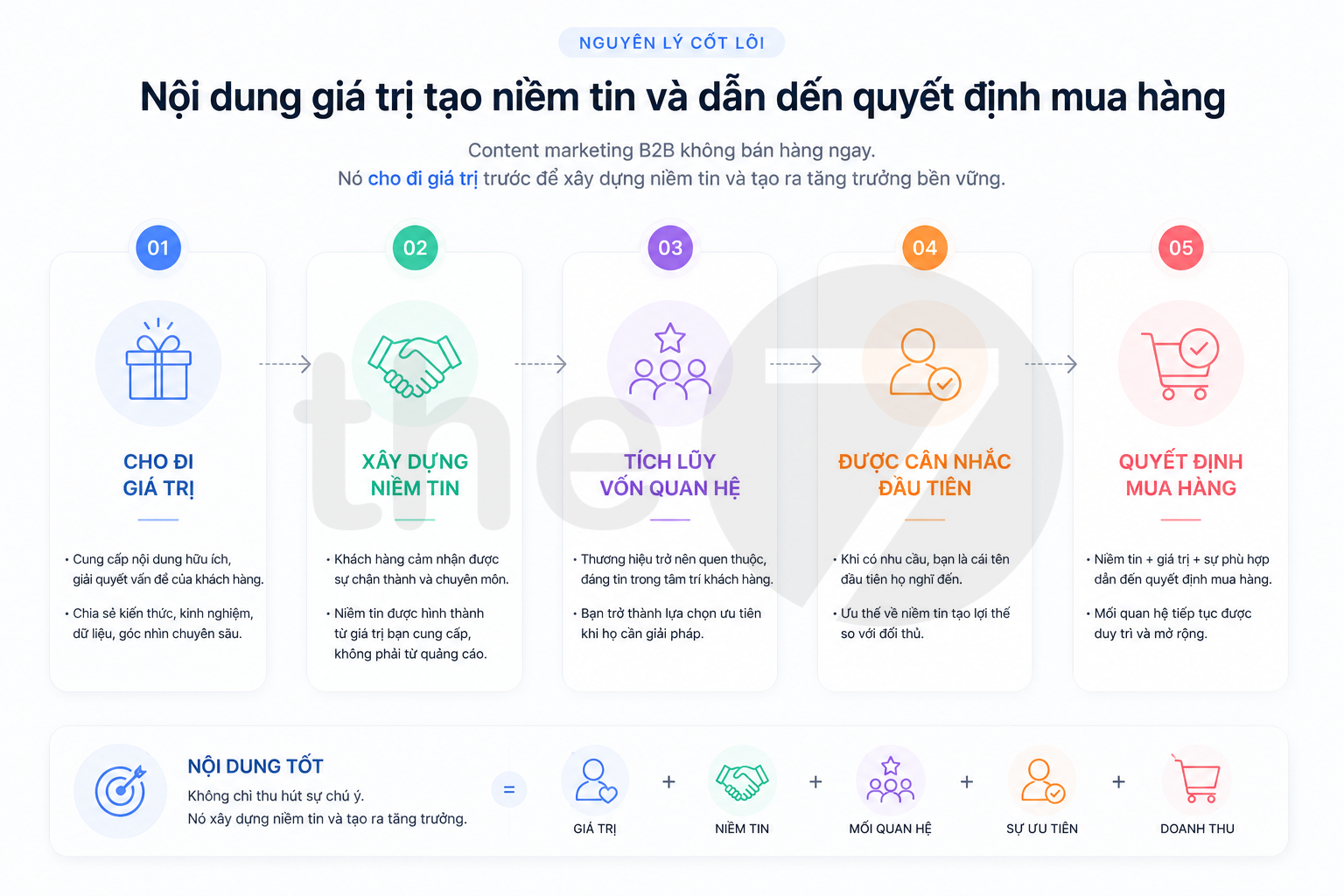
In other words, content marketing doesn’t sell right away. It builds authority first. It creates familiarity first. It gives value first. It gives the market a reason to trust you before they have a reason to buy you.
In B2B, this matters especially because buyers rarely make decisions alone. A single deal can involve the CEO, CFO, CTO, CMO, procurement, operations, legal, finance, and many influencers who never even show up in the CRM. They’re not just buying a product. They’re buying safety, certainty, execution capability, internal credibility, and sometimes even their own career security.
So B2B content marketing isn’t simply writing articles to generate traffic. It’s how a business demonstrates its capability to a market that isn’t ready to buy yet, but is quietly watching, learning, comparing, and remembering.
Good content doesn’t just answer a question. It builds trust. Good content doesn’t just attract views. It accumulates authority. Good content doesn’t just fill a website. It fills the market’s memory with trustworthy signals.
And to understand why most B2B content fails at this, we need to go into a concept far more important than writing technique.
Why is most B2B content worthless?
To understand why mediocre content fails, we need a concept from economics. It’s one of the sharpest ideas for explaining the problem of trust in a market.
In 1973, economist Michael Spence published his paper “Job Market Signaling,” laying the foundation for signaling theory. That work later helped him win the Nobel Prize in Economics in 2001. The question Spence asked was simple but extremely deep: in a market where buyers can’t see a seller’s true quality, how can a genuinely good seller prove they’re good?
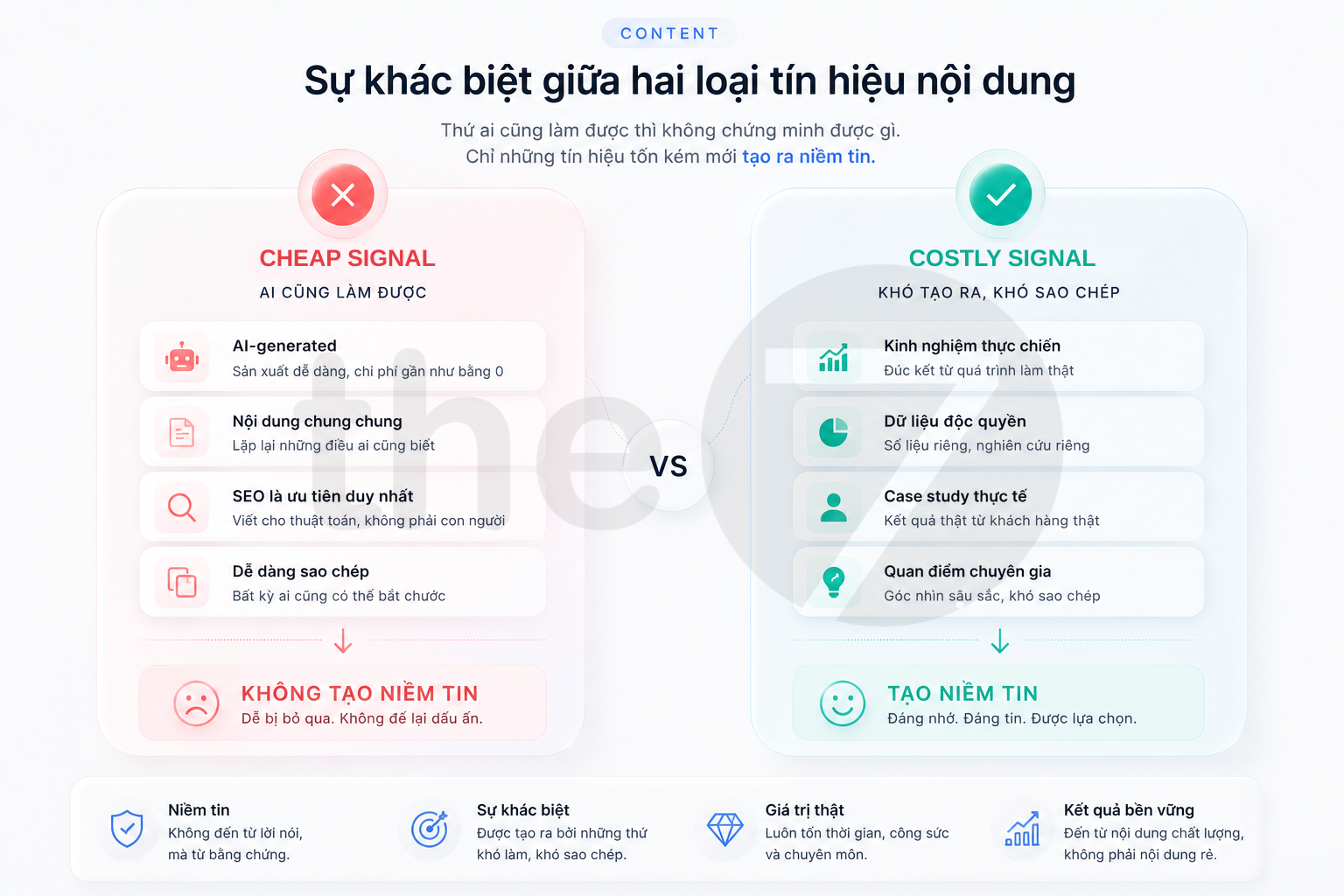
Spence’s answer was: through a signal that only someone genuinely good is capable of producing. A signal is only credible when it’s costly to produce. It has to be costly enough that someone without real quality can’t easily copy it. If anyone can produce that signal, it no longer proves anything, because it can’t tell the good from the bad.
In the labor market, for example, a degree can act as a signal. Not because the diploma itself automatically makes someone better, but because going through a demanding academic program requires time, discipline, ability, and persistence. For a capable person, the cost of getting through that program is bearable. For someone without that capability, the cost is too high. It’s precisely that difficulty that makes the signal credible.
Applied to content marketing, this theory explains nearly the entire problem. A shallow blog post that just restates things everyone already knows is a cheap signal. Anyone can produce it. An intern can produce it. A freelancer who doesn’t understand the industry can produce it. An AI tool can produce it. Because anyone can produce it, it doesn’t prove the business has real capability. It only proves the business has someone who publishes posts. That’s an empty signal.
By contrast, an in-depth analysis grounded in hands-on experience, containing insights only someone who has genuinely worked in the field could have, is an expensive signal. A shallow competitor can’t produce it, because they lack the underlying expertise. Outsiders can’t easily copy it, because they don’t have the lived data. An AI tool can write the sentences, but it can’t fabricate a real experience that’s been tested by real failure. It’s precisely that difficulty that makes the content trustworthy. This is why something anyone can do proves nothing.
When you write something anyone in the industry could write, you’re not sending a signal of capability. You’re just sending noise. Readers may not be able to name it using signaling theory, but they sense it very quickly: this piece doesn’t give me anything new, doesn’t help me understand more deeply, doesn’t prove the writer knows something I don’t already know.
And they move on. In the AI era, this line has become even more unforgiving. In the past, an average blog post still carried a little value because at least it took time to write. But now, average content can be produced almost instantly. When a machine can do it, that’s no longer evidence of expertise. It’s only evidence that you know how to use a tool.
Value has therefore shifted decisively toward what AI doesn’t have on hand: hands-on experience, proprietary data, observations from the field, opinions with a real stance, sharp judgment, and lessons that can only be drawn after actually doing the work, actually getting it wrong, actually fixing it, and actually being held accountable for the outcome.
The content that builds trust in the years ahead will be expensive content. Expensive doesn’t necessarily mean costly to produce in dollar terms. Expensive means it requires something a shallow competitor doesn’t have.
That could be ten years of experience in an industry. That could be proprietary data from hundreds of projects. That could be a contrarian viewpoint defended with sharp reasoning. That could be a real case study, with context, mistakes, results, and lessons learned. That could be the ability to answer a sensitive question that most competitors avoid.
Content like that is harder to create. But precisely because it’s harder to create, it’s valuable. In B2B marketing, trust isn’t built by saying “trust me.” Trust is built by consistently sending signals that someone without real capability can’t easily copy.
Content as a gift: the principle of reciprocity
If signaling theory explains why content has to be deep, another psychological principle explains why giving value first works so well.
Psychologist Robert Cialdini, in his research on influence, identifies reciprocity as one of the most powerful principles governing human behavior. When someone gives us something of value, we tend to want to give something back. This isn’t just politeness. It’s a social mechanism deeply embedded in how humans cooperate, exchange, and build relationships.
People often feel uncomfortable receiving without giving back. A genuine gift creates a light psychological debt. Genuine help creates goodwill. Value given first creates a feeling that the giver deserves attention, deserves to be remembered, and deserves consideration when the right moment comes.
Good content marketing runs exactly on this principle. When you give away a genuinely useful analysis that helps readers understand a problem they’ve been confused about, without immediately demanding they buy, book a call, fill out a form, or talk to sales, you’re building relationship capital. Readers receive real value before paying anything. They feel you’ve helped them. And when a business keeps helping the market understand things better, the market gradually develops a sense of familiarity and trust toward that business.
This is a very different mechanism from direct advertising. Advertising usually asks for immediate action: buy now, sign up now, book now, download now, get a consultation now. Good content marketing isn’t in such a hurry. It says: here’s what you need to understand, here’s a problem you should see clearly, here’s a mistake you can avoid, here’s how we think about this industry. It gives first. And precisely because it gives first, it builds a kind of goodwill that advertising struggles to create.
This is also why content gated too early usually backfires. Many businesses become obsessed with collecting contact information. They turn nearly everything into a form. Want to read the report? Fill out a form. Want to view the document? Fill out a form. Want to know the price? Fill out a form. Want to download the checklist? Fill out a form. The problem is they make readers pay before readers get to receive any value.
This breaks the principle of reciprocity. A gift only creates goodwill when it genuinely feels like a gift. If you say “I have a gift for you, but first leave your email, phone number, company name, job title, company size, expected budget, and implementation timeline,” that no longer feels like a gift to the recipient. It’s a transaction. And for many B2B buyers, it’s a transaction that comes far too early.
They don’t trust you yet. They don’t know if you have anything worthwhile. They’re not sure the content behind the form is worth it. So they leave.
This doesn’t mean every piece of content should be completely open. Some content assets are appropriate to gate, especially when readers are closer to a purchase decision: detailed quotes, in-depth calculators, internal benchmarks, personalized consultations, or materials for people with clear buying intent. But if you gate too early, you lose the chance to build goodwill first.
The better approach is to give away most of your value generously. Let the market feel that you genuinely have expertise. Let them learn something from you first. Let them see that you’re not just hunting for contact information. Then, once they trust you more, calls to action will come far more naturally.
Giving first isn’t naive generosity. It’s an investment in relationship capital. You plant goodwill today to harvest preference when the buying decision arrives later.
In B2B, that decision sometimes comes three months later. Sometimes six months later. Sometimes a year later. But when it comes, buyers rarely start from zero. They start from a list of names already sitting in their heads. Good content marketing is how you get onto that list before sales ever gets a chance to start the conversation.
Answer real questions, even the hard ones
Signaling theory says content has to be deep. The principle of reciprocity says content has to be generous. But there’s still one very important practical question: what should you actually write about?
This is where most businesses go astray. They write about what they want to say, not what the buyer wants to know.
Businesses want to talk about new products, new features, new awards, new events, company culture, vision, mission, the team, and things they’re proud of. None of that is wrong. But B2B buyers usually carry other questions in their heads — more practical, more pointed, and sometimes more uncomfortable ones.
How much does this cost? What’s the true total cost of implementation? What are its drawbacks? When should this solution not be used? How is it different from competitors? Which competitor fits better in which situation? How have others implemented it? Why do so many projects like this fail? What’s the biggest risk in buying this? How should I prepare internally before implementing it?
Most businesses avoid exactly these questions. They don’t want to talk about price because they’re afraid of losing negotiating leverage. They don’t want to talk about drawbacks because they’re afraid of losing customers. They don’t want to compare with competitors because they’re afraid of giving competitors free publicity. They don’t want to talk about situations where they’re not a fit because they’re afraid of scaring buyers off. They don’t want to talk about risk because they’re afraid the market will grow suspicious. So they write safe articles, articles that don’t touch anything sensitive. Articles that are correct but bland. Articles that look professional but dodge every real question.
And buyers, unable to find the answers they need, go elsewhere. This is a failure of courage, not just a failure of content technique. Buyers will find answers to those questions one way or another, whether you answer them or not. They’ll ask colleagues. They’ll search Google. They’ll read reviews. They’ll ask in private communities. They’ll ask ChatGPT. They’ll ask your competitors. They’ll find whoever is willing to say clearly what you avoid saying.
If you answer, you become the source they learned it from. And whoever teaches the buyer usually gains a huge trust advantage. If you dodge, they learn from someone else. And then trust belongs to that someone else.
This is why Marcus Sheridan’s “They Ask, You Answer” principle is so powerful in B2B. It doesn’t start from what the business wants to say. It starts from what buyers are actually asking. And crucially, it forces businesses to answer the hard questions too.
There are five categories of questions B2B businesses should pay special attention to.
First, questions about price. Buyers always want to know the price, or at least how the price is determined. You may not always be able to give a fixed number, especially for complex services. But you can absolutely explain the factors that affect price, common budget ranges, a reasonable minimum, and common misconceptions about cost.
Second, questions about drawbacks. No solution is perfect. When you clearly state your own drawbacks, you don’t weaken yourself. You become more credible, because buyers feel you’re not trying to hide risk.
Third, comparison questions. Buyers always compare. If you don’t help them compare, someone else will do it for you. A fair comparison article, with conditions, with context, with cases where it fits and where it doesn’t, is a very strong signal of confidence.
Fourth, questions about alternatives. Your solution isn’t always the best choice. Being willing to clearly say when a customer should choose a different solution is an expensive signal. Weak players don’t dare do this, because they’re afraid of losing every opportunity. Strong players dare to do it, because they understand that long-term trust matters more than one wrongly matched appointment.
Fifth, questions about failure. Why do implementations fail? Why do so many projects fail to deliver results? What does the customer need to prepare to avoid risk? This kind of content is extremely valuable because it touches buyers’ real fears. B2B buyers don’t just want success. They also want to avoid being wrong, avoid losing face, and avoid being blamed for a bad decision.
Answering hard questions directly is an expensive signal in exactly Spence’s sense. It requires confidence, honesty, and understanding that a shallow competitor doesn’t have. Weak players only dare talk about strengths. Strong players dare to talk about limitations, risks, conditions for success, and situations where they’re not a fit. It’s precisely that willingness that makes you credible.
Where does content marketing sit in the 7B model?
This is where content marketing differs from many other B2B concepts.
Most topics can be placed fairly clearly into one or a few gears of the 7B model. For example, search advertising sits close to Buy. LinkedIn marketing can touch Broadcast, Buzz, Browse, Backing, Believer, and Bridge. ABM is a way of converging many gears onto a narrow list of target accounts.
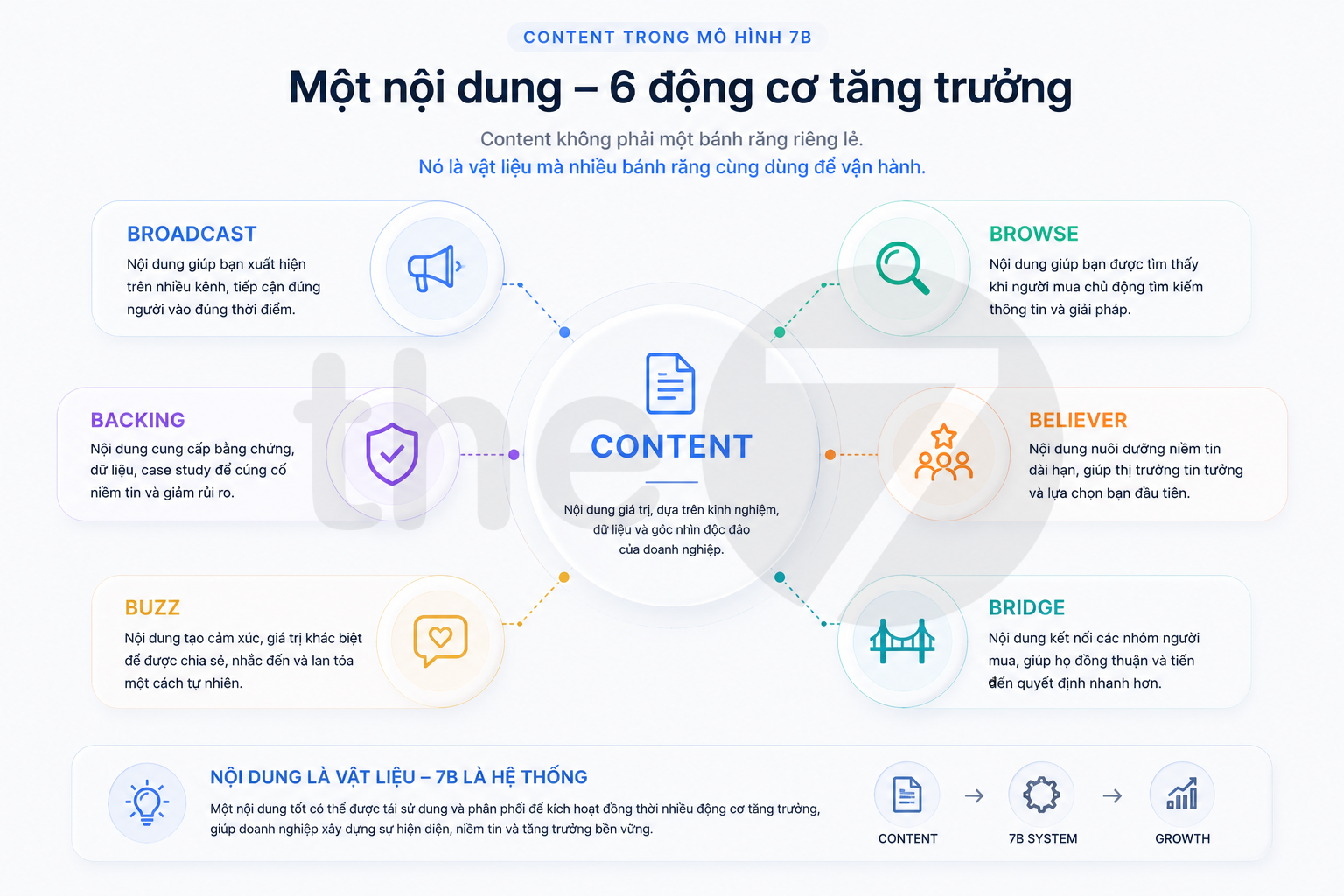
But content marketing isn’t a single gear of its own. It’s the material that many gears use to run.
Let’s look at how content flows through the 7B machine.
- Broadcast needs material to send out. That material is content: articles, videos, podcasts, reports, opinions, analysis, images, newsletters. Without content, Broadcast is just a loudspeaker with nothing to broadcast.
- Browse needs content so buyers can find you when they’re researching on their own. When a buyer searches “ERP implementation cost,” “LinkedIn Ads vs. Google Ads for B2B,” “how to choose an HVAC supplier,” or “risks of implementing a CRM,” what they find isn’t an abstract strategy. They find the specific content you’ve created.
- Backing uses content as evidence. A case study is content. A data report is content. In-depth analysis is content. Documentation explaining your methodology is content. These help buyers and the buying committee see that you don’t just talk a good game — you have grounding, evidence, and capability.
- Believer uses content to nurture existing customers. A customer who has already bought still needs to be educated, kept updated, guided, and reassured that they chose correctly. Content helps them use the product more deeply, understand the methodology better, and have more reasons to stay engaged.
- Buzz also needs content as something for others to share, debate, quote, and discuss. Without a sharp opinion, an interesting piece of data, or a memorable analysis, the market has nothing to say about you beyond your company name and product.
- Even Bridge can use content as a bridge. Partners, experts, communities, journalists, analysts, or industry influencers are far more likely to share a useful piece of analysis than to share a plain sales page.
Do you see it yet?
Content marketing doesn’t sit in one gear. It flows through many gears. It’s the raw material that the 7B machine turns into familiarity, findability, evidence, engagement, buzz, and connection.
This way of seeing it has a very important strategic implication. Because content is shared material, one good piece of content can serve multiple gears at once. An in-depth analysis piece can be used as Broadcast material to build familiarity. It can be optimized to show up in Browse. It can be used by sales as evidence in Backing. It can be sent to existing customers in Believer. It can be shared by others to create Buzz. It can become the reason to open a conversation in Bridge.
A piece of expensive content, if designed correctly, doesn’t just live once. It can be distributed repeatedly, sliced into many formats, used in many contexts, serve many buyer segments, and flow through many gears for months, even years.
Cheap content, by contrast, can’t run through any gear. It’s not good enough to broadcast forcefully in Broadcast. Not deep enough to be found and hold readers in Browse. Not solid enough to serve as evidence in Backing. Not useful enough to nurture Believer. Not distinctive enough to create Buzz. Not valuable enough to open a Bridge.
It just fills a page and sinks. That’s why one piece of high-quality material is worth more than hundreds of pieces of poor material. The question isn’t how many articles you publish per month. The question is how much of your content is genuinely capable of moving through multiple gears and creating a cumulative impact.
What does expensive content look like across different industries?
To avoid staying too theoretical, let’s look at a few examples across different industries. In enterprise software, a company can build an entire library of in-depth technical documentation — the kind of content only a genuinely skilled engineering team can write. This documentation doesn’t just talk generically about product benefits. It goes into system architecture, APIs, security, integrations, performance, common bugs, technical decisions, and how to handle complex scenarios.
This is an expensive signal in exactly Spence’s sense. Competitors without technical depth can’t easily copy it, because they don’t understand it well enough to write it. A marketing team that only knows how to write at a surface level can’t produce it either. An AI tool can help with phrasing, but it can’t replace the real technical knowledge underneath.
That same library both helps the business get found when engineers search, proves capability to a CTO, supports sales in complex deals, and helps existing customers use the product better. One piece of material, many gears.
In the financial sector, a company can publish market analysis reports based on proprietary data that they have and others don’t. Proprietary data is a very strong type of expensive signal, because competitors can’t copy it by reading a few articles on the internet. They simply don’t own that data source.
A report like this can build authority with the market, get quoted by analysts or media, and become a reason for buyers to believe this company sees things others don’t. It’s not just content. It’s evidence of the business’s vantage point within the industry.
In manufacturing, an equipment supplier can create detailed technical guides based on decades of real operational experience. They can write about common factory-floor errors, how to reduce waste, how to choose equipment configurations, how to maintain equipment, how to handle difficult environmental conditions, and how to avoid the implementation mistakes newcomers commonly make.
A new competitor doesn’t have those decades of experience, so they can’t produce equivalent content. Experience accumulated over time is a type of expensive signal that ad spend can’t quickly buy. This content simultaneously attracts engineers looking to solve a problem, proves the supplier understands the trade deeply, and directly answers the real questions operators face every day.
In professional services — consulting, marketing, legal, HR, corporate finance — expensive content usually comes from a way of thinking and experience handling real situations. A good article doesn’t just say “you should have a strategy.” It shows why strategies commonly fail, where clients tend to misunderstand, which decisions lead to which consequences, what signs indicate a project is going off track, and what questions a leader should ask before signing a contract.
This type of content is hard to copy because it requires not just knowledge, but judgment. Judgment comes from experience. Experience comes from having gone through enough real situations.
Three industries, four kinds of examples, one shared principle: content that builds trust is content a competitor can’t easily produce, because it requires expertise, data, experience, or judgment they don’t have.
Don’t measure content by views alone
One big mistake in B2B content marketing is evaluating content using metrics that are far too shallow.
- Views.
- Likes.
- Shares.
- Time on page.
- Number of form fills.
These metrics aren’t useless. But if you only look at them, it’s very easy to optimize for the wrong thing. You’ll tend to write content that’s easier to get noticed rather than content that builds trust. You’ll pick broader topics instead of deeper ones. You’ll chase traffic instead of chasing signals of credibility. You’ll be pleased with a post that gets lots of views from people who will never buy, while overlooking a post with fewer views that was read carefully by exactly ten CEOs in the industry.
In B2B, not every view carries the same value. A thousand reads from students, outsiders, or curious passersby may not be worth as much as ten reads from exactly the right buying committee at your target account. An article that doesn’t generate a form fill right away can still be extremely valuable if it’s sent by sales in a major deal, quoted by a customer in an internal meeting, or causes a decision-maker to quietly follow you for six months.
Good B2B content should also be measured by deeper signals:
- Did it reach the right readers?
- Was it used by sales in real conversations?
- Did it help shorten the explanation process?
- Did it answer a hard question customers commonly ask?
- Was it shared in a private group, an internal email, or a customer’s meeting?
- Did it make a buyer say “I’ve already read your article on this” when walking into a meeting?
- Did it help the business become a name people remember before the need to buy even shows up?
These are signals that are harder to measure than views, but much closer to real value. B2B content marketing isn’t just a game of grabbing attention. It’s a game of building trust in a market with slow decisions, many people, high risk, and many layers of influence.
So don’t just ask one question: how many views did this get? Also ask: what does this piece prove about us?
If the answer is “it proves nothing,” that piece is weak, no matter how many views it got. If the answer is “it proves we understand this problem more deeply than our competitors,” that piece has value, even if its initial readership is small.
Three mistakes in B2B content marketing
The first mistake is producing large volumes of cheap content.
Many businesses believe more articles is always better. They set KPIs for posting every week, every day, even multiple posts a day. To hit that volume, they lower their quality standards. Topics get chosen faster. Writers research less. Opinions get thinner. Articles get safer. The result is a content library that looks large but contains nothing the market actually remembers.
Under signaling theory, this is self-defeating. Cheap content is an empty signal. Mass-producing empty signals doesn’t add up to one strong signal. A hundred shallow articles don’t build as much trust as one genuinely sharp analysis. In the AI era, this mistake is even more dangerous, because machines have made cheap content infinite. When the market is flooded with average content, average content no longer has an advantage.
The fix is to reverse course: fewer, deeper, more expensive.
Instead of asking “how many articles did we publish this month,” ask “what content asset did we create this month that competitors can’t easily copy.” Instead of chasing a dense publishing schedule, build content deep enough to be reused across sales, ads, newsletters, LinkedIn, customer training, and conversations with the market. One piece of high-quality material is worth more than a hundred pieces of poor material.
The second mistake is gating value too early.
Obsessed with collecting contact information, many businesses make readers pay before receiving anything. They turn every asset into lead bait, then assume more form fills is always better. But in practice, a lot of forms only generate low-quality leads, while simultaneously losing the chance to build goodwill with most of a market that isn’t ready to talk to sales yet.
This breaks the principle of reciprocity. A gift only creates goodwill when it’s genuinely given away. When you demand that readers pay before they even know you have something worthwhile, you’re not building relationship capital. You’re creating friction.
The better approach is to give away most of your value generously. Major analyses, core viewpoints, and genuinely useful answers should be left open for the market to access easily. Gating should be reserved for assets that fit people who are closer to taking action: diagnostic tools, personalized consultations, in-depth benchmarks, implementation templates, or content that supports a specific buying decision.
In other words, don’t gate before you’ve built trust. Build trust first, and your calls to action will be less abrasive and more effective.
The third mistake is avoiding hard questions.
Businesses write safe articles that dodge price, dodge drawbacks, dodge comparisons, dodge competitors, dodge risk, dodge conditions for failure. They think this protects the brand. In reality, they’re leaving empty exactly the content territory buyers care about most.
B2B buyers aren’t stupid. They know no solution is perfect. They know price always has conditions. They know every vendor has strengths and weaknesses. When you only talk about strengths, they don’t trust you more. They simply feel you’re selling.
Avoiding a question doesn’t make it go away. It just hands the opportunity to build trust to whoever dares to answer — usually a competitor, a community, an independent consultant, or some other source outside your control.
The fix is to answer hard questions directly, with fairness and context. State clearly when to use it and when not to. State clearly what the price depends on. State clearly what the drawbacks are. State clearly which competitor is strong in which area. State clearly why a project might fail. This doesn’t weaken you. It makes you look like someone who understands the trade and is confident enough to tell the truth.
Answering hard questions is an expensive signal that weak players don’t dare send. It’s precisely that willingness that makes you credible.
Conclusion: something anyone can do proves nothing
Back to where I started. Most B2B content is worthless not because it’s wrong, but because it proves nothing.
- It’s a cheap signal.
- It says things everyone already knows.
- It uses sentences anyone could write.
- It avoids the real questions.
It doesn’t contain enough deep expertise, distinctive enough data, real enough experience, or sharp enough perspective to distinguish the writer from anyone else. And in an era where AI makes cheap content infinite, cheap signals race very quickly toward zero value.
Content that builds trust follows the opposite logic. It’s expensive, in the sense that it requires real expertise, real data, real experience, real judgment, or real courage that a shallow competitor doesn’t have. It’s given away generously, so the principle of reciprocity can build relationship capital. It directly answers the questions buyers are genuinely carrying in their heads, including the hard ones about price, drawbacks, competitors, risk, and conditions for failure.
In the 7B model, that kind of content isn’t a single gear on its own. It’s the precious material that flows through many gears at once. It gives Broadcast something worth broadcasting. It gives Browse something for buyers to find. It gives Backing evidence. It gives Believer a reason to stay engaged. It gives Buzz something to discuss. It gives Bridge a bridge to open relationships.
One piece of expensive content can make the whole machine run better. Cheap content, on the other hand, can’t run through any gear. It just fills a page, dresses up a publishing calendar, creates the impression that a business is active, then sinks into the endless ocean of content out there.
Something anyone can do proves nothing. And B2B content marketing, if it wants to build real trust, has to start from that principle.
To understand how to distribute this content to the right people, read the article on LinkedIn marketing for B2B. To understand why deep content influences buying decisions, read the article on thought leadership. To understand how to build topical authority through a structured content system, read the article on topical authority. And to understand the entire seven-gear machine that content serves as material for, read the article on the 7B gear model.
If you want to go deeper into the entire system with 13 video modules, a diagnostic tool, and a case study library from 12 industries, you can check out the 7B Mastery course at bao7.marketing/khoa-hoc-7b. And to keep up with new content, subscribe to the newsletter to get new articles every week.
FAQ
What is B2B content marketing?
B2B content marketing is a strategy of creating and distributing valuable content to attract, build trust with, nurture, and retain a clearly defined target market. The ultimate goal isn’t just generating views or leads, but building authority and getting buyers to trust the business before they’re ready to buy.
Why is most B2B content worthless?
Because most B2B content is a cheap signal. It says things everyone already knows, in ways anyone could write, so it doesn’t prove a business’s real expertise. In the AI era, average content loses value even faster, because machines can produce it almost instantly.
Should B2B businesses gate their content?
Yes, but not too early. Most of the value should be given away generously to build trust and relationship capital. Gating should only be used for assets suited to people who are already closer to taking action, such as diagnostic tools, in-depth benchmarks, personalized consultations, or materials that support a buying decision.
How does AI affect B2B content marketing?
AI makes mediocre content cheap, fast, and infinite. As a result, value shifts toward content AI doesn’t inherently have: hands-on experience, proprietary data, opinions with a real stance, judgment from the field, and lessons learned from actually doing the work.
Where does content marketing sit in the 7B model?
Content marketing isn’t a single gear of its own in the 7B model. It’s the shared material for many gears, such as Broadcast, Browse, Backing, Believer, Buzz, and Bridge. One piece of deep content can simultaneously help the market get to know you, help buyers find you, serve as evidence, nurture customers, and create buzz.

Nguyễn Đình
Bảo




As CEO of The7, I am committed to sharing practical, useful knowledge with every reader. Every article on The7 is based on my 7 years of hands-on experience in marketing — Facebook advertising, LinkedIn advertising, Google advertising, and marketing strategy. I hope you take away plenty of insight from these posts and apply it successfully in practice.
Related Articles
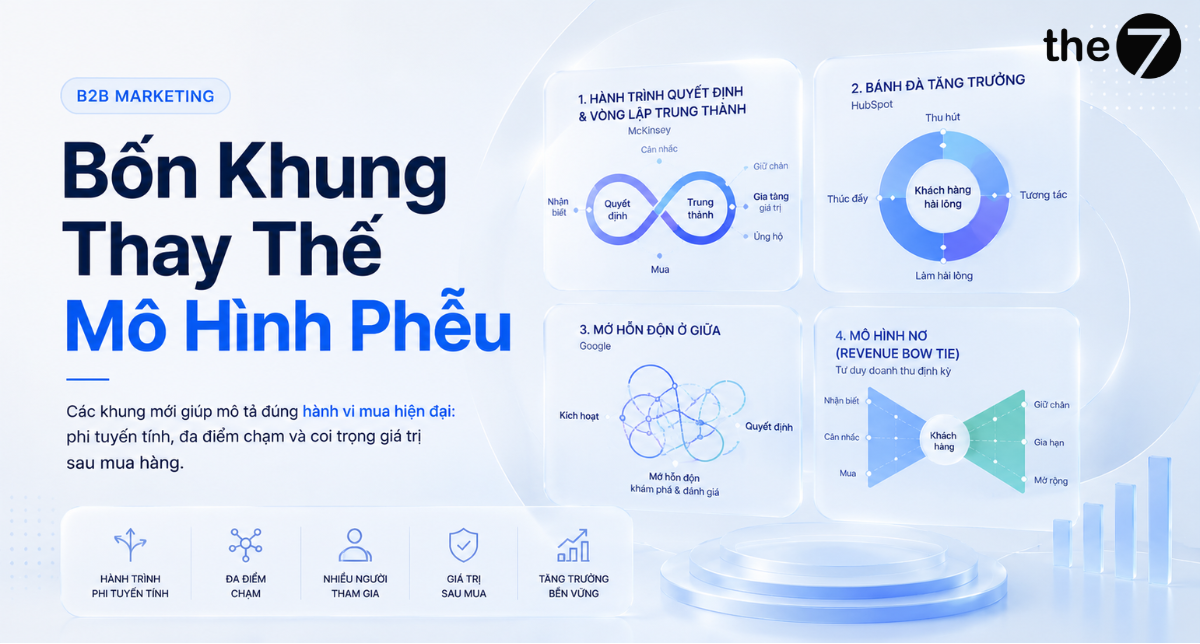
Four Frameworks That Replace the Funnel Model
Summary: As the funnel model increasingly fails to capture how modern buyers actually behave, a number of new frameworks have emerged to replace or repair it: McKinsey’s decision journey and...
What Is Category Design?
Summary: Category design is the act of creating an entirely new type of solution in the market’s mind, instead of competing within an existing category, and then becoming the name...
What Is B2B Positioning?
Summary: B2B positioning is the act of choosing the context you place your product into – the frame of reference that makes its value obvious to the buyer. Positioning isn’t...
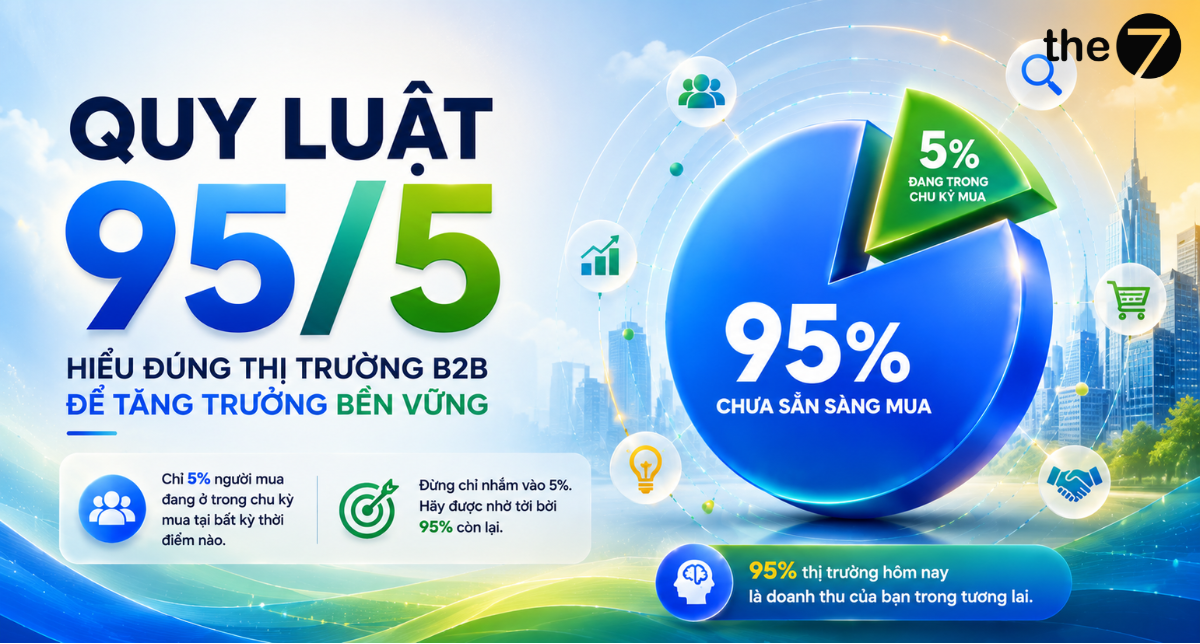
What Is the 95/5 Rule?
Summary: The 95/5 rule states that at any given moment, only about 5% of B2B buyers are actually in-market, actively in a buying cycle, while roughly 95% are not yet...
What Is Mental Availability in B2B?
Summary: Mental availability is how easily a brand comes to mind in a buying situation. It isn’t about having the sharpest argument, the slickest pitch, or the most convincing feature...

What Are B2B Events and Trade Shows?
Summary: B2B events and trade shows are in-person gatherings such as conferences, industry trade shows, workshops, and private meetings, where a business meets buyers, customers, partners, and the industry community...