


What Is Mental Availability in B2B?
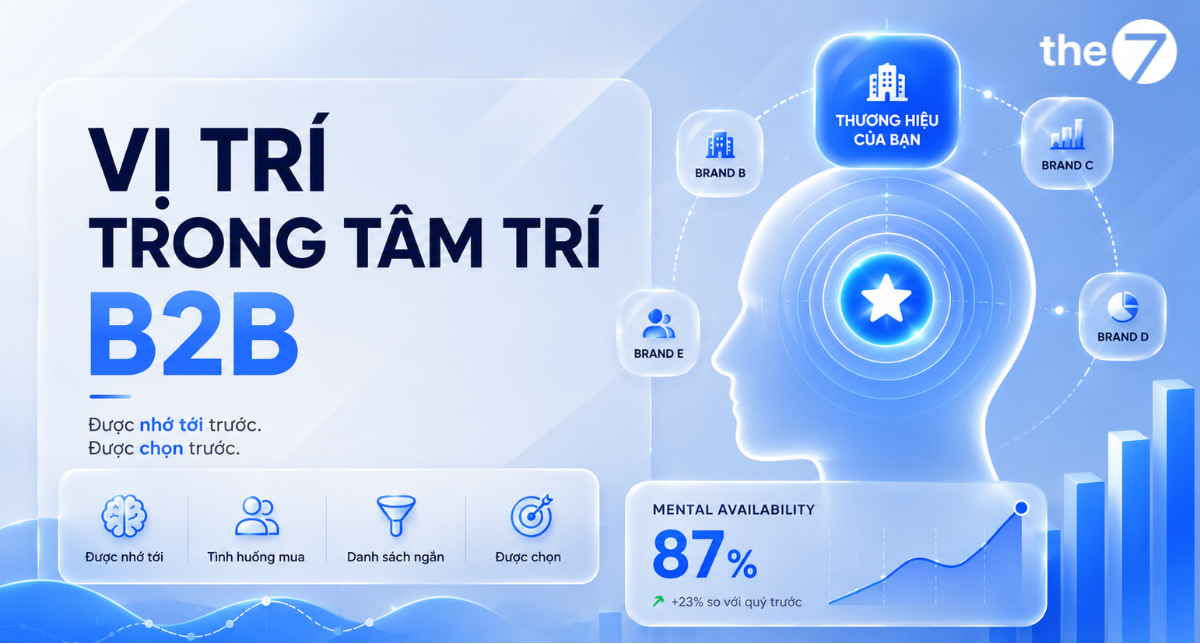
Summary: Mental availability is how easily a brand comes to mind in a buying situation. It isn’t about having the sharpest argument, the slickest pitch, or the most convincing feature comparison. It’s about whether you become the name that pops into a buyer’s mind the moment a need appears. The core truth is simple but uncomfortable: buyers pick the name they remember, not the best name. In the 7B model, mental availability isn’t a single gear — it’s the goal all six demand-generation gears work toward.
Most B2B marketing is obsessed with persuasion. Businesses pour enormous effort into proving they’re better than the competition: more features, better pricing, a stronger team, deeper experience, more rigorous processes, stronger case studies. They believe that if they present sharply enough, buyers will recognize the value and choose them. As a result, a great many B2B campaigns are built like a debate, where the brand tries to make the most logical argument to win inside the buyer’s head.
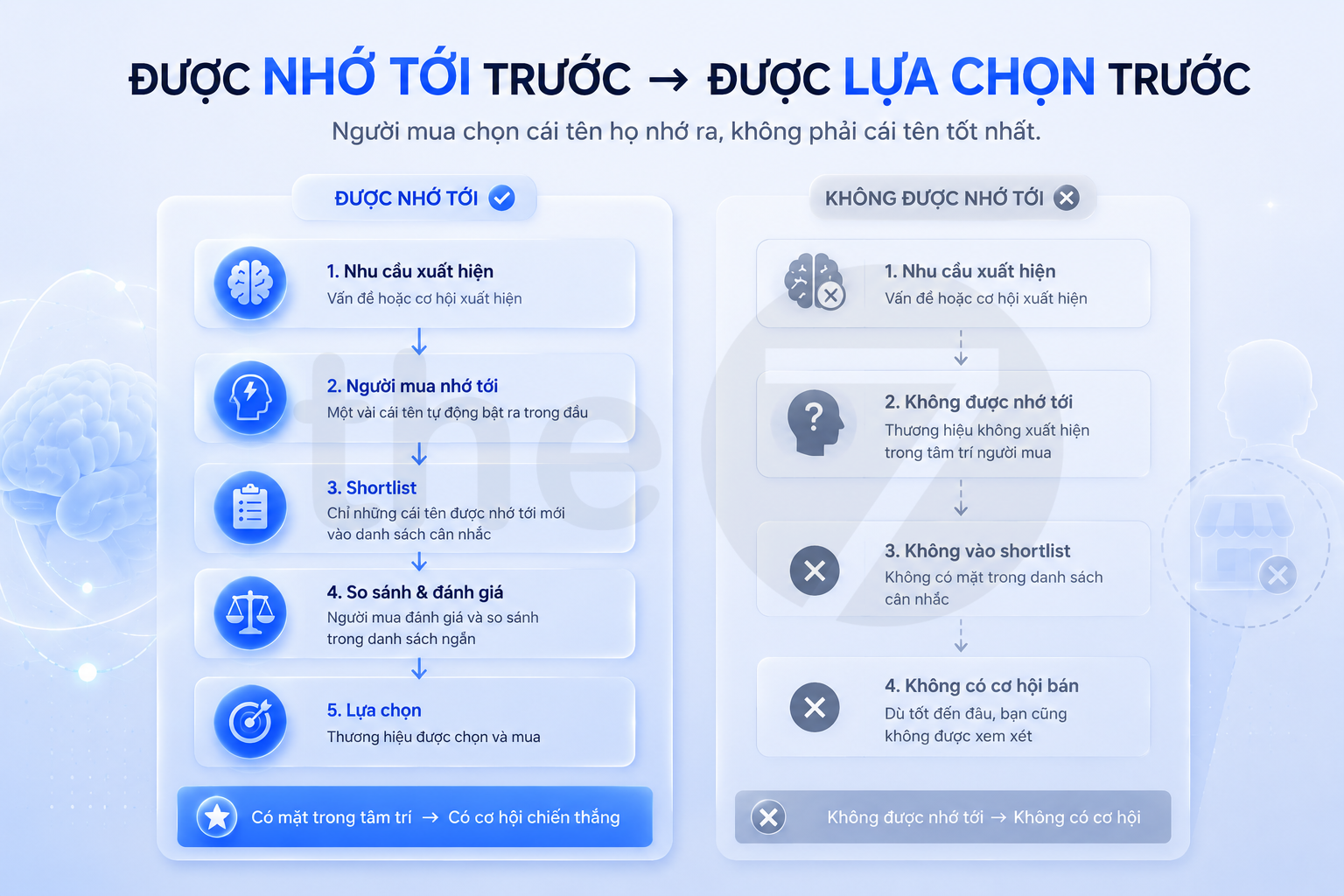
I think that assumption is wrong at its core. Before you get a chance to persuade anyone, you first have to be remembered. And here’s what most businesses overlook: B2B buyers don’t start their buying cycle by fairly evaluating every vendor in the market. They start with a short list of names already sitting in their heads. If you aren’t on that list, the best argument in the world becomes meaningless, because you never get the chance to present it. The real battle isn’t convincing the buyer you’re the best at the last minute. The real battle is being remembered before the evaluation even begins.
This article sets out what mental availability really is, why it matters more than persuasion, and how to build it systematically in B2B. First, let’s start with the definition.
Mental availability is how easily and quickly a brand is recalled in relevant buying situations. The concept is closely tied to the branding-science school of the Ehrenberg-Bass Institute, particularly the work of Byron Sharp. Unlike persuasion, which tries to change the opinion of someone already considering you, mental availability builds the ability to be recalled in the first place. The goal isn’t just to get a buyer to agree with you once they’re sitting across from you — it’s to make your brand one of the names that automatically comes to mind as soon as a need starts to form.
Why does being remembered matter more than being persuasive?
To understand why mental availability matters more than persuasion, we need to look at how buyers actually narrow down their choices. This is a point that has been studied extensively in modern branding science, yet is routinely overlooked in day-to-day B2B marketing practice.
The work of Byron Sharp and the Ehrenberg-Bass Institute, especially from 2010 onward, produced a finding that overturns a lot of old marketing beliefs. They showed that brands don’t grow primarily by convincing people they’re better, but by being remembered by more people, in more buying situations. Growth comes from expanding the number of people who have your brand in mind when a need arises, not from winning every argument about quality, features, or price. In other words, broad memorability is the engine of growth, while persuasion is only a small part that happens afterward.
This may sound counterintuitive, especially in B2B, where people like to think buying decisions are always rational, process-driven, scored, run through a buying committee, and backed by detailed analysis. But however more complex the B2B process is compared to B2C, B2B buyers are still human. They still rely on memory, familiarity, existing associations, and the names that come easily to mind. When a need arises, buyers don’t launch a comprehensive study of every option on the market. The human mind doesn’t work like an objective database. Instead, a handful of names automatically surface first — usually names that have already been built into memory over time.
The real evaluation only happens among the names that surfaced. Brands that don’t surface essentially don’t exist at the moment of purchase, no matter how good they are. This is why buyers choose the name they remember, not the best name. The best name that isn’t remembered never makes the consideration list. A merely decent name that’s instantly recalled does make the list, and because it’s on the list, it has a chance to win. In practice, a brand that’s remembered but only moderately good often beats an excellent but unknown brand, simply because the first brand is in the game and the second one isn’t.
The strategic implication of this is huge. It means most of real marketing work isn’t persuasion — it’s memory-building. Not just proving you’re the best to a small group already considering you, but making yourself remembered by the much larger market of people not considering you today, so that when they do start considering options in the future, you’re already in their heads. Persuasion only works once you’ve already been remembered. Memory comes first, persuasion follows.
This is also where many B2B businesses misunderstand marketing’s role. They only see the last stretch of the journey — where the buyer fills out a form, requests a quote, books a sales call, or sends a brief. But by that point, plenty of brands have already been eliminated from the game, not because they’re worse, but because they were never remembered. If you only show up once the buyer has entered the evaluation stage, you’re walking into a match where the shortlist may have already been set long ago.
In what situations do buyers remember you?
Mental availability isn’t a single, monolithic block. A brand isn’t simply “known” or “unknown.” The more important question is: in what situations does the buyer remember that brand? This is where a modern concept becomes very useful: category entry points.
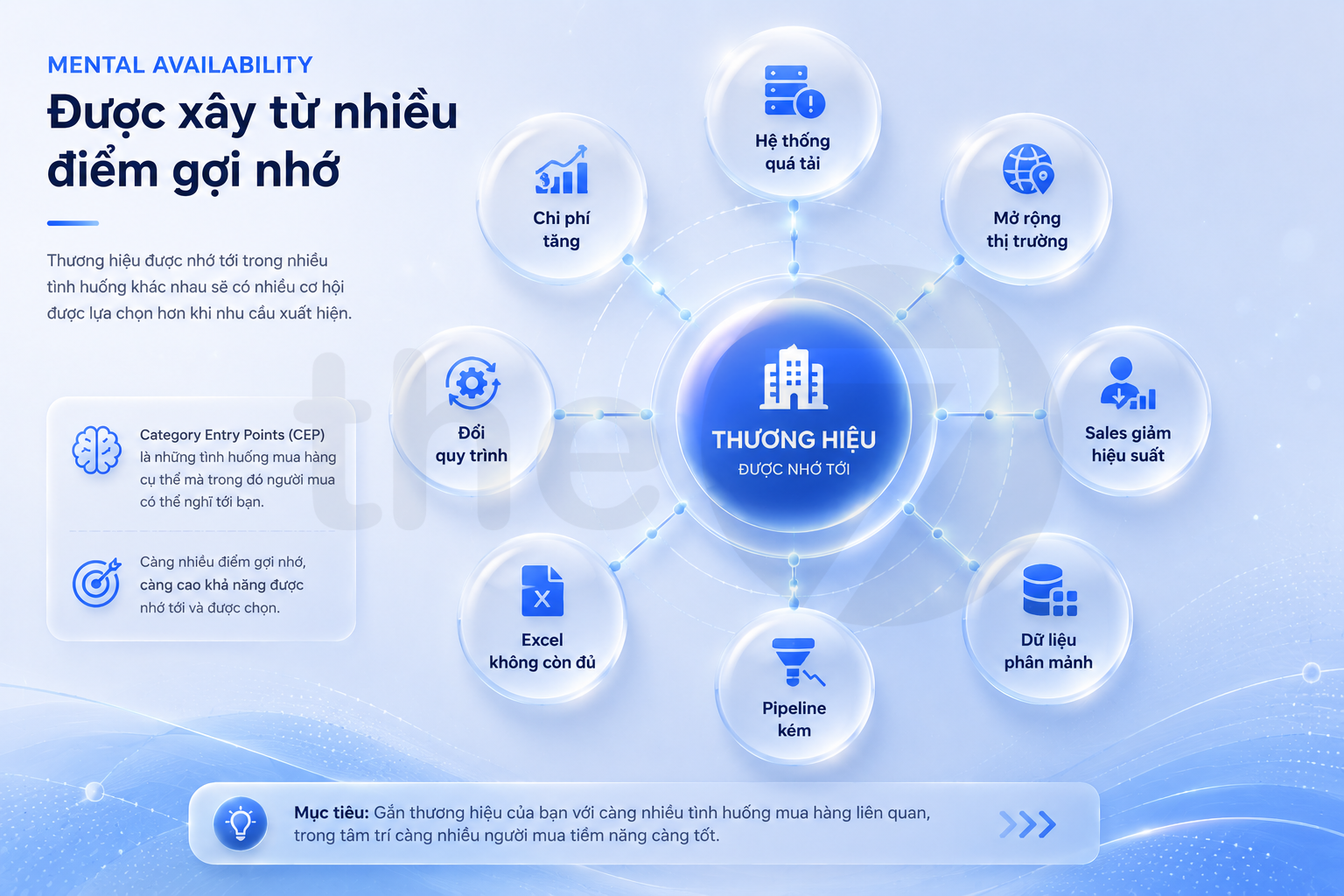
Researcher Jenni Romaniuk, also from the Ehrenberg-Bass Institute, developed the concept of Category Entry Points, which we might call category recall triggers. The core idea is clear: people don’t remember a brand in the abstract — they remember it in a specific situation. A category entry point is a situation, a need, a context, a problem, or a moment that prompts a buyer to start thinking about a type of solution. Mental availability really means having your brand linked in memory to as many relevant entry points as possible.
Picture this in B2B. A buyer doesn’t sit around thinking abstractly about software vendors, machinery suppliers, B2B agencies, consulting firms, or ERP implementation partners in general. They think about those things when a specific situation happens. The old system starts to buckle under load. The company expands into a new market. The sales team complains that leads are low quality. A new regulation forces an operating process to change. The boss demands an improvement in some metric. A competitor starts showing up too often in the market. An internal project falls behind schedule. Each of these situations is an entry point. And the question that determines your mental availability is: when that situation pops into the buyer’s head, does your name come up?
This is how you build mental availability systematically, instead of just vaguely hoping people remember you. You have to identify the most important entry points in your category — the situations that genuinely prompt buyers to start thinking about the type of solution you offer. Then you build a memory association between your brand and those situations, through content, messaging, imagery, case studies, advertising, expert presence, and repeated conversations in the market. The goal is that when the situation happens in real life, your name automatically surfaces as part of the memory of that situation.
The more relevant entry points you’re linked to, the broader your mental availability. A brand linked to only one narrow entry point only surfaces in one narrow situation. A brand linked to many entry points surfaces in more situations, so it has a chance to land on more buyers’ consideration lists, at more moments. This is how mental availability directly converts into more deals won, even though it isn’t always visible right away in a monthly conversion report.
For example, a sales management software company might not want to be remembered only when buyers search for “CRM software.” That’s an entry point that’s both too late and too competitive. They might instead want to be remembered when a business starts noticing fragmented customer data, when the sales team stops keeping records up to date, when managers can’t tell where the pipeline actually stands, when conversion rates drop even as lead volume rises, or when the CEO realizes the company can’t keep running on spreadsheets. Each of those is a different door into memory. If a brand is only linked to the keyword “CRM,” it only shows up once the buyer has already named the solution. If the brand is linked to many earlier situations, it can surface much sooner in the buyer’s mind.
In B2B, this is a critically important point. Many businesses only fight for queries at the end of the journey, where the buyer already knows what they need. But mental availability is built much earlier, at the situations where the need first starts to take shape. If you’re present in the buyer’s memory at the stage where the problem is just being recognized, you’re not only competing to be chosen — you also get a chance to define how the buyer understands the problem.
Why does consistency make you easier to remember?
Category entry points explain which situations you need to be remembered in. But to be remembered easily, you need one more ingredient: consistency of your identifying signals.
Jenni Romaniuk also developed the concept of distinctive brand assets. These are the signals that let people recognize and recall a brand quickly: logo, colors, typography, tagline, visual style, tone of voice, sound, icons, spokesperson, or a distinctive way of presenting things. These assets matter because human memory works through association and repetition. When a signal appears often enough, consistently enough, and is always tied to the same brand, it becomes a shortcut in memory. Buyers don’t need to analyze much — they just need to see a familiar signal and the brand gets re-activated in their mind.
This is why consistency usually matters more than constant creative reinvention. Many businesses change their identity, messaging, and style too often because they’ve grown bored with the old one or want to look fresh. They swap taglines before the market has even had time to remember the old one. They change colors just as the identifying signal is starting to build familiarity. They shift tone because a new marketing team wants to leave its mark. The problem is that every time they change, they break the memory associations that were forming and have to start over from zero.
Marketers usually grow tired of their own messaging long before the market has had a chance to remember it. This is a dangerous paradox. Because you see your brand every day, you assume the market has seen it far too much too. But the market doesn’t live in your marketing department. Buyers only glimpse you occasionally, amid hundreds of other signals competing for attention. What looks stale to you may have only just started to become familiar to them. Consistency, sustained longer than feels comfortable to you, is what builds durable memory assets.
In B2B, this is often dismissed because many people think brand identity is a consumer-goods concern. But human memory doesn’t distinguish between B2B and B2C. A CFO, CTO, CMO, operations director, or head of procurement still recalls brands through the same mechanism of association and repetition as when they buy something for themselves. A B2B business with a consistent identity, messaging, and tone over time will be far easier to remember than one that constantly reinvents itself, even if product quality or expertise is equal.
This doesn’t mean a brand should never change. Businesses still need to refresh when positioning shifts, when the market changes, or when the current identity no longer fits. But change should have a strategic reason, not just internal boredom. In building mental availability, repetition isn’t creative laziness. Repetition is how memory gets formed.
Where does mental availability sit in the 7B model?
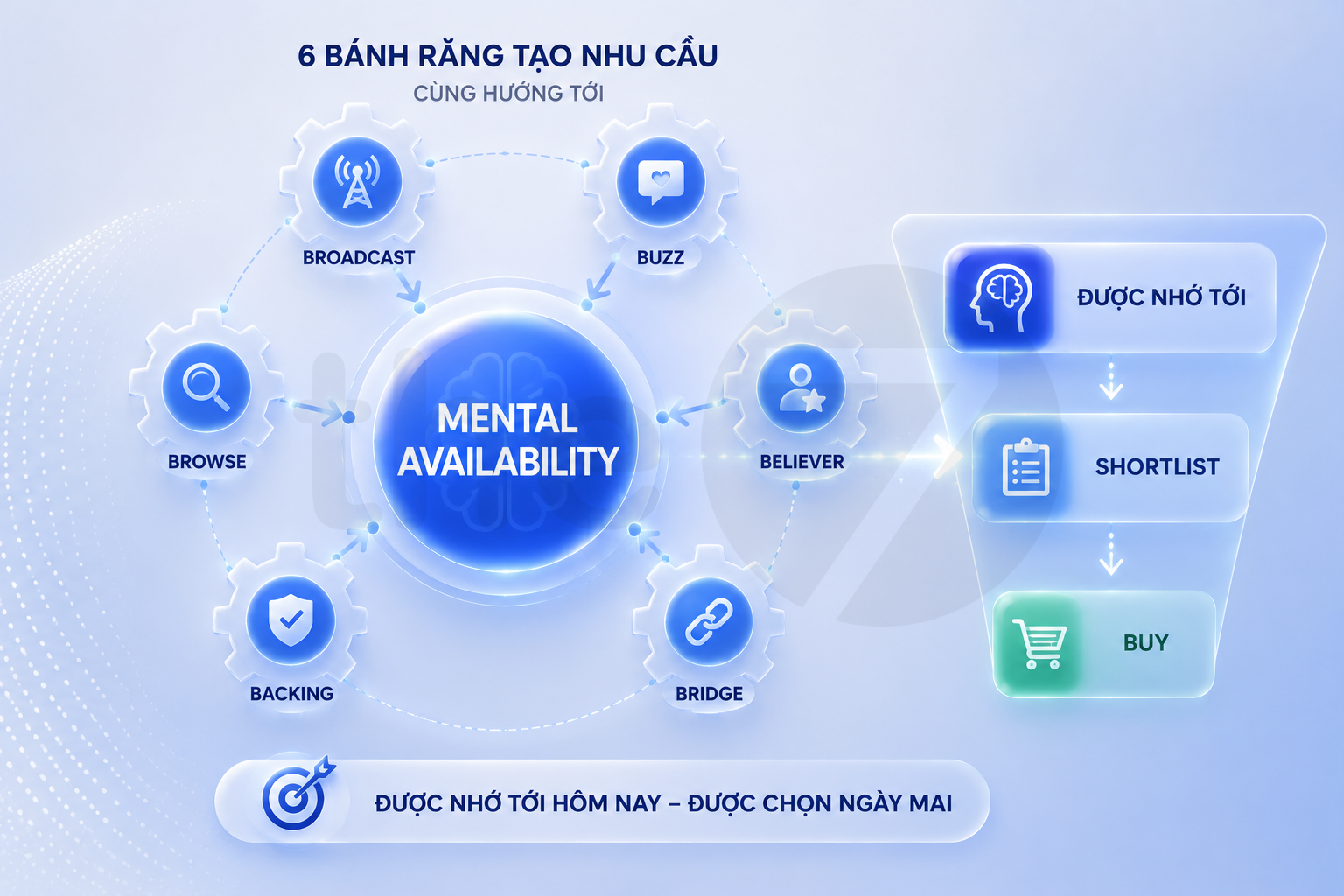
This is where mental availability differs from channel topics like LinkedIn, email, paid ads, podcasts, communities, or events. It isn’t a gear, and it isn’t a channel. It’s the target that all six demand-generation gears work toward. If the 7B model is a machine for sowing and harvesting demand, mental availability is exactly what the sowing part is building over time.
Think about it. Why do you run Broadcast, sending out valuable content to the market on a regular cadence? To be remembered. Why do you build Buzz, so others talk about you, mention you, share you, debate you? To be remembered through many different sources. Why do you do Browse, so that when buyers research on their own, they encounter you along the way? Why do you build Believer, so a group of people believes in you deeply and repeats your ideas? Why do you need Backing, for proof, recognition, and outside credibility? Why do you need Bridge, to reach into relationship networks that ads or one-way content can’t touch?
At the deepest level, all of these gears serve one shared goal: making your brand remembered by more people, in more situations, at exactly the moment a need arises. The six demand-generation gears are the mechanisms. Mental availability is the outcome they produce together.
See it now? Mental availability is the scoreboard for the six demand-generation gears. It tells you whether your sowing is working. When those six gears are running well, the result is rising mental availability: more buyers remember you, in more situations, with stronger associations. When they run poorly, mental availability shrinks: fewer people remember you, the brand gets linked to too few situations, and you’re absent from the consideration list once real deals start forming.
This is also where a common misunderstanding about marketing’s purpose needs clearing up. Many businesses believe marketing’s goal is to generate leads and conversions — that is, the output of the Buy gear. But that’s the output of harvesting, not the purpose of sowing. The real purpose of the six demand-generation gears is to build mental availability, while conversion is the later harvest result of having built that position. A business that measures marketing purely by conversion is measuring the harvest while ignoring the sowing. Yet it’s the sowing — building mental availability — that determines whether the business will have anything left to harvest three years from now.
The deeper reason for this is that most of the market isn’t ready to buy at any given moment. I covered this in more detail in the article on the 95/5 rule. For now, it’s enough to understand one thing: if you only market to people buying right now, you’re ignoring the much larger share of the market that will buy in the future. And if you fail to build their mental availability during the entire time they aren’t yet buying, then by the time they actually enter a buying cycle, you’re very likely to be eliminated before the game even starts.
A few examples from B2B
In enterprise software, a company can build mental availability by linking its name to a specific problem its target customers commonly face. They don’t just say “we’re good software,” because that’s too generic and too easily replaced. Instead, they talk repeatedly about very specific situations: when customer data becomes fragmented, when the sales team stops following process, when managers can’t see the real pipeline, when a business is growing but operations are still manual. Over time, the brand becomes linked to those entry points. When the situation happens in real life, buyers remember them before they even start a broader search.
In manufacturing, an equipment supplier might understand that the most important entry point isn’t the moment a customer types the product name into Google, but the moment old equipment nears end of life, the production line starts becoming unstable, maintenance costs rise, or a new technical standard forces the plant to upgrade. If this supplier has a regular presence in engineering communities, expert content explaining the warning signs for replacement, case studies about reduced downtime, a presence at industry events, and gets mentioned by experts, then when the replacement cycle arrives, their name is already sitting in the decision-maker’s head. Their mental availability was built long before the deal ever showed up in a CRM.
In professional services, a consulting firm can link its name to a specific type of strategic challenge. They don’t need to try to be “the consulting firm for every problem,” because that position is both vague and hard to remember. They can instead pick a clearer cluster of situations: when a company is growing but its governance systems can’t keep up, when the sales team is expanding but performance is dropping, when leadership needs to reposition before entering a new market. When an executive faces exactly that challenge, that consulting firm is the first name that comes to mind — not because the firm persuaded them at the last minute, but because it had already built a memory association between its name and that situation over years.
Three examples, three industries, one shared principle: wins are prepared in advance. A brand doesn’t wait until a buyer draws up a vendor shortlist to start showing up. A brand must already be present in the buyer’s memory well before that, linked to the exact situations that cause the need to form. That’s how mental availability turns into a real competitive advantage.
How do you measure mental availability?
One reason B2B businesses ignore mental availability is that it’s harder to measure than forms, calls, clicks, or direct revenue. But hard to measure doesn’t mean unmeasurable. It just means you can’t measure it the same way you measure conversion ads.
The simplest method is a brand memory survey. You can ask your target customer group an open question: “When you think about a solution to this problem, which brands come to mind?” Then check whether your brand gets mentioned, at what rank, and in what context. The first answer given usually matters most, because it shows which brand surfaces most easily. If you don’t appear in unprompted answers, your mental availability is weak, even if short-term ad metrics still look good.
The second method is measuring by category entry point. Instead of just asking whether buyers know your brand, ask by specific situation. For example: “When a company faces fragmented customer data, which vendor comes to mind?” or “When you need to improve your B2B pipeline, which company do you remember?” This approach is better than a generic awareness question, because it measures the true essence of mental availability: whether the brand is recalled in relevant buying situations. A brand can be widely known by name, but if it isn’t linked to a specific buying situation, it still doesn’t have a strong position in memory.
The third method is watching branded search signals. As mental availability rises, you typically see more people searching directly for the brand name, searching for the brand name alongside a problem, or mentioning the brand in private conversations you don’t always see. Branded search data isn’t perfect, but it’s a useful signal. If more people are searching your name, typing your name alongside a buying situation, or landing on your site via direct traffic, that could be a sign mental availability is strengthening.
The fourth method is asking sales. Not asking sales whether they feel marketing is good, because that answer is usually very subjective. Ask more specifically: did the customer know you before sales reached out, where did they hear about you, what content do they mention, who do they compare you against, what words do they use to describe the problem, do they say “I’ve seen you around a lot”? These signals don’t replace formal brand research, but in B2B they’re valuable, because sales is the person directly hearing how buyers remember and name the brand.
The important point is not to force mental availability into a single metric. It isn’t like CPC or CPL. It’s a memory asset, so it needs to be measured with multiple signals: recall surveys, strength of entry-point association, branded search, direct traffic, unprompted mentions, quality of sales conversations, and how readily the brand appears on consideration lists without needing to be pushed too hard. When multiple signals rise together, you know the sowing is starting to bear fruit.
Three mistakes when building mental availability
The first mistake is pouring everything into persuasion while neglecting memory. Many businesses spend all their resources proving they’re better to the group already considering them, but never build memory with the much larger market that isn’t considering them yet. The result is they can be great at persuading in sales meetings, yet still absent from most buyers’ consideration lists, because nobody remembers them when the need arises. The fix isn’t to abandon persuasion — it’s to put it in its proper place. You still need arguments, evidence, and closing skill, but before any of that you need to invest the bulk of your effort in building broad memory. Being remembered is the precondition for even having a chance to persuade.
The second mistake is failing to link the brand to a specific buying situation. Many businesses build generic awareness, making people know the name but never tying that name to any clear situation. They speak too broadly, too abstractly, too much like everyone else: comprehensive solutions, trusted partner, optimize efficiency, comprehensive digital transformation, elevate your business. These phrases sound safe, but they usually don’t create a sharp memory link. When a need arises, the name doesn’t surface, because it isn’t tied to that situation in the buyer’s mind. The fix is to identify the important entry points and build an association between the brand and exactly the situations that prompt buyers to start thinking about a solution.
The third mistake is constantly changing identity and messaging. Out of boredom with the old look or a desire to feel fresh, many businesses change logos, messaging, style, narrative, and tone far too often. They think they’re refreshing the brand, but they’re actually breaking the memory associations that were forming. The fix is to maintain consistency longer than feels comfortable. Market memory is built through repetition, and the feeling of staleness you notice is usually exactly the moment it’s starting to carve itself into the buyer’s mind.
Conclusion: buyers choose the name they remember
Back to where I started. B2B marketing is obsessed with persuasion, with proving you’re better than the competition. But before you get a chance to persuade anyone, you first have to be remembered. Buyers don’t start by fairly evaluating every option in the market. They start with names already sitting in their heads. If you’re not among them, the best argument in the world is meaningless.
Mental availability means becoming the name that surfaces when a need arises. It’s built by linking the brand to as many relevant buying situations as possible, and through the consistency that makes you easy to recall. Buyers choose the name they remember, not the best name. That’s why a brand that’s remembered but only moderately good often beats an excellent but unknown one.
In the 7B model, mental availability isn’t a gear. It’s the target all six demand-generation gears work toward, the scoreboard for your sowing. Don’t just ask how to convince buyers you’re the best. Ask a more important question: how do you become the name they remember first?
To understand why most of the market isn’t ready to buy — making memory-building for the future essential — read the article on the 95/5 rule. To understand how to position a brand to link with the right buying situations, read the article on B2B positioning. To understand how the six demand-generation gears build mental availability together, read the article on the 7B gear model. And to understand why measurable metrics like conversion don’t capture the full value of building memory, read the article on brand marketing and performance marketing.
Frequently asked questions
What is mental availability?
Mental availability is how easily a brand is recalled in relevant buying situations. A brand has strong mental availability when buyers easily recall it the moment a need arises.
How does mental availability differ from persuasion?
Persuasion tries to make buyers believe you’re better once they’re already considering you. Mental availability gets you remembered before the consideration process even starts. Put simply, mental availability gets you onto the shortlist, while persuasion increases your odds of winning once you’re already on it.
What is a category entry point?
A category entry point, or CEP, is a situation, need, or context that prompts a buyer to start thinking about a type of solution. In B2B, for example, that could be the moment an old system becomes overloaded, the company expands, operating costs rise, or leadership needs to improve a key metric.
Why does consistency matter in brand building?
Consistency helps buyers form memory associations with a brand. When logo, color, messaging, tone, and style repeat long enough, they become a shortcut that makes the brand easier to recognize and recall. Changing too often can break the memory associations that are forming.

Nguyễn Đình
Bảo




As CEO of The7, I am committed to sharing practical, useful knowledge with every reader. Every article on The7 is based on my 7 years of hands-on experience in marketing — Facebook advertising, LinkedIn advertising, Google advertising, and marketing strategy. I hope you take away plenty of insight from these posts and apply it successfully in practice.
Related Articles
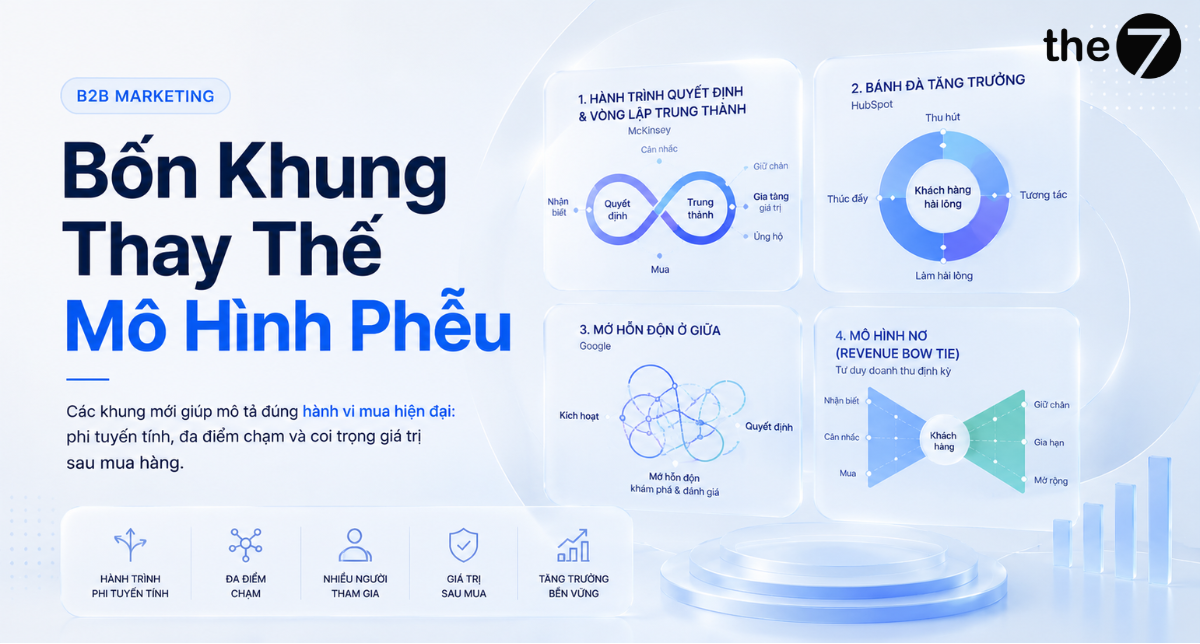
Four Frameworks That Replace the Funnel Model
Summary: As the funnel model increasingly fails to capture how modern buyers actually behave, a number of new frameworks have emerged to replace or repair it: McKinsey’s decision journey and...
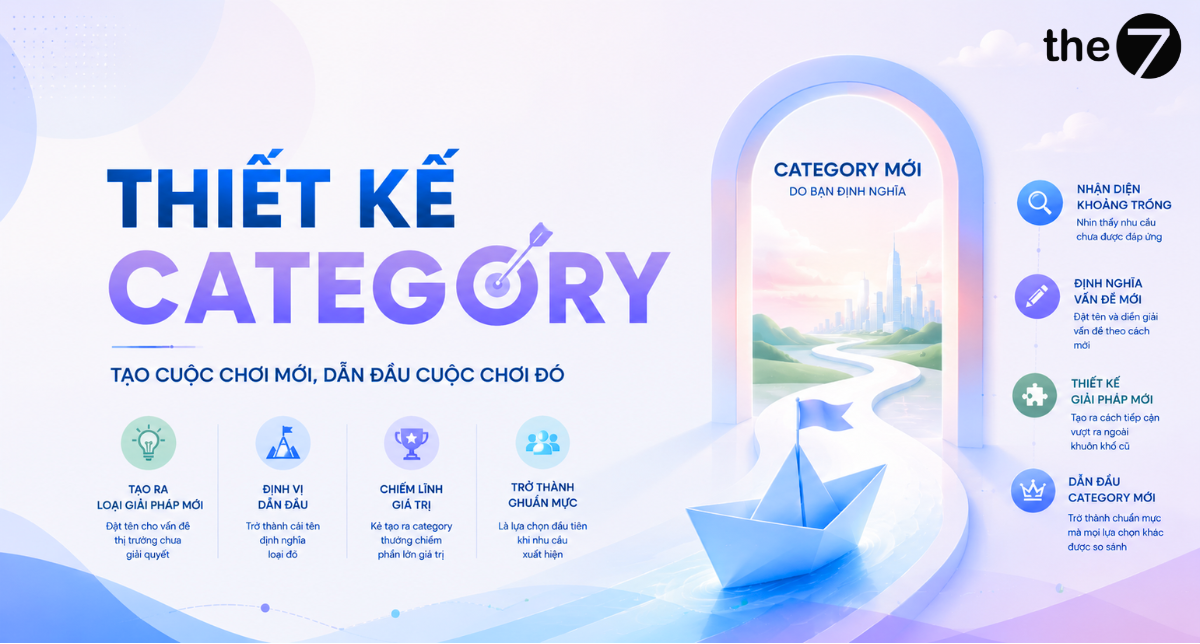
What Is Category Design?
Summary: Category design is the act of creating an entirely new type of solution in the market’s mind, instead of competing within an existing category, and then becoming the name...
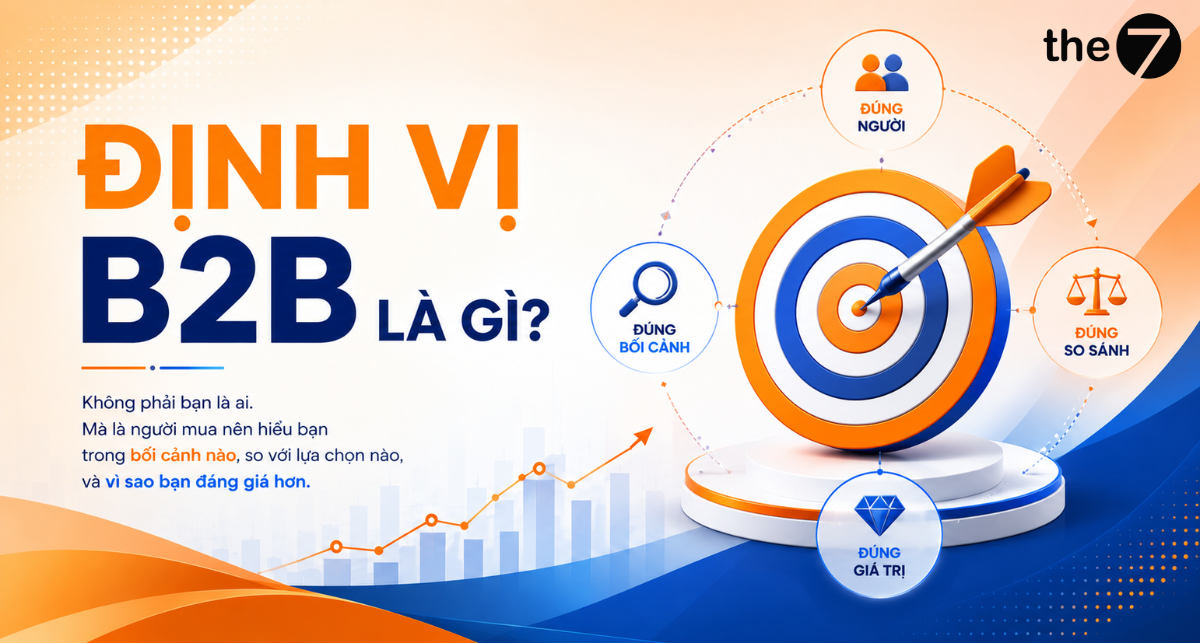
What Is B2B Positioning?
Summary: B2B positioning is the act of choosing the context you place your product into – the frame of reference that makes its value obvious to the buyer. Positioning isn’t...

What Is the 95/5 Rule?
Summary: The 95/5 rule states that at any given moment, only about 5% of B2B buyers are actually in-market, actively in a buying cycle, while roughly 95% are not yet...
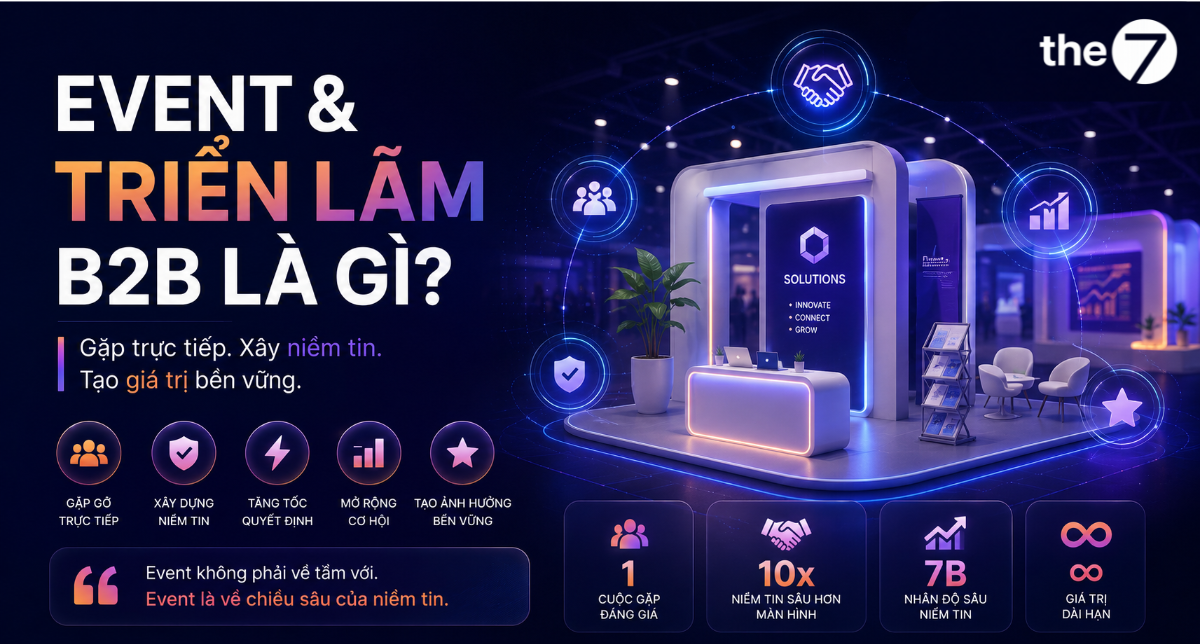
What Are B2B Events and Trade Shows?
Summary: B2B events and trade shows are in-person gatherings such as conferences, industry trade shows, workshops, and private meetings, where a business meets buyers, customers, partners, and the industry community...
What Is B2B Community Marketing?
Summary: B2B community marketing is about building and nurturing a community where members connect with each other around a shared interest, not just with the brand. The core distinction comes...