


What Are B2B Events and Trade Shows?
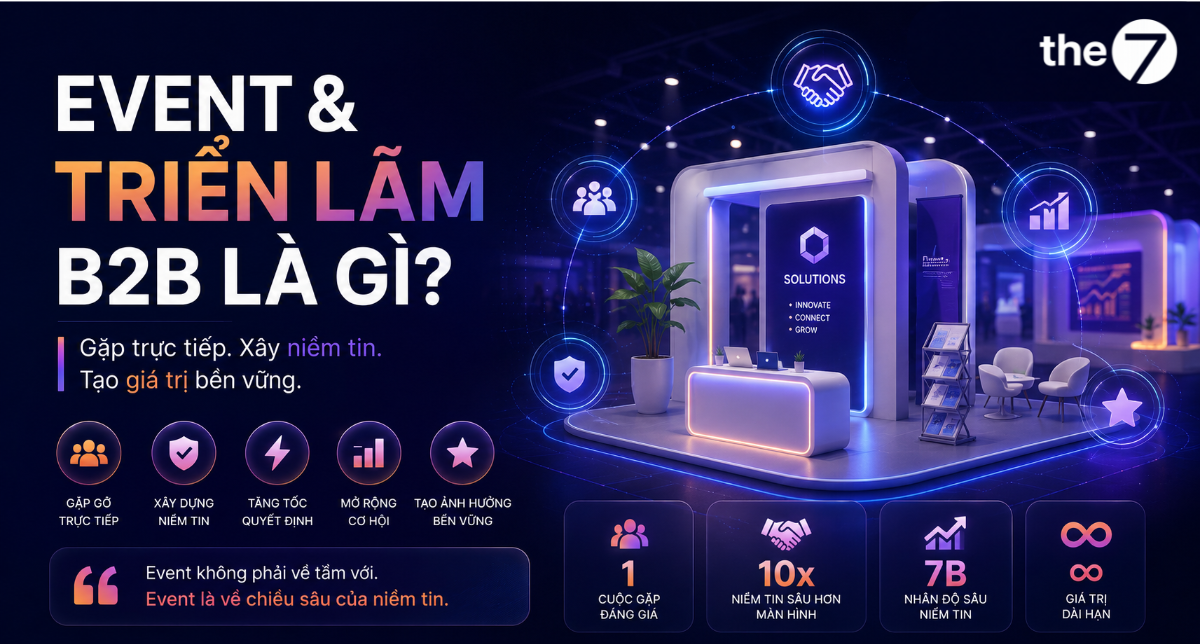
Summary: B2B events and trade shows are in-person gatherings such as conferences, industry trade shows, workshops, and private meetings, where a business meets buyers, customers, partners, and the industry community face to face. In a world where nearly every touchpoint has gone digital, the real value of events doesn’t lie in reach, because on reach they will always lose to digital channels. The value of events lies in something a screen can’t replace: meeting in person builds trust in a way screens cannot. In the 7B model, events aren’t a standalone gear. They’re a multiplier of in-person presence, making the trust that many gears create deeper, more genuine, and more lasting.
Most B2B businesses measure events and trade shows in a very impoverished way: how many business cards collected, how many badge scans at the booth, how many people left contact information after the show. They come back from an event with a stack of business cards, hand it to sales, and start calculating cost per lead. When the numbers don’t look good, they conclude that events are too expensive, too hard to measure, and perhaps no longer worth doing in an era when everything can move online.
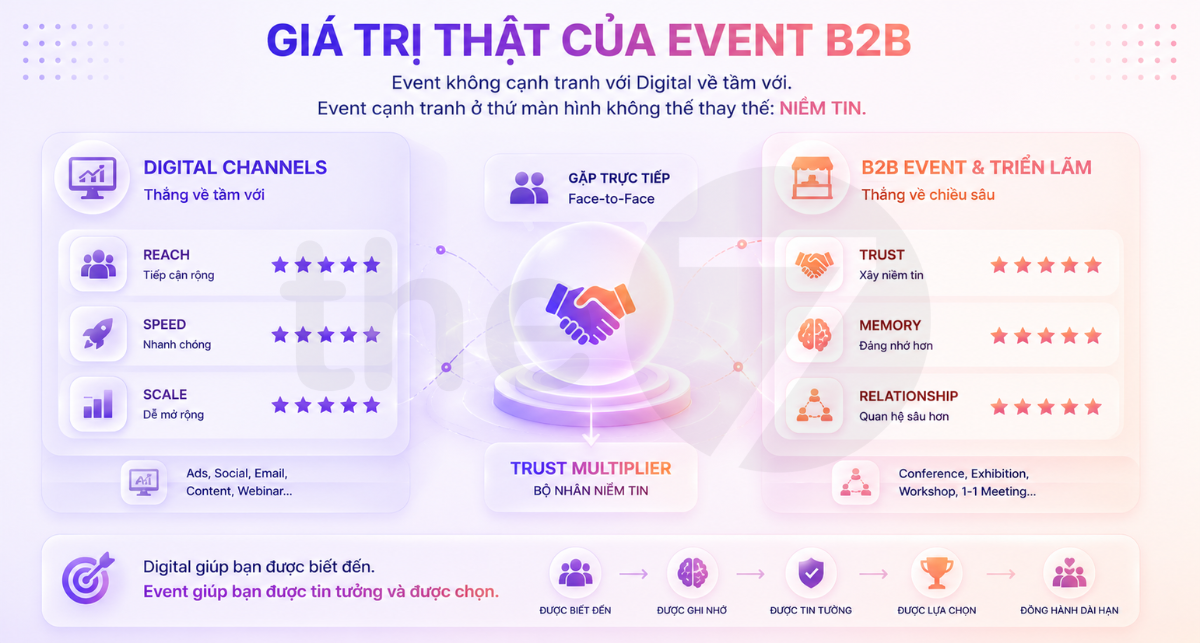
That view is wrong not because business cards are entirely meaningless, but because it applies a shallow metric to a channel that’s actually strong on depth. If the goal is simply reaching lots of people, events lose from the start. A LinkedIn post can reach tens of thousands of people at a far lower cost. An ad campaign can target the exact job title, industry, and country, and measure every click. A webinar can pull attendees from multiple markets without anyone having to travel. On reach and convenience, events stand no chance against digital channels.
But events were never meant to win the reach game. They exist for a different reason: people trust each other more deeply when they meet in person. In B2B, where buying decisions are often expensive, high-risk, involve many stakeholders, and unfold over long cycles, trust doesn’t come from information alone. It comes from the feeling that you’re dealing with real people, with real competence, real presence, and real accountability. Events create the setting for that feeling to emerge faster than any digital channel can.
This article exists to show where the real value of events lies, why meeting in person builds trust differently than a screen does, why people remember experiences more than information, and why counting business cards measures the wrong thing entirely. First, a clear definition.
B2B events and trade shows are in-person gatherings organized for a business to meet, present, exchange with, and build relationships with buyers, existing customers, partners, distributors, experts, and the industry community. They can take the form of trade shows, industry conferences, specialized workshops, product launches, high-level private meetings, intimate dinners, regional roadshows, or on-site product demonstrations. Unlike digital channels, which are optimized for reach, convenience, and behavioral measurability, events create value through in-person presence — something that produces a level of trust and a kind of experience that screen-based interaction can rarely achieve.
Why Does Meeting in Person Build Trust Differently Than a Screen?
To understand why in-person presence is so powerful, a 2017 study by Mahdi Roghanizad and Vanessa Bohns is worth noting. The two researchers compared the effectiveness of the same request when made in person, face to face, versus sent by email. The results showed the in-person request was far more effective than the email request. What’s even more interesting is that participants consistently underestimated this gap. They assumed email came close to meeting in person, when in reality the two formats produce very different levels of persuasive power.
That finding reveals something important about human nature. When you stand in front of a real person, a huge number of social signals appear simultaneously: eye contact, tone of voice, timing of reactions, body language, confidence, awkwardness, sincerity, how they listen, and how they respond. These signals don’t just carry information — they help the human brain assess how trustworthy the other person is. An email can be beautifully written, a landing page can be very clearly designed, a video call can be enough to handle business, but they all still strip away many of the subtle signal layers people use to understand each other in real life.
Applied to B2B, this explains why a single in-person meeting at a trade show can move a relationship further than a month of email exchanges. Buyers don’t just hear you talk about the product, they meet the people behind it. They watch how your team reacts to a hard question, how an engineer explains a problem, how a salesperson handles an unclear point, how leadership shows up in the industry space. These small details aren’t in any brochure, but they create a feeling of trust or distrust very quickly.
In a B2B deal, buyers rarely buy features alone. They buy the certainty that this supplier understands the problem, has the capability to deliver, is stable enough for the long haul, and is trustworthy enough to be held accountable. An in-person meeting can compress a huge number of trust signals into a short window of time. Thirty minutes of face-to-face conversation can sometimes produce a bigger step forward than three months of email, not because the content is that different, but because the level of presence is completely different.
This also explains a very important paradox: the more things move to screens, the more valuable meeting in person becomes. As email, messaging, video calls, ads, and digital content become the default, a real in-person meeting becomes rarer. And because it’s rarer, it becomes more memorable. In a market where every supplier can send email, run ads, post on LinkedIn, and host webinars, a business showing up in real life at the industry’s key touchpoints becomes a strong signal. It says you don’t just exist on a screen, you’re genuinely here, in this industry, in front of these people.
Why Do We Remember Experiences but Forget Information?
In-person presence explains half of an event’s value. The other half lies in how people remember.
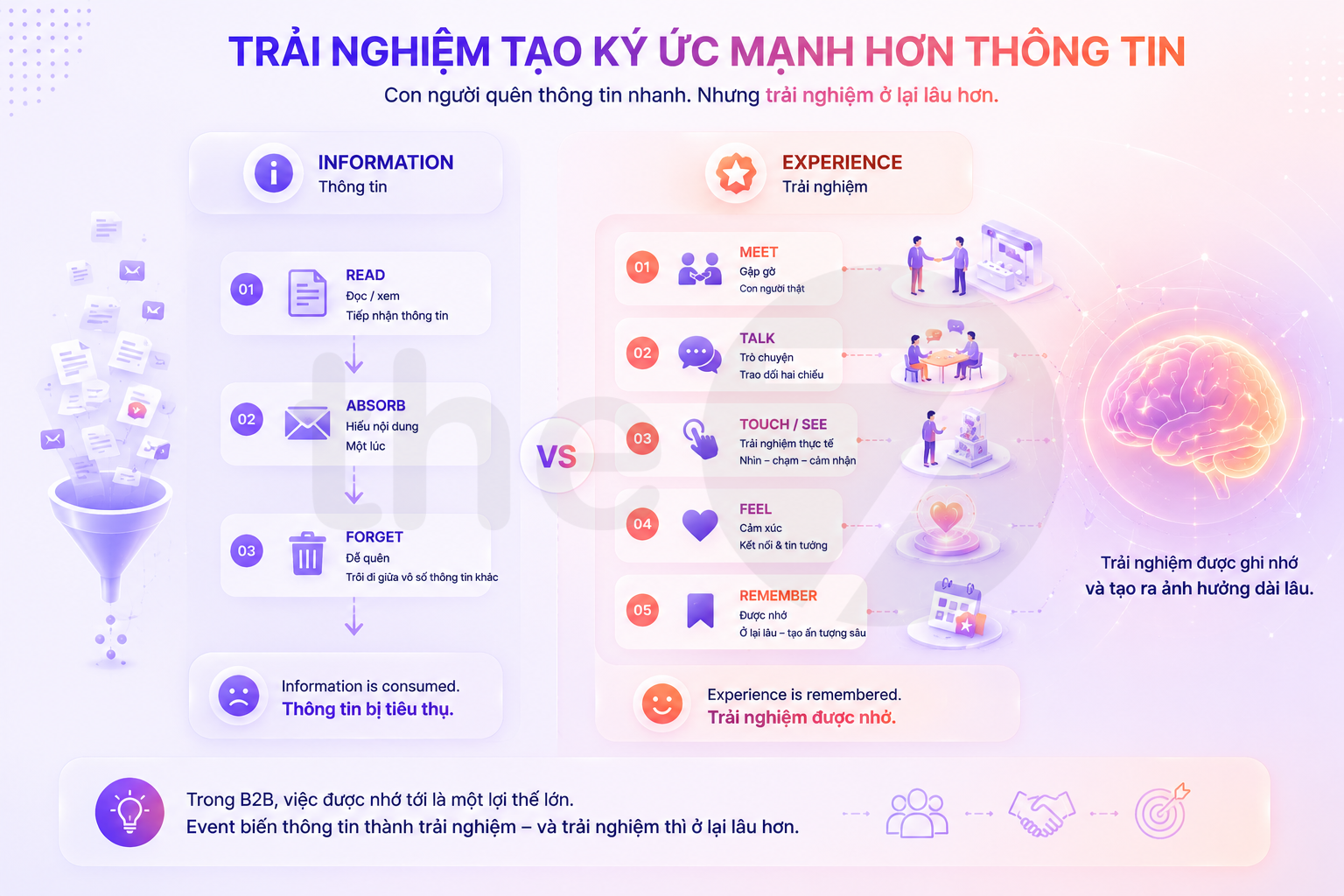
People remember experiences more deeply than plain information. Information read on a screen fades easily because it sits alongside countless other pieces of information in a day: emails, posts, ads, messages, reports, sales materials. But a real experience has a place, people, sounds, a space, emotions, and a specific context. It doesn’t enter memory as a sentence — it enters as a scene, a meeting, a moment. That gives it far more hooks for recall.
A buyer might forget the fifth email you sent, but they may remember a conversation with you at a conference last year. They might not remember every slide you presented, but they remember that your team answered a tough technical question with real confidence. They might not keep the catalogue, but they remember the feeling of watching the equipment run with their own eyes. Events turn information into experience, and experience has a much better chance of staying in memory than information does.
This is a point digital channels struggle to replace. Digital channels are convenient, cheap, fast, and scalable. But precisely because they’re so convenient and so plentiful, they’re also easy to dismiss. One email is one of hundreds. One post is one of thousands scrolled past. One ad is one small touchpoint among countless others. A meeting at an event, by contrast, has its own context: the buyer has to travel there, step into that space, meet that person, hear that story, have that conversation. That context is exactly what gives the memory a clearer shape.
In B2B, being remembered is a major advantage. Buyers usually aren’t ready to buy the moment they meet you. It might be six months later, a year later, or whenever an internal need arises, that they start looking for a solution. When that moment comes, whichever brand is remembered first has the advantage. An event isn’t only trying to generate leads on the spot. It plants a deep memory in the buyer’s mind, so that when the need appears, you aren’t a stranger.
The Power of Shared Presence
In-person presence explains the power of each individual meeting. Experiential memory explains why those meetings last longer in the mind. But events have another layer of value: the power of many people being present in the same place, at the same time, around the same shared interest.
When hundreds or thousands of people from the same industry gather, a collective energy appears. Attendees aren’t just hearing content, they feel like they’re standing in an important space for their industry. They see competitors, partners, customers, suppliers, experts, and the people shaping the game. That feeling creates a seriousness that watching online struggles to match, even if the content is similar. Shared presence makes everything feel more real, more urgent, and more worth paying attention to.
In B2B, shared presence creates at least two kinds of value. First, it reinforces a sense of belonging to an industry community. When a business shows up consistently at important events, it isn’t just promoting products. It’s sending a signal that it’s a genuine part of this industry, present in the important conversations, and not standing outside the flow of the market. For relationship-driven industries such as manufacturing, construction, logistics, enterprise technology, finance, healthcare, or education, this presence signal is highly valuable.
Second, events create chance encounters that can’t be fully planned. A hallway conversation, an introduction at dinner, a question after a panel, a handshake at the neighboring booth, a reunion with an old customer after years apart. Much of the real value of a large event doesn’t lie in the official program, but in these incidental social collisions on the sidelines. It’s exactly the shared physical space that makes those collisions happen.
This is something online events struggle to recreate. Online can deliver content, but it’s very hard to create a hallway. Online can have breakout rooms, but it’s very hard to create a natural sense of chance encounter. Online can have chat, but it’s very hard to replace a conversation standing side by side after a talk. Events are powerful because they aren’t just the stage, they’re the entire space around the stage. And in many cases, it’s exactly that surrounding space where real relationships begin.
Not All Events Are the Same
Another mistake when talking about events is lumping them all into one category. In reality, each type of B2B event creates value differently, and a business needs to understand which game it’s playing before deciding to invest.
Trade shows are typically strong for Backing and Buy. Buyers go there to see solutions, compare suppliers, look at equipment, meet sales and technical teams, and ask specific questions. For industries like industrial manufacturing, machinery, materials, energy, healthcare, construction, or hardware technology, trade shows are where proof comes to life. A catalogue claiming a machine runs smoothly is one thing. Seeing it operate with your own eyes, touching the product, asking an engineer on the spot, and watching the team’s reactions is another thing entirely.
Industry conferences are typically strong for Broadcast, Buzz, and Believer. This is where a business builds authority, shares its point of view, demonstrates its thinking, and joins the industry’s bigger conversations. A good talk doesn’t just create awareness, it positions the business as a voice worth listening to. But a conference’s value doesn’t stop on the stage. It also shows up in existing customers feeling proud to see their supplier there, partners having one more reason to refer you, and the market having more material to talk about you with.
High-level private meetings play a different game: absolute depth. A small dinner with ten CEOs, a closed-door roundtable with a handful of decision-makers, a private workshop for a target account group may not generate many leads, but they create a level of intimacy that a large trade show can’t match. For high-value deals with long cycles that require strong personal trust, small events like these are sometimes worth more than a crowded booth. Here, the question isn’t how many people attended, but whether the right people were in the room, and whether the relationship genuinely deepened afterward.
In other words, events aren’t a single tactic. Trade shows help you prove. Conferences help you build authority. Private meetings help you deepen relationships. Roadshows help you open regional markets. Workshops help pull buyers into experiencing the problem and the solution firsthand. Businesses that fail with events usually aren’t failing because events are useless, but because they used the wrong type of event for the wrong goal.
Where Do Events Fit in the 7B Model?
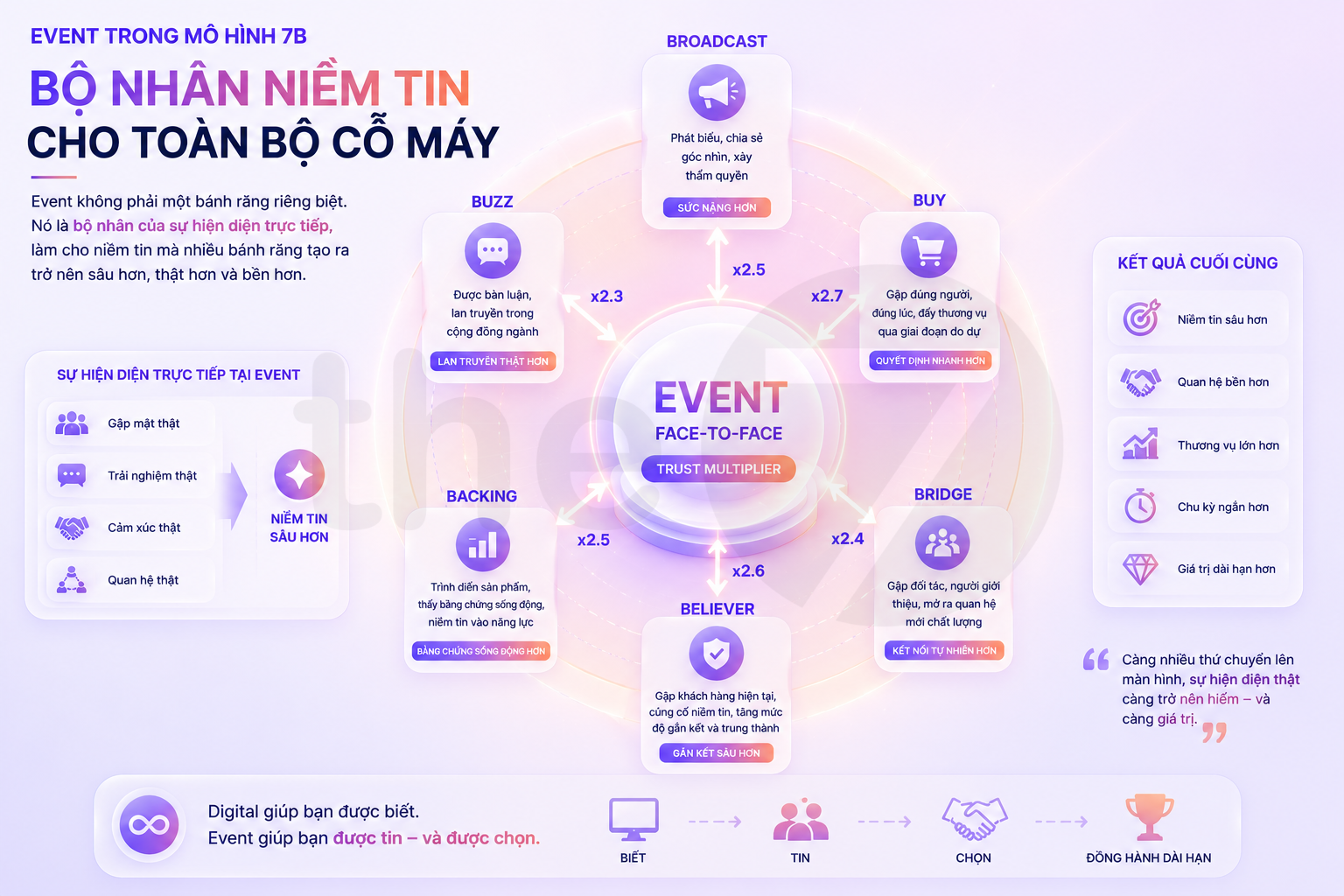
When you place events inside the 7B model, they don’t occupy a gear of their own. Events are a multiplier, something that deepens the trust created by many gears through the power of in-person presence. See more in the article on the 7B gear model.
Look at what happens at an event. When you speak on stage, that’s Broadcast, but Broadcast carrying the weight of a real person standing in front of a real market. When people meet in the hallway and talk about you, that’s Buzz, amplified by everyone being together in the same space. When a buyer in a buying cycle meets you, asks questions, sees your team’s confidence, and feels more reassured, that’s Buy. When you demonstrate the product hands-on, giving the buyer living proof instead of just reading material, that’s Backing. When you meet a partner who can refer new customers, that’s Bridge. When you meet an existing customer face to face, deepen the relationship, and make them more confident in their choice, that’s Believer.
See what’s happening? At an event, almost every gear can turn. But what makes an event different from a platform like LinkedIn, where many gears can also turn, isn’t the number of gears involved. What makes an event special is that it applies a multiplier to all of them: in-person presence makes the trust each gear creates deeper and more lasting.
A LinkedIn post can create Broadcast, but a live talk in front of the right industry community carries a different kind of weight. An online comment can create Buzz, but a sideline conversation between industry leaders spreads differently. A case study document can create Backing, but a hands-on demonstration makes the proof far more tangible. A sign-up form can create Buy, but a handshake at the right moment can push a deal past a stalling point that email never could.
So events don’t turn more gears than other channels. They turn the gears with a depth of trust that only physical presence can create. Advertising is the throttle that amplifies reach. Events are the multiplier that amplifies depth of trust. These two things are completely different, and confusing them is why so many businesses measure events wrong from the start.
Why Counting Business Cards Measures the Wrong Thing
Counting business cards is reach thinking. It treats an event as a funnel for collecting contact information, the more the better. But an event’s greatest strength isn’t creating a huge number of shallow contacts. Its greatest strength is turning a smaller number of important contacts into deeper relationships.
Five deep meetings with the right target customers can be worth more than five hundred badge scans with no context. One meeting with an existing customer can open up an expansion deal far bigger than a list of strangers. A dinner with exactly three distribution partners can create more long-term value than hundreds of post-show follow-up emails. If a business only looks at card count, it’s very easy to optimize for the wrong thing: a crowded booth, lots of giveaways, lots of collected information, but no meeting deep enough to actually change the trajectory of a relationship.
A better way to measure is to ask: how many real relationships did this event deepen? How many important buyers met our team? How many open deals moved to the next stage? How many existing customers had their trust reinforced? How many new partners now have a reason to refer us? How many sideline conversations created opportunities that didn’t exist before? How many people, after the event, remember us more clearly, trust us more, and are more willing to keep talking?
This doesn’t mean quantity doesn’t matter at all. Booth visits, meetings booked, contacts collected, and attendance numbers are still useful. But they’re only surface indicators. They tell you whether activity happened, not whether trust deepened. With events, what matters is the quality of the interaction, the context of the interaction, and the progress that follows it.
An event is the physical version of what a webinar does in the digital space, but it adds a dimension webinars lack: bodily presence. Webinars can create content, educate the market, and pull buyers into an active learning experience. Events do all of that, then add eye contact, handshakes, sideline conversations, shared space, and the feeling that everything is genuinely happening. See more in the article on B2B webinars.
Before, During, and After the Event: Depth Doesn’t Happen on Its Own
Another reason many businesses end up disappointed with events is that they assume showing up is enough. They rent a booth, build the stand, print brochures, station salespeople there, and wait for buyers to walk in on their own. This approach turns an event into an expensive handout counter. Events only create depth when a business proactively designs the touchpoints before, during, and after the event.
Before the event, the most important task isn’t preparing giveaways, but identifying who needs to be met. Lists of existing customers, prospects, partners, distributors, industry journalists, experts, and community influencers should be reviewed in advance. Important meetings should be scheduled ahead of time instead of being left to chance. Pre-event communication shouldn’t just say “we’re at booth number X,” it should give the right people a reason to want to meet you: a fresh perspective, a demo worth seeing, a topic worth discussing, a valuable private meeting.
During the event, the task isn’t to talk as much as possible, but to create quality conversations. An important buyer doesn’t need to hear the whole brochure recited. They need to feel that you understand their context. They need to be asked the right questions. They need to meet the right person on your team. If their problem is technical, let them meet an engineer. If it’s strategic, let them meet someone senior enough to discuss strategy. If they’re an existing customer, let them feel valued, not neglected while you’re off chasing new names.
After the event, most of the value is decided by the speed and quality of follow-up. A generic thank-you email blasted to the entire list will dilute the experience that was just created. A good follow-up has to pick up exactly where the conversation left off: referencing the issue they cared about, sending the right materials, proposing a sensible next step, or connecting them with the right person on the team. If the event created a memory, follow-up is how that memory becomes a relationship. If the follow-up is weak, the event remains just a beautiful moment that fades away.
In other words, an event isn’t a single day at a venue. An event is a chain of touchpoints: before the meeting, during the meeting, and after the meeting. The better a business designs that chain, the more the in-person-presence multiplier delivers. The more superficially it’s handled, the more likely the event becomes an expensive but shallow activity.
A Few Examples by Industry
In industrial manufacturing, trade shows are where big deals get started, validated, or pushed forward. Buyers come to see equipment with their own eyes, touch products, question technical teams, compare suppliers, and sense each side’s real capability. An in-person meeting at a trade show, where a buyer watches equipment run and shakes hands with the technical team, builds a level of trust no catalogue ever could. This is the in-person-presence multiplier applied to Backing and Buy.
In enterprise technology, large industry conferences are where shared presence creates value. A business speaks to build authority, but most of the value tends to lie in sideline meetings: meeting existing customers, meeting implementation partners, meeting buyers who are weighing a solution, meeting people who might never respond to a cold email but are happy to talk once both sides are physically present in an industry setting. The energy of the whole industry gathering gives every meeting more weight.
In financial services, a company might host small, intimate private gatherings for a handful of senior decision-makers. Here, the value isn’t in attendance numbers, but in absolute depth. A few in-person meetings with exactly the most important people, in a space private enough for real conversation, can build a level of trust no other channel can create. This is the in-person-presence multiplier in its most concentrated form.
In healthcare or medical devices, events can play a very strong role for Backing and Believer. Doctors, hospital administrators, distributors, and technical specialists don’t just need to hear quality claims. They need to see how the device operates, how the team trains users, how the company answers technical questions, and how industry peers react. A good demonstration at an event can turn a product from a name on paper into a real option in the buyer’s mind.
In B2B professional services — consulting, marketing, law, audit, training, or implementation technology — events tend to be strong for Broadcast and Bridge. You don’t have machinery to display, but you have thinking, perspective, and relationships. A sharp talk, a well-targeted roundtable, a deep conversation with company leadership can build far more trust than a cold-sent proposal. With professional services, buyers aren’t just buying capability, they’re buying the feeling that this person understands them and is trustworthy enough to partner with.
Five examples, many different industries, one principle: events create value through the depth of trust that in-person presence multiplies, not through the number of contacts collected.
Three Mistakes in B2B Events and Trade Shows
The first mistake is measuring by the number of business cards collected. This is the root mistake, because it applies reach thinking to a depth channel. When you judge an event by badge scans, you optimize for shallow interactions: more visitors is better, more contact info is better, more giveaways handed out is better. But the real value of an event lies in the depth of trust built through in-person meetings. The fix is to measure the quality and progress of relationships: how many meaningful meetings happened, how many deals moved forward, how many existing customers were deepened, how many important partners were activated.
The second mistake is treating events purely as a place to collect new leads. Many businesses arrive at a trade show in hunting mode for strangers, while overlooking the enormous value of reconnecting with existing customers, past partners, distributors, referrers, and relationships quietly shaping the market. In B2B, an existing customer who trusts you more can lead to an expansion contract, a partner who understands you better can lead to more referrals, an industry contact who remembers you better can create Buzz in conversations you’ll never see. The fix is to design the event as an occasion to deepen the entire relationship network, not just as a machine for gathering new leads.
The third mistake is investing only in the official program while neglecting sideline meetings. Some businesses pour all their effort into the booth, the presentation, the backdrop, the brochures, but never prepare a private meeting schedule, never create a setting for partners to meet, never organize a small dinner, never send the right people to important conversations. Meanwhile, most of a large event’s real value usually lies in the hallway, the dinner table, the meeting after a panel, or an unexpected introduction. The fix is to treat the sideline as not secondary but a strategic part of the event itself. Often the stage builds credibility, but the hallway is where the deal actually gets made.
Conclusion: Meeting in Person Builds Trust in a Way Screens Cannot
Back to where I started. Businesses that measure events by business-card counts and doubt their value in the digital age are missing the very thing that makes events worthwhile. Events aren’t a reach channel, and they shouldn’t try to win the reach game, because that game belongs to digital channels. Events win a different game: the game of trust depth that only in-person presence can create.
Three things create that value. First, meeting in person builds trust faster and more deeply than a screen, because it carries human signals that email, ads, or video calls can never fully transmit. Second, real experiences are remembered more durably than passively received information, so a meeting at an event can stay in a buyer’s memory while hundreds of emails fade away. Third, shared presence creates collective energy and chance encounters that no digital channel can recreate.
In the 7B model, events aren’t a gear. They’re the multiplier of in-person presence. They give Broadcast more weight, make Buzz more genuine, make Backing more vivid, make Buy more trustworthy, make Bridge more natural, and make Believer deeper. The more things move onto screens, the more valuable that multiplier becomes, because real presence becomes rarer. So don’t ask how many business cards an event collected. Ask how many real relationships it deepened.
To understand the digital version of an in-person event, read the article on B2B webinars. To understand why much of an event’s influence unfolds beyond measurement, read the article on dark social. To understand how shared presence at events nurtures a sense of community belonging, read the article on B2B community marketing. And to understand the full seven-gear machine whose trust depth events can multiply, read the article on the 7B gear model.
FAQ
What are B2B events and trade shows?
B2B events and trade shows are in-person gatherings such as conferences, industry trade shows, workshops, roadshows, private meetings, or product demonstrations, where a business meets buyers, customers, partners, and the industry community face to face. Their main value doesn’t lie in reaching large numbers of people, but in their ability to build deep trust through in-person presence.
Why do events still matter in the digital age?
Events still matter because digital channels can create reach, but they struggle to replace the sense of trust that comes from people meeting in person. In B2B, buyers typically need to evaluate not just the product, but the capability, reliability, and certainty of the supplier. Meeting in person makes those signals come through much more clearly.
What should you use to measure event effectiveness?
Events shouldn’t be measured only by business cards or badge scans. Those metrics are useful, but they only reflect the surface. You should also measure the number of meaningful meetings, the number of deals advanced to the next stage, the number of existing customers whose relationships deepened, the number of partners activated, and the quality of post-event follow-up.
How do events differ from webinars?
A webinar is the digital version of an event, strong at educating the market, presenting a point of view, and pulling buyers into active content experiences. Events can do the same things, but add a dimension webinars lack: in-person presence. It’s exactly the eye contact, the handshakes, the shared space, and the sideline conversations that make events build deeper trust.

Nguyễn Đình
Bảo




As CEO of The7, I am committed to sharing practical, useful knowledge with every reader. Every article on The7 is based on my 7 years of hands-on experience in marketing — Facebook advertising, LinkedIn advertising, Google advertising, and marketing strategy. I hope you take away plenty of insight from these posts and apply it successfully in practice.
Related Articles
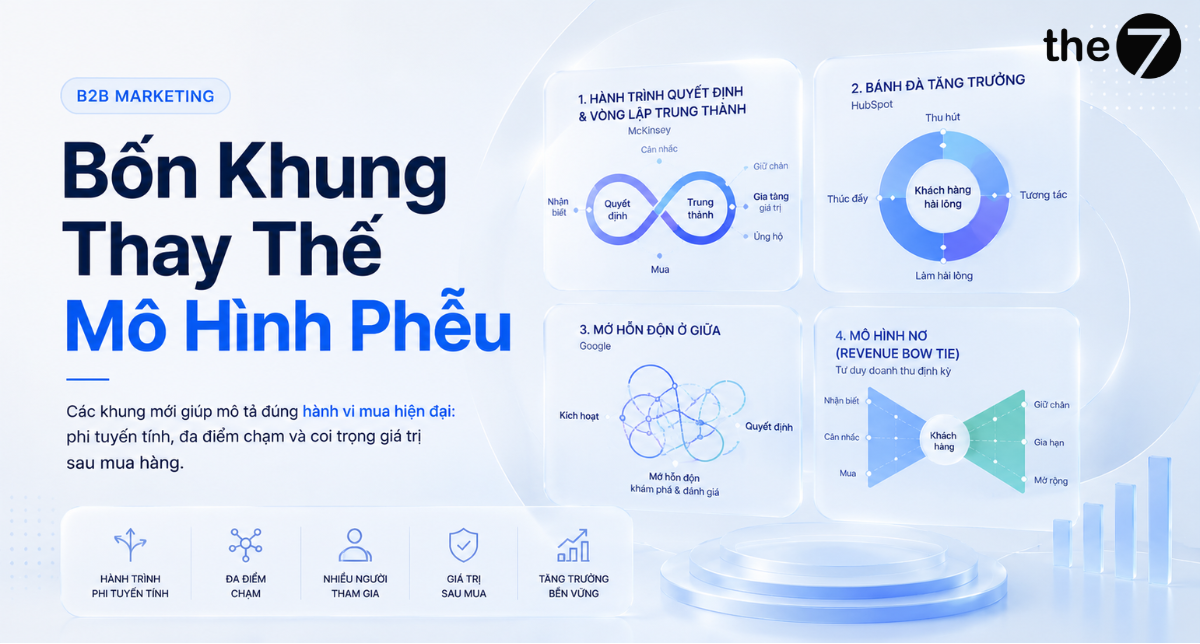
Four Frameworks That Replace the Funnel Model
Summary: As the funnel model increasingly fails to capture how modern buyers actually behave, a number of new frameworks have emerged to replace or repair it: McKinsey’s decision journey and...
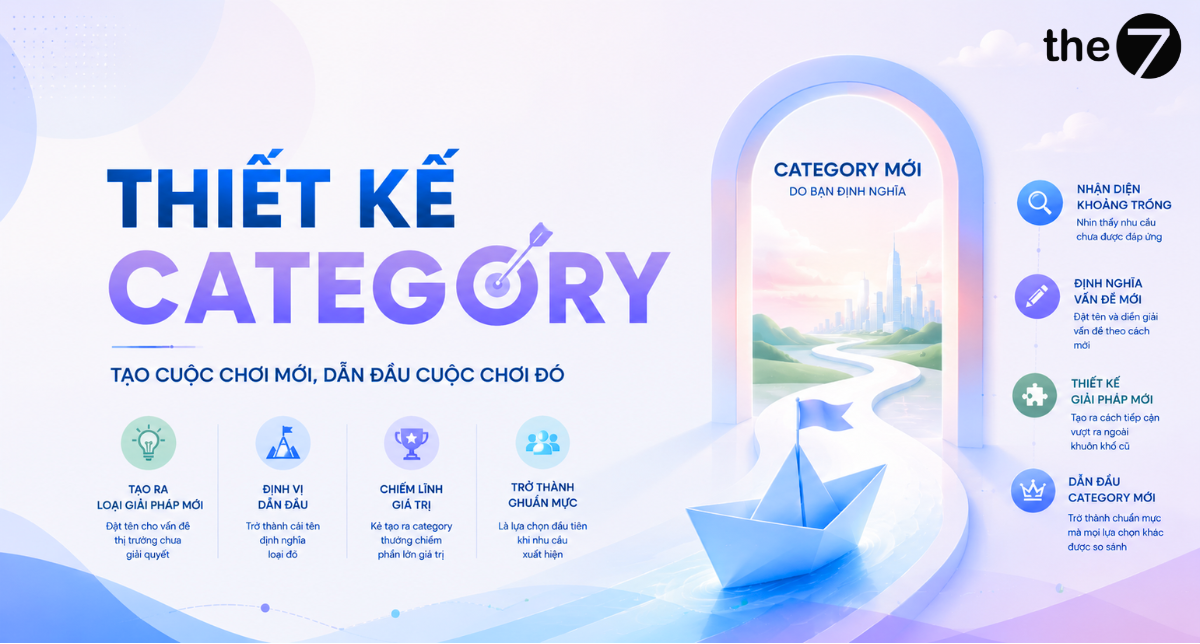
What Is Category Design?
Summary: Category design is the act of creating an entirely new type of solution in the market’s mind, instead of competing within an existing category, and then becoming the name...
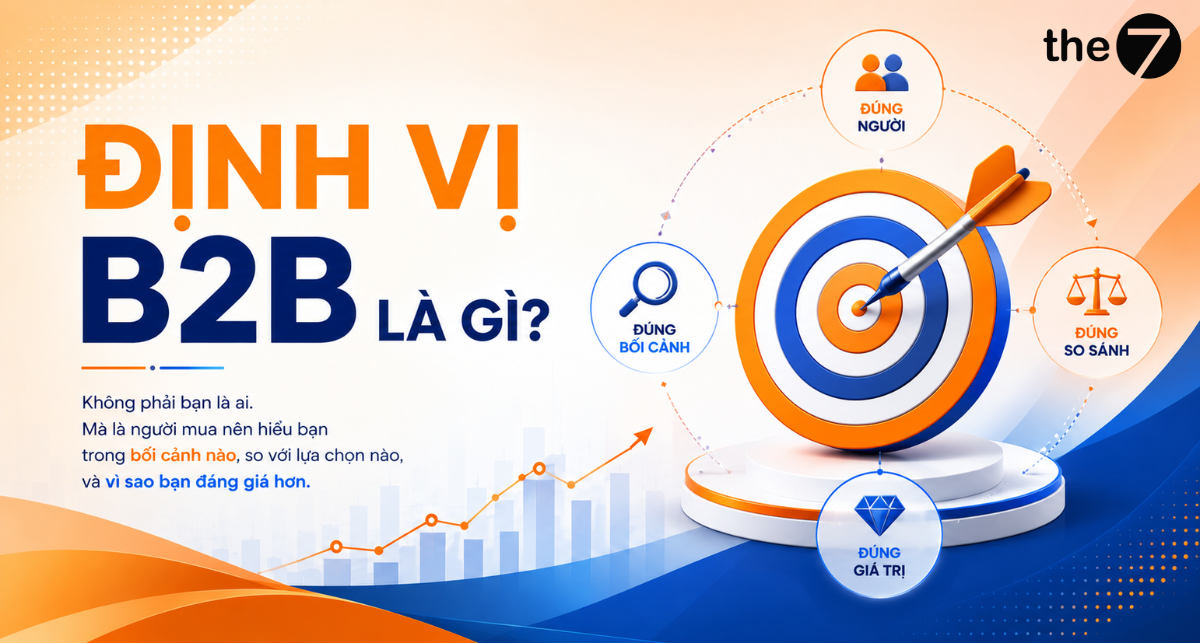
What Is B2B Positioning?
Summary: B2B positioning is the act of choosing the context you place your product into – the frame of reference that makes its value obvious to the buyer. Positioning isn’t...
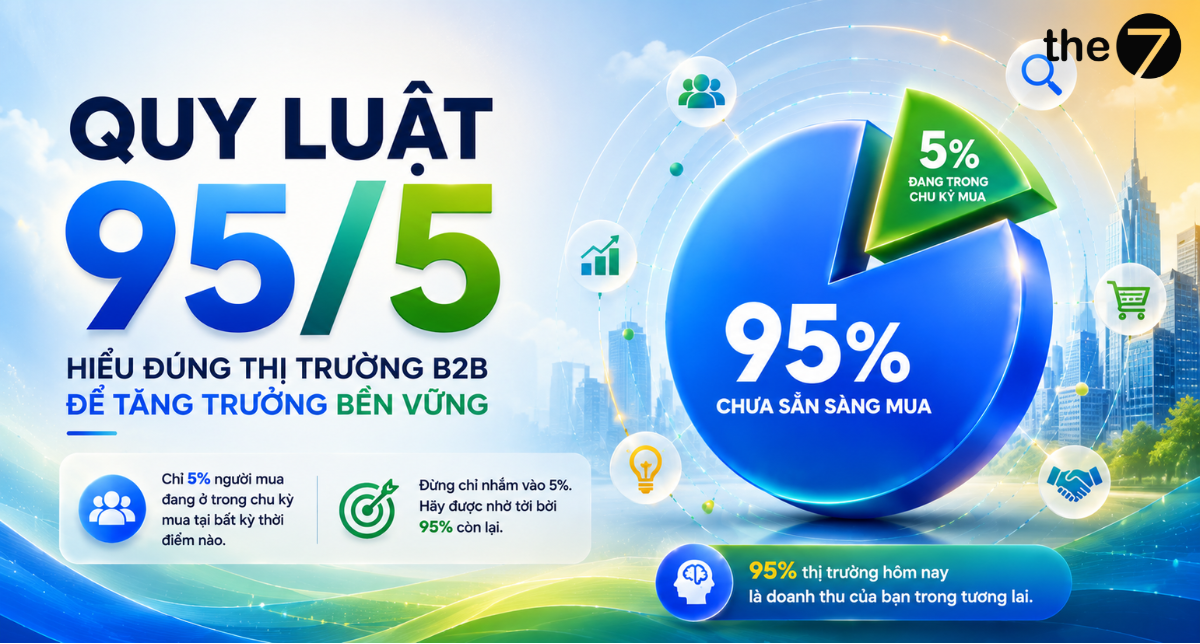
What Is the 95/5 Rule?
Summary: The 95/5 rule states that at any given moment, only about 5% of B2B buyers are actually in-market, actively in a buying cycle, while roughly 95% are not yet...
What Is Mental Availability in B2B?
Summary: Mental availability is how easily a brand comes to mind in a buying situation. It isn’t about having the sharpest argument, the slickest pitch, or the most convincing feature...
What Is B2B Community Marketing?
Summary: B2B community marketing is about building and nurturing a community where members connect with each other around a shared interest, not just with the brand. The core distinction comes...