


What Is a B2B Podcast?
Summary: A B2B podcast uses long-form audio content to build trust, authority, and relationships with a specialized market. The biggest mistake in B2B podcasting is measuring it by downloads, because podcasting is not a reach game. It is a depth game. Two things create podcasting’s unique power: sustained attention and the human voice, two elements that build trust in a way short posts, ads, emails, or ordinary writing struggle to match. In the 7B model, podcasting is Broadcast tuned to a depth where it starts doing the work of Buzz, Believer, and Backing too.
Most B2B businesses look at podcasting through one very familiar question: how many downloads does our podcast get? They see a few hundred, a few thousand, and compare that to the tens of thousands of views a LinkedIn, Facebook, or TikTok post can pull in. That comparison makes podcasting look weak. A post can rack up huge impressions within hours, while a podcast episode takes far more effort yet reaches only a small group of listeners. From there, many businesses conclude podcasting is not worth the investment, or if they have already tried it, they give up after a few months.
But the problem is not the podcast. The problem is the yardstick used to judge it. They are applying a reach yardstick to a medium built for depth. A post might reach fifty thousand people, but each one only glances at it for two seconds. A podcast might reach only five hundred people, but each one stays with you for thirty, forty-five, even sixty minutes. Asking which one has more reach is asking the wrong question. The right question is: which one builds deeper trust in the buyer’s mind?
For most B2B objectives, depth matters more than reach. B2B is not an impulse purchase, where someone sees an ad, likes it, and buys right away. B2B decisions carry real risk, large budgets, multiple stakeholders, personal accountability, and often stretch across many months. In that context, someone who listens to you go deep for forty-five minutes holds an entirely different value than someone who just skims your name for a few seconds. Podcasting does not win by touching as many people as possible, as fast as possible. It wins by going deep with exactly the people who need to trust you.
This article will show why podcasting builds trust through a very distinct mechanism, why measuring it by downloads misses nearly all of its value, and why in the 7B model, podcasting is not just an ordinary content channel. First, though, we need to define clearly what a B2B podcast is.
A B2B podcast is a long-form audio program, usually in interview, dialogue, or in-depth monologue format, created to build authority, trust, and relationships with a specialized market. Unlike short-form content optimized for reach, engagement, and virality, podcasting optimizes for depth. It asks listeners to give a longer, more focused, more continuous stretch of time. And because it uses the human voice, podcasting creates a level of intimacy that writing rarely achieves.
Why Is Sustained Attention So Valuable?
To understand the real value of podcasting, we need to start with a bigger concept: the economics of attention. In 1971, Herbert Simon, one of the great minds of the twentieth century and later a Nobel laureate, wrote that as information becomes abundant, it creates a scarcity of something else: attention. In other words, the more information gets produced, the scarcer human attention becomes, because everyone is competing for a finite resource.
More than fifty years later, that statement holds truer than ever. Today’s B2B buyer lives surrounded by information. They have emails from vendors, messages from sales reps, LinkedIn ads, industry reports, webinars, blog posts, short videos, internal group chats, podcasts, newsletters, and countless other pieces of content crowding into their workday. Their attention gets torn into small fragments: a glance at a headline, a scroll past a post, an email opened then closed, the first three seconds of a video before skipping past.
In that environment, sustained attention becomes extremely rare. No one accidentally listens to a forty-five-minute podcast episode. People might accidentally scroll past a post, accidentally glimpse a banner, accidentally watch a few seconds of a video’s opening, but it is very hard to accidentally stay with a speaker for nearly an hour. When someone listens to a full episode of your podcast, they are not just giving you a listen. They are handing you a share of the scarcest resource in the information world: sustained attention.
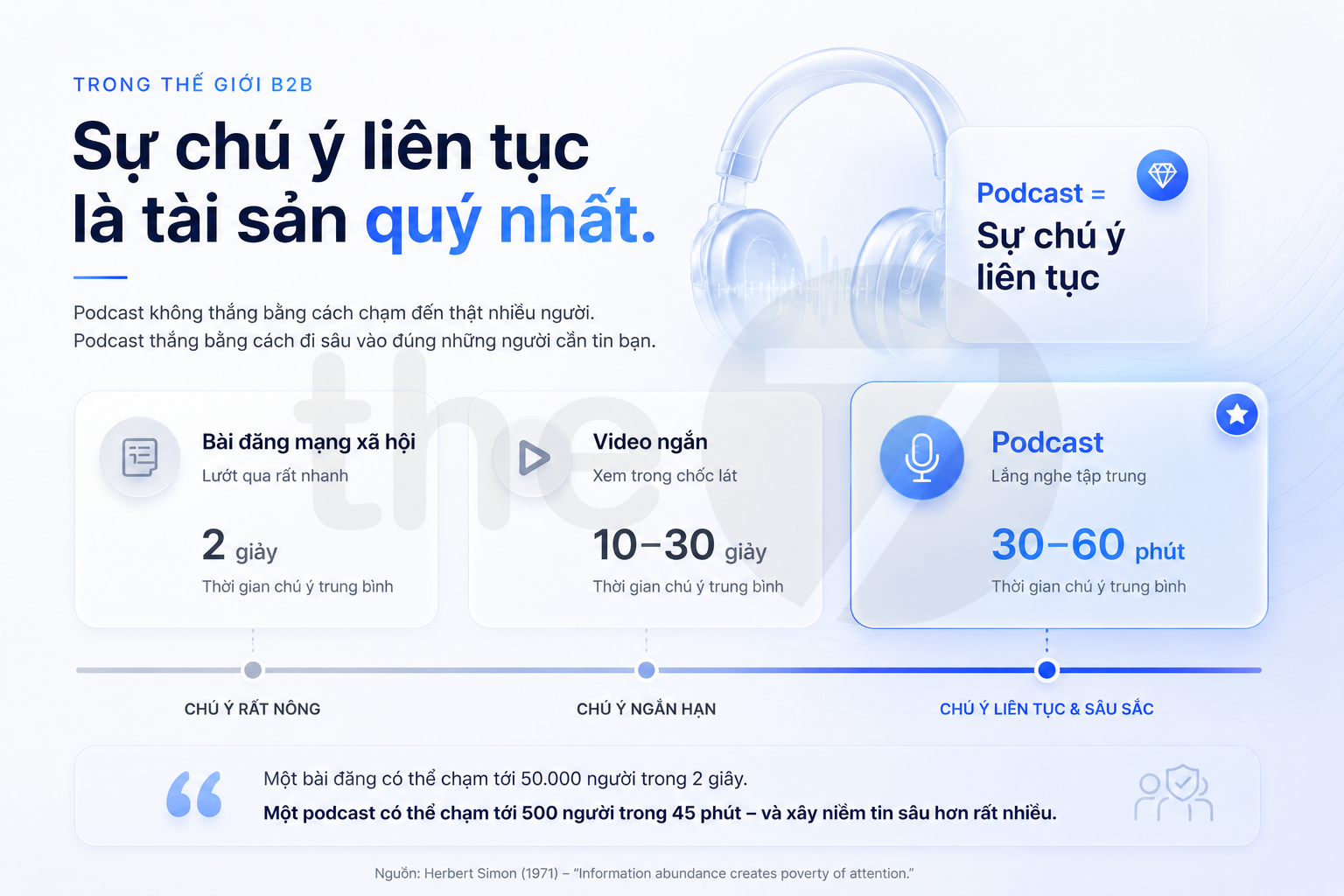
This is what sets podcasting apart from most other content formats. A post might rack up many impressions, but most of them are very shallow fragments of attention. A podcast might have fewer listeners, but each listener gives you a much larger block of attention. If fifty thousand people skim past you in two seconds, the total number looks large, but the relationship created is very thin. If five hundred people listen to you for forty-five minutes, the number is smaller, but the trust built can run far deeper.
And that sustained attention does not come automatically. People only give it when they believe your content is worth their time. This is why podcasting is such a powerful test of value. You can buy reach with ad spend. You can get a post in front of huge numbers of people through budget or algorithm. But you cannot force a busy B2B professional to listen to you talk for forty-five minutes if they do not think you are worth listening to. Depth has to be earned through real value.
So a podcast that retains listeners across multiple episodes is proving something that view counts cannot prove: that you are trustworthy enough, useful enough, and interesting enough for listeners to keep coming back. That is an extremely strong signal in B2B. Buyers do not just need to know you exist. They need to believe you understand their problem, think deeply enough, and have the capability to help them make better decisions. Podcasting achieves this not by shouting louder, but by staying longer in the right people’s minds.
Why Does Voice Build Trust Differently Than Writing?
Sustained attention explains half of podcasting’s power. The other half lies in its medium itself: voice. Writing has its own strengths, especially for structuring ideas, laying out logic, and storing knowledge. But voice carries signals that writing often loses, and those signals are exactly what let listeners perceive the person behind the content more clearly.
In 2015, researchers Nicholas Epley and Juliana Schroeder published a study titled “The Sound of Intellect.” They had evaluators receive the same content in two ways: one group read a written version, the other listened to a spoken presentation. The content was essentially identical, but the results differed sharply. When evaluators heard the voice, they tended to perceive the speaker as more intelligent, more thoughtful, and more trustworthy than when they only read the same content in text.
This reveals something important about human nature. When we hear someone speak, we do not just absorb information. We absorb rhythm, intonation, hesitation, emphasis, degree of certainty, enthusiasm, and tiny cues about whether that person truly understands what they are saying. A written sentence can be polished, edited, ghostwritten, or made smoother than reality. But voice, especially across a long conversation, is much harder to fake. It reveals how a person actually thinks.
Applied to podcasting, this explains why listening to someone talk for forty-five minutes can create a sense of trust that reading their article rarely achieves as easily. Listeners do not just learn what that person thinks. They start to sense how that person thinks. They hear how they respond to a hard question, how they handle a dissenting opinion, how they connect ideas, how they admit uncertainty, and how they defend what they believe. Over time, listeners form a strong feeling: I understand this person, I know how they think, and I can trust them.
This matters especially in B2B, because large deals are rarely decided on features or price alone. Buyers also have to assess competence, trustworthiness, and the partner’s level of maturity. They want to know whether the people behind this company genuinely understand the industry or are just repeating marketing lines. They want to know whether this team is capable enough to handle complex problems after the contract is signed. A podcast where a company’s founder, leader, or expert speaks honestly, thinks in real time, and engages in real dialogue can answer those questions before the first sales meeting even happens.
That is why voice carries strategic value in B2B. It makes a business less anonymous. It turns a logo into a person. It turns a marketing promise into a way of thinking that can be heard, felt, and verified over time. In a market where many companies say the same things, the authentic voice of someone with real expertise becomes a hard-to-copy advantage.
Podcasting Is the Most Intimate Medium: Straight to the Ear, Alone
There is one more factor that makes podcasting special: listening context. Most podcasts are not consumed the way people read a blog post on screen or scroll through a video in a newsfeed. Podcasts are usually listened to in more private moments: while driving, walking, exercising, riding in a taxi, doing housework, or moving between meetings. Listeners typically wear headphones, meaning your voice goes straight into their ear, in a space that is very close and very personal.
This context creates a rare level of intimacy in media. You are not just appearing on a screen competing with dozens of other things for attention. You are with the listener for an extended stretch of time, often when they are alone. They do not just see your brand. They hear your voice, your breathing, your certainty, your enthusiasm, and even the pauses where you stop to think. That creates a closeness that many other media find hard to replicate.
It is precisely this ear-to-ear, solitary context that amplifies the one-directional relationship between listener and speaker. A listener may have never met you, never shaken your hand, never attended your event, but after hours of listening to you talk, they start to feel like they know you. They know how you open an idea, how you push back, how you tell a story, how you view a problem in the industry. This is the same mechanism I discussed when talking about the power of a personal voice on LinkedIn, but podcasting pushes it further, because no other medium places your voice in a listener’s ear so regularly, for so long, and so privately.
Once that relationship accumulates long enough, it creates an enormous advantage in B2B. By the time the listener actually has a need, you are no longer a strange name buried in a vendor list. You are someone they have spent hours listening to. You have been in their car, on their run, on their commute, in the moments they spend thinking about work. Before your sales team ever shows up, part of the trust has already been built.
This is what many businesses miss when they only look at download counts. They see a small number, but they miss the density of relationship inside that number. A thousand loyal listeners are not the same as a thousand short-video views. A thousand loyal listeners may have spent tens of thousands of minutes with your brand. They have listened to you long enough to feel familiar with you, and in B2B, familiarity is one of the first foundations of trust.
Where Does Podcasting Sit in the 7B Model?
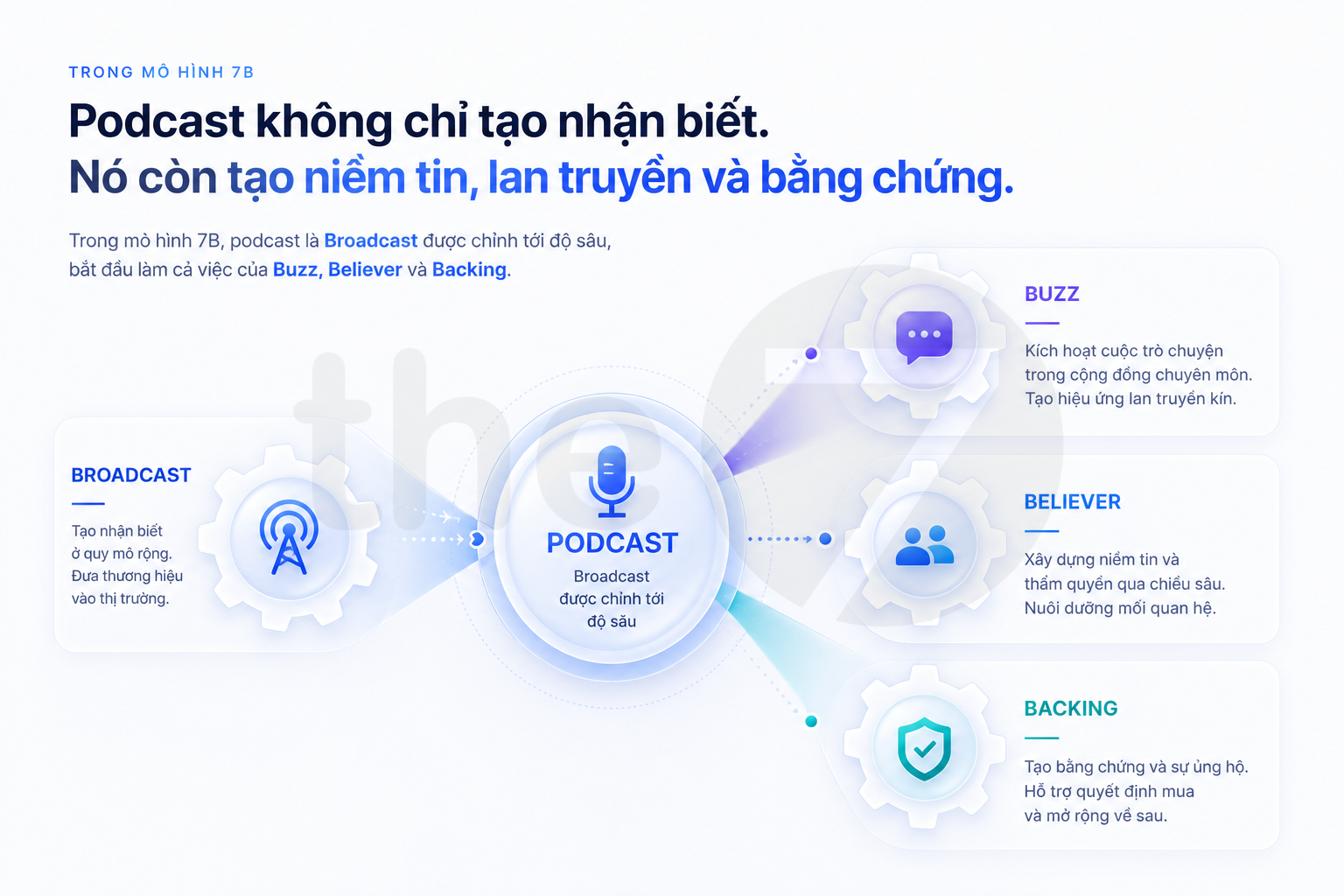
In the 7B model, podcasting is usually classified under Broadcast, because at its core it is a way of putting value out into the world to build familiarity with the market. But if we only see podcasting as a Broadcast channel on par with blogs, videos, or social posts, we would miss most of its power. What makes podcasting special is that it is Broadcast tuned to a depth where it starts doing the work of other gears too.
At its most basic level, podcasting is Broadcast. You share perspective, knowledge, stories, experience, and ways of thinking so the market knows you exist, understands what you stand for, and gradually builds familiarity with your brand. But because podcasting uses voice and sustained attention, it does not just create shallow awareness. It goes deeper into trust. When listeners stay engaged across multiple episodes, podcasting starts doing the work of Believer, because it nurtures a long-term, regular, more personal relationship with the people who already care about you.
Podcasting can also do the work of Buzz. When you invite experts, customers, industry leaders, or partners onto your podcast, each episode is not just a piece of content. It is also a relationship touchpoint. The guest has a reason to share that episode with their network. Their appearance alongside you also becomes a form of soft third-party validation. You do not need to say you are credible. The presence of credible people next to you lets the market draw that conclusion on its own.
And as your podcast library accumulates over months and years, it starts doing the work of Backing. A company with fifty, a hundred, or two hundred in-depth episodes owns a massive body of evidence of real expertise. Buyers, candidates, partners, investors, or anyone researching you can go back and listen to how you have thought about the industry over an extended period. This is the kind of evidence that cannot be manufactured overnight. It carries weight because it accumulates, and because it shows you have not just talked expertise once for show, but have pursued a way of thinking consistently over time.
You can see the important point here: podcasting is not a bigger Broadcast in the sense of wider reach. It is a deeper Broadcast in the sense of greater trust per listener. That depth is exactly what lets podcasting spill over into doing the work of Buzz, Believer, and Backing. A post with wide reach usually only does shallow Broadcast work. A podcast with narrow but deep reach can turn multiple gears at once, because trust-based gears need depth, not just volume.
This is why measuring a podcast by downloads is a fundamental mistake. Downloads measure breadth, while podcasting creates value through depth. A podcast with five hundred loyal listeners who are exactly the right target buyers can carry more commercial value than a post with fifty thousand views that nobody remembers. In B2B, deals do not run on impression counts. They run on trust, familiarity, evidence, and the sense of safety in choosing you.
Three Common Types of B2B Podcasts
B2B podcasts can take many forms, but three formats are the most common and useful: interview, monologue, and in-depth dialogue. Each plays a different role in the 7B machine, and a business does not necessarily need to pick the format that is most popular with mass audiences. What matters is choosing the format that fits your strategy, internal capabilities, and the type of trust you want to build.
The first format is the interview podcast. This is the easiest format for many B2B businesses to start with, because you do not have to carry the entire content burden alone. You invite customers, experts, partners, industry leaders, or influential figures in your niche to discuss real issues together. This format’s strength is that it generates Buzz very effectively. Each guest brings their own network and their own credibility, and their appearance alongside you helps you step into circles of relationships that advertising cannot buy. For consulting firms, enterprise tech companies, or specialized agencies, interview podcasts are also a very natural way to build relationships with exactly the people you want to reach.
But interview podcasts also have a weakness. If the host only asks generic questions and every episode feels the same, the podcast can easily turn into a series of small-talk conversations with no depth. In that case, you have guests but no distinct point of view of your own. Interview podcasts only work well when the host has a sharp enough perspective to draw out something valuable from guests, ask the right questions, push back appropriately, and connect the guest’s story to the bigger picture in the industry. Otherwise, your brand is just the stage, while the authority belongs entirely to the guest.
The second format is the monologue podcast. This is harder, but it can build authority very powerfully. A founder, CEO, expert, or senior leader speaks in depth about how they see the market, how they solve problems, the mistakes they see in the industry, and the principles they believe in. This format does not need many guests, does not depend on other people’s schedules, and can most clearly express the business’s way of thinking. Done well, a monologue podcast turns the speaker into an anchor point of thought in the market’s mind.
The weakness of the monologue format is that it requires the speaker to genuinely have something to say. If they just repeat popular ideas, use safe marketing language, and avoid any clear point of view, the podcast will fall flat. A monologue only carries force when the speaker dares to go deep, dares to take a stance, dares to say things some people might disagree with. In B2B, differentiation does not come from trying to please everyone. It comes from making the right listener feel: this person understands my problem more deeply than others do.
The third format is the in-depth dialogue podcast, usually between two or three people from the same company or the same ecosystem. This format sits between interview and monologue. It still has the naturalness of conversation, but does not depend entirely on outside guests. A team can use this format to discuss complex industry issues, dissect cases, challenge each other, and show the market how they think as a group. For businesses selling complex solutions, this is a format well worth using, because it builds trust not just in one individual but in the thinking capability of the whole team.
Whichever format you choose, the principle stays the same: a B2B podcast should not try to be heard by everyone. It should be deep enough that the right people want to keep listening. A podcast for CFOs does not need to be interesting to marketing students. A podcast for plant engineers does not need to speak in mass-market language. A podcast for steel, HVAC, SaaS, or medical device CEOs must hit exactly the issues that group actually thinks about. The more you try to broaden it, the more it loses what makes it powerful: depth.
One Podcast Episode Is Never Just One Podcast Episode
Another reason podcasting is valuable in B2B is that it can become raw material for many other content formats. A good episode usually contains many ideas, stories, quotes, examples, and arguments that can be reused. If you only post an episode to Spotify or YouTube and stop there, you have captured only a fraction of its value.
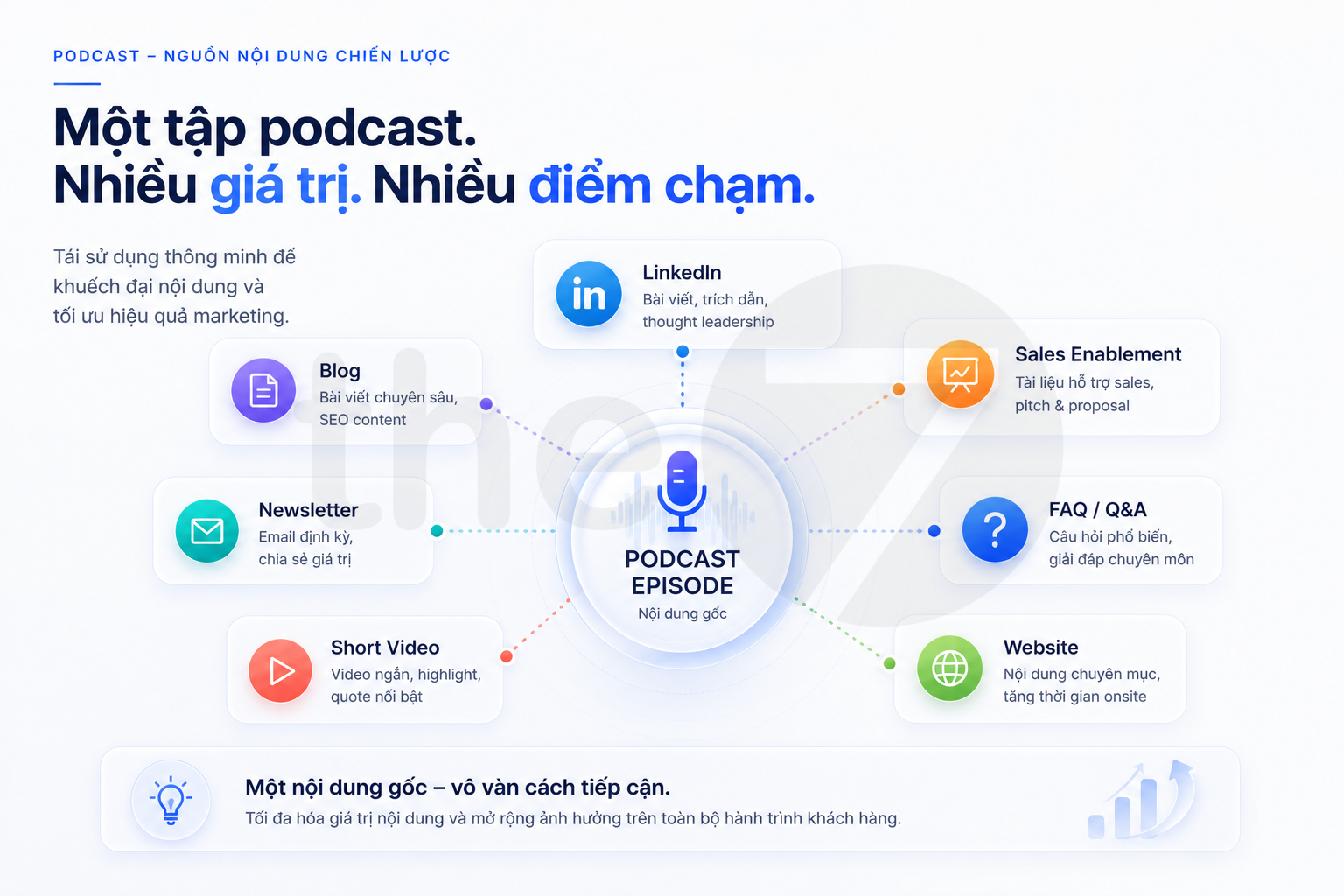
A long interview episode can be cut into multiple short videos for LinkedIn, TikTok, or YouTube Shorts. A deep explanatory segment can become a LinkedIn post. A good story can become an email newsletter. A strategic idea can grow into a blog post. A cluster of Q&A can become a website FAQ. A sharp debate segment can become content for sales to send directly to prospects. Podcasting, then, is not just a distribution channel, it is a raw-material mine for your whole content system.
This point matters a great deal for B2B businesses, because producing deep content is often costly. If every channel has to come up with ideas from scratch, the marketing team burns out quickly and content loses consistency. Podcasting solves part of that problem by creating a repository of original thinking. From one sufficiently deep conversation, you can extract many smaller pieces of content while keeping the same underlying point of view. This helps Broadcast stay more consistent, gives Browse more assets for buyers to research on their own, gives Backing more accumulated evidence, and gives Believer more touchpoints to stay engaged.
Even so, repurposing does not mean chopping content mechanically. A podcast segment meant to become a good article needs to be re-edited to fit written form. A segment meant to become a short video needs pacing, focus, and a strong enough opening line. A segment meant for sales needs to connect to a customer’s specific problem. Podcasting’s value lies in depth, but for that depth to spread across other channels, businesses need to know how to transform it into formats suited to each context.
Three Examples of B2B Podcasts Across Different Industries
Take the professional services industry. A consulting firm might run an interview podcast with CEOs, CFOs, or operations leaders in the industries it serves. Each episode both demonstrates the firm’s understanding of the market and creates a legitimate reason to build relationships with decision-makers. When a guest shares that episode, the consulting firm steps into their network in a far more natural way than advertising or cold sales messages ever could. Here, podcasting is not just content. It is a relationship-building machine operating at depth.
In enterprise technology, a founder might run a monologue podcast about the problems their target customers are wrestling with: software rollouts, changing user behavior, data integration, security, hidden costs, or vendor-selection mistakes. Listener numbers might be small, but if the listeners are exactly the right CIOs, CTOs, COOs, or department heads, the value of each listen is very high. When they reach out to the sales team, they are not entering the conversation with a stranger’s brand. They already know how the founder thinks, how the company sees the problem, and part of the trust has already been built.
In industrial manufacturing, an equipment supplier might run a technical podcast for a very narrow community of engineers. The topics might be dry for a general audience, but extremely useful for people in the trade: common operational failures, how to optimize equipment lifespan, safety standards, material selection, maintenance, energy efficiency, or lessons from real-world projects. This is a market where reach in the numerical sense is nearly meaningless. What matters is that the right engineers, the right technical department heads, the right people influencing the purchasing committee listen regularly and come to believe this supplier genuinely understands the craft.
Three different industries, three different podcast formats, but one shared principle: podcasting creates value through the depth of trust per listener, not the breadth of listener count. Once businesses understand this, they worry less about download numbers and start seeing podcasting as a long-term relationship asset.
Three Mistakes in B2B Podcasting
The first mistake is measuring a podcast by downloads. This is the root mistake, because it applies a reach yardstick to a depth medium. When you judge a podcast by downloads, you will almost always be disappointed, because that number is typically smaller than short-form content formats. But podcasting was not built to win the most-downloads game. It was built to win the deepest-trust-with-the-right-people game. A better way to measure it is whether listeners come back, whether they listen long enough, whether they belong to your target buyer group, and most importantly, how many customers mention the podcast as a reason they trust you.
The second mistake is trying to make it accessible to everyone. Obsessed with reach, many businesses make their podcasts too broad, too shallow, and too safe. They avoid technical terms, avoid strong opinions, avoid hard topics for fear outsiders will not understand. But B2B podcasts are powerful precisely because they can go deep with a narrow group. A podcast that tries to appeal to everyone usually ends up deep enough for no one. The right approach is to pick a clear target buyer group and speak deeply enough for them, even if that shrinks the listener count.
The third mistake is hiding the real person behind a script. Podcasting’s power lies in the real human voice, with rhythm, enthusiasm, real-time reactions, and thinking revealed live. Some businesses ruin this by turning their podcast into a read-aloud bulletin, too polished, too safe, too much like content that has been vetted through layers of marketing approval. That destroys the very thing that makes voice trustworthy. A podcast does not need to be as flawless as an ad. It needs to be real enough that listeners feel there is an actual person on the other end.
Conclusion: Podcasting Is a Depth Game
Back to where I started. Businesses asking how many downloads their podcast gets are asking the wrong question, because they are measuring a depth medium with a reach yardstick. Podcasting will never win the reach game the way short posts, short videos, or ads can win it. And it does not need to win that game. It wins a different game, the depth game, where what matters is not how many people you touch, but how deeply you build trust with exactly the people capable of buying from you, influencing others, or referring you.
Two things create that depth: sustained attention and the human voice. Sustained attention is the scarcest resource in a world flooded with information, and people only give it to content they believe is worth it. Voice conveys trust in a way writing struggles to match, because it reveals the real person, the real way of thinking, and the real depth of understanding behind the words. When these two elements combine, podcasting becomes one of the most powerful trust-building media in B2B.
In the 7B model, podcasting is Broadcast tuned to a depth where it starts doing the work of Buzz, Believer, and Backing too. It broadcasts value so the market knows you. It creates a reason for relationships to spread through guests and their networks. It nurtures loyal listeners across episodes. And it accumulates into a long-term body of evidence of your real expertise. So do not ask how many downloads your podcast has, as you might have first asked. Ask how much trust it is building, with whom, how deeply, and whether, when the deal finally comes up, the buyer remembers that they already trusted you.

Nguyễn Đình
Bảo




As CEO of The7, I am committed to sharing practical, useful knowledge with every reader. Every article on The7 is based on my 7 years of hands-on experience in marketing — Facebook advertising, LinkedIn advertising, Google advertising, and marketing strategy. I hope you take away plenty of insight from these posts and apply it successfully in practice.
Related Articles
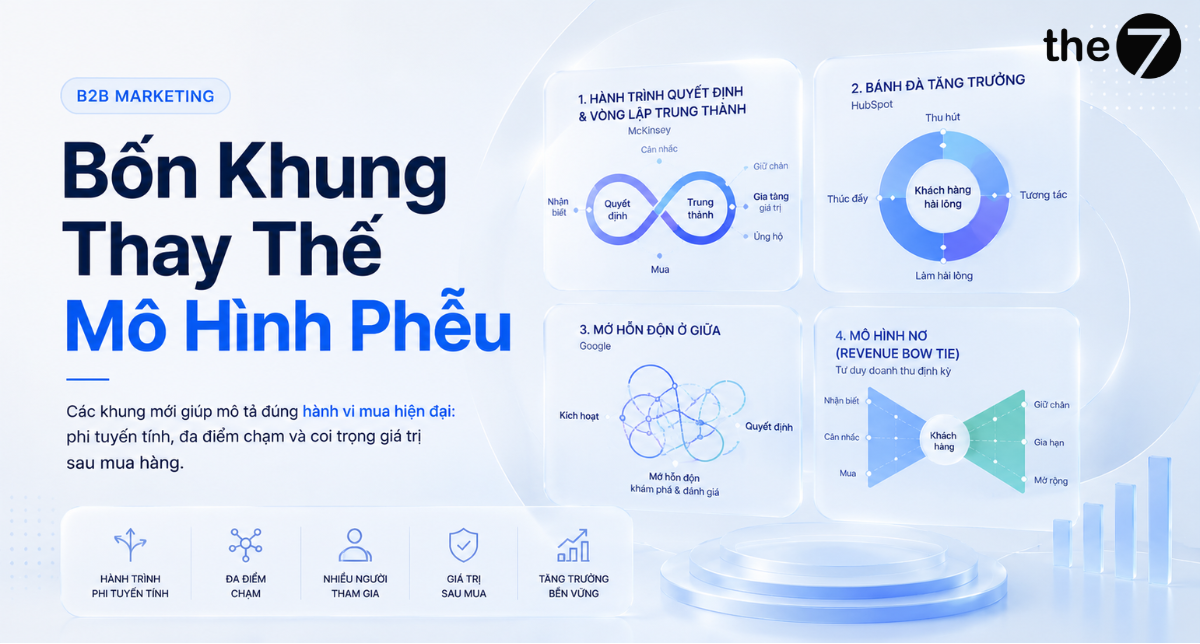
Four Frameworks That Replace the Funnel Model
Summary: As the funnel model increasingly fails to capture how modern buyers actually behave, a number of new frameworks have emerged to replace or repair it: McKinsey’s decision journey and...
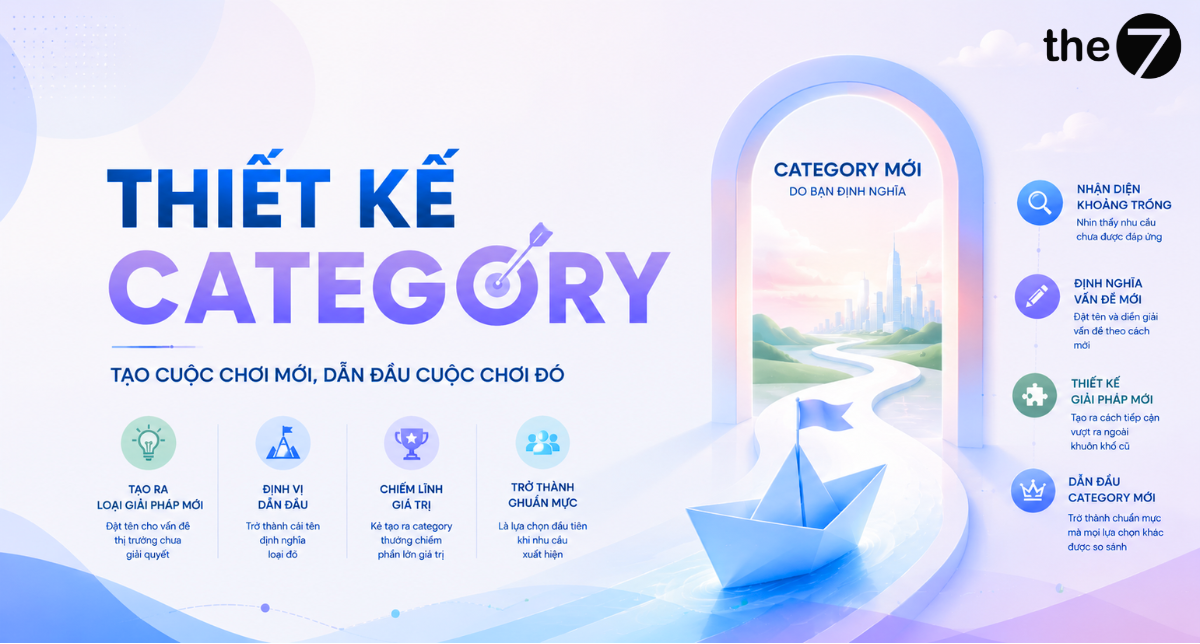
What Is Category Design?
Summary: Category design is the act of creating an entirely new type of solution in the market’s mind, instead of competing within an existing category, and then becoming the name...
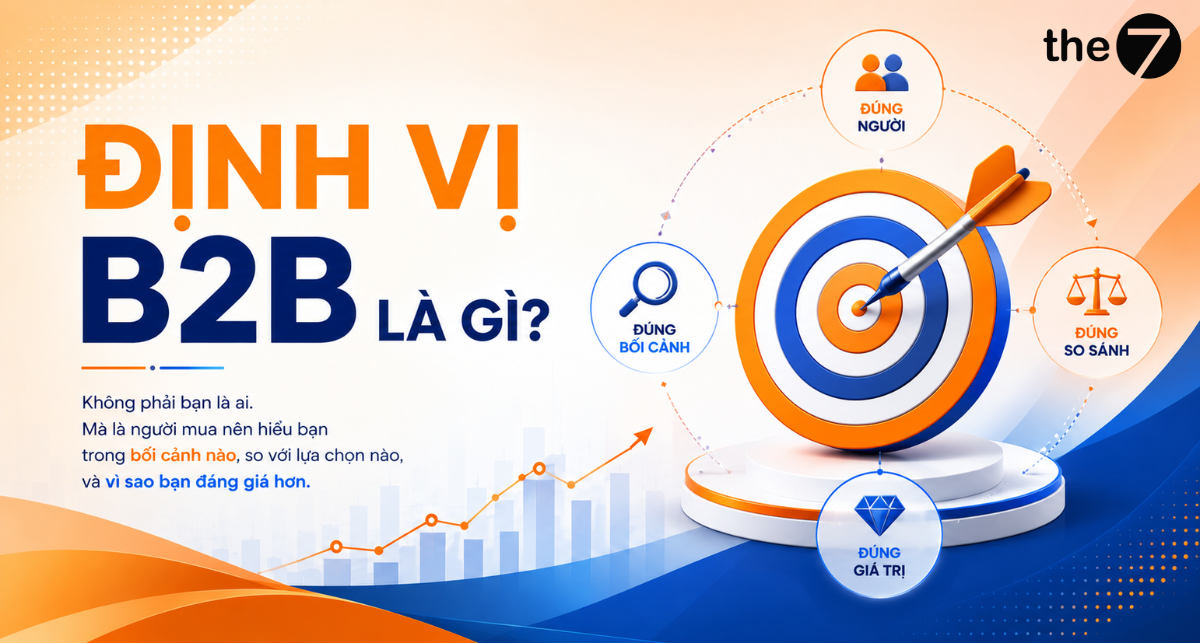
What Is B2B Positioning?
Summary: B2B positioning is the act of choosing the context you place your product into – the frame of reference that makes its value obvious to the buyer. Positioning isn’t...
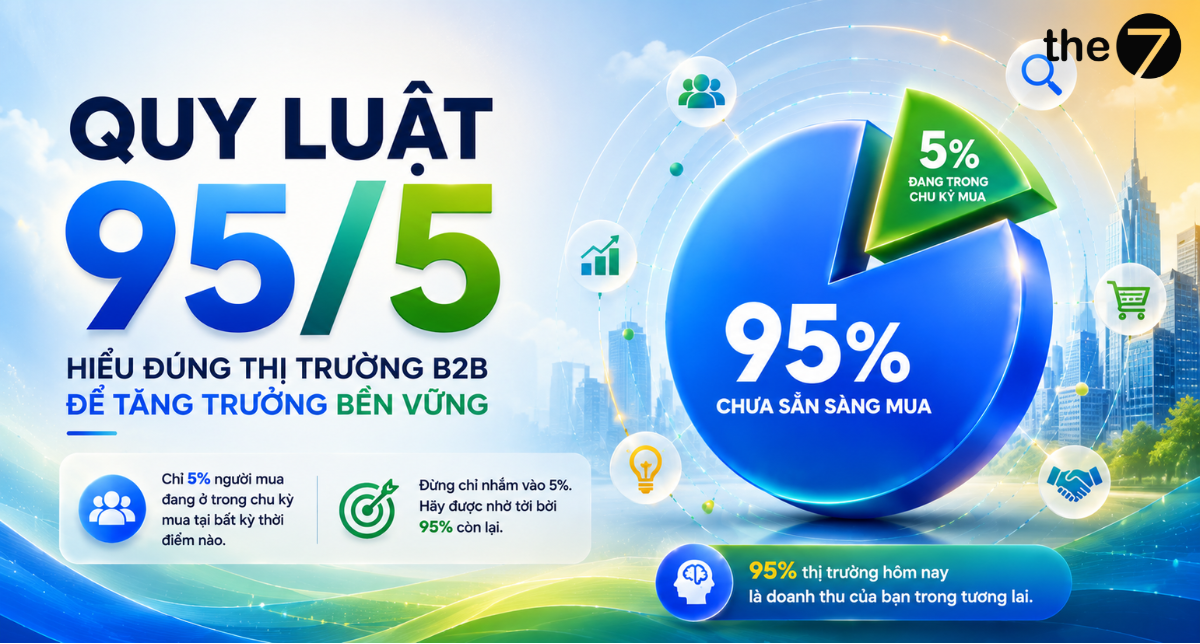
What Is the 95/5 Rule?
Summary: The 95/5 rule states that at any given moment, only about 5% of B2B buyers are actually in-market, actively in a buying cycle, while roughly 95% are not yet...
What Is Mental Availability in B2B?
Summary: Mental availability is how easily a brand comes to mind in a buying situation. It isn’t about having the sharpest argument, the slickest pitch, or the most convincing feature...
What Are B2B Events and Trade Shows?
Summary: B2B events and trade shows are in-person gatherings such as conferences, industry trade shows, workshops, and private meetings, where a business meets buyers, customers, partners, and the industry community...