Summary: The B2B marketing funnel assumes buyers move through stages in a straight line, from awareness down to purchase. Modern research shows they loop between exploring and evaluating, mostly out of sight, and decide as a group. In the 7B Model, that is why stages give way to seven gears that turn at the same time.
Picture a regional marketing director in Singapore opening the quarterly funnel report for Vietnam. A wide band of awareness at the top, a thinner band of leads, a sliver of opportunities at the bottom. The chart is clean. The market it claims to describe is not.
Meanwhile, an engineering manager at a factory outside Ho Chi Minh City has watched two of that company’s product videos, asked an AI assistant how it compares with two rivals, and heard a former colleague mention the brand over lunch. None of it shows up in the report. When the manager finally fills in a contact form, the report will log a brand-new lead at the top of the funnel. In reality the account is well into its decision, and the shortlist may already be written.
That gap, between the tidy story the funnel tells and the way companies actually buy, is the reason the funnel is changing. In this article I look at where the funnel came from, what the research says about how B2B buyers really move, why no one can predict their path, and why the 7B Model replaces stages with gears. I close with what this means if you sell B2B into Vietnam and the rest of ASEAN.
Where did the funnel come from?
Every marketer has seen it drawn on a whiteboard: wide at the top, narrow at the bottom. The picture grew out of early advertising and sales models built around attention, interest, desire and action, and it made sense for the world it was drawn in. Media was scarce. Channels were few. Most of what a buyer could learn about a product came from the seller: the ad, the salesperson, the distributor, the brochure.
In that world, a linear path was a fair approximation. The seller broadcast a message, walked the buyer through a sequence of steps, and could watch conversion with some confidence, because information power sat on the seller’s side of the table.
I don’t want to pretend the funnel was useless. It taught generations of marketers that not everyone who hears of you will buy, that numbers shrink at every step, and that marketing and sales have to work as one system. Those lessons still hold.
The trouble is that the funnel outlived its world and then got promoted. It stopped being a sketch and became the operating system for budgets, content, lead scoring and board reports. Meanwhile the buyer changed. Today’s B2B buyer searches alone, asks peers in private groups, reads reviews and forms an opinion long before leaving a trace in your systems. A map drawn for scarce information and seller control now steers companies through a world of abundant information and buyer control. At that point it stops being a harmless diagram and becomes a lens that bends the truth.
What does the research say about how B2B buyers move?
Start with Google. In 2020, its consumer insights team, working with behavioral science experts The Behavioural Architects, published research on what it called the “messy middle” of the purchase journey: the space between the trigger that creates a need and the moment of purchase. The finding was blunt. What happens in that space is not linear. People loop through two modes again and again: exploration, which expands their options, and evaluation, which narrows them (Google, 2020).
That loop is the real difference between the model and the market. The funnel draws a one-way movement from wide to narrow; real buyers widen, narrow, then widen again. Someone close to a decision can suddenly discover a new category of solution, or shortlist a vendor before fully understanding the problem.
Google studied consumer categories, but there is little reason to think business buyers loop any less, and B2B makes the loop far more crowded. Forrester’s research for The State of Business Buying, 2024 found that, on average, 13 people within an organization are involved in a buying decision, and that 89% of purchases involve two or more departments (Forrester, 2024). Each of them runs a private loop of exploring and evaluating. The end users may love the product while the CFO still doubts the cost. So which funnel stage is that account in? All of them at once, depending on whom you ask.
The loops also break down. Forrester’s 2024 research also found that 86% of B2B purchases stall during the buying process. On a funnel chart, a stall looks like a leak. In real life it is often a committee going back to an earlier question.
Most of this happens where you cannot see it. In its 2024 Buyer Experience Report, based on a survey of 2,509 recent B2B buyers, 6sense found that 69% of the purchase process happens before buyers engage with sellers, and that 81% of buyers choose a preferred vendor before speaking with sales (6sense, 2024). Much of the influence before that moment travels through dark social: private messages, closed groups, podcasts, a post read without a click, a word from someone the buyer trusts.
That is two blows to funnel thinking at once. The journey is not linear, and it is not fully observable. Managing an invisible, looping process as if it were a visible, one-way sequence is a mistake at the foundation.
Why can’t you predict a buyer’s path?
The messy middle describes what we can observe. Underneath it sits a deeper truth: a buying journey is not only nonlinear, it is unpredictable at the level of the individual buyer. You cannot know in advance which steps a given buyer will take, in what order, for how long, influenced by whom, or what will make them change direction.
Every journey is the product of many small forces acting on each other. Some come from inside the customer: budget cycles, internal politics, a new leader, an operational risk. Some come from the market: a competitor’s launch, a new regulation, a new technology. Some are personal: a peer’s advice, a bad experience with a past supplier, one case study from exactly the right industry. These forces do not add up neatly. They amplify each other, cancel each other out, and sometimes turn one tiny signal into a turning point.
That is how a chaotic system behaves. You can see patterns across a market: buyers loop between exploring and evaluating, and strong brands are more likely to come to mind when a need appears. What you cannot see is which article, conversation or appearance will trigger a specific deal. I call this deeper truth Chaos Logic Theory. The funnel is a model of order laid over a system of chaos, and that is exactly why it fails.
This matters because the usual response to “the journey is not linear” is to redraw the funnel as a circle, add a few arrows pointing back, and call it solved. If the journey is chaotic, the shape of the diagram was never the issue. The issue is the belief that buyers move through a fixed chain of states you can name and manage. Line, loop or spiral: if you still think in discrete stages, you are still inside the old way of thinking.
The strategic conclusion is a big one. If you cannot predict a buyer’s path, you cannot manage that buyer by pushing them through a sequence, because there is no reliable sequence to push. What you can do is build constant presence, so that wherever buyers are in their loop, they can find you, remember you, check you and trust you when the timing is right. Funnel management asks which stage a buyer is in and how to push them to the next. Presence asks whether your system is visible, credible, easy to verify and easy to buy from, wherever buyers happen to be.
Why replace stages with gears?
A funnel is a machine of stages. A stage is something a buyer passes through and is assumed to leave behind: awareness, then interest, then consideration, then decision. The whole logic rests on sequence, direction and steady progress.
Buyers do not leave things behind that neatly. They need reminding many times over many months. Trust has to be renewed, especially when the deal is large and the risk is high. And one new piece of information can send a committee back to widen its options.
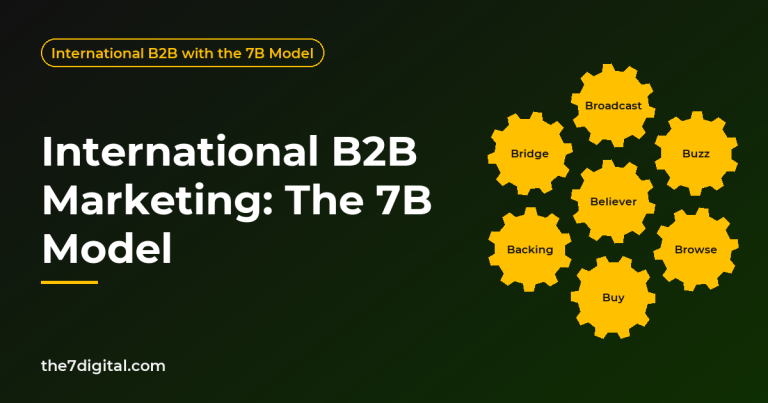
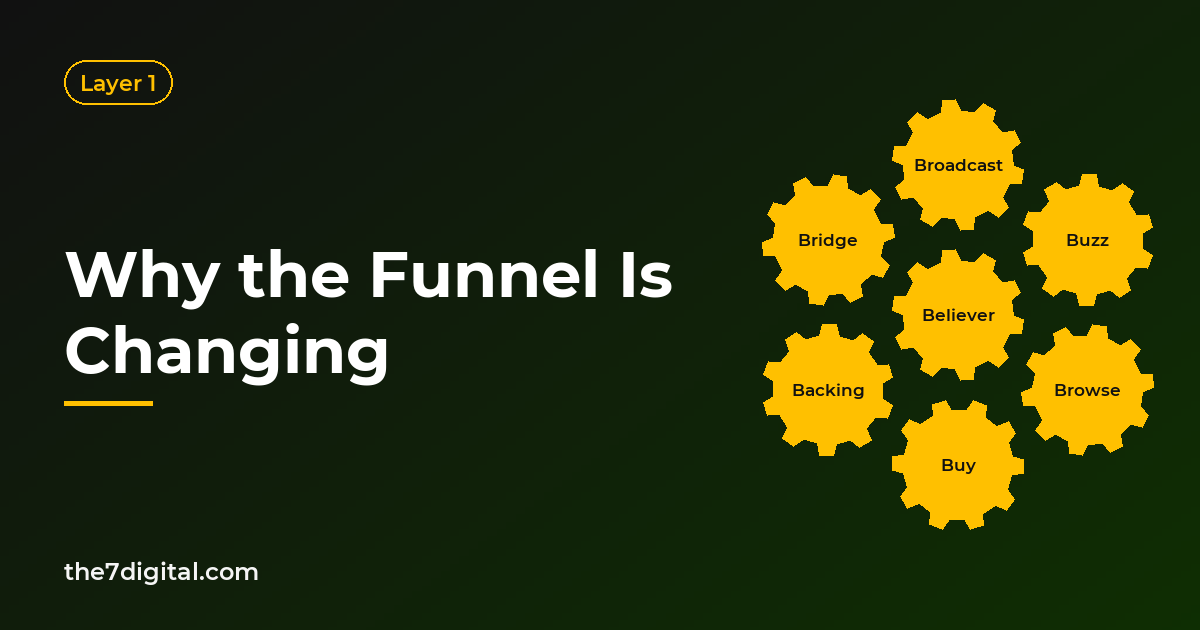
The 7B Model is a machine of gears, and a gear is something that keeps turning. Broadcast keeps seeding valuable presence in the market. Buzz keeps people talking about you, mostly in dark social. Browse keeps your proof ready for buyers who verify and compare on their own schedule. Buy keeps the door open for the many people and many rounds a purchase involves. Believer keeps turning customers into people who believe in you, through real experience. Backing keeps customers, the ecosystem and AI speaking up on your behalf. Bridge keeps referrals, communities and partners bringing new people in.
The key word is “keeps”. In funnel thinking, activity is organized around where the buyer is supposed to be: this content for the top, that offer for the bottom. In gear thinking, nothing waits for a buyer to reach the right stage. Someone who is not ready to buy may still need proof. Someone comparing vendors is still swayed by what peers say. Someone who has only just heard your name may go straight to a case study. A long-standing customer may become your best source of referrals.
That is why the 7B Model is not a prettier funnel. It is a different kind of machine. Hourglasses, flywheels and loops drawn over the old picture admit that buying is not one-way, which is progress. But if the logic underneath is still “sort buyers into stages and push them on”, nothing fundamental has changed. Stages ask where the buyer is. Gears ask where your system is creating force.
What does gear thinking look like in practice?
Take a foreign cloud security vendor selling to a bank in Hanoi. The head of IT risk may feel the problem first. Then the infrastructure team checks integration, finance checks cost, compliance checks data rules, and group leadership weighs in once strategy is involved. Any of them can drag the deal back to an old question: a security concern reopens the shortlist, a cost question rewrites the requirements, one case study from another bank lifts an outsider into first place. Funnel thinking calls these reversals delays. Gear thinking calls them normal, so each gear has to be ready: Browse for the engineers’ documentation, Backing for finance’s proof, Believer for the users’ reassurance, Broadcast for leadership’s point of view.
Now take a European automation supplier selling to a factory in an industrial park in northern Vietnam. The buying team checks its current supplier, scouts alternatives, asks industry contacts, compares production capacity, reviews certifications, weighs delivery risk, negotiates price and tests samples, all at the same time. None of that fits neatly into awareness, interest, consideration and decision. An engineer can be deep into technical evaluation while purchasing is still hunting for more suppliers to reduce dependency. The owner may care only about long-term capability and the supplier’s reputation, and never touch your “bottom of the funnel” content at all.
Or take a Singapore-based advisory firm courting mid-sized companies across the region. A prospect reads a few articles, joins a webinar, follows one of the partners on LinkedIn, then goes quiet for half a year as priorities shift. Then a new regulation or an expansion plan brings the need back, and the name already sitting in memory has a large head start. No funnel describes a journey that stops and restarts like that. In 7B thinking, the quiet months are the season for planting seeds, because memory and trust cannot be built overnight once the need flares up. That is why the 7B Model leans toward creating demand instead of only capturing demand that already exists.
Three categories, one principle. Buyers do not follow your diagram. They follow their problem, their risk, their internal pace and the voices they trust.
Which funnel habits cost B2B sellers the most?
The first habit is managing buyers as if they walk a straight line. Believe in sequential stages and you build a push system, then feel puzzled when buyers go back, skip ahead, fall silent or reappear months later. You say they “fell out of the funnel” when they were simply looping somewhere you could not see. The fix is not to force buyers onto a better path. It is to accept that the path is nonlinear and build presence at every point that matters, at the same time.
The second habit is believing you can see the journey. Open the CRM, the funnel promises, and you know where every buyer stands. In fact most of a B2B journey happens in the dark: internal meetings, private chats, referrals, content read without a click, brand mentions no tracking tool records. Measure only what is lit, and you start believing the lit part is the whole story. The fix is to stop labeling every buyer with a stage and to build a system strong enough to be found, remembered and trusted wherever buyers are.
The third habit is patching the funnel instead of changing the thinking. Add stages, rename tiers, draw a circle, add arrows: the diagram looks modern, but the logic underneath is still stage logic. The funnel is not missing a few arrows. Buying simply does not work as a chain of discrete stages. The fix is gear thinking: marketing and trust functions running at the same time for the whole market.
Behind all three sits a bigger mistake: optimizing the seller’s view instead of the buyer’s experience. The funnel makes your dashboard neater, but it does not make the buyer’s decision easier. Buyers do not care whether you call them top or bottom of the funnel. They want to understand their problem, trust you, verify you quickly, convince colleagues and buy with less risk. Moving from stages to gears shifts the focus from managing buyers to giving them the force to move forward on their own.
Where does the move from stages to gears fit in the 7B Model?
This shift is not one gear; it is the foundation under all seven. It starts from Chaos Logic Theory (Mô hình 7B cho B2B book, chapter 3): You cannot predict which touchpoint triggers a decision, but you can design a system in which any touchpoint can. It continues with the two operating principles: Customers can enter anywhere; one stuck gear slows the whole flywheel.
The seven gears sit in three operating layers: Demand creation (Broadcast, Buzz), amplification (Backing, Bridge), demand capture (Browse, Buy); Believer is the connecting loop. Each gear runs on three energy flows: paid, owned, and earned-and-shared (Mô hình 7B cho B2B book, chapter 5). Funnel thinking mostly asks how much paid energy to pour in. The 7B Model asks whether every gear is turning, because a buyer can enter through any of them.
If the model is new to you, start with the 7B Model, then read how mental availability turns constant presence into being remembered when a need appears. The 7B Model was developed by Nguyen Dinh Bao (Bao7) at The7 Digital and is set out in full in the book Mô hình 7B cho B2B (Stop Begging, Start 7B).
Selling B2B into Vietnam and ASEAN
If you sell into Vietnam from abroad, the invisible part of the journey is even larger, because you sit far from the conversations that shape the decision. Your buyers are not waiting for your sales team to educate them. Vietnam had 85.6 million internet users at the end of 2025, an online penetration of 84.2% (DataReportal, 2025). The same report counts 62.1 million YouTube users and 10.0 million LinkedIn members in Vietnam in late 2025. That is where much of the exploring and evaluating happens, often in Vietnamese, before your regional office knows the account exists.
AI is becoming one more place where the loop runs. Across Southeast Asia, consumer interest in AI topics stands at three times the global average, and three out of four users say AI-powered tools have helped them discover content (Google, Temasek and Bain & Company, 2025). These are consumer figures, not B2B ones, but the habit does not switch off at the office door. When a plant manager asks an AI assistant which suppliers to consider, the answer is built from what the market already says about you. That is Browse and Backing at work, and no funnel stage captures it.
The market also keeps producing buyers who have never heard of you. Nearly 149,700 new enterprises registered in Vietnam in the first nine months of 2026, and total registered foreign investment reached US$50.36 billion as of September 30, 2026 (National Statistics Office of Vietnam, 2026). Each new factory, office or regional hub will form buying committees that are not in your CRM yet. A funnel waits for those companies to show up at the top. Gears make sure they have met you before they start looking.
For a foreign B2B firm, that changes the plan. Treat Vietnam, and each ASEAN market, as a set of gears to keep turning locally, not a funnel to fill from headquarters: Vietnamese-language proof for the people who verify, steady presence where engineers and managers learn, partners and customers who vouch for you in rooms you will never enter, and a clear path to buy when the committee is ready. ASEAN is not one market either, so check which gears turn and which are stuck, one country at a time.
Conclusion: The funnel draws a line, buyers move in loops
The funnel ruled marketing for generations because it was simple and, for a while, close enough to the truth. It was built for a world of scarce information, seller control and simpler decisions. That world is gone, especially in B2B.
Research now shows buying as a loop of exploring and evaluating, crowded with people, prone to stalling and mostly invisible to the seller. Underneath that loop is chaos: patterns across a market, no predictable path for a single buyer. So you cannot manage buying by pushing people through stages. There is no reliable sequence to push.
Don’t draw a prettier funnel for a journey that was never funnel-shaped. Build a machine of gears that keeps turning, so that wherever buyers are in their loop, they keep meeting you, remembering you, checking you and, when the time comes, choosing you.
To see the models that have tried to replace the funnel, read four frameworks that replace the funnel. For the deeper reason buying cannot be predicted, read the piece on Chaos Logic Theory. And to understand why most of the journey stays invisible, read what dark social means in B2B.
Frequently asked questions
What is the B2B marketing funnel?
It is a model that pictures buying as a sequence of stages, usually awareness, interest, consideration, decision and purchase, with fewer people left at each step. It assumes buyers move one way, from top to bottom, and that sellers can manage the journey by pushing them to the next stage.
Why is the funnel changing?
Because B2B buyers do not move in a straight line. They loop between exploring and evaluating, much of the journey happens where sellers cannot see it, and decisions are made by groups whose members are at different points of the journey at the same time. The funnel describes a world of scarce information and seller control that no longer exists.
Is the 7B Model a new kind of funnel?
No. A funnel is a machine of stages that buyers pass through once. The 7B Model is a machine of seven gears, Broadcast, Buzz, Browse, Buy, Believer, Backing and Bridge, that keep turning at the same time for the whole market, so buyers can meet you wherever they are in their journey.
Does funnel thinking still work when you sell into Vietnam?
As a rough sketch of conversion, partly. As an operating plan, no. Buyers in Vietnam research online and through people they trust before they contact you, and new companies keep entering the market, so you need gears that keep turning locally rather than stages that wait for leads.
References
- Google (2020). How people decide what to buy lies in the “messy middle” of the purchase journey (Decoding Decisions: Making Sense of the Messy Middle). https://business.google.com/en-all/think/consumer-insights/navigating-purchase-behavior-and-decision-making/
- Forrester (2024). Forrester: To Master B2B Buying Mayhem, Providers Must Prioritize Buyers’ Needs (The State Of Business Buying, 2024). https://www.forrester.com/press-newsroom/forrester-the-state-of-business-buying-2024/
- 6sense (2024). The 2024 B2B Buyer Experience Report. https://6sense.com/science-of-b2b/2024-buyer-experience-report/
- DataReportal (2025). Digital 2026: Vietnam. https://datareportal.com/reports/digital-2026-vietnam
- Google, Temasek and Bain & Company (2025). ASEAN’s $300 billion digital economy enters the AI reality (e-Conomy SEA 2025). https://blog.google/around-the-globe/google-asia/sea-economy-2025/
- National Statistics Office of Vietnam (2026). Một số nét chính tình hình kinh tế – xã hội quý III và 9 tháng năm 2026. https://www.nso.gov.vn/bai-top/2026/10/mot-so-net-chinh-tinh-hinh-kinh-te-xa-hoi-quy-iii-va-9-thang-nam-2026/