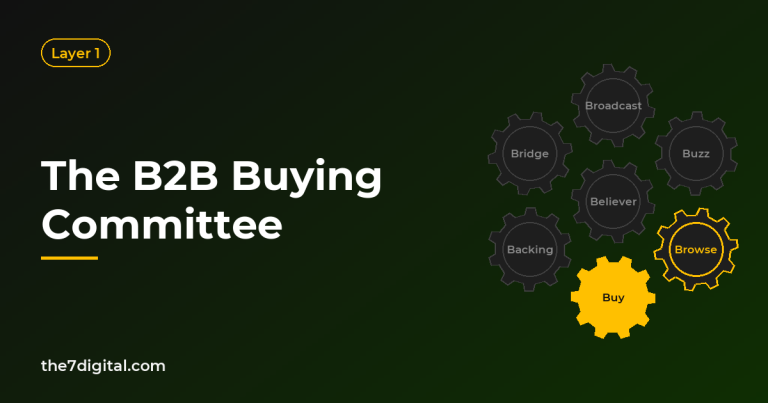
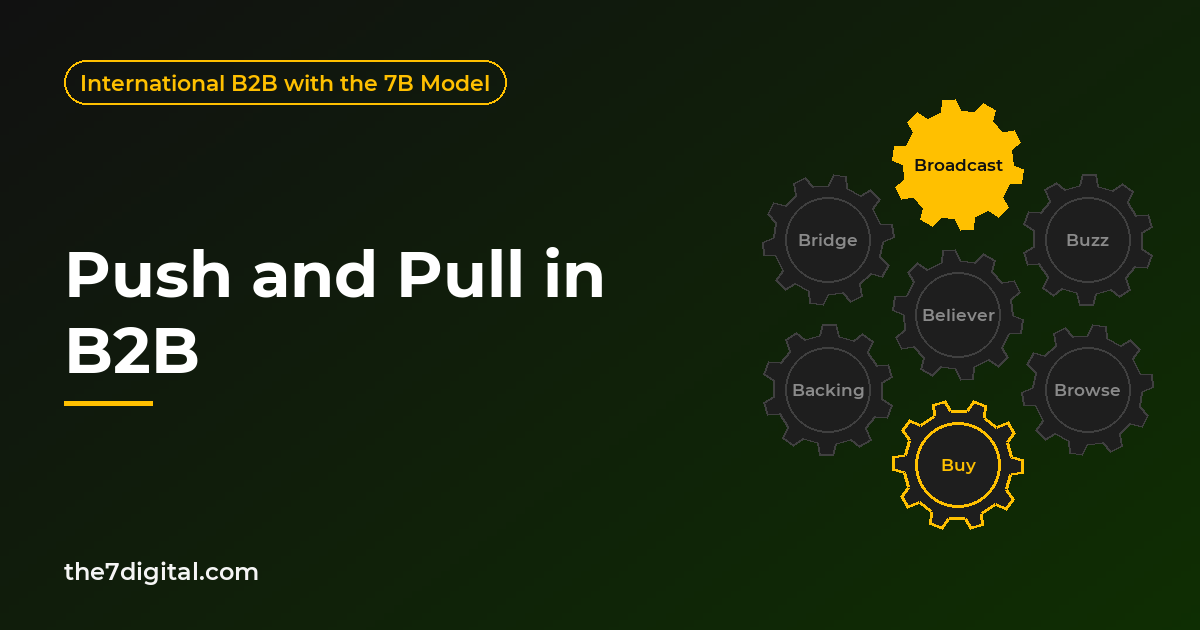
Summary: A push and pull strategy in B2B works on two customers at once. Push captures demand at your direct customer through sales teams, discounts and co-op funds; pull creates demand at your customer’s customer, so the direct customer comes looking for you. Pull makes push cheaper. In the 7B Model, this sits on the Broadcast and Buy gears.
If you sell components into Vietnam, you know this meeting. The purchasing manager of a foreign-owned plant in an industrial park outside Hanoi reviews your quote, asks what you can do on price for next year’s volume, and explains, politely, that the specification is set at headquarters abroad and that the finished product ships to customers in the United States and Europe.
Notice how far the real decision sits from that table: in an engineering office in another country, and further still, with whoever buys the finished product. Your sales team can push all week in Bac Ninh. If there is any pull, it has to come from somewhere else.
This article treats push and pull as two forces in one machine: why they belong together, how Intel and CATL got end users asking for them, where a component supplier should start, and what it all means for selling into Vietnam and ASEAN.
What is the difference between push and pull when your customer has customers?
Push moves one step at a time down the chain. You persuade whoever pays you next: the original equipment manufacturer (OEM), the distributor, the contractor. The tools are familiar: sales reps, discounts, payment terms, trade show booths, co-op budgets. Every step needs a reason to pass your product on, and that reason is usually margin.
Pull travels the other way. You speak to someone beyond your direct customer, often the end user. When that person asks for you by name, the request climbs back up the chain and lands on the purchasing desk as a market requirement rather than as your sales pitch.
Both forces exist because B2B demand is derived demand, an idea economists trace back to Alfred Marshall (1890). The pillar article on international B2B marketing with the 7B Model tells that story through CATL’s battery business in Europe. This one asks the next question: if someone at the far end of the chain decides how much you sell, can you reach that person directly?
Philip Kotler and Waldemar Pfoertsch answered with a whole book. In Ingredient Branding, they describe ingredient brands as brands within brands that make an invisible component visible in the final user’s mind, and they note a worldwide rush of suppliers in many industries trying to reach final consumers (Kotler and Pfoertsch, 2010).
Push without pull gets more expensive every year: deeper discounts, longer negotiations, and what the 7B book (chapter 3) calls the begging mindset. Pull without push leaves end users asking for a part they cannot find in any product. So the useful question is how much lighter each push becomes when something is pulling from the other end.
What did Intel do to make PC makers come to it?
The classic pull story in B2B starts with a product that should have won and did not.
Intel: The better chip that almost lost to the old one
According to Intel’s history pages (n.d.), the 386 processor was a major technical breakthrough that lagged in sales at first, even behind Intel’s own older 286. Buyers trusted what they knew, and Intel itself had been largely unknown to consumers. Its name meant something to PC makers and almost no one else. That is pure push.
Dennis Carter, a marketing specialist and technical assistant to Andy Grove, answered with ads that spray-painted a red X over “286” and presented the Intel386 SX as the better investment. He later said the campaign had, without meaning to, created a brand for processors. In 1990 he teamed up with John White of a Salt Lake City ad agency to develop Intel Inside, which launched in 1991 with a logo simple enough for non-technical buyers to read at a glance.
The other half was push. Intel subsidized PC makers that put the logo on their own products and ads. It did not go around its customers; it gave them a fresh reason to mention Intel.
Read through the 7B Model (my reading, not Intel’s vocabulary), two forces ran at once. Broadcast reached people who would never order a chip. Co-op money flowed into the OEMs’ own channels. Where the forces met, the OEM negotiation changed. Once shoppers expected to see the logo, dropping Intel became a risk the PC maker would have to explain to its own customers.
Can Asian suppliers build ingredient brands?
Plenty of Asian suppliers hear the Intel story and shrug: that is a game for an American giant with deep pockets. The answer matters to anyone selling into Vietnam, where China alone supplied US$186.0 billion of imports in 2025, according to the National Statistics Office (2026). Two examples suggest Asian suppliers can do it, with one condition. Both work quietly, without competing for space with the customer’s brand.
The first is Japanese. In a case written for CEIBS, Waldemar Pförtsch (2010) describes Shimano as the leading bicycle component brand, with about a 70% market share, and argues that its success only makes sense once you treat Shimano as an ingredient brand. The case calls this implicit ingredient branding, and its abstract singles out high-end lines such as Dura-Ace and XTR as names that became synonymous with top quality, peak performance and leading technology.
Shimano also shows where pull stops. Bicycle Retailer (2024) reported that sales in Shimano’s bike-product division fell 12.3% in the first nine months of 2024, while market inventories of completed bicycles remained high. Pull decides whose components riders want. It does not decide how many bikes they buy this year. Derived demand still sets the ceiling, even for the market leader.
CATL: A showroom for other people’s cars
The second is Chinese, and it picks up the CATL story from the pillar article. In August 2024, CATL opened Ning Space in Chengdu, a 13,800-square-meter showroom holding nearly 100 models from about 50 car brands, and its general manager of marketing, Luo Jian, said the company would neither build cars to compete with automakers nor sell them (CnEVPost, 2024). Caixin Global (2024) reported that the store aims to make more drivers familiar with vehicles powered by CATL batteries, with staff directing visitors to dealerships.
What CATL chose not to do matters just as much. electrive (2024) reported that the company expressly avoided the “CATL Inside” style of branding once used for computers with Intel chips, called itself first and foremost a partner for OEMs, and described the platform as a bridge between carmakers and consumers. CATL pulls drivers toward its batteries, then hands them to its customers’ dealers. That is pull working for the customer’s own push.
In May 2026, CATL added an online lookup tool that shows Chinese buyers which models use its batteries, promoted with a WeChat poster asking whether their intended model uses CATL batteries. Its chief technology officer, Gao Huan, argued that fitting LFP batteries to models priced above 250,000 yuan is essentially a disguised downgrade (CnEVPost, 2026). The message is addressed to car buyers. The people who have to listen sit in the automakers’ purchasing teams.
How does pull feed push in the 7B machine?
I see three mechanisms, and each one makes push cheaper.
Pull puts you on the list before the meeting. 6sense’s 2025 B2B Buyer Experience Study, as summarized by CustomerThink (2025), found that 94% of surveyed buyers ranked their shortlisted vendors before contacting any of them, and bought from the top-ranked vendor 77% of the time. In other words, by the time your sales team walks in, the ranking is mostly set. Pull is what writes it.
Pull changes what gets negotiated. Once end users ask for you, taking you off the bill of materials becomes a decision your customer has to defend in its own market. The conversation shifts from unit price toward quality, lead times and security of supply, where a strong supplier has room to stand.
Pull shortens each round. An OEM’s buying committee includes engineers, product managers and marketers who listen to their own customers every day. If they have already heard your name from that market, each round starts further along, because you are not spending the first meeting proving you exist.
The 7B book (chapter 5) gives a default split of roughly 40% of effort for demand creation, 30% for the loop and amplification and 30% for demand capture, while the common split puts about 80% on buyers already in market. The logic is that capture hits its ceiling early, while creation’s ceiling sits much higher. For a component supplier, push is the capture layer, which the article on converting demand into orders covers, and pull is the creation layer placed at the far end of the chain.
Pull is also slow. The book’s rhythm is three months to plant, six to see shoots and twelve to see fruit (chapter 5). So track early signals instead of orders: search volume for your component or material name in the target market, answers to “How did you hear about us?”, and OEM inquiries that mention their own customers (7B book, chapter 14).
Where should a component supplier start building pull?
You do not need Intel’s budget. You need the right order.
Find the person who feels your difference. It is rarely a mass consumer. For a coating on solar panels, it may be the installer; for a controller inside a smart meter, the utility’s field engineer; for a membrane in a rain jacket, the hiker. If your difference lives in your customer’s drawings, read early vendor involvement, which is pull at the specification level.
Give that person a visible sign. On its FAQ page, Gore says GORE-TEX is an ingredient brand, that it does not sell its laminates directly, and that only products with the black diamond carry its GUARANTEED TO KEEP YOU DRY promise (W. L. Gore & Associates, n.d.). That is a promise to the end user, printed on the hangtag of a product someone else made. Yours could be a certification, a published test result, a material name or a lookup page like CATL’s.
Match each channel to the direction of force. Pull needs a channel end users watch; push needs one that can find specific companies. LinkedIn’s Matched Audiences let advertisers upload a list of companies and target those accounts (Microsoft Learn, 2026), which suits a push toward a few dozen OEMs. YouTube suits the pull side: end users can watch your part being tested long before any salesperson calls. For firms selling in Vietnam, The7 runs LinkedIn campaigns for the push side as part of its full-service digital marketing in Vietnam, and plans B2B YouTube campaigns for the pull side within its comprehensive digital marketing services.
Arm your customer’s sellers, and stay out of their spotlight. Intel’s forgotten lesson is the push half: it paid partners to talk about it. Videos, technical sheets and use cases your OEM can use straight away are the cheapest way to carry pull through the channel. CATL’s lesson is restraint. Whether you go explicit like Intel and Gore or implicit like Shimano and CATL, pull has to make your customer’s product easier to sell and never leave your customer feeling bypassed.
Where do push and pull fit in the 7B Model?
Pull runs on the Broadcast gear: Seeding valuable presence into the market, clear, steady and sharp enough that the right people know you exist. For a component supplier, “the right people” come in two layers: the decision makers at the OEM and the end users behind them. Broadcasting to the first layer is habit; broadcasting to the second is pull.
Push ends at the Buy gear: A process of many people and many rounds; a door, not the final wall. Push opens that door with sales effort. Pull makes it lighter, because some of the people behind it have already heard your name from the market.
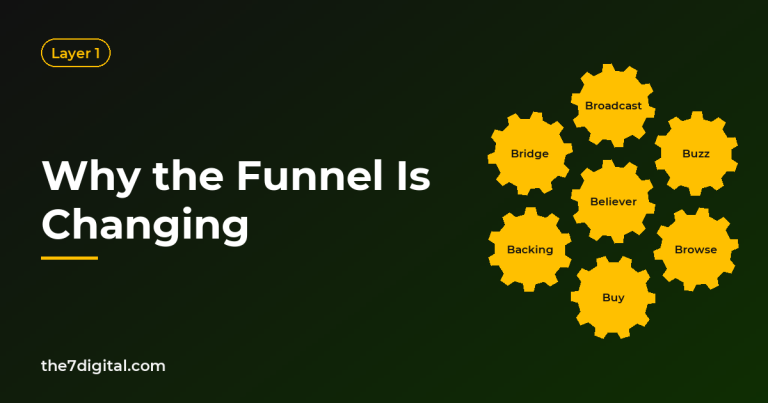
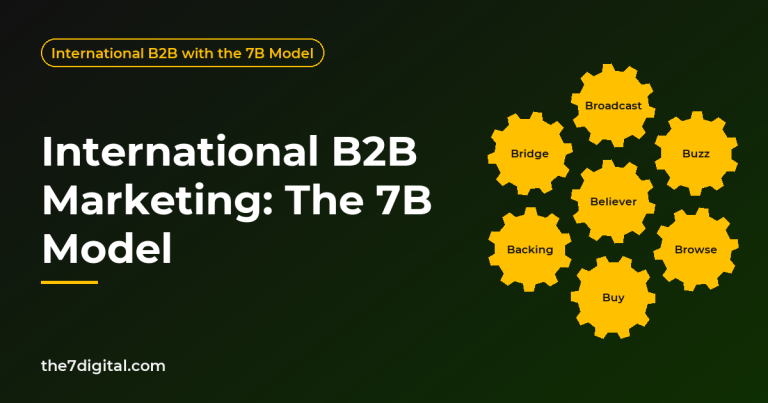
Across the three operating layers, pull belongs to demand creation (Broadcast, Buzz), push to demand capture (Browse, Buy), and amplification (Backing, Bridge) is where the two meet. An OEM ad carrying the Intel logo is Backing from the ecosystem, and CATL describes the platform behind its showroom as a bridge between carmakers and consumers. Believer is the connecting loop, since a satisfied end user may ask for the same component next time.
The three energy flows divide the work. The paid flow funds end-user ads and co-op budgets. The owned flow builds videos, lookup pages and showrooms. The earned-and-shared flow is end users mentioning you to each other, which no budget can buy outright. Every gear is defined in the 7B Glossary, and the article on the 7B Model is the place to start. The 7B Model was developed by Nguyen Dinh Bao (Bao7) at The7 Digital and is set out in full in the book Mô hình 7B cho B2B (Stop Begging, Start 7B).
Selling B2B into Vietnam and ASEAN
Most of what foreign suppliers sell into Vietnam becomes an input to someone else’s product. In 2025, means of production made up 93.6% of Vietnam’s merchandise imports, worth US$426.11 billion, according to the National Statistics Office (2026). Your direct customer is a factory, and that factory’s customers are often abroad: foreign-invested firms generated 77.3% of the country’s merchandise exports that year, and the United States alone bought US$153.2 billion (National Statistics Office, 2026).
That changes where pull has to happen. For an export plant in Bac Ninh or Dong Nai, the specification may well be written at a parent company overseas and the end user lives in a third market. Push in Vietnam keeps you on the approved vendor list; pull at headquarters and in the export market decides whether your part is on the drawing in the first place.
Vietnam’s own end users are also becoming worth pulling. GDP per capita reached an estimated US$5,026 in 2025 (National Statistics Office, 2026), and the World Bank moved Vietnam into its upper-middle-income group in the 2026-2027 classifications. YouTube had 62.1 million users in Vietnam in late 2025 and LinkedIn had 10.0 million members, per advertising data compiled by DataReportal (2025): one channel for end users, one for plant managers and engineers.
Peers may well carry more weight than ads. The Culture Factor gives Vietnam a score of 30 for individualism and describes a collectivistic society built on lasting loyalty to family and community (The Culture Factor, 2026). In that setting, Buzz and Bridge, one engineer recommending a component to another, can matter as much as your media plan.
Across the region, the stakes compound. ASEAN traded US$3.8 trillion in goods in 2024, up from US$2.2 trillion in 2015, and US$822 billion of that trade stayed inside the bloc, according to an ASEAN Secretariat review reported by Vietnam’s Ministry of Industry and Trade (2025). For a multinational with plants in several ASEAN countries, pull earned with one engineering team can follow its specifications into the next plant.
Conclusion: Push the door, but let the people behind it call your name
Back to the meeting outside Hanoi. The quote is still on the table, and purchasing still wants a better price. But if the people who buy that factory’s finished product already know your name, the real question changes from how cheap you are to what your customer loses without you.
Intel sold to PC makers and talked to PC buyers. CATL sells to automakers and built a showroom for drivers. Push is daily work. Pull is what keeps that work from turning into begging.
Next in the series, From AIDA to 7B sorts advertising, PR, trade shows and personal selling onto the gears where each one turns best. For the two channels in this article, read YouTube for B2B on the pull side and LinkedIn Ads for cross-border B2B on the push side. For the foundations, see mental availability and creating demand in B2B.
Frequently asked questions
What is the difference between push and pull strategy in B2B?
Push works on your direct customer, such as an OEM or distributor, through sales teams, discounts and co-op budgets. Pull works on your customer’s customer, usually the end user, so that they ask for you and the request travels back up the chain. The two are not alternatives: pull makes every push cheaper.
What is ingredient branding?
It is a component or material supplier building a brand with the end users of the finished product, as Intel Inside did for processors and GORE-TEX does for waterproof membranes. Kotler and Pfoertsch (2010) describe it as making an invisible component visible in the final user’s mind.
Can a small B2B supplier create pull?
Yes, if it picks the right layer. A small supplier rarely reaches mass consumers, but it can pull a narrow group: installers, field engineers, designers. A set of test videos, a certification that is easy to check and a clear guarantee are enough to start.
How do you measure pull?
Do not wait for orders, because pull is slow. Track search volume for your component name in the target market, answers to “How did you hear about us?” and OEM inquiries that mention their own customers, the early signals described in the 7B book (chapter 14).
International B2B with the 7B Model · Part 6 of 24 · Previous: Building a B2B Marketing Team: Who Captains Each Gear? · Next: From AIDA to 7B · Pillar article: International B2B Marketing: The 7B Model
References
- Marshall, A. (1890). Principles of Economics, Book V, Chapter VI (8th edition, Econlib). https://www.econlib.org/library/Marshall/marP.html?chapter_num=34
- Kotler, P. and Pfoertsch, W. (2010). Ingredient Branding: Making the Invisible Visible, Preface (Springer; excerpt published by beck-shop.de). https://beckassets.blob.core.windows.net/product/preamble/323116/9783642042133_intro_001.pdf
- Intel (n.d.). Ingredient Branding: End User Marketing and “Intel Inside” (Intel history, virtual vault). https://www.intel.com/content/www/us/en/history/virtual-vault/articles/end-user-marketing-intel-inside.html
- Pförtsch, W. A. (2010). Shimano: Implicit Ingredient Branding, case MKT-14-075, CEIBS Case Development Centre. https://ceibs.globalimpact.cn/en/publications/shimano-implicit-ingredient-branding
- Frothingham, S., Bicycle Retailer and Industry News (2024). Shimano’s bike-product sales down 12% so far this year. https://bicycleretailer.com/international/2024/10/29/shimanos-bike-product-sales-down-12-so-far-year
- Zhang, P., CnEVPost (2024). CATL opens 1st experience center to showcase EV models powered by its batteries. https://cnevpost.com/2024/08/10/catl-opens-1st-experience-center-chengdu/
- An, L. and Ding, Y., Caixin Global (2024). CATL Opens Experience Store to Raise Its Profile Among Automakers. https://www.caixinglobal.com/2024-08-12/catl-opens-experience-store-to-raise-its-profile-among-automakers-102225813.html
- Randall, C., electrive (2024). CATL opens a different kind of EV museum. https://electrive.com/2024/08/15/catl-opens-a-different-kind-of-ev-museum
- Kang, L., CnEVPost (2026). CATL launches battery lookup tool for Chinese EV buyers to reinforce premium positioning. https://cnevpost.com/2026/05/01/catl-launches-battery-lookup-tool/
- Dodd, D., CustomerThink (2025). Research Round-Up: 6sense Study Provides Critical Insights on B2B Buyer Behavior. https://customerthink.com/research-round-up-6sense-study-provides-critical-insights-on-b2b-buyer-behavior/
- W. L. Gore & Associates (n.d.). FAQ, GORE-TEX Brand. https://www.gore-tex.com/en_au/support/frequently-asked-questions
- Microsoft Learn (2026). Matched Audiences: Overview, LinkedIn Marketing API documentation. https://learn.microsoft.com/en-us/linkedin/marketing/matched-audiences/matched-audiences
- National Statistics Office of Vietnam (2026). Report on the socio-economic situation in Q4 and 2025 (in Vietnamese). https://www.nso.gov.vn/du-lieu-va-so-lieu-thong-ke/2026/01/bao-cao-tinh-hinh-kinh-te-xa-hoi-quy-iv-va-nam-2025/
- National Statistics Office of Vietnam (2026). Press release on the socio-economic situation in Q4 and 2025 (in Vietnamese). https://www.nso.gov.vn/tin-tuc-thong-ke/2026/01/thong-cao-bao-chi-tinh-hinh-kinh-te-xa-hoi-quy-iv-va-nam-2025/
- Metreau, E., Young, K. E. and Eapen, S. G., World Bank Data Blog (2026). Who moves up and why? A closer look at the 2026-2027 release of the World Bank Group Country Income Classifications. https://blogs.worldbank.org/en/opendata/who-moves-up-and-why–a-closer-look-at-the-new-world-bank-group-
- DataReportal (2025). Digital 2026: Vietnam. https://datareportal.com/reports/digital-2026-vietnam
- The Culture Factor Group (2026). Country comparison tool: Vietnam. https://www.theculturefactor.com/country-comparison-tool?countries=vietnam
- Ministry of Industry and Trade of Vietnam, VNTR (2025). Review of the Implementation of the ASEAN Economic Community Blueprint 2025. https://vntr.moit.gov.vn/news/tong-ket-trien-khai-ke-hoach-tong-the-cong-dong-kinh-te-asean-2025