Summary: The B2B promotion mix covers advertising, PR, trade promotion, personal selling, online channels and trade shows. AIDA lines them up as four steps for one buyer, but buying groups do not climb stairs. In the 7B Model, each tool turns a gear, mostly Broadcast and Buzz, and runs on one of three energy flows.
In 1903, Frank H. Dukesmith, editor of the monthly Salesmanship, split every sale into four parts: securing attention, arousing interest, creating desire and closing the sale. Plenty of salesmen, he complained, could build a sale up to the “third degree” and fall down at the last (Iwamoto, 2023).
Picture a foreign supplier’s launch plan for Vietnam: a booth at a machinery fair in Ho Chi Minh City for attention, a translated brochure for interest, an opening discount for distributors for desire, a “Book a demo” button for action, and a sales team told to always be closing. The staircase is more than 120 years old and still standing.
On the other side of the table, nobody is climbing. A plant director, a purchasing manager, a finance controller and a technical lead at a regional office meet you through different tools at different moments, and most will never click your ad.
This article follows three dates: 1903, AIDA, written for one seller facing one buyer; 1948, Lasswell adds the speaker and the audience; today, the 7B Model gives each tool a gear. It ends with what that means for foreign suppliers in Vietnam and ASEAN.
Why does a 1903 sales formula break when five people decide?
Textbooks credit AIDA to E. St. Elmo Lewis in 1898. Akinori Iwamoto of Kansai University went back to the primary sources: the story traces to one uncited line by Edward K. Strong in 1925, and nothing shows Lewis produced a prototype of AIDA around 1898 (Iwamoto, 2023). In his account, Arthur Frederick Sheldon can be regarded as the originator, and Dukesmith published 11 short articles on AIDA in 1903 and 1904.
In Dukesmith’s version the fourth step is called closing the sale. AIDA assumes one customer’s mind, a salesman in the room and one direction of travel. Modern B2B breaks all three.
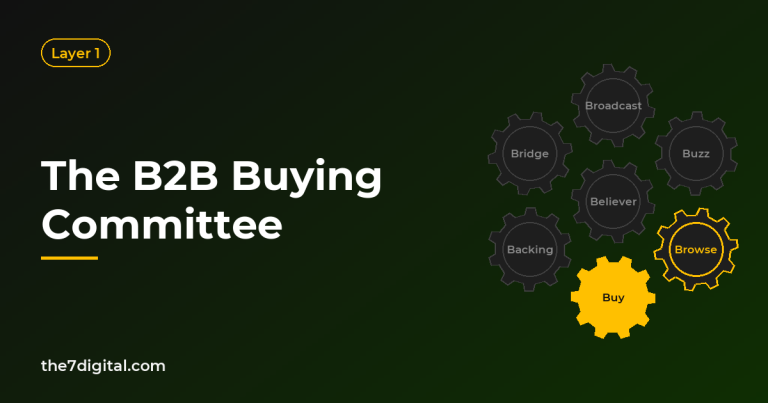
One mind. The 7B Model book (chapter 2) puts five people around the table: the champion, the approver, the influencer, the daily user and the person who can veto. They can sit at different gears at once: the champion trusts you while the finance director searches your name for the first time (the buying committee).
No salesman in the room. According to Gartner (2026), buyers used an average of seven information sources in a recent purchase, and 45% had used GenAI, mainly to gather information on vendors and products. Much of the attention and interest forms without you.
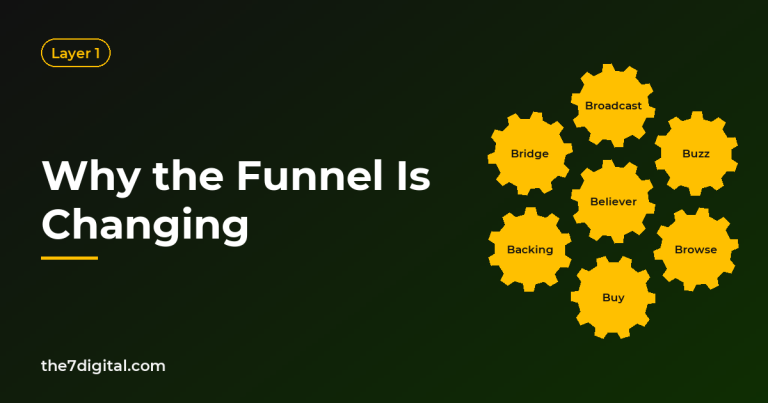
One direction. Buyers enter through a referral, a trade article or an AI answer, then come back for more rounds. That is why the funnel, AIDA’s direct descendant, is being replaced: see why the funnel model is changing and four models that tried to replace the funnel.
AIDA still helps you write one ad or one email (what AIDA is shows how). It fails as a map of how an organization buys.
Do Lasswell’s five questions still work in B2B?
In 1948 Harold Lasswell reduced communication analysis to five questions: who says what, in which channel, to whom, with what effect (per the summary on Wikipedia). Built for mass media, the model is often criticized for lacking a feedback loop, but it forces marketers to look at what AIDA ignores: the speaker and the audience. Put them to B2B today:
- Who says it? Not only you, and your own voice is not automatically trusted: according to Gartner (2026), 49% of B2B buyers say they are more likely to encounter misleading information from a sales rep, while 51% say the same of GenAI. In Vietnam and ASEAN, expect distributors, a parent company’s technical team and trade associations to speak for you.
- Says what? Value handed over on the spot, not a pitch (7B Model book, chapter 6).
- In which channel? More every year: The CMO Survey (2026) found U.S. companies adding digital channels (47.9%), social selling (38.8%) and new face-to-face channels (30.3%).
- To whom? To a committee, and in cross-border B2B one spread across countries (the cross-cultural buying council).
- With what effect? Not clicks. The 7B Model book (chapter 14) tracks four signals, such as branded search volume and the answers to an open “How did you hear about us?” question.
Lasswell saw the speaker and the audience but missed the way back. The 7B Model calls that way back Buzz: the market answers back. The hardest question today is the first one: who says it?
Which gear does each promotion tool turn?
The textbook habit is to assign each tool to an AIDA step. I ask which gear a tool turns and which energy flow powers it: paid, owned or earned-and-shared. The table is my reading, based on the energy mix in the 7B Model book (chapter 5); the last row is mine.
| Tool | Main gears | Main energy flow | Its job in the machine |
|---|---|---|---|
| Advertising | Broadcast, Browse | Paid | Put content before the right people |
| PR | Buzz, Backing | Earned-and-shared | Let others speak for you |
| Trade promotion | Bridge, Buy | Paid | Give distributors a reason to recommend you |
| Personal selling | Buy, Browse | Owned | Help the committee verify |
| Online channels | Browse, Broadcast | Owned | A library buyers explore alone |
| Trade shows | Broadcast, Buzz, Bridge | Paid, earned-and-shared | Meet in person, create stories to retell |
| Employees and community | Buzz, Bridge | Earned-and-shared | Tell the story of the work, bring in contacts |
| The 7B Model · the7digital.com | |||
Advertising is no longer the closer. The 7B Model book (chapter 7) says to pay to amplify valuable content, not the sales pitch, while keeping a share for Browse, such as search and retargeting (paid advertising in B2B, LinkedIn Ads for cross-border B2B). The7 runs this within its full-service digital marketing in Vietnam.
PR and trade shows are where other people start talking about you: a byline in a trade journal or a talk at a show turns Broadcast toward the audience, and adds Backing when the publisher or organizer puts its name next to yours (B2B PR, B2B events and trade shows, trade shows in the 7B machine).
Online channels are a warehouse, not a megaphone: a recorded B2B webinar cut into YouTube clips and LinkedIn posts is an owned asset that gains value with age (YouTube for B2B shows how). Running both as one machine is part of The7’s comprehensive digital marketing services.
Trade promotion needs the most care. Dealer discounts slide into pure push (push and pull in B2B), and when a local distributor carries them, the supplier controls the message least. PR, shows and employees are for seeding: Buzz can be seeded but not bought (7B Model book, chapter 4).
What did a container line learn by talking instead of pitching?
In 2013, Maersk Line’s Facebook page had more than one million likes. MSC, the second-biggest container shipper, had 4,500 and CMA CGM, the third-biggest, about 11,000 (Reuters, 2013). Likes are not revenue, but in the market the gap was small: Maersk held 15.2% and MSC 12.9% (Katona and Sarvary, 2014).
Maersk Line: Communication, not marketing
In late 2011 Maersk Line, then the world’s largest container shipping company, began social media with a team of one, Jonathan Wichmann, working half his time on it at first, with no agency. People told him a shipping line was too boring to follow (Katona and Sarvary, 2014).
He did not start with ads. He found an unused archive of 14,000 photos of ships, ports and seascapes and added stories to them. Facebook told stories in pictures; LinkedIn was where customers were met, with 48,000 followers by 2013, most of them customers. That is the lighthouse of the 7B Model book (chapter 4): it does not chase ships, it keeps its light steady for the ones that need it.
Buzz came from what money cannot buy. About 7,000 of Maersk’s 25,000 employees were seafarers, and many of the page’s early likes came from staff. For customers, the company ran groups that required approval to join and invited users of its Daily Maersk service into a group of their own, because, as director of communications Kavs Valskov put it, a vibrant conversation with customers tells you much more than a survey. That is the market answering back, literally (B2B community marketing).
The total budget was under US$100,000, and the next proposal, US$250,000, was to come from cutting print advertising, web banners and sponsorships (Katona and Sarvary, 2014): the promotion mix, re-sorted on a spreadsheet.
What I value most is the candor about sales. Wichmann admitted the photos do not necessarily get more containers booked, certainly not right away; they keep Maersk top of mind. A 2015 note in California Management Review is more cautious still: little evidence that the success directly moved performance, with the clearest gains in recruiting and employee pride (Dong, 2015). Broadcast and Buzz do not close on schedule. They make you known, so that when a touchpoint triggers a decision, you are already in the buyer’s head (mental availability).
A decade later, Maersk opened Discover the Upside on September 7, 2021 with an upside-down LinkedIn post (Trans.INFO, 2021). Its agency, &Co., says the campaign targeted C-suite approvers and logistics buyers at once, and thousands of employees flipped their profile pictures (&Co., n.d.): Broadcast and Buzz for the whole table. A small team entering ASEAN need not buy presence by the million.
What replaces “Always Be Closing”?
The ABC line was in print by 1950, in a U.S. book on investment salesmanship, and became famous through David Mamet’s play Glengarry Glen Ross and the 1992 film (Popik, 2009). I read it as the slogan for the fourth step Dukesmith wrote down in 1903.
I know that posture from the inside. In my first years I sent hundreds of emails a week to strangers and made hundreds of calls; two to three percent replied and fewer than one percent gave me a meeting (7B Model book, chapter 3). That was outbound marketing done as begging.
Buyers have learned to dodge it. Gartner (2025) found that 73% of B2B buyers actively avoid suppliers who send irrelevant outreach, and Gartner’s Robert Blaisdell warned that bad prospecting damages relationships with potential customers. In Vietnam it is also a legal matter, as the section on Vietnam and ASEAN explains.
In 7B, closing does not disappear; it moves. The Buy gear: A process of many people and many rounds; a door, not the final wall. There is no single closing moment, only smaller doors: technical, financial, legal, procurement. The book’s principle for the whole process is to simplify rather than push (7B Model book, chapter 9).
If your team wants three letters, change the C: always be clarifying (my own twist, not an established term). Clarify price, terms and delivery, and what each member of the buying group still needs to know. Gartner’s Alice Walmesley makes a similar point: sellers should be a sounding board, not repeat generic information (Gartner, 2025). Putting your name in their heads beforehand is the job of Broadcast and Buzz, all year, not at quarter end.
What is left for personal selling and key account management?
More than before, but different. According to Gartner (2026), 70% of B2B buyers prefer a completely digital, self-service buying experience, yet 69% prefer to validate AI-generated insights with sales reps. Buyers research alone, then want a person to confirm it.
In a 7B machine the best salesperson is the best verifier, not the best closer: the right technical answer, the right references, help for the champion who must convince colleagues. For a foreign supplier that means a verifier in the buyer’s language. Personal selling serves Browse and Buy, and works best after Broadcast has made the introduction: a committee that knows your name arrives with specific questions, not “Who are you?”
Key account management goes further, into Believer, Backing and Bridge: every successful large account becomes a reference, a referral and a story for the next round of Broadcast. At Maersk Line, about 25% of business came from large clients such as Wal-Mart, Nike and Tesco and 50% from smaller customers (Katona and Sarvary, 2014). In my reading, the smaller half meets a company through Broadcast and Buzz, so if your team covers only a handful of large accounts in Vietnam, the rest of the market can reach you no other way. Treat your first major customer in an ASEAN country as your best media channel into the second.
Where does the B2B promotion mix fit in the 7B Model?
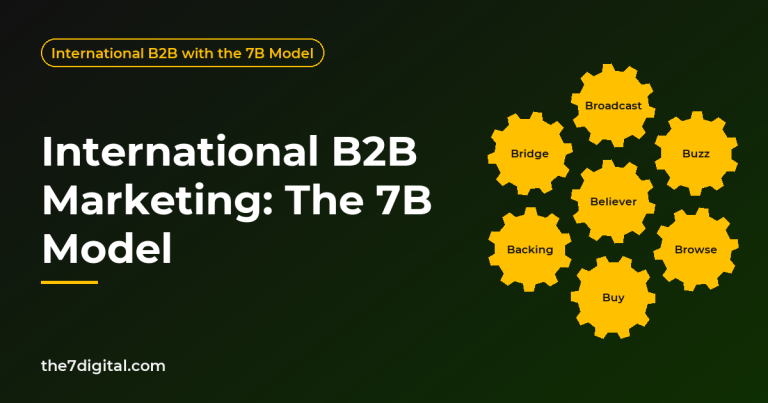
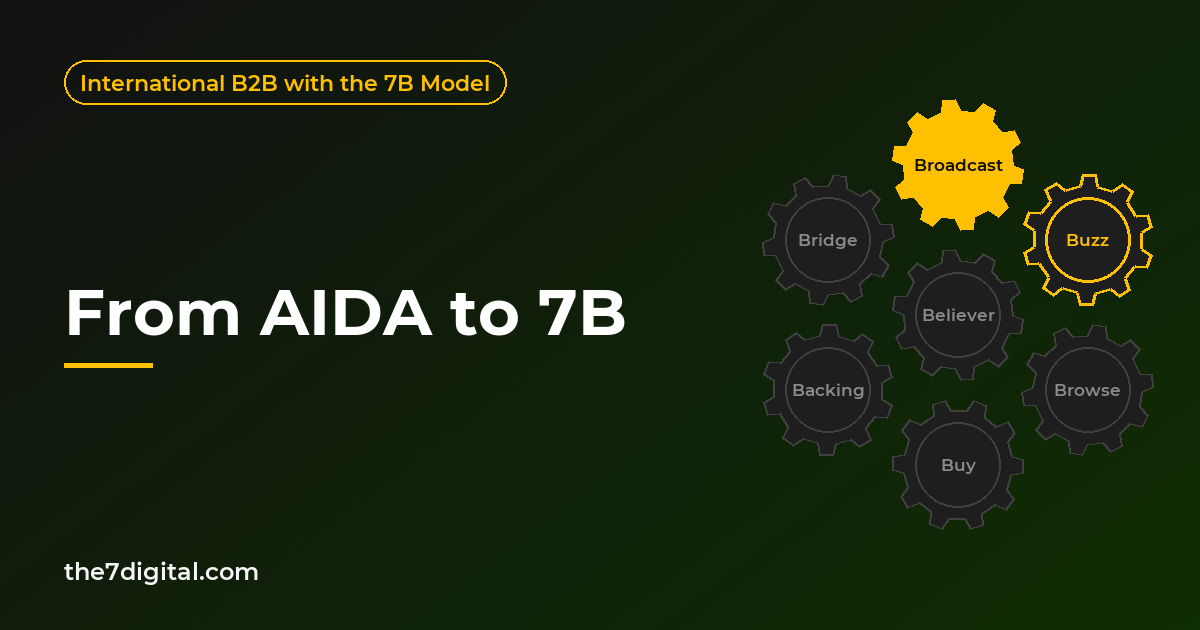
The promotion mix mostly turns the two gears of demand creation. The Broadcast gear: Seeding valuable presence into the market, clear, steady and sharp enough that the right people know you exist. The Buzz gear: The market answers back: people discuss you and mention your name, mostly in dark social. Advertising, trade shows and your own content feed Broadcast; PR, employees and communities create Buzz.
The three operating layers are demand creation (Broadcast, Buzz), amplification (Backing, Bridge) and demand capture (Browse, Buy), with Believer as the connecting loop. AIDA sees one path through all three; the 7B Model runs them in parallel. The three energy flows are paid, owned and earned-and-shared: pay to amplify content, build owned assets into a library, and design for sharing, because customers can enter anywhere.
No new tool launches here, but the 7B Buying Table Map from the cross-cultural buying council works as is: add a column for the promotion tool through which each member meets you. The 7B Model was developed by Nguyen Dinh Bao (Bao7) at The7 Digital and is set out in full in the book Mô hình 7B cho B2B (Stop Begging, Start 7B). The 7B Glossary defines every term, and newcomers can start with what the 7B Model is.
Selling B2B into Vietnam and ASEAN
In the first half of 2026 the foreign-invested sector, crude oil included, accounted for 79.9% of Vietnam’s goods exports, or US$213.01 billion (NSO, 2026). Across Southeast Asia, FDI inflows rose 9.7% to US$244.2 billion in 2025 (UNCTAD, 2026). Broadcast must reach both the plant and the regional office, and Buzz must run in two languages.
Paid Broadcast and paid Buzz now meet a new law: under Vietnam’s amended Advertising Law (Law No. 75/2025/QH15), passed on June 16, 2025 and in force since January 1, 2026, influencers and content creators must label paid or sponsored content and verify the advertiser (Vietnam News, 2025; Vietnam Law Magazine, 2025). Online ads must be identifiable, platforms must give users tools to tell ads from organic content, and foreign advertisers running campaigns in Vietnam must work through licensed Vietnamese advertising firms. A post you pay a creator or expert to publish must therefore be labeled, and your plan should name the local partner from day one. I am not a lawyer; check the text with counsel.
Buzz also has local addresses. Expect it to travel through closed chat groups, industrial park networks and chambers of commerce, where no analytics tool can follow: dark social in its local form (dark social in B2B). Measure it with an open “How did you hear about us?” field on your Vietnamese contact form (7B Model book, chapter 7).
Always Be Closing meets the data law next. Vietnam’s Law on Personal Data Protection (Law No. 91/2025/QH15), in force since January 1, 2026, prohibits buying and selling personal data except where the law provides otherwise. The maximum fine for buying or selling personal data is ten times the proceeds of the violation, according to a summary on the Ha Tinh provincial portal (2026). A purchased list feeding an AIDA email sequence may now be a weak tactic and a legal risk at once.
Personal selling still wins the room, in the room’s language. A sales engineer who explains a specification in Vietnamese, a partner who answers fast and a reference from a plant in the same region do more for the Buy gear than any closing line.
Conclusion: A staircase fits one buyer, a machine fits the whole table
AIDA gives the seller a four-step staircase and an order at the top. A buying group in Vietnam or anywhere in ASEAN does not climb it: several people in several places meet you through different tools, at moments you do not choose. The promotion mix is not short of tools. It is short of a division of labor.
Previous in the series: push and pull in B2B, on end-user pull. Next: LinkedIn Ads for cross-border B2B, on the paid channel that reaches decision makers. The pillar article on international B2B marketing with the 7B Model has the whole map.
Frequently asked questions
What is the B2B promotion mix?
Advertising, public relations, trade promotion, personal selling, online channels and trade shows. The 7B Model adds employees and communities, and assigns each tool one or two gears and a main energy flow instead of an AIDA step.
Who really invented the AIDA model?
It is usually credited to E. St. Elmo Lewis in 1898, but Akinori Iwamoto (2023) found no evidence for that. He argues that Arthur Frederick Sheldon can be regarded as the originator, with Frank H. Dukesmith shaping the model in early sales training.
Is AIDA still useful in B2B marketing?
For a single message, yes: an ad, an email or a landing page still needs to earn attention and end with a clear invitation. As a map of how a buying group decides, no.
What should replace “Always Be Closing”?
Always be clarifying. In the 7B Model, closing becomes a series of smaller doors (technical, financial, legal, procurement), and the seller answers what each member still needs to know, while Broadcast and Buzz make the name familiar beforehand.
International B2B with the 7B Model · Part 7 of 24 · Previous: Push and Pull in B2B · Next: LinkedIn Ads for Cross-Border B2B · Pillar article: International B2B Marketing: The 7B Model
References
- Akinori Iwamoto (2023). The Origin of AIDA: Who Invented and Formulated the AIDA model? Proceedings of the Conference on Historical Analysis and Research in Marketing (CHARM), 21. https://ojs.library.carleton.ca/index.php/pcharm/article/view/4340
- Gartner (2026). Gartner Survey Finds 69% of B2B Buyers Turn to Sales Reps to Validate AI-Generated Insights. https://gcom.pdo.aws.gartner.com/en/newsroom/press-releases/2026-05-20-gartner-survey-finds-sixty-nine-percent-of-b-two-b-buyers-turn-to-sales-reps-to-validate-ai-generated-insights
- Wikipedia (n.d.). Lasswell’s model of communication (on Harold Lasswell’s 1948 essay). https://en.wikipedia.org/wiki/Lasswell%27s_model_of_communication
- Christine Moorman, The CMO Survey (2026). Marketing Contracts Under Economic Pressure Despite Growing Value and AI Gains. https://cmosurvey.org/marketing-contracts-under-economic-pressure-despite-growing-value-and-ai-gains/
- Reuters, republished by The Star (2013). Facing dead whale or lost cargo, shipper Maersk turns to social media. https://www.thestar.com.my/tech/tech-news/2013/09/04/facing-dead-whale-or-lost-cargo-shipper-maersk-turns-to-social-media
- Zsolt Katona, Miklos Sarvary (2014). Maersk Line: B2B Social Media, “It’s Communication, Not Marketing”. California Management Review, 56(3). https://business.columbia.edu/sites/default/files-efs/pubfiles/12772/Maersk_line.pdf
- Lillian Dong (2015). Maersk: The Value of Social Media. California Management Review Insights. https://cmr.berkeley.edu/2015/10/maersk/
- Gregor Gowans, Trans.INFO (2021). ‘Discover the upside’: new Maersk campaign turns heads on social media. https://trans.info/en/discover-the-upside-new-maersk-campaign-turns-heads-on-social-media-253507
- &Co. (n.d.). Discover the Upside (Maersk case). https://www.andco.dk/cases/discover-the-upside
- Barry Popik (2009). “Always Be Closing” (ABC of selling). https://barrypopik.com/blog/always_be_closing_abc_of_selling
- Gartner (2025). Gartner Sales Survey Finds 61% of B2B Buyers Prefer a Rep-Free Buying Experience. https://gcom.pdo.aws.gartner.com/en/newsroom/press-releases/2025-06-25-gartner-sales-survey-finds-61-percent-of-b2b-buyers-prefer-a-rep-free-buying-experience
- National Statistics Office of Vietnam (2026). Report socio-economic performance in second quarter and the first half of 2026. https://www.nso.gov.vn/en/data-and-statistics/2026/08/report-socio-economic-performance-in-second-quarter-and-the-first-half-of-2026/
- UNCTAD (2026). World Investment Report 2026: Country Fact Sheet, Viet Nam. https://unctad.org/system/files/non-official-document/wir_fs_vn_en.pdf
- Vietnam News (2025). NA passes revised Advertising Law to tighten accountability for online content. https://vietnamnews.vn/economy/1719670/na-passes-revised-advertising-law-to-tighten-accountability-for-online-content.html
- Pham Minh Long, Pham Thi Cuc, Nguyen Hoai An, Vietnam Law Magazine (2025). Amended Advertising Law: key new provisions. https://vietnamlawmagazine.vn/amended-advertising-law-key-new-provisions-75799.html
- Ha Tinh Provincial Portal (2026). Luật Bảo vệ dữ liệu cá nhân chính thức có hiệu lực thi hành từ ngày 1/1/2026. https://hatinh.gov.vn/vi/bai-viet/luat-bao-ve-du-lieu-ca-nhan-chinh-thuc-co-hieu-luc-thi-hanh-tu-ngay-112026