Summary: Pillar content is an overview page that maps one topic and links to the pieces answering each narrower question B2B buyers ask. It does not need to be your longest article, only your clearest route. In the 7B Model, it seeds presence through the Broadcast gear and meets buyers verifying through the Browse gear.
Picture a European supplier about to enter Vietnam. Its marketing team takes the longest “ultimate guide” on its English website, has it translated into Vietnamese and calls the result its content strategy for the new market. The scene is one I made up, not a real company’s.
Meanwhile, the purchasing lead at a plant in Binh Duong has a very narrow question and types it in Vietnamese: how does this process differ from the one we run today? The translated guide is somewhere in the results, or it is not. If it is, she scrolls three times, finds nothing that answers her and leaves.
A long article, translated, is still a single door. Your buyer needs a building with signs. This article explains what pillar content really is, a topic map, how to draw one for a market you are entering, and what Vietnam and ASEAN add to the picture in a section of their own.
What is pillar content, if not your longest article?
In short, pillar content is an overview page that covers a broad topic and links two ways with satellite pieces, each answering one narrow question a buyer asks. I call the whole set a topic map: the pillar page, the satellite pieces (practitioners call them cluster pages) and the links between them. Without the links you do not have a map. You have a pile of articles. If you need the basics of content marketing first, start with B2B content marketing.
Length is the first myth to retire. In its self-check questions on helpful content, Google Search Central asks whether you are writing to a particular word count because you have heard Google has a preferred one, and answers in parentheses: “(No, we don’t.)” The same page asks whether content gives a substantial, complete or comprehensive description of the topic. Complete and long are different things. I would argue that a map of short, linked pieces can be more complete than one long article, because every question has its own place and a path to the next. The page does not say Google punishes long articles or prefers short ones, and I do not read that into it.
So a good pillar is usually not the longest page on your site. It is the page with the most ways out: enough summary for a reader to grasp the topic in a few minutes, then directions to the deeper piece that fits their question. What creates those ways out? Ask the place that popularized the idea.
HubSpot: When links mattered more than length
HubSpot’s own blog (Mimi An, updated June 17, 2026) says the foundation of the topic cluster model was a 2015 study, “Topics Over Keywords,” by Anum Hussain and Cambria Davies. They tested the approach on HubSpot’s content team and found that the more internal links they added between related pages, the higher those pages climbed in search results and the more impressions they earned. The page gives no figures from that test, so I give none.
The model itself is plain. The pillar page covers a broad subject at a high level. Each cluster page addresses a subtopic, a long-tail question or a specific use case. Every cluster links back to the pillar with descriptive anchor text, the pillar links to every cluster, and clusters link to each other only when their topics truly overlap.
I read the finding as a statement about structure, not word count: the network of links is what lifted the pages. That echoes inbound marketing, where content pulls buyers toward you instead of you knocking on every door. For a market like Vietnam, the practical lesson is to start from a map of questions asked in the buyer’s language, not from a translation of your longest piece.
Why do B2B buyers need a map more than a longer article?
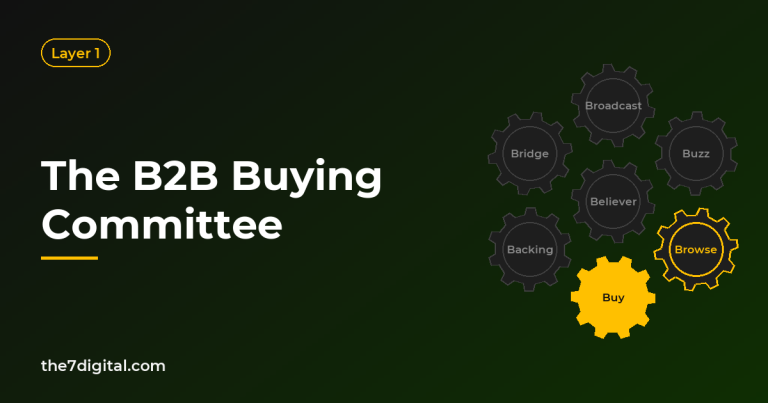
B2B buyers do not read your website top to bottom. They arrive with a question through one of six gateways. The 7B Model book (chapter 8) names them as the Browse gear’s six gateways: search engines and AI answer summaries, conversational AI, specialist review platforms, LinkedIn, YouTube and podcasts, and communities and forums. Whatever the gateway, they land on the page that answers their question, not on your home page, and that page has to stand on its own.
Two surveys show the gateways shifting. G2 (2026) surveyed 1,076 B2B decision makers in North America, EMEA and APAC in March 2026 and found that 51% of B2B software buyers start research with an AI chatbot more often than with Google, while 80% still use Google somewhere in the journey. That is software buyers, not every B2B industry, but the direction is clear: buyers no longer start from one door, and you cannot tell which one they will use.
The second survey is about what happens after the answer. TrustRadius (2026) surveyed 1,862 technology buyers and 444 vendors worldwide in January 2026, and 94% of buyers who used AI say they fact-check its responses at least some of the time. My reading: the summarized answer is not the end of the trip. Someone who checks needs a place to check, and that place is a specific page on your site, which should show the map behind it. Which sources the machines choose to trust is the subject of topical authority; a map is the precondition, not the proof.
Then there is the buying committee. In a buying committee, each person arrives with a different question: the engineer asks how it works, finance asks what it costs to run, procurement asks how you compare. One long article that answers everyone at once answers no one clearly. A map gives each person a way in and a way onward.
Last, the Broadcast side. Bain & Company (2026) reports that around 90% of buyers purchase from their Day 1 list, the vendors they already have in mind when buying starts. I will not unpack that here; the article on mental availability does. The point for a map is that it is not only for being found once buyers start looking. Each satellite piece plants your name before that list forms.
What does a topic map look like in B2B?
A topic map has three parts. Groups are the regions: they tell a reader which topics the map covers. Entries are the points: each one answers a question. Turns are the roads: they connect an entry to its neighbors and to the buyer’s next step. Without turns, a reader arrives, reads and leaves.
Huawei: Five minutes per topic, a turn on every page
Huawei, the Chinese technology company, runs an “IP Encyclopedia” on its Info-Finder site under the line “Grasp each new topic in 5 minutes.” When I opened the encyclopedia’s index page on November 10, 2026, it showed 415 articles and a counter of more than 11 million views. That counter is live, and it counts views, not readers. The articles sit in 12 groups, such as Cyber Security, IPv6, VPN, Routing & Switching and Network Cloudification, and entries are titled as an engineer’s questions: “What Is a Firewall?”, “What Is Phishing?”, “What Is a Zero-Day Attack?”
Inside one entry the map shrinks. “What Is a Firewall?” (by Yang Xiaofen, updated September 11, 2026) runs from history, types and how a firewall works to key performance indicators and a comparison of a firewall, a router and a switch, and only then reaches Huawei’s own firewall products. At the bottom, a “Related Topics” block points to AI Firewall, NGFW, UTM, Switch and Router.
This is a true topic map. Each entry is short and answers one question; the strength is in the 12 groups and the turns. Through the Browse lens, the performance indicators and the comparison sections are verification and comparison, and the engineer moves from a concept question to a comparison question to the product section without leaving the page. Through the Broadcast lens, 415 seeds are sown evenly and kept current. The product appears only at the end, after the reader has understood. That is teach first, sell after, the invitation principle in the 7B Model book (chapter 6).
Two honest notes. The page never uses the words pillar content; reading it as a topic map is my interpretation. And I have no data on the business results of the encyclopedia, so I infer nothing from the counter.
Siemens shows a different kind of map. Its Technology glossary invites readers to look up common industry terms, sorted alphabetically from 0-9 through A-F, G-K, L-P and Q-U to V-Z, each entry a short description, such as Digital twin or Additive manufacturing. An alphabetical lookup suits someone who already knows the word. A pillar map is arranged by question and by the order a buyer needs to understand things, with turns into deeper pieces. Both are maps; they differ in whether the order follows the alphabet or the buyer’s train of thought.
Three signs mark a good map. Entry names are the buyer’s questions, not your product names. Every entry has turns, to its neighbors and to the buyer’s next step, such as a comparison or a product. And the map is kept current, with a visible date.
How do you draw a pillar map for a new market?
The steps are the same at home and abroad, but the raw material is not. Draw the map from the questions of buyers in the market you are entering, never from the map you drew for your home market.
- Pick one topic buyers must understand before they buy: the problem they face, not your product name.
- Collect real questions from people on the ground: your local sales team, distributors and partners, first calls, and the answers to “How did you hear about us?” left blank for customers to fill in. Sort them by role in the buying committee.
- Turn each question worth an article into a satellite piece, and fold small questions into the pillar page.
- Write the pillar page last: a summary of the whole topic, each section pointing to a satellite piece. Link both ways following the rule HubSpot describes, with descriptive anchor text and cross-links only where topics truly overlap.
- Open the door. No gates, no form in front of the content. The invitation principle in the 7B Model book (chapter 6) is to give away the thinking model and sell the implementation.
Write the pillar last because only when you know what the satellite pieces answer do you know what the overview should summarize. Write it first and it turns into a long article trying to say everything, the very trap of the guide in the opening scene.
Pace the work the way the 7B Model book does (chapter 5): three months of sowing, six months to see sprouts, twelve months to see fruit. A map is a year’s work, not a campaign. Measure it with the book’s four substitute indicators (chapter 14) rather than page views alone: brand-name search volume; the answers to “How did you hear about us?”; interaction quality, meaning the right people rather than many people; and the content customers touched before closed deals. The fourth fits a map best, because it shows which satellite pieces buyers read before the deals you won.
The usual mistakes are quick to fix: calling your longest article the pillar and stopping there; writing satellite pieces that do not link back; and leaving an old map with no update date.
How does this series work as a pillar?
You are standing inside a map. The Layer 1 articles on The7’s blog are grouped by topic on the B2B Marketing Library page, which is the pillar for the whole series. The article on the 7B Model is the starting point, where the model is explained, and the 7B Glossary is the lookup table, the same kind as Siemens’s: each term has a standard definition, a few lines of explanation and an article to read next. This article opens the Content group, followed by topical authority and content repurposing.
I arranged the series by the questions a marketer would ask, and what they would ask next, not by article length. That is why many titles are questions and why each article points to the next. A reader can enter from anywhere, a search result, LinkedIn or a link from a colleague, and still see where they are on the map.
Where does pillar content fit in the 7B Model?
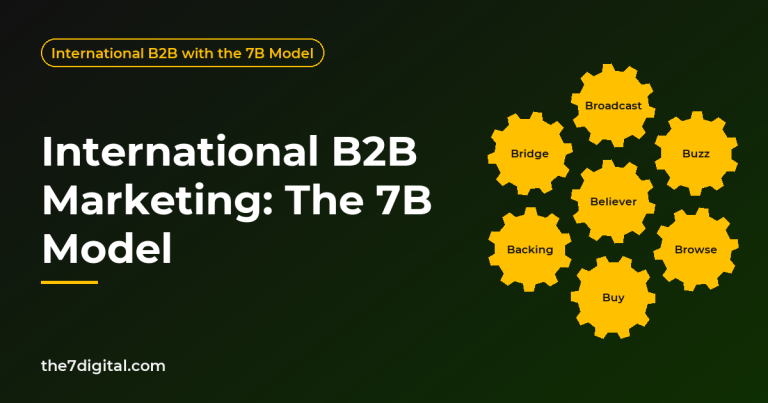
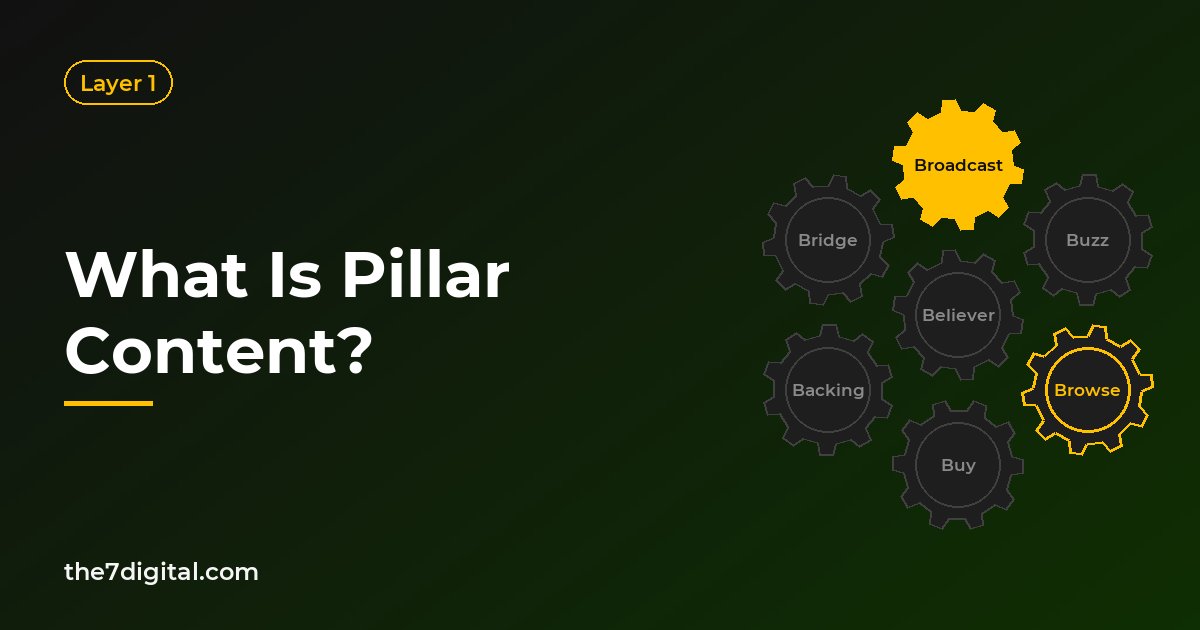
The main gear here is the Broadcast gear: Seeding valuable presence into the market, clear, steady and sharp enough that the right people know you exist. Each satellite piece is one such seed: clear because it answers one question, steady because the series keeps a rhythm, sharp because the answer is direct.
The companion is the Browse gear: Where emotion meets reason: buyers verify and compare you through six gateways. The pillar page is where a buyer arriving from any of the six stops to verify and compare further, then finds the way to the next question.
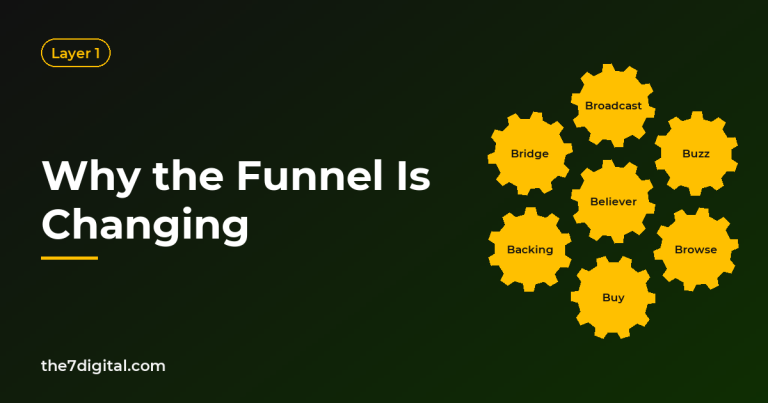
The three operating layers read: Demand creation (Broadcast, Buzz), amplification (Backing, Bridge), demand capture (Browse, Buy); Believer is the connecting loop. Pillar content joins the first layer, where satellite pieces sow, to the third, where buyers come to verify.
The three energy flows are: Paid, owned, earned-and-shared. Pillar content belongs to the owned flow. Paid can amplify satellite pieces, but the map belongs to you, not to any platform.
The two operating principles say: Customers can enter anywhere; one stuck gear slows the whole flywheel. A map is how you make the first half true on your website. For the whole machine, start with the 7B Model.
One caution about words. In the content machine of the 7B Model book (chapter 6), pillar content is the root product, a long video or a podcast, that branches into seven or more outputs; one branch is a long, structured article on your site that serves Browse and gives AI something to cite. The map in this article is where those article outputs get a place and get linked. How to branch is the subject of content repurposing.
The 7B Model was developed by Nguyen Dinh Bao (Bao7) at The7 Digital and is set out in full in the book Mô hình 7B cho B2B (Stop Begging, Start 7B).
Selling B2B into Vietnam and ASEAN
Start with language, because the map has to be in the buyer’s. The 2025 EF English Proficiency Index (EF Education First, 2025) ranks Vietnam 64th in the world with 500 points, against a global average of 488. By job function, the same index gives Purchasing & Procurement 495, below Sales at 507 and Marketing at 511. These are average scores by job function, not a survey of buyers, and I do not read them as proof that your buyers cannot read English. My reading is narrower: the people who check your comparison pages often include procurement, and a map that exists only in English asks them to verify in a second language.
Next, the search gateway. StatCounter (2026) shows Google holding 93.38% of search engine market share in Vietnam in October 2026, with CocCoc at 5.6%, measured by page views across all platforms, not only B2B. DataReportal (2026) counted 85.6 million internet users in Vietnam at the end of 2025, 84.2% of the population. I would build the Vietnamese map for Google first.
Two more gateways matter for B2B. DataReportal (2026) reports, citing LinkedIn’s advertising resources, 10.0 million “members” in Vietnam in late 2025, which counts registered members, not active users. Citing Google’s advertising resources, it reports 62.1 million YouTube users in Vietnam in the same period, an advertising-reach figure. Give each satellite piece an output for these gateways, a LinkedIn post or a short video, that points back to the Vietnamese pillar page.
AI is the fourth gateway, and Southeast Asia leans into it. Google’s blog on the e-Conomy SEA 2025 report (Google, 2025) says consumer interest in AI topics in the region stands at three times the global average, and three in four users say AI-powered tools have helped them discover content and make tasks easier. Those are consumer figures, not B2B ones, so take them as a direction.
When an AI answer is the gateway, a clear map in the local language is what that answer can point back to. For each ASEAN market, redraw the map from that country’s buyer questions instead of translating another country’s map. I have no sourced figures for the other markets yet, so I will not guess at them.
Conclusion: Stop writing longer, start mapping clearer
Your longest article is not automatically your pillar. Your pillar is the page that makes every other page easier to find.
Three ideas to keep. Pillar content is a topic map: an overview page, satellite pieces and links both ways, not the longest article. B2B buyers arrive with narrow questions through many gateways and then verify, so each person on the buying committee needs a way in and a way onward. And drawing the map starts from real buyer questions in the market you are entering, with the pillar page written last, no gates, and a measure that is not word count.
To keep reading, start with topical authority, which covers why Google and AI trust sources that cover a topic fully. Content repurposing shows how one production run fills the map with outputs, and the B2B Marketing Library gives you the whole series at a glance.
Frequently asked questions
What is pillar content?
Pillar content is an overview page covering a broad topic, linked two ways with satellite pieces that each answer one narrow buyer question. Its value sits in the map and the links, not in length. A good pillar page summarizes enough for a reader to grasp the topic, then points to the deeper piece that fits their question.
How is a pillar page different from a long-form article?
A long-form article tries to answer everything on one page. A pillar page summarizes the whole topic and sends readers to deeper pieces that link back. Google Search Central says it has no preferred word count, so length is not the goal. The better question is whether the topic is described completely, not how many words it takes.
How many cluster articles does a pillar page need?
There is no verified standard number. Write as many as it takes to answer the questions buyers actually ask, collected from your sales team and customers. Start with the questions that come up most, add over time and keep the pillar page updated so every new piece links back to it.
Should a foreign B2B company build a separate pillar for Vietnam?
Yes, in Vietnamese, drawn from the questions of local buyers. The 2025 EF English Proficiency Index (EF Education First, 2025) ranks Vietnam 64th with 500 points, and its Purchasing & Procurement score is 495, so an English-only map makes the people who verify your claims do it in a second language. Treat each ASEAN market as its own map.
References
- HubSpot, Mimi An (2026). Topic clusters: The next evolution of SEO. https://blog.hubspot.com/marketing/topic-clusters-seo
- Google Search Central (n.d., accessed November 10, 2026). Creating helpful, reliable, people-first content. https://developers.google.com/search/docs/fundamentals/creating-helpful-content
- Huawei (n.d., accessed November 10, 2026). IP Encyclopedia. https://info.support.huawei.com/info-finder/encyclopedia/en/index.html
- Huawei, Yang Xiaofen (2026). What Is a Firewall? https://info.support.huawei.com/info-finder/encyclopedia/en/Firewall.html
- Siemens (n.d., accessed November 10, 2026). Technology glossary. https://www.siemens.com/en-us/technology/
- Bain & Company (2026). Raising the Odds on a Deal: How Likelihood to Buy Rewires B2B Growth. https://www.bain.com/insights/raising-the-odds-on-a-deal-how-likelihood-to-buy-rewires-b2b-growth/
- G2 (2026). The Answer Economy: How AI Search is Rewiring B2B Software Buying. https://learn.g2.com/g2-2026-ai-search-insight-report
- TrustRadius, HG Insights (2026). TrustRadius 2026 B2B Buying Disconnect Report Reveals AI Has Changed How Buyers Research, But Not What They Trust. https://hginsights.com/news/trustradius-2026-b2b-buying-disconnect-report-reveals-ai-has-changed-how-buyers-research-but-not-what-they-trust/
- StatCounter Global Stats (2026). Search Engine Market Share in Viet Nam, October 2026. https://gs.statcounter.com/search-engine-market-share/all/viet-nam
- DataReportal, Kepios (2026). Digital 2026: Vietnam. https://datareportal.com/reports/digital-2026-vietnam
- EF Education First (2025). EF English Proficiency Index 2025: Vietnam. https://www.ef.com/wwen/epi/regions/asia/vietnam/
- Google, Sapna Chadha (2025). ASEAN’s $300 billion digital economy enters the AI reality. https://blog.google/around-the-globe/google-asia/sea-economy-2025/