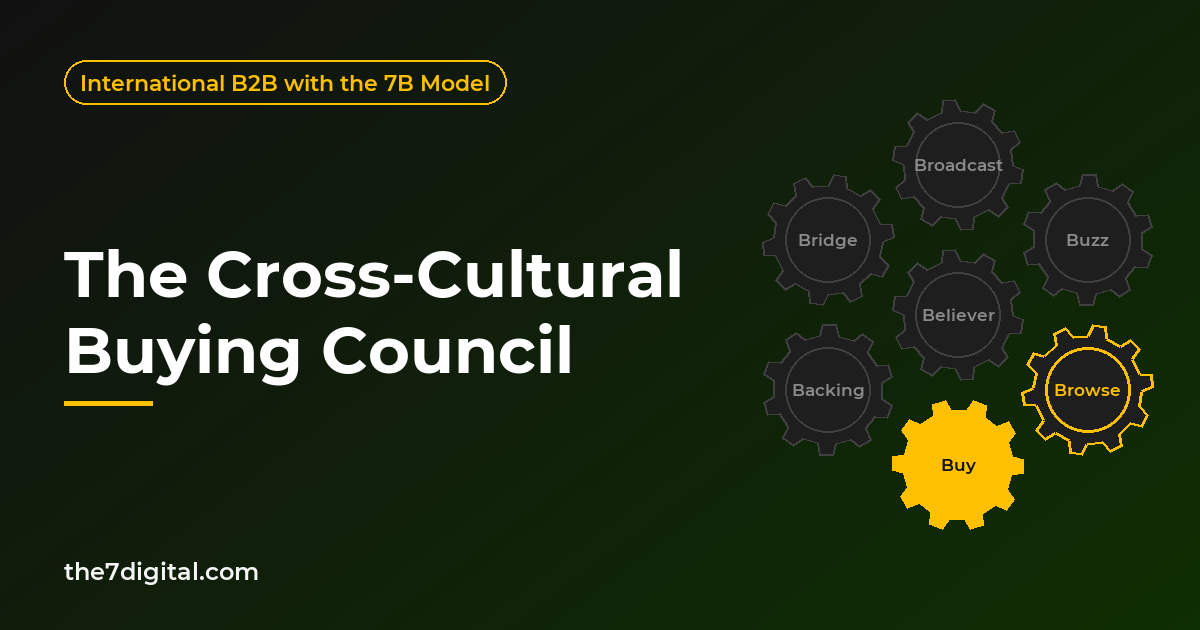
Summary: A B2B buying center in Asia has the same roles as one in Germany or the United States, but culture changes the weight of every seat. In much of Asia the gatekeeper weighs more, so signal the decision maker instead of begging at the door. In the 7B Model, this topic sits in the Buy and Browse gears.
Picture the export manager of a German machine builder touring Southeast Asia. In Ho Chi Minh City, the managing director’s assistant moves the meeting twice; the older man who finally joins says little, asks one question about after-sales service and leaves early. In Jakarta, six people attend, all warm and curious, and none of them can say who will decide or when.
Three months later, both deals are still waiting, for opposite reasons. In Ho Chi Minh City she met the gate, not the decision: the quiet man who left early may have been the one whose nod mattered. In Jakarta she met the table, and the table needed time to agree with itself.
The roles around a B2B buying table do not change at the border; their weight does. This article explains why gatekeepers are harder to pass in Asia, how four cultural dimensions reshape the buying council, and introduces the 7B Buying Table Map for writing those weights down.
Who actually sits at the table in Tokyo, Seoul, Munich or Ho Chi Minh City?
In 1972, Frederick Webster and Yoram Wind named five buying roles inside an organization: users, influencers, buyers, deciders and gatekeepers, a group academics call the buying center, as an Open University course (2020) summarizes it. I walked through each role in the B2B buying committee; the point to keep is that these are five kinds of influence, not five job titles.
In his International B2B Marketing course on Coursera, Professor Dae Ryun Chang of Yonsei University notes that a role rarely shows in a job title or department, while rank sets how much each person’s view weighs. Across borders, culture adds its own weights.
In Japan, The Culture Factor’s country comparison tool (accessed November 2026) describes decision-making as slow and consensus-based, with proposals confirmed at every layer, so the first person you meet carries your file rather than deciding on it.
On the same tool, Germany, at 35 on power distance, is a lower scorer with extensive co-determination rights and a heavy reliance on expertise, so a Munich table is full of engineers. South Korea is in the middle on hierarchy at 60 but scores 85 on uncertainty avoidance, among the highest in the world. In Vietnam, a power distance score of 70 puts the final word high and close to one person, who may not attend your first meeting.
Why are gatekeepers harder to pass in Asia?
Of the five roles, the gatekeeper is the easiest to underestimate: an assistant, a procurement officer, an engineer assigned to screen suppliers. Yet as Chang points out, gatekeepers regulate what flows into the room: which information, which proposals, sometimes which people. Their rank may be modest; their real power is not.
In Asia, he adds, hierarchy rooted in culture often keeps the real decision maker out of sight, and the gatekeeper becomes their frontman: the face you meet, not the hand that signs. The person behind them may be younger than you expect, with authority that comes from family ties more than from a title.
The Culture Factor’s numbers point the same way: power distance is 80 in China and 70 in Vietnam, against 40 in the United States and 35 in Germany. Where it is high, subordinates expect to be told what to do, so someone lower down will seldom carry an unknown supplier upstairs. Knocking harder only hands the gatekeeper another reason to keep the door shut.
The 7B Model book (chapter 3) calls this the beggar’s mindset: one more cold email, one more call, one more request for a meeting. Where gatekeepers are strong, begging is worse than useless, because the person you keep chasing decides whether your name ever enters the room.
Toyota: An open door, and a line that runs through Tier 1
Few Japanese companies describe their purchasing table as plainly as Toyota. Its 75-year history site (Toyota, 2012) traces an approach of always keeping the door open to better goods and better suppliers back to the purchasing handbook of its founding years, a spirit that lives on as fair competition based on an open-door policy. Purchasing works with suppliers and internal functions at every stage, from vehicle development to mass production and spare parts.
Behind the open door, the line has tiers. According to Toyota Times (2024), Toyota buys parts from some 400 domestic Tier 1 companies; counting every tier, its supply chain reaches around 60,000 companies, with annual orders of about 7 trillion yen, and Toyota discusses transactions directly only with Tier 1 firms. In the article’s second part, Deputy Chief Officer Kato of the purchasing team calls a sense of hierarchy between buyer and seller inevitable.
Read through the 7B Model (the reading is mine, not Toyota’s), the gatekeeper for a new component maker is not an assistant declining your call but an entire tier, and the Tier 1 engineer is the frontman. The policy door is open to anyone; a mention in a product development meeting is not. Earning it takes Broadcast that reaches engineers in both tiers, Backing from a Tier 1 customer who vouches for you, and a Bridge through that relationship.
How do four cultural dimensions reshape the buying council?
Geert Hofstede’s model measures national culture on six dimensions (Hofstede, 2011). Chang suggests reading four of them as four questions about the buying council. I keep his questions and change the examples, using The Culture Factor’s scores (accessed November 2026) for Vietnam, its neighbors and common home markets of firms selling into the region:
| Country | Power distance | Individualism | Uncertainty avoidance | Long-term orientation |
|---|---|---|---|---|
| Germany | 35 | 79 | 65 | 57 |
| United States | 40 | 60 | 46 | 50 |
| Japan | 54 | 62 | 92 | 100 |
| South Korea | 60 | 58 | 85 | 86 |
| China | 80 | 43 | 30 | 77 |
| Vietnam | 70 | 30 | 30 | 47 |
| Thailand | 64 | 19 | 64 | 67 |
| Indonesia | 78 | 5 | 48 | 29 |
| Malaysia | 100 | 27 | 36 | 47 |
| Singapore | 74 | 43 | 8 | 67 |
Power distance: how high does the decision sit? High scores push decisions to the top and give the gatekeeper weight; low scores spread them across expertise. The same file must reach the top floor in Kuala Lumpur and satisfy a table of engineers in Stuttgart.
Individualism: how many people are consulted? In collectivist cultures, such as Indonesia at 5 or Vietnam at 30, more people are asked before one person signs, so expect influencers who never appear on an org chart.
Uncertainty avoidance: how much paperwork? High scores mean low tolerance for ambiguity and more rules, written and unwritten. For Japan, The Culture Factor notes that extensive feasibility studies and risk analysis come before any project. Vietnam and China, both at 30, sit at the other end.
Long-term orientation: what is the rhythm? High scorers such as Japan (100) and South Korea (86) will move slowly to secure a long relationship. Low scorers such as Indonesia (29) lean toward established norms, so an introduction from someone already trusted can outweigh a new pitch.
One warning: the scores are national averages, not a portrait of the manager you are about to meet, and Hofstede (2011) warns against confusing them with value differences between individuals. Treat the table as a first hypothesis and test it on real people.
Why is the sales team always outnumbered?
Count the chairs. According to Forrester (2026), the typical buying decision now involves 13 internal stakeholders and nine external influencers, more for complex purchases. On your side, at a trade show in Ho Chi Minh City, there is often one regional sales manager and a local agent.
The imbalance is also in expertise: engineers ask about tolerances, quality about process, finance about payment terms, legal about liability. Chang’s conclusion is that the seller needs a counterpart team, which building a B2B marketing team covers with the 7B Gear Captain Matrix.
Culture also changes how you staff it. Where power distance is high, the rank of the person you send is a message: a junior account manager sent to a managing director can read as disrespect. In Germany, a chief engineer who answers the right question outweighs a vice president’s business card. Send a peer for every heavy seat, by that country’s yardstick.
How do you reach the decision maker without begging at the door?
Start with an uncomfortable fact: most of the choosing is done before you knock. In its 2025 buyer experience report, 6sense (2025) found that 94% of buying groups had ranked preferred vendors before first contact, and bought from that early favorite 77% of the time. Bain & Company (2026) cites research showing that around 90% of buyers end up buying from their Day 1 list: the suppliers already on their mind at the outset.
If you lack mental availability with the decision maker when the gatekeeper presents your file, the gatekeeper is presenting a stranger. The job is not to get past the gatekeeper but to make sure the name they carry upstairs is already familiar. There are three routes, one gear each.
Broadcast to the top floor. Decision makers rarely meet unknown suppliers, but they read and watch. When LinkedIn expanded Thought Leader Ads, it cited 2024 Edelman and LinkedIn research in which nearly 73% of decision makers called an organization’s thought leadership a more trustworthy basis for judging its capabilities than its marketing materials (LinkedIn, 2024). LinkedIn targets by seniority, location and employer (Microsoft Learn, 2026), so an analysis in Vietnamese can reach plant directors in Binh Duong without anyone granting you a meeting.
The groundwork is in LinkedIn marketing for B2B, and The7 offers LinkedIn Ads built on this targeting logic as part of its full-service digital marketing in Vietnam.
Backing from peers in the same country. Forrester’s nine external influencers may be industry peers, associations or former partners: people the decision maker trusts more than you. For a buyer in Ho Chi Minh City, I would bet on one reference in Hanoi over several in Munich.
Bridge through the frontman. Give the gatekeeper what they would want to pass upstairs, written in their language and short enough that they never have to explain it (Mô hình 7B cho B2B book, chapter 9). Chang also suggests technical seminars with a selective guest list; B2B events and trade shows and trade shows in the 7B machine go deeper.
What does the 7B Buying Table Map record?
The 7B Buying Table Map matches content to each member of the buying committee; this article introduces it, and five buyers, five products uses it in full. Each row is a seat: the five people at the meeting table in the 7B Model book (chapter 2), plus the gatekeeper’s seat, which in Asia you cannot leave empty.
| Seat at the table | Who sits here | Weight in this country | Gear they enter through | Gateway they verify you on | What they need to see before they nod |
|---|---|---|---|---|---|
| Champion | |||||
| Signer | |||||
| Influencer | |||||
| Direct user | |||||
| Veto holder | |||||
| Gatekeeper | |||||
| The 7B Model · the7digital.com | |||||
The third column is the cross-cultural part: score each seat from 1 to 5 for its weight in that country, starting from the Hofstede table and correcting it with what local partners tell you. At a Japanese customer the quality department’s veto seat may be a 5; at a founder-run distributor in Jakarta, the signer is. The next two columns connect each seat to the machine: whether the person met you through Broadcast, Buzz or Backing, and which Browse gateway they use to check you.
A finished map usually shows that the heaviest seat is one you have not met, and that its “what they need to see” cell is blank. That blank cell is next quarter’s content plan.
Where does the cross-cultural buying council fit in the 7B Model?
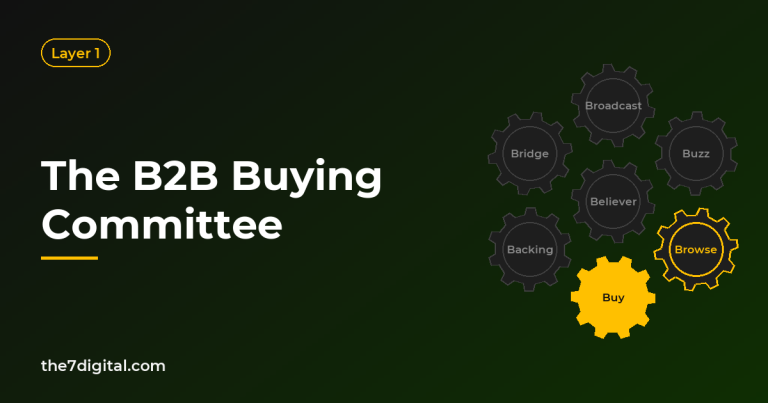
The main gear is Buy: A process of many people and many rounds; a door, not the final wall. Culture does not change that definition; it changes the number of people and rounds: layers that must confirm in Tokyo, experts who must be answered in Munich, colleagues who must agree in Jakarta.
The second gear is Browse: Where emotion meets reason: buyers verify and compare you through six gateways. Each seat verifies you at a different gateway, in its own language. A gatekeeper will search your name and check your LinkedIn page before passing your file on; if those gateways speak only English and German, the file stops there.
Both gears belong to the demand capture layer, yet the way into the room runs through the other two layers: Broadcast in demand creation puts your name before the decision maker, while Backing and Bridge in amplification give you advocates and a way across. Among the three energy flows, paid puts content before the right seniority in the right country, owned is the document pack in the buyer’s language, and earned-and-shared is a local customer who speaks well of you.
Definitions are in the 7B Glossary. The 7B Model was developed by Nguyen Dinh Bao (Bao7) at The7 Digital and is set out in full in the book Mô hình 7B cho B2B (Stop Begging, Start 7B). If the model is new to you, begin with what the 7B Model is.
Selling B2B into Vietnam and ASEAN
Expect the decision to sit higher than at home. Power distance on The Culture Factor’s tool runs 100 in Malaysia, 94 in the Philippines, 78 in Indonesia, 74 in Singapore, 70 in Vietnam and 64 in Thailand, so gatekeepers and frontmen weigh far more in Kuala Lumpur or Hanoi than in Hamburg or Houston. For Vietnam, it notes that challenges to leadership are not well received, so do not try to win by going around the person who invited you.
Expect more people to be consulted than the org chart shows. Indonesia scores 5 on individualism, the Philippines 17, Thailand 19, Malaysia 27 and Vietnam 30, and for Vietnam the tool describes close, long-term loyalty to the in-group of family, extended family and village community. The voices around the table may include an owner’s relative or a trusted former colleague with no formal role in your tender; ask your local partner who they are before you ask for the order.
Expect a different rhythm if you come from Japan, Korea or Germany. On that tool, Vietnam and China score 30 on uncertainty avoidance and Singapore just 8, against 92 for Japan, 85 for South Korea and 65 for Germany. A buyer in Ho Chi Minh City may move before every risk is written down and revise the specification after the first trial. Treat that as part of the table, not a lack of seriousness, and keep the document pack anyway: the veto seat still needs it.
Broadcast can reach the top floor. LinkedIn had 10.0 million members in Vietnam in late 2025, and its ads reached 13.5% of the population aged 18 and above, according to DataReportal (2025). It is not the country’s largest network, but it lets you choose people by seniority and employer. Publish in Vietnamese as well as English, and fill in the map with a local partner who has sat at those tables.
Conclusion: Ask who is consulted before anyone signs
Back to Ho Chi Minh City and Jakarta. Neither meeting failed on product. Both stalled because each table was read with a map drawn at home: looking for a shared, expert-led decision where it sat with one person behind an assistant, and for one decider where the whole table had to agree first.
The roles are the same everywhere; the weights are not. A gatekeeper in Asia is not a wall to climb but the frontman for someone you have not met, and the surest way through is to make sure the person behind the door already knows your name. The book’s title says it in four words: stop begging, start 7B.
The previous article in this series is the pillar, international B2B marketing with the 7B Model; the next, Chaos Logic Theory, explains why that table never moves in a straight line. Most of the consulting described here happens in dark social.
Frequently asked questions
How does culture change a B2B buying center?
Culture does not change the roles; it changes their weight: how high the decision sits, how many people are consulted, how much paperwork is needed and how long it takes. Four of Hofstede’s dimensions give you the first four questions to ask.
Who is the gatekeeper in a buying committee?
The person who controls which information and proposals reach the table, such as an assistant, a procurement officer or an engineer screening suppliers. Webster and Wind (1972) list gatekeepers among five buying roles; in much of Asia, they can be the frontman for a decision maker who rarely appears.
How do I reach decision makers at companies in Vietnam?
Do not go around the person who invited you. Let the decision maker meet your name first through thought leadership in Vietnamese, LinkedIn ads targeted by seniority and a local reference, then give your contact a document pack solid enough to carry upstairs.
Do Hofstede scores apply to individuals?
No. They are national averages, and Hofstede (2011) warns against confusing them with value differences between individuals. Use them as a starting hypothesis for the 7B Buying Table Map, then correct them with local knowledge.
International B2B with the 7B Model · Part 2 of 24 · Previous: International B2B Marketing: The 7B Model · Next: Early Vendor Involvement: Win Before the RFQ · Pillar article: International B2B Marketing: The 7B Model
References
- The Open University (2020). Understanding your customers, 3.4 Business decision makers (OpenLearn). https://www.open.edu/openlearn/money-business/understanding-your-customers/content-section-3.4
- Chang, D. R., Yonsei University (n.d., accessed November 7, 2026). International B2B (Business to Business) Marketing, Coursera course. https://www.coursera.org/learn/b2b-marketing
- The Culture Factor Group (n.d., accessed November 7, 2026). Country comparison tool: Germany, United States, Japan, South Korea, China, Vietnam, Thailand, Indonesia, Malaysia, Singapore, Philippines (Hofstede’s cultural dimensions). https://www.theculturefactor.com/country-comparison-tool?countries=china%2Cgermany%2Cindonesia%2Cjapan%2Cmalaysia%2Cphilippines%2Csingapore%2Csouth+korea%2Cthailand%2Cunited+states%2Cvietnam
- Hofstede, G. (2011). Dimensionalizing Cultures: The Hofstede Model in Context. Online Readings in Psychology and Culture, 2(1). https://scholarworks.gvsu.edu/orpc/vol2/iss1/8/
- Toyota Motor Corporation (2012). 75 Years of Toyota: Purchasing, Overview. https://www.toyota-global.com/company/history_of_toyota/75years/data/automotive_business/production/purchasing/overview/index.html
- Toyota Times (2024). Suppliers, Not Subcontractors: Toyota’s Commitment to Co-prosperity with 60,000 Companies, part 1. https://toyotatimes.jp/en/toyota_news/together_with_our_suppliers/001.html
- Toyota Times (2024). Suppliers, Not Subcontractors: Toyota’s Commitment to Co-prosperity with 60,000 Companies, part 2. https://toyotatimes.jp/en/toyota_news/together_with_our_suppliers/001_1.html
- Forrester (2026). Forrester’s 2026 Buyer Insights: GenAI Is Upending B2B Buying As Leaders Face Mounting Pressure To Justify Every Dollar Spent. https://www.forrester.com/press-newsroom/forrester-2026-the-state-of-business-buying/
- 6sense (2025). The Timeline for Influencing B2B Buyers Is Shrinking: Insights From 6sense’s 2025 Buyer Experience Report. https://6sense.com/newsroom/the-timeline-for-influencing-b2b-buyers-is-shrinking-insights-from-6senses-2025-buyer-experience-report/
- Bain & Company (2026). Raising the Odds on a Deal: How Likelihood to Buy Rewires B2B Growth. https://www.bain.com/insights/raising-the-odds-on-a-deal-how-likelihood-to-buy-rewires-b2b-growth/
- LinkedIn (2024). Companies Can Now Promote Member Content With LinkedIn Thought Leader Ads, press release on CMSWire. https://www.cmswire.com/the-wire/companies-can-now-promote-member-content-with-linkedin-thought-leader-ads
- Microsoft Learn (2026). Ad Targeting, LinkedIn Marketing API documentation. https://learn.microsoft.com/en-us/linkedin/marketing/integrations/ads/advertising-targeting/ads-targeting
- DataReportal (2025). Digital 2026: Vietnam. https://datareportal.com/reports/digital-2026-vietnam