


?)
What Is Account-Based Marketing (ABM)?
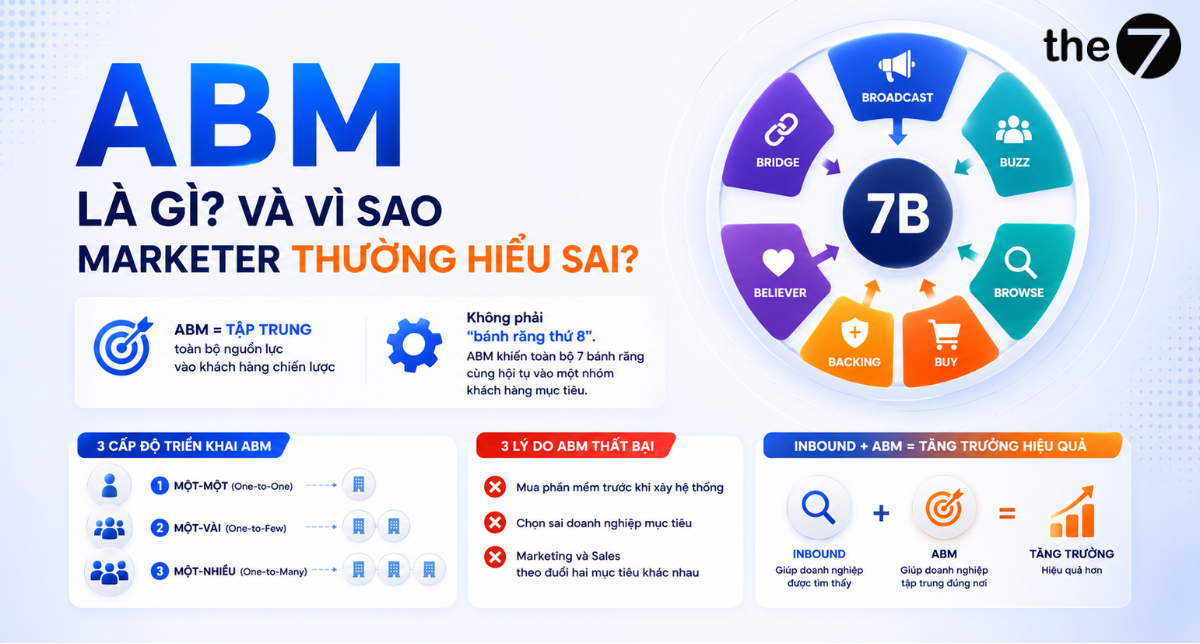
Summary: ABM, or Account-Based Marketing, is a way for marketing and sales to jointly focus resources on a pre-selected group of target customers, instead of trying to reach the entire market. If mass marketing is like casting a wide net to catch as many fish as possible, ABM is like identifying the biggest fish in advance and then going after each one individually. The important thing to understand is that ABM is not a separate marketing strategy. It doesn’t create a new method, and it doesn’t add any activity a business hasn’t already been doing. In the 7B model, ABM isn’t a new gear. It’s a way of operating in which the existing gears are coordinated and simultaneously focused on the same group of target customers. In other words, if 7B is the system, ABM is the way you point that entire system at exactly the customers you most want to win.
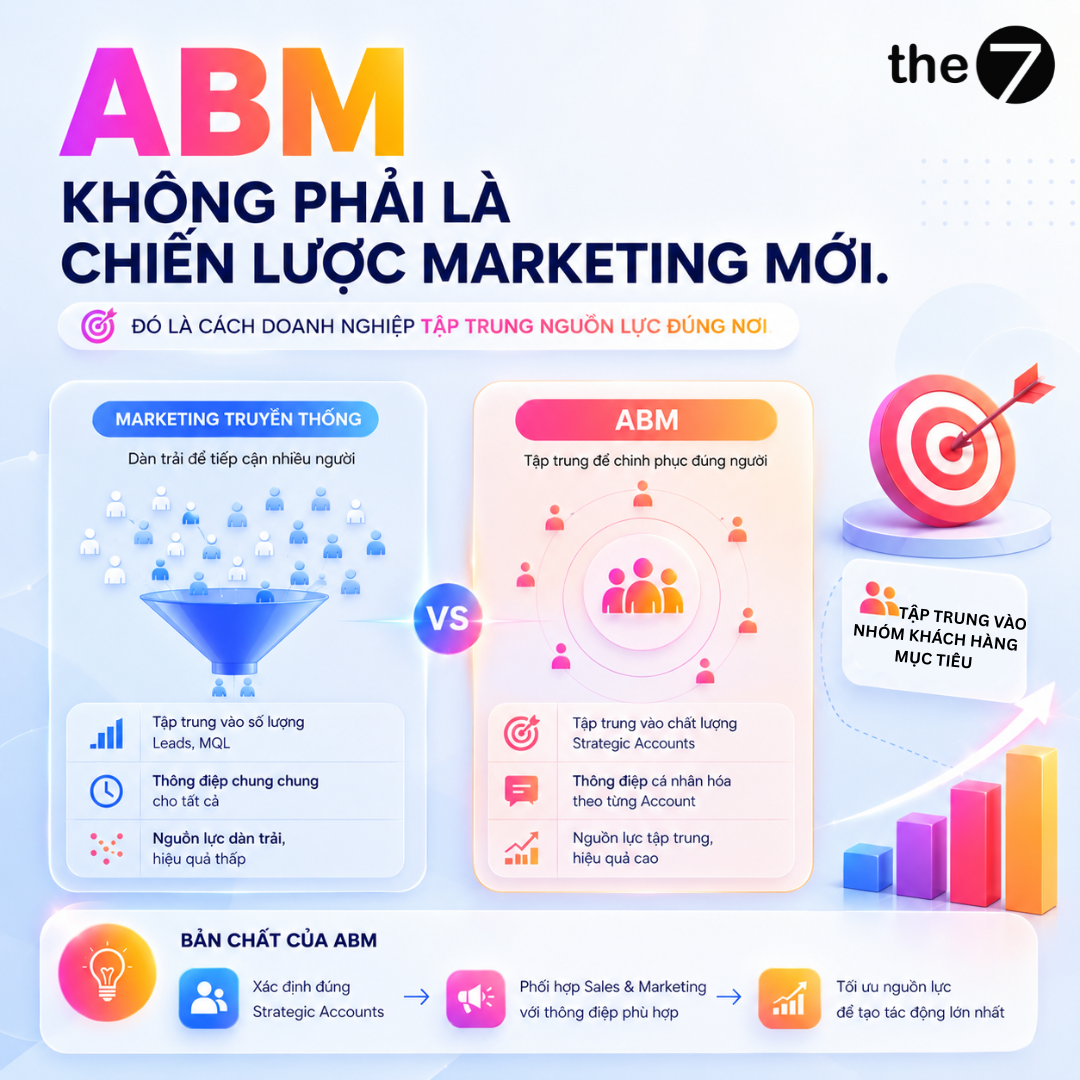
ABM is one of the most misunderstood concepts in B2B today. Whenever a business wants to pursue bigger, more complex, higher-contract-value customers, someone will almost certainly propose rolling out ABM. Then a list of target companies gets built, software gets purchased, a few campaigns get test-run, and everyone believes they’ve started doing ABM.
But a few months later, the results are usually underwhelming. The company list is still sitting there. Ads are still running. Sales is still reaching out. Yet the big deals aren’t showing up any more often than before. A familiar question follows: does ABM actually work, or is it just a concept the marketing-software industry has hyped up?
The problem isn’t ABM. The problem is how people perceive it. Most businesses treat ABM as a tool or a campaign. They think it’s enough to pick a group of companies and market to that group separately. In reality, ABM isn’t something you switch on. It’s a way of reorganizing your entire marketing and sales resources around a specific set of companies. It forces a business to answer a simple but difficult question: if we were only allowed to win twenty large enterprise customers this year, how would we allocate our time, budget, and attention? Seen that way, ABM stops being a tactic. It becomes a resource-focusing mechanism.
That’s also why I don’t see ABM as a standalone marketing strategy. In the 7B model, ABM doesn’t create any new gear. It simply takes the existing gears and points all of them at the same group of target customers.
Before going deeper into where ABM sits in the 7B model, we need to agree on a definition: ABM, short for Account-Based Marketing, is an approach in which a business identifies a target customer list in advance, usually customers with high strategic or high contract value, and then coordinates marketing and sales to run activities designed specifically for that exact group of companies.
ABM’s biggest difference isn’t the tools it uses, but who gets prioritized. Instead of trying to reach the entire market and waiting for the right people to show up, ABM starts by identifying the most important customers first, and then builds activities around them.
Where did ABM come from, and why is it back?
ABM is often viewed as a new B2B marketing trend. In reality, it isn’t new at all. What’s interesting is that what we call ABM today used to be the default way B2B sales worked for decades. An industrial equipment supplier didn’t try to reach the entire market. They knew exactly which companies they wanted to sell to, who the decision-makers were, who influenced those decisions, and who they needed to build relationships with. The entire sales operation revolved around a small number of high-value companies.
Then the internet arrived, bringing CRM, marketing automation, and a wave of tools that let businesses reach thousands of people at once. Scalability became the top priority. Marketing shifted from focusing on a specific set of companies to generating as many leads as possible.
For many years, that approach worked reasonably well. Reach costs were low, data was abundant, and automation systems helped businesses grow faster than ever. But gradually, a paradox began to surface.
Most revenue still came from a small group of large companies. Yet most of the marketing budget was spent attracting and nurturing a huge volume of leads that never became customers. Businesses were optimizing for volume while the real value stayed concentrated in a very small number of target companies.
ABM returned precisely because of that imbalance. What changed wasn’t the principle. What changed was the technology. Data platforms, B2B advertising, website-visitor company identification, and intent data now help businesses know who is showing interest, what topics they’re researching, and when to reach out. Work that used to be done manually can now be scaled to dozens or hundreds of target companies at once. So modern ABM isn’t a new invention. It’s the combination of traditional B2B sales thinking and modern marketing technology.
The biggest difference from the old way is that marketing no longer stands on the sidelines. Instead of waiting for sales to identify a target and then supporting afterward, marketing and sales now coordinate from the very start to build influence, create familiarity, and drive sales opportunities within the same group of target companies. The core spirit hasn’t changed: choose the right customers, then focus resources on them.
The three levels of ABM
One of the most common misconceptions about ABM is thinking it always means building a separate campaign for every single target company. That’s not true.
ABM exists on a broad spectrum, from extremely high personalization for a handful of companies to moderate personalization for hundreds of companies at once. That’s why the industry usually divides ABM into three levels.
The first level is One-to-One ABM, often called strategic ABM. This is the most focused form. A business selects only a very small number of targets, sometimes just five or ten companies, but each opportunity carries very high value. For this group, almost everything can be custom-designed: content, messaging, events, sales materials, even the website experience. Each target company is treated as its own market.
The second level is One-to-Few ABM. Instead of building a separate program for each company, the business groups targets that share similar characteristics together. They might be in the same industry, the same size, the same business model, or facing the same problem. This lets marketing and sales stay highly relevant without having to build everything from scratch for every single company.
The third level is One-to-Many ABM. This approach uses data and technology to reach hundreds of target companies at once. The level of personalization is lower than the previous two, but it still differs from mass marketing in one important way: the companies are pre-selected. Instead of trying to reach the entire market, all resources are still confined to a predefined target list.
What’s worth noting is that the businesses that run ABM most effectively usually don’t rely on just one level. They combine all three. The companies with the highest strategic value get the deepest investment. The next tier of prospects gets handled in clusters. The remaining group is reached through more scalable programs. These three levels differ in the degree of personalization, but they follow the same underlying principle. In ordinary marketing, a business finds customers first and then decides who’s worth investing in. In ABM, a business chooses the target companies first and then decides how to invest resources.
Where does ABM sit in the 7B model?
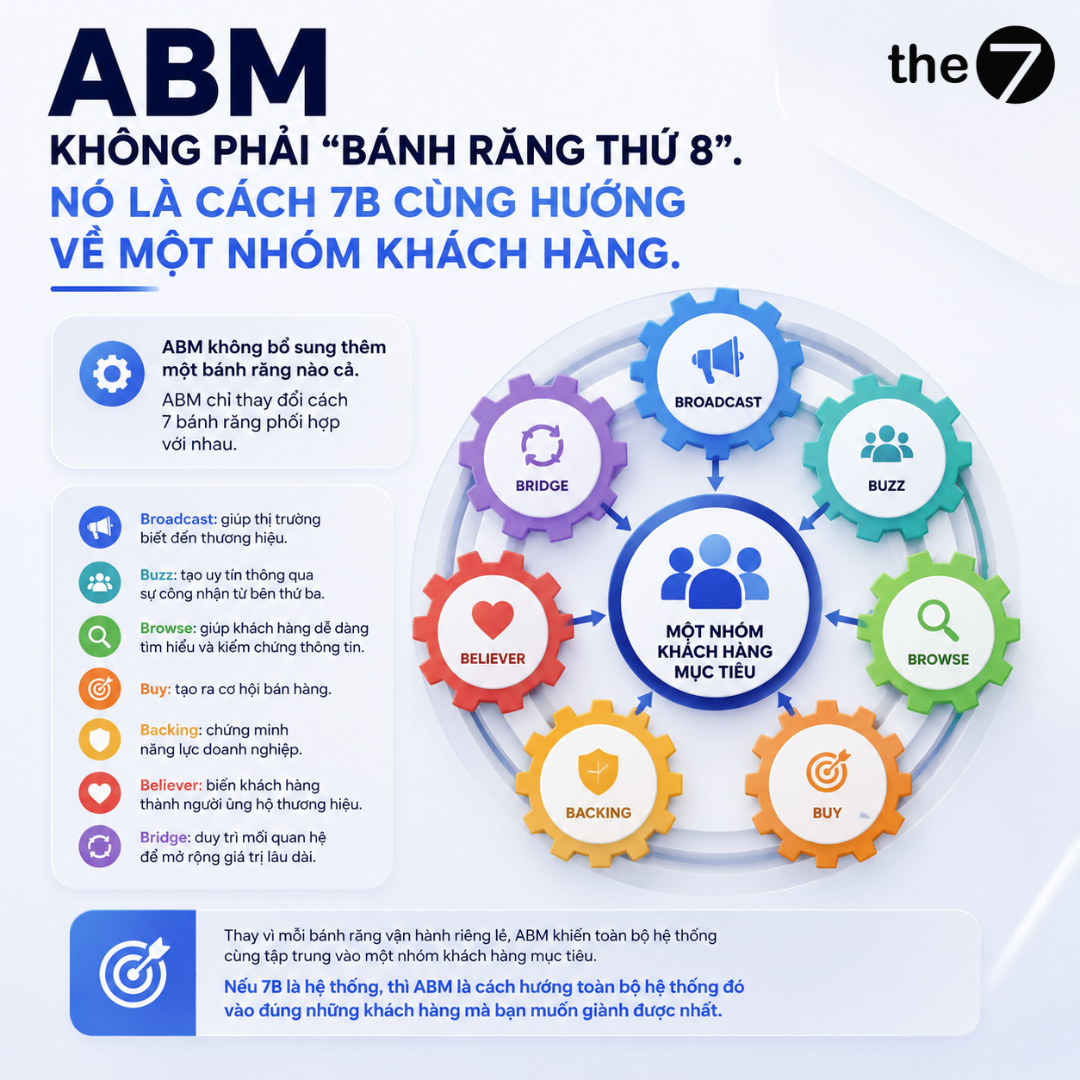
This is where I think the market gets ABM most wrong. Whenever a new concept becomes popular, people tend to treat it as a new method, a new strategy, or a new capability that needs to be bolted onto the existing system. ABM is no exception. Many businesses talk about ABM as if it were an eighth gear added to the marketing machine.
In the 7B model, I don’t see it that way. ABM isn’t an eighth gear. It doesn’t add any function that the existing seven gears don’t already perform. Instead, ABM is a way of operating in which all seven gears are focused together on a pre-selected group of target customers. That’s the core difference.
When a business runs 7B in the ordinary way, the gears turn to create influence across the entire market. Broadcast sends signals out to the market. Buzz spreads through the market. Browse helps the business get found when the market actively searches. Buy supports people entering the buying cycle. Believer, Backing, and Bridge continue to extend influence through customers, partners, and brand advocates.
In ABM, no gear changes its function. What changes is who it serves.
Broadcast no longer aims at reaching the entire market — it focuses on the issues and priorities of one specific group of target companies. Buzz is built so that people inside those companies hear about you through sources they trust. Browse ensures that when members of a buying committee start researching solutions, your business shows up at the right moment. Buy focuses on supporting the evaluation and decision-making process of each target company. After a win, Believer, Backing, and Bridge continue to be used to extend influence to other units within the same organization or to similar companies.
You’ll notice something interesting. No new gear appears. ABM is simply the same seven gears converging on a narrower focal point. That’s why I see ABM as 7B converged. If ordinary 7B is a system that creates influence across the entire market, ABM is the version where the whole system is concentrated on a predefined list of target companies.
This is also exactly why so many ABM programs fail. Businesses buy an ABM platform, build a target company list, run ads, and expect results to appear on their own. But ABM cannot compensate for weaknesses in the underlying system. If a business doesn’t yet have content strong enough to create influence, doesn’t yet have a presence credible enough to build trust, doesn’t yet have customers and partners good enough to provide social proof, then concentrating all resources on a narrow list won’t change that.
ABM doesn’t fix a weak marketing machine. It only makes a well-running machine more focused. In other words, ABM isn’t a replacement for 7B. It’s a way of running 7B at maximum concentration.
Let’s look at a few real-world examples. In telecommunications and infrastructure, network equipment vendors often have only a very small number of worthwhile customers in each country. Each contract can be worth tens or hundreds of millions of dollars, span many years, and involve a large number of decision-makers. For opportunities like that, nobody runs mass marketing.
The business will select each target carrier in advance, research each organization deeply, reach each decision-making group, and build a capability profile specific to each opportunity. To do that, they rely on previous deployment projects, technical certifications, reference customers, and leading experts. In other words, Buy and Backing are concentrated on a very small number of the highest-value target companies.
In pharmaceuticals, the challenge is different but the principle stays the same. Suppliers of equipment, technology, or services to global pharmaceutical corporations don’t have tens of thousands of potential customers to chase. The real market consists of only a finite group of large corporations.
Instead of building a separate program for each company, they typically group companies with similar characteristics together and develop cluster-based ABM programs. Here, scientific research, leading experts, and real-world evidence play an especially important role. Buzz and Backing become the most heavily converged gears for building trust within the target group.
In professional services such as consulting, auditing, or corporate law, ABM often plays out over a much longer timeframe. A consulting firm may spend years building relationships with a small group of strategic corporations. They publish research directly relevant to the problems those corporations are facing, show up at forums where those corporations’ leaders participate, and expand their network through existing clients, partners, and referrers. In this case, Broadcast and Bridge become the most prominent gears.
Three industries, three different implementations, but all following the same principle. None of the examples above created a new marketing strategy. No eighth gear appeared. What changed was only where the business concentrated its resources. That’s the essence of ABM. Not adding new activity, but pouring existing activity into the most important target companies.
How is ABM different from inbound and mass marketing?
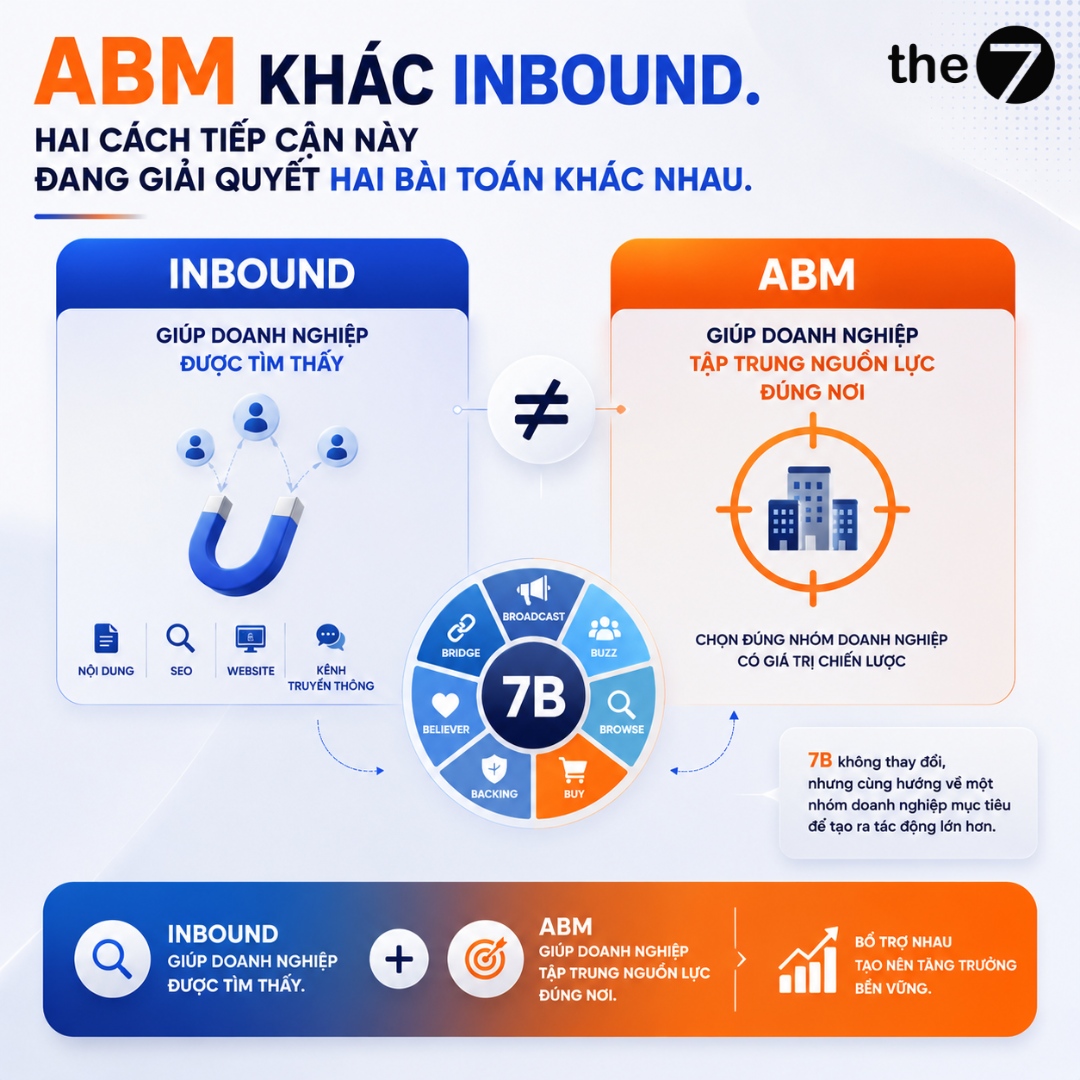
ABM is often positioned as the opposite of inbound marketing, but the two concepts actually answer completely different questions.
Inbound answers the question: how do we get companies that don’t know us yet to come to us on their own?
ABM answers the question: how do we win the companies we’ve already identified as most important?
One focuses on creating attention and attracting new opportunities. The other focuses on allocating resources toward the highest-value existing opportunities. So inbound and ABM don’t exclude each other. In fact, they usually complement each other.
Inbound helps a business get known, get found, and discover opportunities it hadn’t previously seen. ABM begins after that, once a business has identified which target companies deserve more-than-normal resource investment.
ABM also differs from mass marketing in how it allocates attention. Mass marketing tries to create influence across as wide a market as possible, then lets the market sort out the right opportunities on its own. ABM goes the opposite direction. A business identifies the most important target companies first, then concentrates most of its time, budget, and effort on that exact group.
Put simply, mass marketing starts with the market and then finds customers. ABM starts with the customer and then builds activities around them. That’s why ABM is especially well-suited to businesses where most revenue comes from a small number of high-value customers.
Three mistakes when implementing ABM
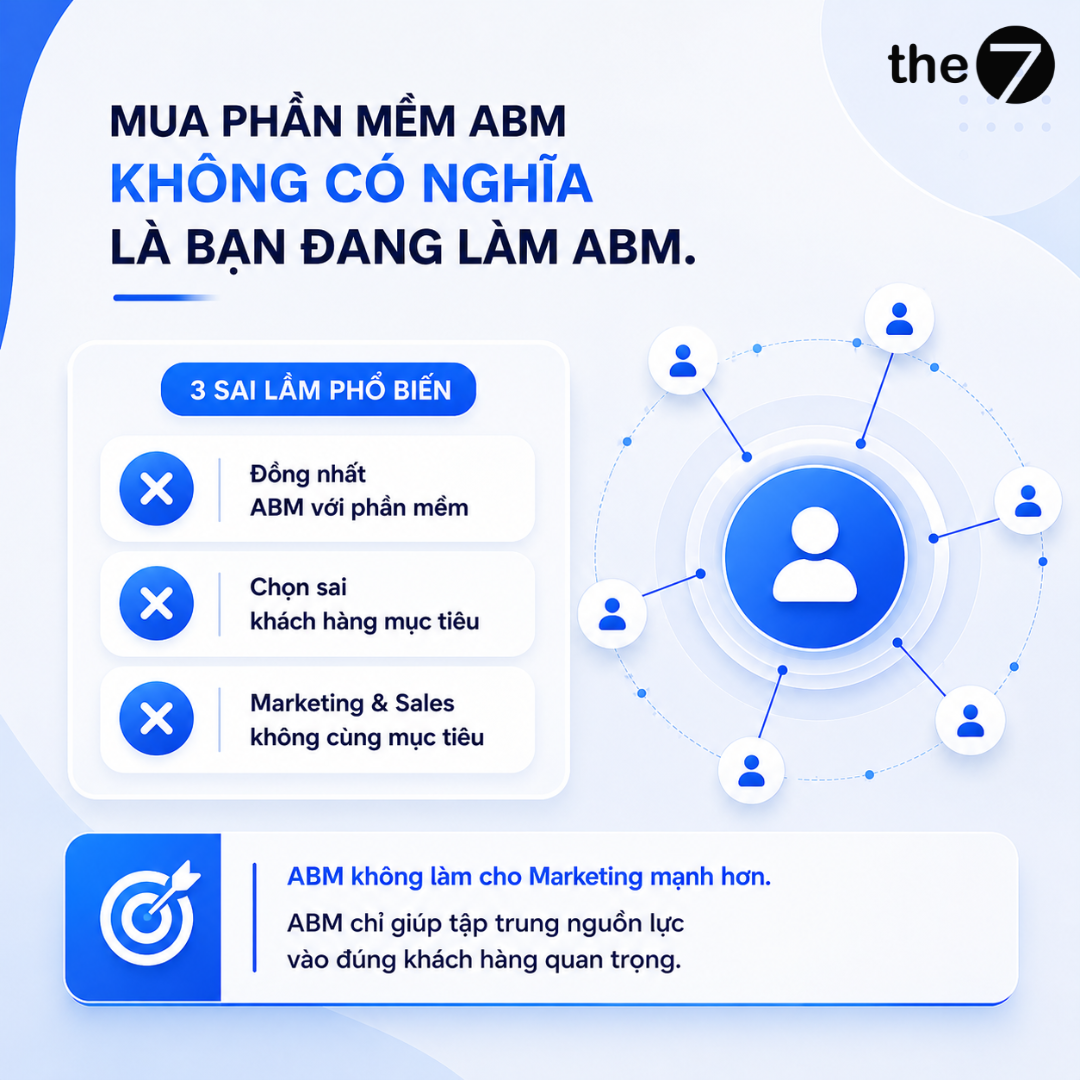
The first mistake is thinking ABM is a piece of software.
Many businesses buy an ABM platform, build a target company list, and believe they’ve started implementing ABM. But software doesn’t create a strategy. It only helps a business execute a strategy more effectively.
If a business doesn’t have content valuable enough, doesn’t have evidence convincing enough, and doesn’t have coordination between marketing and sales, then the software just helps them reach the wrong way toward a target group with greater precision.
ABM succeeds because the underlying system runs well. Software only helps that system focus better.
The second mistake is choosing the wrong target companies.
In ABM, no decision matters more than choosing the right companies to pursue. Many businesses build their list based on ambition rather than data. They pick the corporations they most want to win instead of the corporations best suited to their current capabilities.
The result is that resources get locked into opportunities with a very low probability of success. A target company list that looks attractive on paper isn’t the same as a list capable of generating revenue.
The third mistake is marketing and sales pursuing two different goals.
ABM only works when both departments agree on the target companies, share information, and take joint responsibility for the final outcome. When marketing focuses on one group of companies while sales pursues a different group, nearly all of ABM’s advantages disappear.
That’s also why ABM is usually an internal coordination problem before it’s a marketing problem.
Conclusion: ABM is a focal point, not a tool
What disappoints many people about ABM isn’t that ABM doesn’t work. The problem is that their expectations were wrong.
They see ABM as software, a campaign, or a toolkit they can buy and deploy immediately. But ABM isn’t what creates demand, creates credibility, or creates sales opportunities. It only decides where you focus those things.
That’s why I don’t see ABM as a standalone marketing strategy. In the 7B model, ABM isn’t a new gear. It’s a way for the seven existing gears to point together at a pre-selected group of target companies.
When a business doesn’t yet have noteworthy content, doesn’t yet have strong enough evidence, doesn’t yet have customers to build trust, or doesn’t yet have coordination between marketing and sales, ABM cannot solve those problems. Concentrating resources on a narrow list doesn’t make the system stronger. It only makes existing strengths and weaknesses more visible.
That’s also why ABM is best suited to businesses that already have a marketing and sales machine running reasonably well. In that case, instead of spreading resources across the entire market, a business can concentrate them on the highest-value opportunities.
If I had to sum up ABM in one sentence, I’d put it this way:
ABM isn’t a tool that helps you win big companies. ABM is how you make sure your best resources go to the companies most worth pursuing.

Nguyễn Đình
Bảo




As CEO of The7, I am committed to sharing practical, useful knowledge with every reader. Every article on The7 is based on my 7 years of hands-on experience in marketing — Facebook advertising, LinkedIn advertising, Google advertising, and marketing strategy. I hope you take away plenty of insight from these posts and apply it successfully in practice.
Related Articles
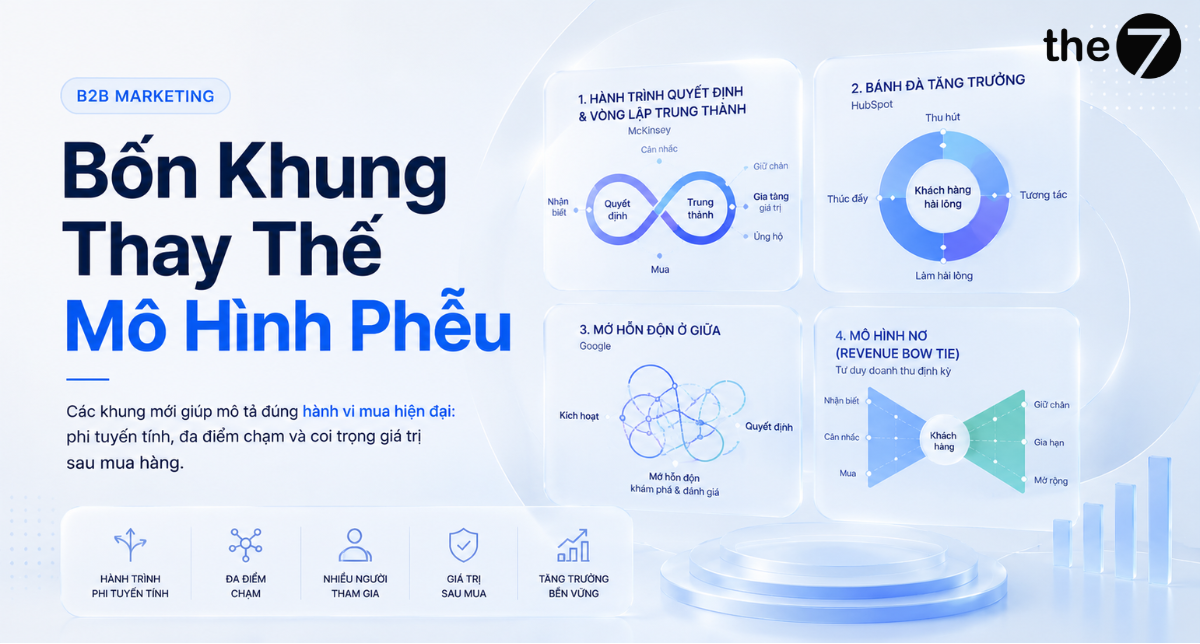
Four Frameworks That Replace the Funnel Model
Summary: As the funnel model increasingly fails to capture how modern buyers actually behave, a number of new frameworks have emerged to replace or repair it: McKinsey’s decision journey and...
What Is Category Design?
Summary: Category design is the act of creating an entirely new type of solution in the market’s mind, instead of competing within an existing category, and then becoming the name...
What Is B2B Positioning?
Summary: B2B positioning is the act of choosing the context you place your product into – the frame of reference that makes its value obvious to the buyer. Positioning isn’t...
What Is the 95/5 Rule?
Summary: The 95/5 rule states that at any given moment, only about 5% of B2B buyers are actually in-market, actively in a buying cycle, while roughly 95% are not yet...
What Is Mental Availability in B2B?
Summary: Mental availability is how easily a brand comes to mind in a buying situation. It isn’t about having the sharpest argument, the slickest pitch, or the most convincing feature...
What Are B2B Events and Trade Shows?
Summary: B2B events and trade shows are in-person gatherings such as conferences, industry trade shows, workshops, and private meetings, where a business meets buyers, customers, partners, and the industry community...