


What Is Outbound Marketing?
Outbound marketing is the set of activities where a business proactively reaches out to buyers first, through email, calls, messages, social media, or account-based targeting programs. Unlike inbound, it doesn’t wait for customers to come find you. Many people believe outbound is outdated or synonymous with spam. That’s not true. What’s dying isn’t outbound. What’s dying is outbound done without discrimination. Sending the same message to thousands of strangers has never been an effective strategy. Outbound done right means reaching the right person, in the right account, with the right message, at the right time. And here’s the most important point: outbound doesn’t create demand on its own. It only harvests demand that has already been created. When the market has already seen you, heard about you, or come into contact with your content or reputation, an email or a call has a chance of being heard. If not, outbound is just a stranger knocking on someone’s door. In the 7B model, outbound doesn’t belong to a single gear — it sits at the intersection of Buzz and Buy, where reputation gets converted into a sales opportunity.
Outbound marketing is how a business proactively opens the conversation with a potential buyer, instead of waiting for them to come find you. It includes outreach emails, calls, messages on professional social networks like LinkedIn, and advertising campaigns aimed at a specific list of accounts. The core difference between outbound and inbound comes down to who takes the first step. With inbound, the buyer comes to you on their own through content, search, or referral. With outbound, the business knocks on the door first. You don’t stand and wait for customers to walk into your store. You go find the people you believe you can help, and open a dialogue with them.
So outbound isn’t spam. Spam is just a bad version of outbound. Just as a bad ad doesn’t kill advertising, a bad email doesn’t kill outbound. What determines effectiveness isn’t who reaches out first, but whether you’re saying the right thing to the right person at the right time.
Why does outbound have a reputation for being dead?
As outreach automation tools became cheap and easy to use, a dangerous mindset began to spread: if sending to a hundred people gets one reply, sending to ten thousand people will get a hundred replies. Outbound gradually turned into a numbers game. The bigger the list, the better. The more standardized the message, the better. Everything got optimized to send more, faster, cheaper.
The result was almost inevitable. Buyers’ inboxes flooded with identical emails. Phones filled up with irrelevant calls. LinkedIn turned into a sea of copy-pasted messages. Buyers learned to delete, ignore, or block anything from a stranger. Email platforms tightened their spam filters. Reply rates collapsed. The mass-outbound machine eventually destroyed itself.
By the mid-2010s, as inbound marketing took off, many people rushed to declare outbound dead. Their argument sounded reasonable: buyers now research, compare, and explore solutions on their own, so stop bothering them and wait for them to reach out.
Half of that argument is right. Buyers genuinely hate being bothered. But what they hate isn’t being reached out to. What they hate is being reached out to for no reason. There’s a huge gap between an email sent to ten thousand strangers and an email sent to exactly one person at exactly one account you want to serve. There’s a huge gap between a generic message and a message that shows you understand the recipient’s business, their context, and their problem.
The first is a nuisance. The second starts a conversation. And this is exactly where many people misread outbound. They look at the failure of mass outbound and conclude that all outbound no longer works. In reality, what’s dying isn’t outbound. What’s dying is trying to sell to people who have never heard of you, have no reason to trust you, and see no value in spending time on you.
Where does right outbound differ from wrong outbound?
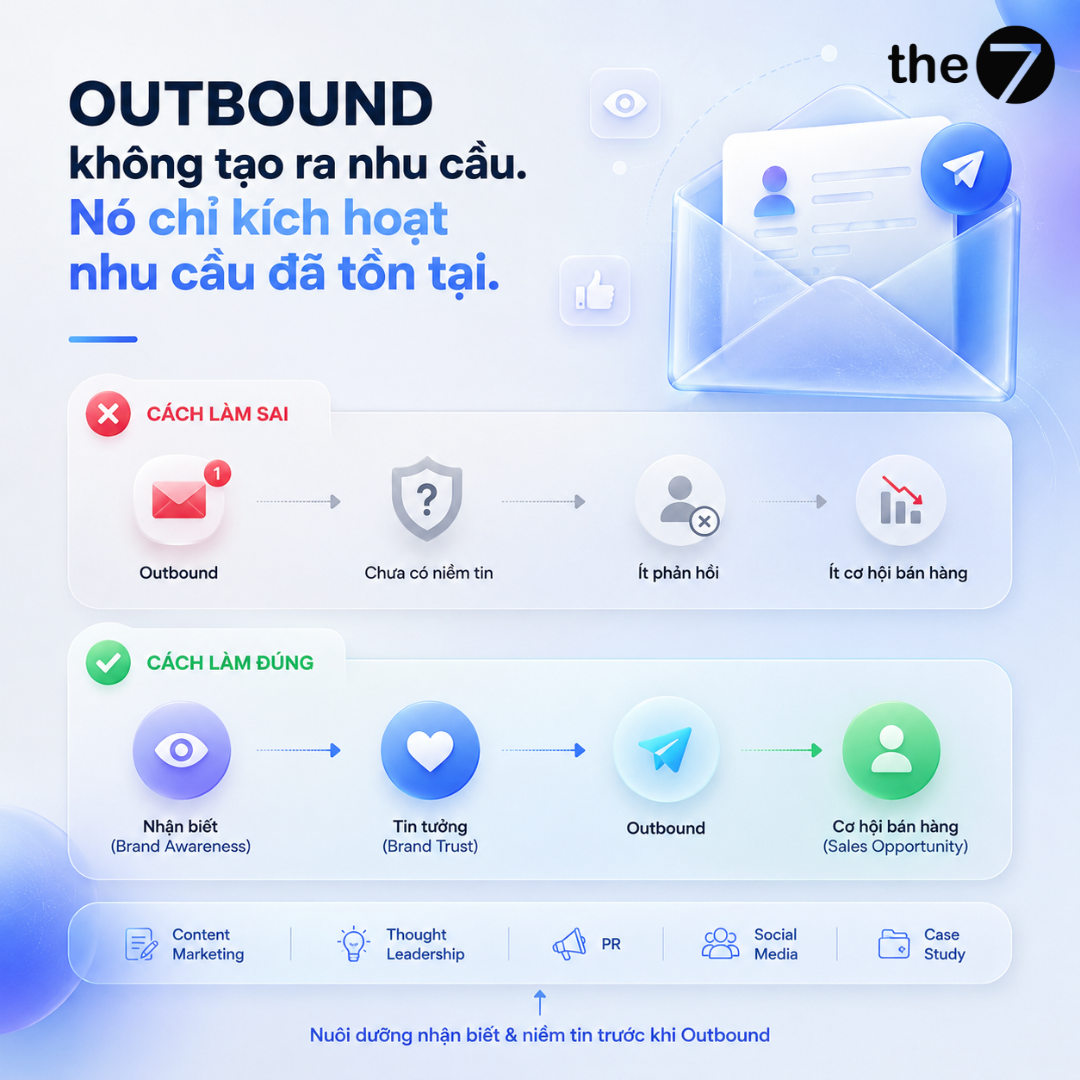
The line between right outbound and wrong outbound comes down to three simple questions.
The first question: who are you reaching out to?
Wrong outbound starts with a list that’s as big as possible. The list is bought, scraped, or collected from wherever possible. The goal is to maximize the number of recipients. Right outbound does the opposite. It starts by identifying a very specific group of accounts, businesses you can genuinely create the most value for. One side thinks in terms of scale. The other thinks in terms of fit.
The second question: what do you say?
Wrong outbound sends the same message to everyone. Swapping in a company name or a recipient’s name is enough. The content mostly talks about the business, the product, and what the sender wants to sell. Right outbound is built around the recipient. It talks about their problem, their context, and what’s happening inside their business. One side tries to present. The other tries to understand. But those two questions still aren’t the deciding factor.
The third question is the biggest line of all: has the recipient ever heard of you before?
This is the point most outbound debates miss. Imagine receiving an email from a company you’ve never heard of. You don’t know who they are. You don’t know whether they’re credible. You don’t know why they’re contacting you. In the first few seconds, your brain almost automatically treats it as an intrusion.
Now imagine that same email coming from a name you’ve encountered several times over the past six months. You once read one of their articles on LinkedIn. You once saw them featured in an industry report. You once heard a colleague mention them in a meeting. You might not be ready to buy, but at least you know they exist.
That’s the difference between appearing out of nowhere and appearing in a mind that already has an image of you. Many people think outbound success comes down to the email script, the opening line, or the automation tool. In reality, most of outbound’s success is decided before the email is even sent. It’s decided by whether the recipient already knows who you are.
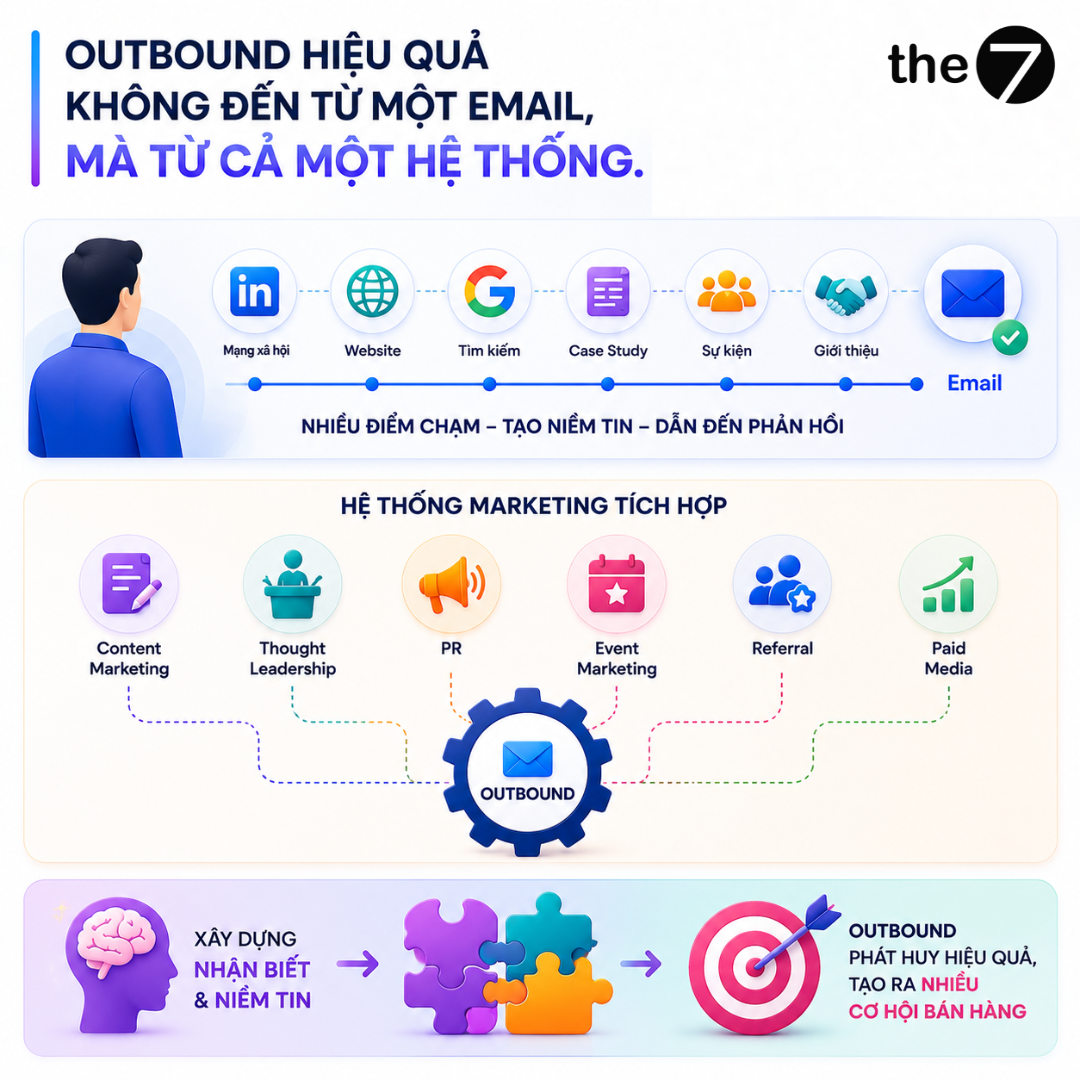
That’s also why outbound works best when it doesn’t stand alone. An email sent after the recipient has already seen you show up repeatedly in the market is almost always stronger than an email from a completely unknown name. Not because the email is better written. But because the ground has already been prepared.
In other words, outbound isn’t the tool that creates familiarity. It’s the tool that exploits familiarity created by other activities. And that’s why it only reaches its true potential when placed inside a larger marketing system.
Where does outbound sit in the 7B model?
This is where I want you to stop viewing outbound as a standalone tactic and start seeing it as part of the whole system.
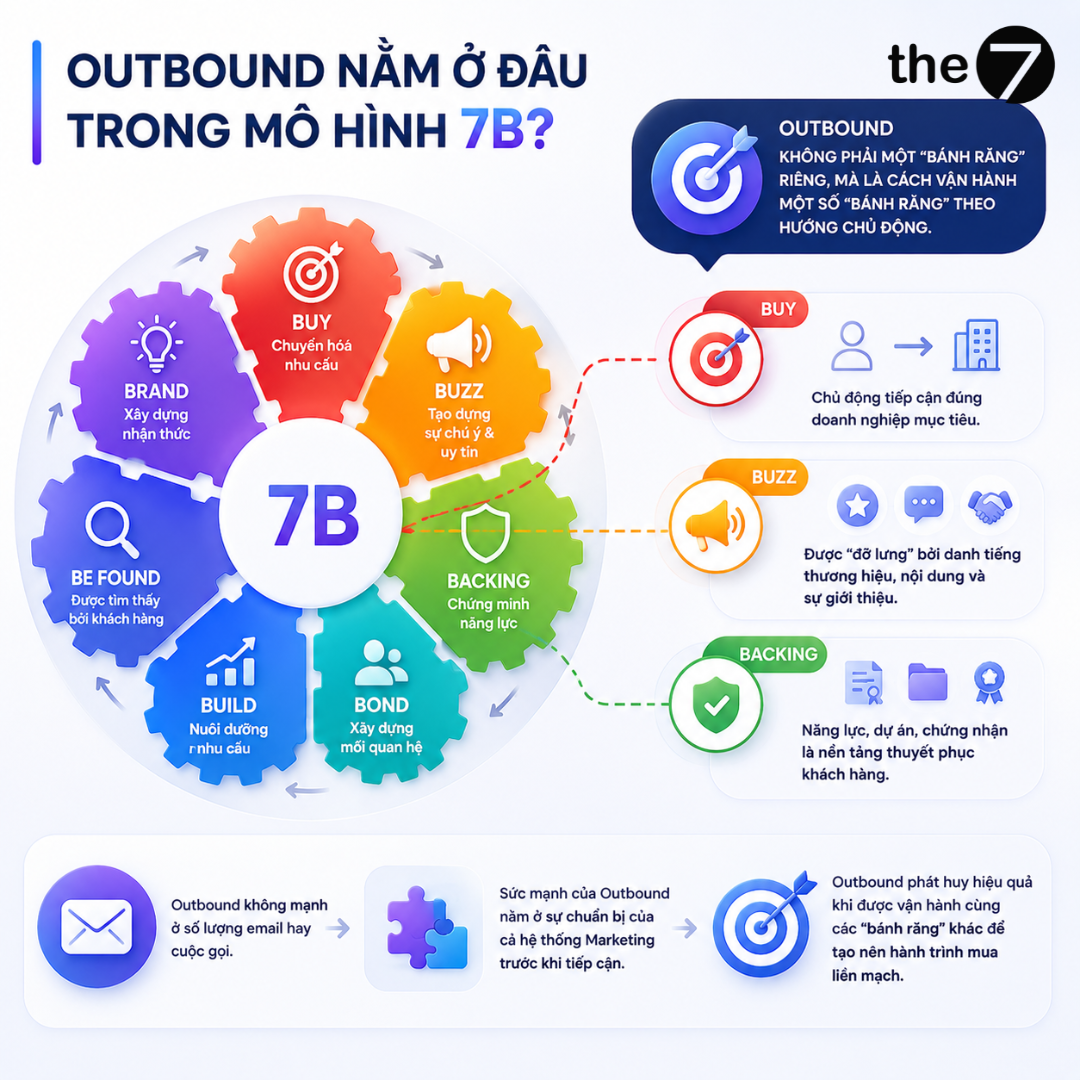
Outbound isn’t a separate gear in the 7B model. It’s how you run some of the existing gears in a proactive direction. In other words, outbound isn’t an independent function standing outside the system. It’s how you act on the system to create faster movement wherever you want it.
When outbound targets a specific list of accounts to open up sales opportunities, it’s exactly the Buy gear running in proactive mode. Instead of waiting for buyers to find their own way to your website, download a document, or request a quote, you proactively bring the conversation directly to them. The end goal doesn’t change. It’s still generating a sales opportunity. The only difference is that you’re the one making the first move.
But real outbound also involves a second gear, and this is the part most people overlook. When you build a relationship with an account over months or years, when an existing customer refers you to another prospect, when someone in the industry mentions your name before you even show up, when your reputation precedes your email or your call, that’s the Buzz gear quietly working on outbound’s behalf.
Buzz is third-party echo. And an outbound reach-out paved by Buzz is almost always far stronger than an outbound reach-out coming out of nowhere. Try putting yourself in the recipient’s shoes. An email from a completely unfamiliar name forces them to answer a string of questions in their head. Who is this person? Who is this company? Are they credible? Why should I spend time on them?
But if the recipient has already read one of your articles, already seen your name in an industry report, already heard a colleague mention you in a meeting, those questions have essentially already been partly answered. Outbound’s job at that point is no longer to break through initial suspicion. It just needs to open the dialogue.
That’s why the exact same email, the exact same call, the exact same offer, can produce completely different results depending entirely on what happened beforehand.
And here’s the most important point when placing outbound inside the 7B model. Outbound, no matter how proactive, doesn’t create demand from zero. It can’t make a market that’s never heard of you suddenly trust you. It can’t make a business that’s never known you exist suddenly want to allocate budget to you. It can’t replace months or years of building awareness, credibility, and trust in the market.
Outbound only works effectively once the demand-creating gears have already been turning. A message sent to someone who already knows your name, already has some goodwill toward you, and is already facing exactly the problem you solve can open a major deal. That same message sent to someone who has never heard of you can vanish in seconds. The difference isn’t in the message. The difference is in what the market already knew about you before the message arrived.
Outbound doesn’t replace sowing. It’s just a more proactive way of harvesting. And to harvest, you first need something to harvest. Let’s look at a few examples of how right outbound plays out in practice, across very different industries.
In finance, Bloomberg sells its Terminal data system to financial institutions through a proactive sales team. But this isn’t cold outbound in the ordinary sense. Before a Bloomberg salesperson calls an investment fund, the Bloomberg name has already been present across the finance industry for decades. It shows up in the news, in market data, on trading screens, and in the daily conversations of investors. When the call happens, the recipient may not want to buy yet, but it’s extremely rare for them not to know who Bloomberg is. Outbound works because it comes after decades of market presence. The call almost never starts from zero.
In manufacturing, a component maker wanting to become a supplier to a major automaker can’t just sit and wait for that automaker to come find them. They have to proactively reach out. They send samples. They attend trade shows. They invite customers to tour the factory. They build relationships with the procurement department, the engineering team, and everyone who influences the purchase decision. This process can take months, even years.
This is outbound in its purest form, and entirely reasonable, because the target customer list may include only a few dozen companies worldwide. But for that outbound effort to have a chance at succeeding, the business must first prepare a wide range of capability evidence: quality certifications, technical documentation, capability profiles, past projects delivered, and real production capacity. In the language of 7B, that’s the Backing gear laying the foundation for outbound. Without Backing, the outreach usually ends right at the first question about capability.
In enterprise software, many companies use account-targeted advertising to keep showing up consistently in front of exactly the businesses they want to serve. Meanwhile, the sales team simultaneously reaches out directly to decision-makers inside those accounts.
Ads make the name familiar. Content makes the business credible. Direct outreach opens the conversation. Each activity alone might not produce much. But combined, they create a very particular feeling in the buyer’s mind: this business seems to be everywhere, and now they’re proactively talking to me.
Three examples, three different industries, but all leading to the same conclusion. Right outbound almost never stands alone. It always follows, or accompanies, something else that already made your name more familiar, more trustworthy, and easier to listen to.
In other words, outbound’s real power doesn’t lie in how many emails you send or how many calls you make. It lies in what the market already knew about you before that email or call ever showed up.
How is outbound different from inbound and demand conversion?
Outbound and inbound are really just two different approaches to the same question: who takes the first step?
With inbound, the buyer actively comes to you. They read an article, find you on Google, hear about you from a referral, or stumble onto your content somewhere, then voluntarily enter the conversation.
With outbound, the business is the one who opens the conversation first. You identify the accounts you want to serve, find the right people involved, and initiate the dialogue instead of waiting for them to show up.
Many people treat inbound and outbound as opposing camps, as if a business has to choose one. In my view, that’s the wrong way to see it. These two approaches aren’t rivals. They solve different problems.
When your target market is very narrow and clearly defined from the start, outbound is almost mandatory. If you only want to become a supplier to the world’s five biggest automakers, sitting and waiting for them to stumble across your article and reach out on their own is more of a hope than an actual strategy. In that case, you have to reach out proactively.
On the other hand, when you serve a broad market with thousands or millions of potential customers, many of whom you don’t even know by name, inbound becomes incredibly valuable. It helps you get found by people you couldn’t have identified in advance to call or email.
So the question isn’t inbound or outbound. The question is, in each specific situation, which one is the more effective way to start the conversation. And most mature businesses eventually use both.
Outbound and demand conversion have a different relationship. They overlap, but they aren’t the same thing. Demand conversion is the activity of turning existing market demand into sales opportunities and revenue. It focuses on people who have already entered the buying cycle, who are researching, comparing, or evaluating solutions.
Outbound is just one of many ways to do that job.
If someone is searching for a solution and the sales team proactively reaches out at the right moment, that’s outbound serving demand conversion. If that same person finds their own way to your website through Google Ads or expert content, that’s still demand conversion, but it isn’t outbound. In other words, demand conversion answers the question of who you’re harvesting. Outbound answers the question of how you harvest. However, outbound has an interesting trait that keeps it from being entirely confined to the scope of demand conversion.
A business can proactively build a relationship with an account long before that account ever enters a buying cycle. They meet at a trade show, connect on LinkedIn, check in periodically, or simply stay present in each other’s minds over time.
At that point, there’s no demand yet. No project yet. No budget yet. Nothing to convert yet. But when the need appears months or years later, that business is no longer an outsider. They’re already on the shortlist.
That’s the point where outbound goes beyond the pure concept of demand conversion. It doesn’t just help harvest demand that already exists. In many cases, it also helps you earn a spot in the game before the demand even appears.
Three mistakes when running outbound
The first mistake is running outbound before creating any footprint in the market.
This is the most common mistake, and also the most costly. A business nobody knows, with no expert content, that has never appeared in any industry discussion, dives straight into sending thousands of emails and outreach messages. Every message hits the same wall: suspicion.
The recipient sees the company name. They search for it. They find nothing notable. No proof of capability. No presence. No reason to trust. And then they delete the message.
In this case, the problem isn’t the opening line or the call to action. The problem is that the business is trying to harvest a field that has never been sown.
The fix isn’t writing a better email. The fix is building a minimum level of presence first, so that when the recipient searches for you, they find something credible enough to keep the conversation going.
The second mistake is equating volume with effectiveness.
The “send as many as possible” mindset has done a great deal to destroy outbound’s reputation over the years, and it’s still eroding the effectiveness of countless sales teams today.
Sending ten thousand irrelevant messages doesn’t just waste resources. It also damages brand reputation, annoys recipients, and in many cases even reduces the business’s own email deliverability.
By contrast, a few dozen well-researched, properly personalized messages sent to the right people usually generate more opportunities than thousands of generic messages. Right outbound isn’t a contest of who sends more. It’s a contest of who understands the customer better.
The third mistake is only talking about yourself.
Many outbound emails open with lines like who we are, what we’ve done, how great our product is, or how different our company is. The sender finds those things fascinating. The recipient doesn’t.
What the recipient cares about is the problem they’re facing, the pressure they’re under, and the outcome they’re trying to achieve. A good outbound message rarely starts with the sending business. It starts with the receiving business.
It talks about the recipient’s context. It addresses a specific problem the recipient has. It shows that the sender took the time to understand before reaching out.
Only after proving that they’re talking to the right person about the right problem does a business earn the right to talk about itself.
Conclusion: outbound is the spearhead, not the whole spear
Back to the point I raised at the start. Outbound isn’t dead. What’s dying is sloppy outbound: buying a list, blasting it out, and hoping for a miracle.
Right outbound, deliberate outreach to the right person, in the right account, at the right time, is still one of the most effective ways to win major deals, especially in markets with a finite, well-defined set of target customers. But outbound is only the spearhead of the spear, not the whole spear.
The spearhead delivers the final thrust. But the power behind that thrust doesn’t come from the spearhead itself. It comes from the entire shaft behind it, driving force in one direction.
The same is true in the 7B model. Outbound works because other gears have already done their job beforehand. There’s already been presence. There’s already been reputation. There’s already been trust. There have already been signals that make your name feel more familiar than everyone else’s.
A spearhead with no shaft behind it is just a piece of metal flying through the air. And an outbound strategy detached from the rest of the marketing system isn’t much different. It might touch the buyer. But it rarely carries enough force to cut through the indifference, suspicion, and competition already present in the market.

Nguyễn Đình
Bảo




As CEO of The7, I am committed to sharing practical, useful knowledge with every reader. Every article on The7 is based on my 7 years of hands-on experience in marketing — Facebook advertising, LinkedIn advertising, Google advertising, and marketing strategy. I hope you take away plenty of insight from these posts and apply it successfully in practice.
Related Articles
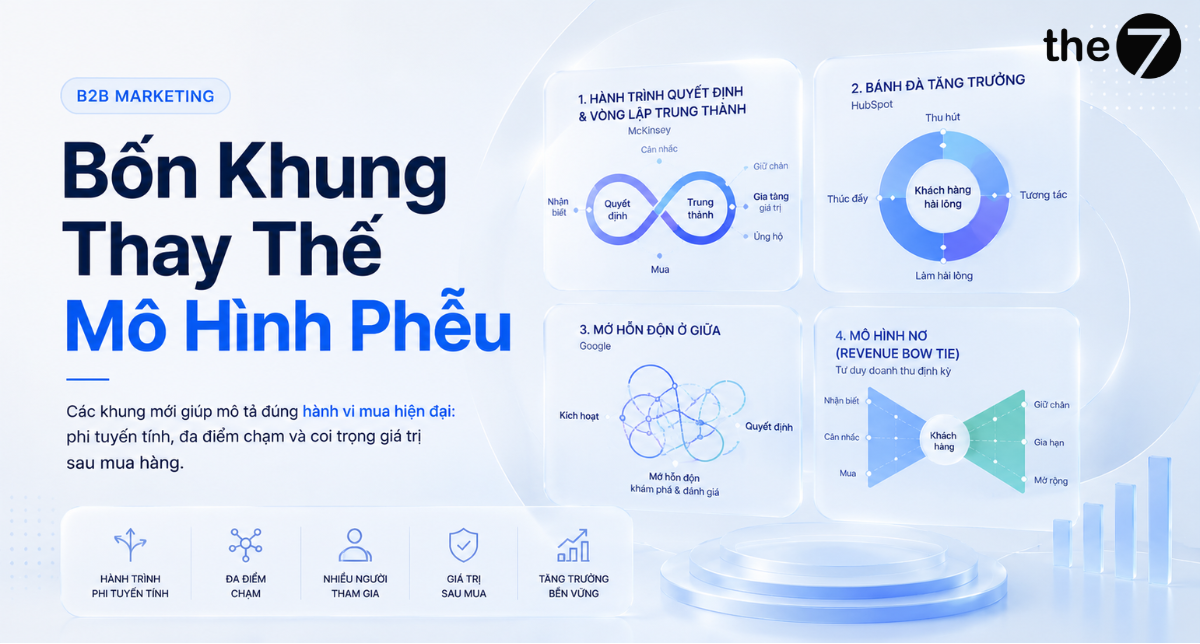
Four Frameworks That Replace the Funnel Model
Summary: As the funnel model increasingly fails to capture how modern buyers actually behave, a number of new frameworks have emerged to replace or repair it: McKinsey’s decision journey and...
What Is Category Design?
Summary: Category design is the act of creating an entirely new type of solution in the market’s mind, instead of competing within an existing category, and then becoming the name...
What Is B2B Positioning?
Summary: B2B positioning is the act of choosing the context you place your product into – the frame of reference that makes its value obvious to the buyer. Positioning isn’t...
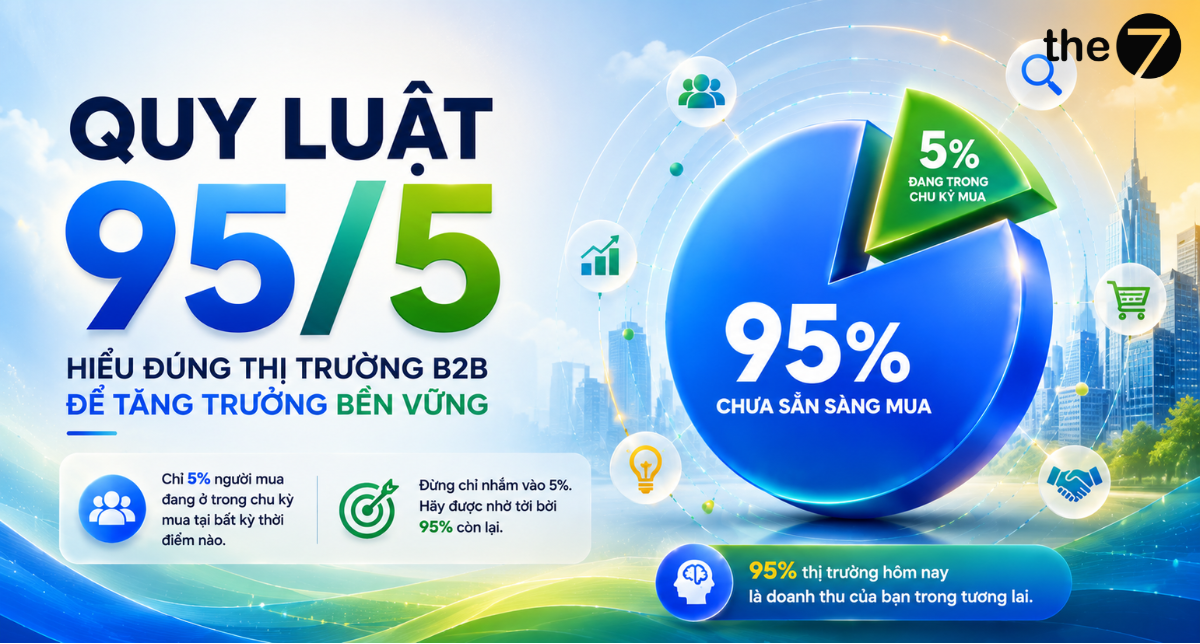
What Is the 95/5 Rule?
Summary: The 95/5 rule states that at any given moment, only about 5% of B2B buyers are actually in-market, actively in a buying cycle, while roughly 95% are not yet...
What Is Mental Availability in B2B?
Summary: Mental availability is how easily a brand comes to mind in a buying situation. It isn’t about having the sharpest argument, the slickest pitch, or the most convincing feature...
What Are B2B Events and Trade Shows?
Summary: B2B events and trade shows are in-person gatherings such as conferences, industry trade shows, workshops, and private meetings, where a business meets buyers, customers, partners, and the industry community...