


What Is Paid Advertising in B2B?
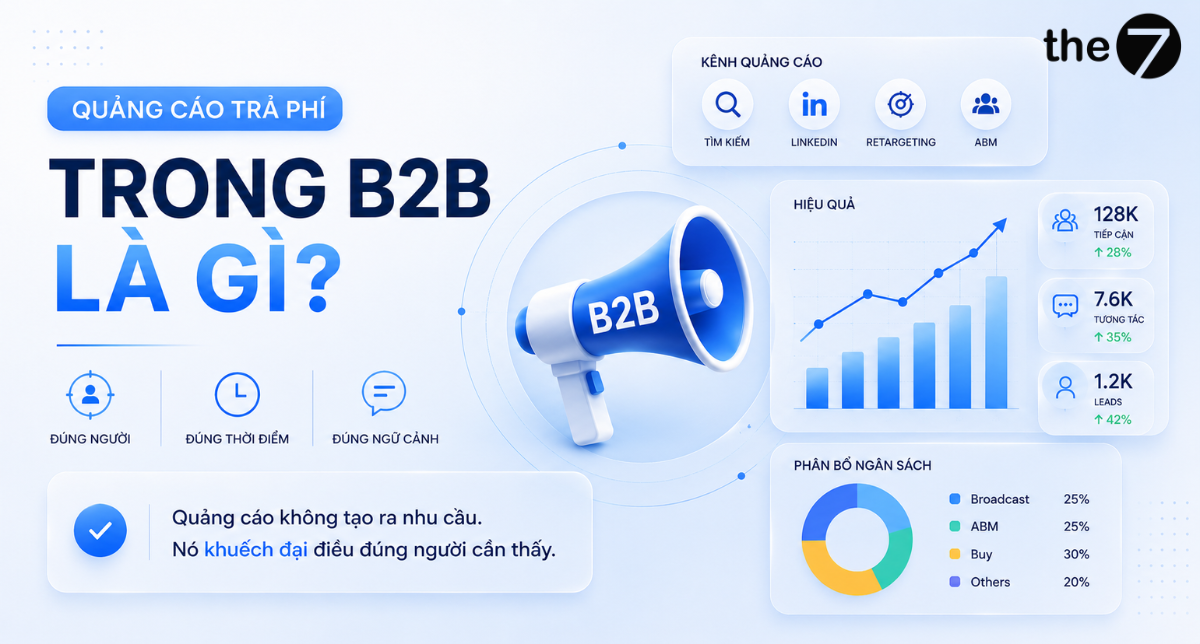
Summary: Paid advertising in B2B means paying to put the right message in front of the people who influence purchase decisions inside target organizations, through channels like search, LinkedIn, retargeting, and ABM. The biggest mistake B2B businesses make is treating it like retail advertising, expecting a single click to lead straight to an order. But in B2B, the click is usually the wrong target. Advertising doesn’t win with a bigger budget — it wins with greater relevance. In the 7B model, paid advertising isn’t a separate gear, but an amplification layer that can be applied across many different gears to make their impact spread further, faster, and stronger.
Most B2B businesses spend their ad budget with a mindset borrowed from the retail world. They run ads, wait for clicks, wait for forms to come in, wait for orders to appear, then calculate a cost per lead or per deal as if the entire purchase decision happened in a single moment. When the numbers don’t look good, they conclude that B2B advertising is expensive, hard to execute, hard to measure, and ineffective. But the problem usually isn’t the advertising itself. The problem is that they’re applying an operating model from the consumer market onto a market with a completely different buying structure.
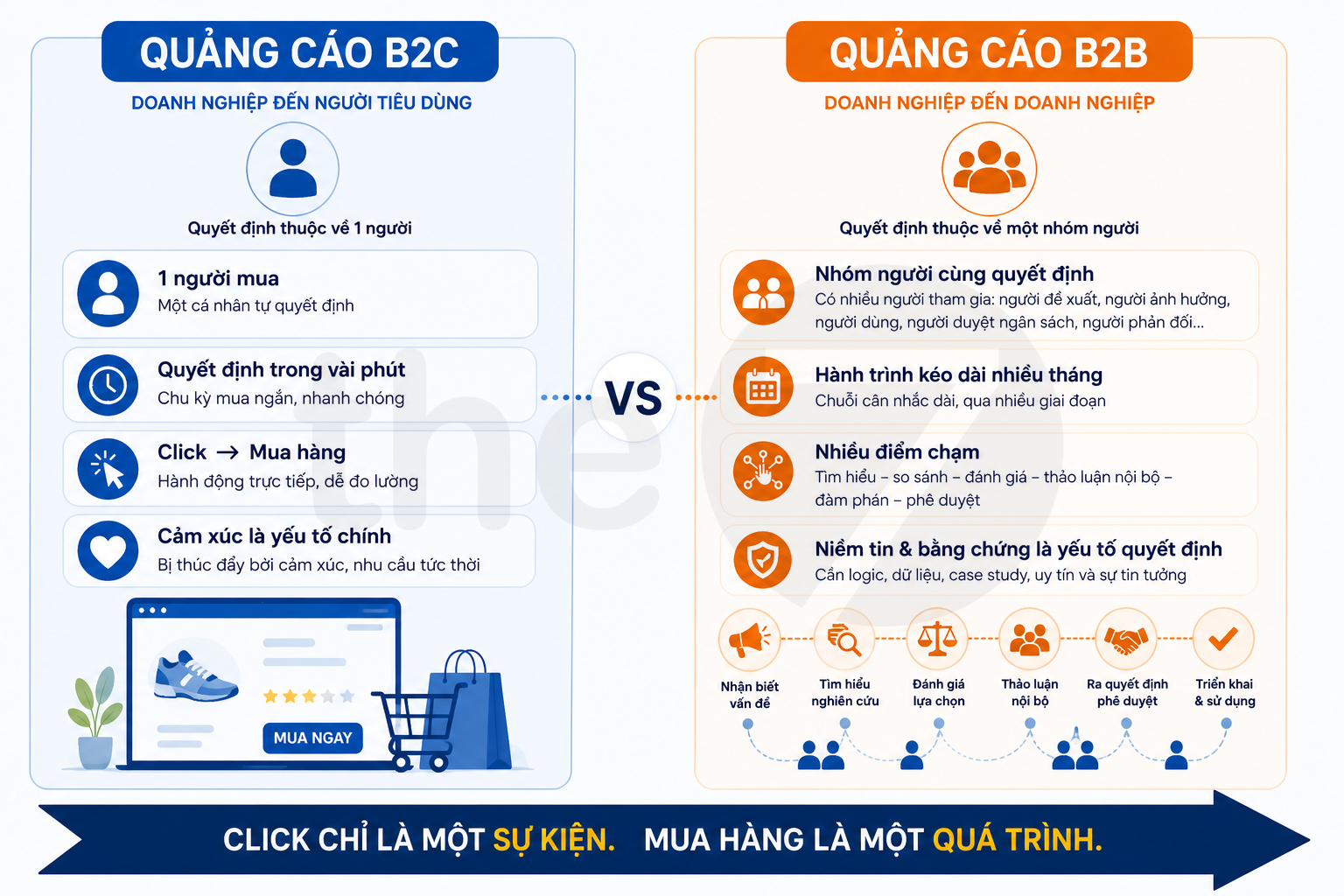
Retail and B2B differ at the root. A consumer might see an ad for a pair of shoes, a shirt, a bottle of perfume, or a cheap course, and decide to buy within minutes if the need, emotion, price, and trust line up. But a business doesn’t see an ad for a software system, an equipment line, a consulting service, or a financial solution and sign a contract five minutes later. A B2B purchase decision typically involves many people, many departments, many risks, many rounds of evaluation, many internal meetings, and many layers of approval. A click can be a small signal along that journey, but it’s rarely the end of it.
This is why the “click then buy” mindset usually breaks B2B advertising from the start. It makes businesses see advertising as a direct sales machine, when the real role of B2B advertising is far broader. Advertising can build familiarity, pave the way for trust, deliver the message to the right people on the buying committee, activate people who already have a need, remind those who are still weighing their options, and amplify content assets that have already proven their value. If you only look at click counts and lead forms, you’re measuring the most visible part — not necessarily the most important one.
This piece doesn’t revisit the philosophical question of what ratio businesses should invest between brand marketing and performance marketing. That question belongs to a separate article. This piece goes into the mechanics of paid advertising in B2B: why the click is the wrong target, why relevance can make advertising cheaper than a bigger budget, why advertising only amplifies rather than creates something from nothing, and why in the 7B model, advertising isn’t a standalone gear but an amplification layer applied across many different gears.
First, let’s define this clearly. Paid advertising in B2B is when a business pays media platforms to deliver a message to the people connected to purchase decisions inside target organizations. Those people can be CEOs, CFOs, CMOs, CTOs, CISOs, heads of operations, plant directors, procurement leads, technical specialists, internal end users, or anyone with real influence over vendor selection. Common channels include search ads, LinkedIn ads, display ads, retargeting, account-based advertising, and sometimes ads that amplify PR or expert content.
The key difference is that B2B advertising doesn’t target only one individual who’s ready to buy right now. It has to account for a long buying journey where many people are involved, each caring about a different piece of the problem. The CEO cares about growth, risk, positioning, and overall efficiency. The CFO cares about cost, ROI, cash flow, contracts, and control. The CTO or technical team cares about integration, security, stability, and deployability. End users care about convenience, speed, and impact on their daily work. A good B2B ad doesn’t just ask “how do I get someone to click,” it has to ask something deeper: “Is this message relevant to the right person, the right role, the right concern, at the right moment in the buying journey?”
Why Is the Click the Wrong Target in B2B?
To understand why optimizing for clicks is wrong in B2B, you need to look at how B2B buyers actually decide. For years, research on B2B buying behavior from Gartner, Forrester, 6sense, and other organizations has pointed to the same reality: the B2B buying journey is no longer linear, no longer simple, and no longer mostly in the hands of the vendor’s sales team. Buyers do a huge amount of research on their own before reaching out. They talk internally. They ask colleagues. They read content. They check communities. They compare vendors. They discuss in private groups. They listen to podcasts, read analyses, watch case studies — and only once they’ve reached a certain level of understanding do they actually step into a direct conversation with a vendor.
A typical B2B purchase decision isn’t made by one person. It’s the result of a group of people, each with a different perspective and a different fear. The person proposing the solution may want change because they’re facing an operational problem. The budget approver may fear costs ballooning. The technical person may fear complex integration. The executive may fear implementation risk. The end user may fear being forced onto a system they find frustrating. When multiple concerns coexist, the buying journey can’t be reduced to a single click, a single form, or a single website visit.
This is the biggest contradiction between the retail advertising model and the reality of B2B advertising. The retail model assumes an individual sees an ad, feels interested, clicks, reads, and buys. That model can hold true for many low- or mid-priced consumer products, where the risk is low and the buyer has full decision-making power. But in B2B, there’s usually no single individual. There’s a buying group. There’s no single decisive moment. There’s a drawn-out chain of deliberation. There’s no straight line from ad to order. There are countless touchpoints, interruptions, internal discussions, and back-and-forth stages.
So when you expect a click to close out a collective decision that takes months, you’re fundamentally expecting the wrong thing. A click isn’t meaningless, but it shouldn’t be elevated into the ultimate goal. Someone might see your ad ten times without clicking, but your brand name starts to feel familiar. A CFO might not fill out a form, but they’ve seen an argument that made them less skeptical. A head of engineering might not download a document, but they remember that you have experience in their industry. A CEO might never publicly engage, but when the team puts a vendor shortlist on the table, a familiar name has an edge over a completely unknown one.
The mistake happens when businesses treat all of this value as zero, simply because it doesn’t show up as a click. In reports, people who don’t click get treated as having no value. But in reality, someone who doesn’t click may still have seen, remembered, become less unfamiliar, and started associating your brand with a specific problem. In B2B, where familiarity and trust usually come before action, underestimating the “saw it but didn’t click” group is a major mistake.
Optimizing too aggressively for clicks also leads businesses into another trap. To get cheap clicks and fast forms, you usually have to pour budget into the group with very clear intent — people who are actively searching, comparing, requesting quotes, or near the end of the buying cycle. This group matters, but it’s small and highly competitive. When every competitor fights over the bottom of the funnel at once, costs rise, messages start to look alike, and buyers get surrounded by near-identical pitches. You might win a few deals, but you won’t build a lasting advantage if your entire ad spend is crammed into that small pond.
The bigger job of B2B advertising is to show up in front of the right people throughout the long journey — not just appear at the very last second when the buyer is already ready to fill out a form. Advertising can help you plant a new perspective in the buyer’s mind before they even build a vendor shortlist. It can help you build familiarity with multiple people inside the same account before sales ever reaches out. It can help a case study, a piece of research, an analysis, or a positioning message get repeated enough times to become a memory. None of this necessarily produces an immediate click, but it sets the stage for later clicks to be higher quality.
So the click is not the ultimate measure of value in B2B. It’s simply the easiest thing to count. And in marketing, the easiest thing to count is often not the most important thing. B2B advertising creates value by delivering the right message to the right people, often enough, over a long enough buying journey, so that when real need finally emerges, your brand is no longer a stranger.
Why Is Relevance Cheaper Than Budget?
If the click isn’t the central goal, where does the real leverage of B2B advertising come from? The answer lies in a very important principle: in modern advertising, budget isn’t the only factor that determines whether you win or lose. Ad platforms don’t simply sell placement to the highest bidder in a crude sense. They run on auction systems that weigh many factors, and how relevant an ad is to the viewer is one important variable.
Ad platforms have their own interest: keeping users engaged. If users keep seeing meaningless, annoying, irrelevant ads, they get frustrated and disengage from the platform. So platforms tend to reward ads that users are likely to find useful, relevant, or at least appropriate to their context. That reward can show up as a lower cost, better delivery frequency, a higher chance of winning the auction, or better impression performance compared with a less relevant ad that pays more.
Put simply, relevance gets rewarded with money. An ad that speaks to the right problem for the right person, in the right industry, the right role, the right context, usually has a cost advantage over a generic ad blasted across a broad market. An ad aimed at a manufacturing CFO focused on cost control looks very different from a generic ad claiming “our solution helps businesses grow.” An ad aimed at a SaaS company’s CTO worried about security and integration looks different from an ad that just lists features. The better you understand the recipient, the more relevant your ad can be. The more relevant it is, the better chance it has of being distributed efficiently by the platform.
This is where most businesses miss the point. When advertising underperforms, the common reflex is to raise the budget. But if the targeting is wrong, the message is weak, the content doesn’t resonate, and the call to action doesn’t match the buying stage, a bigger budget just makes you burn money faster. It doesn’t fix the root cause. Like turning up the volume on an out-of-tune song, a bigger budget can make more people hear you, but it doesn’t make your message more persuasive.
In B2B, relevance starts with understanding very clearly who you’re talking to. Not “businesses in general.” Not “people with a need.” Not “potential customers.” You need to know which industry, which size, which role, which seniority, which market, which situation, which problem, which motivation, and which obstacle. A CEO in manufacturing doesn’t respond to the same message as a marketing manager at a tech company. A CFO at a large corporation doesn’t care about the same things as the owner of a mid-sized business. A head of engineering doesn’t evaluate a solution by the same criteria as a procurement lead. If you use one message for everyone, you’ll be relevant to almost no one.
This is also why professional networking platforms play a special role in B2B advertising. Platforms like LinkedIn hold data on job titles, companies, industries, seniority, skills, organization size, and professional context. This lets businesses target far more precisely than relying only on interests or general consumer behavior. When you can put a message about financial risk management in front of the CFOs of your target account list, or put technical content in front of operations leads in manufacturing, you’re not just increasing your odds of reaching the right person. You’re also increasing the odds that the message feels relevant to them.
This precision creates a double advantage. On one hand, you waste less because less money gets spent on people who have no role in the purchase decision. On the other hand, you gain effectiveness because the recipient is more likely to immediately understand why this message is meant for them. A broadly targeted ad might have a lower CPM on the surface, but if most of the people who see it aren’t relevant, the real cost of reaching one true buyer is actually very high. Conversely, a B2B ad on a professional platform might have a higher CPM, but if it reaches the right person in the right account, the real cost of creating one valuable impression can be far lower.
In other words, “cheap” doesn’t always mean a low cost per click. In B2B, cheap means a reasonable cost to reach the right person with real influence over the purchase decision. If you pay little to reach the wrong person, that’s not cheap — that’s waste disguised by a pretty metric. If you pay a bit more to reach the right person, the right title, the right industry, the right account, with a message matched to their concern, that can be a far more efficient spend.
To do this, your targeting structure needs to be built in layers. The first layer is the target account or market segment: what kind of company, in what industry, what size, what region, do you want to win. The second layer is the role within the buying group: who initiates, who influences, who uses, who approves, who objects. The third layer is the message by concern: what does the finance person need to hear, what does the technical person need to see, what does the executive need to believe. The fourth layer is the stage in the journey: someone who doesn’t know you yet needs different content than someone comparing vendors, and someone who’s visited your website multiple times needs a different reminder than someone seeing your brand for the first time.
When these four layers line up, advertising starts to gain force. It’s no longer a matter of “run one ad creative for one audience.” It becomes a system that delivers different messages to different people in the same market, in a more logical sequence. At that point, budget is just fuel. Relevance is the engine.
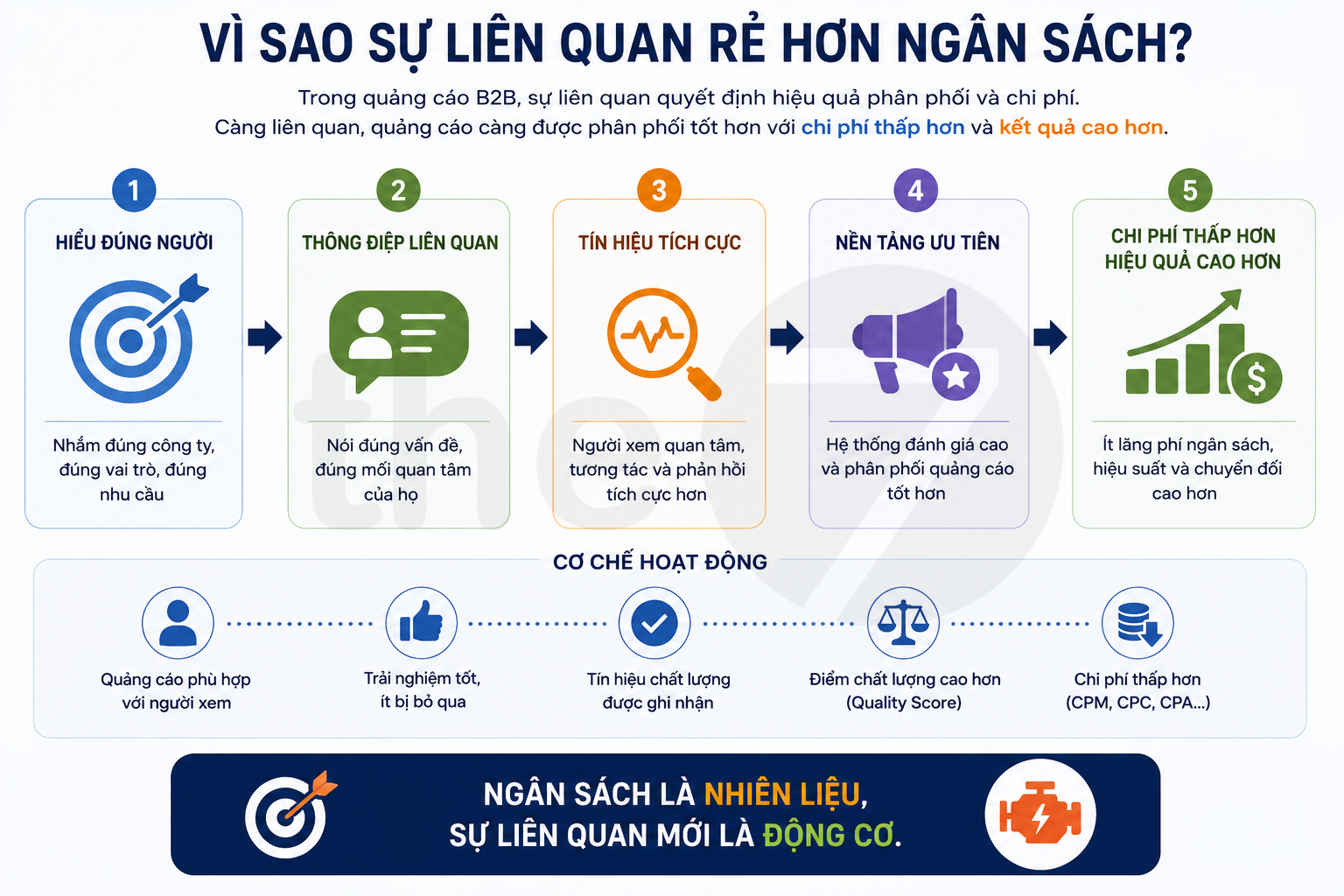
This is why a small business can still compete with a bigger rival in B2B advertising. They may not have as large a budget, but if they understand the market more deeply, choose accounts more precisely, write sharper messages, and use the right platform, they can buy higher-quality attention for the same amount of money. In B2B advertising, deep pockets are an advantage, but not an absolute one. Deep relevance is the advantage that’s harder to copy.
Why Does Advertising Only Amplify, Not Create?
Relevance explains how advertising can be more cost-efficient. But there’s an even more important principle that defines the real limits of advertising: advertising is an amplification layer, not a machine that creates value out of nothing.
Advertising can make a message seen by more people. It can make a good piece of writing travel further. It can make a case study known to the right group of customers. It can make a brand appear repeatedly in front of the people who need to remember it. It can drive more searches, more visits, more views, more reads, more sign-ups, and more inquiries. But all of that rests on one condition: there has to be something worth amplifying.
If you have a strong message, advertising makes it travel further. If you have good content, advertising gets it to the right people more effectively. If you have a product that solves a real problem, advertising helps more of the right people learn about it. If you have a brand that’s already gained a bit of familiarity, advertising thickens that familiarity. But if you have a bland message, a vague positioning, a product with unclear value, content copied from a competitor, or a promise nobody believes, advertising will amplify those things too. It doesn’t turn a bad signal into a good one. It just makes the bad signal louder.
This is one of the most costly misunderstandings businesses have about advertising. They think advertising will save a weak foundation. The website’s value isn’t clear — run ads anyway. Nobody cares about the message — run ads anyway. The product isn’t proven yet — run ads anyway. The brand is completely unknown but still demands that big customers hand over their info right away — run ads anyway. Then they see high costs, low conversion rates, poor leads, sales unable to close, and conclude that advertising doesn’t work.
But advertising can’t fix everything behind it. If the promise isn’t compelling, advertising can’t suddenly make buyers find it compelling. If the landing page is confusing, advertising can’t suddenly make readers understand it. If the case study isn’t convincing enough, advertising can’t make trust appear. If the market has never heard of you and you’re demanding they book a consultation immediately, advertising can’t erase that unfamiliarity with a single impression. It can buy attention, but it can’t force trust.
The amplification layer doesn’t fix a bad signal. It just makes that signal travel further. An out-of-tune guitar plugged into a big speaker doesn’t become a better song. It just makes the out-of-tune sound more unpleasant. Advertising is the same. It doesn’t replace positioning, doesn’t replace strategy, doesn’t replace market understanding, doesn’t replace a good product, doesn’t replace valuable content, and doesn’t replace trust built over time.
This doesn’t mean you have to wait until everything is perfect before running ads. In practice, advertising can also help you learn faster. You can use a small budget to test a message, check which group responds better, try different content angles, and find early signal. But once you’ve found a good signal, that’s when advertising truly becomes a strong amplification layer. It multiplies something that already shows signs of resonating, instead of multiplying an unverified assumption.
So the question before running B2B ads isn’t just “how much budget.” The better question is “what are we amplifying.” If what you’re amplifying is a sharp message, a content asset with real depth, a distinctive argument, credible evidence, a strong case study, or an offer matched to the buying stage, advertising can create a very large effect. If what you’re amplifying is just a generic slogan and a form demanding a stranger’s information, don’t be surprised when the market ignores it.
Advertising is strongest when it’s built on a foundation that already has force. That foundation doesn’t have to be a brand famous across the whole market. It can start from a correct insight, a clear segment, a proven message, an initial group of satisfied customers, genuinely useful expert content, or convincing enough evidence. When the foundation is there, advertising is like adding a layer of amplification on top of a signal that’s already clear. When the foundation isn’t there, advertising just sends the vagueness further.
Where Does Paid Advertising Sit in the 7B Model?
When you place paid advertising within the 7B model, its position is easy to misread. Many people tend to see advertising as a standalone channel, a separate department, a separate campaign, or a separate gear in the growth machine. But in 7B logic, advertising isn’t an independent gear. It’s an amplification layer. It can be applied across many different gears to make their impact travel further, faster, stronger, and more deliberately.
This is an important shift in perspective, because it changes how you allocate budget entirely. If you see advertising as a standalone gear, you ask: “Is advertising generating leads?” But if you see advertising as an amplification layer, you ask something different: “Which gear should we use advertising to amplify, with what goal, at what stage, and with what message?” The second question is far more accurate, because the same advertising, when applied to Broadcast, Buy, Buzz, Believer, Backing, Bridge, or ABM, plays a completely different role.
When you use advertising to amplify Broadcast, you’re putting a message, a point of view, educational content, and a thought-leading perspective in front of more of the right people. This isn’t advertising demanding an immediate purchase. This is advertising to build memory, build familiarity, build context, and make the market understand what you stand for. In B2B, paid Broadcast matters a great deal because organic reach is usually not fast enough, not broad enough, and not precise enough to touch everyone you need to influence.
When you use advertising to amplify Buy, you’re serving people with clearer intent. This is where search ads, retargeting, high-intent-query ads, or ads leading to a conversion page do their work. A buyer searching “CRM software for manufacturing companies,” “ERP implementation cost,” “compare enterprise security solutions,” or “B2B LinkedIn Ads agency” has a different need than someone hearing about the problem for the first time. Buy needs advertising, but Buy shouldn’t be the only place that gets the entire budget.
When you use advertising to amplify Buzz, you make third-party signals visible to more of the right people. An article, an award, an industry report, a testimonial, an expert’s comment, a podcast appearance, or a case study picked up by media can all be pushed toward the group of people who need to see it. The strength of Buzz is that it doesn’t only come from your own mouth. It carries an extra layer of trust because an outside voice is involved. Advertising here doesn’t just say “trust me” — it helps more people see that “other people are talking about me too.”
When you use advertising to amplify ABM, advertising becomes a very sharp weapon. Instead of spreading budget across the whole market, you concentrate it on a narrow list of high-value target accounts. Within each account, you’re not just reaching one person, but many people across the buying group. You can deliver a strategic message to executives, an operational message to the specialist team, a financial message to whoever holds the budget, and a proof message to whoever needs reassurance. This is how advertising makes a brand familiar inside exactly the organizations most worth winning.
When you use advertising to amplify Believer, you’re nurturing the community of people who already trust you, already follow you, already read your content, or have already engaged with your brand. Not every ad has to chase new people. Part of the budget can be used to stay warm with people who already know you — reminding them of a new perspective, inviting them to a webinar, driving them to a newsletter, or helping them keep consuming deeper content. In B2B, many deals don’t come from someone seeing you for the first time, but from someone who’s been quietly following you long enough.
When you use advertising to amplify Backing, you deliver proof to the right people who need to see that proof. A great case study that nobody sees has limited power. An original piece of research that took real effort but only gets posted once and then fades is a real waste. A certification, a report, a measured result, a customer story — if delivered to the right group of people who need reassurance — can lower perceived risk. Backing isn’t just about having proof; it’s about making that proof show up at the right time in front of the right people.
When you use advertising to amplify Bridge, you support partnerships, ecosystems, industry communities, or the intermediary connection points that bring you to market. For example, a co-hosted event with a partner can be advertised to a shared target account list. Content created with an industry expert can be amplified to their community. A program for agents, distributors, or implementation partners can be advertised to expand the network. Here, advertising doesn’t just pull customers toward you — it also strengthens the bridges leading to the market.
Seen this way, you can spot the most common mistake B2B businesses make: they pour almost their entire ad budget into Buy. All the budget goes into conversion ads, form ads, retargeting, bottom-of-funnel search ads, and everything gets forced to prove itself with short-term results. They amplify the smallest gear the hardest, while the gears that build demand, familiarity, trust, proof, and ecosystem run on weak organic momentum. Then they wonder why the whole machine isn’t generating enough force.
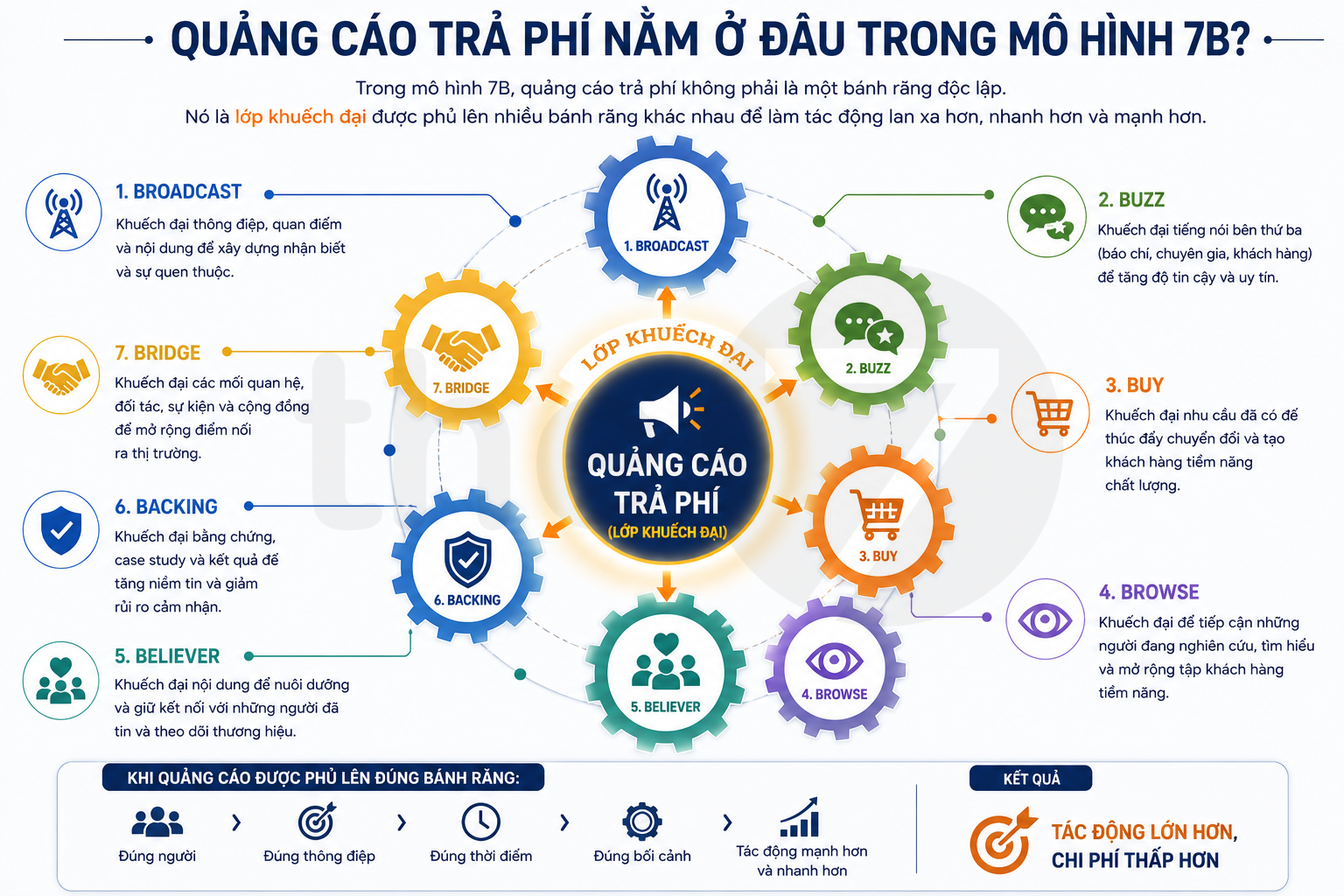
A 7B machine that uses advertising wisely allocates the amplification layer according to each gear’s role. Broadcast needs advertising to widen familiarity. Buzz needs advertising to amplify third-party voices. Buy needs advertising to convert demand that already exists. ABM needs advertising to concentrate force on valuable accounts. Believer needs advertising to nurture people who already trust you. Backing needs advertising to deliver proof to the right people. Bridge needs advertising to expand market connection points. Advertising doesn’t replace these gears, but it makes their impact travel further when placed in the right spot.
Three Examples of B2B Advertising Following the Amplification Logic
Consider an enterprise software company. If this company only runs search ads on keywords like “best business management software” or “ERP software demo,” they’re pouring almost the entire budget into Buy. That approach might generate a few leads, but they’ll be competing head-on with a lot of rivals at the moment the buyer is already close to a decision. A smarter approach is to first use LinkedIn ads to deliver thought-leading content to the right group of CEOs, CFOs, COOs, and operations leads in the target industry. That content helps the market understand the problem, understand the cost of delay, understand the criteria for choosing a solution, and gradually become familiar with the brand’s point of view. Once this group starts searching or returning to the website, Buy advertising steps in to support conversion. Here, the amplification layer is applied to both Broadcast and Buy, not crammed into a single gear.
In financial services, a company targeting large enterprises can use account-based advertising to show up with intent in front of many people inside the same organization. Instead of running broadly to anyone who seems interested in finance, they choose a narrow list of target companies, then design different messages for the executive team, the finance department, the legal department, and the operations team. Executives see messages about risk control and sustainable growth. Finance people see messages about cost of capital, cash flow, and efficiency. Legal sees messages about compliance. Operations sees messages about reducing implementation friction. This is ABM-amplifying advertising, using budget to strengthen presence within the right high-value accounts instead of buying scattered attention across the whole market.
In manufacturing, an equipment or technical solutions supplier might publish original research on operational performance, energy consumption, or safety standards. If they only post that research on their website and wait for it to spread organically, the content may not travel far, even if the quality is good. But if they use advertising to deliver the research to the right community of engineers, plant directors, maintenance managers, and operations leads in the industry, advertising becomes an amplification layer for both Broadcast and Backing. It doesn’t just get more people to see the brand — it delivers technical proof to the exact group of people capable of appreciating that proof. When a supplier keeps showing up with genuinely useful technical content, they stop being seen as just a vendor. They start being seen as a trusted source of expertise.
These three examples come from three different industries, but they follow the same principle: B2B advertising creates value when it’s used to amplify the right gear, with the right message, the right recipient, and the right stage. It underperforms when it’s narrowed down into a tool demanding immediate conversion from people who aren’t yet trusting, familiar, or ready enough.
How Should You Measure B2B Advertising Correctly?
If the click isn’t the ultimate goal, then what should you measure B2B advertising by? This is an important question, because many businesses understand the theory that the B2B journey is long, but when it comes to reporting, they still fall back on the same one question: “How many forms?” That question isn’t wrong, but if it’s the only one you ask, you’ll force the whole system back into short-term thinking.
The right way to measure has to start from advertising’s role within each gear. If advertising is amplifying Broadcast, you can’t measure it by form count alone. You need to measure reach to the right people, frequency of appearance within the target group, growth in branded search, direct traffic or traffic from target accounts, content consumption levels, and shifts among people who’ve been exposed before. Broadcast’s goal isn’t to force the buyer to act immediately — it’s to get your brand and point of view into the market’s memory.
If advertising is amplifying Buy, conversion metrics become more important. You can measure form count, meeting count, cost per lead, qualified-lead rate, conversion-to-opportunity rate, and ultimately revenue. But even in Buy, you shouldn’t look only at volume. A campaign that produces fewer forms — but forms from the right industry, right title, right size, right need, and with a higher likelihood of moving forward with sales — can be far better than a campaign that produces many cheap forms full of the wrong people.
If advertising is amplifying ABM, you should measure at the account level. How many target accounts have been reached? Within each account, how many different roles have seen the message? Is frequency enough to build familiarity? Have the accounts touched by advertising shown more website visits, more content engagement, more responsiveness to sales, or faster deal progress? With ABM, the value doesn’t sit in a single click — it sits in how much you’ve made an entire buying group within an account familiar with your brand.
If advertising is amplifying Buzz or Backing, you need to measure how far trust travels. How many people in the right industry saw an article? How many target accounts read a case study? Did a technical study capture the right expert audience? Did a testimonial reach people currently in the consideration stage? These proof-content pieces might not generate a form right away, but they can lower perceived risk and make it easier for sales to have conversations later.
The key point is that each gear needs a set of metrics fit for its role. The mistake is applying Buy’s metrics to evaluate everything. If you force Broadcast to prove itself with immediate forms, you’ll kill Broadcast. If you force Buzz to prove itself with cheap clicks, you’ll break Buzz. If you force ABM to prove itself with mass lead volume, you’ll get ABM wrong. Measuring correctly doesn’t automatically make advertising work — but measuring incorrectly will definitely make you optimize in the wrong direction.
A good B2B measurement system should accept multiple layers. The first layer is reaching the right people: is the advertising getting to the right accounts, the right titles, the right industry? The second layer is quality engagement: are the right people reading, watching, returning, searching, or going deeper? The third layer is commercial signal: are there forms, meetings, consultation requests, search queries, effective retargeting? The fourth layer is impact on sales opportunities: are touched accounts moving faster, responding better, showing higher win rates, or delivering better deal value?
Not every business can measure all these layers perfectly, and you shouldn’t pretend every impact can be precisely attributed either. But simply shifting the mindset from “are the clicks cheap” to “are we creating the right presence with the right people and supporting the buying journey better,” changes the quality of budget decisions entirely.
Three Mistakes to Avoid in B2B Paid Advertising
The first mistake is treating B2B advertising like retail advertising. Businesses expect someone to see an ad, click, fill out a form, and quickly become a customer, while the B2B purchase decision usually belongs to a group of people and stretches across many stages. This mindset pushes them to pour their entire budget into the small group already ready to buy right now, fighting fiercely against competitors at the bottom of the funnel, while skipping most of the work of building familiarity, trust, and context beforehand. The fix isn’t to abandon conversion advertising — it’s to put it in its proper role. Buy still needs budget, but B2B advertising can’t live in Buy alone.
The second mistake is raising the budget instead of raising relevance. When results fall short, many businesses assume the problem is not spending hard enough. But if the message is unclear, the audience is too broad, buyer roles aren’t differentiated, the target industry isn’t sharp, and the content doesn’t hit the real pain point, a bigger budget just distributes the same low relevance more widely. The fix is going back to the foundational questions: who are we talking to, what kind of company are they, what role do they hold in the buying group, what do they care about, what do they fear, and what message makes them feel “this is for me.” When relevance rises, budget finally has room to work.
The third mistake is amplifying a weak foundation. Advertising can’t save a vague positioning, a generic promise, a confusing landing page, a product with unclear value, or a completely unknown brand demanding action too early. If you push people who don’t know you toward a form asking them to book a consultation right away, most will go silent. Not because they’ll never buy, but because you haven’t given them enough reason to trust yet. The fix is to build the foundation first, or at least use a small budget to test the foundation with advertising before scaling. Once you have a resonating message, good proof, valuable content, and a certain level of familiarity, advertising can truly become an amplification layer.
There’s a fourth mistake that often accompanies the three above: measuring everything with the same set of metrics. Businesses use form count to evaluate Broadcast, use CPC to evaluate Buzz, use lead volume to evaluate ABM, and then conclude these activities don’t work. But each part of the machine has a different role. An ad building awareness among the right people can’t be judged the same way as a bottom-of-funnel search ad. An ABM campaign targeting 50 strategic accounts can’t be judged the same way as a mass lead-generation campaign. Measuring correctly doesn’t automatically make advertising more effective, but measuring incorrectly will definitely make you optimize wrongly.
Conclusion: Advertising Wins on Relevance, Not Budget
Back to where I started. Businesses that conclude B2B advertising is expensive and ineffective are usually businesses using it with retail-advertising expectations. They demand a click that leads straight to an order, in a market where the purchase decision passes through many people, many stages, many discussions, and many layers of trust. When the expectation is wrong, the measurement is wrong. When the measurement is wrong, the optimization is wrong. And when the optimization is wrong, a bigger budget sometimes just makes the mistake more expensive.
In B2B, the click is not a deep enough target. It can be useful, but it can’t represent the entire value of advertising. The real value lies in showing up in front of the right person, the right role, the right account, with the right message, at the right moment in a long buying journey. Someone who doesn’t click today may still remember you. An account that doesn’t submit a form today may still be quietly putting you on its shortlist. A CFO who never publicly engages may still have seen enough to feel less unfamiliar with your name when the team presents its proposal.
B2B advertising also doesn’t simply win on budget. Budget is the fuel, but relevance is the engine. Modern ad platforms reward ads that are more relevant to their recipients. The market also rewards brands that understand the problem better, speak the right language, and show up in the right context. A business with precise targeting and a sharp message can spend its budget far more effectively than a bigger business targeting broadly with generic copy.
And finally, advertising doesn’t create something from nothing. It amplifies. If you have a strong message, it carries that message further. If you have good content, it delivers that content to the right people. If you have credible proof, it helps that proof show up at the right time. But if you have a weak foundation, advertising just exposes that weakness faster. The amplification layer doesn’t fix a bad signal. It just makes that signal louder.
In the 7B model, paid advertising isn’t a standalone gear. It’s an amplification layer applied across many different gears. You can use advertising to amplify Broadcast to build familiarity, amplify Buzz to spread third-party voices, amplify Buy to convert existing demand, amplify ABM to concentrate force on target accounts, amplify Believer to nurture people who already trust you, amplify Backing to deliver proof to the right people, and amplify Bridge to expand market connection points. The biggest mistake is pouring all advertising into Buy alone, then wondering why the whole machine isn’t generating enough force.
Don’t start with the question “how do we get cheaper clicks.” Start with the question “how do we become more relevant to the right people.” Because in B2B, advertising doesn’t win by shouting louder at the entire market. It wins by speaking more accurately to the people who can actually bring you into the purchase decision.
To understand the philosophical question of how to balance brand-building investment and converting demand, read the article on brand marketing and performance marketing. To understand the strongest advertising platform for B2B and its cost mechanics, read the article on LinkedIn marketing for B2B. To understand how to concentrate advertising on a narrow account list, read the article on ABM. And to understand the full seven-gear machine that advertising can amplify, read the article on the 7B gear model.
FAQ – Frequently Asked Questions
What is B2B paid advertising?
B2B paid advertising is when a business pays to deliver a message to the people who influence purchase decisions inside target organizations. These people can be decision-makers, influencers, end users, budget holders, or anyone with the power to object to a solution. Unlike consumer advertising, B2B advertising has to account for a long buying cycle, multiple participants, and many touchpoints before a deal happens.
Why is the click the wrong target in B2B advertising?
Because a click doesn’t fully reflect how B2B purchase decisions actually happen. B2B buyers typically do their own research, discuss internally, compare multiple options, and go through many rounds of deliberation before contacting a vendor. Advertising can build familiarity and trust before any measurable action occurs. If you only optimize for clicks, you’re likely to miss most of the real value advertising delivers over a long buying journey.
How can you lower the cost of B2B advertising?
The sustainable way to lower costs isn’t just chasing cheaper clicks — it’s increasing relevance. Businesses need to target the right account, the right title, the right industry, the right role in the buying group, and write messages matched to each group’s concerns. When advertising is more relevant, less budget is wasted and the platform has more signal to distribute it efficiently.
How is B2B advertising different from retail advertising?
Retail advertising usually targets a fast individual decision, while B2B advertising targets a group of people inside an organization over a much longer buying cycle. Retail can often be measured by immediate orders. B2B needs to also measure reach to the right people, familiarity within target accounts, engagement quality, contribution to sales opportunities, and impact on trust throughout the buying journey.

Nguyễn Đình
Bảo




As CEO of The7, I am committed to sharing practical, useful knowledge with every reader. Every article on The7 is based on my 7 years of hands-on experience in marketing — Facebook advertising, LinkedIn advertising, Google advertising, and marketing strategy. I hope you take away plenty of insight from these posts and apply it successfully in practice.
Related Articles
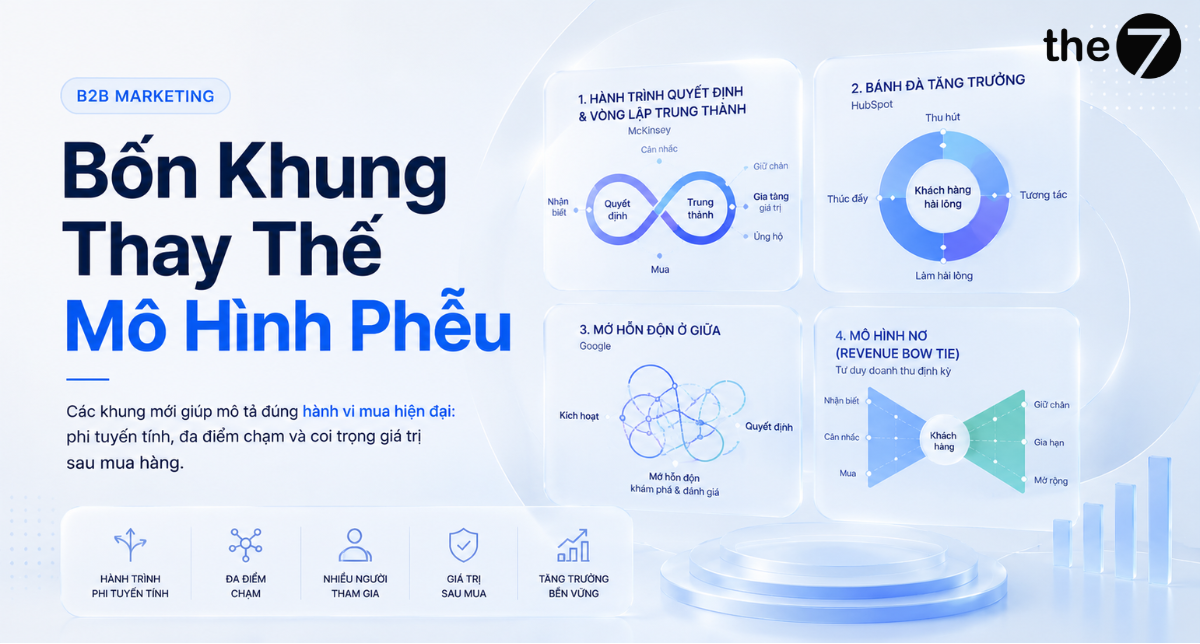
Four Frameworks That Replace the Funnel Model
Summary: As the funnel model increasingly fails to capture how modern buyers actually behave, a number of new frameworks have emerged to replace or repair it: McKinsey’s decision journey and...

What Is Category Design?
Summary: Category design is the act of creating an entirely new type of solution in the market’s mind, instead of competing within an existing category, and then becoming the name...
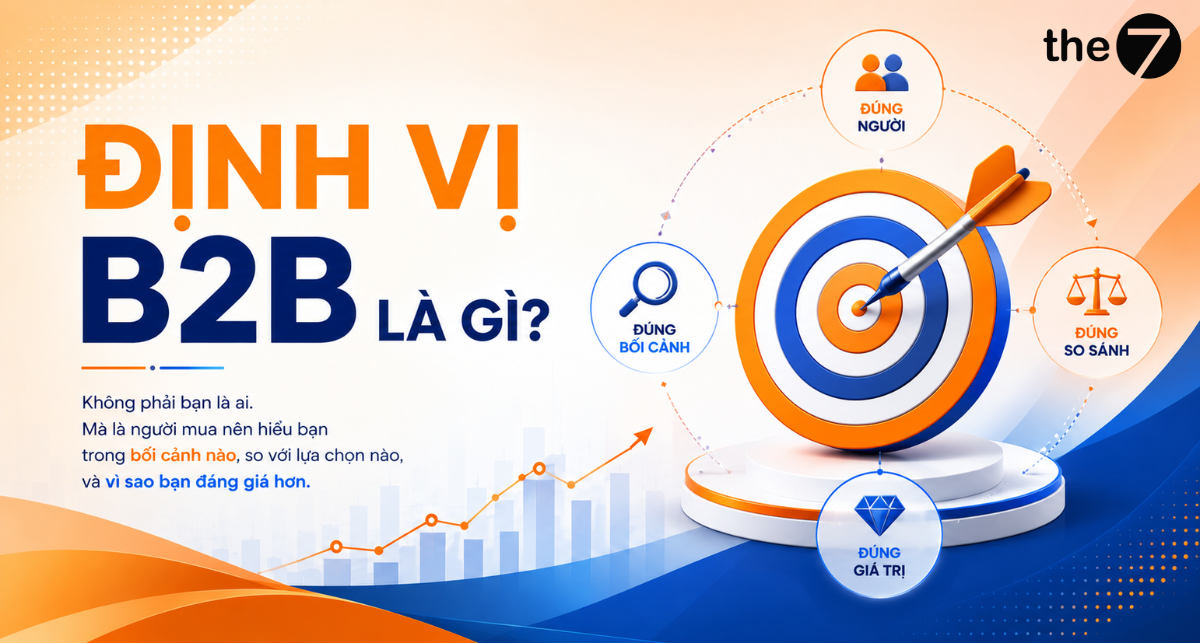
What Is B2B Positioning?
Summary: B2B positioning is the act of choosing the context you place your product into – the frame of reference that makes its value obvious to the buyer. Positioning isn’t...
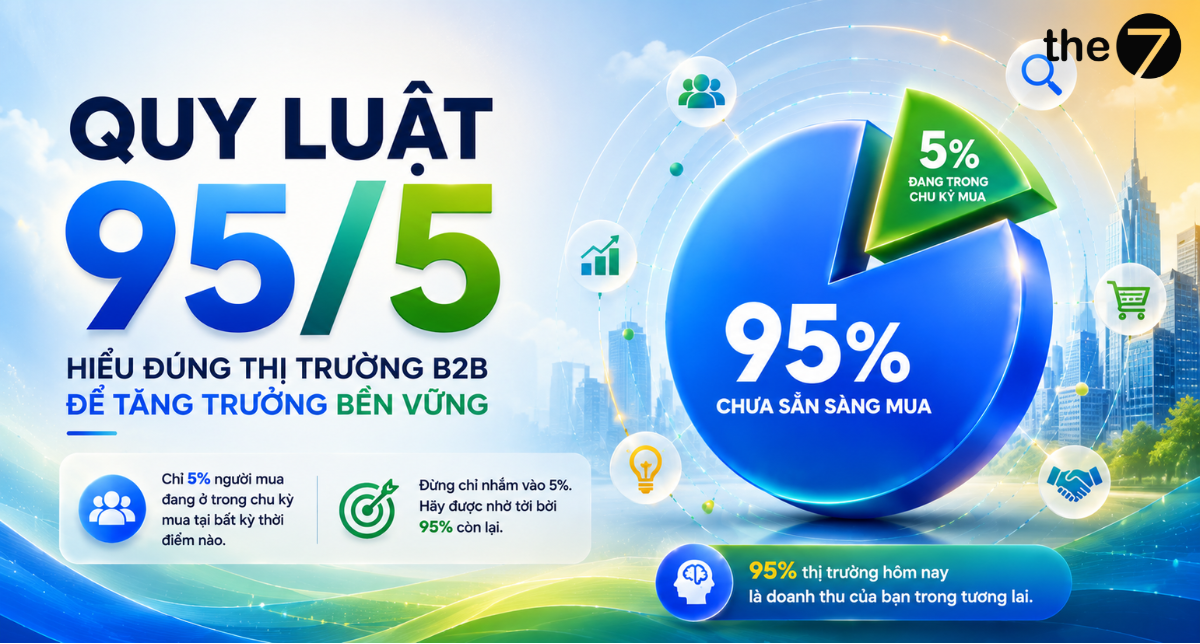
What Is the 95/5 Rule?
Summary: The 95/5 rule states that at any given moment, only about 5% of B2B buyers are actually in-market, actively in a buying cycle, while roughly 95% are not yet...
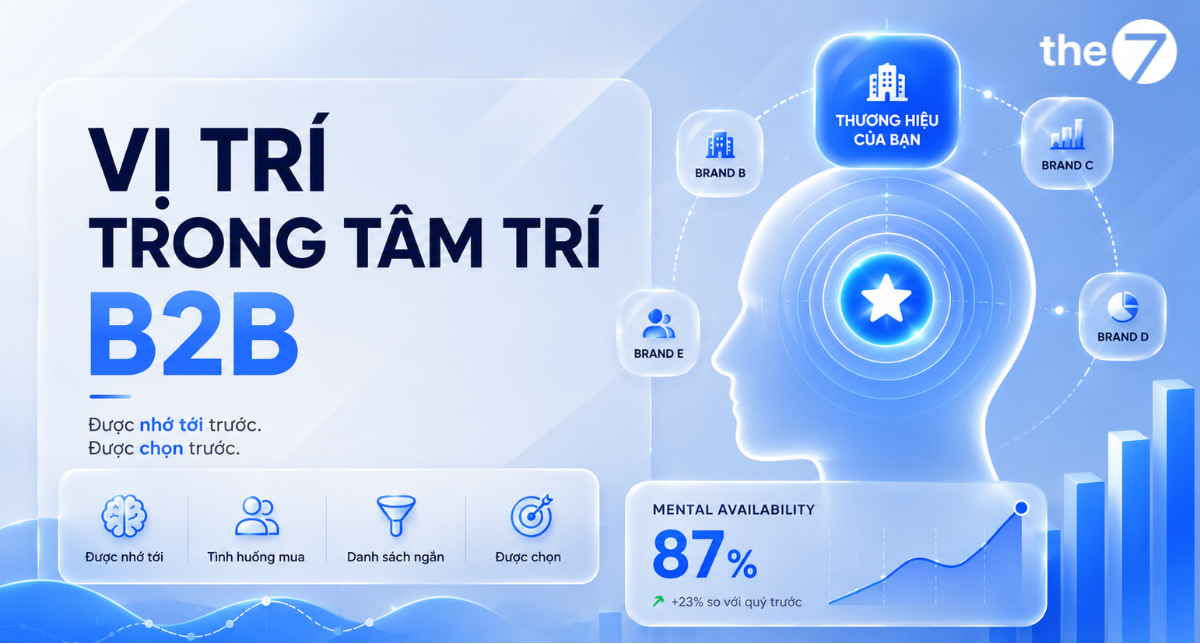
What Is Mental Availability in B2B?
Summary: Mental availability is how easily a brand comes to mind in a buying situation. It isn’t about having the sharpest argument, the slickest pitch, or the most convincing feature...
What Are B2B Events and Trade Shows?
Summary: B2B events and trade shows are in-person gatherings such as conferences, industry trade shows, workshops, and private meetings, where a business meets buyers, customers, partners, and the industry community...