


What Is B2B Positioning?

Summary: B2B positioning is the act of choosing the context you place your product into – the frame of reference that makes its value obvious to the buyer. Positioning isn’t what you say about yourself; it’s what context you place yourself in. The same product, placed in different contexts, will carry different value in the buyer’s eyes. In the 7B model, positioning isn’t a gear. It’s the layer of meaning that determines what every gear transmits, what the market should remember you for, and why you deserve consideration when a need arises.
Most B2B businesses think about positioning the wrong way. They treat positioning as a tagline, a line describing who they are, or a list of features dressed up to sound impressive. They sit down together, write out what the product does, what the company does, who it serves, how it differs, then pack it all into one sentence that sounds professional. Then they call that sentence “positioning.”
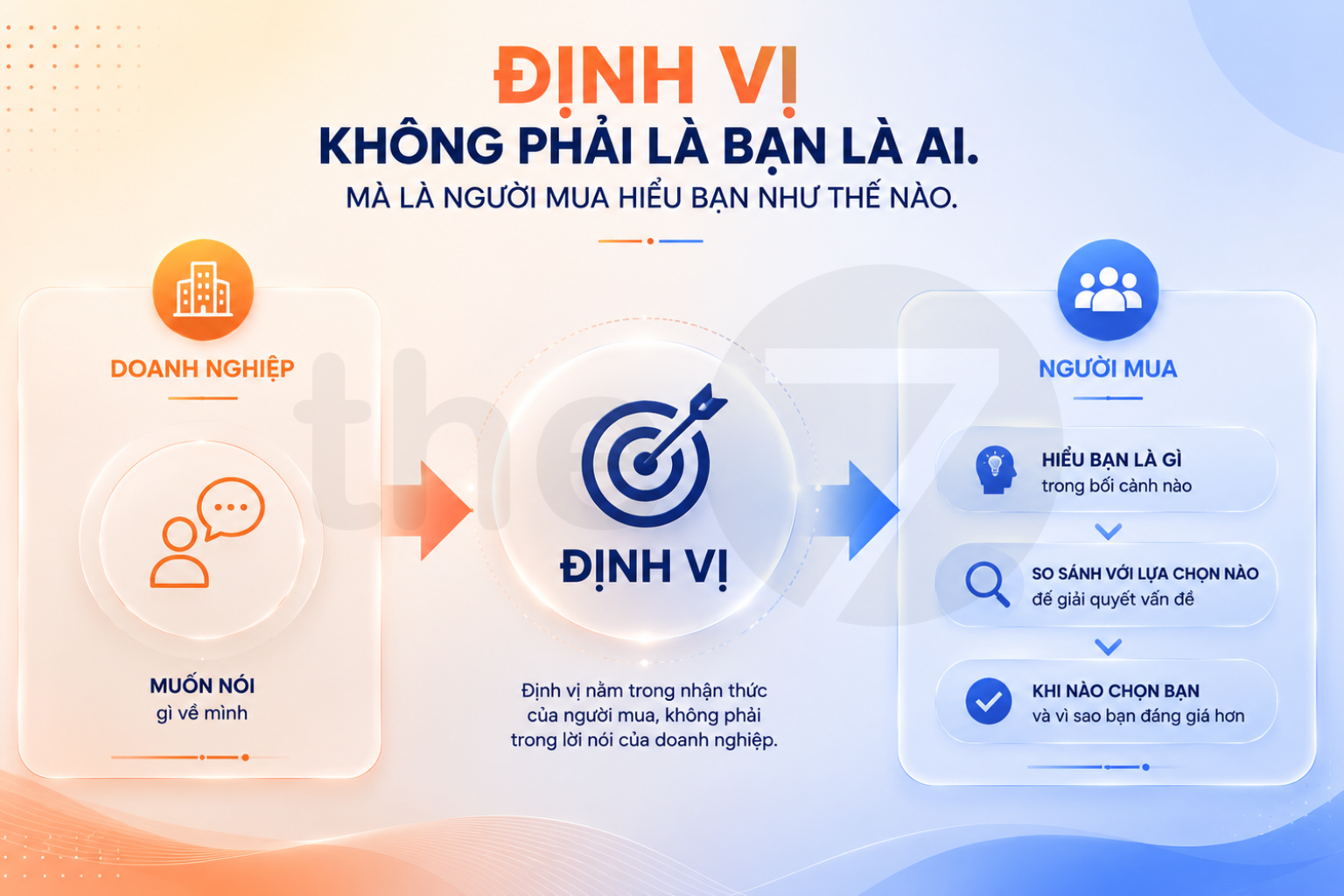
The problem is buyers don’t care how well you describe yourself if they still don’t know where to place you in their mind. When a buyer encounters a new product, they don’t start with the question “how does this company describe itself?” They start with a much quieter question: “What is this like? What should I compare it to? Does it replace what I’m currently using? Is it worth changing for?” If you can’t answer those questions, your positioning doesn’t really exist yet, no matter how well-crafted the wording is.
Real positioning isn’t about describing yourself. It’s about choosing the context in which the buyer will understand your value. This is a counterintuitive but important truth: a product’s value isn’t fixed. That value depends on the context the buyer places it in. The same product, compared against one thing, might look ordinary. But that same product, placed in a different context, can become a very worthwhile choice. Positioning is the art of choosing the right context – the frame of reference that makes your value clear without requiring too much persuasion.
This article will clarify what B2B positioning really is, why it’s a choice about context rather than a description, what buyers are actually comparing you to, why positioning always requires trade-offs, and where positioning sits within the 7B model, inside the whole demand-generation machine.
What Is B2B Positioning?
B2B positioning is establishing the place a product, service or brand holds in a buyer’s mind by choosing a competitive frame of reference – that is, the alternatives the buyer will use to compare you – then clarifying your differentiated value within that frame. Put more simply, positioning answers a very important question: what should the buyer understand you to be, in what context, compared with which alternatives, and why are you worth more within that context?
The concept of positioning was popularized by Al Ries and Jack Trout in the early 1980s as a battle for a spot in the buyer’s mind. That thinking still holds true at its foundation: the market is too noisy, buyers can’t remember everything, so a brand has to claim a clear spot in their head. But for modern B2B, especially in complex markets with many decision participants and long buying cycles, positioning needs to be understood as something deeper than a tagline or a communications slot.
A more modern and practical way of understanding this comes from April Dunford. In Dunford’s thinking, positioning is, at its core, context. When a buyer encounters your product, they need a frame to understand it. They need to know who to compare you to, what to expect from you, what standard to use to evaluate you, and which value matters most. If they place you in the wrong context, they’ll compare you against the wrong competitors, expect the wrong things, and miss your real value. So positioning isn’t about coming up with a clever sentence about yourself. Positioning is about actively choosing the right context so the buyer understands you in the most favorable way.
This point is critically important in B2B, because B2B products often aren’t immediately easy to understand. Management software, an automation solution, a consulting service, industrial equipment, a data platform, or a B2B marketing service – none of these are bought on impulse. Buyers need to understand where that product fits within their current system, what it replaces, what it improves, who it affects, and whether it deserves priority over other problems. If positioning is vague, buyers don’t just fail to see how you’re different. They also don’t know whether it’s worth the energy to understand you at all.
Good positioning reduces the buyer’s cognitive load. It lets them quickly answer: “Ah, this is the solution for this type of problem, for this type of company, in this context, better than the current alternative in this specific way.” When the right context is chosen, value becomes easier to see. When the wrong context is chosen, you may have to explain a great deal and buyers still won’t be convinced.
Why Is Positioning About Choosing Context, Not Describing Yourself?
To understand what positioning really is, you need to drop a very common habit: starting from yourself. Most businesses doing positioning work start with questions like who are we, what features do we have, what industry do we serve, how are we different from competitors, what do we want the market to think of us. Those questions aren’t wrong, but if you start there, positioning very easily turns into an internal description rewritten to sound nicer.
Buyers don’t take in the market that way. They don’t look at each company as a standalone entity and evaluate it in a vacuum. They always place everything into a familiar context. When they see a new solution, they try to slot it into a group they already know. If you’re software, they’ll ask themselves whether you’re like a CRM, an ERP, a reporting tool, a task management tool, or an upgraded spreadsheet. If you’re a B2B agency, they’ll ask whether you’re like an advertising agency, a media agency, a strategy consulting firm, or an outsourced execution team. If you’re an equipment supplier, they’ll ask whether you’re the cheap option, the highly technical option, the safe option, or the option specialized for one specific application.
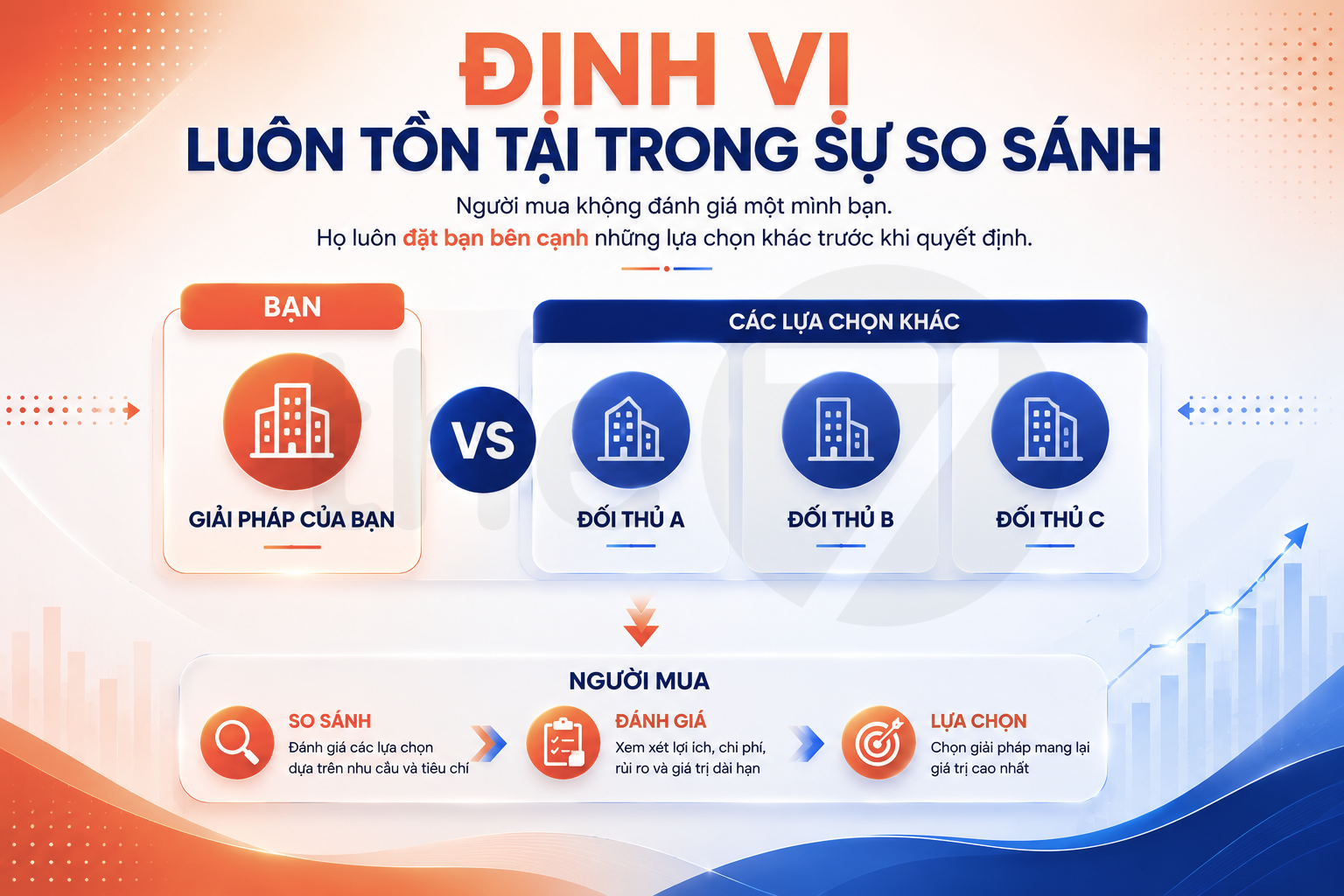
The group a buyer slots you into determines almost everything that follows. It determines who you’re compared against, what standard you’re judged by, what’s expected of you, and whether you’re seen as expensive or cheap. A product might look expensive if compared with a simple tool, but look reasonable if compared with the cost of headcount, operational errors, management time, or the risk of losing a deal. A service might look ordinary if compared with providers of the same type, but look very worthwhile if placed in the context of the opportunity cost of getting your strategy wrong for six months.
This is why positioning isn’t what you say about yourself, but what context you place yourself in. A feature list, however good, becomes weak if the buyer is evaluating you against the wrong standard. Conversely, if you place yourself in the right context – one where your strengths are exactly what the buyer actually needs – your value can become far more self-evident.
Take a simple example. A software company that helps businesses automate management reporting might position itself as a “dashboard software for enterprises.” In that context, buyers will compare it against a whole range of other dashboard tools, then ask about price, how nice the interface looks, how many integrations it has. But if the customer’s real alternative is a team still spending dozens of hours a week manually gathering data from Excel, checking for discrepancies, sending reports late, and making decisions on inconsistent numbers, then the right context might not be “dashboard” at all. The right context might be “the system that eliminates manual reporting for leadership.” The product hasn’t changed, but the frame of reference has. Now, buyers aren’t just comparing features. They start to see the cost of the old way of doing things.
That’s the power of positioning. It doesn’t dress up the product. It changes how the buyer sees the product by placing it in the right value context.
What Is the Buyer’s Real Alternative?
If positioning is about choosing context, the next question is: where does that context come from? The answer lies in the buyer’s real alternative. You can’t position correctly if you don’t know what the buyer is actually weighing you against.
A useful lens comes from the Jobs to be Done theory, developed and popularized by Clayton Christensen. The core idea is that people don’t buy a product just for the product’s own sake. They “hire” a product to do a job in their life or work. In B2B, buyers don’t really want a piece of software, a service, a piece of equipment, or a platform. They want to accomplish a job: reduce risk, save time, increase revenue, reduce errors, manage better, prove results to their boss, protect their budget, or make decisions with more confidence.
Looked at through the lens of the job to be done, an important truth emerges: your alternative isn’t just competitors of the same type. The alternative is every other way the buyer could get the same job done. That could be another piece of software, but it could also be a spreadsheet, internal staff, a manual process, a familiar vendor, a build-it-yourself solution, or simply doing nothing at all.
In B2B, the strongest alternative is often not a direct competitor. It’s inertia. The buyer knows the problem exists, but they’re not necessarily ready to change. They have too many other things to prioritize, too much risk in bringing a new vendor into the system, too many stakeholders to convince in the buying committee, and too many reasons to delay. So your real competitor is often not the company selling a similar product. Your real competitor is the sentence: “Let’s just leave it as it is.”
This completely changes how you approach positioning. If your real alternative is a direct competitor, you can position by making clear why you’re better at what the buyer cares about most. But if the real alternative is doing nothing, then comparing features against a competitor is fighting the wrong battle. The buyer isn’t even sure they want to change yet, so proving you’re better than another vendor may not resolve the real blocker. In that case, positioning has to make clear the cost of staying the same. You have to place yourself in the context of the unsolved problem, not just the context of the vendor market.
This is a very common mistake in B2B. Businesses look at the competitive landscape from the seller’s point of view, while buyers look at their choices from the point of view of the job that needs to get done. The seller asks: “Who are my competitors?” The buyer asks: “Do I even need to do this right now? Can I keep using the old way? Is it worth pulling more people into this decision? Is it worth changing our process?” If your positioning doesn’t answer those questions, you might win the comparison on paper but still lose in reality.
So good positioning always starts with understanding the buyer’s real alternative. What are they using today? What do they hate about the current way of doing things? Why haven’t they changed yet? When the problem gets painful enough, what will they look for first? Who or what will they compare you to? If they don’t choose you, what will they do next? These questions matter far more than listing every competitor in the market.
The Four Components of Complete Positioning
Complete positioning is more than a single sentence. It’s a set of strategic decisions that help the entire market understand you correctly. At a minimum, it needs four components: the frame of reference, the best-fit customer segment, the differentiated value, and credible proof.
The first component is the frame of reference. This is the context you want the buyer to place you in. You want them to understand you as a piece of software in a certain group, a service of a certain type, an alternative to a certain way of doing things, or a new approach to a certain problem. The frame of reference determines the standard used to judge you. If you choose the wrong frame of reference, every strength behind it can be seen incorrectly. If you choose the right one, buyers will more easily understand why those strengths matter.
The second component is the best-fit customer segment. Positioning can’t be sharp if you don’t know who you’re best for. A product might serve many segments, but usually there’s only one, or a few, where its value is clearest, the need is most urgent, and the odds of winning are highest. In B2B, the best-fit segment isn’t just industry or company size. It also includes situation, maturity level, type of problem, internal pressure, and timing of change. “Manufacturing businesses” is too broad. “A factory expanding multiple production lines, with fragmented operational data, where leadership has no unified numbers to make decisions with” is a far sharper context.
The third component is differentiated value. This isn’t a list of features you have that competitors don’t. Differentiated value is the reason you’re the better choice within the chosen context. A feature only has value when it helps the buyer complete an important job faster, more safely, more cheaply, or more reliably. So good positioning doesn’t say “we have this feature.” It says “in this context, this feature solves a problem that the current alternative doesn’t solve.”
The fourth component is proof. B2B doesn’t run on empty promises. Buyers need a reason to believe, especially when a purchase decision affects budget, process, personal reputation, or multiple departments. Proof can be case studies, implementation data, industry experience, deep expertise, similar customers, measurable results, or a mechanism that explains why you can do what you say. Positioning without proof easily becomes a marketing claim. Positioning with proof becomes a belief that can spread through the buying committee.
These four components have to align with one another. If the frame of reference says one thing, the customer segment says another, the differentiated value is too generic, and the proof is unrelated, positioning falls apart. Buyers may hear a lot of messages but can’t piece them together into a clear picture. Conversely, when all four components point in the same direction, positioning becomes sharp. Buyers understand what you are, who you’re for, where you beat the alternative, and why they should believe you.
Why Does Trying to Appeal to Everyone Erase Positioning?
Choosing context and understanding the real alternative lead to a core principle: positioning always requires trade-offs. If there’s no trade-off, it’s not yet positioning. It’s just a broad description.
Positioning is, by nature, a choice. When you choose a context, you choose to stand out on certain things and accept not standing out on others. When you choose the group of buyers you serve best, you accept that you’re not the ideal choice for every other group. When you choose one differentiated value to etch into the market’s mind, you accept not saying everything you’re capable of. Strong positioning always has a clear trade-off: you’re the excellent choice for this, for these people, in this context, and not the best choice for everything else.
But most businesses are afraid of trade-offs. They’re afraid that if they’re too clear about who they’re for, people outside that group will walk away. They’re afraid that if they choose a specific context, the market will think they’re small. They’re afraid that if they emphasize one core value, other values will be seen as less important. So they choose the safer path: speak broadly, speak generically, speak in a way that’s always technically true. They want to be the comprehensive, flexible, optimal solution, suitable for every business, in every industry, with every need.
That may sound less risky, but it’s actually the fastest way to erase your positioning. When you try to appeal to everyone, you don’t strongly appeal to anyone. Positioning that tries to fit everyone has no clear context, no clear buyer group, no clear reason to be remembered. Buyers don’t know what to compare you to, don’t know where you excel, and ultimately don’t remember you for anything.
In B2B, genericness is even more dangerous, because buyers rarely buy alone. A deal usually has to pass through many people, many departments, many different concerns. If positioning isn’t sharp, the message dilutes as it passes through each member of the buying committee. The first person to hear you might understand vaguely, the second understands it slightly differently, the third only remembers a few features, and the final decision-maker doesn’t see a strong enough reason to prioritize you. Sharp positioning helps the message survive that process, because it’s easy to repeat, easy to explain, and easy to tie to a specific problem.
This is why strong positioning requires courage. It requires you to dare to say: we are the best choice for this, not for that. We serve this customer group best, not every group. We solve this problem the deepest, not every problem. That trade-off may close some doors, but it opens a bigger one: becoming the obvious choice within the exact context where you have the ability to win.
How Do You Choose the Right Positioning Context?
If positioning is about choosing context, the most important practical question is how to know which context is right. There’s no mechanical answer, but there’s a way of thinking that can help businesses avoid falling into generic positioning or the wrong frame.
The first step is to look back at the best customers you’ve ever had. Not your biggest customers on paper, but the customers who got the clearest value from you, implemented most successfully, understood you fastest, paid a fair price, and are most likely to refer you to others. They often reveal the natural context where your product is strongest. Ask: what were they doing before they used you? What problem made them start looking for a solution? What alternatives had they tried? What moment made them realize the old way was no longer working? Why did they choose you instead of continuing as before?
The second step is identifying the real alternative. Don’t just list your direct competitors. List everything the customer could do if they didn’t buy from you. Could they use a spreadsheet? Hand it to internal staff? Hire a different vendor? Build it themselves? Delay? Cut the scope of the problem? Accept living with the errors? These alternatives are the real context of the buying decision. If you don’t understand them, you may be positioning for a battle that isn’t actually happening in the buyer’s mind.
The third step is finding the strengths that only matter within a specific context. Many businesses list their strengths too early, then try to cram all of them into the message. A better approach is to ask: in what context does this strength become critically important? For example, “fast implementation” might not matter to a business still doing long-term research, but it matters a great deal to a company that just received budget and needs to run before next quarter. “Deep specialization in one industry” might not appeal to a broad market, but it’s extremely valuable to a customer group tired of explaining their industry’s quirks to a generalist vendor. A strength doesn’t have inherent value. It has value when tied to a situation the buyer actually cares about.
The fourth step is checking whether that context is big enough, painful enough, and memorable enough. A good context isn’t just strategically correct – it also has to work out in the real market. It has to be big enough to be worth pursuing, painful enough that the buyer is motivated to change, and simple enough to be conveyed through content, sales, ads, PR, events, community, and private conversations. If the context is too narrow, you might be sharp but lack enough market. If it’s too broad, you might have market but lack sharpness. Good positioning sits at the balance point: specific enough to be remembered, big enough to be a real business opportunity.
The final step is turning positioning into consistent language across the entire machine. Positioning has no value if it only lives in a strategy document. It has to flow into how you write content, how sales opens conversations, how the website frames the problem, how case studies are told, how ads choose their message, how the team answers the question “what does your company do,” and how the market talks about you when you’re not in the room. Positioning only truly exists when it’s repeated often enough, consistently enough, across enough touchpoints, to become a shared memory.
How Is Positioning Different From Category Design?
One distinction worth making clear: positioning and category design are related but not the same. Positioning is choosing the most favorable existing context for the buyer to understand your value. Category design is creating a new context when the available contexts aren’t enough to explain your value.
If the market already has a suitable frame of reference, your job is to choose that frame, clarify your point of difference, and prove why you’re the best choice for a specific group of buyers. This is positioning. But if every current frame of reference causes you to be misunderstood, wrongly compared, or undervalued, you may need to create a new category. At that point, you’re not just saying “we’re better within this category.” You’re saying “the old way of looking at this problem is no longer right, and a new category is needed to solve it.”
This distinction matters because not every business needs category design. Many businesses just need better positioning within an existing context. Trying to create a new category when the market doesn’t yet need one can make the message confusing, costly, and slower than necessary. Conversely, if you truly have a different approach that old frames can’t explain, positioning within an existing category alone might make you look smaller. In that case, category design is the next step.
Put simply, positioning asks: among the contexts buyers already understand, which one is most favorable for us? Category design asks: do we need to create a new context so the market correctly understands the problem and correctly understands us? The two are connected but shouldn’t be confused. One is choosing a frame. The other is creating a frame.
Where Does Positioning Sit in the 7B Model?
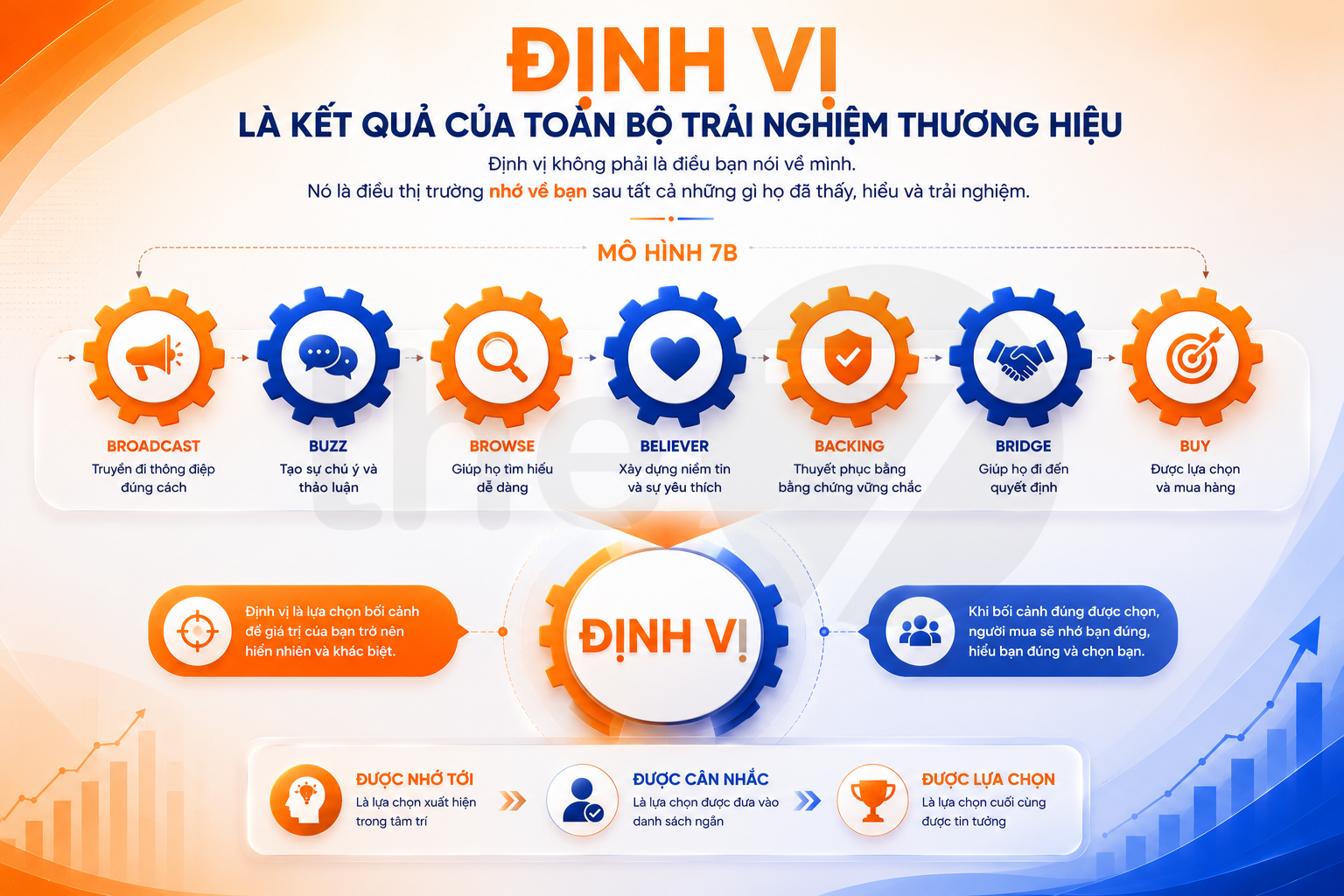
When you place positioning within the 7B model, it isn’t a gear. It’s the layer of meaning sitting above everything else, determining what every gear transmits. If you picture the 7B model as a non-linear machine that helps a business build mental availability, generate demand, nurture belief and convert demand, then positioning is the answer to what meaning that machine is embedding into the market.
Look at each gear. Broadcast pushes out content, but what is that content about? Buzz generates buzz, but what are people saying you are? Browse helps buyers find you, but in what context do they find you? Believer nurtures belief, but what promise is that belief tied to? Backing builds proof, but what does that proof prove? Bridge extends influence through partners, experts, community, and relationships, but are all those parties helping the market understand you in the right way? Even Buy, the gear closest to conversion, still depends on positioning, because buyers only act once they clearly understand why you deserve to be chosen within their context.
Before the gears can build mental availability, they need to know what memory to build. What do you want to be remembered for? In what context? With which buyer group? When a certain problem arises, whose name should pop into their head? Positioning is the upstream decision that answers those questions. It supplies the meaningful content for every gear.
If positioning is vague, the gears can still turn, but they’ll transmit disjointed signals. Broadcast says one thing, ads say another, sales explains it a different way, the website frames it differently, case studies prove something else. The market may see you many times but never form a clear memory. You have presence, but that presence doesn’t accumulate into a strong position in the mind.
If positioning is sharp, every gear reinforces the same meaning. Every post, every discussion, every case study, every appearance on LinkedIn, every referral, every time a buyer finds you through Browse, all deepen the same context: who you are, who you’re for, what problem you solve, why you’re better than the alternative, and why you’re trustworthy. When that happens, 7B doesn’t just create presence. It creates a memory with clear content.
This is also where positioning connects directly to mental availability. Mental availability answers the question of how well you’re remembered. Positioning answers the question of what you’re remembered for. A business can be widely remembered but for something very vague. That’s strong mental availability built on weak positioning. Conversely, a business can be remembered for a very clear meaning, in exactly the right buying context, by exactly the right group of people who need it. That’s strong mental availability built on strong positioning. The two need each other. Positioning determines the content of the memory. Mental availability determines the breadth and durability of that memory.
A Few Examples of B2B Positioning
In the enterprise software industry, a company might realize that its customers’ real alternative isn’t competing software of the same type, but customers continuing to do things manually with spreadsheets. If this company positions itself by comparing every feature against competitors, they can fall into a very narrow battle over interface, price, integrations, and feature lists. But if they understand that the real enemy is a manual process causing delays, inconsistencies and lack of transparency, positioning can shift to a stronger context: eliminating the manual operations that make leadership slow and wrong in their decisions. In that context, the software’s value no longer sits in a handful of individual features – it sits in replacing an old way of working that has already become too costly.
In professional services, a consulting firm might choose to position itself as a deep specialist for exactly one type of problem and one type of client, rather than a generalist consultancy serving every need. That trade-off will certainly close some doors. They won’t be the right fit for every project, every industry, every problem. But that very trade-off is what makes them the clearest choice when the right type of problem comes up. In a market full of firms claiming they can do everything, specialization can become a very powerful context to be remembered by.
In manufacturing, an equipment supplier might choose not to position on generic technical specs, since generic specs easily pull buyers into a price comparison. Instead, they place the equipment within the exact job that a specific type of customer needs done. They don’t just say the machine is faster, more durable, more cost-efficient. They say this equipment fits best in the context of a factory needing to reduce errors at a specific stage, increase stability in a specific operating environment, or meet a specific standard that customers in that industry are under pressure to meet. When the product is placed within the exact job to be done, it’s no longer generic equipment. It becomes the answer to a clear situation.
Three examples, three industries, but one shared principle: positioning creates value by choosing the right context so that your value becomes self-evident. It doesn’t make the product technically better, but it makes the product’s value seen more accurately. And in B2B, a great many deals are lost not because the product was weak, but because the buyer never understood the right value context for the product.
Three Mistakes in B2B Positioning
The first mistake is treating positioning as a tagline instead of a choice about context. Many businesses spend far too much effort polishing a sentence that sounds nice, but never decide which context they want the buyer to place them in. The result is a professional-sounding line that doesn’t shape how buyers compare and evaluate them. The fix isn’t to write a better sentence from the start – it’s to go back to the foundational question: what are buyers comparing us to, does that context favor us, and if not, which context do we need to pull them into?
The second mistake is misreading the buyer’s real alternative. Many businesses position as though their only competitor is companies selling the same type of product, when the buyer’s real alternative is often much broader. Sometimes it’s a spreadsheet, a manual process, an internal team, a familiar vendor, or simply inertia. If the real alternative is doing nothing, but you position by comparing features against a competitor, you’re fighting the wrong battle. The fix is to understand the real job the buyer needs done, every way they could get that job done, and the reason they haven’t changed yet.
The third mistake is fearing trade-offs and trying to appeal to everyone. Because they’re afraid of closing any door, many businesses position too broadly, too safely, too generically. They want to fit every industry, every size, every need, every situation. But that very breadth weakens the positioning. Buyers don’t know which context you’re especially suited to, don’t know what to remember you for, and have no strong reason to choose you over the alternatives. The fix is to accept that positioning always requires trade-offs. You have to dare to be the excellent choice for one specific thing, for one specific buyer group, in one specific context, rather than the average choice for everyone.
FAQ on B2B Positioning
What is B2B positioning?
Positioning is choosing the context in which the buyer correctly understands the value of your product, service, or brand. It includes defining the competitive frame of reference, the buyer’s real alternative, the best-fit customer segment, the differentiated value, and the proof that makes that value credible. Positioning isn’t just a description – it’s a strategic decision about how you want to be understood and remembered in the market’s mind.
How is positioning different from a slogan?
A slogan is a sentence used for communication. Positioning is the strategic choice standing behind that sentence. A slogan can sound great but still be useless if it doesn’t help buyers understand which context to place you in and which alternative to compare you against. Good positioning can generate many different pieces of messaging, but all of them should reinforce the same value context.
What is the buyer’s real alternative?
The real alternative is every way the buyer could get the job done if they didn’t buy from you. It’s not just direct competitors – it also includes spreadsheets, manual processes, internal teams, familiar vendors, building it yourself, delaying, or doing nothing. In B2B, doing nothing is often one of the strongest alternatives.
Why does positioning require trade-offs?
Because positioning is a choice. When you choose a context, a customer group, and a differentiated value, you’re simultaneously accepting that you’re not the best choice for every context, every customer, and every problem. This trade-off makes positioning sharper, more memorable, and easier to choose in the right situation. Conversely, trying to appeal to everyone usually makes a brand blur and stand out to no one.
Conclusion: Positioning Is the Context You Choose, Not What You Say
Back to where I started. Most B2B businesses treat positioning as a catchy self-description, a well-worded feature list, or a tagline that sounds different. But real positioning doesn’t live in the first sentence you write. It lives in the context you choose so the buyer understands your value.
Positioning isn’t what you say about yourself – it’s what context you place yourself in. The same product, placed in different contexts, carries different value in the buyer’s eyes. So the work of positioning is choosing the right frame of reference so your value becomes self-evident. That starts with understanding the buyer’s real alternative, which often includes inertia, not just direct competitors. It requires you to look at the product through the lens of the job to be done, not just its features. And most importantly, it requires the courage to make trade-offs – to dare to stand out on certain things, for certain people, in certain contexts, instead of trying to fit everyone.
Within the 7B model, positioning isn’t a gear. It’s the layer of meaning that determines what every gear transmits. Broadcast, Buzz, Browse, Buy, Believer, Backing and Bridge all need a memory content to embed into the market’s mind. Positioning is that content. It determines what you’re remembered for, in what context, and when your name should come to a buyer’s mind. If mental availability is how well you’re remembered, positioning is why you’re remembered.
So don’t start with the question “how do we describe ourselves better?” Start with the more important question: “What context, compared with which alternative, do we want the buyer to place us in, so our value becomes clearest?”
To understand how to create an entirely new context instead of choosing among existing ones, read our article on category design. To understand the goal that positioning supplies content for, read our article on mental availability. To understand how the gears carry the positioning message, read our article on the 7B gear model. And to understand how the positioning message is expressed consistently through content, read our article on B2B content marketing.

Nguyễn Đình
Bảo




As CEO of The7, I am committed to sharing practical, useful knowledge with every reader. Every article on The7 is based on my 7 years of hands-on experience in marketing — Facebook advertising, LinkedIn advertising, Google advertising, and marketing strategy. I hope you take away plenty of insight from these posts and apply it successfully in practice.
Related Articles
Four Frameworks That Replace the Funnel Model
Summary: As the funnel model increasingly fails to capture how modern buyers actually behave, a number of new frameworks have emerged to replace or repair it: McKinsey’s decision journey and...

What Is Category Design?
Summary: Category design is the act of creating an entirely new type of solution in the market’s mind, instead of competing within an existing category, and then becoming the name...

What Is the 95/5 Rule?
Summary: The 95/5 rule states that at any given moment, only about 5% of B2B buyers are actually in-market, actively in a buying cycle, while roughly 95% are not yet...
What Is Mental Availability in B2B?
Summary: Mental availability is how easily a brand comes to mind in a buying situation. It isn’t about having the sharpest argument, the slickest pitch, or the most convincing feature...

What Are B2B Events and Trade Shows?
Summary: B2B events and trade shows are in-person gatherings such as conferences, industry trade shows, workshops, and private meetings, where a business meets buyers, customers, partners, and the industry community...
What Is B2B Community Marketing?
Summary: B2B community marketing is about building and nurturing a community where members connect with each other around a shared interest, not just with the brand. The core distinction comes...