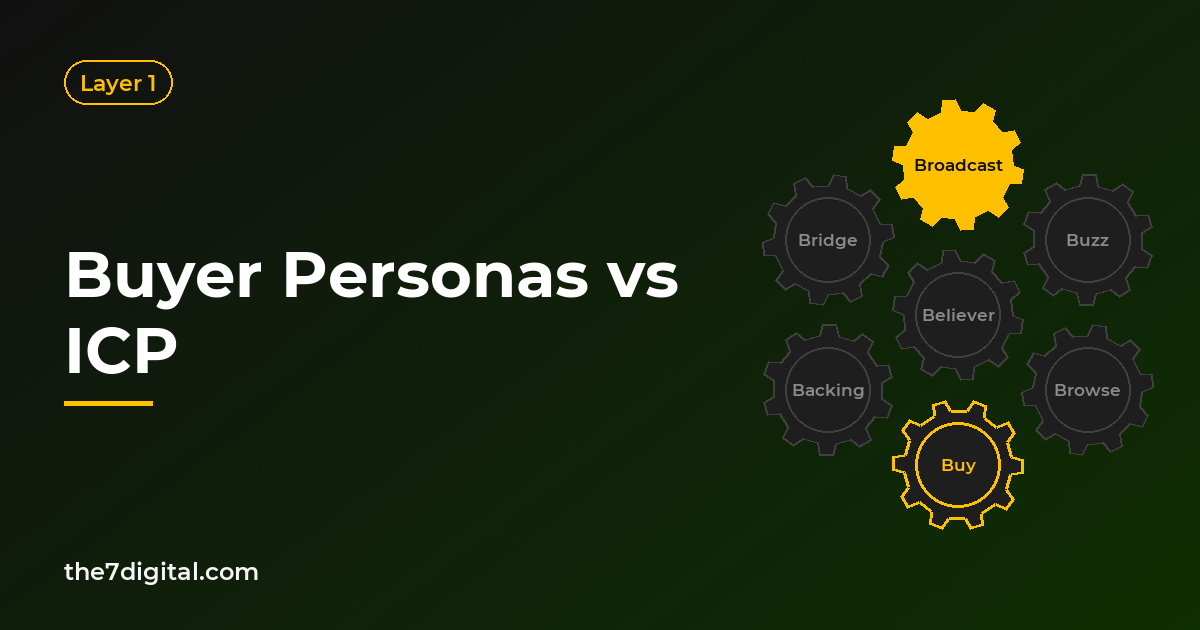
Summary: Buyer persona vs ICP comes down to the unit: an ideal customer profile (ICP) picks the companies worth pursuing, while a buyer persona describes the people inside them. Merge the two and you market to an average buyer who does not exist. In the 7B Model, both sit on the Broadcast and Buy gears.
Snowflake’s 10-K for the fiscal year ended January 31, 2026 says its customers included 790 of the Forbes Global 2000, based on the 2025 list, and that those customers contributed about 43% of the year’s revenue, out of 13,328 customers in total (Snowflake, 2026). That is a precise, measurable list of the companies behind a large share of the business. Not one of those 790 names is a person.
The same filing says the platform reaches every level of an organization: data analysts, data engineers and developers through self-service, senior executives through the direct sales team. Two lists, two jobs. One is a list of companies. The other is a description of the people inside them.
Picture a foreign B2B firm arriving in Vietnam with one document that tries to do both. It calls the document a persona, and it carries a company size, a job title and a hobby. This article pulls the two apart: what each answers, why merging them creates an average buyer, how to build each, with lessons from Grainger, Mindray and HubSpot, and what changes in Vietnam.
What is the difference between an ICP and a buyer persona?
The two tools look at different things. HubSpot (2026) describes the ICP as the type of company that would benefit most from your product, so it tells you which companies to target. A buyer persona, in its words, is “a research-based profile that represents a segment of your target audience,” and the detailed version profiles one decision-maker’s goals, challenges, behaviors and motivations.
They differ in the unit. An ICP looks at an organization. A persona looks at a person. A different unit means a different question, different inputs and different owners.
| Criterion | ICP | Buyer persona |
|---|---|---|
| Unit | One company | One person, by role |
| Question it answers | Should we pursue this company? | What does this person need to see to say yes? |
| Inputs | Your best customers: industry, size, how they buy | Interviews with real buyers, call notes |
| Outputs | Companies to pursue and not to pursue | Messages, content and proof for each role |
| What breaks if used alone | Right company, wrong words | Right words, wrong company |
LinkedIn’s own ad targeting keeps the two apart. Its documentation on Microsoft Learn (2026) lists company criteria (industry, company size, revenue, growth rate, and company category such as Fortune Global 500) separately from criteria about people (title, job function, seniority, skills, years of experience). LinkedIn does not use the terms ICP or persona; the labels company side and people side are mine. The structure is clear all the same: you choose companies in one group of fields and people in another.
An ICP is also where account-based marketing starts. The ICP is the description; the target account list is the set of named companies you pick from it. And every company on that list is a B2B buying committee, not a single buyer, so one ICP always carries several personas.
The ICP tells you which door to knock on. The persona tells you what to say when it opens.
Why does merging them create a buyer who does not exist?
Merge them and you average. Take the company size of one group of customers, the job title of another and the worries of a third, then divide. You get a person whose company does not exist and whose worries average out opposite worries. Say a large plant fears a line stopping mid-run while a small workshop fears cash flow at month end: the average of those fears belongs to nobody.
The damage shows up three ways. A hybrid persona, with company size next to personal worries, blurs both targeting and message: ads reach the wrong companies and words miss the right people. An ICP alone gets the company right but writes one message for the whole table, usually for the signer. A persona alone gets the words right for the wrong company: readers who like your content but cannot buy, or cost too much to serve.
Buyers notice. Gartner (2025) surveyed 632 B2B buyers in August and September 2024 and found that 73% actively avoid suppliers who send irrelevant outreach, even though many organizations have increased their investment in outreach. Read that as the price of the average buyer: a message written for the average is irrelevant to every real person.
Averaging erases the situation first. Professor Jenni Romaniuk of the Ehrenberg-Bass Institute (Romaniuk, 2022) writes that each buying situation is shaped by its own combination of internal and external factors, and her B2B examples sound like real life: “A company that the board would respect.” “Junior staff would find it easy to use.” Those are the expected reactions of other people, exactly what a B2B persona should hold and what an average erases. The concept behind them is mental availability.
Age is a weak field too. Forrester (2023) reported that Millennials and Gen Z make up 64% of business buyers, and that younger buyers go to more sources and find third-party resources more impactful than vendor resources. The field worth keeping in a persona is not age. It is where that person verifies.
No average company has ever signed a contract.
How do you build an ICP that holds up?
Segmenting industrial markets has always been hard. In 1984, Benson Shapiro and Thomas Bonoma wrote in Harvard Business Review (Shapiro and Bonoma, 1984) that the same industrial product often has multiple applications, and that it is hard to tell which differences are important and which are trivial. An ICP is the decision about which differences matter.
Build it from your best customers, not from a wish list, with four filters:
- Fit. Industry, size, geography and the systems they run.
- How they buy. How complex their purchasing process is and who holds the pen.
- Value and cost to serve. Who pays enough and who costs you too much effort; see cost-to-serve.
- Proof you already have. Where you have references in the same industry and size.
Then add a do-not-pursue list with a reason on every line. The 7B Model book (chapter 13) says strategy is the choice of what to leave out. The ICP is that choice made at the company level.
W.W. Grainger: One distributor, two kinds of customers, two doors
W.W. Grainger, a US distributor of maintenance, repair and operating (MRO) supplies, splits its business into two segments in its 10-K for 2025 (Grainger, 2026). High-Touch Solutions North America serves customers that are typically mid-size and large businesses with complex purchasing, offers about 2 million products, and counts many customers on electronic purchasing platforms that connect directly to Grainger’s systems. Endless Assortment serves customers that are typically smaller and mid-size businesses with less complex purchasing, through the online channels Zoro (mainly in the US, about 13 million products) and MonotaRO (mainly in Japan, about 29 million).
Net sales for 2025 were $17,942 million, up 5%: $13,993 million at High-Touch, up 2% mainly on volume, and $3,625 million at Endless Assortment, up 16% on repeat business and enterprise customer growth at MonotaRO (Grainger, 2026). The two models serve more than 4.6 million customers.
I read the two segments as two ICPs, and the dividing line runs through size and how customers buy. Each gets its own door: a connected purchasing system and a smaller range for the complex buyer, a vast self-service catalog for the simple one. They also grew at different speeds in the same year, so the ICP is a decision about the business model, not just a list for marketing. The filing says nothing about the people inside these customers, and that is the part an ICP cannot answer.
If you sell into Vietnam, the same test applies. A plant with a formal purchasing process and a small workshop where the owner buys may need two doors, even two sales models. Do not force both through one process.
What should a B2B buyer persona contain?
Build personas from real people. HubSpot’s blog post (2026) suggests interviewing 3 to 5 people per persona, mixing customers, prospects and people who do not know your company, and stopping when you can predict what the interviewee is about to say. Add a source you already have: the open question “How did you hear about us?”, left blank so the customer writes the answer (Mô hình 7B cho B2B book, chapter 7). For how to use those answers, see self-reported attribution.
A usable B2B persona holds five things:
- Their seat. Where they sit in the buying committee and what they stand to lose if they choose wrong. For their role in building consensus, read champions, mobilizers, blockers and skeptics.
- The situations. What makes them think of your kind of solution. Romaniuk (2022) uses W prompts (When, Where, While, with What, Why, hoW feeling, with/for Whom) to list them. Bring the same prompts into persona interviews.
- Proof and where they verify it. What they need to see, and where they check across the six gateways of Browse (Mô hình 7B cho B2B book, chapter 8).
- Their words. How they name the problem, the raw material for B2B positioning.
- The reactions they fear. What the board will think, and whether junior staff will find it easy to use.
Leave out age, gender, hobbies and stock photos. LinkedIn’s documentation says apps that use its targeting must show a notice that its tools may not be used to discriminate based on personal characteristics like gender, age, race or ethnicity (Microsoft Learn, 2026). That is one more reason to drop those fields: they rarely help B2B sales.
HubSpot also describes a negative persona, someone you do not want as a customer, such as a buyer who looks only at price or someone who engages with your content only to gain knowledge. In the 7B Model that last group is not the target of Buy, but Broadcast still hands out value on the spot, with no gate (Mô hình 7B cho B2B book, chapter 6). Just do not count them as the right people when you measure.
A persona found by listening, not by drawing, looks like this. According to its draft listing document of May 2026 (Mindray, 2026), the Shenzhen medical device maker Mindray has products used by 87 of Newsweek’s top 100 hospitals worldwide, and its R&D engineers work closely with frontline clinical institutions overseas to understand local needs and pain points. That lets it serve both high-end customers seeking advanced technology and primary institutions operating under resource constraints, a “dual-track innovation system” in the draft’s words.
Its example is the BC-7500 CRP hematology analyzer, launched in 2020 for pediatric hospitals and emergency departments, where blood volume is limited, repeated draws are difficult, testing is fragmented and results are slow. The draft never uses the word persona, but the situation it describes is exactly what a persona should capture. Mindray’s draft does not describe an average doctor. It describes how little blood a sick child can give.
How do the ICP and personas work together?
Split the work this way. The ICP decides where the paid energy of Broadcast goes and which accounts the sales team works. Personas decide what Broadcast says and what proof Browse offers.
Do not shrink Broadcast to fit the ICP. The IPA (2025) page on the five principles of growth in B2B marketing, a report by Peter Field and Les Binet launched by the B2B Institute, a think tank funded by LinkedIn, lists “expand your customer base” as the third. The page gives only the headline, so the interpretation is mine: the ICP is a filter for selling, not a fence around content. Broadcast may run wider than the ICP. Buy may not.
Measure against “the right people.” The third of the four replacement metrics in the 7B Model is engagement quality: do not ask which piece got the most views, ask which piece attracted the right people (Mô hình 7B cho B2B book, chapter 14). Define the right people as ICP times persona and split engagement reports on both: which companies in the ICP, which roles inside them. Then seat each persona using the 7B Buying Table Map.
A quick test shows whether you are mixing the two. Does your persona document list company size or revenue? Does your ICP name specific companies? Is every persona based on real interviews? Any wrong answer means the two are still merged.
HubSpot: A boundary written in numbers, content written for each team
HubSpot wrote its ICP into a securities filing. Its S-1 of August 2014 (HubSpot, 2014) says it focuses on mid-market businesses, defined as those with 10 to 2,000 employees. As of June 30, 2014, it had 11,624 customers in more than 70 countries, and the filing says its blog drew about 1.5 million visits a month. Its 10-K for 2025 (HubSpot, 2026) defines mid-market as 2 to 2,000 employees, says the company still sells to organizations from small businesses to enterprises, and reports 288,706 customers in more than 135 countries. Its products follow the people on the customer’s side: Marketing Hub for marketers, Sales Hub for sales teams, Service Hub for customer service.
Three things stand out. First, the ICP is one sentence written in numbers, and it moved slowly: over more than eleven years the floor dropped from 10 employees to 2 while the ceiling stayed at 2,000. Second, inside that boundary the products are organized by people: one ICP, several personas. Third, Broadcast ran wider than the ICP: about 1.5 million blog visits a month against 11,624 customers, with selling filtered by the ICP.
HubSpot wrote its ICP into a securities filing as a headcount range, then built products for each team inside that range.
Where do buyer personas and the ICP fit in the 7B Model?
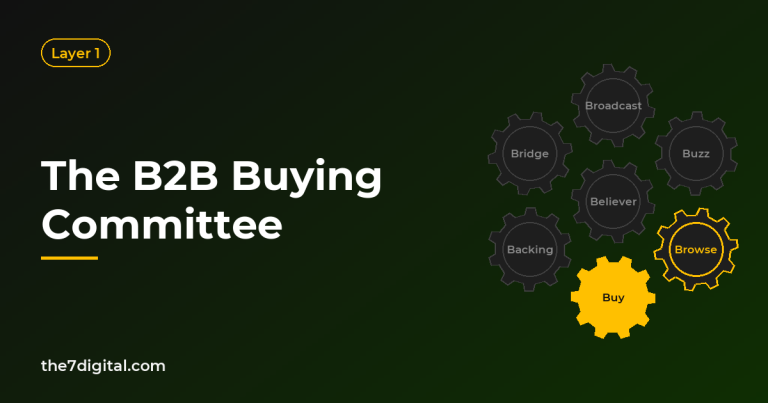
The main gear here is the Broadcast gear: Seeding valuable presence into the market, clear, steady and sharp enough that the right people know you exist. “The right people” takes two decisions, not one. The right companies are the ICP’s job. The right people inside them are the persona’s job. The 7B Model book (chapter 4) pictures Broadcast as a lighthouse: it does not chase ships, it stands still and signals, and the ships that need it will see it. The ICP picks the stretch of sea. The persona picks the signal the people on the ships recognize.
The companion is the Buy gear: A process of many people and many rounds; a door, not the final wall. Many people means several personas inside one account. How the door opens depends on the ICP you chose, as Grainger’s two doors show.
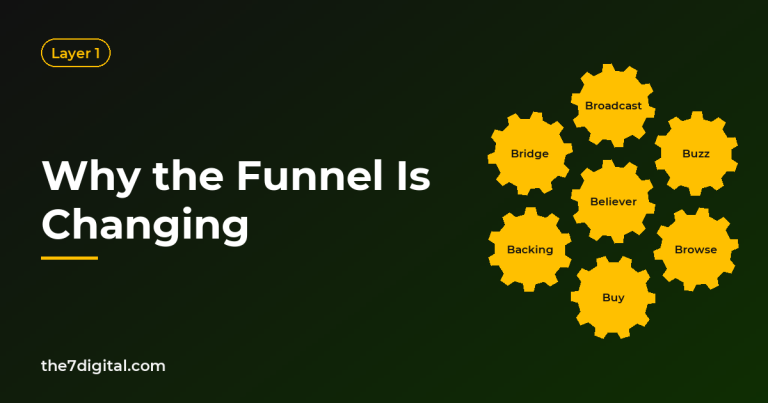
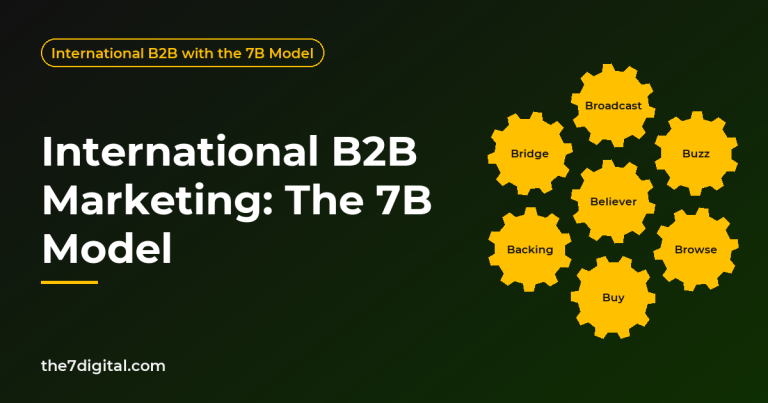
The three operating layers read: Demand creation (Broadcast, Buzz), amplification (Backing, Bridge), demand capture (Browse, Buy); Believer is the connecting loop. ICP and personas serve both demand creation and demand capture: Broadcast reaches the right people, Browse offers the right proof, Buy opens the right door.
The three energy flows are: Paid, owned, earned-and-shared. Paid targets by ICP, owned content is written by persona, and earned-and-shared comes from ICP customers whose people pass your proof on to colleagues. The two operating principles say: Customers can enter anywhere; one stuck gear slows the whole flywheel. So personas must include people who arrive through Buzz or Backing, not only through ads, and a wrong ICP is a stuck Buy gear: however well Broadcast spins, the whole machine slows.
The 7B Model was developed by Nguyen Dinh Bao (Bao7) at The7 Digital and is set out in full in the book Mô hình 7B cho B2B (Stop Begging, Start 7B). For the whole machine, start with the 7B Model.
Selling B2B into Vietnam and ASEAN
Size labels do not travel. HubSpot calls companies with 2 to 2,000 employees mid-market (HubSpot, 2026). Vietnam’s national statistics office, citing Decree 80/2021 in its White Book, sorts firms differently. A medium enterprise has fewer than 200 workers and under VND 200 billion in revenue in agriculture, forestry, fisheries, industry and construction, and fewer than 100 workers and under VND 300 billion in revenue in trade and services; by capital, the ceiling is VND 100 billion in both (National Statistics Office of Vietnam, 2026). The same word, mid-market or medium, points at very different companies. Write the ICP in the numbers local data uses, not in labels.
The top of the list is short. Of 838,753 enterprises with business results at the end of 2024, micro firms made up 67.1% and small firms 26.6%; 30,746 were medium, 22,196 were large and, on a separate cut, 26,803 were foreign-invested (National Statistics Office of Vietnam, 2026). An ICP of medium and large firms is a named list you can work account by account, the way account-based marketing does. Ability to pay matters too: 78.1% of large firms were profitable, against 35.5% of micro firms (National Statistics Office of Vietnam, 2026).
The list moves fast. The national business registry counted 1,017,056 operating enterprises at the end of 2025, up 8.2%, and 195,147 new ones during the year, up 24.1% (National Statistics Office of Vietnam, 2026). That count uses a different definition from the survey above, so do not compare the two. In the first ten months of 2026, more than 243,600 enterprises registered or returned to operation while 182,000 left the market, about 18,200 a month (National Statistics Office of Vietnam, 2026). Its nine-month report says the pressure to exit remains concentrated mainly among small firms. Refresh your account list every quarter.
The map changed, and growth is faster outside the two big cities. The same White Book presents its 2024 survey results across 63 provinces and its 2025 registry data across 34 provinces and cities, so remap the territory fields in your CRM before you trust a regional report. In 2025 the number of enterprises grew 22.3% in Hung Yen, 17.6% in Bac Ninh and 12.7% in Dong Nai, against 5.3% in Hanoi and 3.0% in Ho Chi Minh City (National Statistics Office of Vietnam, 2026).
One ICP can cross borders; personas cannot. A list of companies defined by size, industry and how they buy can span Vietnam and its neighbors. The people inside them cannot be averaged across ASEAN: an “ASEAN persona” is the average buyer again. Build personas country by country, in the local language, from interviews with real buyers in each market. In foreign-invested accounts, some seats may sit at headquarters abroad, so interview both sides.
Conclusion: The ICP picks the door, the persona picks the words
Go back to Snowflake’s two lists. One names 790 companies. The other describes analysts, engineers, developers and executives. Neither can stand in for the other, and merging them gives you a buyer who does not exist.
The average buyer never signs. Real people do, when you knock on the right door and say what they need to hear.
To go further, read the B2B buying committee for who sits behind the door, and account-based marketing for putting the whole machine behind a list of named companies.
Frequently asked questions
What is the difference between a buyer persona and an ICP?
An ICP describes the kind of company worth pursuing: industry, size, how it buys and the value you can serve profitably. A buyer persona describes the people inside those companies: their seat in the buying committee, the situations that send them looking, and the proof they need. The ICP answers who to sell to; the persona answers what to say to whom.
Should you build the ICP or the personas first?
The ICP. Pick the companies first, then interview people who work in them. Personas built from people outside your ICP pull your content toward buyers who cannot buy or cost too much to serve.
How many buyer personas does a B2B company need?
There is no standard number. Start with the roles that actually change decisions inside your ICP accounts, and stop at the number your team really uses to write content and prepare proof. A persona nobody uses is one too many.
How do you define an ICP for Vietnam?
In numbers, not labels. Of 838,753 Vietnamese enterprises with business results at the end of 2024, 93.7% were micro or small, and there were 30,746 medium and 22,196 large firms (National Statistics Office of Vietnam, 2026). Name the companies you want, check them against local size criteria, and refresh the list often: in the first ten months of 2026, about 18,200 enterprises a month withdrew from the market (National Statistics Office of Vietnam, 2026).
References
- Snowflake (2026). Form 10-K for the fiscal year ended January 31, 2026. https://www.sec.gov/Archives/edgar/data/1640147/000164014726000008/snow-20260131.htm
- HubSpot (2026). How to create detailed buyer personas for your business. https://blog.hubspot.com/marketing/buyer-persona-research
- Microsoft Learn (2026). Ad Targeting, LinkedIn Marketing API. https://learn.microsoft.com/en-us/linkedin/marketing/integrations/ads/advertising-targeting/ads-targeting
- Gartner (2025). Gartner Sales Survey Finds 61% of B2B Buyers Prefer a Rep-Free Buying Experience. https://www.gartner.com/en/newsroom/press-releases/2025-06-25-gartner-sales-survey-finds-61-percent-of-b2b-buyers-prefer-a-rep-free-buying-experience
- Jenni Romaniuk, Ehrenberg-Bass Institute (2022). Category Entry Points in a Business-to-Business (B2B) world. https://marketingscience.info/news-and-insights/category-entry-points-in-a-business-to-business-b2b-world
- Forrester (2023). Forrester: Generational Shifts Are Disrupting Traditional Business Buying Behaviors And Necessitate Reevaluating Go-To-Market Strategies. https://www.forrester.com/press-newsroom/changing-b2b-buying-behaviors/
- Benson P. Shapiro, Thomas V. Bonoma (1984). How to Segment Industrial Markets. Harvard Business Review. https://hbr.org/1984/05/how-to-segment-industrial-markets
- W.W. Grainger (2026). Form 10-K for the fiscal year ended December 31, 2025. https://www.sec.gov/Archives/edgar/data/277135/000027713526000011/gww-20251231.htm
- Mindray (2026). Draft listing document, Business section (HKEXnews, May 11, 2026). https://www1.hkexnews.hk/app/sehk/2026/108529/a132791/sehk26051101307.pdf
- IPA (2025). Five Principles of Growth in B2B Marketing (report by Peter Field and Les Binet, launched by the B2B Institute). https://ipa.co.uk/effworks/marketing-marketing-v2/five-principles-of-growth-in-b2b-marketing/
- HubSpot (2014). Form S-1 Registration Statement. https://www.sec.gov/Archives/edgar/data/1404655/000119312514320044/d697256ds1.htm
- HubSpot (2026). Form 10-K for the fiscal year ended December 31, 2025. https://www.sec.gov/Archives/edgar/data/1404655/000119312526046646/hubs-20251231.htm
- National Statistics Office of Vietnam (2026). Vietnam Enterprises White Book 2026 (Sách trắng doanh nghiệp Việt Nam năm 2026). https://www.nso.gov.vn/wp-content/uploads/2026/10/Sach-trang-doanh-nghiep-Viet-Nam-nam-2026.pdf
- National Statistics Office of Vietnam (2026). Socio-economic situation report for October and the first ten months of 2026 (Báo cáo tình hình kinh tế, xã hội tháng Mười và 10 tháng năm 2026). https://www.nso.gov.vn/bai-top/2026/11/bao-cao-tinh-hinh-kinh-te-xa-hoi-thang-muoi-va-10-thang-nam-2026/
- National Statistics Office of Vietnam (2026). Enterprise activity in Q3 and the first nine months of 2026 (Hoạt động doanh nghiệp quý III và 9 tháng năm 2026). https://www.nso.gov.vn/du-lieu-va-so-lieu-thong-ke/2026/10/hoat-dong-doanh-nghiep-quy-iii-va-9-thang-nam-2026-tin-hieu-cai-thien-tu-san-xuat-dau-tu-va-thi-truong/