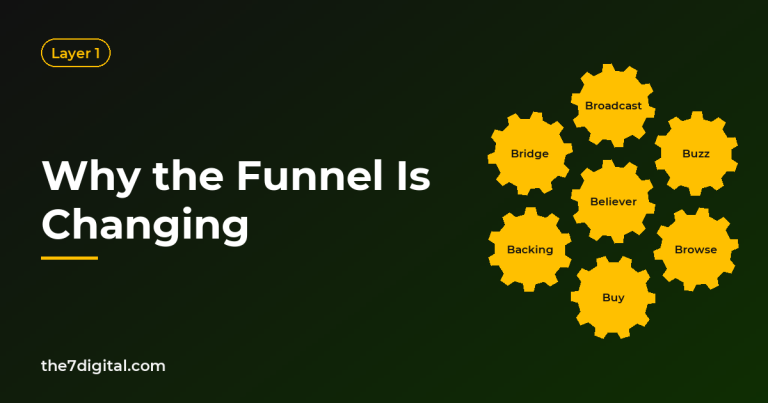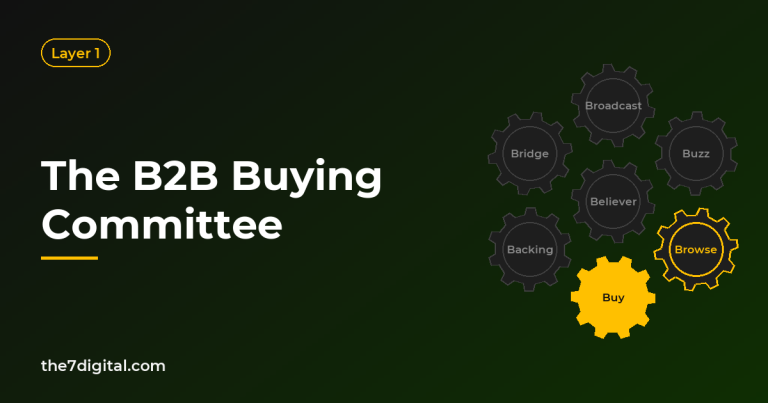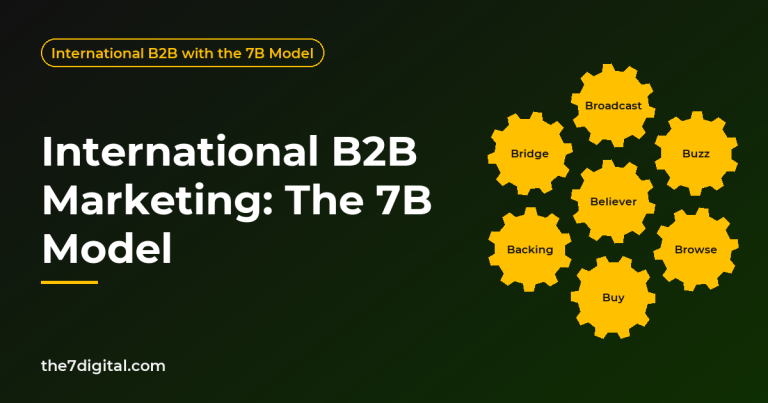
Summary: Champions and mobilizers are often different people. A champion likes you; a mobilizer can move a whole buying committee to agreement. Invest in mobilizers, answer skeptics with evidence they can check, and remove what blockers are protecting. In the 7B Model, this sits in the Buy gear.
Here is a line from a trip report, the kind a regional sales manager files on the flight home after a plant demo in Vietnam. It is a composite, not any company’s file. “Plant manager loved it. Replied to my message within the hour. Will take it to the general director. Champion confirmed.” The CRM now shows the deal as strong. Three months later it has not moved. Nobody said no. The plant manager is still “taking it up,” and the only other name in the file, a regional finance controller who was not at the demo, has not heard from you since.
The research behind The Challenger Customer (2015) points the other way. Brent Adamson, Matthew Dixon, Pat Spenner and Nick Toman report that sales teams naturally gravitate toward eager contacts, yet the highest-performing teams spend their time on buyers who are “far more skeptical,” far less interested in meeting and ultimately indifferent to who wins the deal.
A champion is an attitude: this person likes you. What you need is a capability: this person can move an organization. Below: the four types, what each needs from your content, where they sit in the 7B Model, and what changes when your buyers are in Vietnam and ASEAN.
Why doesn’t your biggest fan win you the deal?
Start with where the decision went. Sales reps were long taught to find the one executive who could approve a deal alone. Karl Schmidt, Brent Adamson and Anna Bird wrote in Harvard Business Review (2015) that unilateral decision makers are now rare and that reaching consensus has become harder and slower. If you sell from abroad, assume the person who signs is not the person who met you. The B2B buying committee explains who else sits at that table.
Challenger’s book page describes mobilizers as the buying influences who can enable change. The book also sets “Talkers” against mobilizers, but the page does not define them, so this is my reading: a talker is open, shares a lot, is easy to book and never moves anyone. Plenty of champions are only talkers. The book behind the 7B Model puts it in a marketer’s language (Mô hình 7B cho B2B book, chapter 9): the champion inside the buyer is your most valuable ally and the weakest voice in the room, because they cannot sign and still have to persuade everyone else.
When nobody pulls, deals slide into “no decision.” Challenger (2024) cites its own 2019 buyer survey: up to 38% of purchase attempts end that way, meaning nearly 4 in 10 would-be buyers quit before deciding to change anything. Challenger sells sales training and does not state the sample size, so read this as a direction, not a benchmark.
Why do teams still misinvest? Talkers are easy. They answer fast, share freely and make every meeting feel like progress, and Challenger (2024) notes that sellers struggle to tell talkers and mobilizers apart. For a foreign supplier the trap is sharper: the contact you can reach is often the one who speaks good English and enjoys meeting foreign partners. That person may be a fine guide, not necessarily a mover of the general director. A champion gives you information. A mobilizer gives you movement.
Who is a mobilizer, and how do you spot one?
A mobilizer is loyal to the change, not to you. The research says the best teams pursue buyers who are, in the end, indifferent to who wins the deal (Adamson, Dixon, Spenner and Toman, 2015). Flattery does nothing for them. A reason to change does. The book offers a blueprint for finding them and engaging them with “disruptive insight,” which I read as a view that makes them see their own company’s problem in a new way.
Here is what each type tends to say and do. The table is my field observation, not research data, and the lines are illustrations, not quotes.
| Type | What they say | What they do | What you do |
|---|---|---|---|
| Champion who is a talker | “Love it. I’ll take it to my boss.” | Replies fast, shares freely, never introduces you to anyone | Learn the org chart from them; don’t hand them the job of moving the table |
| Mobilizer | “If we do this, what will finance ask?” | Pushes back, asks about risk, books your next meeting with someone else | Invest time; bring a new view of their problem and a tool to build the case |
| Skeptic | “How was this measured? Let me call a customer.” | Asks for raw data, checks it, nods slowly | Give method, editable assumptions, references to call; state the limits first |
| Blocker | “What we have works fine.” | Goes quiet, delays, adds conditions | Find what they protect and make it cheaper |
The first two rows are the easiest to confuse, because both are warm while they sit with you. The difference shows after you leave: one sends regards, the other calls a third person. A mobilizer asks hard questions too, but about the meeting ahead; a skeptic asks about your evidence. A mobilizer’s questions are not an attack. They are rehearsal for a meeting you will not attend.
Three tests I use. Ask, “If this is approved, who will object, and why?” A mobilizer names people and reasons; a talker says “probably nobody.” Ask for an introduction to whoever worries about budget in the next two weeks: a mobilizer books it; a talker promises to ask. Offer a view that contradicts how their company thinks today: a mobilizer argues and asks for a trial; a talker nods politely.
Types do not follow titles: a finance director can be a talker and a junior engineer a mobilizer. Never bet on one person, either; working several people inside the same target account is the home turf of account-based marketing.
Why can the skeptic be your best ally?
A skeptic looks like an obstacle: hard questions, requests for raw numbers, a demand to call a customer. Yet the highest-performing sales teams go after buyers who are “far more skeptical” (Adamson, Dixon, Spenner and Toman, 2015). I use the word skeptic for that kind of buyer. On the Penguin Random House book page, skepticism and indifference to who wins belong to the same buyers, so a skeptic and a mobilizer are often one person. When someone hard to convince finally nods, the table tends to follow.
A skeptic does not dislike you. They fear being wrong. In The JOLT Effect (2022), Matthew Dixon and Ted McKenna draw on more than two and a half million sales conversations and conclude that once purchase intent exists, customers stop worrying about succeeding and start worrying about not failing. Bain & Company (2026) adds that some members of a buying group will always choose what they see as the safe choice.
A skeptic needs evidence they can interrogate: how it was measured, whether there was a control group, whether the assumptions can be edited and whether the limits are stated or hidden.
GitHub and Accenture: A controlled trial for people who won’t take your word for it
On May 13, 2024, GitHub (2024) published a study with Accenture, the consulting and technology firm: a randomized controlled trial in which developers were randomly assigned to a group with GitHub Copilot or a group without it. Accenture developers saw 8.69% more pull requests, a 15% rise in the pull request merge rate and an 84% rise in successful builds, and 81.4% installed the Copilot extension the day they received a license (GitHub, 2024).
Read the numbers by who worries about what: merge rate and successful builds for whoever worries about code quality, installation speed for whoever worries about rollout, and the 95% who said they enjoyed coding more (GitHub, 2024) for the developers themselves. One body of evidence, several answers.
Now the part a skeptic will ask about. GitHub sells Copilot and published the study itself. The page states no sample size, and it does not say whether those gains are measured against the control group. A vendor that names such limits first usually keeps a skeptic’s trust better than one that only shows numbers. In this region, a measured result from a plant or branch nearby, with a control group, will outweigh a global case study.
Sometimes the buyer runs the trial. In the UK Government Digital Service’s Microsoft 365 Copilot experiment, which ran across 20,000 government employees in 12 organizations, users reported saving 26 minutes a day on average, and 82% said they would not want to go back (GDS, 2025). The report itself says the savings are self-reported and that it could not identify how the saved time was spent. The lesson: agree the measure with the skeptic before a trial starts, not after it ends.
Don’t dodge the skeptic. Hand them a ruler.
Should you persuade a blocker or work around one?
Do not lump three things together. A skeptic resists an idea that has not been proven. A blocker defends the status quo: their budget, their authority, their team’s workload, sometimes an earlier decision of their own. Veto seats such as IT, legal and procurement usually say “not yet” because documents are missing, so serve them early. Challenger (2024) warns that sellers may fail to address blockers’ concerns effectively.
A forgotten blocker usually doesn’t kill the deal outright; the deal drifts into no decision. That is a large group: citing The JOLT Effect, Challenger (2024) puts no-decision losses at 40% to 60% of all lost deals, and that counts every deal nobody decided, not only deals with a blocker. The book behind the 7B Model puts it in a seller’s language: B2B deals rarely die loudly; the buyer says “let me think about it” and disappears (Mô hình 7B cho B2B book, chapter 9).
So what do you do? Don’t argue features, because features do not answer what the blocker is guarding. Find what they protect and make it cheaper: phase the rollout, run a small trial with a commitment, change the payment structure, take work off their team.
Intuitive Surgical: When the capital budget is the wall, change the shape of the deal
Intuitive Surgical, the American maker of the da Vinci robotic surgery system, calls the first system sale into an account a major capital equipment purchase. Its 10-K for fiscal 2025 says the sales cycle is typically lengthy and affected by capital spending prioritization and the timing of budgeting cycles (Intuitive Surgical, 2026).
Yet the company is not simply waiting for budgets to open. In 2025 it placed 1,721 systems, and 872 of them, or 51%, went out under operating lease arrangements, 496 of them usage-based (Intuitive Surgical, 2026). The company writes that usage-based arrangements reduce customers’ overall risk and need for capital outlay.
The filing does not say who inside a hospital blocks a deal. Look instead through the eyes of whoever holds the capital budget: they rarely argue about the robot’s clinical value; they say “not this budget cycle,” and a features debate cannot answer that. Intuitive did not win the argument. It removed its premise: for more than half of 2025 placements, the hospital did not have to buy outright from the capital budget.
If you sell to a foreign-invested plant in Vietnam, its capital budget may follow the parent group’s planning cycle, so check it early. Financial structure is content for blockers, not only a matter for your own finance team. The mobilizer works from inside; you supply the ammunition. Going around a blocker without a mobilizer tends to leave an enemy in the account.
Blockers don’t need to lose. They need to see that what they guard is safe.
What content lets a mobilizer sell for you in meetings you never attend?
A mobilizer’s job is to bring the group to one conclusion, not to praise your product. Gartner (2025) advises sellers to help members understand each other’s viewpoints and to aim at the group’s shared interests rather than each person’s.
The book behind the 7B Model puts one principle through the whole Buy gear: simplify rather than force, including simplifying internal persuasion (Mô hình 7B cho B2B book, chapter 9). The handover kit for champions is in the buying committee article; building and running a whole toolkit belongs to sales enablement. Three principles are specific to mobilizer content: build from the customer’s own numbers, not your averages; give one data set but a different output for each person at the table; and keep the assumptions editable, so the skeptic can check instead of having to believe.
Google Cloud and Microsoft: Business cases built from the buyer’s own data
Two big cloud vendors build into their migration tools a way to assemble an economic case from the customer’s own data. Microsoft’s Azure Migrate business case estimates total cost of ownership (TCO), potential savings and sustainability impact from the customer’s own server data (Microsoft Learn, 2024). Its assumptions are published and editable: the weighted average cost of capital defaults to 7%, and users can change it (Microsoft Learn, 2024). Its executive summary lays out savings and year-by-year cash flow.
Google Cloud’s Migration Center goes the same way. Its TCO report is built from asset groups the customer selects in their own discovery data, and it exports to Google Slides as a summary for executive-level decisions and to Google Sheets for detail on every server and database.
Now look at the two tools from the buyer’s side. The person pushing a cloud move is rarely the signer. They must sell finance on cash flow, leadership on a summary and engineers on server-level detail, and these tools let them do it from their own company’s numbers, while the skeptic edits the assumptions instead of trusting the vendor’s.
For Vietnam, localize the business case: Vietnamese language, Vietnamese dong, local cost assumptions, and a second version in the format the buyer’s parent company uses. Mobilizer content will also travel through closed channels: screenshots, forwards in internal chat groups, pasted into an email to the boss, the kind of dark social no dashboard records. Design the summary to survive being cut out of context: your name, the number and its source on one page.
You do not need to be in the room. You need to be in the hands of the person speaking.
Where do champions, mobilizers, blockers and skeptics fit in the 7B Model?
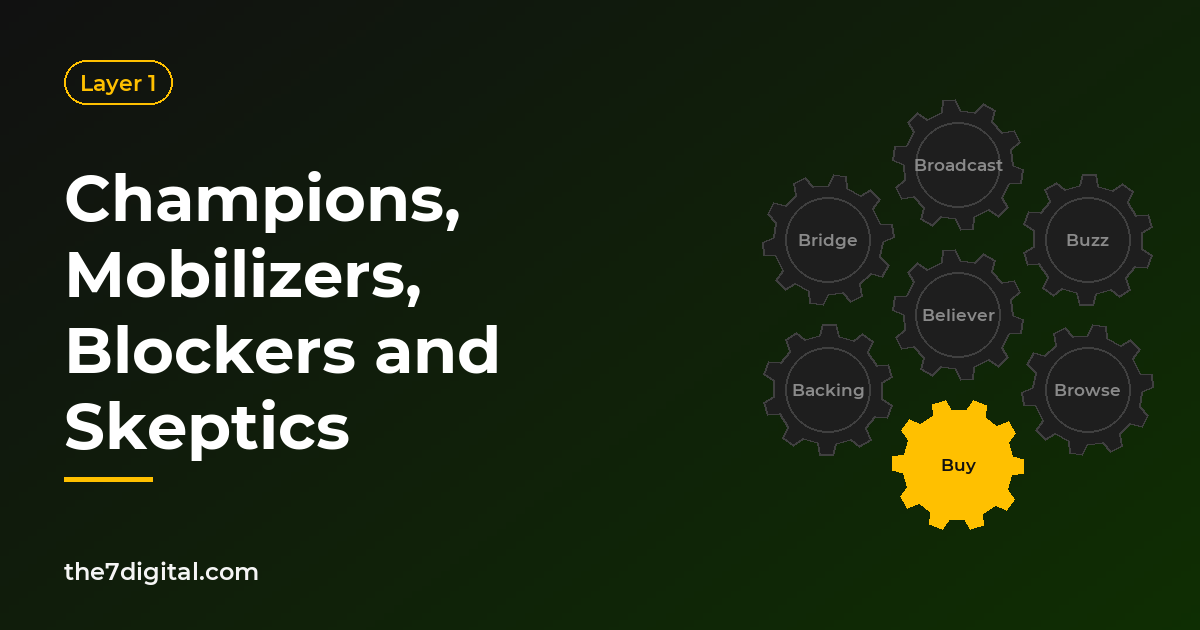
All four types work in the Buy gear: A process of many people and many rounds; a door, not the final wall. Many people means all four share one table. Many rounds means someone has to carry your story between meetings. And the door gives me this article’s image: its handle is on the inside. You cannot open it from outside. A mobilizer can.
Buy sits with Browse in demand capture, but these four types pull other gears into the room. The skeptic verifies at Browse and trusts Backing, the third-party proof. The mobilizer reuses the Broadcast content you planted to teach the group. For the general picture, see how to convert demand into orders. Of the three energy flows, paid, owned, earned-and-shared, this topic leans on the last two: the business case and the proof page are yours, and the mobilizer forwards them.
The two operating principles fit tightly: customers can enter anywhere; one stuck gear slows the whole flywheel. A skeptic may meet you first through someone else’s review, and a forgotten blocker jams Buy. The loyalty loop closes the story: Believers create Backing, Backing creates Bridges, and Bridges bring new people back into Broadcast, Browse and Buy. A mobilizer who wins inside the buyer becomes a Believer, their story becomes Backing, and a job change can make them a Bridge.
If you already use the 7B Buying Table Map, add one question to each seat: does this person talk or pull? The 7B Model was developed by Nguyen Dinh Bao (Bao7) at The7 Digital and is set out in full in the book Mô hình 7B cho B2B (Stop Begging, Start 7B).
Selling B2B into Vietnam and ASEAN
Start with hierarchy, because it decides who can mobilize. On The Culture Factor’s version of the Hofstede model, Vietnam scores 70 on power distance, and the page describes a society where inequalities are taken for granted, centralization is popular and the ideal boss is “a benevolent autocrat” (The Culture Factor, n.d.). That is a national average, not a description of anyone you will meet. But it is a useful warning: the friendly mid-level manager may be a talker by structure, not temperament, while the mobilizer is more likely the person the general director consults. So ask early: who will the director ask before deciding?
Next, the skeptics. On uncertainty avoidance, Vietnam scores 30, which the same page describes as a relatively relaxed attitude in which “practice counts more than principles” (The Culture Factor, n.d.). A skeptic here is more likely to want to see the thing run than to read a white paper. Budget for a trial on site, with the measure agreed in advance, and offer a visit to a plant that already uses your product.
Third, the channel. Citing the platform’s own statements, DataReportal puts Zalo at 78.3 million monthly active users in Vietnam and estimates that 91.4% of the country’s internet users also use it (DataReportal, 2025). Those are consumer figures, not buyer figures, but they show where a mobilizer will probably forward your summary: as a screenshot in an internal chat group. Write it for that trip: Vietnamese, readable on a phone, with the number, its source and your name on one screen.
Finally, the skeptic may not sit in Vietnam. In the first ten months of 2026, the foreign-invested sector, crude oil included, accounted for 81.2% of Vietnam’s goods exports, by preliminary figures (Tạp chí Kinh tế – Tài chính, 2026). In newly registered foreign capital over the same period, Singapore led with 31% and South Korea followed with 18.9% (Thời báo Tài chính Việt Nam, 2026).
My reading: many buyers in Vietnam answer to a regional headquarters or a parent company, so whoever guards the budget or doubts your numbers may sit in Singapore or Seoul. Give the local mobilizer a version in the language and format headquarters uses. The scores above are Vietnam’s only; check other ASEAN markets separately.
Conclusion: Your biggest fan is not your way through the door
Go back to the trip report. The plant manager is a good guide and a poor engine. The regional finance controller who has not heard from you since the demo may decide whether the file moves. Stop counting the people who like you. Find who moves the table, give the skeptic a ruler and remove what the blocker is guarding. The Buy door has its handle on the inside; make sure someone in there is strong enough to pull it.
For who sits around the table, read the B2B buying committee. For how the toolkit that equips your champions is built and run, read sales enablement. For how content travels inside the buyer, read dark social.
Frequently asked questions
What is the difference between a champion and a mobilizer?
A champion is on your side; a mobilizer can make their organization change. Challenger’s book page describes mobilizers as the buying influences who can enable change. Many champions are only talkers: open and enthusiastic, yet unable to move anyone.
How do you identify a mobilizer in a buying committee?
In my experience, watch what they do, not how warm they are. Mobilizers ask about risk and rollout, push back, can name who will object and why, and set up your next meeting with someone else. Talkers introduce you to no one.
How should you handle a blocker in a B2B deal?
Don’t argue features. Find what they protect, such as budget, risk or workload, and make it cheaper: phasing, a small trial or a different payment structure. Let your mobilizer work it inside. Don’t let the deal drift into no decision: citing The JOLT Effect, Challenger (2024) puts no-decision losses at 40% to 60% of all lost deals.
How do mobilizers work inside Vietnamese companies?
Power tends to sit at the top: on The Culture Factor’s version of Hofstede’s model, Vietnam scores 70 on power distance (The Culture Factor, n.d.), so the mobilizer is more likely the person the director consults. Expect your summary to be forwarded in chat: citing the platform itself, DataReportal (2025) puts Zalo at 78.3 million monthly active users, a consumer figure rather than a B2B one. Give your mobilizer a short Vietnamese summary that reads well on a phone.
References
- Brent Adamson, Matthew Dixon, Pat Spenner, Nick Toman (2015). The Challenger Customer: Selling to the Hidden Influencer Who Can Multiply Your Results (Portfolio; Penguin Random House book page). https://www.penguinrandomhouse.com/books/318682/the-challenger-customer-by-brent-adamson-matthew-dixon-pat-spenner-and-nick-toman/9781591848158/
- Challenger (n.d., accessed November 9, 2026). Challenger book page, The Challenger Customer section. https://challengerinc.com/the-challenger-sales-book/
- Challenger (2024). Growing B2B Buying Groups Are Driving Purchasing Gridlock. https://challengerinc.com/blog/buying-group-gridlock/
- Matthew Dixon, Ted McKenna (2022). The JOLT Effect: How High Performers Overcome Customer Indecision (Portfolio; Penguin Random House book page). https://www.penguinrandomhouse.com/books/697165/the-jolt-effect-by-matthew-dixon-and-ted-mckenna/
- Karl Schmidt, Brent Adamson, Anna Bird (2015). Making the Consensus Sale. Harvard Business Review. https://hbr.org/2015/03/making-the-consensus-sale
- Gartner (2025). Gartner Sales Survey Finds 74% of B2B Buyer Teams Demonstrate “Unhealthy Conflict” During The Decision Process. https://www.gartner.com/en/newsroom/press-releases/2025-05-07-gartner-sales-survey-finds-74-percent-of-b2b-buyer-teams-demonstrate-unhealthy-conflict-during-the-decision-process
- Bain & Company (2026). Raising the Odds on a Deal: How Likelihood to Buy Rewires B2B Growth. https://www.bain.com/insights/raising-the-odds-on-a-deal-how-likelihood-to-buy-rewires-b2b-growth/
- Ya Gao, GitHub Customer Research (2024). Research: Quantifying GitHub Copilot’s impact in the enterprise with Accenture. https://github.blog/news-insights/research/research-quantifying-github-copilots-impact-in-the-enterprise-with-accenture/
- Government Digital Service (2025). Microsoft 365 Copilot Experiment: Cross-Government Findings Report. https://www.gov.uk/government/publications/microsoft-365-copilot-experiment-cross-government-findings-report/microsoft-365-copilot-experiment-cross-government-findings-report-html
- Intuitive Surgical (2026). Form 10-K for the fiscal year ended December 31, 2025. https://www.sec.gov/Archives/edgar/data/1035267/000103526726000010/isrg-20251231.htm
- Microsoft Learn (2024). Business Case in Azure Migrate (updated 2026). https://learn.microsoft.com/en-us/azure/migrate/concepts-business-case-calculation
- Google Cloud (n.d., accessed November 9, 2026). Migration Center: generate total cost of ownership (TCO) reports. https://docs.cloud.google.com/migration-center/docs/generate-tco-report
- The Culture Factor Group (n.d., accessed November 9, 2026). Country comparison tool: Vietnam. https://www.theculturefactor.com/country-comparison-tool?countries=vietnam
- DataReportal, Simon Kemp (2025). Digital 2026: Vietnam. https://datareportal.com/reports/digital-2026-vietnam
- Tạp chí Kinh tế – Tài chính, Thuỷ Hà (2026). 10 tháng năm 2026: Xuất nhập khẩu hàng hóa của Việt Nam lần đầu vượt mốc 1.000 tỷ USD. https://tapchikinhtetaichinh.vn/10-thang-nam-2026-xuat-nhap-khau-hang-hoa-cua-viet-nam-lan-dau-vuot-moc-1-000-ty-usd-171406.html
- Thời báo Tài chính Việt Nam, Diệu Hoa (2026). Việt Nam thu hút 54,85 tỷ USD vốn đầu tư nước ngoài trong 10 tháng. https://thoibaotaichinhvietnam.vn/viet-nam-thu-hut-54-85-ty-usd-von-dau-tu-nuoc-ngoai-trong-10-thang-206324.html