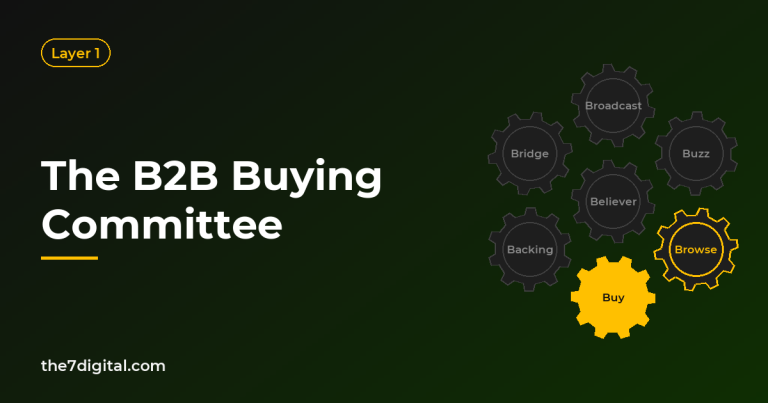
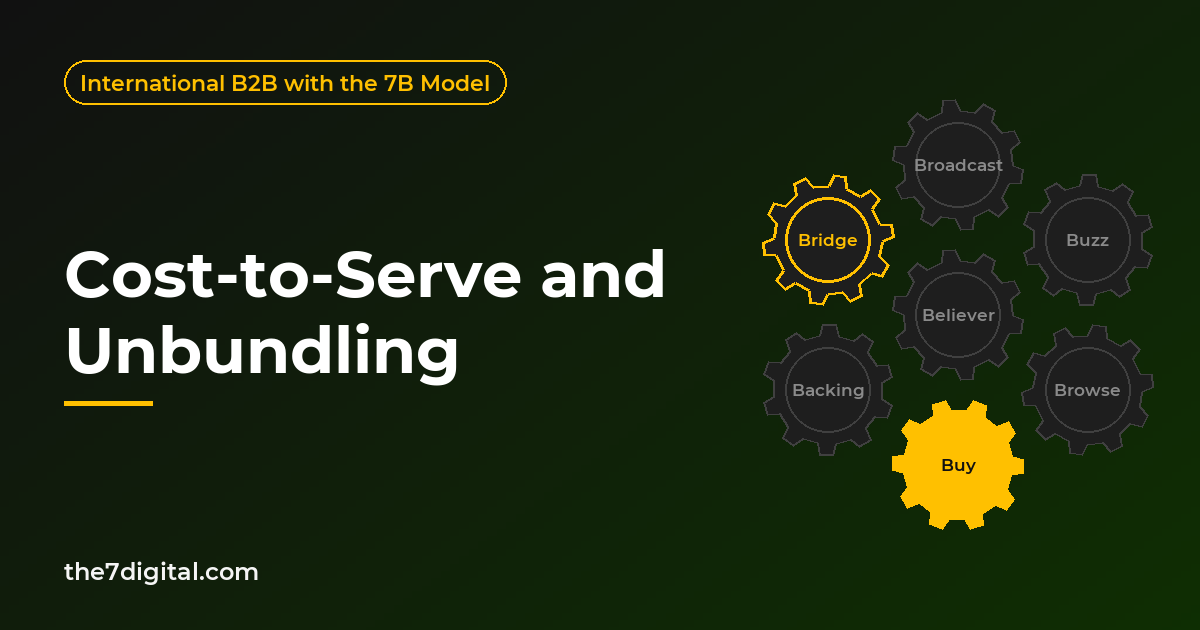
Summary: Cost to serve is everything you spend to win, deliver and support one customer, from the first quote to after-sales service. Big accounts are not always profitable ones. Decide who qualifies, then unbundle product and service so each group pays for what it uses. In the 7B Model, this sits in the Buy and Bridge gears.
In the first ten months of 2026, nearly 162,300 new enterprises registered in Vietnam and nearly 81,400 returned to business, while on average about 18,200 left the market every month (National Statistics Office, via Tạp chí Kinh tế – Tài chính, 2026).
I read that as a market where accounts arrive and vanish by the thousand. Serve them all the same way and the biggest names on your list may be the ones quietly costing you money, while the smallest cost more to serve than they pay.
This article sorts customers into four types by price and cost to serve, shows why demanding, low-paying accounts eat margin, and explains what unbundling opens up. Then it matches each type to a gear, follows how Maersk chose its customers, and ends with Vietnam and ASEAN.
Who are the four customer groups in the price and cost-to-serve matrix?
In 1987, Benson Shapiro and his co-authors opened a Harvard Business Review article with this line: “High sales volume does not necessarily mean high income, as many companies have found to their sorrow” (Shapiro et al., 1987). They add that profits, as a percentage of sales, are often much higher on some orders than on others. In my reading, the gap comes from how each customer makes you serve them, not from the quote.
Total cost of ownership is what the customer pays over a product’s life. Cost to serve is its mirror image: what you spend, customer by customer. The last article asked which customers deserve a commitment on lifetime cost; this one answers.
The matrix sets net price, the price after discounts and allowances, against cost to serve. Cost to serve rests on four kinds of cost: presale, production, distribution and post-sale service (according to a summary by Rajagopal and Sanchez (2004)). The four cells keep the names from the original paper, and the last column is my reading:
| Customer type | Net price | Cost to serve | Typical signs |
|---|---|---|---|
| Carriage trade | High | High | Custom work, many review rounds, pays well |
| Passive | High | Low | Orders steadily, asks little, rarely complains |
| Bargain basement | Low | Low | Wants a standard product, self-serves |
| Aggressive | Low | High | Squeezes price, fines you, wants small drops, pays late |
Suppliers tend to believe most of their accounts sit in carriage trade and bargain basement, where price and cost move together. When the analysis is actually done, it usually shows more than half in passive and aggressive, according to Rajagopal and Sanchez (2004). I read true profit and true loss as sitting there.
The average hides both. A.T. Kearney research, cited by Martin Christopher in his logistics textbook, suggests that what matters is how costs vary by customer and by order size. Christopher adds that the average cost to serve is easy to calculate, but there may be no customer that incurs it (Christopher, 2004).
A product report tells you what makes money. It does not tell you who makes you money.
How do demanding, low-paying accounts eat your margin?
Talk Business & Politics (2020) reported on 3 September that Walmart would require every supplier, from 15 September, to deliver 98% of orders on time and in full (OTIF), whether freight is prepaid by the supplier or collected by Walmart. Suppliers missing the target would be fined 3% of the cost of goods. They were meeting about 70% at the time (Talk Business & Politics, 2020). One supplier called the rule “very punitive and unnecessary.”
That fine is a cost-to-serve line the customer wrote, and it never appears on your quote. Closing the gap from 70% to 98% takes extra trips, buffer stock and early shipments (my reading, not the article’s; Talk Business & Politics, 2020).
Why does an account land in this cell? Shapiro and colleagues name four aspects that affect profitability: customer economics, power, the nature of the decision-making unit, and the institutional relationship between buyer and seller (according to Rajagopal and Sanchez, 2004). My reading: a customer with thin margins squeezes you, a big customer facing a small supplier writes the rules, and a buying committee with many seats adds a meeting and a quote in every round. Size is not the problem. A price that does not match the cost the customer causes is.
Measure before you judge. Martin Christopher’s customer profit and loss account lists costs that never show on a quote, from sales calls to returns and the actual payment period. His test: “What costs would I avoid and what revenues would I lose if I lost this customer?” (Christopher, 2004).
There are four ways out: price the extra work separately; unbundle the costly service, as Walmart’s collect option does (Walmart ships the goods, and the supplier takes a cost reduction to compensate); rewrite the terms to simplify rather than force, with clear prices, short contracts and fair terms (Mô hình 7B cho B2B book, chapter 9); and, when nothing fits, walk away.
What options open up when you unbundle product and service?
Anderson and Narus saw the gap in 1995: suppliers had built flexible plants, modular components and shared platforms to tailor offers cheaply, yet “most manufacturers have focused only on the products themselves,” while service has a huge impact on costs and profits (Anderson and Narus, 1995). I think cost to serve swells in the services around the product, so unbundling means giving that layer its own price and choices. I see four ways.
A lean core for those who need only the core. In 2025, TSMC made 12,682 products for 534 customers (TSMC, accessed 2026). Its CyberShuttle service lets many designs share tooling costs through one multi-project mask set and, according to TSMC, slashes prototyping cost by up to 90% (TSMC, accessed 2026). I call that a shared ride: a cheap Buy door for designs still being tested, and today’s prototype customer may be tomorrow’s production customer.
A tiered menu the customer chooses from. That is SAP’s story, just below.
A separate price for the service the customer wants to run itself. Walmart’s collect option, above, is the example.
A partner that carries the service layer. TSMC’s Value Chain Alliance brings in independent design service companies to help system companies, ASIC companies and start-ups bring designs to production; according to TSMC, it extends the company’s ability to serve a broader range of customers (TSMC, accessed 2026). This is where the Bridge gear starts to turn.
SAP: One premium tier for everyone, then a retreat
In July 2008, SAP announced it would replace Standard Support with Enterprise Support, lifting support costs by nearly 30% (Rosalie Marshall, iTnews, 2008). Alan Bowling, chairman of the UK and Ireland SAP User Group, said: “Many of our members may not want or need this extra level of support.” Enterprise Support was first priced at 22% of license fees a year, when standard support was just 17%. The plan forced every customer up a tier, and vocal opposition from user groups made SAP back down (Information Age, 2010).
SAP then set up a KPI program with SUGEN, the SAP User Group Executive Network, pledging to tie future Enterprise Support price rises to meeting the KPIs. A hundred companies took part, and the burden on them was heavy (Computerworld, 2010). On 14 January 2010, SAP restored the choice: Standard Support at 18% of the software license base, adjusted for inflation from 2011, and Enterprise Support at a 22% list price; the KPI program was no longer needed (Computerworld, 2010).
The software did not change. What changed was who could choose to pay for which level of service. Pushing customers who paid for the basic tier up to a dearer one was, I think, a way to turn them into unhappy customers. Those 17%, 22% and 18% rates belong to 2008 through 2010, according to Information Age and Computerworld (2010).
Which gear should turn hardest for each customer group?
Choosing customers also means choosing the gear that carries them. The table is my reading through the 7B Model, not Shapiro data.
| Customer type | Gear that turns hardest | How to unbundle | Warning sign |
|---|---|---|---|
| Carriage trade | Buy, Believer | Full package, each part priced | Extras are not billed |
| Passive | Believer, Bridge | Lean package, no forced upgrades | Rivals quote; the customer compares |
| Bargain basement | Browse, Bridge | Self-serve core at list price | Asks for service without paying for it |
| Aggressive | Buy | Bill extras, or use a partner | Account loses money two quarters running |
Carriage trade accounts need the Buy gear most: many people, many rounds, so each seat needs an owner and its own content, the way account-based marketing works. Believer keeps the promise after signing. Passive accounts are your best source of Bridge: ask for an introduction right after the customer hits a concrete result, and reward them with what money cannot buy, such as early access, an advisory board seat or a joint case study (Mô hình 7B cho B2B book, chapter 12).
Bargain basement accounts take the self-serve door: list prices and online ordering, in the spirit of Maersk Spot, below. Their Bridge runs through partners, as at TSMC, and through user communities, as in B2B community marketing; which partners is the work of the next article, choosing international B2B channels.
Each group also needs its own way of running ads: content for the right seats at carriage trade accounts, search and retargeting that lead bargain basement accounts to the self-serve page, and retargeting from your customer list to invite passive accounts to refer others. The7 runs that paid side as one machine within its comprehensive digital marketing services.
From begging to selecting: who do you say no to?
The Mô hình 7B cho B2B book (chapter 3) sets two mindsets side by side. The chaser asks who will buy; the leader asks who is a good fit to work with. Chapter 13 goes on: strategy is choosing what to give up. Who is a good fit depends on where you choose to stand, which is B2B positioning. These five questions are my reading:
- Does the net price, after discounts, fines and bad debt, pay for the cost to serve?
- Is the level of service the account needs predictable?
- Does it pay on time?
- Does it buy for your strengths, or only for the lowest price?
- In a year, could it become Backing (a case, a review) or Bridge (a referral)?
Maersk: A carrier that chose its customers at the peak of the boom
In June 2019, Maersk launched Maersk Spot: online booking, a fixed price paid upfront and a cargo loading guarantee. The commitment runs both ways, with a fee if the customer cancels and compensation if cargo is rolled (Maritime Logistics Professional, 2019). Silvia Ding of Maersk said overbooking of up to 30% is not uncommon and often leads to cargo being rolled (Maritime Logistics Professional, 2019). In my reading, the fee and the compensation put a price on that hidden cost.
In the second quarter of 2020, Maersk’s chief financial officer said, Maersk Spot carried more than 40% of its spot volume, and CEO Søren Skou called it “a commitment product” (FreightWaves, 2020). For 2021, the share of long-term contracts rose to 65%, from 50% a year earlier (Hellenic Shipping News, 2022). Vincent Clerc, then head of Maersk’s ocean and logistics business, said its business with forwarders would shrink to 25 to 30% of what Maersk does in 2022, because it had “made the decision to forfeit some of the spot opportunities to really invest in long-term relationships” (FreightWaves, 2022).
The bill came due with small forwarders. In January 2022, The Loadstar reported that Maersk would offer them only Maersk Spot, and “thousands” of small forwarders feared for their survival. A mid-sized forwarder called the decision Maersk’s prerogative, but said it “came out of the blue” (The Loadstar, 2022). In February 2023, with spot rates having collapsed, CEO Clerc expected contract rates to move toward spot rates (FreightWaves, 2023).
I read it this way: Maersk did not shut small customers out. It moved them to a door that was cheaper to serve, and paid in public anger because the move came with no warning. Three lessons: say no by opening a different door, such as a self-serve product or a partner; say it early; and keep a way back, because Buy is a door, not the final wall.
Where do cost to serve and unbundling fit in the 7B Model?
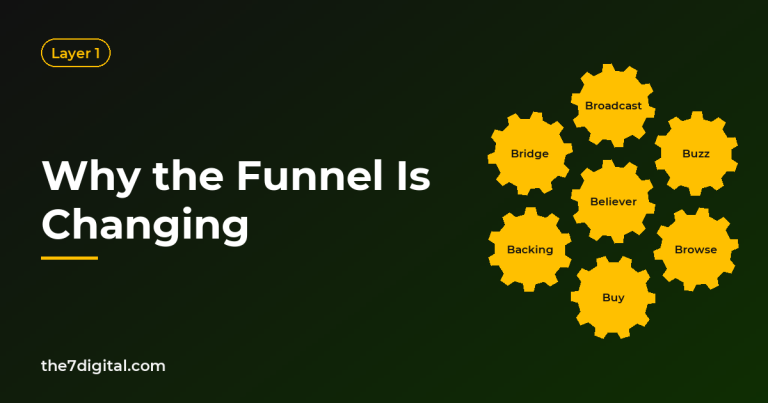
This topic is where the Buy gear turns at a different weight for each customer group, and where the Bridge gear takes the accounts your team cannot serve at a profit. The Buy gear: A process of many people and many rounds; a door, not the final wall. The Bridge gear: Customers bring in others through referrals, communities and partners, and the flywheel amplifies itself.
Read through cost to serve, many people and many rounds are a presale cost, because every review round is another meeting and another quote, and a door means a customer who enters through the self-serve door today can become a contract customer tomorrow. Bridge lets partners carry the service layer, as at TSMC, and communities amplify, as SAP’s user groups showed.
Buy sits in the demand capture layer, Bridge in the amplification layer, and Believer is the connecting loop: a customer served at the right level becomes a Believer, and Believers create Backing, which creates Bridges. For how demand turns into orders, read converting demand into orders; this article adds which orders to take.
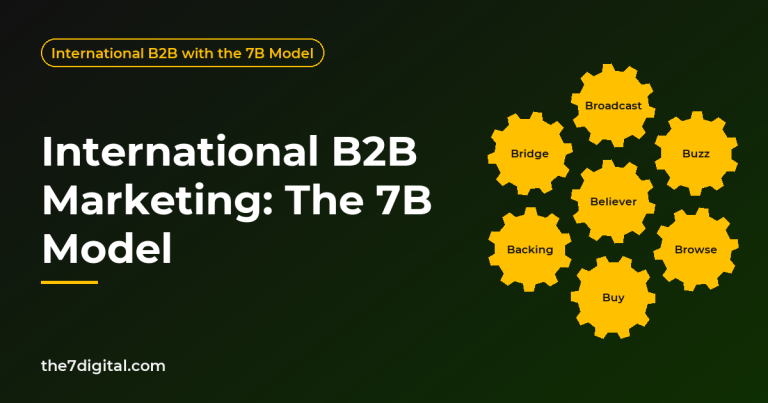
The three energy flows share the work: paid is a different ad approach for each group, owned is the price page and service menu, and earned-and-shared is referrals and user groups. Each gear has a one-line definition in the 7B Glossary, and the 7B Model shows how the seven fit together. The 7B Model was developed by Nguyen Dinh Bao (Bao7) at The7 Digital and is set out in full in the book Mô hình 7B cho B2B (Stop Begging, Start 7B).
Selling B2B into Vietnam and ASEAN
Two ends of the account list. In the first ten months of 2026, the foreign-invested sector, including crude oil, accounted for 81.2% of Vietnam’s goods exports, or USD 405.31 billion (National Statistics Office, via Tạp chí Kinh tế – Tài chính, 2026). In my reading, many of the largest accounts a foreign supplier meets are factories like these, buying under global procurement playbooks. Expect the Walmart pattern, with penalties and tight delivery rules, and price the extras into the contract.
A long tail that moves fast. Nearly 56,300 enterprises completed dissolution in the same ten months, up 109.8% on the same period a year earlier (National Statistics Office, via Tạp chí Kinh tế – Tài chính, 2026). I would not guess why, but I would screen payment behavior, keep small accounts on standard terms and build no custom service for an account that may not exist next year.
Put a self-serve door in Vietnamese. Publish a price list in Vietnamese dong and in Vietnamese, a standard tier, online ordering or a simple quote form, and clear payment terms: the logic of Maersk Spot, a fixed price and a commitment on both sides.
Let partners carry the service layer. Local distributors, system integrators and service partners can be the service layer for small accounts, the way TSMC extends its reach through design service partners. Keep Broadcast and Backing in your own hands.
Say no without closing the door. Route accounts instead of rejecting them, and tell them early; the forwarders’ complaint was that the news came out of the blue. A rejected account talks, usually in closed groups (dark social). Across ASEAN, price service country by country rather than on one regional average, because averages hide the accounts that lose money.
Conclusion: The best account is not the biggest one
Back to the numbers I opened with. A market that adds and loses thousands of accounts a month rewards suppliers who know what each account costs to serve.
The best account is not the biggest one. It is the one whose price pays for the way you serve it, and who brings in others like it.
Last time, total cost of ownership looked at cost from the buyer’s side. Next, choosing international B2B channels asks who should serve customers for you. The pillar article is international B2B marketing with the 7B Model.
Frequently asked questions
What is cost to serve in B2B?
Cost to serve is every cost tied to one customer, from meetings and quotes to delivery and after-sales support. According to a summary by Rajagopal and Sanchez (2004), the matrix of Shapiro and colleagues groups these into four types: presale, production, distribution and post-sale service.
What are the four customer types in the price and cost-to-serve matrix?
The matrix sets net price against cost to serve, which gives four types: carriage trade, passive, bargain basement and aggressive. According to Rajagopal and Sanchez (2004), more than half of a supplier’s accounts usually sit in passive and aggressive.
What does unbundling mean in B2B?
Unbundling means selling the core and the services around it as separate choices, so each group pays for the service level it needs. From January 2010, SAP let customers choose Standard Support at 18% of the software license base or Enterprise Support at a 22% list price (Computerworld, 2010).
How do I serve small accounts in Vietnam without losing money?
Give them a standard tier: a price list in VND and in Vietnamese, clear payment terms, online ordering and a local partner for hands-on service. Keep your custom team for accounts that pass your qualification test, and review cost to serve per account every quarter.
International B2B with the 7B Model · Part 14 of 24 · Previous: Total Cost of Ownership in B2B · Next: Choosing International B2B Channels · Pillar article: International B2B Marketing: The 7B Model
References
- National Statistics Office, via Tạp chí Kinh tế – Tài chính (2026). Hơn 243,6 nghìn doanh nghiệp gia nhập và quay trở lại thị trường trong 10 tháng năm 2026 (More than 243,600 enterprises entered and returned to the market in the first 10 months of 2026, in Vietnamese). https://tapchikinhtetaichinh.vn/hon-243-6-nghin-doanh-nghiep-gia-nhap-va-quay-tro-lai-thi-truong-trong-10-thang-nam-2026-171415.html
- Shapiro, B. P., Rangan, V. K., Moriarty, R. T., Ross, E. B. (1987). Manage Customers for Profits (Not Just Sales). Harvard Business Review, September 1987. https://hbr.org/1987/09/manage-customers-for-profits-not-just-sales
- Rajagopal, Sanchez, R. (2004). Analysis of Customer Portfolio and Relationship Management Models: Bridging Managerial Dimensions. EconWPA. https://econwpa.ub.uni-muenchen.de/econ-wp/mic/papers/0407/0407001.pdf
- Christopher, M. (2004). Logistics and Supply Chain Management, 3rd edition, chapter 3: Measuring logistics costs and performance. Financial Times Prentice Hall. https://ptgmedia.pearsoncmg.com/images/0273681761/samplechapter/0273681761_ch03.PDF
- Talk Business & Politics (2020). Walmart demands all suppliers comply with 98% on-time in-full shipment rule. https://talkbusiness.net/2020/09/walmart-demands-all-suppliers-comply-with-98-on-time-in-full-shipment-rule/
- Anderson, J. C., Narus, J. A. (1995). Capturing the Value of Supplementary Services. Harvard Business Review, January 1995. https://hbr.org/1995/01/capturing-the-value-of-supplementary-services
- TSMC (n.d., accessed 9 November 2026). Company Profile. https://investor.tsmc.com/fundamentals
- TSMC (n.d., accessed 9 November 2026). CyberShuttle. https://www.tsmc.com/english/dedicatedFoundry/services/cyberShuttle
- TSMC (n.d., accessed 9 November 2026). Value Chain Alliance. https://www.tsmc.com/dedicatedFoundry/oip/value-chain-aggregator
- Marshall, R., iTnews (2008). SAP users cry foul over support fee hike. https://www.itnews.com.au/news/sap-users-cry-foul-over-support-fee-hike-118043
- Information Age (2010). SAP backs down on Enterprise Support. https://www.information-age.com/?p=25357
- Computerworld (2010). Is the SAP KPI program really dead? https://www.computerworld.com/?p=1599708
- Computerworld (2010). Update: SAP shakes up support plan, executive team. https://www.computerworld.com/?p=1549846
- Maritime Logistics Professional (2019). Maersk Launches Maersk Spot. https://www.maritimeprofessional.com/news/maersk-launches-maersk-spot-347658
- FreightWaves (2020). World’s largest container line triples profits despite COVID. https://www.freightwaves.com/?p=287469
- Hellenic Shipping News (2022). A.P. Moller – Maersk reports record earnings for 2021 and guides for a strong 2022. https://www.hellenicshippingnews.com/?p=910235
- FreightWaves (2022). Shipping giant Maersk could rake in $50 billion over just two years. https://www.freightwaves.com/news/shipping-giant-maersk-could-rake-in-50-billion-over-just-two-years
- The Loadstar (2022). Maersk space ban means ‘a dark future’, maybe the end, for small forwarders. https://theloadstar.com/maersk-space-ban-means-a-dark-future-maybe-the-end-for-small-forwarders/
- FreightWaves (2023). Maersk: Container shipping contract rates will sink to spot levels. https://www.freightwaves.com/news/maersk-container-shipping-contract-rates-will-sink-to-spot-levels
- National Statistics Office, via Tạp chí Kinh tế – Tài chính (2026). 10 tháng năm 2026: Xuất nhập khẩu hàng hóa của Việt Nam lần đầu vượt mốc 1.000 tỷ USD (First 10 months of 2026: Vietnam’s goods trade passes USD 1,000 billion for the first time, in Vietnamese). https://tapchikinhtetaichinh.vn/10-thang-nam-2026-xuat-nhap-khau-hang-hoa-cua-viet-nam-lan-dau-vuot-moc-1-000-ty-usd-171406.html