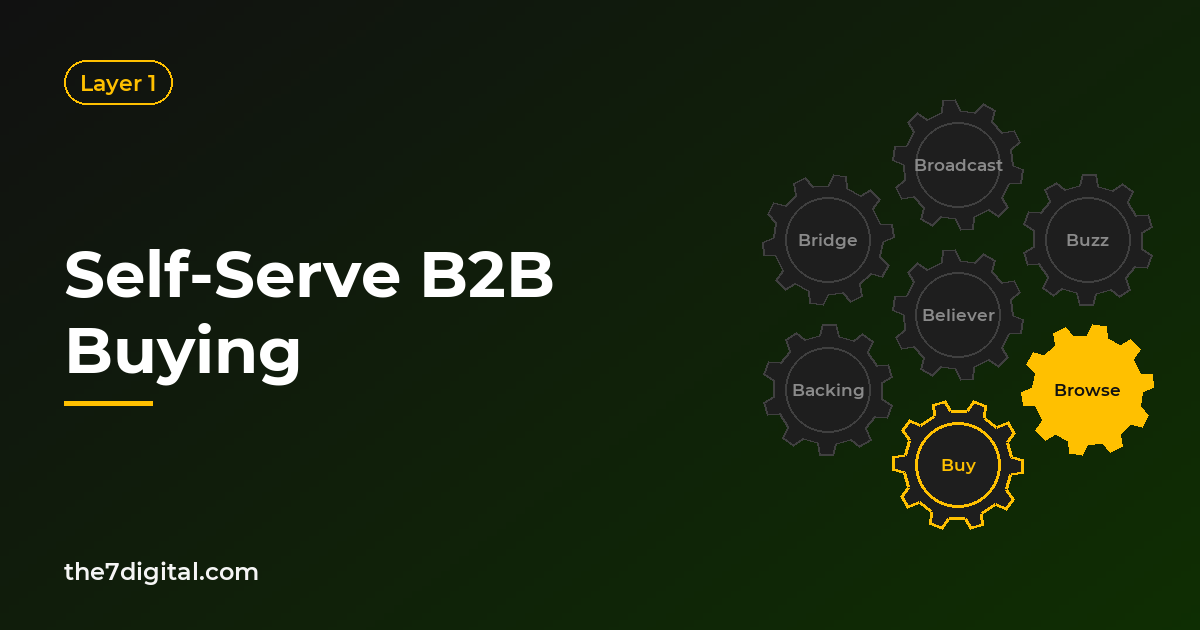
Summary: Self-serve B2B buying means buyers research, compare, price and sometimes order without a sales rep leading the way. To earn it, your website must answer price, comparison and implementation questions up front, then open a door to an expert at the moments that matter. In the 7B Model, it sits in the Browse and Buy gears.
A belief I hear from foreign suppliers planning to sell in Vietnam goes like this: here, the customer always calls first. So the website gets an About page, a product list and one button that says “Send us your RFQ,” and the real selling starts when the phone rings.
I would not wait by the phone. Buyers everywhere do much of their own work before they talk to anyone, and nothing I have seen suggests Vietnam is the exception. The engineer checking your datasheet at a Vietnamese plant searches in Vietnamese, asks an AI assistant, compares you with two other names and forwards a screenshot to the boss over a chat app. If your site cannot say what you cost, how you compare and how a rollout works, you are crossed off before the first call, and nobody tells you.
Taking people out of the process is not the answer either, because buying entirely alone is the fastest way to buy wrong. This article covers what buyers want to handle alone, what your website must answer, why fully self-serve buying goes wrong and where the door to an expert belongs, with lessons from Protolabs, ZKH, Snowflake and Stripe, and then what changes in Vietnam and ASEAN.
How much of the purchase do B2B buyers want to handle alone?
Start with the preference. In a survey of 645 B2B buyers run from August to September 2025, Gartner (2026) found that 70% prefer a completely digital, self-service buying experience. Why buyers avoid reps is the subject of why B2B buyers avoid sales reps; here I look at the road they walk by themselves. For how that road loops back on itself, read the B2B buying journey.
The seller does not vanish; the seller moves. 6sense (2025) surveyed more than 4,000 buyers in North America, EMEA and APAC and found that the balance between independent research and seller engagement had shifted from 70/30 to 60/40. 6sense sells ABM and intent-data software, so read that as a direction, not a measurement.
Now put a second Gartner survey beside the first. Asked about all stages together, 632 buyers told Gartner (2025) they prefer to complete an average of 3.0 activities both online and with supplier reps, 2.3 activities with reps and 1.8 activities through digital self-service tools. The two surveys differ in year and in question, so I do not add them up. They point the same way, though: buyers want to drive, and they do not want to be left alone.
That is what “self-serve” should mean in B2B: the right to steer, not an invitation to walk the road without a guide. The question is no longer whether to let buyers buy on their own, but which part they walk alone and which part they walk with someone. The part they walk alone starts with three questions your website has to answer.
What must your website answer before anyone calls?
Three questions used to belong to the seller: what does it cost, how does it compare, and how does a rollout work. Every one you leave unanswered becomes a call buyers would rather not make, and some will make it to someone else.
Price. TrustRadius (2026) surveyed 1,862 technology buyers and 444 vendors worldwide in January 2026 and found that transparent pricing has been buyers’ number one wish-list item for vendors for four years running. Those are technology buyers, but I doubt the habit of checking a price first stops at software. If your price “depends,” publish what it depends on: a starting price or range, three to five factors that move it, a worked example or two, and the threshold where a custom package begins.
Comparison. Buyers compare you whether or not you publish a comparison page: on review sites, with colleagues, and in dark social you never see. TrustRadius (2026) found that buyers rank product demos, free trials, prior experience and user reviews among the most influential resources. A good comparison page says who you fit and who you do not, which is the work of B2B positioning, and it is written so that a competitor could read it without finding a line to dispute.
Implementation. In G2’s 2026 buyer report, more than 1,000 software buyers said that once a vendor is chosen, IT security review is the biggest source of delay: 39% named it, and 50% of enterprise buyers did. G2 (2026) also put budget approval (32%) and implementation planning (25%) close behind. These questions arrive either early on your website or late in the middle of the deal, in any industry. Publish a rollout page: a week-by-week plan, what the customer must do, integrations, training and security documents. For physical products, add lead time, installation, commissioning and warranty.
Protolabs: Upload the drawing, get the price and the critique
Protolabs makes custom parts from drawings, from prototypes to production runs, through four services: injection molding, CNC machining, 3D printing and sheet metal fabrication. Its homepage (accessed 2026) opens with two invitations: an online quote for parts within days, or a talk with a production expert. You select a manufacturing process and upload a 3D CAD file; within a few hours, the company says, it sends a design for manufacturability (DFM) analysis and real-time pricing, with a free interactive analysis to improve the design. Machined parts can arrive in as fast as one day, and applications engineers are always available by phone.
Made-to-drawing work is the category people call impossible to quote in advance. Protolabs turned the engineer’s first review into software and put the buy door and the engineer door on the same page: software for the standard case, people for the exceptions. Swap your “send us your RFQ” email for an upload path, a quote deadline published in advance, and an applications engineer with a name.
Why does fully self-serve buying go wrong?
A website answers “what is it” and “what does it cost” well. It struggles with “does it fit us, on this line, with this team.” I could not find a survey that measures regret among buyers who bought entirely alone, so I argue from mechanism, with a number for each link in the chain.
Link one is judging fit. Gartner (2025) saw the boundary: buyers favor online self-service tools over sellers for general information and learning new things, but when a task depends on context, such as judging whether a product or service suits their company, they would rather ask a seller. Remove every human and the buyer faces the hardest question alone.
Link two is that every source can be wrong. In the May 2026 release from Gartner (2026), covering 645 buyers, 51% said they are more likely to meet misleading information from generative AI, and 49% said they are more likely to meet it from a sales rep. Buyers trust neither side blindly, so they look for a place to check. If an assistant builds an answer from a thin or contradictory page of yours, the wrong answer may carry your name; how AI chat is changing B2B buying tells that story.
Link three is that machines may search but not sign. G2 (2026) found that more than half of software buyers use or plan to use AI agents in buying. Yet fewer than half (47%) would let an agent research and recommend, only 9% would let it execute purchases within approved guardrails, and just 2% would allow purchases without pre-approval (G2, 2026). Even buyers who automate the research keep the last step for people, and for several people: a purchase belongs to the whole B2B buying committee.
Link four is confidence. In its March 2026 survey of 646 buyers, Gartner (2026) found that confident buyers are twice as likely to report a high-quality deal as buyers with low decision confidence, and says buyers need a clear picture of how a solution improves outcomes in their own role and business context. A buyer can have all the information and still lack confidence; I believe that buyer either stops or buys just to get it over with.
The price shows up after the signature. B2B deals often die quietly over a question nobody answered (Mô hình 7B cho B2B book, chapter 9). When a buyer signs and chooses wrong, the deal does not die. It lingers: the customer does not become a Believer, and what they say next lands on the review sites where the next buyer is comparing you.
Fully self-serve buying is not wrong because buyers walk alone. It is wrong because it leaves them alone at the hardest part.
Where should the door to an expert open?
When. Gartner (2026) says reps stay buyers’ most important information source when they define a business problem, pick a preferred supplier, win support inside their company and close the purchase. Robert Blaisdell, a VP Analyst at Gartner, says the preference for self-service is not a sign that sellers matter less; it is a sign that “sellers need to show up differently,” where they help buyers validate information and reduce risk.
Each moment suggests its own door, and the pairing is mine, not Gartner’s: an expert who will talk about the problem rather than your product, a talk on selection criteria, a pack the champion can forward, a person who handles the paperwork and the custom package.
How. The door is an invitation, not a toll booth, so put no gate in front of your content. The principle I use from the book is to hand over the thinking and sell the implementation (Mô hình 7B cho B2B book, chapter 6). In practice that is an “ask an engineer” button with a real name and photo, a short booking link, or a chat with a human behind it; in Vietnam, often Zalo. Three ways to split the door follow.
ZKH: The hardware store serves itself, the factory gets a team
ZKH Group is a China-based B2B e-commerce platform for maintenance, repair and operations (MRO) supplies. Its 20-F annual report for 2025 (ZKH, 2026) describes two platforms. The ZKH platform serves enterprises, large to small, with complex buying processes, and adds procurement management services. The GBB platform serves retailers and micro businesses, used to buying offline and to opaque prices, with transparent pricing and detailed technical specifications. In 2025 the ZKH platform generated RMB 9.1 billion in GMV (gross merchandise value), 89.8% of the total, and GBB RMB 1.0 billion, 10.2% (ZKH, 2026).
Behind the self-serve door there are people: about 1,200 salespeople, with key-account teams and on-site support at large customers’ plants. The meeting point is where customers already are: the company’s AI assistant sits inside more than 30,000 Enterprise WeChat groups of customers and suppliers.
My reading: ZKH splits the door by the complexity of the purchase. Simple buyers go all the way alone, with clear prices, full specifications and a list they can upload to get matching products back; complex buyers get services and a team. For Vietnam, that suggests a self-serve catalog with Vietnamese prices for small buyers, a key-account team for large plants, and the expert door in Zalo, the way ZKH puts it in WeChat.
Snowflake: Engineers let themselves in, executives get a host
Snowflake sells a cloud data platform. Its 10-K for the fiscal year ended January 31, 2026 (Snowflake, 2026) says many organizations first adopt the platform through a self-service trial on its website. The company reaches data analysts, data engineers and developers through that self-service model, and senior executives through its direct sales team.
My reading: the door is split by role. The people who will use the product verify it with their own hands, which is the Browse gear. The people who sign get a conversation with a person, which is the Buy gear. The trial does not replace the sales team; I think it puts the team in the right room. So give engineers trials, samples and technical documents without a call, and keep the executive meeting for someone who can hold it.
Stripe: A printed price for most, a table for the few
Stripe builds payments infrastructure for businesses. Its US pricing page, accessed November 10, 2026, prints the standard rate (Stripe, 2026): 2.9% + 30 cents per successful domestic card transaction, plus 1.5% for international cards and 1% for currency conversion, with no setup, monthly or hidden fees. Beside it sits a Custom option for businesses with large payments volume or unique business models, and its button leads to the sales team.
My reading: the door is split by size. A public price lets most buyers compare and start alone. Negotiation survives only for those with a reason to negotiate, and it starts from a price everyone can see: publishing a price does not kill negotiation, it anchors it. One piece of advice, not a fact about Stripe: the page I read is the US version, so a price page for Vietnam must be a Vietnamese page, with local currency, tax and invoicing, not a translation of the American one.
Three companies, one principle: let buyers walk the standard part alone, accompany them through the specific part, and write the threshold between the two on your website instead of leaving them to guess.
How do you test your self-serve path?
Borrow an afternoon. Ask someone outside your sales team to play a stranger who has never heard of you and go from Google to a decision on whether to shortlist you in about thirty minutes. Write down every place they had to guess and every place they had to hand over a phone number. Then check four questions:
- Can a buyer find a price, or a range with the factors that move it?
- Does a page say who you fit and who you do not, next to an honest comparison?
- Is there a rollout page with a timeline, the customer’s tasks and the security documents?
- Is there an expert with a name that buyers can reach without a long form?
Next, borrow a metric from the book: for each closed deal, check which content the customer touched before signing (Mô hình 7B cho B2B book, chapter 14). Listen to the first call too. If the buyer’s first sentence is still “What does it cost?”, the price page has not done its job. Every empty answer is a stuck gear.
Where does self-serve B2B buying fit in the 7B Model?
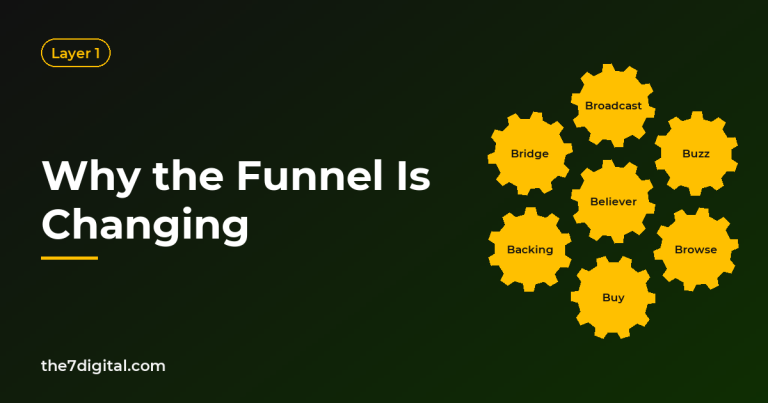
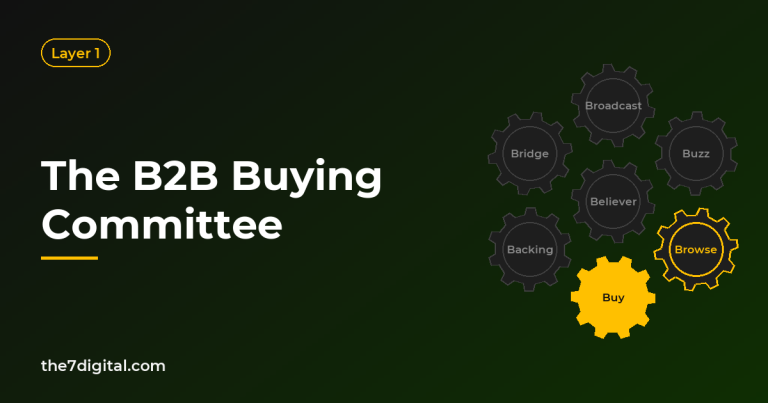
The main gear here is the Browse gear: Where emotion meets reason: buyers verify and compare you through six gateways. Self-serve is Browse taking on work sellers used to do: explaining, comparing and quoting. Buyers can start at any of six gateways: search engines and AI answer summaries, conversational AI, specialist review platforms, LinkedIn, YouTube and podcasts, and communities and forums (Mô hình 7B cho B2B book, chapter 8). Your website is where they stop to verify further, so it must be enough for them to go on alone.
The companion is the Buy gear: A process of many people and many rounds; a door, not the final wall. The door to an expert serves the rounds of that process, and in the book that door leads straight into the Believer gear, so a wrong purchase sends the customer toward a bad experience instead of belief.
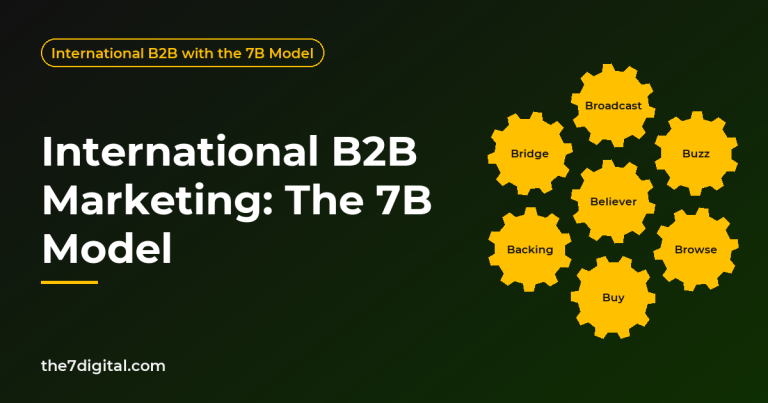
The three operating layers read: Demand creation (Broadcast, Buzz), amplification (Backing, Bridge), demand capture (Browse, Buy); Believer is the connecting loop. Self-serve only captures demand that already exists; it does not create it. For how demand becomes orders, read converting demand into orders.
The three energy flows are: Paid, owned, earned-and-shared. Owned does most of the work here: price, comparison and rollout pages, and trials. Paid brings searchers to the right page, and earned-and-shared is past customers’ reviews and stories, where buyers compare you when you are not in the room.
The two operating principles say: Customers can enter anywhere; one stuck gear slows the whole flywheel. A buyer can land straight on your price page from an AI answer, and a missing page is a stuck gear. For the whole machine, start with the 7B Model.
The 7B Model was developed by Nguyen Dinh Bao (Bao7) at The7 Digital and is set out in full in the book Mô hình 7B cho B2B (Stop Begging, Start 7B).
Selling B2B into Vietnam and ASEAN
Start with where your buyers begin. DataReportal (2025) counted 85.6 million internet users in Vietnam at the end of 2025, 84.2% of the population, and StatCounter (2026) shows Google holding 93.38% of search in Vietnam in October 2026. Those figures cover all users, not only B2B buyers, but they show where a self-serve path usually starts: a Vietnamese query on Google. Your Vietnamese pages are what it meets first.
Language comes next, because a buying committee is not one person. By job function, EF’s English Proficiency Index (EF, 2025) lists average scores of 467 for technicians and maintenance, 495 for purchasing and procurement and 553 for strategy and project management, against 500 for Vietnam as a whole, which ranks 64th. Those are scores by job function across working people, not a survey of buyers. My reading is that a committee has people at both ends of that spread, and an English-only page is written for the upper end.
AI adds a second reason: Vietnamese is the default language of AI use in Vietnam, at 80% of conversations, the highest local-language share among six markets surveyed (Google, Temasek and Bain & Company, 2026), so an assistant can quote your Vietnamese page only if one exists.
The expert door in Vietnam is often a chat. DataReportal (2025) reports that 91.4% of Vietnam’s internet users also use Zalo. ZKH puts its assistant into WeChat groups; a named engineer on Zalo, next to a web form, is the local equivalent.
Finally, the Buy door and payment. The e-Conomy SEA 2026 report on Vietnam says Vietnam matches Malaysia as Southeast Asia’s fastest-growing digital economy, up 20% year on year, with non-cash transactions up 38% in early 2026 (Google, Temasek and Bain & Company, 2026). Across the region, over 60% of all payments are digital and cross-border QR connections now run across eight countries (Google, Temasek and Bain & Company, 2025, via Google’s blog). Small orders can be paid on the spot by digital means; large orders need a clear path from quote to invoice in local currency. The pattern I would plan for is one regional self-serve core, a local price page per country, and an expert door per market.
Conclusion: Let buyers drive, but never leave them alone
Self-serve is not fewer people. It is people in the right place.
Buyers want to drive. Give them the three answers they need, price, comparison and rollout, so they can go a long way alone, and put a named expert where they would otherwise guess: defining the problem, choosing a supplier, building support inside their company and closing. Split the door by complexity, role and size, and write the thresholds on your site.
If you want to keep reading, start with why B2B buyers avoid sales reps, which digs into why buyers keep sellers at a distance.
Frequently asked questions
What is self-serve B2B buying?
It is when business buyers research, compare, price, trial and sometimes order through a website or digital platform without a seller walking them through each step. In B2B it is rarely all or nothing: buyers drive most of the journey, then want an expert at a few decisive moments.
Should B2B companies publish prices on their website?
Publish at least an anchor: a starting price or range, the factors that move it, and the threshold where a custom package begins. Transparent pricing has topped technology buyers’ wish list for vendors four years running (TrustRadius, 2026). Stripe prints a standard price and still offers a Custom option, so a public price starts negotiation rather than ending it.
Can complex B2B products be sold self-serve?
The standard part can. Protolabs takes a 3D CAD file and returns a manufacturability analysis with pricing within a few hours (Protolabs homepage, accessed 2026), and ZKH runs one platform for simple buying and another, with services and a sales team, for complex procurement (ZKH, 2026). The custom, high-risk part with many approvers still needs people.
How does self-serve B2B buying work in Vietnam?
Buyers research in Vietnamese, mostly through Google and increasingly through AI assistants that also answer in Vietnamese. The expert door is often a Zalo chat rather than a form, and large orders need a clear route from quote to invoice in local currency.
References
- Gartner (2026). Gartner Survey Finds 69% of B2B Buyers Turn to Sales Reps to Validate AI-Generated Insights. https://www.gartner.com/en/newsroom/press-releases/2026-05-20-gartner-survey-finds-sixty-nine-percent-of-b-two-b-buyers-turn-to-sales-reps-to-validate-ai-generated-insights
- Gartner (2026). Gartner Sales Survey Finds 67% of B2B Buyers Prefer a Rep-Free Experience. https://www.gartner.com/en/newsroom/press-releases/2026-03-09-gartner-sales-survey-finds-67-percent-of-b2b-buyers-prefer-a-rep-free-experience
- Gartner (2025). Gartner Sales Survey Finds 61% of B2B Buyers Prefer a Rep-Free Buying Experience. https://www.gartner.com/en/newsroom/press-releases/2025-06-25-gartner-sales-survey-finds-61-percent-of-b2b-buyers-prefer-a-rep-free-buying-experience
- 6sense (2025). The Timeline for Influencing B2B Buyers Is Shrinking: Insights From 6sense’s 2025 Buyer Experience Report. https://6sense.com/newsroom/the-timeline-for-influencing-b2b-buyers-is-shrinking-insights-from-6senses-2025-buyer-experience-report/
- TrustRadius, HG Insights (2026). TrustRadius 2026 B2B Buying Disconnect Report Reveals AI Has Changed How Buyers Research, But Not What They Trust. https://hginsights.com/news/trustradius-2026-b2b-buying-disconnect-report-reveals-ai-has-changed-how-buyers-research-but-not-what-they-trust/
- G2 (2026). New G2 Research: AI Is Reshaping How B2B Software Deals Are Won and Lost. https://company.g2.com/news/buyer-behavior-2026
- Protolabs (n.d., accessed November 10, 2026). Digital Manufacturing for Early Prototyping to Final Production. https://www.protolabs.com/
- ZKH Group (2026). ZKH 2025 Annual Report (Form 20-F). https://ir.zkh.com/image/ZKH_20-F_2026-04-24.pdf
- Snowflake (2026). Form 10-K for the fiscal year ended January 31, 2026. https://www.sec.gov/Archives/edgar/data/1640147/000164014726000008/snow-20260131.htm
- Stripe (2026). Pricing & Fees. https://stripe.com/pricing
- DataReportal (2025). Digital 2026: Vietnam. https://datareportal.com/reports/digital-2026-vietnam
- StatCounter Global Stats (2026). Search Engine Market Share in Viet Nam, October 2026. https://gs.statcounter.com/search-engine-market-share/all/viet-nam
- EF Education First (2025). EF English Proficiency Index: Vietnam. https://www.ef.com/wwen/epi/regions/asia/vietnam/
- Google, Temasek and Bain & Company (2026). e-Conomy SEA 2026: Vietnam. https://services.google.com/fh/files/misc/vietnam_e_conomy_sea_2026_report.pdf
- Google, Temasek and Bain & Company, via Google’s The Keyword blog (2025). ASEAN’s $300 billion digital economy enters the AI reality. https://blog.google/around-the-globe/google-asia/sea-economy-2025/