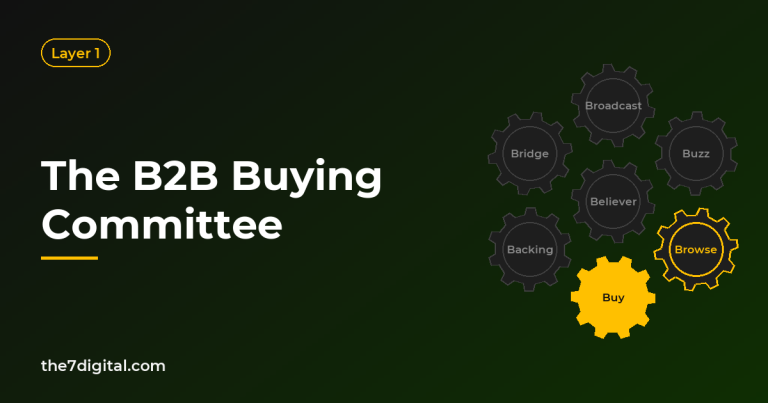
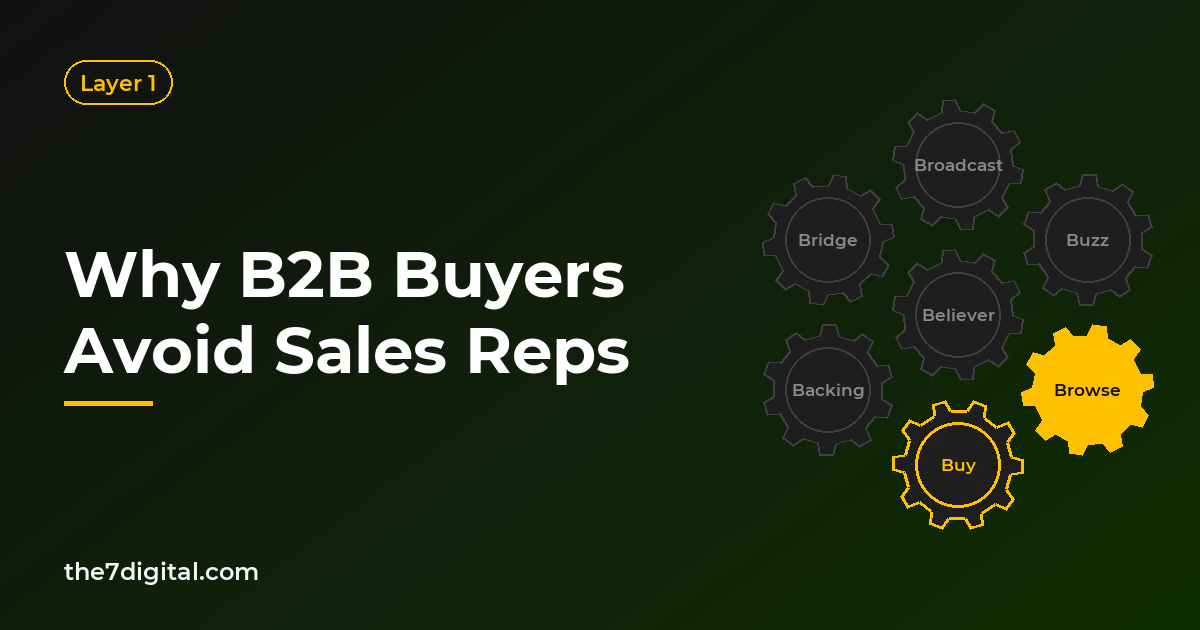
Summary: B2B buyers avoid sales reps because reps tend to show up at the wrong time, before there is a need or after a favorite is picked, and say what buyers have already read. Buyers still want a person when they need to validate. In the 7B Model, this sits in the Browse and Buy gears.
Two numbers sit side by side on the desk of any company about to hire a sales team for Vietnam. Gartner (2026) says in its March release that 67% of B2B buyers prefer a rep-free experience, based on a survey of 646 buyers. Yet GlobalSpec and TREW Marketing (2026) found that only 10% of technical buyers prefer to avoid salespeople entirely. Read quickly, one number says buyers do not want you and the other says they do.
That is not an academic puzzle if you sell into Vietnam or elsewhere in Southeast Asia. It decides who you hire first: someone who works a call list, or an engineer who can answer a buyer’s question in Vietnamese.
Both numbers are right, and they do not conflict. Buyers avoid reps who arrive at the wrong time and say the wrong thing, and they still look for a person when they need to verify what they have read. Below: why buyers avoid reps, when they seek one out and the new role that follows, with Salesforce, Gong and Keyence, then what changes in Vietnam and ASEAN. For the self-service side, read self-serve B2B buying.
How much do B2B buyers really avoid sales reps?
The idea is not new. In 2012, Adamson, Dixon and Toman wrote in Harvard Business Review that customers don’t need sellers the way they used to, because procurement teams and consultants can define solutions themselves.
Gartner (2025) surveyed 632 B2B buyers in August and September 2024 and, in a June 2025 release, reported that 61% prefer an overall rep-free buying experience. A year later, Gartner’s March release asked 646 buyers in August and September 2025 and found 67% (Gartner, 2026). The questions are worded a little differently, so I read a direction, not a trend line.
The number on the other side is far smaller. In its State of Marketing to Engineers 2026 report, GlobalSpec with TREW Marketing and Elektor surveyed more than 1,000 engineers and technical professionals worldwide, and only 10% of technical buyers say they prefer to avoid salespeople entirely (GlobalSpec and TREW Marketing, 2026). GlobalSpec sells advertising to engineers, so it has a stake in the result. The numbers measure different groups with different questions: prefer a rep-free experience, and prefer to avoid reps entirely. People want to hold the wheel. They do not shut the door on humans.
Where should the rep stand? G2 (2025) surveyed 1,169 B2B decision-makers in April 2025, mostly software buyers: nearly two out of three now want a vendor’s salespeople only in the later stages of the journey, up 17 points from a year earlier. G2 runs a software review site, so it has a stake too.
So buyers avoid timing and talk, not people.
Why do reps show up at the wrong time?
A rep’s calendar runs on monthly and quarterly quotas. A buyer’s need runs on a calendar of its own. When the two drift apart, reps arrive in one of three ways: too early, too late, or never.
Too early means a pitch before there is a need. Nearly three in four buyers, 73% according to Gartner (2025), say they actively avoid suppliers that send outreach that has nothing to do with them. Robert Blaisdell (VP Analyst, Gartner Sales Practice) said bad prospecting damages relationships with the very customers you want. So a badly timed call does more than fail once. It puts your name on a list to avoid.
I do not conclude that cold outreach is dead. Our piece on outbound marketing argues that only sloppy outbound is dying, and that outbound works when the market already knows you and the message is relevant.
Too late is the mirror image. Kerry Cunningham (Head of Research, 6sense) said in the release for the 2025 Buyer Experience Report (6sense, 2025) that buyers are choosing a preliminary winner much earlier than before. A rep who arrives after that can only confirm a choice already made or fight uphill. 6sense sells an ABM platform, so this is the view of a party with a stake. The root cause sits in the demand creation layer, not in the call: see demand creation.
The right time is the buyer’s time. According to GlobalSpec and TREW Marketing (2026), technical buyers first contact sales when they need what they cannot find online, and the top three reasons are pricing or availability (26%), validating information found online (23%) and technical complexity of a solution (21%), among the 708 who answered. They also pick the channel: 59% want email for first contact and 22% want phone (GlobalSpec and TREW Marketing, 2026). The report’s explanation is that an email demands no answer on the spot, so an engineer can weigh relevance at their own pace. Buyers do not hate being contacted. They hate someone else’s schedule.
Salesforce: Let the machine knock, keep people for proof
On February 3, 2026, Salesforce published a survey of 4,050 sales professionals in 22 countries, fielded in August and September 2025. According to Salesforce (2026), the average seller spends 40% of their time selling, and Gen Z reps just 35%. Despite nearly a full workday a week on prospecting, 48% say they lack the bandwidth for adequate cold outreach (Salesforce, 2026).
In the same piece, Adam Alfano, Salesforce’s EVP of Sales, says agents now work all the company’s untouched leads. They used to sit; now agents sweep through and sift them. In four months, agents contacted 130,000 leads and created 3,200 opportunities, and he expects ten times more next year.
The division is mine, not Salesforce’s: 130,000 over 3,200 is about one opportunity per 40 leads contacted. “Wrong time” has a third form, never: leads in the system that nobody touches, a door open with no one behind it, a stuck gear, even at a CRM company. And in those four months most contacted leads did not become opportunities, so reaching everyone does not replace reaching the right person at the right time.
The figures are Salesforce’s own, and it sells this kind of agent; the page does not say how many opportunities became contracts. The sample included Singapore but no other ASEAN market, so treat it as a direction, not a Vietnam benchmark. If you cover Vietnam from a regional hub, decide which answers a machine may give and which need a Vietnamese speaker.
Why do reps say the wrong thing?
There are three ways to say the wrong thing. The first is repeating what the buyer already has. Alice Walmesley (Director Analyst, Gartner Sales Practice) said in the 2025 release that instead of generic information buyers can find elsewhere, sellers should offer unique guidance and act as a sounding board. Reading the datasheet back to someone who has read it is the fastest way to become redundant.
The second is contradicting the website. In the same release, Gartner (2025) reports that 69% of B2B buyers see inconsistencies between the sales organization’s website and what sellers tell them. Do not confuse it with the other 69% in this article, from the May release of Gartner (2026), which concerns validating AI with reps. Blaisdell warns that a mismatch can create mistrust and put the transaction at risk. This is where two teams must speak with one voice, and how is the subject of sales and marketing alignment.
The third is speaking unprepared. Salesforce (2026) also reports that 46% of sellers rarely get feedback on their sales conversations and 47% do not get enough role-play before customer calls. I suspect people who do not rehearse fall back on the script.
Gong: The losing side talks more
Gong (2025), which sells software that analyzes sales calls, looked at 326,000 sales calls of at least 10 minutes, updating research first run in 2016. On average, sellers talk 60% of the time and listen 40% (Gong, 2025).
In won deals sellers spoke 57% of the time; in lost deals, 62% (Gong, 2025). Gong itself calls that gap not massive, and I agree: the weight is not in five points. Lost deals often feature long seller monologues, and sellers who won asked 15 to 16 questions per call against about 20 in lost deals. My reading: talking too much and firing too many questions are two sides of the same fault, a seller busy delivering a message while the buyer came to verify one specific thing.
This is correlation from calls on Gong’s own platform; it does not prove that talking less wins. When one side of the call is not speaking a first language, as between a foreign seller and a Vietnamese engineer, my advice, not a statistic, is to talk less and confirm in writing.
The book explains why this matters. Without the 7B machine, Buy is a battle resting on a forty-five-minute presentation; with it, reps lead the process instead of persuading (Mô hình 7B cho B2B book, chapter 9). Buyers come to verify, not to be persuaded.
When do buyers actually want a rep?
When they need to verify. Gartner (2026) surveyed 645 B2B buyers in August and September 2025 and published the results in its May release: buyers used an average of seven information sources in a recent purchase, 45% used generative AI, mainly to gather information on vendors and products, and 69% prefer to validate AI-generated insights with sales reps. Robert Blaisdell says AI and self-service do not eliminate the role of the seller; for the AI side, read how AI chat is changing B2B buying.
Gartner turns that into advice: rather than maximizing rep involvement at every stage, let sellers engage where they add the greatest unique value, moving from the primary source of information to a “source of validation and confidence” at key points in the buying process. That is the core of this article: the rep stops explaining the world to the buyer and starts confirming or challenging what the buyer already knows.
Buyers do verify. TrustRadius (2026) surveyed 1,862 technology buyers worldwide in January 2026, and 94% of buyers who used AI said they fact-check its responses at least some of the time. The same report says buyers continue to rely on trusted human validation before making purchasing decisions. These are technology buyers, so I stretch the number no further.
Who is trusted to validate? Among engineers, generative AI tools sit at the bottom of the trust ranking with just 10%, while 66% rate engineering experts at vendor companies very or extremely trustworthy, according to GlobalSpec and TREW Marketing (2026). That 10% is a different 10% from the one in the first section, which was about avoiding salespeople entirely (GlobalSpec and TREW Marketing, 2026). The report does not measure trust in salespeople, so I do not infer it. The book says buyers today do not lack sellers, they lack guides (Mô hình 7B cho B2B book, chapter 3). What does a guide look like in a real company?
Keyence: Every door leads to a sales engineer
Keyence, founded in 1974, is a Japanese maker of sensors, measurement and automation equipment. According to its corporate overview (Keyence, accessed 2026), it serves 400,000 customers in 110 countries and sells direct, so customers work with knowledgeable sales engineers.
Its Our Service page (Keyence, accessed 2026) says the sales engineers are technically trained, with product knowledge plus application and industry experience, and lists direct local contact, fast appointments, free trial equipment, phone and on-site technical support, and same-day shipping on most orders.
The pairing is mine, not Keyence’s. The three reasons technical buyers make first contact map onto the site’s doors, Price Inquiry, Experience Demo / Test, Free Trial Unit and Ask an Expert: price inquiries to pricing and availability, demos and trial units to validation, the expert door to complex solutions. The rep is not knocking to pitch but standing behind a door the buyer opens, bringing proof to the buyer’s own problem: that is Browse. The Buy door leads straight into operations: quick appointments, same-day shipping, support until the line runs.
The pages do not say how trial units work, how long an appointment takes or what anything costs, and the figures are the company’s own, so I do not guess. The lesson is about people, not the website: the first person a buyer meets must answer technical questions and be allowed to hand over a unit to try. Measure reps by trials that lead to decisions, not calls made.
What does the new sales role look like?
A new role does not mean fewer reps. It means standing somewhere else: from the person who knocks to the person behind the door the buyer opens.
| Job | Door-knocking rep | Validation advisor |
|---|---|---|
| Shows up when | On quota, mass cold calls | When a buyer asks about price or needs to verify |
| Says what | Company intro, datasheet read back | What the website cannot say |
| Brings what | Slides and a price list | Samples, data, reference customers |
| Goes with | Alone | An engineer, someone who knows rollout |
| Measured by | Calls made, meetings booked | Inbound questions, reasons for contact |
Three moves take you from the middle column to the right one. First, let content carry general information. Each week, ask the sales team “What did customers ask most this week?” and turn every answer into content, so the next time a buyer asks, the rep sends a link and the call starts higher (Mô hình 7B cho B2B book, chapter 6). See B2B content marketing. Second, practice listening before talking: set a rhythm of feedback and role-play, open calls with a question about what the buyer wants to verify, and send the answer in writing afterward. Third, let machines handle the first touch and keep people for validation.
Then measure it. On the first call, ask “What made you get in touch today?”, my suggestion and not a metric from the book, next to the question the book recommends, “How did you hear about us?”, left blank for the customer to fill in (Mô hình 7B cho B2B book, chapter 7). Buyers will seek out the rep worth meeting.
Where does the sales rep fit in the 7B Model?
The main gear is the Browse gear: Where emotion meets reason: buyers verify and compare you through six gateways. The six gateways are search engines and AI answer summaries, conversational AI, specialist review platforms, LinkedIn, YouTube and podcasts, and communities and forums (Mô hình 7B cho B2B book, chapter 8). The rep is not a sixth gateway. The rep is who buyers turn to when the gateways leave doubts, as with the 69% of buyers who prefer to validate AI-generated insights with reps (Gartner, May 2026 release).
The companion is the Buy gear: A process of many people and many rounds; a door, not the final wall. In Buy the rep leads the process instead of persuading, simplifying rather than forcing (Mô hình 7B cho B2B book, chapter 9).
The three operating layers read: Demand creation (Broadcast, Buzz), amplification (Backing, Bridge), demand capture (Browse, Buy); Believer is the connecting loop. A cold call is the capture layer doing the work of the creation layer: the reason for a buyer to reach out has to be created beforehand by Broadcast and Buzz. For how demand becomes orders, read turning demand into orders.
The three energy flows are: Paid, owned, earned-and-shared. Owned is the pages and content that answer what reps hear most, earned-and-shared is the colleagues and reviews that help buyers verify, and paid amplifies content, not sales pitches (Mô hình 7B cho B2B book, chapter 7).
The two operating principles say: Customers can enter anywhere; one stuck gear slows the whole flywheel. A rep who contradicts the website, or a lead nobody answers, is a stuck gear. For the whole machine, start with the 7B Model.
The 7B Model was developed by Nguyen Dinh Bao (Bao7) at The7 Digital and is set out in full in the book Mô hình 7B cho B2B (Stop Begging, Start 7B).
Selling B2B into Vietnam and ASEAN
Your buyers in Vietnam are mostly buying inputs. In the first ten months of 2026, goods classed as means of production made up 94.1% of Vietnam’s imports, US$481.03 billion of US$511.31 billion, according to preliminary figures from Vietnam’s National Statistics Office (2026). So the buyers you meet are largely technical buyers for factories, the group GlobalSpec measured, who reach out for price and availability, to verify, and to talk through complexity. Hire for those jobs.
New factories are new buying committees. Registered foreign investment in Vietnam reached US$54.85 billion as of October 31, 2026, up 74.0% from a year earlier (National Statistics Office, 2026). That is registered capital, not spending. A new plant forms its buying group while specifications are still being written, and that is the moment to be present, not after the request for quotation has gone out. Early vendor involvement covers how.
A cold call reaches an outsider’s inbox. The Culture Factor scores Vietnam 30 on individualism: a collectivistic society where people stay loyal to their in-group over the long term, and where hiring and promotion take the in-group into account (The Culture Factor, n.d.). That is a national average, not a portrait of one buyer. My reading is that a message from a stranger starts outside the group, so verification travels through people your buyer already trusts, customers, partners and colleagues, the dark social you cannot see.
They will check your rep before they reply. DataReportal (2025), citing LinkedIn’s own ad tools, counted 10.0 million LinkedIn members in Vietnam in late 2025, registered members rather than active users. The book places LinkedIn among the six gateways as the place where buyers check whether you are real, not where you sell (Mô hình 7B cho B2B book, chapter 8). Your rep’s profile is part of the sale: real expertise, real posts.
Put the validation door in Vietnam, in Vietnamese. Keyence’s Vietnamese-language site carries the same kinds of doors as its US site: free trial equipment, demo and test requests, price inquiries and a general Ask KEYENCE link. Its local offices page lists four offices in three cities, two in Hanoi, one in Hai Phong and one in Ho Chi Minh City, and its service page says most orders ship the same day, from warehouses that include one in Vietnam (Keyence Vietnam, accessed 2026). The human step of verification has to be local, fast and in Vietnamese. Vietnam is the market with data here; for the rest of ASEAN, test these five points market by market.
Conclusion: Buyers don’t avoid people, they avoid bad timing
In Vietnam, do not ask how many reps to hire. Ask how fast a qualified person can answer when a buyer asks to verify.
Buyers avoid bad timing and bad talk, not people: most want to drive, yet only one in ten technical buyers wants to avoid salespeople entirely (GlobalSpec and TREW Marketing, 2026). A rep is most valuable at the validation step, and a new role means a new place to stand and a new thing to measure. To keep reading, start with self-serve B2B buying, then sales and marketing alignment and outbound marketing.
Frequently asked questions
Why do B2B buyers avoid sales reps?
Because reps often arrive at the wrong time and say the wrong thing. Gartner (2025) found that 73% of B2B buyers actively avoid suppliers who send irrelevant outreach, and buyers who have researched do not need the brochure read back. They do not avoid people: only 10% of technical buyers prefer to avoid salespeople entirely (GlobalSpec and TREW Marketing, 2026).
When do B2B buyers want to talk to a sales rep?
When they need what they cannot find alone. Technical buyers say their top reasons for first contact are pricing or availability (26%), validating information found online (23%) and technical complexity (21%), according to GlobalSpec and TREW Marketing (2026). Gartner’s May release adds that 69% of B2B buyers prefer to validate AI-generated insights with sales reps (Gartner, 2026).
Does cold outreach still work in B2B?
Only when the market already knows you and the message is relevant to the person receiving it. Gartner’s Robert Blaisdell put the risk plainly in 2025: bad prospecting actively damages relationships with potential customers. Let content create a reason first, then reach out to people who have one.
How should a foreign B2B company staff sales for Vietnam?
Staff for validation, not for volume. Most of what Vietnam imports is production inputs, 94.1% of goods imports in the first ten months of 2026 according to Vietnam’s National Statistics Office (2026), so your buyers are largely technical. Put people who can answer pricing, validation and technical questions in Vietnam, in Vietnamese, as Keyence does.
References
- Brent Adamson, Matthew Dixon, Nick Toman (2012). The End of Solution Sales. Harvard Business Review. https://hbr.org/2012/07/the-end-of-solution-sales
- Gartner (2025). Gartner Sales Survey Finds 61% of B2B Buyers Prefer a Rep-Free Buying Experience. https://www.gartner.com/en/newsroom/press-releases/2025-06-25-gartner-sales-survey-finds-61-percent-of-b2b-buyers-prefer-a-rep-free-buying-experience
- Gartner (2026). Gartner Sales Survey Finds 67% of B2B Buyers Prefer a Rep-Free Experience. https://www.gartner.com/en/newsroom/press-releases/2026-03-09-gartner-sales-survey-finds-67-percent-of-b2b-buyers-prefer-a-rep-free-experience
- Gartner (2026). Gartner Survey Finds 69% of B2B Buyers Turn to Sales Reps to Validate AI-Generated Insights. https://www.gartner.com/en/newsroom/press-releases/2026-05-20-gartner-survey-finds-sixty-nine-percent-of-b-two-b-buyers-turn-to-sales-reps-to-validate-ai-generated-insights
- GlobalSpec, TREW Marketing (2026). State of Marketing to Engineers 2026. https://advertising.globalspec.com/state-of-marketing-to-engineers-research-report
- G2 (2025). New G2 Research: How AI is Redefining the Buyer Journey in 2025 and How Sellers Can Adapt. https://company.g2.com/news/buyer-behavior-in-2025
- 6sense (2025). The Timeline for Influencing B2B Buyers Is Shrinking: Insights From 6sense’s 2025 Buyer Experience Report. https://6sense.com/newsroom/the-timeline-for-influencing-b2b-buyers-is-shrinking-insights-from-6senses-2025-buyer-experience-report/
- Salesforce (2026). The Productivity Gap: New Survey Shows 9 in 10 Sellers Are Betting on AI and Agents To Help. https://www.salesforce.com/news/stories/state-of-sales-report-announcement-2026/
- Gong, Dan Morgese (2025). Mastering the talk-to-listen ratio in sales calls. https://www.gong.io/blog/talk-to-listen-conversion-ratio/
- TrustRadius, HG Insights (2026). TrustRadius 2026 B2B Buying Disconnect Report Reveals AI Has Changed How Buyers Research, But Not What They Trust. https://hginsights.com/news/trustradius-2026-b2b-buying-disconnect-report-reveals-ai-has-changed-how-buyers-research-but-not-what-they-trust/
- KEYENCE (n.d., accessed November 10, 2026). Corporate Overview. https://www.keyence.com/about-us/corporate/
- KEYENCE (n.d., accessed November 10, 2026). Our Service. https://www.keyence.com/about-us/service/
- KEYENCE Vietnam (n.d., accessed November 10, 2026). Dịch vụ của chúng tôi. https://www.keyence.com.vn/about-us/service/
- KEYENCE Vietnam (n.d., accessed November 10, 2026). Văn phòng tại địa phương. https://www.keyence.com.vn/about-us/network/local.jsp
- Cục Thống kê Việt Nam, National Statistics Office (2026). Báo cáo tình hình kinh tế – xã hội tháng Mười và 10 tháng năm 2026. https://www.nso.gov.vn/bai-top/2026/11/bao-cao-tinh-hinh-kinh-te-xa-hoi-thang-muoi-va-10-thang-nam-2026/
- The Culture Factor Group (n.d., accessed November 10, 2026). Country comparison tool: Vietnam. https://www.theculturefactor.com/country-comparison-tool?countries=vietnam
- DataReportal (2025). Digital 2026: Vietnam. https://datareportal.com/reports/digital-2026-vietnam