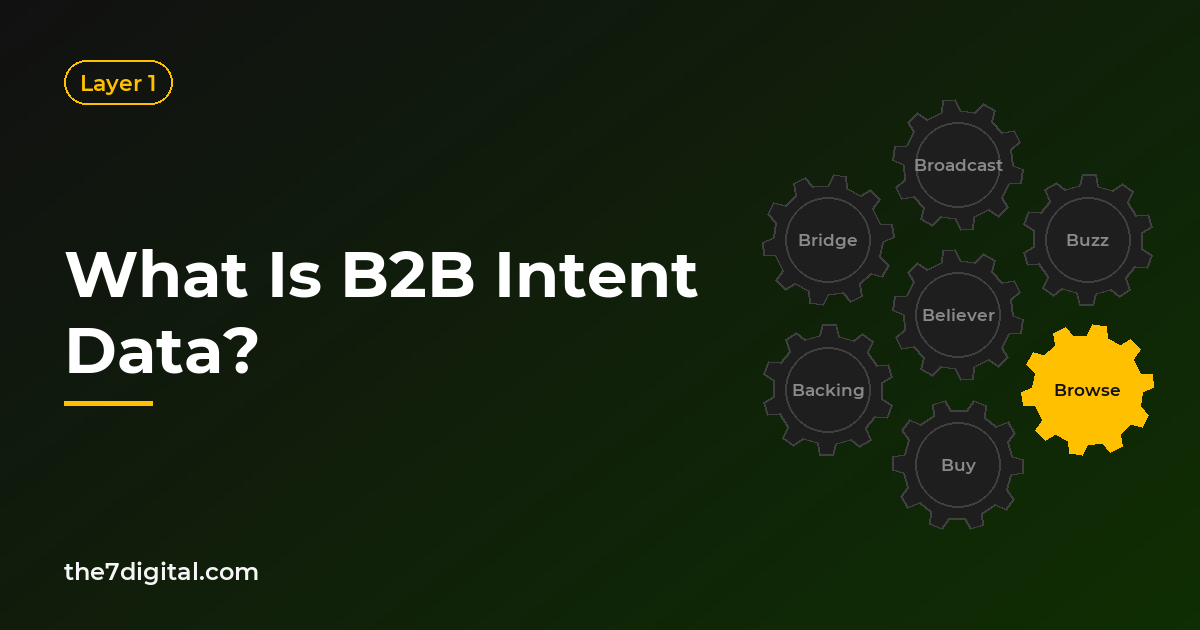
Summary: B2B intent data is the trail a company leaves while it researches a topic, collected on your own website and product (first-party) or on other people’s platforms (third-party). It tells you who is researching, not who will buy. In the 7B Model, intent data belongs to the Browse gear.
On October 24, 2024, Ireland’s Data Protection Commission fined LinkedIn €310 million over how it processed members’ personal data for behavioral analysis and targeted advertising, covering both first-party and third-party data. The inquiry had begun in August 2018, after a complaint from the French non-profit La Quadrature du Net. The commission found that the legal bases LinkedIn relied on for that processing did not hold, and its deputy commissioner, Graham Doyle, called processing personal data without an appropriate legal basis “a clear and serious violation” (Data Protection Commission, 2024).
If LinkedIn has to show that it may read its own members’ behavior, expect to show the same about the signals you buy. Intent data tells you which companies are reading about your problem this month. It does not tell you who will buy, and it is not permission to chase anyone.
If you sell B2B into Vietnam, the tempting move is to bring the intent subscription you already pay for and start calling every spike. The ground there is different. A growing share of research can happen in Vietnamese and inside AI chats, under a personal data law that took effect on January 1, 2026. I will cover what intent data measures (a lesson from Bombora), how first-party differs from third-party (TechTarget and G2), why researching is not buying, how to use signals for priority and timing, where timely turns intrusive, and what changes in Vietnam and ASEAN.
What does B2B intent data actually measure?
Start with what the machines can actually see. It is not intent in the psychological sense. It is a footprint: pages read, prices checked, products set side by side, documents downloaded, searches run. A vendor tallies those footprints by company and by topic, then compares each company against its own baseline, meaning its normal level of reading. When a company reads more than its habit, a flag goes up. That is arithmetic, not mind reading.
The footprints are collected in three places: your own properties (website, trial, email), large platforms (search engines, review sites, LinkedIn), and publisher networks that pool their data. Those places double as the gateways of Browse, which I come back to below. Google puts the idea in plain words. Its Google Ads help page describes in-market segments as people “researching products and are actively considering buying” something like yours, built for advertisers who want conversions from “likely buyers” (Google Ads Help, accessed 2026). Likely is the honest word. I placed intent data among the ways to capture demand in converting demand into orders; this article opens that box.
Bombora: Counting reading, not contracts
Bombora sells intent data gathered across other people’s sites. On its Company Surge page, the company defines buyer intent as a signal that predicts when a company is “in market” for a product or solution, and says the signal can come from first-party and third-party sources (Bombora, accessed 2026). The data comes from a data co-op of thousands of media destinations, read through a consent-driven tag, according to Bombora. It tracks research activity on 25,300+ topics and, for each account-topic pair, compares the most recent three weeks against a 12-week baseline.
Three things matter here. The unit is a company and a topic, not a person and not a contract. The signal is a change against that company’s own baseline, so a large company that reads every day spikes only when it reads more than usual. And “predicts” is the vendor’s word for a probability. Bombora counts reading, and that is what it does. Nobody can count a signature before it happens.
A topic network built mostly on English-language pages could see very little of the research that happens in Vietnamese. How any vendor’s network covers Vietnam is exactly the question to ask before you sign.
How is first-party intent data different from third-party?
Not by quality. By three questions: who collected it, on whose property, and with whose consent. First-party data is collected on your own properties: which pages get read, who views pricing, how a trial is used, who replies to an email or joins a webinar, what buyers ask on sales calls. At the market level it includes brand search volume, the first of four metrics the 7B Model proposes (Mô hình 7B cho B2B book, chapter 14), and the answers to “How did you hear about us?”, left open so buyers write in their own words. Third-party data is collected by someone else, on their property, and sold to you.
G2 shows the third-party side. Its Buyer Intent page says the product reveals which of the “100M buyers on G2.com,” G2’s own figure, are actively researching your product, category or competitors (G2, accessed 2026).
The signals are product and category page views, competitor comparisons, pricing page engagement, and review reading and writing. A free trial offers a retroactive look at the exact companies researching your software and category over the past 30 days. G2 says its data is based on verified buyer evaluation, “not modeled or inferred behavior.” On a comparison page the buyer has stopped browsing for fun and started choosing, which makes this Browse in plain sight. For G2 the data is first-party. For you it is third-party, still at the company level, and the trial looks back only 30 days. And the buyer is choosing on someone else’s land.
| Question | First-party | Third-party |
|---|---|---|
| Collected where | Your site, trials, emails, webinars, calls | Publisher networks, review platforms, ad platforms |
| Unit | Can reach individuals who leave their details | Usually a company and a topic |
| Who else has it | Only you | Anyone who buys the same package, rivals included |
| Depends on | Buyer consent and how you store and use it | Data law, browsers, how the vendor collects |
TechTarget: Someone else’s first-party data
TechTarget, Inc., which trades as Informa TechTarget, says in its 2025 10-K, filed with the SEC on March 11, 2026, that it has “significant scale in permissioned first-party B2B data”: a permissioned audience of about 57.6 million technology and business professionals.
It also gathers information about readers of certain content by tracking their content consumption, or the content consumption of the companies they work for. The company says its Activity Intelligence platform gives insight into “who is in-market and where they are on their buying journey.” Its Informa TechTarget Portal succeeded the Priority Engine intent data product, and vendor sales teams use it to identify relevant new prospects and tailor outreach to interests. In its risk factors, the company notes that the EU and other jurisdictions require informed consent before a cookie is placed on a user’s device, and that changes in laws on marketing, data collection and privacy could significantly affect the business.
Four things follow. “First-party” describes who collected the data, not how good it is, so TechTarget’s first-party data is third-party in your hands. The asset is a registered audience that gave permission, a lesson about owned data rather than about buying lists. The same signal can be sold to every vendor in a category, yours included; that is my inference, since the filing does not say it is exclusive. And the seller itself lists cookie and data laws as a risk. The best first-party data you can buy is still someone else’s first-party data.
If you buy this kind of data for Vietnam, ask how many of those 57.6 million people are in Vietnam. The filing does not say.
Why is researching not the same as buying?
Four gaps sit between a spike on a dashboard and a signature. Who is reading: a company-level signal mixes students, consultants, job applicants, existing customers and curious engineers. Why they are reading: learning is not the same as having a project, and projects die before they get a budget. Who decides: a company is a B2B buying committee, and the reader is not necessarily the one who signs. When: a signal is a window of weeks, three at Bombora and 30 days in G2’s free look-back, and the decision may sit far beyond it.
Real signals are rare. For services such as banking, legal, software and telecoms, research by the Ehrenberg-Bass Institute (2021) for LinkedIn’s B2B Institute found only about 5% of companies in the market in a given quarter, which I covered in the 95/5 rule. Rare signals and plentiful noise make a poor pair. Your competitors can buy the same third-party signal, and demand capture has a ceiling: the number of people ready to buy is fixed, so more signals do not create more buyers (Mô hình 7B cho B2B book, chapter 5).
Some places have nobody counting. Conversations among colleagues and private messages are dark social. AI chat is the other blind spot. A G2 (2025) survey of 1,169 B2B decision makers, published in a report on software buying, found nearly 8 in 10 say AI search has changed how they research, with 29% starting on platforms such as ChatGPT more often than on Google. I leave the details to how AI chat is changing B2B buying. When a signal finally lights up, whether the buyer remembers you is a matter of mental availability, settled long before the spike.
An intent signal is a knock on the door, not a signature.
How should you use intent signals to prioritize and time outreach?
Signals should change the order and timing of what you were going to do anyway. They do not license a new kind of contact. These six moves keep them in their place.
- Filter with your ICP (ideal customer profile) first. A signal from a company outside your target list is noise; see buyer personas vs ICP.
- Reorder your account-based marketing list and keep intent-based ad targeting inside the share of ad spend that serves Browse. The money that goes first amplifies valuable Broadcast content and waits for no signal (Mô hình 7B cho B2B book, chapters 5 and 7).
- Fix the gateways for hot topics. When many target accounts read about the same subject, check that your case studies, comparison pages, pricing information and demos already answer it.
- Give sellers context, not scripts. G2 (2025) found nearly two in three buyers now prefer to engage vendor salespeople only in the later stages of buying, up 17 percentage points from a year earlier. Gartner (2025) found buyers favor self-service for general information and learning, and seller input for tasks that need contextual intelligence. A topic spike is the moment to be easy to find, not the moment to dial.
- Answer hand-raisers fast. A quote request, a demo request or a reply to your email is the clearest first-party signal there is.
- Measure on real outcomes. Compare accounts with signals against accounts without, on real opportunities and closed deals, and after each closed deal ask the buyer which content they touched before signing (Mô hình 7B cho B2B book, chapter 14).
A good signal changes your to-do list, not your manners.
Where is the line between timely and intrusive?
Gartner (2025) found that many B2B buyers feel overwhelmed and frustrated by the outreach they receive from sellers, and that 73% actively avoid suppliers who send irrelevant outreach. A Salesforce (2026) survey of 4,450 marketing decision makers found 84% confess to running generic campaigns. Its Agentforce Marketing CMO, Bobby Jania, said marketers are using “the most powerful technology in history to send more one-way spam, faster.” Adding intent data to a spam machine only gets the spam to the right inbox. LinkedIn’s fine, from the top of this article, shows what the law does with behavioral reading when the legal basis is missing.
Third-party tracking also runs on rules that browser makers write. WebKit (2020) announced that cookies for cross-site resources are blocked by default in Safari “across the board,” building on Intelligent Tracking Prevention, first released in 2017. In April 2025, Google (2025) said Chrome would keep its current approach of letting users choose on third-party cookies, with no new standalone prompt. Third-party tracking runs on someone else’s rails.
The 7B Model book says it plainly: you cannot, and should not try to, track everything (Mô hình 7B cho B2B book, chapter 14). Before each touch, I run three tests.
- Would the buyer be comfortable if they knew how you knew?
- Does this touch give value on the spot, or only ask for a meeting?
- Are you working with a company, or following a person?
If you have to hide how you know, you know too much.
Where does B2B intent data fit in the 7B Model?
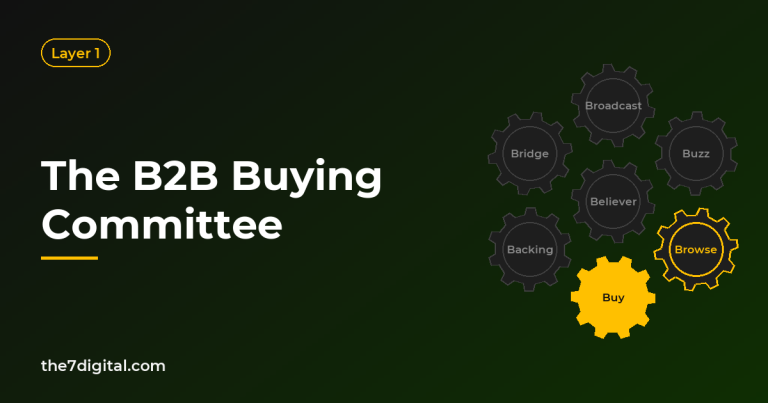
The main gear here is the Browse gear: Where emotion meets reason: buyers verify and compare you through six gateways. Intent data is the footprint of that verifying and comparing, and it exists only at gateways where someone stands counting.
The book names six (Mô hình 7B cho B2B book, chapter 8): search engines and synthesized answers, AI chat, specialist review platforms, LinkedIn, YouTube and podcasts, and communities and forums. Search gives you Google’s in-market segments and brand search volume. Review platforms give you G2-style signals. LinkedIn and YouTube keep their own data, and LinkedIn answers to the law, as the fine at the top of this article shows. AI chat leaves almost nothing for you. Browse is the door between influence and revenue (chapter 8). A signal tells you someone is trying the door; whether the room behind it is ready is your job.
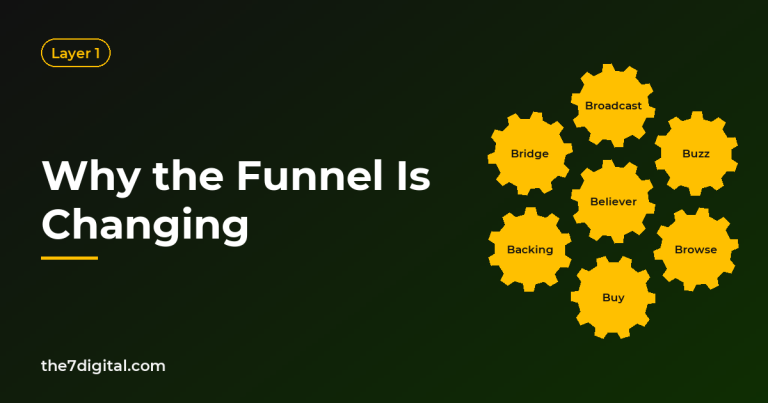
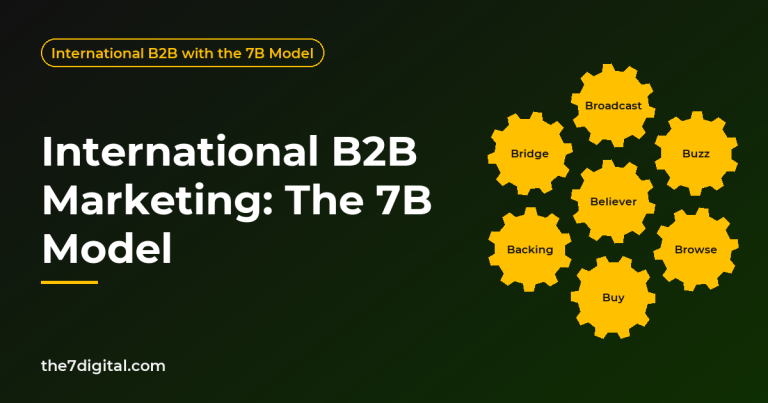
The 7B Model’s three operating layers: Demand creation (Broadcast, Buzz), amplification (Backing, Bridge), demand capture (Browse, Buy); Believer is the connecting loop. Browse sits in the capture layer next to Buy, and intent data is a capture tool. It catches demand that exists. It does not create any; Broadcast and Buzz do that. The three energy flows: Paid, owned, earned-and-shared. Paid is signal-based targeting inside the Browse budget. Owned is the first-party signal on your site, newsletter and community. Earned-and-shared mostly travels through closed channels where no signal is counted.
The two operating principles: Customers can enter anywhere; one stuck gear slows the whole flywheel. Because customers enter anywhere, many entrances leave no signal. Because one stuck gear slows the whole flywheel, a signal pointing at an empty Browse is wasted money (Mô hình 7B cho B2B book, chapter 4). And the Chaos Logic Theory: You cannot predict which touchpoint triggers a decision, but you can design a system in which any touchpoint can. Intent data tries to guess the trigger. The 7B Model says design for all of them; see Chaos Logic Theory.
The 7B Model was developed by Nguyen Dinh Bao (Bao7) at The7 Digital and is set out in full in the book Mô hình 7B cho B2B (Stop Begging, Start 7B). For the whole machine, read the 7B Model.
Selling B2B into Vietnam and ASEAN
Research in Vietnam starts in a chat window. In Vietnam, 65% of the working population uses generative AI and 44% of consumer journeys begin with AI, according to the Vietnam report of e-Conomy SEA 2026 by Google, Temasek and Bain & Company (2026), drawing on a Google and YouGov survey of 9,006 AI users across six countries in July 2026. These are AI users and consumers in general, not B2B buyers, but I would not assume the habit stops at the office door. Bombora says its tag sits on every site in its co-op; a question typed into a chat window usually does not happen on any of those pages.
And it happens in Vietnamese. Of AI conversations in Vietnam, 80% are in Vietnamese, the highest share among the six countries surveyed (Google, Temasek and Bain & Company, 2026). My advice: before you buy third-party intent for Vietnam, ask the vendor what share of its signals comes from Vietnamese-language sources and Vietnamese accounts. Then publish in Vietnamese on your own site, so that first-party signals exist at all.
The data law changed in 2026. Vietnam’s Personal Data Protection Law (Law No. 91/2025/QH15) took effect on January 1, 2026. According to a summary on the Hà Tĩnh Provincial Portal (2026), it prohibits buying and selling personal data except where the law provides otherwise and gives people the right to consent, refuse and withdraw consent. The same summary (Hà Tĩnh Provincial Portal, 2026) lists maximum fines of ten times the revenue earned from buying or selling personal data, 5% of the previous year’s revenue for organizations that breach cross-border transfer rules, and VND 3 billion for other violations.
My reading, which is not legal advice: contact-level lists of “people researching X” are the riskiest product to import, and account-level signals plus consented first-party data are the safer base. If your intent vendor processes Vietnamese data abroad, ask how it handles cross-border transfer, and check the specifics with a lawyer.
Across ASEAN, research is digital and the purchase is still human. Southeast Asia’s digital economy keeps growing at 17% in 2026, and 243 million people, 58% of the working population, use generative AI. Consumers discover and evaluate options more thoroughly with AI but still execute final transactions manually, given high values and low tolerance for errors (Google, Temasek and Bain & Company, 2026). That is consumer behavior, not B2B procurement, but it points the same way as the G2 and Gartner findings above. A signal can time the human part of a sale, but only if the human brings context the buyer could not get from a chat window.
Start with first-party, country by country. Track brand searches in each market (Mô hình 7B cho B2B book, chapter 6). Ask “How did you hear about us?” in Vietnamese on the first call and let buyers write their own answer; for how to use those answers, see self-reported attribution. Add third-party account-level signals only for ICP accounts where the vendor can show coverage, and never let a signal trigger a cold call that reveals the tracking. One ICP can cross borders, but signals have to be read country by country, and the data rules of each country you sell into deserve a check before you buy.
Conclusion: A signal is a knock on the door, not a signature
Intent data counts reading at the company level against that company’s own baseline. First-party data is yours; third-party data is everyone’s. Use it to change the order and timing of your work, never to follow anyone around.
Do not ask who is researching so you can call them today. Ask what they will find when they come looking.
To go further, read about account-based marketing for putting the whole machine behind a list of target accounts, and buyer personas vs ICP for choosing the right companies before you listen to any signal.
Frequently asked questions
What is B2B intent data?
It is the trail of research behavior, such as reading articles, viewing pricing pages, comparing products and downloading documents, grouped by company and by topic. It shows which companies are researching a topic more than usual. It does not show whether they will buy, who inside them is reading, or why.
What is the difference between first-party and third-party intent data?
First-party signals come from your own properties: your website, trials, emails, webinars, sales calls and brand searches. Third-party signals are collected on other people’s sites, such as publisher networks and review platforms, and sold to many vendors. First-party data is narrow but deep and yours alone; third-party data is wider but thinner, and your competitors can buy it too.
Does intent data tell you who will buy?
No. It tells you who is researching. The reader may be a student, a consultant, an existing customer or a curious engineer, and the project may die before it gets a budget. Use signals to reorder priorities and choose timing, then check them against real opportunities and closed deals.
Can you use third-party intent data in Vietnam?
Yes, at the account level and with care. Research in Vietnam increasingly happens in Vietnamese and inside AI chats: 80% of AI conversations in Vietnam are in Vietnamese (Google, Temasek and Bain & Company, 2026), a figure for AI users in general rather than B2B buyers. Little of that activity is likely to reach English-language publisher networks. Vietnam’s Personal Data Protection Law, in force since January 1, 2026, prohibits buying and selling personal data except where the law provides otherwise, so treat contact-level lists as the riskiest option.
References
- Salesforce (2026). 75% of Marketers Have Adopted AI, Yet Still Use It to Send Generic Campaigns (State of Marketing, 10th edition). https://www.salesforce.com/news/stories/state-of-marketing-2026/
- Google (n.d., accessed November 10, 2026). About audience segments, Google Ads Help. https://support.google.com/google-ads/answer/2497941?hl=en
- Bombora (n.d., accessed November 10, 2026). Bombora Company Surge: The gold standard in B2B Intent data. https://bombora.com/intent-data/
- G2 (n.d., accessed November 10, 2026). Buyer Intent Data. https://sell.g2.com/buyer-intent
- TechTarget, Inc. (2026). Form 10-K for the fiscal year ended December 31, 2025. https://www.sec.gov/Archives/edgar/data/2018064/000119312526102183/ttgt-20251231.htm
- Ehrenberg-Bass Institute for Marketing Science (2021). Ehrenberg-Bass: 95% of B2B buyers are not in the market for your products. https://marketingscience.info/news-and-insights/ehrenberg-bass-95-of-b2b-buyers-are-not-in-the-market-for-your-products
- G2 (2025). New G2 Research: How AI is Redefining the Buyer Journey in 2025 and How Sellers Can Adapt. https://company.g2.com/news/buyer-behavior-in-2025
- Gartner (2025). Gartner Sales Survey Finds 61% of B2B Buyers Prefer a Rep-Free Buying Experience. https://www.gartner.com/en/newsroom/press-releases/2025-06-25-gartner-sales-survey-finds-61-percent-of-b2b-buyers-prefer-a-rep-free-buying-experience
- Data Protection Commission (2024). Irish Data Protection Commission fines LinkedIn Ireland €310 million. https://www.dataprotection.ie/en/news-media/press-releases/irish-data-protection-commission-fines-linkedin-ireland-eu310-million
- John Wilander, WebKit (2020). Full Third-Party Cookie Blocking and More. https://webkit.org/blog/10218/full-third-party-cookie-blocking-and-more/
- Anthony Chavez, Google (2025). Next steps for Privacy Sandbox and tracking protections in Chrome. https://privacysandbox.google.com/blog/privacy-sandbox-next-steps
- Hà Tĩnh Provincial Portal (2026). Luật Bảo vệ dữ liệu cá nhân chính thức có hiệu lực thi hành từ ngày 1/1/2026 (The Personal Data Protection Law takes effect on January 1, 2026). https://hatinh.gov.vn/vi/bai-viet/luat-bao-ve-du-lieu-ca-nhan-chinh-thuc-co-hieu-luc-thi-hanh-tu-ngay-112026
- Google, Temasek and Bain & Company (2026). e-Conomy SEA 2026: Vietnam country report. https://services.google.com/fh/files/misc/vietnam_e_conomy_sea_2026_report.pdf
- Google, Temasek and Bain & Company (2026). e-Conomy SEA 2026: Building the intelligent economy. https://economysea.withgoogle.com/report/