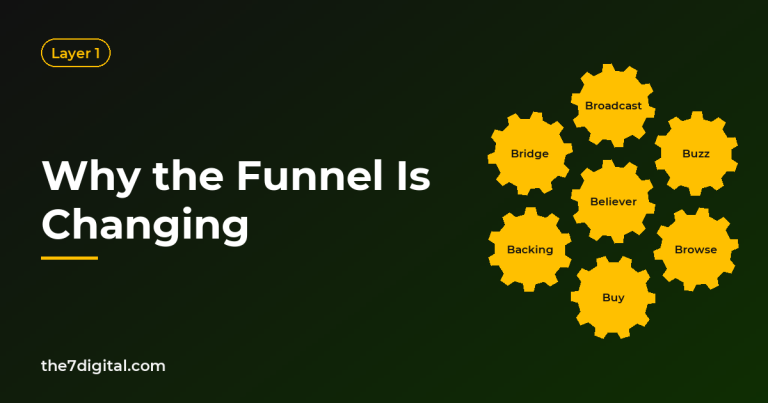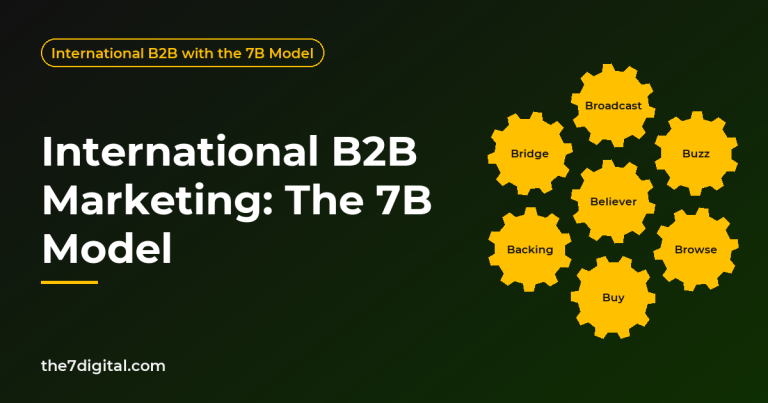
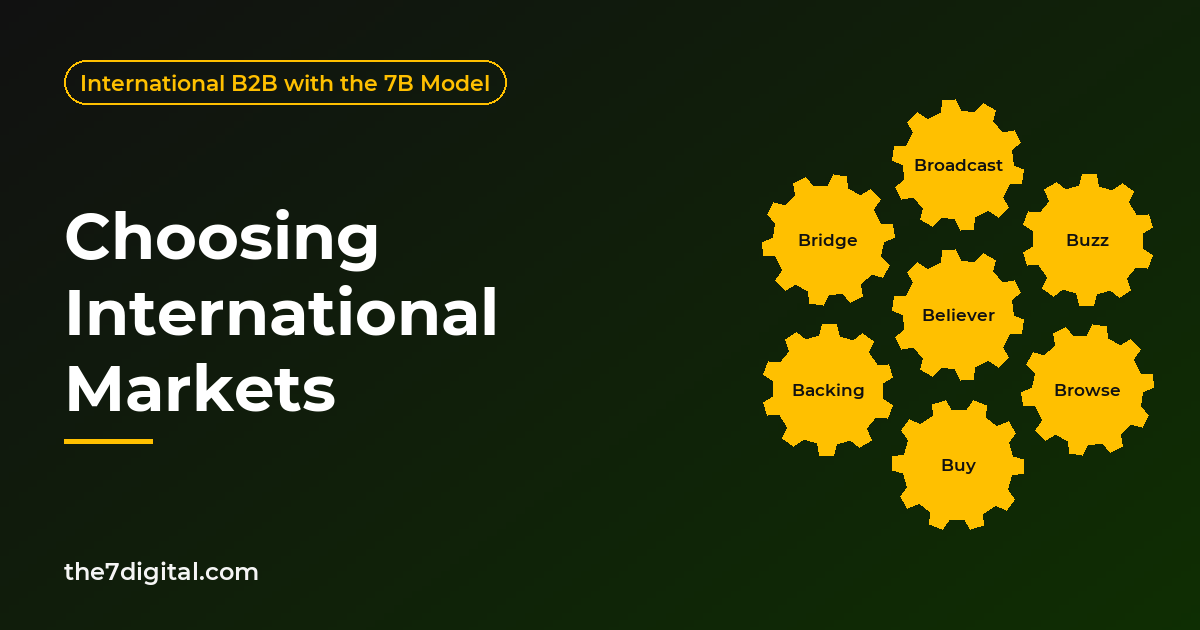
Summary: International market selection in B2B is usually framed as a question of demand and competition. The question that decides results is different: in that country, which of your gears will turn at once, and which will jam? The 7B Market X-Ray scores each gear before you open an office. In the 7B Model, market selection touches all seven gears.
The case for Southeast Asia usually reaches the board as a slide of big numbers. Vietnam’s economy grew an estimated 8.02% in 2025, according to Vietnam’s National Statistics Office (2026), and foreign investment registered through September 30, 2026 totaled US$50.36 billion, 76.4% more than a year before (NSO, 2026). Thailand, Indonesia and Malaysia fill the next columns. Someone circles the biggest number, and the meeting moves on.
A year later, the same board asks why the pipeline is so thin. The website had no page a Vietnamese engineer would want to read, no buyer in Ho Chi Minh City knew the name, and the distributor everyone counted on had worked with a competitor for years. The slide measured demand. It never measured whether the company’s machine could run there.
None of this is new. In Harvard Business Review in 2001, Pankaj Ghemawat warned that companies routinely overestimate how attractive foreign markets are, dazzled by their sheer size. This article launches a second page for that slide, the 7B Market X-Ray, with BYD’s route into Europe and a way to test a market with ads first.
What decisions does choosing a foreign market involve?
In the International B2B Marketing course he teaches for Yonsei University on Coursera, Professor Dae Ryun Chang treats market selection as a narrowing sequence: whether to go abroad at all, then which region, which beachhead country and which segment within it. I keep his sequence and attach one machine question to each level.
Whether to go: you need a named reason, because going abroad without one only thins out your resources. Which region: the 7B question is whether proof can cross borders, since shared standards or procurement rules let a customer story from one country work as Backing in the next.
Which beachhead: the country you enter first so you can spread to its neighbors. It is rarely the biggest market. It is the one where your machine completes a full turn soonest: someone hears you, someone buys, someone tells others. Which segment: a positioning choice, covered in depth in B2B positioning.
Ghemawat adds a ruler. As IESE Business School (2016) summarized his later book on the laws of globalization, international interactions are dampened by cultural, administrative and geographic distance, and often by economic distance too, which he calls the CAGE distance framework.
Read through the 7B Model, each distance jams different gears. Cultural distance hits Buzz and Buy: where dark social flows and how a group gets to yes. Administrative distance hits Buy: tenders, certificates, duties. Geographic distance hits Believer: who fixes the machine and how fast parts arrive. Economic distance hits Browse, because buyers at a different income level compare you with a different calculation.
What are you going abroad for?
Chang’s list of reasons to go abroad is longer than a revenue line: more markets, a global image, scale that lowers unit costs, access to key technology, or steady access to parts and materials that are scarce at home. Each reason changes which gear you score first.
If you go for revenue, score Buy and Bridge first: who will sign, and who will introduce you to the people who sign. If you go for image, Backing leads, because one demanding customer in Singapore or Japan becomes proof at home. If you go for scale, ask whether the Buy gear allows long, high-volume contracts. If you go for technology or supply, Bridge becomes the main road.
Pick one main reason before you pick a country. The 7B Model book (chapter 13) defines strategy as choosing what to drop: seven gears cannot all run at full power, and five markets cannot all open at full strength.
Which six threats should you check before you go?
Chang also suggests a risk checklist to run before going abroad. I map each item to the gear it jams:
- Host-country regulation, including the offset demands common in defense contracts: jams Buy.
- Thin or missing distribution infrastructure: jams Bridge and Believer.
- Vendor qualification, which sometimes extends to your own suppliers: jams Buy and Backing.
- Incumbents with money to spend: jams Broadcast and Browse.
- A different business culture: jams Buzz and Buy.
- Provincial thinking inside your own company: jams every gear.
The first threat can arrive fast. On June 19, 2025, the European Commission adopted the first measure under its International Procurement Instrument, excluding companies from China from EU public tenders for medical devices above €5 million and limiting Chinese-origin devices to no more than 50% in the contracts concerned (European Commission, 2025). The products did not change, but for one group of suppliers the Buy gear in large tenders closed, and no campaign can reopen it.
The last threat is the quietest: headquarters assumes the home playbook will travel. That is why the X-ray below should be filled in with people who know the target market.
What does the 7B Market X-Ray score?
The 7B Model book (chapter 13) opens every strategy with an X-ray: score each of the seven gears green, yellow or red against concrete criteria, then find the weakest operating layer. The 7B Market X-Ray takes the same machine and places it in a specific country. One column per candidate country, one question per gear:
| Gear | Question in that country | Country A | Country B | Country C |
|---|---|---|---|---|
| Broadcast | Which channels reach the right people? | |||
| Buzz | Where do buyers talk to each other? | |||
| Browse | Which gateways do they check you on? | |||
| Buy | Who approves, under which rules? | |||
| Believer | Who serves the customer after signing? | |||
| Backing | Who there will speak for you? | |||
| Bridge | Who will introduce you? | |||
| The 7B Model · the7digital.com | ||||
Green: the gear turns with what you already have. Yellow: it turns if you invest, by translating the site, filming in the local language or hiring locally. Red: something outside your control jams it for the next twelve months, such as procurement law, a ban or no partner willing to take you on.
Answers vary between neighbors more than most teams expect. LinkedIn’s ads reached 37.4% of adults in Malaysia in late 2025, according to DataReportal (2025), but 11.1% in Thailand (DataReportal, 2025). The same Broadcast plan can be green in Kuala Lumpur and yellow in Bangkok.
For Browse, Naver held 42.25% of South Korea’s search engine market in October 2026 (StatCounter, 2026), while Google held 93.38% in Vietnam (StatCounter, 2026), so a Korean supplier moving into Vietnam trades a two-engine search market for a one-engine one. Language is a gateway too: in a survey of B2B technology buyers by CSA Research (2022), 66% of business users said they would pay up to 30% more for a localized product.
Bridge and Believer shift as well. In its draft Hong Kong listing document of May 2026, Mindray, the Chinese medical device maker, says it focuses on direct sales in North America and Western Europe, while in emerging markets, where customers are dispersed, it relies on distributors to grow quickly. One company, two machines; emerging markets made up about 65% of its overseas revenue in 2025 (Mindray, 2026).
Then read the film by layer. Red in demand capture (Browse, Buy) is a stop sign: money spent on Broadcast only sends buyers to a closed door. Red in amplification (Backing, Bridge) is a matter of time and partners. Red in demand creation is the easiest to fix, because content and ads can change within months.
BYD: Europe’s front door was a small Dutch island
Europe’s first public electric bus tender did not come from London or Paris. According to BYD Europe (2023), it came from the Dutch province of Friesland, and BYD delivered it: six 12-meter buses and a 15-year maintenance contract, running from 2013 for Arriva on the island of Schiermonnikoog. Ten years on, the six buses had covered 877,549 kilometers, and the company says many European countries followed Friesland’s lead.
In Britain, BYD did not go alone. In October 2015 it signed a working partnership on electric buses with the British bus builder Alexander Dennis (ADL), and in August 2023 the partnership delivered its 1,500th electric bus, one of 299 for Go-Ahead London (Truck & Bus Builder, 2023).
In April 2017, BYD opened its first owned bus plant in Europe, in Komárom, Hungary, by which time its European leadership could point to the largest zero-emission bus fleet at a major international airport (Schiphol) and the largest electric city bus fleet (London) (BYD Europe, 2017). In September 2025, BYD delivered its 5,000th electric bus for Europe, to Umove in Copenhagen (Bus & Coach Buyer, 2025).
Through the 7B Market X-Ray (my reading, not the company’s words): in 2013, this Chinese bus maker was close to red on Backing and Broadcast across Europe, but in Friesland the Buy gear was green. BYD entered where a gear could turn, turned six buses into Backing, placed that Backing where buyers from all over Europe pass through, borrowed Bridge from a local bus builder, and only then built a factory. The small island was never a big market. It was where the first gear turned.
How do you test a market with ads before opening an office?
An office is a commitment of years: a lease, staff, a legal entity. A three-month test campaign is an X-ray taken in real conditions, at a fraction of the cost of a year spent going the wrong way.
Take the two or three countries with the fewest red cells and one pillar piece of content, rewritten in each language. LinkedIn targets by location, industry, job function and seniority (Microsoft Learn, 2026); Google Ads lets you pick countries or regions and advises keeping language and location settings consistent (Google Ads Help). Why the money should amplify content is covered in paid advertising in B2B, and LinkedIn Ads for cross-border B2B goes deeper. Then measure each country with the four signals from the 7B Model book (chapter 14):
- Branded search from that country: Search Console’s performance report has ready-made tabs for queries and countries (Google Search Central).
- What buyers write, unprompted, when a form in their language asks how they heard about you.
- Whether the right companies engaged: LinkedIn’s reporting groups results by company name and member country (Microsoft Learn, 2026).
- Which content buyers touched before the first calls.
Patience is part of the test. In the 2026 LinkedIn Ads benchmarks from Dreamdata (2026), built on its customers’ data, it took 281 days on average to get from a first ad impression to revenue. Most buyers in a new country have no need this quarter, the logic behind the 95/5 rule, so do not grade the test on first-month orders.
After three months, take the second X-ray. If branded search has not moved, the content is not sharp enough or is not reaching the right people (Mô hình 7B cho B2B book, chapter 6). If the right companies engage but nobody asks for a quote, suspect Buy: no partner, no certificate, or buyers who need your people nearby. If the gears turn together, it is time to choose how to enter, the subject of export, license or joint venture.
Where does market selection fit in the 7B Model?
Market selection does not belong to one gear. It places all seven, Broadcast, Buzz, Browse, Buy, Believer, Backing and Bridge, in a new environment, so this article rests on two of the model’s foundation definitions.
The three operating layers: Demand creation (Broadcast, Buzz), amplification (Backing, Bridge), demand capture (Browse, Buy); Believer is the connecting loop. The X-ray scores gear by gear, but the go or no-go decision sits at the layer: a country that is red across demand capture should wait, however big its demand.
The two operating principles: Customers can enter anywhere; one stuck gear slows the whole flywheel. Buyers in a new country may arrive through a video, a trade show or a partner’s word, but if Browse is stuck because your site does not speak their language, every door opens onto the same wall. Chaos Logic Theory is why you cannot predict which door opens first.
The energy for a test comes from the three flows the model names: Paid, owned, earned-and-shared. The campaign is paid, the local-language site is owned, and the first customer willing to talk about you is earned-and-shared. That third flow decides whether you can open a second country.
The 7B Market X-Ray launches in this article as the first step of the one-page 7B strategy for each market, and standardize or localize uses its results to decide which gears stay and which get rebuilt. Terms are defined in the 7B Glossary. The 7B Model was developed by Nguyen Dinh Bao (Bao7) at The7 Digital and is set out in full in the book Mô hình 7B cho B2B (Stop Begging, Start 7B). New readers can start with what the 7B Model is.
Selling B2B into Vietnam and ASEAN
Start with the distance that is shrinking. Vietnam removed 65% of its duties on EU goods the day the EU-Vietnam Free Trade Agreement took effect in August 2020 and will remove the rest by 2030, according to the European Commission (2026). The agreement also opens procurement by central government ministries, including roads and ports, with the threshold falling over time from 1.5 million to 130,000 SDR (European Commission, 2026). For EU firms, part of the Buy gear in public projects moves from red toward yellow; others should check their own agreements.
Then score the friction that remains. In EuroCham’s Q3 2026 survey, European firms in Vietnam most often named administrative procedures and paperwork (60%), unclear or inconsistently applied regulations (53%), tax administration (52%) and talent shortages (49%), yet nine in ten would still recommend Vietnam as an investment destination (EuroCham, 2026). That reads as a yellow Buy gear: deals close, but plan for more rounds and a partner who knows the paperwork.
Broadcast and Browse have their own shape. In late 2025, LinkedIn counted 10.0 million members in Vietnam, with ads reaching 13.5% of adults, and YouTube counted 62.1 million users (DataReportal, 2025). LinkedIn finds the job titles; YouTube reaches nearly everyone else around the buying table. Browse runs through one engine, Google, but in Vietnamese, so a site without Vietnamese pages leaves that gear yellow however good the product is.
A test campaign is the cheapest way to fill in Vietnam’s column before you incorporate. Run it in Vietnamese and track the four signals for Vietnam alone. Mind the data rules too. Since January 1, 2026, Vietnam’s personal data law has let people give, refuse or withdraw consent (Viet Nam News, 2026), so every form needs a clear opt-in.
Across ASEAN, run one X-ray per country, not one for the region; the LinkedIn gap between Kuala Lumpur and Bangkok is one example. What travels better than channels is proof. Intra-ASEAN trade reached US$822 billion in 2024, according to Vietnam’s Ministry of Industry and Trade (2025), citing the ASEAN Secretariat, so a reference customer in Vietnam is worth showing to its suppliers and buyers next door. That is how a beachhead earns its name.
Conclusion: The biggest market is rarely the first door
Go back to the board and its slide of big numbers. Keep the slide, because demand is a necessary condition, but add the second page: seven rows, a few country columns, every cell in color. The second page usually reorders the first.
The right question is not which market is biggest but where your machine can complete a full turn soonest. BYD found its answer on an island with six buses. You may find yours in the country your spreadsheet ranked third.
The previous article in the series, cross-industry growth, covers growing into new industries; the next, export, license or joint venture, covers how to enter the country you have chosen. The pillar article, international B2B marketing with the 7B Model, maps the whole series.
Frequently asked questions
How many ASEAN markets should we enter at once?
One beachhead, chosen from two or three candidates on the X-ray. The 7B Model book (chapter 13) defines strategy as choosing what to drop: get one machine to complete a full turn in one country, then use that country’s Backing to open the next.
How is the CAGE framework different from the 7B Market X-Ray?
Pankaj Ghemawat’s CAGE framework measures the distance between two countries along cultural, administrative, geographic and economic lines. The 7B Market X-Ray asks whether each of your gears can turn in the target country. CAGE tells you how long the road is; the X-ray tells you where your machine will break down on it.
Can we test Vietnam before setting up a legal entity?
Yes. LinkedIn and Google Ads both target by country, so you can run Vietnamese-language content for three months and track the four signals for Vietnam alone, with a clear opt-in on every form under the data law in force since January 1, 2026. The entity, office and hires come later, once the gears show they can turn.
When should we pull back from a market?
When a demand capture gear is red for reasons you cannot fix, such as procurement rules that exclude you, or when branded search stays flat after two test rounds even though the content reached the right people. Pulling back can mean pausing: keep the partner, keep the content, wait for conditions to change.
Weighing Vietnam or another ASEAN market? The7 runs a test-market campaign before you open an office: LinkedIn, YouTube and Google Search in the local language, four signals tracked country by country, and a 7B Market X-Ray of each market at the end. Book a 7B X-ray.
International B2B with the 7B Model · Part 20 of 24 · Previous: Cross-Industry Growth · Next: Export, License or Joint Venture? · Pillar article: International B2B Marketing: The 7B Model
References
- National Statistics Office of Vietnam (2026). Press release on the socio-economic situation in Q4 and 2025. https://www.nso.gov.vn/tin-tuc-thong-ke/2026/01/thong-cao-bao-chi-tinh-hinh-kinh-te-xa-hoi-quy-iv-va-nam-2025/
- National Statistics Office of Vietnam (2026). Highlights of the socio-economic situation in Q3 and the first nine months of 2026. https://www.nso.gov.vn/bai-top/2026/10/mot-so-net-chinh-tinh-hinh-kinh-te-xa-hoi-quy-iii-va-9-thang-nam-2026/
- Pankaj Ghemawat (2001). Distance Still Matters: The Hard Reality of Global Expansion. Harvard Business Review. https://hbr.org/2001/09/distance-still-matters-the-hard-reality-of-global-expansion
- IESE Business School (2016). Two laws for global business, IESE Insight (on Pankaj Ghemawat’s The Laws of Globalization and Business Applications). https://www.iese.edu/insight/articles/global-business-laws-business-applications/
- Coursera, Yonsei University (n.d., accessed November 7, 2026). International B2B (Business to Business) Marketing, Professor Dae Ryun Chang. https://www.coursera.org/learn/b2b-marketing
- European Commission (2025). China, Medical devices: first measure under the International Procurement Instrument. https://policy.trade.ec.europa.eu/help-exporters-and-importers/accessing-markets/public-procurement/international-procurement-instrument/china-medical-devices_en
- DataReportal (2025). Digital 2026: Malaysia. https://datareportal.com/reports/digital-2026-malaysia
- DataReportal (2025). Digital 2026: Thailand. https://datareportal.com/reports/digital-2026-thailand
- StatCounter (2026). Search Engine Market Share Republic Of Korea. https://gs.statcounter.com/search-engine-market-share/all/south-korea
- StatCounter (2026). Search Engine Market Share Viet Nam. https://gs.statcounter.com/search-engine-market-share/all/viet-nam
- CSA Research (2022). Do B2B Buyers Value Localized Experiences? https://www.csa-research.com/l/blog/article/do-b2b-buyers-value-localization
- Mindray (2026). Draft listing document, Business section, published on HKEXnews (May 11, 2026). https://www1.hkexnews.hk/app/sehk/2026/108529/a132791/sehk26051101307.pdf
- BYD Europe (2023). BYD Celebrates Milestone eBus Anniversary in the Netherlands. https://bydeurope.com/article/455
- Truck & Bus Builder (2023). BYD ADL partnership delivers 1,500th electric bus. https://truckandbusbuilder.com/article/2023/08/26/byd-adl-partnership-delivers-its-1500th-electric-bus
- BYD Europe (2017). BYD opens Hungary electric bus factory, targeting 400 a year capacity. https://bydeurope.com/article/231
- Bus & Coach Buyer (2025). 5,000th BYD electric bus in Europe. https://www.busandcoachbuyer.com/5000th-byd-electric-bus-in-europe/
- Microsoft Learn (2026). Ad Targeting, LinkedIn Marketing API documentation. https://learn.microsoft.com/en-us/linkedin/marketing/integrations/ads/advertising-targeting/ads-targeting
- Google (n.d., accessed November 7, 2026). Target ads to geographic locations, Google Ads Help. https://support.google.com/google-ads/answer/1722043?hl=en
- Google (n.d., accessed November 7, 2026). Performance report (Search results): Overview and basic setup, Search Console Help. https://support.google.com/webmasters/answer/7576553?hl=en
- Microsoft Learn (2026). Reporting, LinkedIn Marketing API documentation. https://learn.microsoft.com/en-us/linkedin/marketing/integrations/ads-reporting/ads-reporting
- Dreamdata (2026). Announcing The 2026 LinkedIn Ads Benchmarks Report by Dreamdata. https://dreamdata.io/blog/announcing-linkedin-ads-benchmarks-report-2026
- European Commission (2026). EU-Vietnam Free Trade Agreement, Access2Markets. https://trade.ec.europa.eu/access-to-markets/en/content/eu-vietnam-free-trade-agreement
- EuroCham Vietnam (2026). EuroCham Business Confidence Index Q3 2026: Translating Economic Gains Into Business Opportunities. https://eurochamvn.org/eurocham-business-confidence-index-q3-2026-translating-economic-gains-into-business-opportunities/
- DataReportal (2025). Digital 2026: Vietnam. https://datareportal.com/reports/digital-2026-vietnam
- Viet Nam News (2026). Several major laws to take effect from January 1, 2026. https://vietnamnews.vn/politics-laws/1733035/several-major-laws-to-take-effect-from-january-1-2026.html
- Ministry of Industry and Trade of Vietnam, VNTR portal (2025). Review of the Implementation of the ASEAN Economic Community Blueprint 2025. https://vntr.moit.gov.vn/news/tong-ket-trien-khai-ke-hoach-tong-the-cong-dong-kinh-te-asean-2025