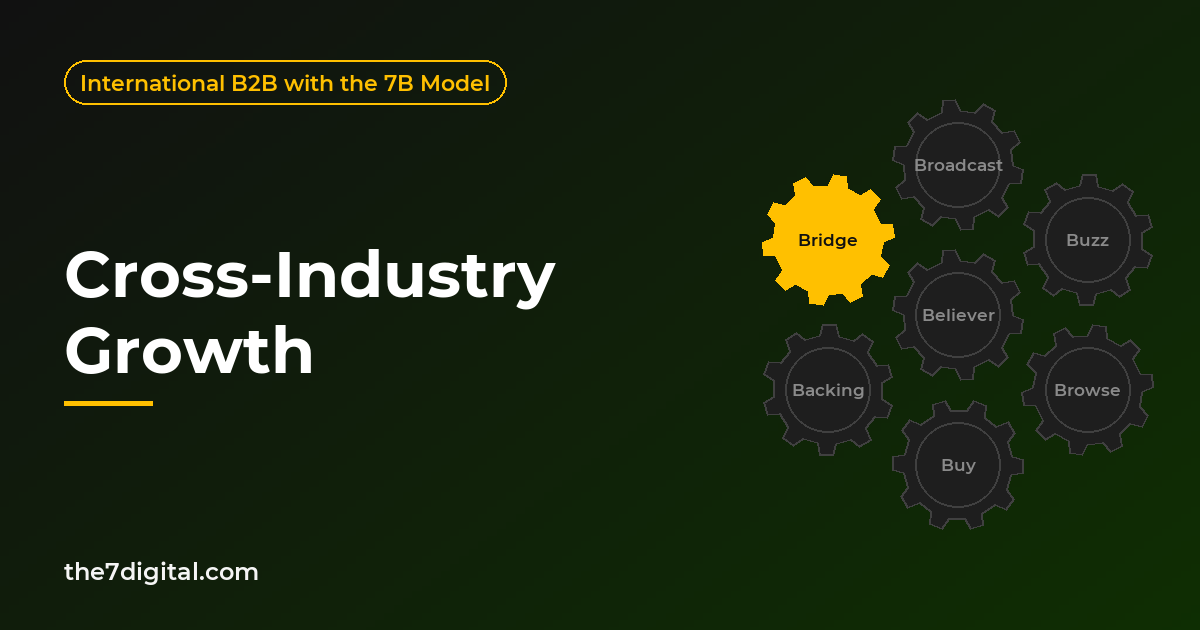
Summary: Cross-industry growth means taking a B2B capability into another industry, vertically, horizontally or diagonally. In a new industry nobody knows your name, so the first move is a bridge: a partner that already serves the same buyers with a different product, before you spend on broadcasting. In the 7B Model, that is the Bridge gear.
In November 2025, GoTyme Bank became the first bank to go live on Wise Platform in the Philippines, letting more than 7.8 million GoTyme customers receive money from over 11,000 banks in 23 major currencies (Wise, 2026). Earlier that year Flip, an Indonesian fintech with more than 15 million customers, announced a strategic partnership with Wise Platform (Wise, 2025). Jenius, SMBC Indonesia’s digital bank, and MBSB Bank, the first bank in Malaysia to build it into a retail banking app, followed (Wise, 2025).
Wise began in 2011 as TransferWise because two friends in London found that their banks charged expensive fees and gave bad exchange rates (Wise, accessed 2026). Now it also grows inside banks’ own apps. In my reading, Wise entered a new industry, banking infrastructure, through the banks’ own front doors.
If you sell B2B into Vietnam or ASEAN, you face that problem twice: a new industry, in a country where nobody has your name on a list yet. Last time, borrowing from other industries showed how ideas cross industry lines. This article takes your own company across. I cover three directions of cross-industry growth, why the first move is a bridge, how Komatsu, Alibaba and Wise built theirs, five questions to ask before you cross, and what the Vietnamese and ASEAN data say.
Which directions can cross-industry growth take?
The Ansoff matrix splits a company’s routes to growth into four cells, by two questions: is the product old or new, and is the market old or new. Diversification, a new product for a new market, is usually considered the riskiest cell because it requires both product and market development (per the summary on Wikipedia of Ansoff (1957)). Entering another industry puts you in market development, when an existing product meets new buyers, or in diversification, when both are new.
Professor Dae Ryun Chang of Yonsei University reads the same map through a B2B lens in his International B2B Marketing course on Coursera. The course page says the many applications of a B2B product open the door to cross-industry growth. He names three directions, and I put them in my own words.
Vertical growth takes a product into one more industry of use. Horizontal growth sells something no single industry owns, such as cloud or payments, to many industries at once. Diagonal growth crosses the line into B2C. In his B2B2C view, a business product ends up in consumers’ lives through many industries, so every new application is another industry you can sell into.
Each direction leaves you with a missing half: the product without the customer (vertical and horizontal), the customer without the product, or neither (diagonal). A foreign supplier may lack the country too. So the question is not which cell you sit in, but who already holds the half you lack.
If buyers in the new industry have no name yet for what you sell, that is a job for category design, not for advertising. The direction is a map. The bridge is the road.
Why is a new industry so expensive to enter without a bridge?
Start with the buyer’s list. According to Bain & Company (2026), around 90% of buyers purchase from their Day 1 list, the vendors they already have in mind when buying begins. Among technology buyers, TrustRadius (2026) found that 83% shortlisted three or fewer products.
In your old industry, your name already sits on a few such lists. In the new one it does not, and Backing is close to zero: no customer speaks for you, no industry body vouches for you, and AI has nothing to cite (the three tiers of Backing, Mô hình 7B cho B2B book, chapter 11). Broadcasting from zero is the long, expensive road. That is my reading of the two numbers, not a finding of the two sources.
So the first move in the 7B Model is a bridge: find a company already on your future buyers’ lists and sell something different alongside it. The pillar article, international B2B marketing with the 7B Model, made this point for new countries; for a new industry it holds even more strongly. A distributor is not this bridge: it sells your own product and is a rented bridge, as choosing international B2B channels explains. This article is about the second kind of partner, one that sells something else to the same buyer (Mô hình 7B cho B2B book, chapter 12).
Komatsu and EARTHBRAIN: Four industries, one job site
Komatsu’s history page says it developed Komtrax, a machine-tracking system, in 1998, made it standard on its machines from July 2001 and, in February 2015, embarked on Smart Construction, ICT solutions for construction job sites (Komatsu, accessed 2026).
Today Smart Construction is still a registered trademark of Komatsu (EARTHBRAIN, accessed 2026), but the platform sits with EARTHBRAIN, a Tokyo company that develops, supplies and maintains digital solutions for construction. Komatsu holds 54.5% of it, NTT Docomo Business 35.5%, Sony Semiconductor Solutions 5% and Nomura Research Institute 5% (EARTHBRAIN, accessed 2026).
In 7B terms I read three things. Four companies from four industries aim at one customer, the job site, in the deepest form of building an ecosystem together (Mô hình 7B cho B2B book, chapter 12): they share capital. Each brings the half the others lack. Komatsu has the job-site relationships Komtrax built, while the other three bring the capabilities of their own industries, so for them construction is a new vertical. The name stayed with Komatsu, so Backing still pools in one place. Komatsu did not build its bridge into digital alone. It built it with three companies that needed to cross too.
For a foreign company entering an industry in Vietnam, the local partner already standing on the plant floor, the job site or the hospital ward is your Komatsu. Agree on day one who keeps the name and who keeps the customer data.
How does a product built for every industry reach its customers?
Horizontal growth looks easiest. Cloud, payments and AI work in every industry, so it seems you only need to sell wider. But in my reading, “every industry” is not one market: buyers still buy industry by industry, at industry-specific tables, and each industry has its own gatekeeper.
Alibaba Cloud: From its own plumbing to 20-plus industries
Alibaba.com, a B2B marketplace, launched in 1999 as the first business of Alibaba Group (Alibaba Group, 2024). The group says its cloud technology originally grew out of the needs of its own China commerce, payments and logistics businesses, and it now offers cloud services to customers worldwide (Alibaba Group, accessed 2026).
For the quarter ended June 30, 2026, the new AI Cloud and Compute Services segment, which combines Cloud Intelligence Group with the chip unit T-Head, reported revenue of RMB48,437 million (US$7,139 million), up 45%, with revenue from external customers also growing 45% (Alibaba Group, 2026). Its Zhenwu chips are used through Alibaba Cloud services by more than 650 external customers across over 20 industries, including autonomous driving, Internet and financial services.
The QwenWork AI agent is deeply integrated with the ecosystems of Alibaba Cloud and DingTalk, which the release calls a “natural gateway” to Alibaba’s enterprise user base, and it reaches further through third-party platforms. These are all the company’s own figures.
I read it this way: a horizontal product still goes through doors, one at a time. Alibaba’s own commerce needs produced the cloud, the cloud is the route by which the chips reach more than 650 buyers, and DingTalk’s enterprise users are the door for the AI agent. Alibaba did not broadcast to more than twenty industries at once. It walked through doors its customers had already opened.
If you bring a horizontal offer such as cloud, payments or AI into ASEAN, start with the industry where your existing customers already run plants or offices in Vietnam, not the biggest industry on a market report.
What changes when you cross from consumers into business?
Professor Chang calls a B2B company’s step into B2C diagonal growth. The reverse step is a diagonal too, and I think it is just as hard: a brand known to consumers does not automatically earn a seat at a bank’s meeting table.
Wise Platform: Through the banks, not around them
Wise Platform lets banks, financial institutions and businesses integrate Wise’s infrastructure into their own platforms. In November 2024, Standard Chartered partnered with it so that SC Remit customers in Asia and the Middle East could send money in 21 currencies, with the rollout planned over the coming quarters. In December 2024, Morgan Stanley selected it for foreign exchange international settlements for its corporate customers, the first investment bank to enable these capabilities on Wise Platform (Wise, 2025). In March 2025, Itaú, Latin America’s largest bank by assets, partnered with it so that customers could make cross-border payments and send remittances from the Itaú app (Wise, 2025).
My take: this is diagonal growth run backward, from consumers to bank infrastructure, and it runs on an ordinary bridge. The bank keeps the customer, Wise brings a different product, the international transfer rail, and customers use it inside the app they already trust. The Mô hình 7B cho B2B book (chapter 12) calls that selling together and building an ecosystem together. In a new industry the table is new too: the buyer is the bank, and the user is the bank’s customer.
Wise did not need Flip’s 15-million-plus customers to know its name first. It needed one partner they already used.
What should you ask before you enter another industry?
These five questions are my own, in the order I would ask them.
- Which half are you missing: the customer, the product or the country? With the product but no customer, find whoever holds the customer. With the customer but no product, find someone to build it with you. Missing both, you are in Ansoff’s diversification cell, so move slowly.
- Who already serves those buyers with a different product and does not compete with you? Write down five names, as the Mô hình 7B cho B2B book suggests (chapter 12), then who keeps the customer, the name and the data if the partnership ends.
- What proof travels with you? A case from your old industry is only indirect proof. Plan the first reference customer in the new industry and a case study naming both parties (Mô hình 7B cho B2B book, chapter 11).
- Who sits around the table in the new industry? The signer, the user and the checker often differ from your old industry, as banks and their customers did for Wise. Redraw the B2B buying committee before you write content.
- How do you test cheaply, and what do you measure? On LinkedIn, covered in LinkedIn marketing for B2B, industry is an ad targeting facet, and the API documentation lists a similarEntities lookup for it that returns values similar to a given one (Microsoft Learn, 2026). Run a small campaign with content made with the partner, aimed at the target industry and a few neighbors (LinkedIn Ads for cross-border B2B covers the mechanics). Measure with the four signals (Mô hình 7B cho B2B book, chapter 14) and partner-sourced deals per quarter (chapter 12), over three months to sow, six to sprout, twelve to bear fruit (chapter 5).
Test a new industry with a small budget and a real partner, not a big campaign and a hope.
Where does cross-industry growth fit in the 7B Model?
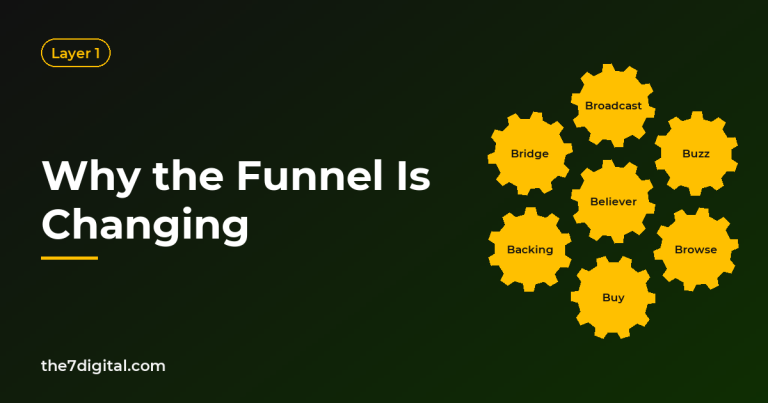
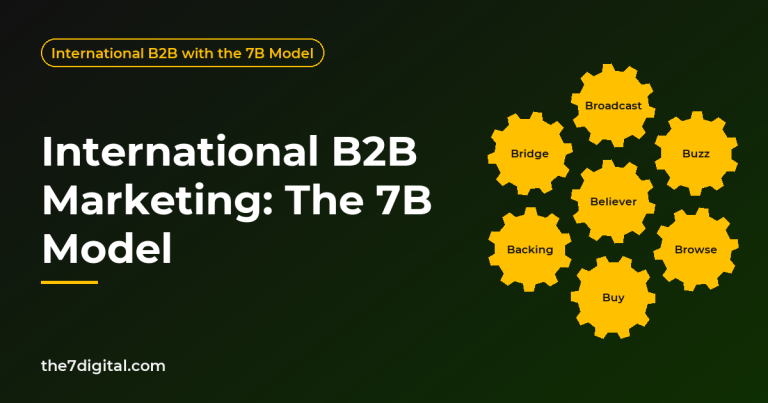
It sits in the Bridge gear. The Bridge gear: Customers bring in others through referrals, communities and partners, and the flywheel amplifies itself. In a new industry the first thing missing is not signal but introducers, so this gear has to turn first. Bridge sits in the amplification layer next to Backing, with Believer as the connecting loop.
The loyalty loop reads: Believers create Backing, Backing creates Bridges, and Bridges bring new people back into Broadcast, Browse and Buy. In a new industry the loop first turns on someone else’s Believers, the partner’s customers; once you have your own there, it turns by itself. Two operating principles apply: Customers can enter anywhere; one stuck gear slows the whole flywheel. At first Backing is the stuck gear, and Bridge carries the load until the first case arrives.
The three energy flows are Paid, owned, earned-and-shared. Paid is a small test on LinkedIn, owned is the content and integrations you build together, and earned-and-shared is what partners and customers say about you. The community mechanism of Bridge is covered in B2B community marketing; all seven gears sit on one page in the 7B Model and the 7B Glossary. The 7B Model was developed by Nguyen Dinh Bao (Bao7) at The7 Digital and is set out in full in the book Mô hình 7B cho B2B (Stop Begging, Start 7B).
Selling B2B into Vietnam and ASEAN
New industries arrive in pairs. Registered foreign direct investment in Vietnam reached USD 54.85 billion by 31 October 2026, up 74% and the highest since 2009. Of the USD 30.73 billion newly registered across 3,478 projects, manufacturing and processing took 47.5% and warehousing and transport 16.7% (National Statistics Office via Thoi bao Tai chinh Viet Nam, 2026). In my reading, plants and the logistics that serve them are growing side by side, so a foreign investor that buys from you in one can walk you into the other.
Horizontal offers meet vertical gatekeepers. Vietnam’s digital economy reaches USD 49 billion in gross merchandise value in 2026, and Vietnam matches Malaysia as Southeast Asia’s fastest-growing digital economy at 20%, with digital lending up 34%, non-cash transactions up 38% in early 2026 and 65% of the working population using generative AI (Google, Temasek and Bain & Company, 2026). These count users in general, not B2B buyers. Horizontal offers such as payments and AI find demand in every industry here, I think, but each industry still has a gatekeeper.
In the region, the fastest bridge is the company that holds the customer. That is how Wise Platform has moved into Indonesia, Malaysia and the Philippines, through local banks and fintechs rather than by broadcasting to their customers. Your version might be a local systems integrator, the enterprise arm of a telecom operator or a consultancy that already sits in front of your target buyers.
Going through a partner means going through its customer data. Vietnam’s Personal Data Protection Law took effect on January 1, 2026 and gives data subjects six core rights, including the right to consent or withhold consent and the right to withdraw it (Viet Nam News, 2026). A joint campaign with a local partner runs on the partner’s customer list, so design consent and withdrawal in from day one. This is not legal advice; check with local counsel.
Test the industry before you fund it. LinkedIn’s own advertising figures show 10.0 million members in Vietnam in late 2025, with its ads reaching 13.5% of adults and its potential ad reach up by 1.40 million (+16.3%) in a year (DataReportal, 2025). I think that is enough to test one industry before a full Broadcast budget. The7 runs this kind of industry test on LinkedIn Ads as part of its full-service digital marketing in Vietnam.
Conclusion: In a new industry, get introduced before you get loud
Three bridges: Komatsu shared its capital, Alibaba walked through doors its customers had opened, and Wise went through the banks. All three went through someone who already held half the road. At home you broadcast to be remembered. In a new industry you need to be introduced first, and only then are you worth remembering.
Last time, borrowing from other industries covered borrowing ideas; next, choosing international markets moves the question from a new industry to a new country, with the 7B Market X-Ray. The whole map sits in the pillar article, international B2B marketing with the 7B Model.
Frequently asked questions
What is cross-industry growth in B2B?
It means taking a capability you already sell into another industry: vertically (one more industry of use), horizontally (an offer no single industry owns) or diagonally (across the B2B and B2C line), in Professor Dae Ryun Chang’s terms. The hard part is getting onto a buyer list where nobody knows you yet.
How is cross-industry growth different from diversification?
In Ansoff’s 1957 matrix, diversification means a new product for a new market, the riskiest cell. Cross-industry growth often sits one cell over, an existing capability for a new market. A partner that already serves that market can supply the half you lack.
How do I choose a partner for a new industry in Vietnam?
Look for a company that already serves your target customer with a different product and does not compete with you. Agree early on who keeps the customer, the brand and the data, and build consent into any joint campaign under the Personal Data Protection Law in force since January 1, 2026 (Viet Nam News, 2026).
Can LinkedIn target a specific industry in Vietnam?
Yes. Industry is one of LinkedIn’s ad targeting facets, alongside locations (Microsoft Learn, 2026), and LinkedIn had 10.0 million members in Vietnam in late 2025 (DataReportal, 2025). That is enough to test one industry with partner co-created content before a full Broadcast budget.
International B2B with the 7B Model · Part 19 of 24 · Previous: Borrowing from Other Industries · Next: Choosing International Markets · Pillar article: International B2B Marketing: The 7B Model
References
- Komatsu (n.d., accessed 9 November 2026). History. https://www.komatsu.jp/en/aboutus/history
- EARTHBRAIN (n.d., accessed 9 November 2026). Company information (Japanese-language page). https://www.earthbrain.com/company/
- EARTHBRAIN (n.d., accessed 9 November 2026). Smart Construction (Japanese-language page). https://jp.smartconstruction.com/
- Alibaba Group (2024). Alibaba.com: A leading platform for global B2B e-commerce. https://www.alibabagroup.com/en-US/about-alibaba-businesses-1747711844698554368
- Alibaba Group (n.d., accessed 9 November 2026). Alibaba Cloud. https://www.alibabagroup.com/en-US/about-alibaba-businesses-1747835448811585536
- Alibaba Group (2026). Alibaba Group Announces June Quarter 2026 Results. https://data.alibabagroup.com/ecms-files/1532295521/fa5d65fc-9b3e-4e82-a8fc-4ce1c3e2c407/Alibaba%20Group%20Announces%20June%20Quarter%202026%20Results.pdf
- Wise (n.d., accessed 9 November 2026). Our story. https://wise.com/gb/about/our-story
- Wise (2025). Wise Platform Mission Update Q4 2024. https://wise.com/gb/blog/wise-platform-mission-update-q4-2024
- Wise (2025). Wise Platform Mission Update Q1 2025. https://wise.com/gb/blog/wise-platform-mission-update-q1-2025
- Wise (2025). Wise Platform Mission Update Q3 2025. https://wise.com/gb/blog/wise-platform-mission-update-q3-2025
- Wise (2026). Wise Platform Mission Update Q4 2025. https://wise.com/gb/blog/wise-platform-mission-update-q4-2025
- Wikipedia (n.d.). Ansoff matrix (on H. Igor Ansoff’s Strategies for Diversification, Harvard Business Review, 1957). https://en.wikipedia.org/wiki/Ansoff_matrix
- Dae Ryun Chang, Yonsei University (n.d., accessed 9 November 2026). International B2B (Business to Business) Marketing, Coursera. https://www.coursera.org/learn/b2b-marketing
- Bain & Company (2026). Raising the Odds on a Deal: How Likelihood to Buy Rewires B2B Growth. https://www.bain.com/insights/raising-the-odds-on-a-deal-how-likelihood-to-buy-rewires-b2b-growth/
- TrustRadius, HG Insights (2026). TrustRadius 2026 B2B Buying Disconnect Report Reveals AI Has Changed How Buyers Research, But Not What They Trust. https://hginsights.com/news/trustradius-2026-b2b-buying-disconnect-report-reveals-ai-has-changed-how-buyers-research-but-not-what-they-trust/
- Microsoft Learn (2026). Ad Targeting, LinkedIn Marketing API. https://learn.microsoft.com/en-us/linkedin/marketing/integrations/ads/advertising-targeting/ads-targeting
- Cục Thống kê, via Thời báo Tài chính Việt Nam (2026). Việt Nam thu hút 54,85 tỷ USD vốn đầu tư nước ngoài trong 10 tháng (Vietnam attracts USD 54.85 billion of foreign investment in 10 months). https://thoibaotaichinhvietnam.vn/viet-nam-thu-hut-54-85-ty-usd-von-dau-tu-nuoc-ngoai-trong-10-thang-206324.html
- Google, Temasek and Bain & Company (2026). e-Conomy SEA 2026: Vietnam. https://services.google.com/fh/files/misc/vietnam_e_conomy_sea_2026_report.pdf
- Viet Nam News (2026). Several major laws to take effect from January 1, 2026. https://vietnamnews.vn/politics-laws/1733035/several-major-laws-to-take-effect-from-january-1-2026.html
- DataReportal (2025). Digital 2026: Vietnam. https://datareportal.com/reports/digital-2026-vietnam