Summary: An international B2B marketing strategy should fit on one page per market: the X-ray result, two or three gears to push, four goals with one named owner each, the resources and the review dates. One page forces you to choose what not to do. In the 7B Model, this tool brings all seven gears together.
On July 1, 2026, a World Bank Data Blog post on the new income classifications named five countries moving from lower-middle to upper-middle income. Vietnam and the Philippines were two of them, and they got there by different roads. Vietnam rode an export-led model, with exports up more than 15% in both 2024 and 2025. The Philippines grew through broad-based expansion, with GDP up an average of 5.8% a year over five years, across all major industries (World Bank, 2026).
Same label on paper, two different machines underneath. Plan for “ASEAN” in one regional deck and that deck has to cover both at once: long enough to include every market, too long for anyone to remember what comes first.
This last article in the series does the opposite of its predecessors: it cuts. It takes the money split in B2B marketing budgets and the maps from the articles before it, and puts them on one page per market. The One-Page 7B Strategy, a template you fill in by hand, launches here.
Why should an international strategy fit on one page?
In 1996, Michael Porter wrote in Harvard Business Review that trade-offs are essential to strategy: “The essence of strategy is choosing what not to do.” He added that choices about what not to do matter as much as choices about what to do (Porter, 1996).
The 7B Model book (chapter 13) puts the same idea inside the machine: no company has the people, money and hours to run all seven gears at full power, so push two hard instead of spreading effort across seven. Execution is where it hurts: Donald Sull, Rebecca Homkes and Charles Sull (2015) report that two-thirds to three-quarters of large organizations struggle with it. A longer document will not cure that: when everything gets written in, nothing gets chosen.
Selling across borders makes it worse. Every country has its own seven gears, so the list of things you could do multiplies with each market. One “international strategy” hides the trade-offs; one page per country drags them into the open, because no page holds seven gears times five countries. Positioning your company, as B2B positioning explains, was your first act of dropping something. This page is the second, at the level of action.
Salesforce: A strategy that started on an envelope
In the first weeks of Salesforce, Marc Benioff suggested that he and his cofounders commit to writing a V2MOM, and he scribbled his own on a large American Express envelope. Cofounder Parker Harris saved it, framed it and gave it to Benioff on the day of the company’s IPO (Benioff, 2024).
A V2MOM answers five questions: Vision (what do you want to achieve?), Values (what’s important to you?), Methods (how do you get it?), Obstacles (what is in your way?) and Measures (how do you know you have it?). Benioff ranks his values in order of importance, an exercise that forces him to choose between pairs of competing priorities: “if everything is a priority, nothing is.” The how-to also advises ranking the methods by priority (Benioff, 2024).
Every year, every department and every employee drafts their own, and Salesforce publishes them on its corporate social network instead of hiding them in a vault (Benioff, 2024).
Salesforce does not use the 7B Model, so this is my reading: Obstacles look like the red cells on an X-ray, ranked Methods like the two or three gears in the middle of the page, Measures like four goals with numbers, and publishing every V2MOM like a page taped beside the desk. A V2MOM is written per year and per person; this page is per market, revised each quarter. Salesforce grew from four people to more than 50,000 employees (Benioff, 2024). The plan still starts with five questions.
How do the five steps work market by market?
The international version runs the 7B Model book’s five steps (chapter 13) once per country.
Step one, X-ray each country. Run the 7B Market X-Ray for that country, scoring gears against criteria, not feelings: Browse is green when you appear in five or six of the six gateways, with current content, and AI assistants name you correctly (7B Model book, chapter 13). Then find that country’s weakest layer, where resources go first, and carry over the keep, adapt or rebuild decisions from the 7B Equivalence Map.
Step two, pick two or three priority gears. The book’s test is the domino effect: how many other gears does fixing this one move? Broadcast is usually the biggest domino because the content machine feeds five other gears. Believer is second, because without it there is no Backing, no Bridge and no loyalty loop. Buy is the fastest win when customers arrive but drop out for lack of material (7B Model book, chapter 13).
The book gives three scenarios for a whole company; with several countries, I read them as three stages each country passes through. A new country, unknown: Broadcast and Backing. A country that knows you from a trade show or a distributor but stalls on deals: Browse and Buy. A country with customers but no referrals: Believer and Bridge. Then sign one commitment sentence per country: which two gears get the push, while the other five hold at their current level.
Step three, four goals that are not vanity. A vanity metric looks good on a dashboard and never connects to revenue, like follower counts or impressions. Each country gets four goals, each tied to a part of the machine. One, demand creation: brand-name search volume in that country, with marks at six and twelve months, a rough measure of mental availability.
Two, amplification: the share of deals that customers say came from dark social and referrals. If you have not measured it, set 15 to 20% after twelve months (7B Model book, chapter 13), and ask “How did you hear about us?” in the local language, as self-reported attribution explains.
Three, demand capture: pipeline value, close rate and revenue. In the first year of a new system, growth of 30 to 50% is reasonable, so do not promise triple before the system exists. Four, the loyalty loop: the book’s example is six case studies a year, fifteen reviews, ten referrals and retention of 85% or more (7B Model book, chapter 13). Every number also needs a deadline and one owner you can call by name.
Google follows the same discipline. According to Google re:Work (2016), John Doerr introduced OKRs to Google’s leadership in early 2000, and the guide says to “pick just three to five objectives” because more can overextend teams.
Step four, real resources. Money is written as percentages across the three layers, as in the budget article above. People and hours are written by role, partner hours included, and each priority gear gets one captain from the 7B Gear Captain Matrix.
Step five, the review rhythm. The weekly, monthly and quarterly checks sit in the template below. Several countries add one thing: a quarterly session that reviews every page on the same day, re-scores each X-ray and revises each page by hand (7B Model book, chapter 13).
Picture a European automation supplier selling into Vietnam and Thailand. In Vietnam it is new, so the page names Broadcast and Backing, with a first Vietnamese reference customer. In Thailand a distributor already carries its name but deals stall, so the page names Browse and Buy. Same company, two pages, two pairs of gears.
Which cross-country and cross-industry checks come before you commit?
Professor Dae Ryun Chang of Yonsei University follows an approach called CCCI in his International B2B Marketing course on Coursera: check across countries and across industries. The two-way check is his idea; the seven questions below are mine, each pointing to an article in this series: the first five check the country side, the last two the industry side.
- Has this country been X-rayed on its own terms? The article on choosing international markets scores each gear with that country’s own questions.
- How will you enter, and which gears must you keep in your own hands? Export, license or joint venture picks the mode by the gears you cannot hand over.
- Which gears travel intact, and which must be rebuilt? The 7B Equivalence Map records a decision for each gear.
- Who sits around the buyer’s table, and what does each person need to see before saying yes? The cross-cultural buying council and five buyers, five products go seat by seat.
- Who in that country will speak for you and bring others to you? See relationships in Asian B2B and choosing international B2B channels.
- How has the neighboring industry solved this problem? Borrowing from other industries shows how to translate a solution for your customers.
- Can the gears you have today turn in a new industry? Cross-industry growth starts with a bridge to a partner that already serves that industry’s customers.
A checklist adds no work to the page. It tells you which work is not ripe enough to go on it.
What does the One-Page 7B Strategy look like?
This tool launches here. The book’s original (chapter 13) is one A4 sheet in five parts; the international version makes one page per country and adds two lines from The7, a header for the country and how you enter it, and a footer for what you will not do. Copy the table, print it, fill it in by hand: no form stands in the way, as the book advises (7B Model book, chapter 6).
| Page area | What goes there | Comes from | Market: …….. |
|---|---|---|---|
| Header | Country, entry mode, working language, local partner | Entry mode, channel choice | |
| Top left: X-ray | Seven gears in green, yellow or red; the weakest layer | 7B Market X-Ray | |
| Top right: four goals | Four twelve-month numbers, one name per number | The book’s suggested numbers, the four signals | |
| Center: two or three priority gears | Main activities, owner, frequency, measure; keep, adapt or rebuild | 7B Equivalence Map, 7B Gear Captain Matrix | |
| Bottom left: resources | Budget as percentages across the three layers; hours by role, partners included | The default 40/30/30 split | |
| Bottom right: review rhythm | Weekly 15 minutes, monthly 30, quarterly 2 hours; dates, names, deliverables | The four measurement columns | |
| Footer: what we drop | Gears held at their current level; work and countries not started this quarter | ||
| The 7B Model · the7digital.com | |||
The center gets the most room. Only the two or three priority gears have a cell there; listing all seven means you have not chosen yet (7B Model book, chapter 13).
Tape the page next to your desk. A plan that is 70% right and acted on now beats one that is 100% right and sits in a drawer (7B Model book, chapter 13).
If a cell will not fill in, you have just found the first job of the quarter.
When should you bring in outside eyes for the X-ray?
In 2005, Bain & Company surveyed 362 firms: 80% believed they delivered a superior experience to customers, but when the customers were asked, only 8% were really delivering (Bain & Company, 2005). That is a survey of customer experience in general, not B2B alone. Treat it only as a comparison: if eight in ten companies think they are superior and customers credit fewer than one in ten, the Believer cell that insiders color for themselves is likely greener than reality.
The second reason is fear of dropping things. Porter (1996) wrote, “Trade-offs are frightening,” and noted that people sometimes prefer making no choice to risking blame for a bad one. Inside a company every gear has an owner, so dropping a gear means dropping someone’s work.
There are four moments for a second pair of eyes: before the first page for a new country; when a gear is still red after two quarters of effort; when the team cannot agree on what to drop; and after a big change such as a new entry mode or a new partner. Outsiders ask the questions insiders avoid and compare with what they see elsewhere. The decision on what to drop and the signature under the page stay in-house, as agency or in-house argues.
Outsiders take the X-ray. Insiders sign the page.
Where does the One-Page 7B Strategy fit in the 7B Model?
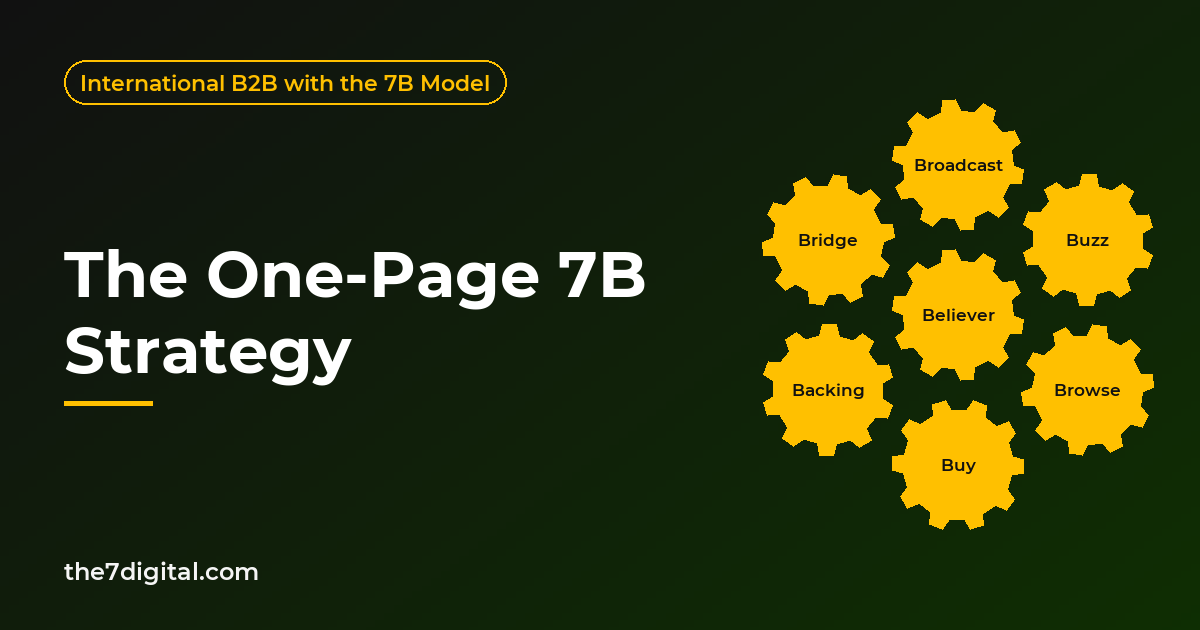
All seven gears have a cell in the X-ray corner of the One-Page 7B Strategy, but only two or three get room in the center.
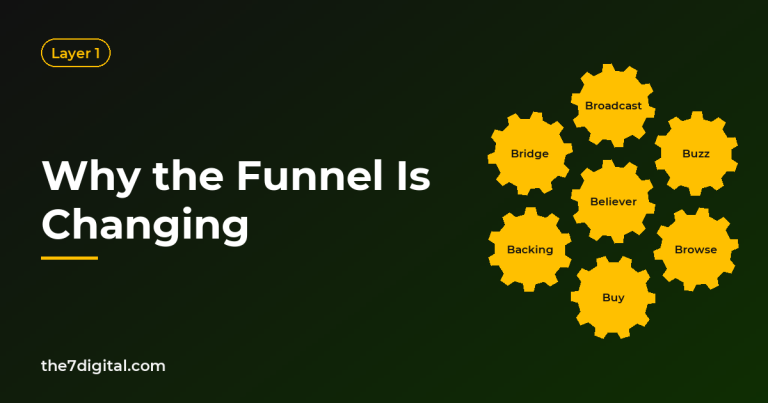
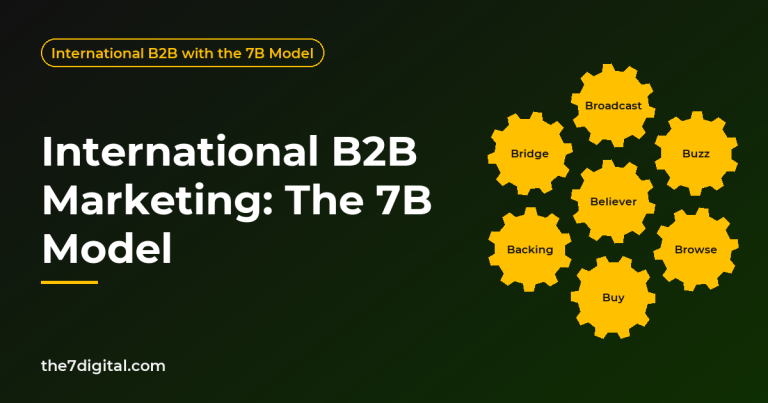
Three operating layers: Demand creation (Broadcast, Buzz), amplification (Backing, Bridge), demand capture (Browse, Buy); Believer is the connecting loop. On the page, the X-ray finds the weakest layer and resources split across all three.
Two operating principles: Customers can enter anywhere; one stuck gear slows the whole flywheel. The second explains why a priority gear is usually a stuck one; the first, why the other five hold steady instead of being switched off.
Three energy flows: Paid, owned, earned-and-shared. So the resources corner is not only money: with a zero budget, the owned and earned-and-shared flows still run on hours of work (7B Model book, chapter 5).
The page gathers the series’ toolkit: the X-Ray, the Equivalence Map, the Gear Captain Matrix and the 7B Buying Table Map. Every term has an entry in the 7B Glossary. The 7B Model was developed by Nguyen Dinh Bao (Bao7) at The7 Digital and is set out in full in the book Mô hình 7B cho B2B (Stop Begging, Start 7B). If the seven gears are new to you, what the 7B Model is comes before this article.
Selling B2B into Vietnam and ASEAN
AI answers belong on the Vietnam X-ray. In Vietnam, 65% of the working population uses generative AI, and AI adoption is the third highest in Southeast Asia, though usage depth ranks fourth of the six markets studied, below the regional average (Google, Temasek and Bain & Company, 2026). Conversational AI is one of the six Browse gateways (7B Model book, chapter 8), and AI citation is the third tier of Backing (chapter 11). So on your Vietnam page, the X-ray cells for Browse and Backing should ask what AI answers say about you in Vietnamese. These figures describe working-age people in general, not B2B buyers.
Guard the footer: what you will not do. Disbursed foreign direct investment in Vietnam reached an estimated US$27.62 billion in 2025, up 9.0% and the highest in five years (National Statistics Office of Vietnam, 2026). My reading: if that money brings more foreign suppliers to the same buyers, what you will not do, the footer of your Vietnam page, counts for more here.
Pick the pair for your stage. A newcomer usually starts with Broadcast and Backing, and the Backing has to be Vietnamese: a first local reference customer, since a case from home is only indirect proof. If a distributor already carries your name, the stage is closer to Browse and Buy.
Name a local owner and count partner hours. Every goal on the Vietnam page needs a name, ideally someone based in Vietnam. If a distributor holds Bridge, their hours belong in the resources corner. Ask “How did you hear about us?” in Vietnamese.
One page per ASEAN market, one review day. Vietnam and the Philippines reached the same income tier by different roads, so Thailand, Indonesia or Malaysia each get their own page too, reviewed on the same day each quarter.
Conclusion: One page is where you say no
Porter says strategy is choosing what not to do, Salesforce started on an envelope, and five steps turn that into one page per country: one pair of gears, four numbers and four names.
One page is not where you write everything you know. It is where you say no to what has to wait.
This is the last article in the series. To start again from the top, read international B2B marketing with the 7B Model; the whole series sits in the B2B marketing library.
Frequently asked questions
How long should an international B2B marketing strategy be?
One page per market: short enough to read in half a minute and specific enough to tell you what to do tomorrow morning (7B Model book, chapter 13). The analysis behind it, such as the X-ray and the equivalence map, can run long. The decisions cannot: which gears come first, which goals, whose name, when you review.
How many priority gears should one market get?
Two or three, picked by domino effect: fix the gear that moves the most others (7B Model book, chapter 13). A new market usually needs Broadcast and Backing; one that knows your name but stalls on deals needs Browse and Buy; one with customers but no referrals needs Believer and Bridge. The other five hold at their current level.
How often should I update a one-page 7B strategy?
Every quarter, in a two-hour session that re-scores all seven gears (7B Model book, chapter 13). If you sell in several countries, review every page on the same day to compare markets. Between quarters the page stays put; the weekly and monthly checks only ask whether the work matches it.
Do I need a separate page for each ASEAN market?
Yes, if you sell in more than one. Markets that look alike on paper move differently: in its 2026 release, the World Bank moved both Vietnam and the Philippines to upper-middle income, one through export-led growth, the other through broad-based expansion (World Bank, 2026). Use the same template, write separate pages, and expect different priority gears.
Want a second pair of eyes on your machine? Book a 7B X-ray of your market.
International B2B with the 7B Model · Part 24 of 24 · Previous: B2B Marketing Budgets, Including Cross-Border Ad Spend · Pillar article: International B2B Marketing: The 7B Model
References
- Michael E. Porter (1996). What Is Strategy? Harvard Business Review. https://hbr.org/1996/11/what-is-strategy
- Donald Sull, Rebecca Homkes, Charles Sull (2015). Why Strategy Execution Unravels, and What to Do About It. Harvard Business Review. https://hbr.org/2015/03/why-strategy-execution-unravelsand-what-to-do-about-it
- Marc Benioff, Salesforce (2024). Create Strategic Company Alignment With a V2MOM (first published in 2013). https://www.salesforce.com/blog/how-to-create-alignment-within-your-company/
- Google re:Work (2016). Guides: Set goals with OKRs. https://rework.withgoogle.com/intl/en/guides/set-goals-with-okrs
- James Allen, Frederick F. Reichheld, Barney Hamilton, Rob Markey, Bain & Company (2005). Closing the delivery gap: How to achieve true customer-led growth. https://www.bain.com/insights/closing-the-delivery-gap-newsletter/
- Coursera, Yonsei University (n.d., accessed 9 November 2026). International B2B (Business to Business) Marketing, Professor Dae Ryun Chang. https://www.coursera.org/learn/b2b-marketing
- Eric Metreau, Kathryn Elizabeth Young, Shwetha Grace Eapen, World Bank Group (2026). Who moves up and why? A closer look at the 2026-2027 release of the World Bank Group Country Income Classifications. https://blogs.worldbank.org/en/opendata/who-moves-up-and-why–a-closer-look-at-the-new-world-bank-group-
- Google, Temasek and Bain & Company (2026). e-Conomy SEA 2026: Vietnam. https://services.google.com/fh/files/misc/vietnam_e_conomy_sea_2026_report.pdf
- National Statistics Office of Vietnam (2026). Press release on the socio-economic situation in the fourth quarter and the whole year of 2025 (Vietnamese). https://www.nso.gov.vn/tin-tuc-thong-ke/2026/01/thong-cao-bao-chi-tinh-hinh-kinh-te-xa-hoi-quy-iv-va-nam-2025/