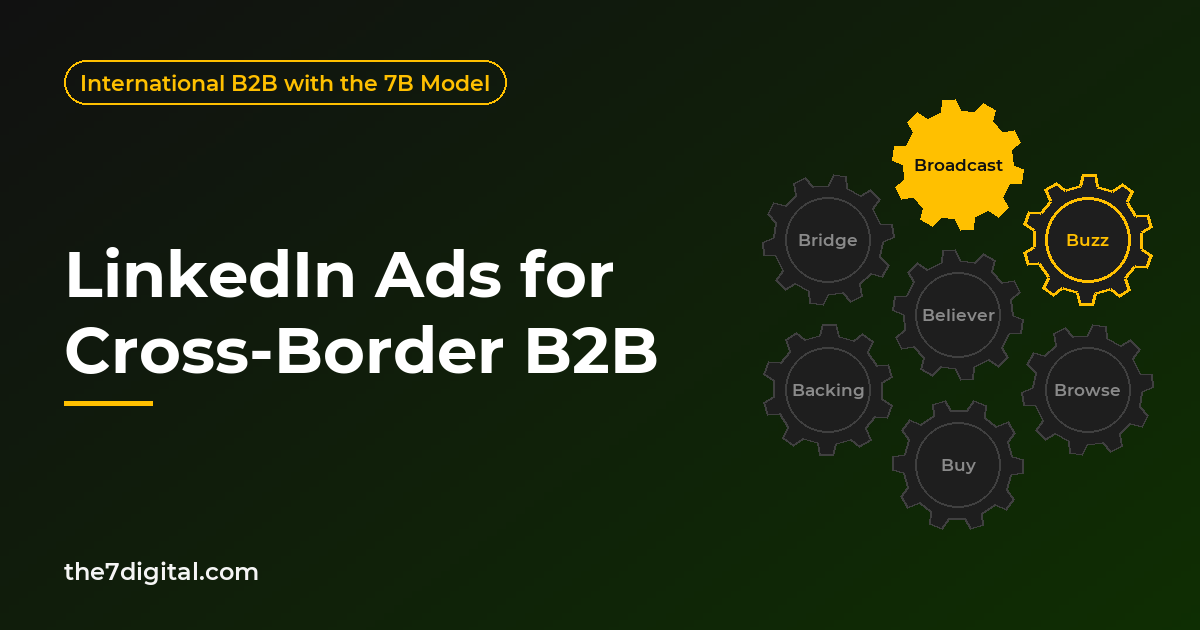
Summary: LinkedIn ads in Vietnam and across ASEAN pay off when the budget amplifies valuable content to the right decision makers in each country, not when it pushes sales pitches at strangers. LinkedIn merges industry, job function and country targeting in one place. In the 7B Model, LinkedIn advertising serves Broadcast and Buzz in the demand creation layer.
The brief lands on a Monday in Munich: Vietnam is the next growth market. By Friday the campaign is live, aimed at manufacturing directors in Vietnam. The ad promises what every supplier promises: German engineering, proven quality, request a quote. Three months later the dashboard shows a handful of leads, mostly resellers asking for price lists, and a sales director who now believes LinkedIn does not work in Vietnam.
Here is the odd part. Few channels let a foreign supplier reach a plant manager in Binh Duong or a procurement head in Bangkok as precisely as LinkedIn. But precision only magnifies what you put in front of people. Show a pitch to buyers who have never heard of you, and you pay a premium to be ignored with great accuracy.
The six questions below run from targeting to hiring an agency, and one idea runs through all of them: pay to amplify valuable content, not sales pitches.
What are vertical and horizontal media, and how does LinkedIn merge them?
Before social media, a supplier that wanted foreign buyers to notice it bought space in two kinds of print. Vertical titles served one industry, such as packaging, and were read by everyone in it, from engineers to the CEO. Horizontal titles served one function, such as purchasing, across many industries. One axis gave you context, the other a role. Every country had its own titles and rate cards, so a mid-size exporter could afford one or two magazines in one market.
LinkedIn compresses both axes into one ad account. Its Marketing API documentation on Microsoft Learn (2026) lists targeting facets that include industries, job functions, seniorities, titles, company size, locations and interface language. Industry is the vertical axis; function, seniority and title form the horizontal one; location adds a third axis the trade press never sold cheaply: the country. With more than 1.3 billion members, according to Microsoft’s 2026 annual report, LinkedIn is a giant newsstand where you rent each cell of that grid.
But a cell is not a message. Trade magazines had articles, and the ads sat next to the stories readers came for; on LinkedIn, your ad is the article. Fill the right cell with a pitch and you have bought a magazine with no editorial pages. The general logic is in paid advertising in B2B; what follows is about what deserves to go into each cell.
How do you target decision makers country by country?
Start outside Campaign Manager: in the country you want, are the decision makers on LinkedIn at all? DataReportal’s Digital 2026 reports, which draw on LinkedIn’s advertising tools, show how uneven the picture is. In late 2025 LinkedIn’s ads reached 98.3% of adults in the United States but only 5.1% in Japan (DataReportal, 2025). Southeast Asia spans a wide range too, as the section on Vietnam and ASEAN below shows.
These are registered members, not monthly active users, so read them as maximum reach. China is its own case: LinkedIn sunset its localized product there, launched the InCareer jobs app in December 2021, and in 2023 announced that InCareer would close too (CNBC, 2023). Score each market with the 7B Market X-Ray before you split the budget.
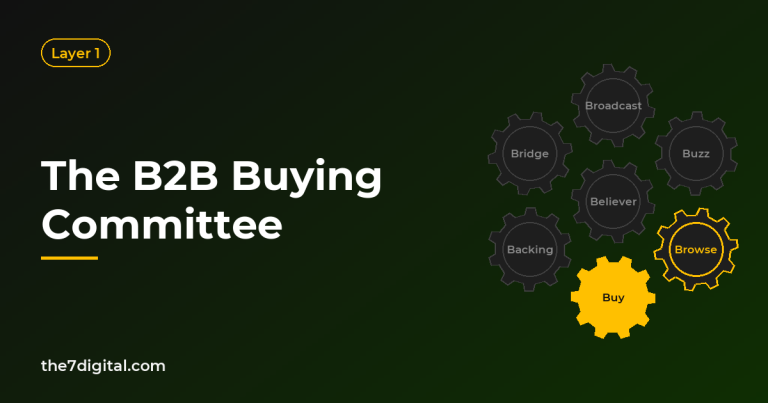
Next, map the buying committee before you build the audience. The most common mistake I see is targeting one title, usually the head of procurement, and hoping that person sells your case to the whole plant. In customer data from Dreamdata (2026), the average journey involves 10 stakeholders, up from 6.8. Reach the engineer who will test your sample, the plant manager, the quality lead and the budget holder, as the B2B buying committee explains.
Then choose how to build the audience: a grid of attributes, or a list of target companies. The Matched Audiences documentation on Microsoft Learn (2026) describes uploading a CSV list of companies or contacts to target those exact accounts, which is account-based marketing applied to ads. Rules also differ by region: since May 2024 LinkedIn has disabled member group targeting in the European Economic Area and Switzerland (Microsoft Learn, 2026).
Document Ads, Thought Leader Ads or video: which formats serve Broadcast and Buzz?
My rule is short: pick formats that let people take the full value on the spot. Three formats do that.
Document Ads, according to LinkedIn’s documentation on Microsoft Learn (2026), are Sponsored Content that puts a document straight into the feed, where members read and download it without leaving LinkedIn. The gated preview, a few pages and then a form, applies only to lead generation campaigns, so the gate is a choice, not a default. A technical guide or an import standards checklist deserves to be read in full right there.
Thought Leader Ads amplify a person’s post instead of a company page’s. They started with employees’ posts; since March 2024 brands can sponsor content from any member, not just employees, once the author approves (LinkedIn, 2024). Announcing the change, LinkedIn cited a 2024 study by Edelman and LinkedIn: nearly 73% of decision makers say an organization’s thought leadership is a more trustworthy basis for judging its capabilities than its marketing materials and product sheets (LinkedIn, 2024).
Video is the bridge to YouTube, which YouTube for B2B covers in depth. The three formats work together: one pillar piece a month can become a document, a few expert posts and some clips, as the content machine of the 7B Model suggests (Mô hình 7B cho B2B book, chapter 6).
Lenovo: When people outperform the logo
Lenovo, the world’s largest PC maker and a Beijing-based company (China Daily, 2025), shows how a Chinese firm can put real people at the front of feeds worldwide. According to Lenovo’s own entry for the 17th Shorty Awards, a Gold Honor winner in Paid & Amplification, its global social media team piloted Thought Leader Ads with its annual ESG report, then extended them to executives in its incubator business unit and to moments such as the World Economic Forum in Davos and its own Tech World event (Shorty Awards, 2025). The entry also suggests using a product expert’s post to target IT decision makers.
By Lenovo’s own count, these ads earned engagement rates six times LinkedIn’s historical benchmarks, and campaign click-through rates rose 63% once audiences had seen them (Shorty Awards, 2025). Three posts from a Gartner event reached a 6.92% engagement rate at a cost per engagement of $0.38, 94% below benchmark (Shorty Awards, 2025). Each boosted post brought employees 285 new followers on average.
Through the 7B lens, this is Broadcast in a human voice: paid reach puts a real expert in front of the right people instead of a logo in front of a crowd. Buzz shows up as engagement and new followers, who may see the next post without further spend, and the later lift in clicks hints that Broadcast makes demand capture cheaper. These are self-reported figures against LinkedIn’s own benchmarks, so I read them as a direction, not a promise.
Why shouldn’t you put a form in front of your content?
A form in front of content is a trade: my document for your email and phone number. In a market that knows you, the trade sometimes works. Across a border it breaks, because the reader has no reason yet to trust a supplier from another country.
Buyer research shows why. In the 2025 Buyer Experience Report from 6sense, 94% of surveyed buyers ranked their shortlist vendors before contacting any of them, and they bought from their top-ranked vendor 77% of the time (6sense, 2025). According to Gartner (2026), 67% of B2B buyers prefer a rep-free experience (IT-Online, 2026). A form is a request for contact: it hides your content while the shortlist forms and promises exactly what readers want to avoid, a sales call.
Most of your future buyers are also out of the market today, as the 95/5 rule shows, so they have no reason to fill in a form yet.
The 7B Model answers with one principle: give away the mental model, sell the implementation (Mô hình 7B cho B2B book, chapter 6). Give the what and the why in full; sell the how for each customer’s plant. On LinkedIn, that means keeping Document Ads open, reading signals through company-level reporting, and retargeting site visitors through the LinkedIn Insight Tag with a concrete next step, such as a sample or a drawing review. Keep forms for buyers who ask for a quote.
Budget follows the same logic. The book says to pay to amplify valuable Broadcast content first and the pitch later, while keeping a share for Browse and traditional demand capture (Mô hình 7B cho B2B book, chapters 5 and 7). The stakes are real: according to Gartner (2025), paid media still dominates marketing spend at 30.6% of marketing budgets (Silicon UK, 2025).
Beyond CPC and CPM, what shows the machine is turning in each country?
On CPC alone, LinkedIn always loses. In Dreamdata’s 2026 benchmark data, LinkedIn’s CPC was €5.98 against €1.60 on Meta, yet the cost per company influenced was €70.11, first ad impression to revenue took 281 days, and LinkedIn’s ROAS reached 121% in 2025 (Dreamdata, 2026). It is customer data from a vendor of measurement software, but the message is clear: judging LinkedIn on a 30-day window is cutting down the tree before harvest.
The 7B Model replaces CPC with four signals, and across borders each one must be split by country (Mô hình 7B cho B2B book, chapter 14):
- Branded search volume, filtered by the searcher’s country.
- Answers to “How did you hear about us?”, left open for buyers to write in, grouped by country.
- Engagement quality: right companies, right titles, right country. LinkedIn’s reporting documentation on Microsoft Learn (2026) shows results by country, company, title and seniority, with professional demographics approximated to protect member privacy.
- Content touched before closed deals; with a CRM connected to LinkedIn, the revenue attribution report shows how ads influence opportunities (Microsoft Learn, 2026).
Be patient with the rhythm: three months to sow, six to see sprouts, twelve to see fruit (Mô hình 7B cho B2B book, chapter 5). Dreamdata’s 281 days lands between the sprout and the fruit. A campaign cut in month two has not failed; it has not had time to work.
When should you hand LinkedIn Ads to an agency?
LinkedIn Ads has two halves, and only one should be outsourced. The core is your expertise, your customer stories, your choice of markets and the voices of real people; no agency can write your engineers’ experience for them.
The operating half can go out: targeting grids per country, ad testing by language, budget discipline and reporting on the four signals. Outsource when you run two or more markets and nobody owns the weekly cadence, or when monthly reports still show only CPC, CPM and form fills.
When you pick an agency, ask four things: do they build audiences around the buying committee or one title, do they leave documents open, do their reports split by country, and whose name is on the ad account? The last sounds minor, but years of Broadcast data live in that account. Use the 7B Gear Captain Matrix to give each gear an owner, even when a partner runs the paid side. For that side in Vietnam, The7 offers LinkedIn Ads built on this logic as part of its full-service digital marketing.
Where does LinkedIn advertising fit in the 7B Model?
The main gear is Broadcast: Seeding valuable presence into the market, clear, steady and sharp enough that the right people know you exist. Paid reach on LinkedIn keeps that presence steady in countries your organic distribution does not reach yet.
The second gear is Buzz: The market answers back: people discuss you and mention your name, mostly in dark social. You cannot buy Buzz, but you can buy it a chance: an expert’s post in front of the right people is kindling for comments, shares and the forwards that make up dark social.
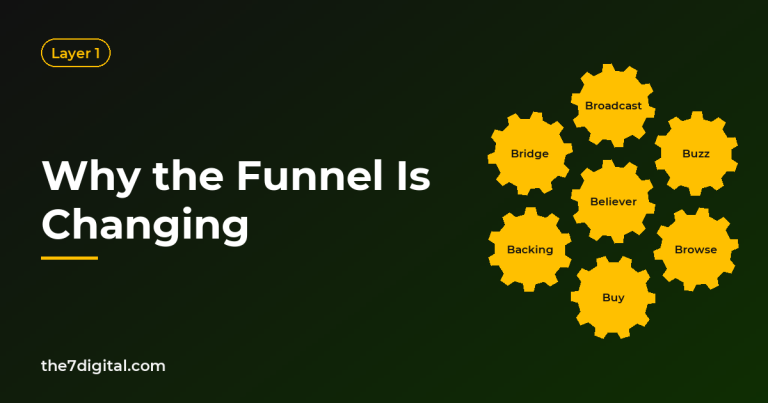
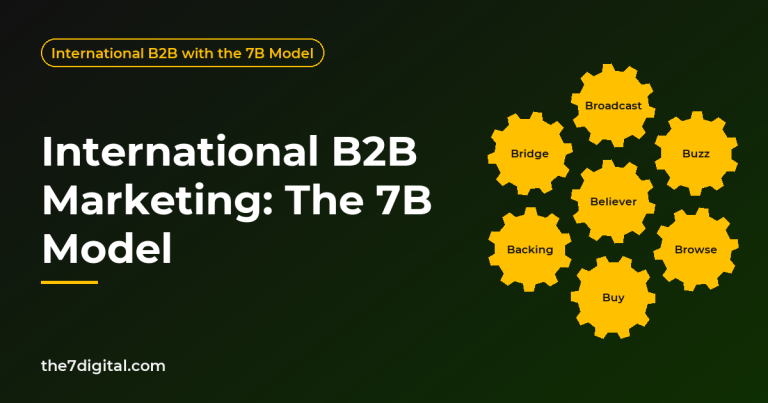
Both gears sit in the first of the three operating layers: Demand creation (Broadcast, Buzz), amplification (Backing, Bridge), demand capture (Browse, Buy); Believer is the connecting loop. LinkedIn Ads is the paid energy flow, and it only earns its keep when it amplifies the owned flow, such as your company page, your experts’ profiles and your documents, on the way to the earned-and-shared flow.
LinkedIn is also one of the six Browse gateways (Mô hình 7B cho B2B book, chapter 8): buyers who hear your name will check your company page and your leaders’ profiles, so what the ads promise must match what those pages show. The end goal is mental availability in each market, and every term here is in the 7B Glossary. The 7B Model was developed by Nguyen Dinh Bao (Bao7) at The7 Digital and is set out in full in the book Mô hình 7B cho B2B (Stop Begging, Start 7B).
Selling B2B into Vietnam and ASEAN
Vietnam is a mid-sized LinkedIn market that is growing fast. DataReportal (2025) counts 10.0 million members in Vietnam in late 2025, equal to 13.5% of adults, after a rise of 1.40 million, or 16.3%, in a year. Read that as reach into the professional and managerial layer, not the whole buying committee, and pair LinkedIn with Vietnamese-language search and video for the engineers who will judge your trial.
ASEAN is several LinkedIn markets, not one. In late 2025 LinkedIn’s ads reached 37.4% of adults in Malaysia and 28.1% in the Philippines, but 18.3% in Indonesia and 11.1% in Thailand (DataReportal, 2025). In Singapore the figure was 101.3% of adults (DataReportal, 2025), a reminder that these counts are registered accounts, not people. Set budgets and expectations market by market, and lean on company lists where reach is thin.
Language matters more than many foreign suppliers expect. In the EF English Proficiency Index 2025, Vietnam ranked 64th with 500 points and Thailand 116th with 402, while Malaysia ranked 24th with 581. Run English creative where it fits, but localize your key documents and posts into Vietnamese or Thai, and use interface language targeting to match each version to its reader.
Hierarchy shapes who signs. Vietnam scores 70 on power distance in Hofstede’s model as published by The Culture Factor: hierarchy is accepted and centralization is popular. Target senior titles, but also feed the managers who prepare the decision, and consider having your own senior leaders front some Thought Leader Ads, so that senior buyers hear from someone of comparable rank.
Finally, the buyer may not sit where the plant is. Foreign-invested firms generated 77.3% of Vietnam’s merchandise exports in 2025, according to Vietnam’s National Statistics Office (2026). Many plants you will sell to belong to foreign groups, and part of their buying committee may sit in a regional office abroad, so put the parent companies on your account list and widen the location targeting for those accounts.
Conclusion: Pay for presence, not for pitches
Back to the brief from Munich. The targeting was not wrong; the pitch inside it was. Had those three months gone into a technical guide, posts by the company’s engineers and a factory video placed in front of the right buying committees, the dashboard might still show no deals, but the company’s name would have started to show up in searches from Ho Chi Minh City and Hanoi.
LinkedIn does not sell you customers. It sells you the right to appear in front of the right people, in the right country, as often as you like. Use that right to teach and you will be remembered; use it to pitch and you will be scrolled past with world-class precision.
This article belongs to the series international B2B marketing with the 7B Model. The previous part, from AIDA to 7B, places each communication tool on the right gear; the next, YouTube for B2B, turns to the video gateway. For the platform basics, read LinkedIn marketing for B2B.
Frequently asked questions
Are LinkedIn ads in Vietnam worth the cost?
Per click they look expensive: in Dreamdata’s 2026 benchmark data, LinkedIn’s CPC was €5.98 against €1.60 on Meta. The better question is what it costs to put your content in front of a target company in Vietnam, and how long before that company searches for your name.
Should I target job titles or a company list?
Both, in order. If you know the plants, distributors or groups you want, upload the company list and filter by function and seniority. If not, start with an industry, function and country grid, and let company-level reporting build the list over time.
Should I use Lead Gen Forms?
Yes, when buyers want to act: asking for a quote, a sample or a factory visit. Do not use them to lock up knowledge, because buyers who do not know you yet rarely trade their contact details for a stranger’s document.
How long do cross-border LinkedIn ads take to show results?
Think in quarters, not weeks: three months to sow, six to see sprouts, twelve to see fruit (Mô hình 7B cho B2B book, chapter 5). In Dreamdata’s 2026 benchmark data, the average time from first ad impression to revenue was 281 days.
The7 runs LinkedIn Ads on the 7B Model: most of the budget puts your content in front of the right decision makers in the markets you choose, the rest meets them when they start to research. Get a budget consultation.
International B2B with the 7B Model · Part 8 of 24 · Previous: From AIDA to 7B · Next: YouTube for B2B · Pillar article: International B2B Marketing: The 7B Model
References
- Microsoft Learn (2026). Ad Targeting, LinkedIn Marketing API. https://learn.microsoft.com/en-us/linkedin/marketing/integrations/ads/advertising-targeting/ads-targeting
- Microsoft (2026). Microsoft 2026 Annual Report. https://www.microsoft.com/investor/reports/ar26/index.html
- DataReportal (2025). Digital 2026: The United States of America. https://datareportal.com/reports/digital-2026-united-states-of-america
- DataReportal (2025). Digital 2026: Japan. https://datareportal.com/reports/digital-2026-japan
- CNBC (2023). LinkedIn lays off 716 employees, kills China jobs app. https://www.cnbc.com/2023/05/09/linkedin-layoffs-2023-716-employees-hit-and-china-app-discontinued.html
- Dreamdata (2026). Announcing The 2026 LinkedIn Ads Benchmarks Report by Dreamdata. https://dreamdata.io/blog/announcing-linkedin-ads-benchmarks-report-2026
- Microsoft Learn (2026). Matched Audiences: Overview, LinkedIn Marketing API. https://learn.microsoft.com/en-us/linkedin/marketing/matched-audiences/matched-audiences
- Microsoft Learn (2026). Document Ads API, LinkedIn Marketing API. https://learn.microsoft.com/en-us/linkedin/marketing/integrations/ads/advertising-targeting/version/document-ads
- LinkedIn (2024). Companies Can Now Promote Member Content With LinkedIn Thought Leader Ads (press release republished by CMSWire, citing the 2024 Edelman-LinkedIn B2B Thought Leadership Impact Study). https://www.cmswire.com/the-wire/companies-can-now-promote-member-content-with-linkedin-thought-leader-ads
- China Daily (2025). Lenovo’s Yang Yuanqing outlines bold AI vision. https://www.chinadaily.com.cn/a/202504/01/WS67ebd0a9a3104d9fd381d14f.html
- Shorty Awards (2025). Thought Leadership Redefined: Lenovo’s Insightful LinkedIn Ad Campaign (Lenovo’s entry, 17th Shorty Awards). https://shortyawards.com/17th/lenovos-linkedin-campaign-showcases-the-power-of-thought-leadership-ads
- 6sense (2025). 2025 Buyer Experience Report, as summarized by David Dodd on CustomerThink: Research Round-Up: 6sense Study Provides Critical Insights on B2B Buyer Behavior. https://customerthink.com/research-round-up-6sense-study-provides-critical-insights-on-b2b-buyer-behavior/
- Gartner (2026). Survey of 646 B2B buyers, as reported by IT-Online: B2B buyers prefer a rep-free experience. https://it-online.co.za/?p=313149
- Gartner (2025). Gartner 2025 CMO Spend Survey Reveals Marketing Budgets Have Flatlined at 7.7% of Overall Company Revenue (press release republished by Silicon UK). https://www.silicon.co.uk/press-release/gartner-2025-cmo-spend-survey-reveals-marketing-budgets-have-flatlined-at-7-7-of-overall-company-revenue
- Microsoft Learn (2026). Reporting, LinkedIn Marketing API. https://learn.microsoft.com/en-us/linkedin/marketing/integrations/ads-reporting/ads-reporting
- DataReportal (2025). Digital 2026: Vietnam. https://datareportal.com/reports/digital-2026-vietnam
- DataReportal (2025). Digital 2026: Malaysia. https://datareportal.com/reports/digital-2026-malaysia
- DataReportal (2025). Digital 2026: The Philippines. https://datareportal.com/reports/digital-2026-philippines
- DataReportal (2025). Digital 2026: Indonesia. https://datareportal.com/reports/digital-2026-indonesia
- DataReportal (2025). Digital 2026: Thailand. https://datareportal.com/reports/digital-2026-thailand
- DataReportal (2025). Digital 2026: Singapore. https://datareportal.com/reports/digital-2026-singapore
- EF Education First (2025). EF English Proficiency Index 2025: Vietnam. https://www.ef.com/wwen/epi/regions/asia/vietnam/
- EF Education First (2025). EF English Proficiency Index 2025: Thailand. https://www.ef.com/wwen/epi/regions/asia/thailand/
- EF Education First (2025). EF English Proficiency Index 2025: Malaysia. https://www.ef.com/wwen/epi/regions/asia/malaysia/
- The Culture Factor Group (2026). Country comparison tool: Vietnam (accessed 7 November 2026). https://www.theculturefactor.com/country-comparison-tool?countries=vietnam
- National Statistics Office of Vietnam (2026). Report on the socio-economic situation in the fourth quarter and the year 2025 (in Vietnamese). https://www.nso.gov.vn/du-lieu-va-so-lieu-thong-ke/2026/01/bao-cao-tinh-hinh-kinh-te-xa-hoi-quy-iv-va-nam-2025/